The path forward for gen AI-powered code development in 2025

This article is part of VentureBeat’s special issue, “AI at Scale: From Vision to Viability.” Read more from this special issue here. This article is part of VentureBeat’s special issue, “AI at Scale: From Vision to Viability.” Read more from the issue here. Three years ago AI-powered code development was mostly just GitHub Copilot.  GitHub’s AI-powered developer tool amazed developers with its ability to help with code completion and even generate new code. Now, at the start of 2025, a dozen or more generative AI coding tools and services are available from vendors big and small. AI-powered coding tools now provide sophisticated code generation and completion features, and support an array of programming languages and deployment patterns.  The new class of software development tools has the potential to completely revolutionize how applications are built and delivered — or so many vendors claim. Some observers have worried that these new tools will spell the end for professional coders as we know it. What’s the reality? How are tools actually making an impact today? Where do they fall short and where is the market headed in 2025? “This past year, AI tools have become increasingly essential for developer productivity,” Mario Rodriguez, chief product officer at GitHub, told VentureBeat.  The enterprise efficiency promise of gen AI-powered code development So what can gen AI-powered code development tools do now? Rodriguez said that tools like GitHub Copilot can already generate 30-50% of code in certain workflows. The tools can also help automate repetitive tasks and assist with debugging and learning. They can even serve as a thought partner to help developers go from idea to application in minutes. “We’re also seeing that AI tools not only help developers write code faster, but also write better quality code,” Rodriguez said. “In our latest controlled developer study we found that code written with Copilot is not only easier to read but also more functional — it’s 56% more likely to pass unit tests.” While GitHub Copilot is an early pioneer in the space, other more recent entrants are seeing similar gains. One of the hottest vendors in the space is Replit, which has developed an AI-agent approach to accelerate software development. According to Amjad Masad, CEO of Replit, gen AI-powered coding tools can make coding anywhere between 10-40% faster for professional engineers. “The biggest beneficiaries are front-end engineers, where there is so much boilerplate and repetition in the work,” Masad told VentureBeat. “On the other hand, I think it’s having less impact on low-level software engineers where you have to be careful with memory management and security.” What’s more exciting for Masad isn’t the impact of gen AI coding on existing developers, but rather the impact it can have on others. “The most exciting thing, at least from the perspective of Replit, is that it can make non-engineers into junior engineers,” Masad said. “Suddenly, anyone can create software with code. This can change the world.” Certainly gen AI-powered coding tools have the potential to democratize development and improve professional developers’ efficiency. That said, it isn’t a panacea and it does have some limitations, at least for now. “For simple, isolated projects, AI has made remarkable progress,” Itamar Friedman, cofounder and CEO of Qodo, told VentureBeat. Qodo (formerly Codium AI) is building out a series of AI agent-driven enterprise application development tools. Friedman said that using automated AI tools, anyone can now create basic websites faster and with more personalization than traditional website builders can.  “However, for complex enterprise software that powers Fortune 5000 companies, AI isn’t yet capable of full end-to-end automation,” Friedman noted. “It excels at specific tasks, like question-answering on complex code, line completion, test generation and code reviews.” Friedman argued that the core challenge is in the complexity of enterprise software. In his view, pure large language model (LLM) capabilities on their own can’t handle this complexity.  “Simply using AI to generate more lines of code could actually worsen code quality — which is already a significant problem in enterprise settings,” Friedman said. “So the reason that we don’t see huge adoption yet is because there are still more advances in technology, engineering and machine learning that need to be achieved in order for AI solutions to fully understand complicated enterprise software.” Friedman said that Qodo is addressing that issue by focusing on understanding complex code, indexing it, categorizing it and understanding organizational best practices to generate meaningful tests and code reviews. Another barrier to broader adoption and deployment is legacy code. Brandon Jung, VP of ecosystem at gen AI development vendor Tabnine, told VentureBeat that he sees a lack of quality data preventing wider adoption of AI coding tools.  “For enterprises, many have large, old code bases and that code is not well understood,” Jung said. “Data has always been critical to machine learning and that is no different with gen AI for code.” Towards fully agentic AI-driven code development in 2025 No single LLM can handle everything required for modern enterprise software development. That’s why leading vendors have embraced an agentic AI approach. Qodo’s Friedman expects that in 2025 the features that seemed revolutionary in 2022 — like autocomplete and simple code chat functions — will become commoditized.  “The real evolution will be towards specialized agentic workflows — not one universal agent, but many specialized ones each excelling at specific tasks,” Friedman said. “In 2025 we’re going to see many of these specialized agents developed and deployed until eventually, when there are enough of these, we’re going to see the next inflection point, where agents can collaborate to create complex software.” It’s a direction that GitHub’s Rodriguez sees as well. He expects that throughout 2025, AI tools will continue to evolve to assist developers throughout the entire software lifecycle. That’s more than just writing code; it’s also building, deploying, testing, maintaining and even fixing software. Humans will not be replaced in this process, they will be augmented with AI that will make things faster and more efficient. “This is going to be accomplished with the

The path forward for gen AI-powered code development in 2025 Read More »

Upgrade Your Sales Game: Three Key Takeaways From Forrester’s Review Of 13 North American Investing Sales Websites

The desktop website is a crucial part of the sales journey for a new investing-account customer. More than half of US and Canadian online adults who opened an investing account use a computer to research the product. To better understand and identify investing sales best practices, we evaluated the sales digital experiences of 13 North American investment firms for opening a new self-directed account across the first four phases of the customer lifecycle (discover, evaluate, commit, and initiate). Our research reveals that: Investment firms are not making it easy to get help when needed. A prospective customer may need assistance with the nuances of a self-directed account such as fees, trading options, and its rules and regulations. Live chat is readily available from most firms for existing customers. It should also be available to prospects throughout the process of researching, evaluating, and buying a product; most firms in our evaluation failed to offer this, and they are missing an opportunity to address a prospect’s concerns early in the customer lifecycle and increase the chance of converting interest into a sale. Investment firms need to make it easier to navigate the website. Investing websites have a ton of resources: product information, tutorials, articles, and more. It can be difficult for a prospect to find what they need quickly. Many firms in our evaluation struggled with having a consistent and easy-to-understand navigation menu. Their search features were likewise not easily accessible, failing to yield relevant results for a query. A prospect who cannot navigate the website effectively or find what they are looking for will quickly lose confidence in the brand and look for another firm that can meet their needs. Investment firms in the US lag behind Canadian firms. Firms in the US scored higher than the Canadian firms in just nine of the 26 digital experience criteria we used. US firms performed below-average and struggled across most criteria in the buying and onboarding phases of the customer lifecycle. Specifically, the majority of US firms lacked adequate access to human help from within the product application, relevant cross-selling capabilities in the application, and informative post-application communication. For a deeper dive into our Digital Experience Review™ research, further insights from our reviews, and specific best-practice examples, Forrester clients can check out the full report here: The Forrester Digital Experience Review™: North American Investing Sales Sites, Q1 2025. If you are interested in evaluating your own firm’s digital sales experience and want to use the same criteria we did for our reviews, be sure to check out our interactive self-assessment tool: The Forrester Investing Sales Website Digital Experience Assessment. If you want to discuss any of our findings, or the results of your digital experience self-assessment, please reach out to your Forrester account team. source

Upgrade Your Sales Game: Three Key Takeaways From Forrester’s Review Of 13 North American Investing Sales Websites Read More »

Nvidia intros new guardrail microservices for agentic AI

Nvidia today added new Nvidia inference microservices (NIMs) for AI guardrails to its Nvidia NeMo Guardrails software tools. The new microservices aim to help enterprises improve accuracy, security, and control of agentic AI applications, addressing a key reservation IT leaders have about adopting the technology. “One-in-ten organizations are already using AI agents today, and more than 80% plan to adopt AI agents within the next three years,” Kari Briski, vice president of enterprise AI models, software, and services at Nvidia, said in a press conference Wednesday. “This means that you don’t just build agents for accuracy of the task, but you must also evaluate AI agents to meet security, data privacy, and governance requirements, and that can be a major barrier to deployment.” Briski explained that beyond trust, safety, security, and compliance, successfully deploying AI agents in production requires they be performant. They must stay on track while remaining fast and responsive in their interactions with end users and other AI agents. To that end, Nvidia today introduced three new NIMs for NeMo Guardrails aimed at content safety, topic control, and jailbreak detection. source

Nvidia intros new guardrail microservices for agentic AI Read More »

Transforming trade operations with work orchestration, automation, and genAI

Trade operations teams face increasing pressure to tighten processes, reduce costs, and ensure compliance—all while managing complex infrastructures and siloed systems. But there’s good news: Automated orchestration solutions and generative AI (genAI) are helping teams address these challenges and reshape the trade operations landscape. One significant challenge companies face is the shift to T+1 settlement cycles, which reduces the time to complete a trade from two business days to one. This tighter timeframe forces operations teams to adapt quickly; past strategies of assigning more employees to handle increasing volumes no longer suffice. “Our clients have been through a transformation of offshoring, nearshoring, and trying to remove costs,” said Mark Wilson, Managing Director, Capital Markets at Accenture, in a recent panel discussion. “But the need to continue to do more with less is greater than it has ever been.”  This means firms must adapt work orchestration solutions that integrate processes across legacy systems, improving efficiency and minimizing risk. But organizations don’t need to overhaul their entire infrastructure to take advantage of the advances that such orchestration offers, said Ryan Clare, Head of Corporate Transformation and Automation at Jefferies, during the panel discussion. Instead, he suggests layering orchestration tools on top of legacy platforms. “The legacy platforms do their job very well,” he said. “You build a layer on top that just connects into them.” This “fabric layer,” as he calls it, enables greater automation while maintaining essential core operations. This helps avoid costly overhauls. Generative AI in Action: Adding real value GenAI also plays important role in transforming operations and is already delivering tangible benefits. “We’ve used genAI for email automation—reading emails, doing analysis, inserting the results into workflows, and generating responses,” said Wilson. “For example, if a client asks about the status of a trade, genAI can pull the information from the order management system, generate the response, and place it in the user’s outbox for review.” These capabilities reduce manual effort, ensure accuracy, and streamline communication. “It just allows you to start and finish the task much quicker and get to the answer faster,” said Clare. While genAI is often hyped as revolutionary and with the potential to replace staff, John Almeida, Global Head of Wealth and Asset Management at ServiceNow, said he thinks genAI will instead be a technology used to enhance productivity. “I don’t believe genAI is going to replace people,” he said. “It complements humans by making them more efficient—handling low-value tasks like summarizing documents so employees can focus on higher-value, customer-facing work.” Transforming Trade Operations One Process at a Time: A Panel Discussion Accenture + ServiceNow: A work orchestration game-changer Accenture has developed a new Intelligent Work Orchestration solution for the capital markets industry. Developed on the ServiceNow platform, Intelligent Work Orchestration bridges operational siloes with a single pane of glass—a centralized hub where teams can access everything they need to track progress and identify pain points. Accenture’s solution is built around three core pillars: End-to-end process management to automate core trade processes Gen AI-powered email automation to streamline communication Centralized command centers to offer real-time insights for faster decision making To learn more about how Accenture and ServiceNow are driving operational efficiency across capital markets and financial services or get in touch visit our resource page. source

Transforming trade operations with work orchestration, automation, and genAI Read More »

9th Circ. Revives H-1B Fraud Charges Against CEO, HR Head

By Rae Ann Varona ( January 15, 2025, 10:42 PM EST) — The Ninth Circuit on Tuesday revived criminal visa fraud charges against a semiconductor company’s CEO and human resources manager, saying in a published opinion that the government could protect itself against fraud, even through questions it had no right asking…. Law360 is on it, so you are, too. A Law360 subscription puts you at the center of fast-moving legal issues, trends and developments so you can act with speed and confidence. Over 200 articles are published daily across more than 60 topics, industries, practice areas and jurisdictions. A Law360 subscription includes features such as Daily newsletters Expert analysis Mobile app Advanced search Judge information Real-time alerts 450K+ searchable archived articles And more! Experience Law360 today with a free 7-day trial. source

9th Circ. Revives H-1B Fraud Charges Against CEO, HR Head Read More »

4 bold AI predictions for 2025

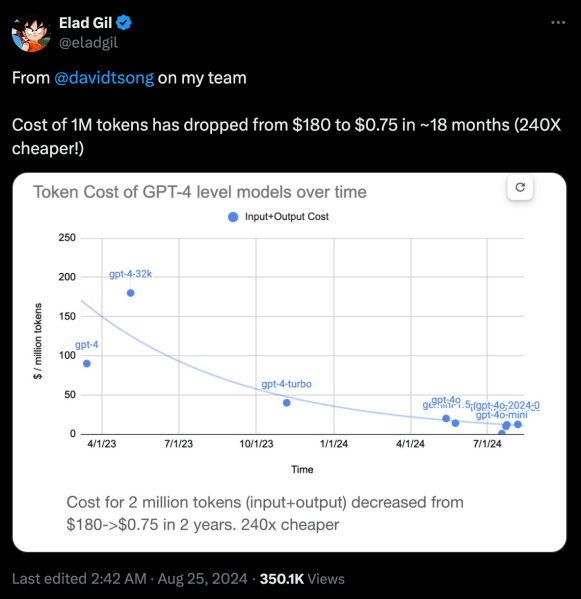
This article is part of VentureBeat’s special issue, “AI at Scale: From Vision to Viability.” Read more from this special issue here. This article is part of VentureBeat’s special issue, “AI at Scale: From Vision to Viability.” Read more from the issue here. As we wrap up 2024, we can look back and acknowledge that artificial intelligence has made impressive and groundbreaking advances. At the current pace, predicting what kind of surprises 2025 has in store for AI is virtually impossible. But several trends paint a compelling picture of what enterprises can expect in the coming year and how they can prepare themselves to take full advantage. The plummeting costs of inference In the past year, the costs of frontier models have steadily decreased. The price per million tokens of OpenAI’s top-performing large language model (LLM) has dropped by more than 200 times in the past two years.  One key factor driving down the price of inference is growing competition. For many enterprise applications, most frontier models will be suitable, which makes it easy to switch from one to another, shifting the competition to pricing. Improvements in accelerator chips and specialized inference hardware are also making it possible for AI labs to provide their models at lower costs.  To take advantage of this trend, enterprises should start experimenting with the most advanced LLMs and build application prototypes around them even if the costs are currently high. The continued reduction in model prices means that many of these applications will soon be scalable. At the same time, the models’ capabilities continue to improve, which means you can do a lot more with the same budget than you could in the past year.  The rise of large reasoning models The release of OpenAI o1 has triggered a new wave of innovation in the LLM space. The trend of letting models “think” for longer and review their answers is making it possible for them to solve reasoning problems that were impossible with single-inference calls. Even though OpenAI has not released o1’s details, its impressive capabilities have triggered a new race in the AI space. There are now many open-source models that replicate o1’s reasoning abilities and are extending the paradigm to new fields, such as answering open-ended questions. Advances in o1-like models, which are sometimes referred to as large reasoning models (LRMs), can have two important implications for the future. First, given the immense number of tokens that LRMs must generate for their answers, we can expect hardware companies to be more incentivized to create specialized AI accelerators with higher token throughput.  Second, LRMs can help address one of the important bottlenecks of the next generation of language models: high-quality training data. There are already reports that OpenAI is using o1 to generate training examples for its next generation of models. We can also expect LRMs to help spawn a new generation of small specialized models that have been trained on synthetic data for very specific tasks. To take advantage of these developments, enterprises should allocate time and budget to experimenting with the possible applications of frontier LRMs. They should always test the limits of frontier models, and think about what kinds of applications would be possible if the next generation of models overcome those limitations. Combined with the ongoing reduction in inference costs, LRMs can unlock many new applications in the coming year. Transformer alternatives are picking up steam The memory and compute bottleneck of transformers, the main deep learning architecture used in LLMs, has given rise to a field of alternative models with linear complexity. The most popular of these architectures, the state-space model (SSM), has seen many advances in the past year. Other promising models include liquid neural networks (LNNs), which use new mathematical equations to do a lot more with many fewer artificial neurons and compute cycles.  In the past year, researchers and AI labs have released pure SSM models as well as hybrid models that combine the strengths of transformers and linear models. Although these models have yet to perform at the level of the cutting-edge transformer-based models, they are catching up fast and are already orders of magnitude faster and more efficient. If progress in the field continues, many simpler LLM applications can be offloaded to these models and run on edge devices or local servers, where enterprises can use bespoke data without sending it to third parties. Changes to scaling laws The scaling laws of LLMs are constantly evolving. The release of GPT-3 in 2020 proved that scaling model size would continue to deliver impressive results and enable models to perform tasks for which they were not explicitly trained. In 2022, DeepMind released the Chinchilla paper, which set a new direction in data scaling laws. Chinchilla proved that by training a model on an immense dataset that is several times larger than the number of its parameters, you can continue to gain improvements. This development enabled smaller models to compete with frontier models with hundreds of billions of parameters. Today, there is fear that both of those scaling laws are nearing their limits. Reports indicate that frontier labs are experiencing diminishing returns on training larger models. At the same time, training datasets have already grown to tens of trillions of tokens, and obtaining quality data is becoming increasingly difficult and costly.  Meanwhile, LRMs are promising a new vector: inference-time scaling. Where model and dataset size fail, we might be able to break new ground by letting the models run more inference cycles and fix their own mistakes. As we enter 2025, the AI landscape continues to evolve in unexpected ways, with new architectures, reasoning capabilities, and economic models reshaping what’s possible. For enterprises willing to experiment and adapt, these trends represent not just technological advancement, but a fundamental shift in how we can harness AI to solve real-world problems. source

4 bold AI predictions for 2025 Read More »

The Unifying Power Of Rebranding: HCLTech’s Strategic Transformation

HCLTech was recognized as Forrester’s 2024 B2B Program Of The Year Awards winner for marketing executives, thanks to the impressive results from its comprehensive rebrand and digital transformation. Rebrands are expensive, time-consuming, and not without risk, but when done right, a company can see substantial results. For HCLTech, the rebrand unified the company, created cohesive messaging, enabled clear buyer journeys, and ignited an even stronger sense of pride among its over 200,000 employees. The Right Time And Right Reasons For A Rebrand HCLTech, a company with impressive growth fueled by organic expansion and strategic acquisitions, nevertheless faced a brand identity crisis. Independent branding efforts across business units led to fragmented messaging, inconsistent creative, and disjointed digital experiences. With limited brand recognition in key markets, HCLTech felt it was the $13 billion company that nobody knew. Recognizing the need for a unified brand identity, HCLTech embarked on a comprehensive rebrand and digital experience transformation. Factors For Success Several factors drove HCLTech’s success: Executive support. Leadership saw the rebrand as essential for driving growth, fostering customer loyalty, and attracting top talent. They fully supported all aspects of the initiative, including the expansive digital experience transformation that encompassed a complete rearchitecting of internal and external websites, streamlining buyer journeys, and a focus on performance-driven content. Most importantly, the executive team supported substantial long-term investment in brand campaigns post-launch to ensure that the brand took hold with target audiences around the globe. A strategic initiative. The rebrand was a strategic move to unify the diverse business units under a single, powerful identity with plans for activation programs that would drive revenue growth goals. This was no vanity project focused on fonts and colors. This extensive, data-driven project aligned with the business strategy and exhibited a long-term commitment from executives. Customer- and employee-inspired. HCLTech’s rebrand was more than a name change; it was a strategic move to unify the diverse business units under a single, powerful identity derived from the company’s mission, vision, values, and brand purpose, which center around clients, people, communities, and the planet. Strategic sponsorships and aligned advertising. The company amplified the brand experience through strategic sponsorships in key markets, including the sponsorship of MetLife Stadium (home of the New York Jets and Giants), the Australian national cricket team, and the Scuderia Ferrari HP Formula One team. Targeted advertising and account-based marketing initiatives further amplified brand awareness and perceptions. Stellar Results HCLTech’s brand value surged by 15.9% year over year, making it the fastest-growing IT services brand globally according to Brand Finance Global 500 and IT Services 25 2024. The business saw a 25.7% increase in its stock price and associated market capitalization, alongside significant improvements in brand familiarity and consideration scores with a 75% lift in brand recall. The new unified digital platform enhanced user experiences, attracting more visitors and job seekers, and also delivered operational efficiencies. source

The Unifying Power Of Rebranding: HCLTech’s Strategic Transformation Read More »

7 Key Benefits of Effective Project Management

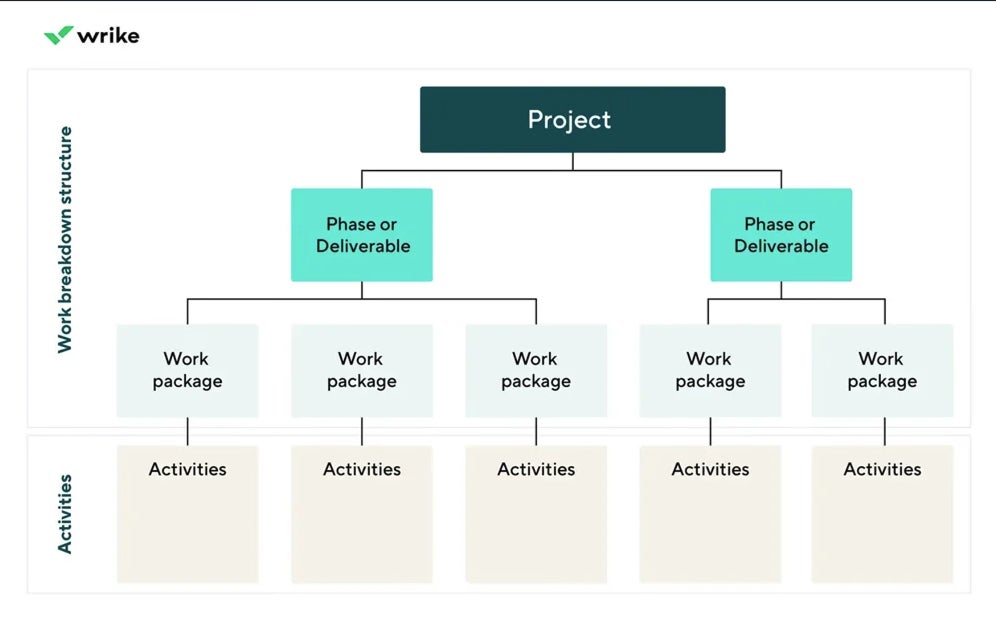
Project management involves coordinating resources, managing timelines, and ensuring objectives are met efficiently. When effectively implemented, structured project management can benefit your team and help make the most of your resources. Below I outline the top advantages of project management and offer tips for choosing the right tools to streamline your work. Benefits of Project Management Improved organization and prioritization Organizing tasks and projects using a strategic approach makes it easier for teams to stay focused and prioritize work. Define deliverables: Divide larger projects into smaller, more manageable tasks. Prioritize: Teams can accurately assess and focus on the highest priority items. Manage schedules: Calendar and timeline tools help teams keep track of deadlines. Visualize progress: Tools like Gantt charts and kanban boards clearly depict project stages and resources. Work breakdown structure organized with the Critical Path Method. Image: Wrike The example above would be particularly advantageous to a software development team using the Critical Path Method (CPM) project management strategy to identify tasks and allocate resources. SEE: For more on structuring projects effectively, check out our Critical Path Method Guide for Project Management. Enhanced collaboration and communication Clear and easy communication between team members fosters better teamwork and produces better project results. Project management software can help streamline this communication and maintain transparency. Centralize information: When the team is all communicating in one place, there is no need to worry about who was cc’d on an update or try to remember who attended a meeting. Facilitate communication: Use integrated messaging and file-sharing tools to maintain an easily accessible work history. Align team efforts: Ensure everyone is working toward common goals. By providing a centralized platform, team members can easily share information, documents, and updates on their progress. This visibility allows for more effective communication, faster decision-making, and better issue resolution. An example of a kanban board for agile project management communication. Image: monday.com Teams that adopt agile project management benefit from daily standups, collective information and status monitoring, and iterative feedback loops to continuously improve. SEE: To learn more about agile project management, read our article, What is Agile Project Management? A Comprehensive Guide. Accurate budget tracking and financial control Managing budgets is a critical aspect of any project. Utilizing project management tools can help ensure financial control and organize information. Cost estimation: Predict costs before the start of the project using AI forecasting features. Expense tracking: Monitor costs in real-time against the available budget. Financial reporting: Generate reports to keep track of project spending and financial performance. This level of financial control and visibility helps projects stay within budget and supports better resource planning for future projects. For example, a marketing team can use project management software to track ad spend and ROI to more accurately plan costs for future campaigns. Increased accountability and transparency Project management software increases accountability and transparency both within teams and throughout a larger organization. Task assignments: Clearly define who is responsible for which aspects of the project. Collective visibility helps team members understand their roles and take ownership of their work. Progress tracking: Monitor the ongoing status of tasks or project phases. This allows for real-time progress tracking, making holding individuals accountable for meeting deadlines and completing tasks easier. Activity logs: Keep track of all actions within the project. Teams that work with outside clients can utilize these logs to show that project expectations were met. This improved accountability fosters a sense of ownership and responsibility within the team, leading to better overall project outcomes. For teams that are particularly focused on efficiency, using scrum project management techniques structures works in sprints, improving time management and productivity. An example of a scrum sprint planning project. Image: Smartsheet SEE: If you want to know more about how Scrum can improve your productivity, read What is Scrum? Methodology Overview for Project Planning. Effective risk management and problem-solving Managing risks and unforeseen circumstances is essential for smooth project execution. Project management software helps your team stay proactive and minimize issues throughout the project lifecycle. Risk identification: Spot potential issues early with timeline overviews and bug reports. Contingency planning: Adjust project plans according to identified risks, with clear communication and documentation of changes for all participants to see. Issue tracking: Use automation features to monitor issues in real-time and assign them to the right people to address. Feedback loops: Implement systems for continuous improvement for following iterations. For example, construction projects often use risk assessments to plan for weather delays or supply shortages. Working in event or emergency response project management requires creating branching contingency plans for potential problem scenarios. Project management tools help centralize and organize this planning process. Efficient time and resource management Project management helps teams plan, view, manage, and adjust their resources, including time, money, personnel, and supplies. Time tracking: Monitor how much time is spent on each task and adjust processes as needed for efficiency. Workload balancing: Track which tasks are assigned to each team member or department and shift the workload so that no one is over or under-utilized. Resource allocation: Use project overview features to assign resources where they’re most needed. By monitoring progress and identifying bottlenecks through project management tools, managers can make informed decisions and reallocate resources as needed to keep projects on track. Example of a resource utilization dashboard. Image: Microsoft Project Streamlined reporting and analysis Project management tools assist teams in making data-driven decisions based on a combination of past performance, current resources, and risk forecasting. Customized reports: Generate insights on demand that include the specific data relevant to your current project or issue. Data visualization: Use dashboards to interpret data quickly and streamline status updates. Trend analysis: Utilize AI tools to identify patterns to improve future projects. By providing insights into project performance, teams can identify areas for improvement and implement changes, ensuring projects stay on track and meet objectives. How to choose the right project management software If you first identify what type of project management style your team will use, the right

7 Key Benefits of Effective Project Management Read More »

Nvidia tackles agentic AI safety and security with new NeMo Guardrails NIMs

Join our daily and weekly newsletters for the latest updates and exclusive content on industry-leading AI coverage. Learn More As the use of agentic AI continues to grow, so too does the need for safety and security. Today, Nvidia announced a series of updates to its NeMo Guardrails technology designed specifically to address the needs of agentic AI. The basic idea behind guardrails is to provide some form of policy and control for large language models (LLMs) to help prevent unauthorized and unintended outputs. The guardrails concept has been broadly embraced in recent years by multiple vendors, including AWS. The new NeMo Guardrails updates from Nvidia are designed to make it easier for organizations to deploy and provide more granular types of controls. NeMo Guardrails are now available as a NIM (Nvidia Inference Microservices), which are optimized for Nvidia’s GPUs. Additionally, there are three new specific NIM services that enterprises can deploy for content safety, topic control and jailbreak detection. The guardrails have been optimized for agentic AI deployments, rather than just singular LLMs. “It’s not just about guard-railing a model anymore,” Kari Briski, VP for enterprise AI models, software and services at Nvidia, said in a press briefing. “It’s about guard railing and a total system.” What the new NeMo Guardrails bring to enterprise Agentic AI Agentic AI use is expected to be a dominant trend in 2025.  While agentic AI has plenty of benefits, it also brings new challenges, particularly around security, data privacy and governance requirements, which can create significant barriers to deployment. The three new NeMo Guardrails NIMs are intended to help solve some of those challenges. They include: Content Safety NIM: Trained on Nvidia’s Aegis content safety dataset with 35,000 human-annotated samples, this service blocks harmful, toxic and unethical content. Topic Control NIM: Helps ensure that AI interactions remain within predefined topical boundaries, preventing conversation drift and unauthorized information disclosure. Jailbreak Detection NIM: Helps prevent security bypasses through clever hacks, leveraging training data from 17,000 known successful jailbreaks. Complexity of safeguarding agentic AI systems The complexity of safeguarding agentic AI systems is significant, as they can involve multiple interconnected agents and models.  Briski provided an example of a retail customer service agent scenario. Consider a person interacting with at least three agents, a reasoning LLM, a retrieval-augmented generation (RAG) agent and a customer service assistant agent. All are required to enable the live agent.  “Depending on the user interaction, many different LLMs or interactions can be made, and you have to guardrail each one of them,” said Briski. While there is complexity, she noted that a key goal with NeMo Guardrails NIMs is to make it easier for enterprises. As part of today’s rollout, Nvidia is also providing blueprints to demonstrate how the different guardrail NIMs can be deployed for varying scenarios, including customer service and retail. How Nvidia guardrails impact agentic AI performance Another primary concern for enterprises deploying agentic AI is performance.  Briski said that as enterprises deploy agentic AI, there can be concern about introducing latency by adding guardrails.  “I think as people were initially trying to add guardrails in the past, they were applying larger LLMs to try and guardrail,” she explained.  The latest NeMo Guardrail NIMs have been fine-tuned and optimized to address latency concerns. Nvidia’s early testing shows that organizations can get 50% better protection with guardrails, which only add approximately a half second of latency. “This is really important when deploying agents, because as we know, it’s not just one agent, there are multiple agents that could be within an agentic system,” said Briski. Nvidia NeMo Guardrails NIMs for agentic AI are available under the Nvidia AI enterprise license, which currently costs $4,500 per GPU per year. Developers can try them out for free under an open source license, as well as on build.nvidia.com. source

Nvidia tackles agentic AI safety and security with new NeMo Guardrails NIMs Read More »

Here’s what AI-powered startups need to succeed in 2025

Presented by Twilio In 2024, thousands of startups emerged built on the powerful capabilities of cutting-edge large language models (LLMs). Statistically speaking, only one-fifth will survive to the end of 2025. To make it beyond this year, these companies will need an edge. That said, I’ve never been more excited about the potential of a new tech sector. AI-powered startups will remake our world in ways we can’t imagine yet — if they have the ingredients to succeed. Serving as a judge for Twilio’s Startup Searchlight 2.0 competition, which celebrates the builders creating the future of communications and customer engagement, drove this point home for me. We selected 12 honorees from among the more than 500 companies that applied. All of the winners embody a few basic principles that startups need to remember when building AI-powered solutions. Keep these in mind, and you will have a good start on building an AI business that will last. 1. Focus on business basics You can’t count on AI alone to give you a competitive advantage — it’s too ubiquitous. The challenges of starting and running a startup remain much as they were before LLMs came along. You need to attract, convert and retain customers. You need to keep costs under control: While AI is getting cheaper all the time, it is still possible to run up the tab if you create complicated workflows (and take note that 72% of IT and financial leaders say AI costs are becoming “unmanageable”). Of course, you also need to establish and defend a sustainable competitive advantage. AI’s power can be your advantage too, if you can take something that is currently complicated to do and encapsulate it in an easy-to-use API framework. That’s what Twilio did for telephony a decade ago, and it’s what the big AI models are doing today. If you want to build a sustainable tech business today, think about how you can deliver it via an API. 2. Build more than a wrapper If you’re just creating a “wrapper” for existing LLMs, you won’t be able to maintain differentiation over the long haul.  For example, if you’re trying to create a tool to help create code, do speech transcription or scan PDFs and extract information, it doesn’t matter how nice your interface is — the major LLMs are already excellent at these tasks. Focus on an area where you can provide a differentiated service that gives you a compounding advantage through a data flywheel or network effects. For example, one of the AI Startup Searchlight honorees, Goodcall, automates voice calls for businesses. It has been amassing anonymized data from over 4 million customer calls to build a more robust database and improved analytics. Another area startups could focus on is pulling data out of unstructured customer conversations. One Searchlight honoree, Spoke AI, does this by pulling data from customers’ voice calls so that business users can see who is calling them, what they might want, how they are feeling and what they talked about previously with colleagues. 3. Understand the growth trajectory of AI  AI is changing incredibly fast. The number of AI patents per year has increased 31x since 2010, with over 62,000 granted in 2022.  When deciding where to focus your efforts, first learn about the arc of LLM development and where it’s likely to go in the next 12 months. If you don’t, your solution may be obsolete before you can get it to market. For example, the big AI labs are currently working to enhance the reasoning capabilities of these models, improving their capabilities in various complex domains. Don’t focus on advanced reasoning unless you have billions in funding! By contrast, one of the Searchlight honorees, CuraJOY, is a grassroots tech nonprofit that uses AI and entertainment to improve the accessibility, effectiveness and equity of social and mental health support. That’s definitely not an area of focus for the big AI models — but it’s meeting a major societal need. 4. Capture the excitement New AI solutions attract a lot of interest, but the excitement is fleeting. If you don’t have a plan to capture those tire-kickers and turn them into long-term customers, your business will fade quickly along with the hype. You need to maintain a high interest level. One way to do that is to keep improving your product based on customers’ input. For example, you might use AI to capture and sort customer feedback and route the highest-value feature requests directly to your product team. That will keep customers coming back and fuel sustainable growth. Another way is to keep raising the bar with new capabilities, certifications and customer-friendly offers. Here’s an illustration from a Searchlight honoree: Alpharun is an AI-powered phone interview platform; it was part of the OpenAI accelerator this year and won the audience award at the 2024 Staffing Industry Analysts conference. The company wasn’t content to rest on its laurels: It’s already securing key technology certifications and offering its customers uptime guarantees, international support and top-notch reliability — essential offerings for the enterprise customers it’s targeting. Looking forward to an AI-powered economy While 2024 marked the year of AI experimentation, 2025 will be defined by AI-powered startups delivering measurable business impact. Through my work at Lightspeed and experience judging Twilio’s Searchlight competition, one thing is clear: The most promising companies aren’t just creating clever AI implementations — they’re building robust businesses that can weather the inevitable changes in technology.  The AI Searchlight honorees exemplify this approach, building true competitive moats with compounding advantages. These companies show us that lasting success comes from combining AI capabilities with deep domain expertise and strong business fundamentals.  We’re at the dawn of a new tech boom, and I have no doubt that some of today’s builders will emerge as tomorrow’s tech giants.  Learn more about the Twilio AI Startup Searchlight and the honorees here. Nnamdi Iregbulem is an investment partner at Lightspeed Venture Partners. Sponsored articles are content produced by a company that is

Here’s what AI-powered startups need to succeed in 2025 Read More »