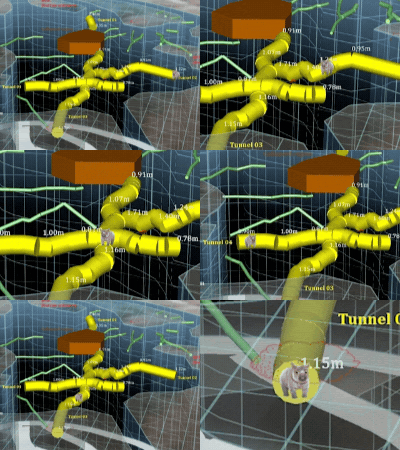
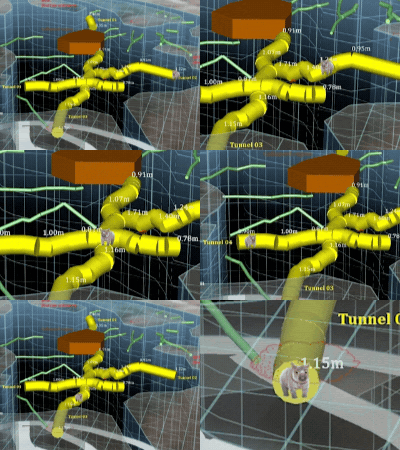
Nearly three years on from deploying ground-penetrating radar technology to “spy” on the underground lives of one of Australia’s most critical endangered species, scientists have learnt that northern hairy-nose wombats will build elaborate burrows regardless of the material they’re working with. And that one of the females has a baby on board.
Researchers at the Australian Wildlife Conservancy (AWC), The Wombat Foundation (TWF) and Queensland’s Department of the Environment, Tourism, Science and Innovation used this radar technique at Queensland’s Richard Underwood Nature Refuge (RUNF) to better understand what happens when these shy animals are out of sight.
When they compared the data with previous sets taken from a very different site in Epping Forest National Park (EFNP) – where the last remaining wild population of these wombats reside – the scientists noticed a stark difference in their burrow design.
“This opens us to a whole new ‘underworld’ of options when it comes to identifying potential translocation and recovery sites for the species,” says Andy Howe, former RUNR sanctuary ecologist and lead researcher.
At RUNF, burrows were shallower than those detected at EFNP, most likely a reflection of the materials the wombats had to work with during their construction projects. RUNF’s sandy loams and loamy sands have a higher near-surface degree of structural integrity, meaning the wombats didn’t have to dig down deep – like they do in the national park, where loose sandy material is more prevalent – in order to establish their tunnel networks.
Australian Wildlife Conservancy
Why does this matter? Well, for a species with a single natural population remaining – the others are the result of animal translocation to help reestablish their numbers – it challenges what ecologists thought regarding wombat soil preferences. So it opens up more possibilities for rewilding the fragile species.
“Up until now, we’ve drawn on studies from the remnant population of wombats at Epping Forest to determine the type of soil required for potential translocation sites,” adds Howe. “However, this study, combined with historical evidence of the pre-European distribution of the species, revealed that northern hairy-nosed wombats can construct functional burrows across a broader range of soil types, expanding the potential range of suitable sites for future conservation efforts.”
Researchers will build on this new knowledge to find another site to become the fourth area in Australia housing a population of these marsupials. And knowing that the wombats are somewhat adaptable when it comes to living arrangements could make the search much easier.
“With this new knowledge, we can now look beyond the handful of sites once considered suitable for the wombats, and start identifying other landscapes that could support a new population,” says Dr Alexander Watson, Northeast Regional Ecologist for AWC.
And in more good news for the translocated RUNF population, scientists have identified a female carrying a pouch young. Captured by a motion sensor camera, the female’s protruding pouch suggested that her baby was about four- to five-months old as of June.

Australian Wildlife Conservancy

Australian Wildlife Conservancy
“There are only around 450 Northern Hairy-nosed Wombats left in the world – but you can now make that 451,” says Ben Stepkovitch, a wildlife ecologist at AWC. “We’re all very excited about the images because every new joey adds to the overall population of the species, giving us hope that they’ll persist well beyond the near future.”
“We’re also thrilled because it’s so rare to get such clear pictures of an active pouch when it’s this small,” he adds.
In 2023, we reported on the rollout of the ground-penetrating radar tech, allowing researchers to get an insight into these animals’ lives like never before. And the results demonstrate just how important innovative techniques are as a research tool – in this case, revealing entirely new information about a species that’s been dangerously close to irreversible population collapse.
Finally, this seems like a good time to revisit footage of the elusive northern hairy-nosed wombat captured back when the radar study was announced.
Northern Hairy-nosed Wombat
Source: Australian Wildlife Conservancy