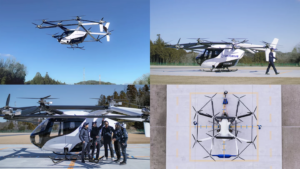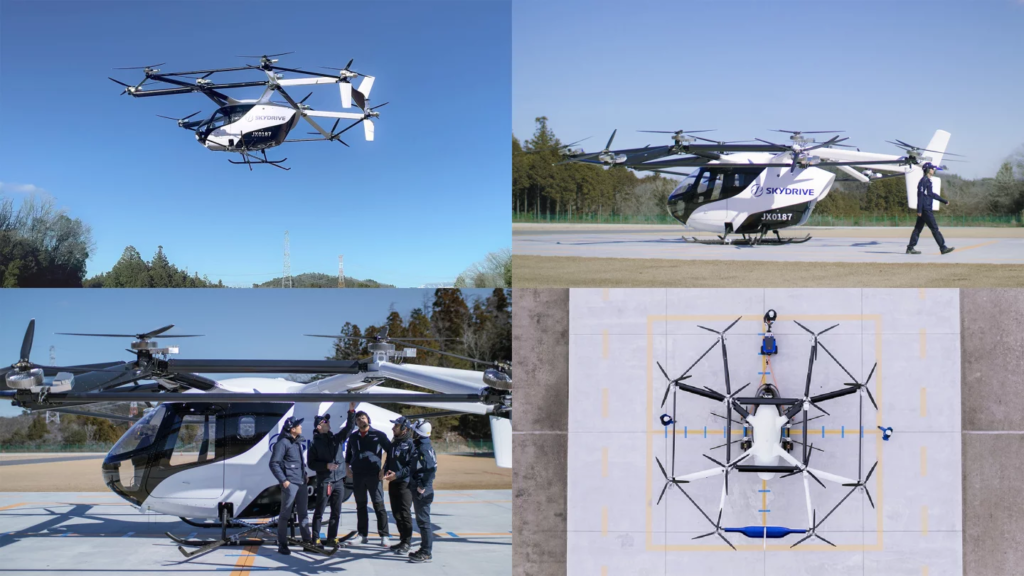
Toyota-backed SkyDrive’s SD-05 multicopter has achieved stable flight at 100 km/h (62 mph), proving its wingless design handles real aerodynamic loads. The milestone feeds Japan’s JCAB certification process and keeps 2028 commercial launch in sight, if regulators can keep pace.
What matters in this test is not the speed itself but what surviving that speed means. The craft proved the aerodynamic forces, vibrations, and structural loads acting on a fixed-wing-free multicopter at cruise velocity behave exactly as the design predicted. In commercial aviation, that alignment between simulation and real-world data is the foundation regulators demand before they’ll even discuss a type certificate.
The SD-05 is an eVTOL – an electric aircraft that takes off and lands vertically – built around a deliberately stripped-down philosophy. Where American rivals like Joby Aviation and Archer use tilting rotors and fixed wings to carry up to four passengers plus a pilot over longer distances, the SD-05 runs on 12 independent rotors managed by a central flight computer, with no wings and no complex mechanical pivots. It seats three – a pilot and two passengers – and is designed for short urban hops. Current range sits at around 15 km (9.3 miles) per charge, with SkyDrive targeting 30–40 km (18.6–24.9 miles) as battery technology improves.
【SkyDrive】 100km/h High-Speed Flight Test in Japan
That minimal architecture has a real advantage in dense urban airspace. It offers more flexible takeoff and landing footprints and lower maintenance costs than mechanically complex rivals. The tradeoff is that there’s no prior flight data to lean on. Every test is uncharted territory.
According to the company, data from the speed campaign confirmed that “the observed flight characteristics and behavior match our expectations from the design and analysis phase.” That’s not a boast, it’s the minimum bar needed to move forward. But clearing it matters. These results are the empirical fuel SkyDrive needs to advance its certification process with Japan’s Civil Aviation Bureau (JCAB) and, eventually, the US Federal Aviation Administration (FAA).
The SD-05’s development has accumulated hundreds of test flights since the earlier SD-03 prototype, including independent testing of batteries, motors and rotors, plus aerodynamic trials in wind tunnels operated by JAXA, Japan’s space agency. That accumulated track record will form the backbone of SkyDrive’s regulatory argument.

SkyDrive
The urban air mobility (UAM) sector is already crowded and unforgiving. The SD-05’s closest philosophical rival is China’s EHang EH216-S, a two-seat autonomous multicopter that already holds a type certificate from Chinese aviation authorities – though its approved operations are currently limited to low-altitude sightseeing routes rather than true urban taxi services. Germany’s Volocopter pursues a similar short-hop urban focus with its VoloCity, though its commercial rollout has moved slower than anticipated.
Where Joby and Archer target medium-distance routes to replace ground taxis on commuter corridors, SkyDrive is betting on the intra-city jump – the kind of short, frequent urban hop where a compact multicopter’s agility is hardest to replicate.
Hitting 100 km/h (62 mph) is a milestone, not a finish line. SkyDrive says it will continue expanding the SD-05’s flight envelope –the full range of speeds, altitudes and conditions the aircraft is tested to handle – to build the data package regulators require. If results stay on track, SkyDrive is targeting type certification and the start of commercial operations in 2028 – but the timeline depends as much on regulators as on engineers.

SkyDrive
Japan’s JCAB is expected to follow a path broadly aligned with Western frameworks: rigorous, methodical, and unhurried. In the US, the FAA has launched an eVTOL Integration Pilot Program spanning 26 states, with Archer participating in several of those projects – cautious steps forward, not a green light. Europe’s aviation safety agency EASA published a comprehensive eVTOL regulatory framework in 2022 and puts the realistic arrival of widespread air taxi services at around 2030.
China, meanwhile, is already running certified commercial flights, albeit limited to tourist hops in designated scenic areas, not true point-to-point urban transit. The global picture is one of uneven progress: the technology is maturing faster than the rules designed to govern it, and 2028 may prove optimistic for anyone outside Beijing’s regulatory orbit.
Source: Skydrive