Solar geoengineering methods are often seen as a controversial last resort that may be required in the face of an accelerating climate crisis. They are largely untested, meaning they could have drastic unforeseen consequences affecting everyone on the planet.
Now, a team of scientists from Boston University has just added another new method to the list. Surprisingly, its goal isn’t to artificially cool our planet. Instead, it would target Earth’s magnetic fields with chemicals that would shield us from the most severe of solar storms.
In simulations, Boston University researcher Brian Walsh and colleagues found that their system, dubbed StormWall, could halve the intensity of a geomagnetic storm. In a paper published in the journal Space Weather, they explain how StormWall could prevent an economic disaster triggered by the most extreme space weather.
Shielding Earth’s infrastructure from the Sun
Solar storms are typically caused by massive, unpredictable coronal mass ejections (CMEs) – vast eruptions of plasma and magnetic fields that shoot energy out into the Solar System.
As Walsh and colleagues point out in their paper, severe solar storms can have a devastating economic impact. They have been shown to interfere with radio communications and even fry electronics in space and on Earth.
For instance, in May 2024, a powerful solar storm disrupted GPS systems used to accurately guide tractors. This cost US farmers an estimated $500 million.
In 2021, UC Irvine computer scientist Sangeetha Abdu Jyothi, who was not involved in the new study, calculated that a “solar superstorm” could cause a global internet outage, costing the US economy over $7 billion a day.
The University of Boston researchers’ predictions align with this outlook. In their paper, they claim that a massive once-in-a-century geomagnetic storm would trigger power grid costs exceeding $2.4 trillion.
You might ask, how could something that has historically had only a relatively minor impact on our economy trigger such a devastating economic outcome?
The fact is, extreme solar storms are rare, but not quite rare enough to ignore. The last truly massive solar storm, known as the Carrington Event, took place in 1859. According to some experts, we are overdue for another similar event.
Today, our economy is inextricably linked to electronic systems and more dependent on space-based infrastructure than ever before. Take electronic financial transactions, for instance. Every single one of these relies on a time stamp beamed to Earth via satellite.
Then there’s the fact that extreme solar storms are rare, but not quite rare enough to ignore. The last truly massive solar storm, known as the Carrington Event, took place in 1859.
StormWall: A new form of solar protection
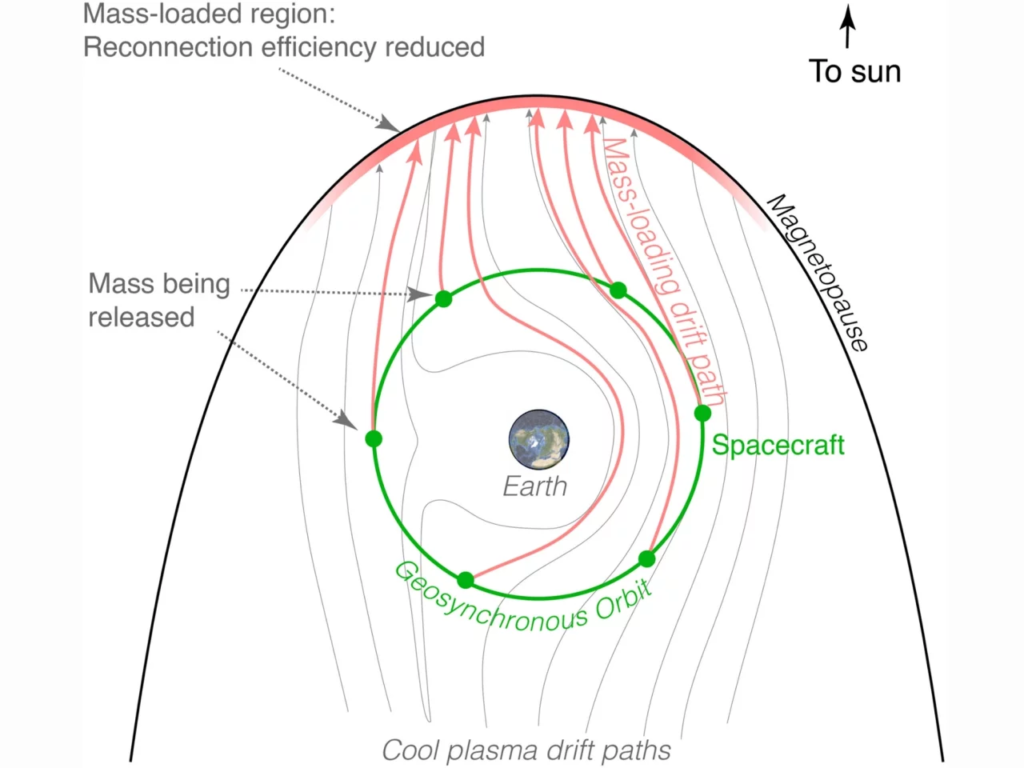
Walsh and colleagues’ StormWall proposal would see six spacecraft launch to geostationary orbit, matching Earth’s rotation. From there, they would fire a gas consisting of an ionizing material to the edge of Earth’s magnetic field.
The researchers suggested an alkaline chemical element like barium or lithium in their proposal. When released, these materials would have their electrons stripped by solar radiation, inducing an electrical charge that would seed the atmosphere with plasma.

Walsh et al., Space Weather, 2026
In simulations, the team found that the resulting “weather wall” would temporarily strengthen our defenses and deflect any potentially damaging space weather. Essentially, the plasma would disrupt the flow of energy and bounce any space weather away from our planet.
Importantly, the materials would not drift back down to Earth, removing the concerns associated with other geoengineering proposals. “The material drifts out on these natural highways, it leaves the system – the magnetosphere flushes the material out within six or so hours,” Walsh said in a press statement.
That short shelf life is a double-edged sword, though, as it likely means more costly launches would be required to keep StormWall effective.
Walsh’s team addresses this issue in their paper. As with any space venture, weight and cost could be a big barrier to implementation, they explain. The six StormWall spacecraft would have to carry roughly a dozen oil trucks’ worth of material between them.
In their paper, the researchers note that the “total required payload mass to orbit is within near-future technological capabilities of humans.”
According to their calculations, it would take SpaceX’s Starship six launches to send the required materials to space. They do, however, note that SpaceX has yet to officially release an anticipated mass capacity to geosynchronous orbit.
Walsh and his team are also studying ways to keep those costs down, such as flying to a geosynchronous transfer orbit instead, and slowly releasing the materials to extend StormWall’s lifetime. Ultimately, they believe their method could finally allow us to gain a little control over the Sun’s unpredictable, volatile outbursts.
“People have always thought, ‘space is huge, the sun is massive, we just have to sit here and take whatever it gives us.’ But what we found is that we can impact it,” Walsh explained.
Six Starship launches for one mission would not be cheap. Though when weighed against a potentially catastrophic economic scenario, it may just be worth it.
This research was published in the journal Space Weather
Fact-checked by Mike McRae