CFA Institute

Top 10 Blogs of 2025: Insights on Market Cycles and Financial History

The blogs that resonated most with readers in 2025 were those that used historical evidence to illuminate present-day dynamics. Across topics — market concentration, small-cap cycles, private-equity stress, geopolitical shifts, AI, and even foundational valuation tools like discounted cash flow — practitioners consistently sought analysis that connected current signals to the longer arcs that shape them. And the Most Read blog published in 2025, built entirely around historical quotes, shows how powerful distilled insight can be. Mark J. Higgins, CFA, CFP, and Rachel Kloepfer take us on a compact tour through centuries of market wisdom, highlighting behavioral tendencies that repeat across cycles and helping investors recognize them in current conditions. Daniel Fang, CFA, CAIA, reviews the structural and cyclical forces that shape relative performance between small and large caps. He outlines the conditions that have marked turning points in past cycles. Bill Pauley, CFA, Kevin Bales, CFA, and Adam Schreiber, CFA, CAIA, examine historical concentration regimes that resulted in “lost decades,” highlighting how elevated dependence on a small group of stocks can reshape risk, diversification, and forward return expectations. Mark J. Higgins, CFA, CFP, breaks down seven indicators that private-market risks may be rising, providing investors with a practical lens for evaluating structural and late-cycle vulnerabilities. Michael Schopf, CFA, presents a head-to-head comparison of AI models and human analysts. The results show where machines now outperform, where analysts retain an edge, and how this evolving division of strengths is reshaping research teams. In this review of prior Fed cutting cycles, Bill Pauley, CFA, Kevin Bales, CFA, Adam Schreiber, CFA, CAIA, and Ty Painter highlight the market patterns, sector rotations, and risk dynamics that tend to follow policy pivots, giving investors a clear framework for interpreting today’s rate environment. Written in April, this piece offered a forward-looking analysis of how tariff shifts and geopolitical tensions were expected to influence the global economy through 2025. Kanan Mammadov framed his outlook with macro context around growth, inflation, and evolving regional market conditions. Markus Schuller, Michelle Sisto, PhD, Wojtek Wojaczek, PhD, Franz Mohr, Patrick J. Wierckx, CFA, and Jurgen Janssens offer a practical look at how investment teams are adopting AI across research, portfolio construction, and workflow design. They distill five lessons from early front-line deployment and the operational changes the technology is driving. Sandeep Srinivas, CFA, reviews the challenges of applying discounted cash flow models, underscoring their sensitivity to assumptions and the practical complexities that arise in real-world analysis. Paul Lavery, PhD, explains why private-equity buyouts rely on multi-entity structures, showing how acquisition vehicles and layered financing shape deal mechanics and affect risk and portfolio company outcomes. Understanding this architecture is essential for evaluating modern PE transactions. source

Top 10 Blogs of 2025: Insights on Market Cycles and Financial History Read More »

From Hedge to Test Case: Gold’s Volatility and the Limits of Safety

Gold’s spectacular rally in 2025 has entered a more volatile phase. After topping $4,300 an ounce and gaining more than 50% for the year, the metal has now fallen sharply. The correction underscores what many investors suspected: even a structural bull market can stumble when sentiment overshoots. The question is no longer simply why gold has risen, but whether its newfound prominence as a portfolio cornerstone can withstand stress. For investors, this latest swing is a reminder that gold’s evolution from hedge to strategic signal is a story still being written. Geopolitical Anxiety and the Safe-Haven Reflex Conflict and political dysfunction remain powerful motivators for gold demand. Ongoing wars in Ukraine and Gaza, persistent regional instability, and US fiscal uncertainty have reinforced the impulse to seek protection in real assets. As Nigel Green of deVere Group noted, “political promises do not equate to financial security.” When faith in institutions wavers, gold’s lack of counterparty risk becomes its greatest asset. But the pullback highlights that even fear has limits. As short-term risks ebb or markets regain confidence, the safe-haven trade can unwind quickly. Professional investors increasingly view gold as a strategic holding rather than a panic hedge, a nuanced shift that explains both the strength of the rally and the speed of its correction. Central Banks: Still the Quiet Accumulators Behind the headlines, central banks continue to anchor demand. Since 2022, they have collectively purchased about 1,000 tons of gold annually, the fastest pace in decades. The freezing of Russia’s reserves was a turning point, prompting emerging-market central banks to diversify away from the dollar and into politically neutral reserves. A World Gold Council survey found that 95% of central banks expect global gold holdings to rise further over the next year. These official purchases remain a stabilizing force even amid market volatility. For private investors, they signal that diversification into tangible stores of value is not a short-term fad but part of a longer-term realignment of monetary strategy. Policy Shifts and the Dollar Dynamic The macro backdrop also continues to matter. Earlier in the year, expectations of US rate cuts had propelled gold higher by lowering the opportunity cost of holding non-yielding assets. But as the dollar rebounded and traders pared back bets on further easing, gold’s tailwind briefly turned into a headwind. For portfolio managers, this reinforces the lesson that gold’s sensitivity to policy and currency expectations can be as important as its role as an inflation or crisis hedge. The same flows that lift prices can retreat just as quickly when macro narratives change. Investor Flows and Momentum Reversal ETF inflows were a major accelerant of the rally, with record-setting September inflows supporting the strongest quarter on record. Yet those same flows may now be amplifying the downside. As the price dropped, profit-taking by speculative positions cascaded through futures and ETF markets, illustrating how liquidity can magnify both directions of movement. Still, the underlying investor interest remains intact. Compared with digital assets and many commodities, gold’s liquidity and perceived stability continue to attract strategic reallocations, particularly from institutions reassessing long-term diversification. A Test of Conviction The correction doesn’t negate gold’s structural appeal, it tests it. The same drivers that propelled the rally (geopolitical tensions, central-bank diversification, and fiscal strain) are still in place. But the pace of gains had outstripped fundamentals, and the pullback is a reminder that no “safe haven” is immune to volatility. For professional investors, the key takeaway is balance. Gold’s new role is not to outperform equities or replace bonds but to signal shifts in trust, liquidity, and policy credibility. Its latest slide shows that the market is still calibrating how much of that signal belongs in portfolios, and at what price. source

From Hedge to Test Case: Gold’s Volatility and the Limits of Safety Read More »

Patience Pays: Why Quality Shares Outperform in the Long Run

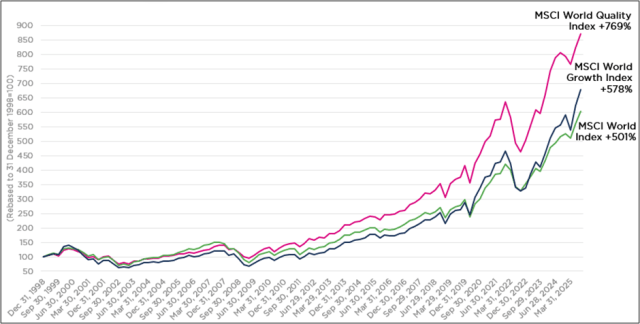
Time in the market is better than timing the market, the adage says. Likewise, to see “quality” shares outperform over time, investors must be patient. Quality stocks are defined as stocks of companies with high returns on equity, stable earnings, and low debt. They’re known among investors for outperforming broader markets over the long run, as seen in Figure 1. Figure 1: Stock market performance (31 December 1998-30 September 2025). Over the long term, quality shares have significantly outperformed the broader stock market. Source: CCLA, Bloomberg, MSCI (returns net of withholding tax, in local currency). The above data is not annualized. Past performance is not a reliable indicator of future returns. The value of investments may fall as well as rise. Clients often ask us: “How has my portfolio performed this quarter?” or “What do you expect markets to do next quarter?” They’re right to ask that question, but single quarters aren’t always the most helpful way of gauging long-term success. In 2025, for example, quarterly returns fluctuated, showing how unpredictable short-term outcomes can be. When US President Donald Trump took office in January, he implemented company-friendly tax cuts and deregulated key industries, moves that typically create market tailwinds. However, during the first quarter, the MSCI World Index fell 3.6%. In April, President Trump announced tariffs that were, by many estimates, negative for the US economy. But the index rose 9.5% in the second quarter. And between 1 July and 1 October this year, the index rose another 7%, despite more tariffs. Now, some “star” investors claim that they can time the stock market. But most evidence shows that trying to time the market usually ends with poor returns. When we look at the data, systematic stock market patterns have mainly played out over the longer term. And over that longer term, quality shares have historically outperformed other types of shares. Payoff Takes Time Adhering to any investment style, including quality, usually means that a manager mixes periods of outperformance with periods of underperformance. Figure 2 and Table 3 below show the MSCI World Index (currently 1,320 companies from 23 countries) with its smaller sub-indices the MSCI World Quality Index (300 highest-quality companies from those same countries) and the MSCI World Growth Index (603 highest-growth companies) over the time periods stated. Figure 2: Quarterly, annual, five-year and 10-year returns of the MSCI World Quality Index, relative to the MSCI World Index (31 December 2008-30 September 2025). The longer the timeframe, the more quality has outperformed the MSCI World Index. Source: MSCI, CCLA. The above data is not annualized. Past performance is not a reliable indicator of future returns. The value of investments may fall as well as rise. The data for Figure 2 above is represented in Table 3 below. Column 1 of that Table shows the performance, in absolute terms, of the MSCI World Quality Index, which is made up of companies with high returns on equity, stable year-on-year earnings growth, and low debt levels, for quarters ending on the dates shown. Banking giant JPMorgan, for example, isn’t in the MSCI World Quality Index because, like many banks, it has high debt levels. Column 2 shows the relative performance of the MSCI World Quality Index versus the MSCI World Index. Column 3 shows the relative performance of the MSCI World Quality Index versus the MSCI World Growth Index. The MSCI Growth Index captures shares with high growth rates in revenues, earnings per share and in retained earnings. It includes, for example, Nvidia and Microsoft, but not Facebook parent Meta, because Meta’s growth is comparatively low. Columns 4 through 6 of Table 3 show the same absolute and relative performance, but for the one-year period ending on the date shown. Columns 7 through 12 show the same data for, respectively, five-year timeframes and 10-year timeframes. Table 3: Quarterly, annual, five-year and 10-year performance (2008-2025). The longer the timeframe, the more quality shares have outperformed the broader stock market and growth shares. The left-hand side of Table 3 is a patchwork of reds and greens, as quality shares underperform and outperform in a pattern that is hard to predict from quarter-to-quarter. By contrast, the right-hand side is mostly green, demonstrating that over the longer time horizon, quality shares have outperformed the broader market. The bottom row of Column 11 in Table 3 above shows that the MSCI World Quality Index has outperformed the broader MSCI World Index over all 10-year timeframes since 1998. That’s a remarkably consistent performance. Figure 4 shows this performance in a line chart. Figure 4: Historical outperformance of the MSCI World Quality Index over the MSCI World Index (31 December 1998-30 September 2025). Over longer periods, quality shares have increasingly outperformed the broader stock market. Source: CCLA, MSCI. Past performance is not a reliable indicator of future results. The value of investments may fall as well as rise. Quality Over Growth Quality shares have also outperformed (currently popular) growth stocks the longer you have held them, in 85% of the quarters over a 10-year horizon. Only infrequent, structural crises have upset that regularity. For example, quality shares underperformed growth shares for six quarters in 2021 to 2022, when investors piled into growth stocks such as Peloton and Zoom during the Covid pandemic and lockdown. For the quarters during which the 10-year performance of quality shares lagged growth shares, quality shares had 10-year absolute returns between 178% and 335%, hardly a major concern in performance terms. The bottom row of Column 3 in Table 3 is particularly interesting. The 49% (circled) demonstrates that growth shares outperformed quality shares slightly more often on a quarterly basis. Nevertheless, using the same returns over a longer run, e.g., five years or 10 years, quality outperformed growth 69% of the time (column 9) or 85% of the time (column 12), respectively. In the Long Run Why this paradox between marginal underperformance in the short run and substantial outperformance in the long run? Principally, during market crises in the last 25 years, prices

Patience Pays: Why Quality Shares Outperform in the Long Run Read More »

How to Value Digital Tokens: A 5-Step Fair Value Framework

The development of digital financial assets has fundamentally changed the financial ecosystem, challenging traditional valuation methodologies and introducing new complexities for both analysts and investors. Digital assets — which include cryptocurrencies, stablecoins, non-fungible tokens (NFTs), and tokenized securities — are now used in business transactions, investment portfolios, and capital formation. Even with their growing use, valuation remains clouded with uncertainty due to the absence of standardized valuation frameworks and methods, a market infrastructure that is often fragmented, and limited technological transparency. For financial analysts, this evolution presents both an opportunity and a challenge. Traditional valuation concepts still apply, but they must be adapted to a market where observable inputs, governance structures, and trading conventions differ sharply from established asset classes. This post explains how to approach fair value measurement for digital tokens under ASC 820 and IFRS 13, highlighting key areas of professional judgment such as identifying principal markets, determining exit prices, and assessing discounts for illiquidity or lock-ups. The discussion is organized into five steps that mirror the valuation process: from identifying the token to determining its fair value under varying market and liquidity conditions. Unlike traditional financial assets, many digital instruments often lack established market oversight, observable market inputs, or common and consistent rights of ownership. Tokenized securities may represent beneficial interests in special purpose vehicles, fractional equity, or synthetic exposures, each with distinct legal and economic implications. Cryptocurrencies and NFTs, by contrast, are traded across decentralized exchanges with varying degrees of price transparency and custody risk, and can be susceptible to manipulation. These factors complicate the application of established valuation methods such as those described in ASC 820 and IFRS 13 Fair Value Measurements, which rely on market participant assumptions and observable inputs. These criteria may be absent or unreliable with digital assets. Even with these significant challenges, the traditional valuation approaches still apply to the valuation of digital assets. Tokens that generate cash flows to their holder may lend themselves to the use of a discounted cash flow method of valuation. Certain digital assets are actively traded on certain exchanges, which may be useful to provide inputs for relative valuation methodologies. Finally, developers commonly track the costs to tokenize a security, which can be useful in applying methods of valuation under the cost approach. This post explores the valuation challenges posed by digital assets, with a focus on fair value measurement, marketability discounts, legal structure, and technological risk. It proposes a structured approach to valuation that integrates traditional financial principles with emerging practices in blockchain analytics and decentralized finance. Through practical examples and a methodological analysis of tokens that are traded on major digital exchanges such as Coinbase and Binance, it aims to equip financial analysts with the tools necessary to navigate the valuations within this evolving asset class with rigor and clarity, with a focus on the market approach. Depending on trading volume and market characteristics, these tokens would typically qualify as Level 1 or Level 2 assets under the ASC 820/IFRS 13 fair value standards. We conclude with some notes on Simple Agreement for Future Tokens (SAFTs) as a type of contract (Level 3) that is becoming increasingly common in token-based fund raising as an alternative to actual token issuance for early-stage projects. Step 1: Identify the Token You’re Valuing As a first step in the valuation process, it is critical to identify the key technical features of the digital asset being valued. Some common types include: Cryptocurrencies (ex: Bitcoin, Ethereum, Solana). Cryptocurrencies typically have a dedicated blockchain and are used for peer-to-peer payments. Stablecoins (ex: Theter’s USDT and USDC). Stablecoins are used as a step in the conversion of other digital tokens into a fiat currency such as the US dollar or the Euro. They typically trade at a price close to par (1 USDT = 1 USD), but, similarly to certain money market funds, this parity should not be taken for granted, as it can break in periods of market disruption and may affect the proceeds at exit in an underlying digital token sale. Utility tokens (for example, Ethereum’s Ether, Solana’s Chainlink). Utility tokens operate above an underlying primary blockchain. They may be used to pay for services provided by the issuing platform (Service Tokens), exercise voting rights in the operations of the underlying business (Government Tokens), or for a variety of other functions. They could also be purchased as an investment to gain exposure to the underlying platform. While a token does not provide equity participation rights, the traded price of a utility token will typically benefit from progress made in the development of the underlying platform’s business plan and, more generally, from improvements in the underlying platform’s operations. An understanding of the token’s technical features is critical to assess the token’s risk profile, identify comparable tokens, and identify the drivers of supply and demand which ultimately determine the token’s market performance. Tokens that operate on the same blockchain may belong to different layers. Native Layer-1 tokens are the primary cryptocurrencies of independent blockchain networks, such as Bitcoin (BTC) and Ethereum (ETH). Layer 2 tokens strive to extend the capabilities of the underlying base layer network. Tokens on the same blockchain may also differ based on their use of standards. For instance, Binance USD (BUSD) operates using the ERC-20 standard on Ethereum, while NTFs typically use ERC-721. Other important features to consider include the total supply of tokens and number of tokens in circulation, the characteristics of the initial coin offering, and the token’s regulatory background. The token’s whitepaper will provide relevant information on the project behind the token’s issuance and will help identify its key technical features. Step 2: Determine the Principal Market According to ASC 820 and IFRS 13, the fair value of an asset should be measured based on pricing information obtained from its “principal market,” defined as “the market with the greatest volume and level of activity for an asset or liability.” It is common for digital tokens to trade on multiple exchanges. For example, based

How to Value Digital Tokens: A 5-Step Fair Value Framework Read More »

Book Review: Enrich Your Future

Enrich Your Future: The Keys to Successful Investing. 2024. Larry E. Swedroe. Wiley. Before you reach the introduction to Enrich Your Future: The Keys to Successful Investing, you will be thrown a curveball in the foreword by Cliff Asness, managing and founding partner at AQR Capital. He lures us into a trap by suggesting a number of best investment practices. For instance, he recommends beating the stock market through timing and stock picking, using fire and hire decisions on money managers that add value in the long term, and retaining oversized holdings as a prudent and low-risk strategy. Surprise! These approaches are the opposite of what Larry Swedroe recommends in Enrich Your Future. Indeed, they are the opposite of what Swedroe has practiced for decades as head of economic and financial research at Buckingham Strategic Wealth and what he has expressed in his numerous books and articles. He explains that the tactics illustrated in the foreword can be highly damaging to long-term financial health. This engaging book is simultaneously memorable and humorous. The numerous sports analogies between investing and success in playing or betting on basketball, American football, and golf will have you smiling as you absorb the lessons. Swedroe presents unforgettable investment precepts in four parts: (1) How Markets Work: How Security Prices Are Determined and Why It’s So Difficult to Outperform; (2) Strategic Portfolio Decisions; (3) Behavioral Finance: We Have Met the Enemy and He Is Us; and (4) Playing the Winner’s Game in Life and Investing. The themes repeated throughout each part are, first, the necessity of having an investment plan that focuses on objectives and risk tolerance; and second, implementing that plan using passive investments. It is as simple as that. With such a plan in place, investors need only to rebalance as necessary or to shift allocations if their objective or risk tolerance changes. Swedroe provides an abundance of entertainment with sports analogies related to probabilities of success in betting — and to investing in an efficient market. In the sports world, there exists a collective knowledge, analogous to the efficient market, which reflects everything known about each team and all the players in it. It is extremely difficult to achieve an “excess return” in sports betting absent a surprise, such as the 64th-ranked NCAA basketball team moving into the Elite Eight or better. The price-to-earnings and book-to-market ratios act like point spreads. Swedroe’s argument is that beating the market is almost impossible to achieve on an ongoing basis because of the market’s efficiency, and that everything known about an individual stock is incorporated into its price — until a surprise occurs, such as an earnings blowup or a blowout forecast. At the end of each chapter, Swedroe supplies “The Moral of the Tale,” succinctly summarizing the preceding topics and items he implores investors to address. With these “morals” in hand, readers will come away with no doubt about his recommendations for smart investing and letting the market work for the investor. For example, the competition is just too tough for any one investor or fund manager to outperform consistently. Just take par. Do not be greedy for birdies and eagles. Another lesson, from Chapter 16, “All Crystal Balls Are Cloudy,” is never make the mistake of treating even the highly likely as if it were certain. My favorite chapter is Chapter 34, “Bear Markets.” In it, Swedroe recommends that you create and sign an investment plan, complete with an asset allocation plan, and stick with it. Be certain that it considers bear markets so that you do not freak out when they occur. Change the plan only if your assumptions about risk change. This simple though highly charged “moral” summarizes the book perfectly and applies to both individual and institutional investors. Value-oriented, conservatively motivated, or risk-averse investors may cringe as they read Chapter 30, “The Economically Irrational Investor Preference for Dividend-Paying Stocks.” I suggest readers keep in mind that risk assessment is one of the key elements of asset allocation. Many investors may prefer a preservation objective, with an overweight in fixed-income assets and dividend-producing stocks from companies that are fairly priced and have a clear dividend policy. Swedroe makes a strong case for avoiding dividends, however. He cites the 1961 paper by Merton Miller and Franco Modigliani, “Dividend Policy, Growth, and the Valuation of Shares,” which established that dividend policy should be irrelevant to stock returns. He also acknowledges Warren Buffett’s comments on the same point when Berkshire Hathaway announced a share buyback in September 2011. Swedroe further points out that 60% of US stocks and 40% of international stocks do not pay dividends. Therefore, investors who must include dividends in their investment portfolios are far less diversified than they could be, he maintains. Swedroe states that investors should sell stock rather than receive dividends. It is a matter of how the “payout” problem is framed. For some institutional and individual investors, the selling strategy may be suitable, but for others it may be inadvisable. I am reminded of years when portfolio distributions have become severely depleted due to market declines, as in 2022, when the S&P 500 Index fell by 19.4%, and 2008, when it collapsed by 38.5%. Swedroe’s “enriched future” goes beyond achieving successful returns on investment from a well-allocated passive portfolio. He devotes Chapter 40, “The Big Rocks,” to the effects that applying modern portfolio theory, the efficient market hypothesis, and passive investing have on personal and professional lives. Don’t sweat the small stuff and hear all the market’s noise. Focus on what matters in life: family, faith, and causes. The appendix presents a selection of passive funds by asset class, and this list goes well beyond the expected iShares and SPDRs. Well-detailed chapter notes are also provided. Yet, this expansive book lacks an index. I found myself wanting specific direction to the work of prominent scholars and practitioners such as Asness, Modigliano, Peter Bernstein, Aswath Damodaran, Charles Ellis, Eugene Fama, Andrew Lo, Jeremy Siegel, and Nassim Nicholas Taleb,

Book Review: Enrich Your Future Read More »

What Successful Investors Read: Book Recommendations from Professionals

When I watch expert investors giving interviews from home on a Zoom call, I always hope to get a glimpse of the books on the shelves behind them. I’ll pause the video and try to decipher the titles in their personal libraries. Maybe, just maybe, reading what they read will help me (and you) think a little more like they do. Recently, I spoke with prominent investors and asked them a simple question: What books should someone read if they want to become a better investor? Their answers were wide-ranging and practical. What follows are their recommendations, edited for clarity. Start with the Basics: Numbers and Clear Thinking David Abrams, Founder, Abrams Capital, recommends Innumeracy, a short book by John Allen Paulos. “People don’t understand how numbers work,” he says. For Abrams, “the first step” in investing is to become more fluent with numbers. Without that, he argues, “you aren’t going to make a lot of progress in finance.” You do not need to be “a brilliant mathematician,” but you do need to understand “something about numbers and how math works.” With that foundation, he adds, “the financial stuff then becomes easier.” He also recommends Black Box Thinking  by Matthew Syed. The title refers to the black box in airplanes. Abrams’s point is that the airline industry records and studies its mistakes, in contrast to many industries that bury them, such as medicine. For those interested in self-improvement, he says it is a valuable idea to consider. The book also argues that sometimes looking at the data that is not apparent is as important, or more so, than the data that is obvious. Reflect on Human Behavior  William Bernstein, Co-Founder, Efficient Frontier Advisors, recommends two books. One is Joe Henrich’s The Secret of Our Success. “It’s about human beings—how we operate, how our brains work, and how different societies function.”  The other is Expert Political Judgment by Philip Tetlock, which examines what separates good forecasters from poor ones. “What you really learn is that there are almost no good forecasters,” he observes.   Wisdom From “The Oracle” Himself  Abrams and Tobias Carlisle, Founder, Acquirers Funds, recommend reading Warren Buffett’s Letters to the Shareholders of Berkshire Hathaway. They are available for free on the internet and reading them is like getting an MBA, says Carlisle.  “I think that a lot of the stuff that they teach in the MBA is silly—and I did a business degree,” he quips. “They taught me a lot of silly stuff that sort of put me on the wrong path. But I was fortunate that I had read Buffett’s letters when I was about 17 years old.”  Ric Dillon, Founder, Vela Investment Management, also recommends Buffett’s letters but a curated version. “For people who are really interested in investments, the best book is The Essays of Warren Buffett: Lessons for Corporate America,” he notes. Lawrence Cunningham, the book’s author, compiled decades of Buffett’s letters into a coherent roadmap for sound investing and strong corporate governance.   “It is priceless,” he says, adding, that even though that’s what he did, “you don’t have to read it cover to cover.” At one point he went to Barnes & Noble bookstore, bought all the copies, and gave them to his board members and executives. “It is by far the best book I’ve ever read in finance generally, and in investments in particular.”   Adapt to Complex, Shifting Markets  Bernard Horn, Founder, Polaris Capital Management, suggests Andrew Lo’s book Adaptive Markets. Investing is like sailing, and the winds are always shifting, he says. “The conditions and the environment that you are investing in are constantly changing and becoming more sophisticated over time. We’re living in a world where things are changing very rapidly.” Advancements in technology and science are moving very quickly, he points out.  “If you don’t keep getting better educated throughout your career, somebody else may take advantage of you. It is a competition. You have to constantly keep evolving.”  On Cognitive Behavior, Discipline, and Strategy  Barry Ritholtz, Founder, Ritholtz Wealth Management, says Daniel Kahneman’s Thinking, Fast and Slow is the first book he recommends to anybody who asks for a book about investing. “You realize your brain is part of the problem. It isn’t the Federal Reserve; it isn’t the secret cows controlling the market. It is your brain. You weren’t built for this—you were built for surviving on the Savannah.”  A second recommendation, Charlie Ellis’s Winning the Loser’s Game, compares investing to playing tennis. Ninety-nine-point nine percent of people who play tennis are amateurs; only a tiny fraction are pros, he says. “And pros win in very specific ways—they serve aces, hit with power, paint the lines, and pull off elegant drop shots.”  This contrasts with how amateurs play and win, he notes. “We double fault. We hit the ball into the net. We attempt a fancy shot and miss. Most amateur matches aren’t won by scoring points—they’re lost through unforced errors.”  If you focus on staying within your limits, returning the ball, and avoiding mistakes, you’ll do well in tennis—and even better in investing. Trouble arises when investors believe they can consistently pick winning stocks or superior fund managers. Most can’t.  Cautionary Tales Every Investor Should Know  Roger Lowenstein’s When Genius Failed, is a fascinating book, says Tom Sosnoff, Founder, thinkorswim and tastytrade. “It is about Long-Term Capital Management and the Nobel Prize winners who wrote the Black Scholes model and then almost blew up the markets.”  He also recommends Where Are the Customers’ Yachts?  by Fred Schwed. It’s essentially about a tour of the old Merrill Lynch offices in Battery Park, overlooking the Hudson River. A Merrill guy is showing a visitor all the Wall Street guys’ yachts. The visitor looks out and asks, “Well, where are the customers’ yachts?” The Merrill guy replies, “Yeah… there aren’t any of those around here.”  It’s a reminder that intelligence, models, and prestige can’t protect you from reality. It’s an absolute Wall Street classic.  Stay Curious, Humble, and Agile  Taken together, the recommendations point to a simple idea: becoming a better investor requires stronger judgment, intellectual curiosity, humility, and a willingness to learn from history.   source

What Successful Investors Read: Book Recommendations from Professionals Read More »

Revolution and Risk: How to Pilot the AI Revolution

The artificial intelligence (AI) revolution, with its expansion into neural networks and other novel fields, marks a dramatic shift away from traditional innovation models. And like all revolutions, it comes with challenges as rapid technological advancement gives rise to concurrent risks. Market volatility and convoluted regulations are significant hurdles, especially for generative AI and large language models (LLMs). But previous market bubbles provide valuable lessons for investors and emphasize the need for a clear-sighted, cautious approach. New Boss Same as the Old Boss? Today’s AI trends are influencing both the macroeconomic outlook as well as our investment strategies. With their enormous influence, Google, Microsoft, Meta, IBM, Amazon, Nvidia, and other technology giants are setting the pace for the rapidly evolving sector. By nurturing specialized AI start-ups and continuously innovating and delivering new AI products, these companies are laying the foundation for the industry’s future. While progress is substantial, especially in graphic processing units (GPUs), the slow pace of mass adoption is a concern. By deploying open AI models, however, big tech could help bring stability to the market. AI has had a relatively small direct impact on big tech’s revenues but contributed a projected $2.4 trillion increase to the sector’s overall value. Generative AI has an undeniable appeal. ChatGPT and other platforms have made remarkable strides, with their undeniable conversational prowess. Yet they betray a surprising lack of depth. They build sentences based on statistical patterns not deep comprehension. Such a flaw could contribute to the spread of misinformation. Buckle Up? Despite such shortcomings, investment capital continues to flood into these systems, propelled as much by AI’s buzzword appeal as its evidence-based results. The disparity between public perception and practical utility is marked, but generative AI is poised to up its game in the years ahead and address its limitations, Few sectors are immune to generative AI’s potential benefits. As the technology is honed and deployed at scale for commercial use, the productivity gains across the global economy could be astronomical. While generative AI is shaping market trends, significant regulatory impediments are coming into focus, particularly around the transparency of algorithms, and underscore the inherent risks. That’s why AI investors should be on the lookout for companies with solid fundamentals and pragmatic valuations as a hedge against the uncertainties embedded in the market. As AI investors, we must be discerning. Not all AI start-ups are sound investments. For example, Lede AI’s venture into AI-generated news articles was a disappointment. AI-generated journalism missed critical details, injected inaccuracies into its stories, damaged the reputations of storied news organizations, and underscored AI’s quality and consistency issue. iTutorGroup applied AI to its recruitment processes and subsequently had to settle an age discrimination lawsuit, emphasizing why AI applications require robust guardrails to avoid such financial and reputational traps. Reality is creeping into the AI sector in the wake of the ChatGPT boom. Jasper and other emerging companies have grappled with dwindling user engagement and workforce cutbacks. Platforms like Midjourney and Synthesia have seen diminished traffic as they have dialed back their ambitions for market dominance. Now, many AI applications would be satisfied with proficient functionality. The strong positions of tech giants like Microsoft and Google have also given investors pause. A stark gap has emerged between high-flying investor aspirations and genuine market conditions. The enthusiasm that spurred the initial wave of AI commercialization is giving way to disillusionment and doubt. The high cost of AI model training and the lack of a transparent and viable business blueprint have contributed to the growing frustration as have a host of legal and ethical debates. Given such difficulties and despite a significant influx of capital and widespread public anticipation, AI start-ups may be hazardous investments. Regulations Cometh? President Joseph Biden’s 31 October 2023 executive order signals an imperative shift in the control of generative AI. It seeks to position the United States at the forefront of AI development and emphasizes safety, security, and addressing algorithmic bias. The order requires AI developers to conduct safety tests and publicly share their findings. It holds the US Department of Commerce and other entities accountable for defining and regulating AI standards. While these mandates will help ensure AI’s safe and ethical application, they could also further increase execution costs, slow research and development, and impose new standards on data privacy and management. Such regulation could limit AI’s application, particularly among smaller firms and start-ups, potentially stunting their growth. Finding the right balance between AI development and the essential supervisory role of public policy will be an ongoing challenge for US and global regulators. Beware the Bubble? In today’s high-speed, tech-driven investment world, bubbles are both more frequent and more intense. The main accelerant? The pervasive influence of the internet and social media. This dynamic ensures the rapid flow of capital into developing trends and fuels the cyclical fervor of AI investment. What are the implications of this? A likely procession of booms and busts within the AI sector that resemble generational shifts, with each surge and downturn shaping and propelling the industry’s evolution. Does this mean investors ought to pull back? Certainly not. Rather, it underscores how crucial an intelligent investment strategy in emerging AI technology could be. We must exercise thorough due diligence and keep a keen eye on cash flow and other solid value indicators. Exposure to investments rooted in unrealized and unproven potential should be carefully controlled. Technology bubbles are nothing new, From Railway Mania in the United Kingdom to the dot-com bubble in the United States, they underscore the interplay between economic theory and speculative fervor. Bubbles can end in swift, dramatic market implosions or gradual deflations, and they can transform entire industries. Despite the excessive speculation, many present-day tech leviathans emerged out of the dot-com bubble and went on to reshape our world. The dot-com boom reminds us of the dangers of unchecked optimism when investing in technology. But we must also remember the tech industry adapted and refocused on the intrinsic value of its investments.

Revolution and Risk: How to Pilot the AI Revolution Read More »

Stay the Course: Navigating Euro Inflation

The anchoring of inflation expectations is a cornerstone of modern macroeconomic theory and a key measure of central bank credibility. When investors believe inflation will remain close to target over the long term, central banks can influence economic activity effectively by adjusting interest rates in line with the Taylor principle (Bauer, 2015). But if long-term expectations become unstable, markets may doubt the bank’s commitment or capacity to control inflation, diminishing the power of policy decisions. This issue has come to the forefront in Europe. The European Central Bank’s (ECB) primary, medium-term mandate is to ensure inflation remains stable at 2%. Aggressive monetary tightening by the ECB including rate hikes and quantitative tightening, brought inflation down to 2.5% by June 2024 after it surged to a record 10.7% in October 2022 amid post-COVID supply shocks and energy price spikes. Yet even this level sits slightly above the ECB’s 2% goal, leaving markets and policymakers to ask: has the ECB successfully preserved the anchoring of inflation expectations, or has recent turbulence eroded its credibility? This blog outlines a broader award-winning thesis by the author who won first prize in the 2024 CFA Society Belgium’s Master Theses Awards and addresses this question by examining how euro-area inflation expectations, measured through inflation-linked swap (ILS) rates, responded to monetary policy shocks between 2013 and 2024. This period spans two critical phases: the pre-COVID years of persistently low inflation and the post-COVID spike. Understanding investor reactions across this timeline sheds light on whether the ECB’s forward guidance, rate adjustments, and quantitative easing (QE) have reinforced or undermined confidence in its inflation target. What sets this study apart While earlier research has examined high-frequency market surprises around policy announcements (e.g., Bernanke & Kuttner, 2005; Gurkaynak, Sack & Swanson, 2005; Altavilla et al., 2019), this study introduces new innovations: It extends the timeline to 2013 to 2024, capturing both the pre-COVID period of low inflation and the post-COVID surge that most prior analyses overlook. It examines the full-term structure of inflation expectations by analyzing spot and forward ILS rates up to ten-year maturities (García & Werner, 2021; Miccoli & Neri, 2019), providing a more comprehensive view across short, medium, and long-term horizons. It applies local projections with external instruments, a method shown by Plagborg-Møller & Wolf (2022) to be more robust than traditional Vector Autoregression (VAR) models for shorter samples and horizons. Finally, it separates pure monetary policy effects from information effects using methodologies inspired by Jarociński & Karadi (2020) and Andrade & Ferroni (2021), distinguishing news about Odyssean shocks, which refer to future policy from Delphic shocks, which are signals about the economic outlook. What we found was that for the ECB, the results argue for cautious use of forward guidance. While it can shape market expectations effectively, poorly calibrated guidance risks generating Delphic shocks that undermine policy goals. Conventional rate moves and quantitative easing (QE) influence expectations more predictably. Overreacting with overly restrictive policy, however, is unnecessary. The anchoring of long-term expectations suggests that inflation can be steered back to target without jeopardizing growth. Short-Term Uncertainty, Long-Term Stability We took the analysis in three parts: First, we measured how ILS rates respond to four identified types of monetary shocks: target rate set by policy changes, short-term guidance/timing, medium term forward guidance, and quantitative easing (QE). The immediate response of ILS rates to these shocks is muted, but significant movements emerge after 10 to 15 days, a lag consistent with the low liquidity of the euro-area inflation swap market (Miccoli & Neri, 2019). Restrictive target rate and QE shocks lower near-term inflation expectations up to two years, as theory predicts. By contrast, short-term timing and forward guidance shocks yield weaker, sometimes counterintuitive effects, echoing earlier observations by Altavilla et al. (2019) and Andrade & Ferroni (2021). To address these anomalies, the second stage of this thesis separates Odyssean and Delphic components. By analyzing co-movements between two-year overnight index swaps (OIS) and the Euro STOXX 50 around policy announcements, we classify each shock type (Odyssean future policy and Delphic economic outlook) and in doing we see some surprising reactions of inflation expectations are responses to economic news, not monetary policy per se. Still, splitting events this way shortens the sample and increases estimation noise. To mitigate this, the final stage applies a new identification strategy treating each event as a mix of three factors: Odyssean timing, Odyssean forward guidance, and Delphic path. This refined model produces responses consistent with macroeconomic theory: restrictive Odyssean shocks depress near-term expectations by up to 10 basis points, while Delphic shocks raise them. Importantly, the model underscores that forward guidance carries the risk of triggering Delphic shocks if markets misinterpret signals as news about the economic outlook, potentially offsetting its intended effects. This makes conventional measures and QE safer alternatives. Across all models, five- to-10-year inflation expectations remain unaffected by policy surprises. Even during the extreme volatility of 2022 to 2023, investors did not revise their long-term outlook for euro-area inflation in a way that would suggest de-anchoring. This is strong evidence that, despite the ECB’s delayed response to soaring prices, its 2% target remains credible. Implications for Investors and Policymakers For market participants, these findings offer two takeaways: First, near-term inflation pricing can be sensitive to communication missteps. Investors should consider not only the size and direction of policy moves but also the tone and context of ECB statements, particularly during volatile periods when distinguishing between Odyssean and Delphic signals is difficult. Second, the persistence of anchored long-term expectations suggests that inflation expectations remain firmly anchored. This credibility helps stabilize financial markets and temper risk premiums even when short-term price movements are volatile. In sum, even during the recent post-COVID period of high inflation, monetary policy announcements did not lead to a de-anchoring of long-term inflation expectations in the euro area. Consequently, the ECB’s inflation target of 2% appears credible to financial markets, indicating that the ECB may not need to adopt an overly restrictive monetary stance to guide inflation back

Stay the Course: Navigating Euro Inflation Read More »

What ESG News Matters Most to the Market?

The following is derived from the 2022 Scroll Award-winning article “Which Corporate ESG News Does the Market React To?” by George Serafeim and Aaron Yoon, from the Financial Analysts Journal. Stock prices react only to financially material environmental, social, and governance (ESG) news and more so when the news is positive, receives more media coverage, and relates to social capital issues. That’s the conclusion of research I conducted with George Serafeim. We also find that based on their response to news that was likely to affect a company’s fundamentals, ESG investors are motivated by financial rather than nonpecuniary factors. Past Research Previous studies by Philipp Krüger and Gunther Capelle-Blancard and Aurélien Petit, for example, concluded that the market responds negatively to both positive and negative ESG news. However, which specific ESG news most moves the market is unclear as is whether any prior evidence would be generalizable today. Earlier research has tended to have small sample sizes, focus on periods when capital markets dismissed ESG issues through an agency-cost lens, and not differentiate ESG-related news that was likely to be material for a given industry. But now there is increasing buy-in that ESG issues use firm resources and therefore should affect shareholder value. Our Research The data sample we analyze is orders-of-magnitude larger than those in prior studies. It includes 109,014 unique firm-day observations for 3,109 companies with ESG news between January 2010 and June 2018. We divide our sample based on materiality classifications from the Sustainability Accounting Standards Board (SASB). FactSet TruValue Labs (TVL) tracks ESG-related information each day across thousands of companies, classifies news from different sources as positive or negative, and creates sentiment scores to gauge how positive or negative the news is for a firm-day and whether the news is financially material. TVL draws its data from many sources — including reports by analysts, media, advocacy groups, and government regulators — and its measures focus on vetted, reputable, and credible news sources that are likely to generate new information and insights for investors. Our primary research design is on a firm-day panel where the dependent variable is the daily market-adjusted stock return and our key independent variables are indicators of positive and negative news on that day based on TVL’s ESG news score. With this daily structure, we implement an event-study research design that measures short-term price reactions to ESG news every day. Our first set of analyses demonstrates that not all news events are associated with significant changes in stock price. Only financially material news translates into big price movements. For example, on firm-dates with at least three news articles — according to TVL, sentiment analysis requires at least three articles to be accurate — materially positive ESG news generated significant and positive price reactions. Negative news, however, did not generate similarly sized price swings. Our results increase in economic significance when we restrict the sample to material news that receives more than five ESG articles on a coverage day. Negative news sends stock prices lower. In contrast, there are no price movements for ESG news that is not material according to SASB standards, regardless of how we restrict our sample. When we evaluate ESG news themes, positive and negative news classified under social capital — that is, news about product impact on customers due to product safety, quality, affordability, and access issues — generates the largest and most significant market responses. This is particularly interesting given that ESG data and ratings contain little information about product impacts, with most metrics reflecting operational activities. We do see smaller but significant price movements associated with negative natural capital-related news and positive human capital and business model innovation-related news, among other themes. Finally, we examine how investors react to ESG news relative to expectations about a firm’s ESG activities. Using the MSCI ESG score as a proxy for investor expectations, we find that it predicts future ESG news. We then separate the positive and negative news into predicted and residual components as a function of a firm’s ESG performance score to determine whether unexpected news or news predicted by a firm’s ESG score influences stock prices. According to our results, the unexpected component of positive news drives investor behavior. This suggests that ESG performance scores have predictive power regarding future ESG news and that investors incorporate this predictive component in their stock price reactions. Our Results Our study paints a different picture of how investors respond to ESG news than its predecessors. We show that investors react positively to positive ESG news and much more strongly for positive than negative news. Why are our results different from those of earlier studies? Because we examine a period when ESG was much more prevalent and rely on technological advancements that systematically measure ESG news using natural language processing (NLP). This yields better measurement quality and less selection bias compared to studies that relied on human analysts subjectively codifying ESG news. Further, we extend our understanding of financial materiality of ESG issues. For example, in “Corporate Sustainability: First Evidence on Materiality,” Mozaffar Khan, Serafeim, and I determine that companies with good ratings on material sustainability issues exhibit superior long-term stock returns compared with companies with poor ratings. But firms with good ratings on immaterial issues did not outperform those with poor ratings. The market reacts to financially material information even during a short-term window by using data that provides daily ESG news data and classifies ESG news according to financial materiality. How can our results inform investment analysis? First, as more investors integrate ESG issues into their portfolio allocation decisions, related news should generate greater stock price movements. That said, we still know little about which specific issues create the most meaningful price swings when disseminated as news. Our results suggest that certain types of news lead to bigger swings. Second, we document that for much of our sample, corporate ESG news evokes little tangible response. This finding is intriguing. After all, if investors believe the market doesn’t appreciate the

What ESG News Matters Most to the Market? Read More »

Agency Risk in the Lower Middle Market: A Guide for PE Professionals

If there was a Wild West in Private Equity (PE), it would be the Lower Middle Market (LMM) — the ecosystem of companies with revenues between $5 million and $50 million. The LMM offers lucrative opportunities but comes with unique risks that can derail even the most promising deals. For investment professionals, navigating this space requires a deep understanding of agency risk, an often-overlooked challenge stemming from the reliance on underqualified intermediaries and inexperienced sellers. Companies at this end of the market can vary greatly in terms of management quality, company infrastructure, and economic viability (post change of control). In addition, this end of the market is severely under advised, meaning that services given by the business brokers operating in this market are not as sophisticated as larger PE markets. Sellers often have little corporate or finance experience. Rather, they are technical and operating experts who often have built their businesses from scratch — without the help of institutional capital. A sale transaction is often a business owner’s first foray into the world of mergers & acquisitions (M&A). These business owners are selling their life’s work. The LMM Business Broker Profile Business brokers — the intermediaries in the lower middle market — are often not sophisticated M&A experts like investment bankers or attorneys. Yet, they have little trouble convincing sellers that they are. Brokers know enough about the M&A process to sound sophisticated to sellers. Given that brokers are usually the first point of contact with business owners considering M&A in this market, they quickly gain trust. This new trust, or acquiescence, quickly turns into an “advisory” relationship with a lengthy non-circumvention period with the broker squarely in the middle. At first blush, this arrangement does not raise any red flags. The broker helps the seller market the business — there is nothing wrong with that. The problem and the risk stems from the fact that the marketing relationship often turns into a de-facto financial advisory and/or legal advisory relationship. This is because often a seller isn’t sure if he or she wants to sell. Sellers are reluctant to spend money on appropriate advisors before they are certain of the viability of a sale. Brokers often step in to fill this void and are generally happy to negotiate letters of intent (LOI) on behalf of sellers and opine on deal terms. This is where significant agency risk[1] comes into play. There are three sub-categories of agency risk that LMM sellers and buyers should be aware of and attempt to mitigate: Anchoring: Brokers will sometimes anchor sellers to terms that are not market. Unlike investment banks that can see hundreds of deals a year, some brokers may work on five or fewer transactions a year. Worse, some or all these transactions may not close. However, this may not stop a broker from providing an opinion on what they believe are market terms for a particular part of the deal. We’ve had a broker anchor a seller to an interest rate that, when pressed, the broker admitted that they got from a term sheet on a transaction that did not close. Anchoring to terms that are non-market erodes trust by worsening what are already tight and emotional negotiations. Because brokers are good at convincing sellers that they are M&A experts, sellers might believe buyers are not being fair or forthcoming when a term comes in that is not in line with the anchor. Bad advice: Bad advice is an error of omission. It happens when a broker misses something that an attorney or a financial advisor would catch. This typically has to do with the details. For example, a broker often will help a seller negotiate an LOI while the buyer will have an attorney perform this task. You can imagine the mismatch. Once the LOI is signed and the seller finally engages an attorney, the attorney will look at the signed LOI and point out areas in which the seller is at a disadvantage. Situations like this can lead to bad optics — the seller will again think the buyer is trying to take advantage — leading to re-trading and wasted money. These circumstances erode trust by worsening what are already tight and emotional negotiations between a buyer and a seller. Telephone: Some brokers like to remain in the middle of the conversation, insisting that they are involved in calls or meetings, and some sellers give their brokers permission to negotiate on their behalf. The agency risk here is the potential for brokers to take liberties with negotiations. For example, a broker may neglect to vet an idea with the seller before offering it up as a term or a compromise. A broker can misinterpret or misrepresent a term from the buy-side to a seller, particularly if an agreed-upon term would make the broker look bad. We’ve had both situations happen and either can lead to frustration, re-trading, and eroded trust. Agency risk is a real problem and can make it significantly harder, if not impossible, to get a deal done. Knowing this, there are a few ways to control and partially mitigate agency risk: Speak candidly with the broker about anchoring. Brokers are incentivized to get deals done. If they are made aware of the anchoring impact that their words can have on sellers, it could make a difference. We had a good outcome regarding an anchoring situation where the broker acknowledged that he likely said too much, and it was a lesson learned. Mitigating this situation by having a conversation with the broker about anchoring to different deals or their own opinions can build trust and save a lot of pain later. Advise the seller to obtain advisory services. To us, a seller with counsel indicates a level of seriousness regarding the sale process. If a seller does not have legal counsel or financial advisory lined up pre-LOI, advise them to do so. It is important to note that, while the LOI is not legally binding, it does

Agency Risk in the Lower Middle Market: A Guide for PE Professionals Read More »