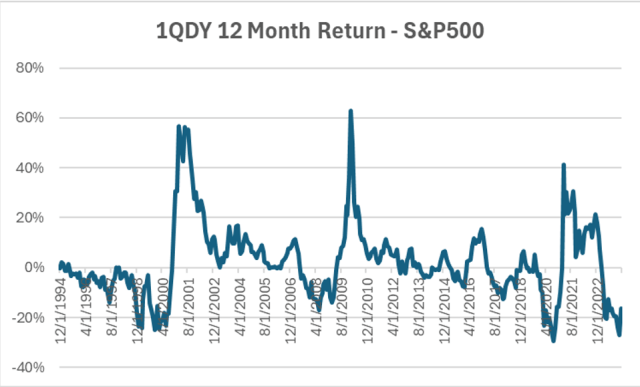
Investment Returns Are NOT Random
There is notable disagreement among academics about how investment time horizon should affect portfolio allocations. In recent research released through CFA Institute Research Foundation, we explored this topic at length. We find that the assumption that returns are independent over time is inconsistent with historical evidence, both domestically and internationally across stocks, bonds, and alternatives. These findings suggest that investment professionals may need to re-think their portfolio optimization routines — including mean variance optimization (MVO) — which typically assume returns are random across time. This article is the first in a series of three. Here, we will provide context about how returns historically have evolved over time. In subsequent articles, we will describe what this means for equity portfolios and portfolios of real assets like commodities. Risk and Investment Horizon One commonly held belief among many investors and financial advisors is that the risk of certain asset classes, in particular equities, declines over longer investment periods, an effect commonly dubbed “time diversification.” Evidence provided to support this hypothesis is how the distribution of compounded returns tends to converge for longer investment horizons, as demonstrated in Exhibit 1, which is based on the returns of US equities from 1872 to 2023. Exhibit 1. The Distribution of Compounded Equity Returns by Investment Horizon 1872 to 2023. A key problem with this perspective is that investors should not focus on compounded returns. Rather, they should focus on compounded wealth. And compounded wealth tells a different story. Using the same returns over the same period, Exhibit 2 includes how the distribution of wealth changes by investment horizon and there is clear evidence that it is diverging, not converging. Exhibit 2. The Distribution of Compounded Wealth by Investment Horizon for an Equity Investor 1872 to 2023. In reality, the risk of virtually all investments increases over time, when risk is defined as the increased dispersion in wealth. This perspective is consistent with options pricing models. While the risk of all investments is increasing, it is important to note that the rate of the increase could vary over time and this variance has important implications for investors with longer holding periods. If the relative risks of investments change by investment horizon, that would suggest some type of serial dependence is present, which means the returns evolve in a way that isn’t completely random. Previous research suggests that the return on an investment such as stocks is relatively random. This theory is perhaps best exemplified in Burton Malkiel’s book, A Random Walk Down Wall Street. But our research finds that autocorrelation exists. In our paper, “Investment Horizon, Serial Correlation, and Better (Retirement) Portfolios,” we provide context around autocorrelation, or how past returns are related to future returns. We examine five US return series — bills, bonds, stocks, commodities, and inflation — using historical annual returns from 1872 to 2023, leveraging data from the Jordà-Schularick-Taylor (JST) dataset and the Bank of Canada. Exhibit 3 includes the coefficients from a series of ordinary least squares (OLS) regressions, where the dependent variable is the actual return for that calendar year, while the returns for the previous five calendar years are included as independent variables. Historical returns for each asset class are re-centered, so they have an average return of zero and a standard deviation of one, to reduce any implications associated with historical differences in returns and risk levels. In other words, the regression is effectively based on the z-values of the historical time series returns. Negative coefficients are highlighted in blue, since this implies the risk of the asset declines over time because a positive return would be more likely to be followed by a negative return. Positive coefficients that are statistically significant, implying that the risk of the asset increases over time, are highlighted in red. Exhibit 3. Regression Coefficients for an Ordinary Least Squares (OLS) Regression, Where the Dependent Variable is the Current Calendar Year for the Asset Class 1872 to 2023. Back to Exhibit 1, there are several coefficients that are statistically significant, defined as a p value less than 0.05, which suggests the historical returns series is not truly independent across time. Certain asset classes, such as bonds, have exhibited positive autocorrelation historically, while other asset classes, such as equities, have exhibited negative autocorrelation. This suggests that the longer-term risks of owning either asset could change due to the investment horizon. The relative risk of owning equities should decline compared to bonds, for example. Next, we look at how the risk of assets can change when considering inflation. For this analysis, we estimate the correlation between the cumulative growth in wealth and cumulative impact of inflation for different investment horizons for the same four asset classes. Exhibit 4. Historical Correlations in Wealth Growth for Various US Asset Classes by Investment Period 1872 to 2023. Inflation is often explicitly considered in certain types of optimizations (e.g., a “surplus” or liability-relative optimization). One potential issue when considering inflation, however, is that changes in the prices of goods or services do not necessarily move in sync with the changes in the financial markets. In other words, there could be lagged effects. For example, while financial markets can experience sudden changes in value, inflation tends to take on more of a latent effect, where changes can be delayed and take years to manifest. Focusing on the correlation — or covariance — of inflation with a given asset class like equities over one-year periods may hide potential longer-term effects. The correlations of the four asset classes vary notably with inflation by different investment horizons. For example, a one-year investment horizon, which is a common time frame used for MVO assumptions, the correlations are relatively low for all asset classes, suggesting little potential hedging benefit. However, there are notable increases over a 10-year period that can at least be partially explained by positive drift for each asset. The correlation between commodities and inflation increases to 0.62, for example. The notable increase in correlations for bills and commodities is especially
Investment Returns Are NOT Random Read More »