
CIO CIO

AI PCs are here: Dell + Qualcomm’s Snapdragon show off insane battery life, local AI demos

Overview Discover the future of computing with Dell’s latest AI PCs, powered by Snapdragon and cutting-edge NPUs. In this episode of DEMO, host Keith Shaw visits Dell’s Executive Briefing Center and chats with Munira Baldiwala, Director of Commercial Mobility Product Management at Dell, to explore the real-world performance of AI-powered laptops — featuring incredible battery life, on-device AI processing, live translation, and code generation without the cloud. 💡 What You’ll See in This Video: * Live demo of real-time language translation with Microsoft Copilot+ * AI-assisted code generation using Llama 7B, all done locally* How NPUs deliver faster performance & longer battery life * Why AI PCs are critical for the future of work * Introduction to Dell Pro AI Studio for enterprise AI development 🔥 Whether you’re an IT leader, developer, or tech enthusiast, this video will show you how AI PCs are transforming business productivity and redefining mobile computing. 📌 Chapters 00:00 – Introduction 00:22 – What Are AI PCs? 01:35 – NPU & Power Efficiency Explained 02:26 – Live AI Demo: Language Translation 06:33 – Live AI Demo: Code Generation 10:36 – Studio Effects & Use Cases 14:06 – Dell Pro AI Studio & Enterprise Benefits 17:42 – Wrap-Up & Final Thoughts 🔔 Subscribe to TECH(talk) for more weekly demos, interviews, and deep dives into the latest tech trends. 👍 Like | 💬 Comment | 🔁 Share #Dell #AIPC #Snapdragon #NPU #BatteryLife #AIDemo #GenerativeAI #LocalAI #Llama2 #CopilotPlus #AIForBusiness #TechTalk #DEMO This episode is sponsored by Dell and Qualcomm. Register Now source

AI PCs are here: Dell + Qualcomm’s Snapdragon show off insane battery life, local AI demos Read More »

M&S says it will respond to April cyberattack by accelerating digital transformation plans

“We are focused on recovery, restoring our systems, operations, and customer proposition over the rest of the first half, with the aim of exiting this period a much stronger business,” he added. Despite the staggering impact on profits, by some distance the largest sum ever publicly admitted to by a UK company as a result of a cyberattack, shareholders will take some comfort that Machin believes the final cost of the incident “will be reduced through management of costs, insurance, and other trading actions.” He said that these costs will be “presented separately as an adjusting item.” This, of course, currently doesn’t factor in any costs arising from any legal action around the customer data breach it admitted to having suffered during the attack. source

M&S says it will respond to April cyberattack by accelerating digital transformation plans Read More »

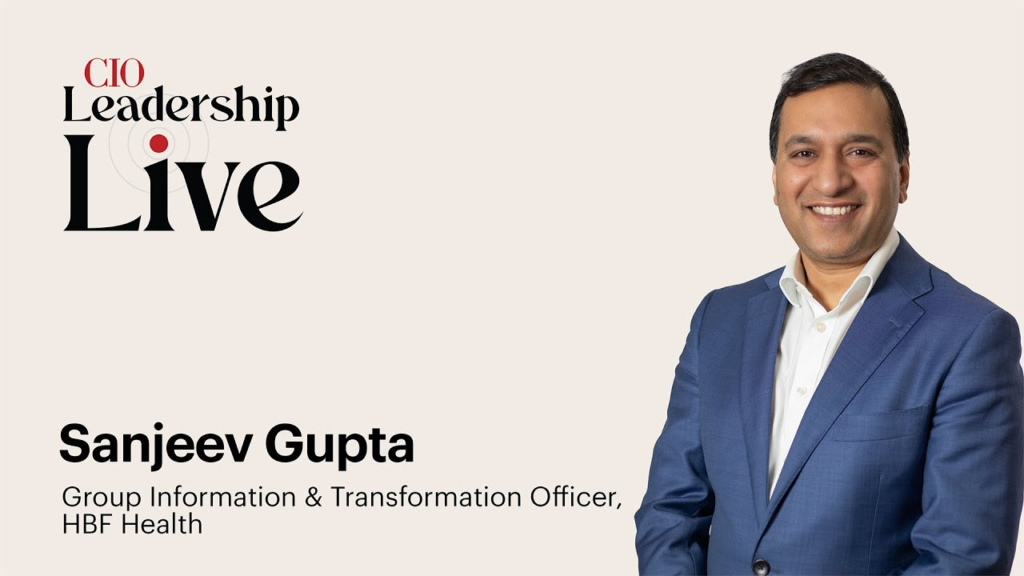
CIO Leadership Live Australia with Sanjeev Gupta, Chief Information & Transformation Officer, HBF Health

Sanjeev Gupta: The program that we did actually commence back in October 2019 and was completed in August of 24 so last year, it came about as we at HBF found ourselves at the centre of three key strategic challenges. Some of them are even valid today. So affordability around private health insurance, demographic trends, which Australia has an aging population, and which means increase in chronic illnesses, putting pressures on claims, inflation and competitive landscape, where we had, really, as I call it, using a cycling analogy, fallen behind the peloton, and the only way to sort of, you know, get ahead is to first catch up with the peloton. So our transformation program was designed to to meet these challenges that are reflected in our our market price position, complex products, suite and our aging system. So a three fold strategy was introduced to modernize the systems and operations by creating the best possible experiences for our members, providers and employees, and to establish the foundations of a more sustainable organization ready for future growth. The scope of this program, SaaS migrate our legacy system, which was a mainframe based, COBOL based, core insurance platform, to a public cloud based modern architecture platform so a new core insurance platform that includes product policy claims. It’s hosted on AWS, as I was alluding earlier, a new CRM, new marketing automation system built on Salesforce, enhanced member portal, our redesigned website and new app, as well as a new data platform, which was built on snowflake. And we did all of this while changing our way of working and the operating model to implement a scaled agile model as well. What it, what it sort of delivered for us, is increasing operational efficiency. To give an example. It’s quite simple, but you know, when our members have event like, you know, they, they have a birth of a baby, typically, before the transformation, if they were to add a baby to their existing policy. It took us anything between 30 to 40 minutes with some inherent procedure complexities, multiple screens that our frontline team had to navigate today with a single pane of glass and streamlined processes with our CRM and core insurance platform integrated, this process can be completed in about five minutes. Similarly for our employee and member empowerment, you know, faster delivery with those modular components means our teams can iterate and continually build new features without tripping over each other. The release of the my HBF portal that I was talking about is allowing our members to manage their private health cover in their way, and there’s no need for them to rely on the operating hours of the call center or the prime challenge, and they can make their claims. They can update their details, they can view their limits and usage. They can view their policy details. They can change their communication preferences. So all of this has allowed us to improve our member experience and also the employee experience.   source

CIO Leadership Live Australia with Sanjeev Gupta, Chief Information & Transformation Officer, HBF Health Read More »

IoT security: Challenges and best practices for a hyperconnected world

Imagine waking up one morning to find your smart home turning against you. Your thermostat is cranked to extremes, your security cameras have gone dark and your smart fridge is placing orders you never approved. Outside, your electric vehicle suddenly flashes its headlights, blasts the radio at full volume and randomly locks and unlocks its doors — without anyone inside. It rolls slowly down the driveway, not by command but under someone else’s control. This isn’t science fiction — it’s a plausible scenario in today’s hyperconnected world where the security of Internet of Things (IoT) devices is too often an afterthought. The expanding attack surface The IoT revolution is reshaping industries — from precision agriculture to autonomous vehicles, from remote healthcare to predictive maintenance in manufacturing. But this unprecedented proliferation has created an equally unprecedented attack surface. The sheer scale and heterogeneity of IoT ecosystems — spanning devices from multiple vendors, operating on divergent protocols and deployed across critical environments — make them an attractive and vulnerable target for attackers. source

IoT security: Challenges and best practices for a hyperconnected world Read More »

Barriers to running AI in the cloud – and what to do about them

As organizations rush to deploy and run AI to power not just pilots, but also key use cases supporting vital business functions, the cloud would appear to be the best environment for deployment. At least at first glance. After all, the cloud has unlimited extensibility, with the ability to expand or reduce resources on demand. It doesn’t require capital expenditures to deploy gear and is accessible from anywhere. Overall, one would imagine that AI deployment in the cloud would be cheaper and simpler to manage than it would on-premises. For some AI deployments, that may be true. But many enterprises are discovering that there are significant challenges to deploying AI in the cloud. Foundry’s most recent Cloud Computing Study surveyed senior IT executives about the challenges stalling cloud adoption. The No. 1 barrier was cost, cited by nearly half (48%). Security and compliance concerns were the second most significant obstacle (35%) while integration and migration challenges came in third (34%). The survey drilled down into what, specifically, was driving IT’s cost and budget concerns, and found that the largest issue was unpredictability (34%) followed closely by the complexity of cloud pricing models (31%). Compounding these problems, IT leaders said, was the fact that they lacked cost optimization strategies (25%) and visibility into cloud usage (23%). They also noted that transferring data was extremely expensive (25%). Simply put, IT leaders worried about how they’d be able to effectively manage and control cloud costs. In the long term, they feared it might be more costly than working on-premises. Of course, cost isn’t everything. The pressure to get AI up and running quickly could be seen as a big advantage with the cloud, where all resources are available on demand. Most hardware vendors sell only parts of the full solution for AI, which means IT has to spend time, money, and effort selecting, deploying, and integrating them all to enable the desired use cases. Note the emphasis on most. Organizations can accelerate on-premises AI infrastructure deployments and see rapid time to value by working with a vendor that takes a holistic approach. These vendors will handle every step – from system design to cooling, installation, power efficiency, and software validation – so the organization’s IT team can focus on producing results, not overcoming roadblocks. ASUS is an example of a holistic AI infrastructure vendor. Their ASUS AI Pod is a fully deployed, ready-to-run AI infrastructure with the power to train and operate massive AI models, all delivered in just eight weeks. Specifically, ASUS delivers a full rack with 72 NVIDIA Blackwell GPUs, 36 NVIDIA Grace CPUs, and 5th-gen NVIDIA NVLink, which enables trillion-parameter LLM inference and training. It’s a scalable solution that supports liquid cooling and is ideal for a scale-up ecosystem. Plus, it includes full software stack deployment and ongoing support. So, the decision of where to deploy AI — the cloud or on-premises — isn’t necessarily a slam dunk for a hyperscale solution. With the right vendor, on-premises deployment can be fast, performant, scalable, and cost-efficient. Learn more about the ASUS AI POD. source

Barriers to running AI in the cloud – and what to do about them Read More »

Basis Technologies launches Klario to help automate SAP change management

How it works Customers enter their requirements into the product in plain English, and the product will come back with questions to clarify the request, said Apostolakis. Once the user agrees on its understanding, Klario identifies options for the change from the data pool and presents them to the user. “The system at no point makes its own decisions without the user having actually validated the next action,” Apostolakis said. “This is key, because one of the big problems with AI is trust, and rightly so.” Once the options are identified, the user can ask Klario questions, do further research, or query the database again. When they are satisfied with the selected option, the system does a quick check of its feasibility at a high level, checking that the customer’s implementation is, for example, on the right release of SAP, and that the necessary skills are likely to be in-house. It flags any gaps to be considered in the planning. Then the user can select “Create blueprints,” which will generate the project tasks and other necessary items in Cloud ALM. source

Basis Technologies launches Klario to help automate SAP change management Read More »

Aussie businesses to spend $26B on public cloud services in 2025

“These factors are expected to sustain cloud growth, particularly as enterprises seek agility and scalability amid uncertainty this year, as trade restrictions and tariffs dampen business confidence and introduce greater unpredictability into short-term planning,” he said. While the situation continues to change, a lot of cloud spend is tied to multi-year annuity contracts with providers. “Tariffs are more likely to affect input costs and disrupt supply chains for new or incremental cloud spending, rather than existing usage,” he said. “This may lead to cautious spending by providers and delays in data centre expansions, prompting marginal adjustments to cloud spending projections. source

Aussie businesses to spend $26B on public cloud services in 2025 Read More »

Return-to-office mandates: Didn’t we already fight this war?

As part of this voyage of discovery, American employers figured out that they didn’t have to care about their relationship with employees. Employees existed to perform tasks, and their connection to management was purely transactional. Now, proponents of back-to-the-cubicle management are extolling the virtues of the relationships they can only have with employees through face-to-face encounters. It’s their employees who are pointing out, with no little justice, that they can perform their tasks at home just as well as they can in the office. Relationships? What does management think … that this is the 1950s? What’s needed to succeed There’s a big missing piece of this puzzle. It isn’t how to best encourage — “coerce” is a more accurate verb — employees to come back into the office, so as to restore the manager/employee relationship, which is how the dialog is usually crafted. source

Return-to-office mandates: Didn’t we already fight this war? Read More »

Understanding and overcoming common CICS challenges

IT environments are increasingly complex to manage, and overburdened administrators are tasked with refining them, keeping them secure, and preventing downtime. Mainframes are critical to that infrastructure, as they process and store billions of transactions worth of sensitive data and confidential records daily. Any slowdown or disruption in mainframe performance can come with enormous financial and business continuity costs. Large enterprises can lose up to $9,000 per minute during outages1. The stakes are even higher in industries with strict compliance demands, like finance and healthcare. In these industries, potential losses can easily exceed $5 million per hour on top of assessed fines and non-compliance penalties. Beyond financial penalties, organizations face long-term consequences, including hits to customer trust, brand reputation erosion, and possible regulatory scrutiny. One of the critical components within an IBM IT environment is the Customer Information Control System (CICS). CICS is the transaction engine for countless real-time processes across industries. This middleware system manages online transactions and connectivity for various applications, requiring high reliability and performance. Bottlenecks and downtime to these systems can be detrimental to an enterprise, leaving it unable to receive or process data until it is restored. These risks underscore the need for organizations to adopt tools designed to improve proactive performance monitoring and system optimization. Navigating the complexities of a regulated landscape Today, enterprises face mounting challenges, including increased regulatory demands, workforce skillset shifts, and ever-worsening system complexities. Recently implemented regulations, like the Digital Operational Resilience Act (DORA), mandate a higher standard of system resilience, levying additional costly penalties if downtime exceeds the allotted recovery time window. This increased scrutiny emphasizes the need for preemptive measures to mitigate mainframe issues, including those with CICS. The trouble is that preventing these problems can be quite complex without the right expertise and solutions. To make matters worse, IT teams face a growing talent vacuum caused by retiring seasoned mainframe professionals. Younger IT administrators may lack a deep understanding of mainframe technology, compounding the difficulty of troubleshooting issues in high-stakes environments. This knowledge gap becomes a significant operational challenge as applications become more interconnected and distributed. CICS is crucial in sectors where speed, reliability, and security are non-negotiable, but CICS environments often suffer from performance challenges that can be difficult to detect and resolve, including: Latency in transaction response times CPU consumption spikes and inefficient workload distribution Fragmented diagnostics across complex environments As CICS workloads scale, pinpointing performance inhibitors becomes increasingly complex, especially without experienced personnel. CICS observability: A new era of new era of mainframe insight Today’s enterprises need real-time diagnostics to optimize performance, anticipate problems, and react to issues as they occur. These insights can prevent CICS-related bottlenecks and improve resiliency during downtime. CICS observability tools allow teams to detect, diagnose, and resolve issues in real time without requiring decades of mainframe experience. They transform raw operational data into actionable insights, giving teams the visibility they need to: Identify slow or failing transactions before they impact users Analyze performance metrics with intuitive visualizations Pinpoint inefficiencies in resource utilization Improve system-wide throughput without major code rewrites These tools level the playing field for IT administrators who are not mainframe experts, making diagnostics accessible and fast. Solutions like Rocket® CProf are designed to give enterprises full observability into their CICS environments through real-time monitoring and diagnostics with a user-friendly interface. This allows IT teams to act faster, giving them peace of mind and the resources they need to handle any issues that may crop up. Modern enterprises need accessible, intelligent, and efficient IT environment tools. These solutions must address today’s mainframe challenges by simplifying these complex systems and enabling real-time, data-driven decisions. Implementing user-friendly tools reduces reliance on mainframe experts, improves performance, and reduces overall costs, helping organizations build more resilient and agile IT operations. Learn how to maximize CICS performance through modern observability. [1] “The True Cost Of Downtime (And How To Avoid It),” April 10, 2024, Forbes Technology Council. source

Understanding and overcoming common CICS challenges Read More »