CIO CIO

From virtualization to cloud: Achieving hybrid cloud success

There are many benefits of running workloads in the cloud, including greater efficiency, stronger performance, the ability to scale, and ubiquitous access to applications, data, and cloud-native services. That said, there are also advantages to a hybrid approach, where applications live both on-premises and in the cloud. A collaboration between Google Cloud and Broadcom enables organizations to take full advantage of this strategy. As a result, enterprises can gain business benefits, including the ability to: Maximize and protect their existing VMware investments Easily connect workloads running in different environments Place workloads where they want, when they want Gain access to all the benefits of the public cloud. A nondisruptive migration The most compelling benefits for IT leaders are the ease of migration and the consistency of the software platform and functionality between on-premises and cloud environments. Customers can stand up a dedicated cloud in under an hour and seamlessly extend or move virtual workloads to Google Cloud VMware Engine without any disruption or refactoring. The solution combines the power of VMware Cloud Foundation (VCF) with unique Google Cloud capabilities, delivering a consistent operational experience from on-prem to the cloud without the need for retraining. In addition, with VCF license portability, customers can extend their entitlements from on-prem to Google Cloud VMware Engine, gaining choice and flexibility for where they place their workloads. Additionally, VMware NSX empowers IT teams to extend their layer 2 and 3 environments and associated design rules into Google Cloud. This means they can maintain identical policies across environments, which dramatically simplifies administration and security governance in hybrid cloud deployments. Benefits of running virtualized workloads in Google Cloud A significant advantage to housing workloads in the cloud: scalability on demand. In times of peak use — such as end-of-year processes or heavy e-commerce traffic around holidays — IT can size for average use and burst as needed. That’s a more efficient and less costly model than having to provision for peak use year-round with an on-premises environment. Also, moving workloads to the cloud reduces the need to purchase, deploy, and maintain on-premises equipment. IT can also connect cloud-based VMware workloads to powerful artificial intelligence (AI), analytics, and other cloud services. In addition, IT can expect to gain high availability and resilience; Google Cloud leverages the same global backbone that runs YouTube, Gmail, Google Photos, and many other services used daily around the world. Finally, IT can realize considerable savings by leveraging its existing VMware skill sets and gain additional value by connecting other cloud services to enterprise applications. Costs are predictable and transparent, enabling organizations to determine their overall workload requirements and then migrate between on-premises locations and the cloud as appropriate. “Hybrid cloud doesn’t have to be complex,” says Mike Fink, global technical sales director for Google Cloud VMware Engine at Broadcom. “Thanks to this partnership, IT can move virtualized workloads and licenses into the cloud, protect their investment in VMware technology, and leverage Google automation to reduce overall cost while supercharging applications with cloud services, elasticity, and high availability.” Find out how easy it is to extend from on-prem to the cloud and migrate your workloads to Google Cloud VMware Engine. Find more information by clicking here. source

From virtualization to cloud: Achieving hybrid cloud success Read More »
SAP customers on Business Suite: New strategy, same old concerns

“To achieve this, SAP must continuously harmonize its product landscape and consistently implement uniform standards, for example, in data models and identity and security services,” said DSAG CTO Sebastian Westphal. “Because, by definition, a suite requires the seamless integration of the SAP solutions it contains, uniform operating models, and clear migration and implementation strategies along the way.”  What’s wanted in Business Suite: Flexible integration In addition, DSAG members expect a modular suite that can be flexibly adapted to corporate requirements and integrated into corporate architectures without undue effort and expense. Moreover, several points of SAP’s strategy still need to be clarified. According to Westphal, transparent cost structures and contract models, as well as long-term support for partner solutions, are key concerns. “There’s still a lot to do to create a fully integrated business suite,” Westphal said.   RISE Migration expected to be extended Regarding migration, DSAG customer companies welcome SAP’s continuation of its RISE Migration and Modernization program, originally announced at the beginning of 2024 — and originally scheduled to expire at the end of last year. This program is expected to significantly reduce the costs and time required for migrating to the new SAP world, for example, by offsetting previous investments in SAP products. According to the DSAG, SAP will continue the program in 2025 under a different name. A corresponding announcement is expected in the coming weeks.  source

SAP customers on Business Suite: New strategy, same old concerns Read More »

AI brings order to observability disorder

Digital tools are the lifeblood of today’s enterprises, but the complexity of hybrid cloud architectures, involving thousands of containers, microservices and applications, frustrates operational leaders trying to optimize business outcomes. Many are using a profusion of point siloed tools to manage performance, adding to complexity by making humans the principal integration point. Traditional IT performance monitoring technology has failed to keep pace with growing infrastructure complexity. Siloed point tools frustrate collaboration and scale poorly. Proprietary data formats and capacity-based pricing dissuade customers from mining the analytical value of historical data. Artificial intelligence has contributed to complexity. Businesses now want to monitor large language models as well as applications to spot anomalies that may contribute to inaccuracies,  bias, and slow performance. Legacy observability systems were never designed for the ability to bring together these disparate sources of data.  A unified observability platform leveraging AI can radically simplify the tools and processes for improved visibility and resolving problems faster, enabling the business to optimize operations based on reliable insights. By consolidating on one set of integrated observability solutions, organizations can lower costs, simplify complex processes, and enable better cross-function collaboration.  “Noise overwhelms site reliability engineering teams,” says Gagan Singh, Vice President of  Product Marketing at Elastic. Irrelevant and low-priority alerts can overwhelm engineers, leading them to overlook critical issues and delaying incident response. Machine learning models are ideally suited to categorizing anomalies and surfacing relevant alerts so engineers can focus on critical performance and availability issues. “We can now leverage GenAI to enable SREs to surface insights more effectively,” Singh says.  Generative AI can simplify problem resolution and recommend appropriate remediation actions for your organization, all while interacting using natural language. It can enrich telemetry data with business context to explain problems and solutions in terms business leaders can also understand.  “Customers want an observability solution that gives them an integrated view across all segments, whether on-premises or in the cloud,” Singh says. Consolidate observability tools When considering a next-generation observability solution, IT leaders should look for these features and characteristics:  A comprehensive set of integrated capabilities that can be extended through third-party integrations. A single view of all operations on premises and in the cloud. Petabyte-level scalability and use of low-cost object storage with millisec response to enable historical analysis and reduce costs.  The ability to enrich data with business context. For example, a bank should be able to see separate views of the performance of its ATM and online banking systems. The ability to connect operational and business data so site reliability engineers can be notified of the highest-priority business-impacting issues. Support for OpenTelemetry, APIs, and open standards to unify telemetry data for comprehensive analysis.  Support for a wide range of large language models in the cloud and on premises. Powerful vectorDB capabilities to allow engineers to flexibly query large sets of structured and unstructured data.  A transparent, published pricing model based on consumption.  AI-powered capabilities that enable rapid analysis and provide performance-related information in an understandable business context.  Elastic resolves problems faster with an open-source, AI-powered observability solution that is accurate, proactive, and efficient. Leveraging an efficient, high-performance data store. Elastic enables comprehensive visibility and tools consolidation across complex hybrid and multi-cloud environments and accelerates problem resolution with unified observability at lower TCO. Built for practitioners, Elastic reduces toil and improves SRE productivity, accelerating problem resolution and triage using a RAG-powered AI Assistant, zero-config multi-signal anomaly detection and pattern analysis, and an open, extensible architecture with OTel-native interoperability. To request a meeting to learn how Elastic Observability can help your business click here. source

AI brings order to observability disorder Read More »

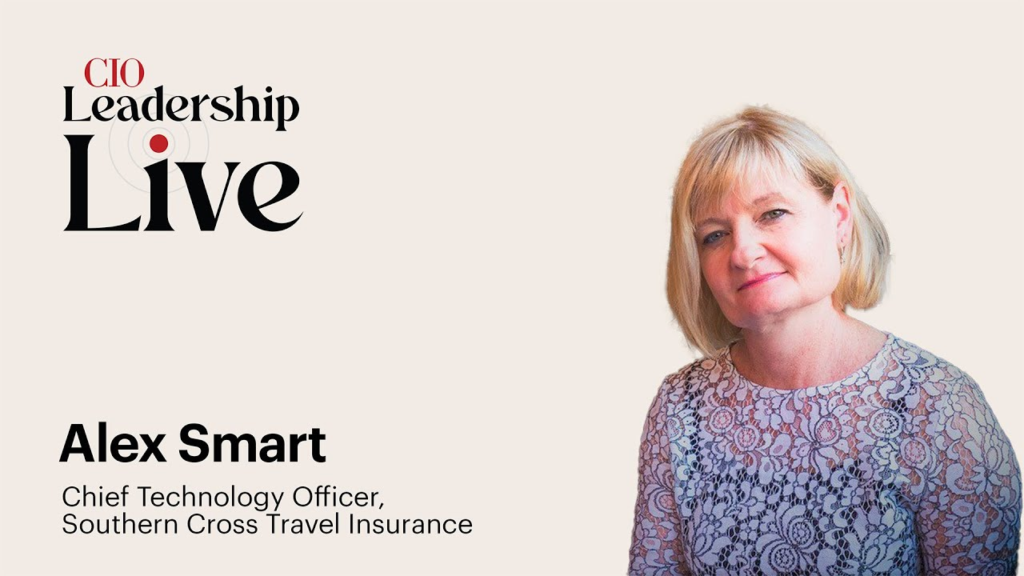
CIO Leadership Live NZ with Alex Smart, Chief Technology Officer, Southern Cross Travel Insurance

Alex Smart  Yeah, that’s the question that everybody’s asking at the moment. So digital first future. We are already there. It’s not really a future. Just about every business is digital first, even if they don’t think they are. Everything that underpins every transaction you do in your business is underpinned by some kind of technology. You know, your email, your banking transactions, your your file storage. So even if you don’t sell anything online, you’re still a digital business. So I think the digital business is here, but I think what has changed over that COVID period is the expectation of the experience of the digital business, both from your internal customers, but also your actual customers that you’re selling products to. They expect a different experience. They expect to be able to do what they can do in person, digitally as well, and they want to have the option to choose which way they go. Now, for businesses, that’s a big challenge, because, you know, transforming things that you’ve been doing over the phone or through a human into a digital environment. It’s not necessarily that easy or that easy to scale, and that’s where I think the emergence of new technologies like AI is changing the game, and so we’re using AI. For instance, at the moment, to understand the sentiment of people who call us. So we used to do sentiment analysis quite manually. We used to listen into calls. We used to review call recordings, but now we have continuous AI monitoring of customer sentiment, and it can even alert you know, your your contact center team leaders, when something’s going off track. And what that does is it just helps us provide a better experience immediately for our customers, whereas before it would have been, oh, six months ago, we found we weren’t doing that well. Let’s put a program in place to improve it. Now we know instantly how well we’re doing, and it can also help us pick up on where sentiment might be falling. It might be a particular product design. It might be something that they’re finding that they can’t do on a website. So, you know, I think this is where ao is just accelerating those experiences and helping businesses to move faster. And I think we’re very open to adopting that. I wouldn’t call us bleeding edge, but I do think we’re quite leading edge on some of that stuff. And I think because we’re a small business and we’re quite an agile business, it’s probably slightly easier for us to adopt some of those changes and test them. If you’ve been a large, well established organization, it takes a bit more time to turn a big ship than a little boat. So speaking of turning big ships, you’ve led several transformation projects throughout your career. So what is it that attracts you to them? And what advice would you have to new CIOs, who are maybe taking on their first major change project? Yeah, okay, so the first part of your question, I’ll tackle first, which is what attracts me to transformation. And that’s I’m essentially a problem solver at heart. I actually I probably don’t have deep skills than anything else. That’s the one thing that I would own as my deep skill is being a problem solver. I love facing into a real challenge and figuring out how to solve for that challenge. That’s what transformation is, because you don’t go down a transformation path unless you have a really painful problem to solve, because it’s not an easy thing to do. Incremental improvement is far better because it has less impact. But you don’t do incremental change for a really big problem. You do transformational change for a really big problem. So I think that’s what’s attracted me to transformation, because I love solving those problems, and I think there are some things in transformation that, if you know in advance, can help you really be successful at them. So we’ve already talked about one, which is, keep the objective front and center. Don’t get distracted. Remember the problem you’re trying to solve, and be really single minded about solving that problem. But alongside that form, the simplest path to get there to solve that problem. Don’t make it complex. Don’t try and add everything and all at once, go down the simplest path to get to that objective. There’s plenty of time later to improve it. And once you do that, once you form that path, then you can kind of understand what capabilities you’re going to need, and you can assemble a small group of people highly skilled in those capabilities to form a lead team. And that core team is essential for the success of delivering a transformation. And I would suggest that that team can’t be people from outside of your business. That core team has to be people who are in your business because nobody loves your business like people who work in it. You can have some brilliant contracting partners, and we do have some brilliant contracting partners, but they can’t love your business like your people do. So that core team is essential, but you’re never going to get enough people for a transformation from your internal team. So obviously you need to grow that, and you need to scale up by bringing in resources that you can scale down later. And that’s easy to do once you have that real core team that really has ownership, that’s highly capable that understands the simple path that you’ve laid out and can hold the main thing and make the main thing the main thing.   source

CIO Leadership Live NZ with Alex Smart, Chief Technology Officer, Southern Cross Travel Insurance Read More »

IT compensation satisfaction at an all-time low

A recent survey found IT compensation satisfaction has hit a record low, with relatively few IT workers saying they are satisfied with their pay. Industry observers, however, suggest the issue might not be entirely about money, leaving CIOs with options for boosting morale on thin budgets. In its latest IT salary survey, tech careers site Dice found IT worker compensation satisfaction has recently plunged, “with only 41% of tech professionals reporting they were either ‘very’ or ‘somewhat’ satisfied with their compensation. This represents a significant decline from previous years.” Dice identified several likely causes, including feeling underpaid compared to peers (59%), fewer annual salary increases, and the “rate of employers offering several key benefits (401K, health insurance, PTO, remote work, etc.) appears to be declining.” source

IT compensation satisfaction at an all-time low Read More »

Google’s AI innovations at Cloud Next 2025: What CIOs need to know

Smaller LLMs and other updates At Cloud Next 2025, Google also introduced specialized LLMs for video, audio, and images in the form of Veo 2, Chirp 3, and Imagen 3. According to analysts, these specialized LLMs might help enterprises achieve more accuracy on video, audio and image generation-related tasks while reducing costs to a certain extent. Specialized LLMs and smaller, faster Gemini variants directly address cost-performance optimization — an unsolved issue in enterprise AI scaling, according to Hinchcliffe. “For CIOs, these updates make it more realistic to embed LLMs in edge devices, private data stores, or verticalized apps without overspending,” Hinchcliffe said. To enterprises with productivity, Google, last week, updated its productivity suite with new agents via Google Workspace and introduced new CES agents. However, Hinchcliffe said the real value of these updates for any CIO lies in the fact that these agents or updates help bridge the gap between enterprise task automation and structured, governable AI workflows. “This is something that most vendors gloss over in their demonstration of new capabilities,” Hinchcliffe said. Other updates that Google announced included a slew of data analytics, databases, networking, and security updates along with a new Application Design Center. source

Google’s AI innovations at Cloud Next 2025: What CIOs need to know Read More »

Transforming customer experience with AI at Alorica

Alorica, a global leader in customer experience solutions serving Fortune 500 companies, has positioned itself at the forefront of AI innovation in customer service, developing solutions that directly address client needs while elevating agent capabilities. With operations around the world, Alorica leverages AI to transform how businesses connect with their customers. Michael Clifton, who joined as CIO and is now co-CEO, discusses his dual focus on commercial AI products as well as internal productivity, and provides fresh lessons learned on driving value from AI. At Alorica, you develop AI commercial products for your clients while leveraging AI for internal productivity use cases. What are some examples of your AI products? Our business is customer experience, whether we deliver that experience by phone, chat, web, and all the other channels our clients offer their customers for a seamless and enjoyable experience. So to maintain our value, we’re always evolving our products. In the context of voice, that means giving our clients’ customers the right information quickly, with a clear dialect, and with increasing levels of automation. source

Transforming customer experience with AI at Alorica Read More »

CIO Sharon Mandell transforms Juniper Networks for the AI era

Traditionally, Juniper’s business processes were targeted toward very large, complex, and long sales cycles. Mist required the exact opposite: a more bundled package sale to the enterprise, Mandell says. It would not be easy, but the CIO — recognizing business alignment was the key — enlisted both the business and technology sides of the house and got to work. “I locked on to the need for a business transformation, which required a change to many, if not all of our systems,” Mandell says. “Business transformation is a team sport and not always easy. IT can’t make this transformation alone. Leaders and subject matter experts in other impacted functions have to come along with this change in approach as well.” Much input and planning were required to evolve Juniper’s business model and prepare for a services future, she says. The company started by selecting and implementing new products to better integrate teams. For example, she and her IT team modified Juniper’s Salesforce Opportunity Management system, implemented new sales forecasting approaches using Clari, re-engineered the company’s use of Oracle CPQ, and updated its SAP Order Management systems. source

CIO Sharon Mandell transforms Juniper Networks for the AI era Read More »

What is technical debt? A business risk IT must manage

A rush to meet deadlines: Time constraints often force teams to take shortcuts, leading to substandard code that must be dealt with later. Your tech leadership team must prioritize tasks effectively and track postponed work to ensure it ultimately gets addressed. Unclear project requirements: When goals are vaguely written or not well thought out, teams may produce code that doesn’t really align with the underlying needs. Work done early on to define clear requirements can pay off later with cleaner code. Poorly written code: One of the main sources of tech debt, sloppy code makes future development and refactoring slow and inefficient; well-structured code, on the other hand, is easier to maintain and integrate with new features. Inadequate documentation: If poorly documented, even well-written code will cost your team and their successors wasted time and effort down the line. Establishing strong documentation from the start may take time, but will ultimately reduce effort going forward. Inevitable system evolution: Even well-designed codebases require ongoing maintenance due to evolving business needs, security threats, and outdated technologies. Code can “drift” due to dependencies on other packages or minor tweaks that have unintended consequences. In some ways this is the most insidious cause of tech debt, and should be guarded against. How to measure and manage technical debt One important difference between financial and technical debt: It’s much easier to quantify how much money you owe than it is to figure out your exact level of technical debt. There are techniques to help, however; for instance, in a whitepaper, CodeScene suggests a strategy in which you measure your team’s unplanned work, which is a good stand-in for time spent cleaning up tech debt they’ve inherited. Even if you can’t hang a number on your debt, you still need to get a handle on it. Andrew Sharp, research director at Info-Tech Research Group, is a strong advocate for tracking technical debt. He advises IT leaders to document their most critical technical debt, understand its business impact, and establish a clear process for resolving it. Understanding what technical debt you have is the first step to managing it. CIO’s Mary K. Pratt has a deep dive on how tech leaders should approach managing technical debt: You need to prioritize it on your road maps, think about it as a business risk, and be sure that when you do take on new debt, it’s in the planned/prudent quadrant.  source

What is technical debt? A business risk IT must manage Read More »

When transformation needs a home

To buck the trend, many Fortune 500-like organizations are rethinking their operating model. They’re rightsizing the number of business units relative to the customer segments they care about. Maybe they collapse down to two P&Ls—B2B and B2C, for instance. But even with a simplified structure, old habits die hard. People still work in the legacy model. The collaboration you need just isn’t happening. And that’s where a transformation function can help—not to rewrite the org chart, but to enable the enterprise mindset your strategy now calls for. From SKUs to solutions Or maybe your products are naturally complementary, and the next wave of growth lies in bundling them into holistic solutions. The challenge? This shift requires systems and teams that once operated autonomously to act in concert. One manufacturing client made this shift. To enable a unified solution go-to-market strategy, they had to align three distinct domains: the physical product teams that engineer and build the offerings, the mobile application teams that allow customers to interact with and manage smart products, and the digital function responsible for outbound marketing, ecommerce, and key lead-to-cash capabilities like CPQ, fulfillment, and customer care. All three were critical. But working together wasn’t the default. Transformation, in this case, wasn’t a PMO—it was the connective tissue that brought these parts together to build something greater than the sum of their parts. source

When transformation needs a home Read More »