Forrester

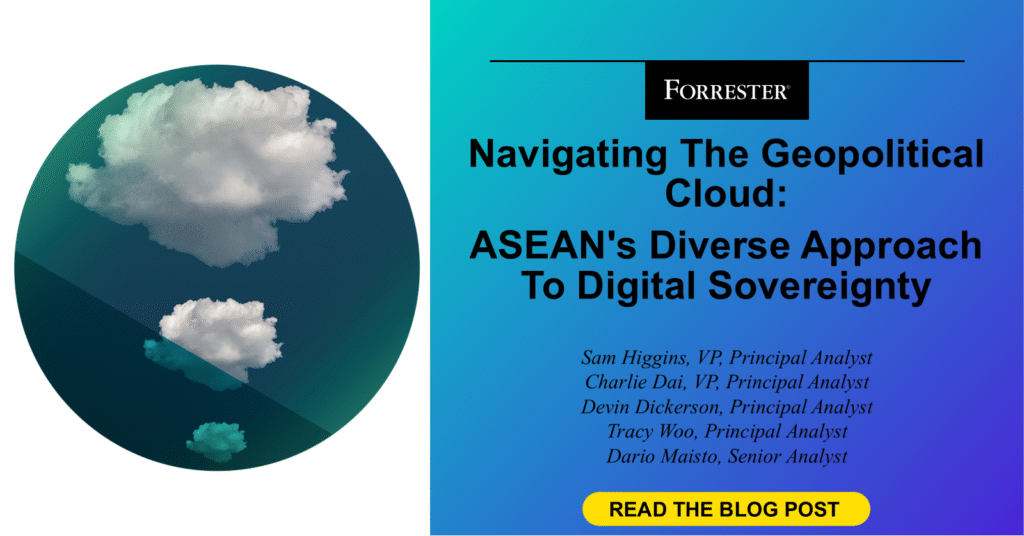
Navigating The Geopolitical Cloud: ASEAN's Diverse Approach To Digital Sovereignty

The digital landscape in ASEAN is undergoing a profound transformation, driven by a potent cocktail of digital sovereignty imperatives and shifting global geopolitics. For years, conventional wisdom in enterprise cloud adoption revolved around multicloud – leveraging several providers for redundancy, cost optimization, and avoiding vendor lock-in, or merely by accident. What we’re now observing in Southeast Asia, however, is a more nuanced and strategically driven “diverse cloud” approach that directly addresses concerns around US foreign policy uncertainty and the imperative for localized data control. The result? A fascinating trend where local cloud providers, US hyperscalers (AWS, Azure, GCP), and Chinese powerhouses (Alibaba Cloud, Tencent Cloud, Huawei Cloud) are all finding a place in the regional digital ecosystem. This isn’t just about technical merit; it’s about strategic alignment and risk mitigation. Chinese Cloud Leaders: Strategic “Go-Global” Ambitions Starting With APAC Perhaps one of the most telling indicators of this shift is the renewed vigor of Chinese cloud service providers in the APAC region. On one hand, the economic slowdown in the domestic market and the globalization needs of Chinese firms like PDD and BYD are driving them to accelerate their global operations. On the other hand, they are also rebalancing their regional investments to address ongoing geopolitical frictions. While Alibaba Cloud ceased operations in Australia and India in 2024, all Chinese cloud leaders like Alibaba Cloud, Tencent Cloud, and Huawei Cloud have renewed their strategic initiatives in APAC with ASEAN nations centre stage. Their unique proposition — a hyperscaler with deep roots in a non-Western superpower — resonates strongly with ASEAN countries seeking alternatives and balance. Their investments in new data centers, partnerships with local telcos, and tailored industry solutions underscore this renewed commitment. They are positioning themselves not just as a technology provider, but as a strategic partner in achieving digital autonomy. Country-Specific Strategies: A Patchwork Of Pragmatism While the overarching theme is diversification, the specific manifestations vary across ASEAN: Indonesia is actively promoting local cloud providers while also engaging with foreign hyperscalers. Their focus is often on data residency and ensuring that critical citizen data remains within their borders. We’re seeing hybrid models proliferate, with sensitive data hosted locally, while less critical workloads leverage global providers. Vietnam’s “made in Vietnam 2025” initiative extends to digital infrastructure, with a push for domestic technology development, but this approach also sees the Vietnamese welcoming investment from major global players, fostering competition and ensuring access to cutting-edge cloud services. Their strategy often involves requiring foreign providers to partner with local entities or establish significant local presence. Malaysia is actively pursuing a “Cloud First Strategy” policy, with an emphasis on security and data governance. Keen to leverage the benefits of cloud computing while maintaining control over their digital destiny, this translates to a preference for providers who can demonstrate strong security credentials and a willingness to comply with local regulations. Even Singapore, a traditionally more open market, is emphasizing resilience and diversification in its digital infrastructure strategy. While a hub for many global hyperscalers, there’s an increased focus on ensuring redundancy and exploring options that might offer greater control in a fragmented geopolitical landscape. Beyond Multicloud: The Geopolitical Imperative And The AI Factor This “diverse cloud” approach is more than just an IT strategy; it’s a geopolitical imperative. ASEAN nations are acutely aware of their unique position in a contested global arena. By diversifying their cloud infrastructure across a range of providers — local, US, and Chinese — they are asserting their digital sovereignty, mitigating risks, and ensuring that their digital future remains firmly in their own hands. Crucially, we expect this strategic pattern to proliferate in different forms, particularly as the global race for AI supremacy heats up. Consider: The UAE, with its ambitious “National AI Strategy,” is a prime example of a nation looking to build a robust, AI-native digital government. While partnering with US hyperscalers, the UAE is also heavily investing in sovereign cloud capabilities and fostering homegrown AI champions such as G42. This isn’t about shunning global players but rather maintaining sovereignty over the foundational AI infrastructure that will power their future. Similarly, the European Union, long a proponent of digital sovereignty through even ill-fated initiatives like Gaia-X, is increasingly recognizing that its ambitious AI Act and strategy require a strong, sovereign cloud foundation. With a significant portion of data still residing on non-EU clouds, there’s a concerted effort to foster European cloud providers and ensure that critical AI workloads and data remain within EU jurisdiction, subject to EU law. Beyond compliance; it’s about strategic autonomy in an AI-driven world, where control over data and infrastructure directly translates to economic competitiveness and national security. For enterprises operating in these dynamic regions, understanding this nuanced approach is paramount. It’s no longer just about optimizing costs or achieving technical agility. It’s about building a cloud strategy that is resilient not only to technological failures but also to geopolitical tremors, especially as AI permeates every layer of the digital stack. The “diverse cloud” is here to stay, and it’s reshaping the digital landscape of Southeast Asia and beyond in profound ways. source

Navigating The Geopolitical Cloud: ASEAN's Diverse Approach To Digital Sovereignty Read More »

Skip The Hype Reel — GPT-5’s Real Story Is In The System Card

I gave the GPT-5 launch video a few minutes of my attention — underwhelming. Reasoning and coding scores nudged upward but nothing that would cause competitors to bow down, and the Bernoulli demo was painful to watch. I decided to press pause on the stagecraft and head straight to where the facts live: the system card. The system card contains the pages of dense, dry text where marketing takes a back seat and the engineers quietly slip in the real story. What I found is a significantly improved core system. The upgrades — integrated routing, a rebuilt multimodal core, and adaptive inference — aren’t crowd-pleasing upgrades, but they directly address operational pain points that enterprises face today with generative AI applications. Routing As A Core Capability Routing models — picking the right model for the right task — is one of the hardest things that solution developers have to do. Most development teams have been hacking together their own solutions and often making suboptimal trade-offs in cost vs. speed vs. answer quality. GPT-5 quietly makes that work obsolete by moving the logic into the model itself. Multimodel routing is now native. A classifier scores each query for complexity and risk, then routes it to the right model variant — from quick “nano” and “mini” models to heavier “thinking” and “pro” ones for deep reasoning. Trade-off decisions are automated. The system handles cost/speed/accuracy balancing internally, removing the need for developers to constantly tweak orchestration code. Multimodal From The Ground Up Past multimodal models often felt like a buddy cop film — two personalities with different styles forced to work together. GPT-5’s multimodality is less a reluctant partnership and more a shared brain, with all input types handled in the same architectural space. One architecture for all inputs. Text, images, audio, and code share the same representational space, which reduces context loss during transitions. Better continuity for mixed-media workflows. Tasks that require fluid movement between modalities — such as interpreting a diagram and generating relevant code — are handled more coherently. An Inference Pipeline That Adapts On The Fly In today’s applications, every model output is treated the same — the same heavy process whether you were asking for a weather report or verifying a legal clause. GPT-5 begins to show some judgment, applying extra scrutiny only when it’s warranted. This is an important but subtle advance. Dynamic safeguards match the task. Real-time risk scoring means GPT-5 will follow deeper reasoning and fact-checking for prompts interpreted as complex or sensitive. Simple, low-risk queries will be prioritized to run fast. Parallel fact-checking reduces error risk. Submodels verify claims in real time, and “self-consistency” techniques compare multiple drafts to choose the best one. Hot-swap safety patches keep things running. OpenAI can fix issues without retraining the entire model, reducing downtime and disruption. Safety And Accuracy: Incremental But Useful AI alignment and safety is serious business — the number of public “oops” moments are trending up. GPT-5 shows enough improvement to make enterprise deployments a little less nerve-wracking. Fewer “confident” mistakes. Hallucination rates are lower than GPT-4o in adversarial testing, and valid queries are less likely to be wrongly refused. Better resistance to manipulation. Jailbreak attempts succeed less often, and safeguards operate before, during, and after generation. Risk remaining in some areas. Similar to Anthropic’s Opus 4, OpenAI decided to implement higher protections around chemical and biological questions. It’s clear that OpenAI is aware of the risk, but it is not clear how strong the guardrails are in GPT-5. Why The Gains Feel Smaller In the early days of large-model releases, the jumps in model capabilities were obvious. Now, with most public benchmarks already in the high nineties, progress is far harder to see. But after a few hours of using GPT-5, my conclusion is that the improvements are meaningful. Having one model instead of many makes sense, model performance is seemingly faster, and GPT-5 just produces better text and code. Those little things add up. What It Means For Enterprises For business leaders, GPT-5 is less new trick and more core upgrade. The updates may not wow on stage, but they offer more important benefits. Simpler AI integration. Native routing and multimodality cut the need for complex custom pipelines, reducing both engineering effort and integration risk. More predictable cost-performance balance. Automatic model selection optimizes compute use without constant human intervention. Operational stability and performance at scale. Adaptive safeguards and inference checks lower error rates and moderation overhead. Fewer edge-case failures and more predictable performance reduce the operational friction of deploying AI at scale. Want to dive deeper? Connect with me to discuss your ChatGPT-5 or other large language model-related questions. source

Skip The Hype Reel — GPT-5’s Real Story Is In The System Card Read More »

Infrastructure As Platform: Conquering Chaos In The Agentic Era Requires A New Foundation

In today’s business landscape, adaptivity, innovation, and scalability are not just nice to have — they are necessities to address rapidly changing customer needs, volatile trading markets, increasing disruption from competition, and the expectation of accelerated outcomes. Furthermore, resilience, security, and governance must be embedded in everything. There are no trade-offs. But key platform outcomes like innovation and resilience don’t happen in a vacuum. They require investment in strong foundations that support experimentation, scale, and transformation while addressing increasing levels of compliance accountability and systemic risk. That foundation is your infrastructure. And if your infrastructure still resembles the rigid, siloed systems of the past, it’s time to rethink what it means to be “modern.” Traditional infrastructure paradigms were often built around static provisioning, manual governance, and reactive operations that hold organizations back. These systems were designed for an unchanging world where all the inputs and outputs were easily controlled, not the dynamic, agentic AI-led technology era we are about to enter. They prioritize uptime over adaptability and compliance over creativity. The infrastructure of the past was a compromise of trade-offs that are no longer acceptable in a world where change is constant and disruption is inevitable. To inspire innovation within your organization, you must turn your infrastructure into a constantly evolving platform aligned with enterprise strategy that supports rapid iteration and embeds resilience into every layer. This isn’t just about upgrading hardware or migrating to the cloud. It’s about transforming infrastructure into a strategic enabler of business outcomes. From Infrastructure To Platform: A Strategic Shift Making the shift means evolving infrastructure from static systems to dynamic platforms driven by APIs, infrastructure as code, and automation. These platforms are observable, accountable, securable, and intelligent. But the transformation is not just technical. It’s a cultural shift. IT teams must evolve from administrators to developers, embedding security and policy enforcement directly into automated workflows. AIOps must replace reactive firefighting with predictive, data-driven operations. Governance must scale with infrastructure, using codified controls to ensure compliance without slowing innovation. Most importantly, infrastructure must shift from being a cost center to a business asset, one that enables value creation across the enterprise. What Does Future-Proof Infrastructure Look Like? A future-proof infrastructure platform is not just cloud-native — it’s cloud-smart. It supports hybrid and multicloud deployments, embraces open standards, and integrates seamlessly with application platforms. It’s designed with resilience goals in mind, addressing security, availability, and accountability through deep integration with observability, analytics, and automation platforms. This kind of infrastructure will be needed to enable your agentic business fabric, an intelligent business ecosystem where AI agents collaborate with human expertise to orchestrate data and automate workflows that deliver measurable business outcomes. Getting There Is Not Easy Most enterprises carry significant infrastructure-related technical debt, making the transition to future platforms both costly and complex. Getting there requires more than technical upgrades; it demands a cultural shift. IT teams must adopt product management principles, evolve into platform stewards, and continuously align infrastructure with changing business needs. Building a plan for the future means identifying what your infrastructure must enable, prioritizing investments that move you toward that vision, and executing a roadmap that transforms your current infrastructure investments into new, more adaptable infrastructure platforms. This is not a one-time project. It’s a continuous evolution. Aligned, Resilient Infrastructure Is An Innovation Catalyst To reach the ever-elusive goals of agility, scalability, security, and speed, organizations must stop treating infrastructure as a cost center and start leveraging it as a catalyst for innovation. By rethinking infrastructure as a strategic platform, aligning it with enterprise goals, and embedding resilience into its core, you build the strong but flexible pillars needed to support your organization in the face of uncertainty. The future belongs to those who build it on aligned, adaptive, and resilient foundations. Learn More Is your infrastructure ready for the future? Join me this November at Forrester’s Technology & Innovation Summit North America in Austin. I’ll be presenting a keynote entitled “Build Infrastructure As Platforms To Master Growth, Agility, And Governance” to help you learn how to transition your business’s infrastructure platforms to meet the future of your business. We’ll also have a full track on cloud, infrastructure, and operations at the event. Last but not least, if your IT or EA organization has been leading change, enabling the business, and transforming your tech stack to meet the future, apply for the Technology Strategy Impact or Enterprise Architecture Awards. Check out our T&I Summit page for the details. Winners will be featured at the Summit in November. source

Infrastructure As Platform: Conquering Chaos In The Agentic Era Requires A New Foundation Read More »

Meta: So Long, Metaverse; Hello, Superintelligence

When Facebook, Inc., famously changed its name to Meta Platforms, Inc., in October 2021, it cemented that the behemoth social media company was now an emerging “metaverse company.” There was just one problem: The vast majority of people didn’t care about the metaverse. Meta struggled to demonstrate tangible value with the metaverse — hemorrhaging money and, in a way, facing a bit of an existential crisis following the company’s pivot. For quarter after quarter, we heard less and less about the metaverse and more and more about AI. In fact, “how AI is transforming everything we do” is the major theme for Meta in 2025 — and rightfully so. Not only has Meta made demonstrable strides with AI, but it’s helping to future-proof itself as a growth company, should its family of apps get affected by the current anti-trust case or changing social media sentiment. According to Forrester’s Media And Marketing Survey, 2025, 52% of US online adults indicate that they feel more negatively about social media now versus a year ago. Meta Plans To Win The AI Race With Superintelligence Leading up to Meta’s Q2 earnings call (later today), Mark Zuckerberg shed more light on the company’s superintelligence ambitions — a capstone that’s symbolic of Meta’s ongoing reinvention from a social media company to a metaverse company to, now, a super-intelligence company. Zuckerberg said: “Superintelligence has the potential to begin a new era of personal empowerment.” “Meta’s vision is to bring personal superintelligence to everyone.” “Expect people to spend less time in productivity software and more time creating and connecting.” To do this requires the best of the best talent. And Meta’s been on a tear when it comes to recruiting top AI talent. If Meta leapfrogs the superintelligence race, it’s because of its deep pockets. Yes, money talks, and Meta is spending lots of it to lure luminaries from competitors such as OpenAI, Google, and Apple with lavish compensation packages while also spending hundreds of billions on data centers to power and scale its AI initiatives. Zuckerberg’s Vision For Superintelligence Is Optimistic, Not Realistic Meta’s CEO is hopeful that superintelligence will be used to empower people and not “focused on replacing large swaths of society.” But let’s be real: Human replacement is already happening, and this is just the beginning. As The Wall Street Journal reported earlier this week, “CEOs are shrinking their workforces — and they couldn’t be prouder.” Forrester data continues to corroborate this — in that business leaders see AI as an efficiency play above all else. According to Forrester’s State Of AI Survey, 2025, 43% of AI decision-makers use “improved productivity” to measure their organizations’ AI outcomes. And the top two responses for how their organizations have been positively impacted by AI in the past year are: employee effectiveness and employee time savings. The fact is that AI can save companies’ time and money. That’s a good thing for shareholder value. But will it be good for society? As with every major technology disruption some good will come from it … but also some bad. How bad the impact of superintelligence gets depends, in part, on the ethics of the companies developing it. Meta says it “will need to be rigorous about mitigating these risks and careful about what we choose to open-source.” But many companies are vying feverishly to win the superintelligence race. But at what cost are they willing to do so? Mere trust in companies to do the right thing just isn’t going to cut it. Forrester clients: Let’s chat more about this via a Forrester guidance session. source

Meta: So Long, Metaverse; Hello, Superintelligence Read More »

CMO Fortunes Falter Amid Economic And Role Uncertainty

Over the past year, the representation and tenure of CMOs and senior marketing executives at Fortune 500 companies have sharply declined. The numbers tell a sobering story: Over one in five Fortune 500 companies changed their marketing leadership over the past 12 months. The average CMO tenure is now just 3.9 years, down from 4.1 years — not surprising given the churn. We are also seeing a noticeable decline in the number of CMOs in the Fortune 500. Only 58% of companies have a marketing executive reporting directly to the CEO or sitting in the C-suite, down from 63% last year. B2B companies are leading the retreat, with executive-level CMO presence dropping from 48% to just 42%. This erosion isn’t just statistical — it’s visible in headlines. Over the past few years, household-name brands such as Johnson & Johnson, Starbucks, and UPS have eliminated or restructured the CMO role. When Forbes released its list of the 50 most influential CMOs, 14 of them didn’t actually hold the CMO title. Instead, they bear alternative labels like chief commercial officer. This rebranding appears to say it all: The CMO role, as traditionally defined, is being recast or sometimes eliminated altogether. Business Pressure And Lack Of Clarity Are Driving CMO Turbulence So what’s going on? Part of the answer to CMO turmoil is the economy. In separate Forrester studies, 51% of B2B CMOs and 43% of B2C CMOs say they expect a recession in the coming year. Economic anxiety and budget pressures are triggering strategic reevaluations, and CMOs often find themselves on the defensive — struggling to prove ROI, hold ground with finance, and avoid being scapegoated for declining growth. Marketers tend to be the first cut and the last to be re-funded. But economics is only part of the story. What we’re witnessing is a deeper transformation for marketing leaders. The remit of the modern CMO has become a moving target — stretched between brand and demand, product and pipeline, digital and physical. In many companies, these priorities are being fractured among numerous executive leadership roles. The result? Power and resources are diluted, focus shifts to more short-term revenue objectives, and accountability is fragmented. Indeed, when companies eliminate the CMO role, many end up reinstating it over time. CMOs Must Show Connections To Commercial Outcomes Despite this turmoil, there are clear signs of resilience and opportunity. Many CMOs are using the moment to redefine the role — expanding their purview to include programs that support customer retention, not only acquisition and expansion. Some are taking on aspects of sales, like having revenue development reps report to them or customer success. Others are leveraging digital commerce and the drive for greater self-service buying to transform marketing’s role as a growth driver. Marketing leaders who can make measurable connections between brand-building, demand generation, and commercial outcomes are holding the line. Our analysis also shows that marketing does drive transformation in the C-suite: Women still make up the majority of Fortune 500 CMOs, a notable bright spot in a male-dominated executive landscape. Clarify Marketing’s Purpose To Drive Change Companies are asking tough questions about the CMO mandate, its contribution to growth, and its rightful place at the leadership table. Savvy marketers see this as an opportunity to clarify marketing’s purpose and show how they can drive growth. The alternative is clear: Change or be changed. In this climate, survival may hinge less on what’s in the job description and more on how boldly CMOs reimagine their role. For more details on our survey of Fortune 500 CMO representation and tenure, clients can view the full report and schedule a guidance session with me to discuss the findings. source

CMO Fortunes Falter Amid Economic And Role Uncertainty Read More »

From Digital Sovereignty Platforms to Sovereign Cloud Platforms: Three Reasons For A Title Change

During last few weeks, we have decided to rename the planned Forrester Landscape on “Digital Sovereignty Platforms” to “Sovereign Cloud Platforms” to better reflect swift and rapid changes in the general availability of sovereign tech products and services. Three main reasons brought us to make this change: The current sovereign tech landscape is more complex than one year ago. In 2024, the sovereign platforms market was still blurred, with very few comprehensive announcements from vendors and service providers and little actual choice for products with general availability (GA). That is why at the end of 2024, we planned Forrester’s sovereignty Landscapes and Waves for 2025 with a broader scope in mind than just cloud. Newly announced tariffs, the anticipated retaliation measures, and an increasing global geopolitical volatility overall have resulted in an evolved sovereign technology landscape with more products and services available, specifically in the cloud space. Each tech market is developing its own sovereign solutions. From software, to networks, to service providers and beyond, digital sovereignty is a theme that is pervading every area of the enterprises’ IT stack. This is driving the creation of new sovereign solutions and services parallel to those already available in the different tech markets. This results in the evolution of a sort of sovereign twins: solutions and services which mirror the generic ones, embedding sovereign guardrails and features. As a result, we have recently observed the clearest and broadest advancements in the sovereign cloud space. Global clients want to know what their sovereign cloud options are. New risks – such as foreign administrations being empowered to push the kill switch – have raised concerns at global organizations about their dependencies on foreign vendors. Our clients nowadays realize that these dependencies – when not properly managed – could put them out of business. Therefore, our clients want to know their alternatives. We have seen the greatest uptick in demand with regards to a specific overview of the sovereign cloud solutions available nowadays. For all these reasons, we are moving ahead with a new title for this Forrester Landscape and Wave evaluation project to start analyzing just one of these sovereign tech markets and leaving space for more accurate analysis of other such markets in the future. For now, welcome to the era of sovereign cloud platforms. source

From Digital Sovereignty Platforms to Sovereign Cloud Platforms: Three Reasons For A Title Change Read More »

Meet Evelyn Mitchell-Wolf: Forrester’s New Adtech Analyst

The internet we know and love (or hate … or hate to love) is built on programmatic advertising. Ads subsidize consumers’ access to all kinds of content, from unboxing videos to recipe and travel blogs to local news. And for well over a decade, programmatic has supplied a critical revenue source on the open web, nourishing a vibrant tapestry of publishers and creators. Now, a new era threatens the viability of open web publishers’ business models. And it goes deeper than genAI. That’s just one existential crisis stacked on top of several others: signal loss eroding addressability, regulatory intervention in the adtech vendor marketplace, and ad budget scrutiny amid macroeconomic whiplash, to name a few. I’m excited to join Forrester as the B2C marketing team’s newest adtech analyst to help clients navigate it all. My first report will unpack how programmatic supply will evolve as the industry acclimates to this new era, and what publishers can do to prepare. Beyond that, I’ll be covering all your favorite adtech topics, including brand safety, ad fraud, evolving power dynamics between buy- and sell-side intermediaries, and more. I’ll bring to bear my experience as an analyst at EMARKETER covering adtech, measurement, and regulation as well as my perspective as a former media planner and channel insights specialist. If you’re a Forrester client, set up a guidance session with me today to discuss the current and future state of adtech. source

Meet Evelyn Mitchell-Wolf: Forrester’s New Adtech Analyst Read More »

New Research: Top Emerging Technologies In Healthcare

Emerging technologies are flooding the healthcare space, and healthcare organizations (HCOs) are struggling to keep up. My upcoming research on the top emerging technologies in healthcare for 2025 will help healthcare leaders prioritize what matters most — now and in the future. HCOs are under constant pressure to improve clinical outcomes and workforce retention amid budget constraints and market volatility. They’re sifting through a multitude of vendors and tech offerings, trying to solve big problems efficiently while building sustainable and versatile technical infrastructure. The opportunity is clear: HCOs can transform clinical workflows to prepare for next-gen experiences and operations. The challenge? Every new tech — agentic AI, generative AI, and synthetic data, to name a few — demands more time, resources, and maintenance. This research will help you answer the questions: “What technologies do I need to care about today?” and (equally important) “Which ones can wait?” The research will identify the emerging technologies that HCOs should invest in — and when — by mapping them across three benefit horizons: short-term (proven ROI in <2 years), medium-term (evolving potential in 2–5 years), and long-term (5-plus years to deliver tangible value). As we enter the era of intelligent healthcare organizations, vendor partnerships and strategic planning are more critical than ever. Here’s what digital healthcare leaders can do now: Assess current tech maturity. Not every HCO is ready for every innovation — review your current tech stack to identify areas of low maturity or concern. Focus on what aligns with your mission and capabilities, then develop a roadmap to evolve your technology. Pilot strategically. Use proofs of concept to test emerging technologies in low-risk environments. Identify measurable outcomes to assess the success of these pilots and create a plan for wider implementation. Build cross-functional coalitions. Emerging tech success depends on collaboration between IT, clinical, policy, and operations. Ensure that you’ve established relationships with key stakeholders across the HCO and can clearly communicate the risks and benefits of the technology. Invest in talent and governance. New tools require new skills — and new rules. Governance and adherence to policy is critical for HCOs, as trust and reliability are key factors in the customer and employee experience. Build comprehensive governance policies and a long-term strategy to implement these technologies. Get Involved Over the next month, we will be conducting interviews with leaders at HCOs on emerging technologies in healthcare. We’d love to hear your view! If you would like to participate in our research, please contact Shannon Germain Farraher ([email protected]). source

New Research: Top Emerging Technologies In Healthcare Read More »

The Autonomous Testing Platforms Landscape, Q3 2025, Is Out!

As software development accelerates through AI and generative technologies, testing is under pressure to keep pace. The rise of TuringBots and AI-generated code has collapsed traditional development cycles, introducing new complexities and risks. Yet many testing practices remain manual, fragmented, and slow. Without a strategic shift, testing threatens to become the bottleneck of the software delivery lifecycle, undermining speed, quality, and business agility. Organizations need to rethink how they approach testing — not just as a technical checkpoint but as a continuous, intelligent process that aligns with modern development increasingly based on generative, agentic AI. This is why we shifted our research from continuous automation platforms to autonomous testing platforms, as announced in this blog post a few months ago. Who Offers What To Support Your Autonomous Testing Strategy To help technology leaders and QA professionals make sense of this dynamic space, Forrester just published The Autonomous Testing Platforms Landscape, Q3 2025. This report profiles 31 vendors and defines the emerging category of autonomous testing platforms (ATPs) — solutions that combine traditional automation with AI and genAI agents to perform increasingly autonomous testing tasks. The report offers a comprehensive view of how ATPs are evolving, what business value they deliver, and how buyers can evaluate platforms based on core and extended use cases. It’s a valuable resource for anyone looking to modernize their testing strategy and align it with the pace of innovation in software development. What Autonomous Testing Platforms Bring To The Table Accelerate time to value through AI-driven test automation. ATPs reduce the time required to design, generate, and maintain test cases by automating traditionally manual tasks. They enable self-healing for brittle tests, optimize execution, and generate tests directly from requirements. Reduce strategic risk and improve governance. AI-powered platforms support risk-based orchestration, intelligent test scoping, and real-time analytics. They prioritize testing based on business impact and historical defect patterns, ensuring that critical paths are validated. Democratize testing and foster cross-team collaboration. With no-code/low-code interfaces and natural language test authoring, ATPs empower nontechnical users to “vibe-test.” Business stakeholders, product managers, and developers can all participate in defining and validating tests, leading to broader coverage and better alignment with business goals. Start addressing the testing of AI applications. As AI inserts itself into production enterprise applications (AI-infused apps, or AIIAs), these also need to be tested, which means we now need to test whether the AIIA is hallucinating, not being accurate, or not meeting original intent — these are all additional capabilities that testing tool platforms need to address. A Market In Transition — And Why It Matters The ATP market is rapidly evolving but still maturing. While many vendors claim AI-native capabilities, buyers must distinguish between genuine innovation and marketing hype. Core features such as DevOps integration and UI testing are now table stakes; differentiation lies in agentic testing, business outcome validation, and intent-based test creation. Organizations face challenges typical of a market in flux: fragmented toolchains, skill gaps, unclear ROI, and resistance to change. The emergence of agentic AI — systems that autonomously discover, generate, and execute tests — is redefining the role of testers and the architecture of testing platforms. This shift demands new frameworks, governance models, and cross-functional collaboration. Take The Next Step Toward Autonomous Testing If your organization is grappling with the speed and complexity of modern software delivery, now is the time to explore autonomous testing. The Autonomous Testing Platforms Landscape, Q3 2025, provides the clarity and structure needed to evaluate vendors, align testing with business outcomes, and prepare for the future of AI-driven quality assurance. We are just about to kick off the next step in this research, which is the Forrester Wave™ evaluation covering autonomous testing platforms (set to publish in Q4 2025) that will pick and compare the leading 15 players featured in the landscape. Reach out to schedule an inquiry or guidance session if you are updating your testing strategy and just want to keep up with the new requirements and opportunities that genAI and agents are creating. source

The Autonomous Testing Platforms Landscape, Q3 2025, Is Out! Read More »

Forrester’s 2025 Enterprise Architecture Awards Winner And Runners-Up For APAC

Enterprise architecture (EA) is critical for enabling organizations to operate at scale and over long time horizons. As the only global awards program dedicated to recognizing excellence in EA, the Forrester Enterprise Architecture Awards (EA Awards) has been attracting leading firms worldwide to submit descriptions of their EA programs and achievements for evaluation since 2010. This year, we continue our partnership with The Open Group to co-judge the EA Awards, and in my home region of APAC, it’s a privilege for me to review leading regional EA practices and learn from them, and I am honored to announce the winner and runners-up for 2025. Forrester’s outcome-driven EA model emphasizes four primary benefits through a hands-on practice: revenue/mission outcome, customer experience/employee experience (CX/EX), cost efficiency, and risk reduction. And as most leading enterprises are pursuing another year of technological advancements, especially in AI, the EA Awards this year spotlight organizations that demonstrate how their EA frameworks have pushed the boundaries of technology and fueled innovation to drive business growth. We congratulate the Hong Kong Jockey Club, this year’s winner, and runners-up AIA Group and Nan Shan Life Insurance Company. They all demonstrate how excellent EA practices helped align their IT strategies with business objectives, empowering them to accelerate business innovation and stay ahead of the curve. Winner: Hong Kong Jockey Club The Hong Kong Jockey Club (HKJC), a world-class sport organization that acts continuously for the betterment of society, embarked on a journey to modernize digital capabilities, strengthen governance, and enhance stakeholder experience. Through disciplined modeling, enhanced governance, executive stakeholder engagement, and visible digital successes, HKJC demonstrated that EA can deliver tangible value in mapping the IT capability to the business strategy and outcome. Over the past 18 months, HKJC’s EA practice has been instrumental in advancing key elements of its business strategy to ensure sustainable growth, digital innovation, and operational excellence. HKJC: Enabled the modernization of critical platforms for data-driven decisions. By developing an integrated digital EA repository, HKJC mapped over 500 systems, 400 business capabilities, and 700 technology artifacts; established standardized modeling views; and built over 29 dynamic dashboards. These outputs directly supported racing operations, customer-facing digital enhancements, and real-time decision-making capabilities. HKJC not only partnered with the business stakeholders to review the critical business activities and the business strategy but also defined it as an operating model and continues enriching its contents based on a purpose-driven approach. Embraced a structured governance framework for business alignment. This framework allowed faster evaluation of digital investments, aligning technology roadmaps with its strategic priorities. As part of the framework, HKJC provides architectural guidance to a range of initiatives, such as mobile-first customer platforms, digital-led venue experiences, and predictive analytics for customer engagement. This ensures resilience, scalability, and alignment with customer centricity and enterprise goals. Focused on architecture assets to enable resilient business growth. First, architecture models exposed redundancies in application portfolios and guided consolidation strategies, increasing operational efficiency while minimizing technical debt. Business capability mapping identified critical areas for digital enablement, leading to more informed project prioritization and resource allocation. Second, the standardized and correlated architecture repository improved visibility into system dependencies, cybersecurity vulnerabilities, third-party supplier risk, and disaster recovery requirements, enhancing HKJC’s resilience posture. Created a structured yet flexible environment to encourage innovation. This environment is the key enabler to ensure that experimentation, emerging technology adoption, and iterative learning are supported within strategic guardrails. HKJC took a modular approach in its design of the EA repository and metamodels, allowing agile teams and business innovators to perform quick impact assessment and model new capabilities, products, and services rapidly without disrupting core enterprise architectures. HKJC also took a lightweight governance approach for innovation initiatives and new technology product evaluation. It enables innovation velocity while preserving architectural coherence. Runner-Up: AIA Group AIA Group (AIA) is the largest independent publicly listed pan-Asian life insurer. It operates in 18 markets with over 25,000 employees, offering a wide range of products including individual protection and saving, employee benefits, and credit life and pension services to corporate clients. AIA’s EA team has been dedicated to building a series of Technology, Digital, and Analytics (TDA) program. The extraordinary business outcome of TDA 1.0 since 2021 paved the way to AIA’s winning of Forrester’s EA Award in 2022. In 2024, AIA defined a TDA 2.0 architecture to transform itself into the most customer-obsessed, intelligent, innovative, and efficient insurer powered by technology. The EA practice of AIA in TDA 2.0 is: Focusing on four workstreams to drive quantifiable business outcomes. These workstreams span future-proofed technology, distribution intelligence, customer digital experience, and health technology and data. Each workstream covers a range of initiatives that generate measurable business results. For example, the hyperscale architecture in the future-proofed technology workstream optimized IT spend with FinOps, achieving reduction in unit costs. And the AI-enabled middle-office architecture across the buy, service, and claims journeys in the customer digital experience workstream contributes to exceptional levels of customer satisfaction, dramatically improving operational efficiency in servicing, underwriting, and claims processing. Driving innovation with architecture governance to accelerate value. AIA formed an AI Council to lead responsible generative AI adoption and coordinate planning, tech choices, and cross-market synergies. To ensure governance of architecture and program delivery, AIA built a Data Council to define enterprisewide data governance and resolve data issues. It also publishes blueprints and reference models to drive consistency, reuse, and faster value delivery. And by working closely with local teams, AIA’s Cloud Center of Excellence provides cloud-native patterns, automation tools, and security frameworks, strengthening governance and security posture while maintaining agility. Leading platform engineering to enable long-term business growth. AIA received the top score in the bonus category of platform engineering as part of this year’s EA Awards. Cloud-native strategy and infrastructure modernization delivered significant cloud and network savings. AI-powered software engineering based on its proprietary genAI engineering platform achieved up to 55% reduction in coding and review time, accelerating delivery and improving quality. And its AIA Knowledge Assistant Platform powers business users to create and manage genAI

Forrester’s 2025 Enterprise Architecture Awards Winner And Runners-Up For APAC Read More »