Forrester

Introducing AEGIS — The Guardrails That CISOs Need For The Agentic Enterprise

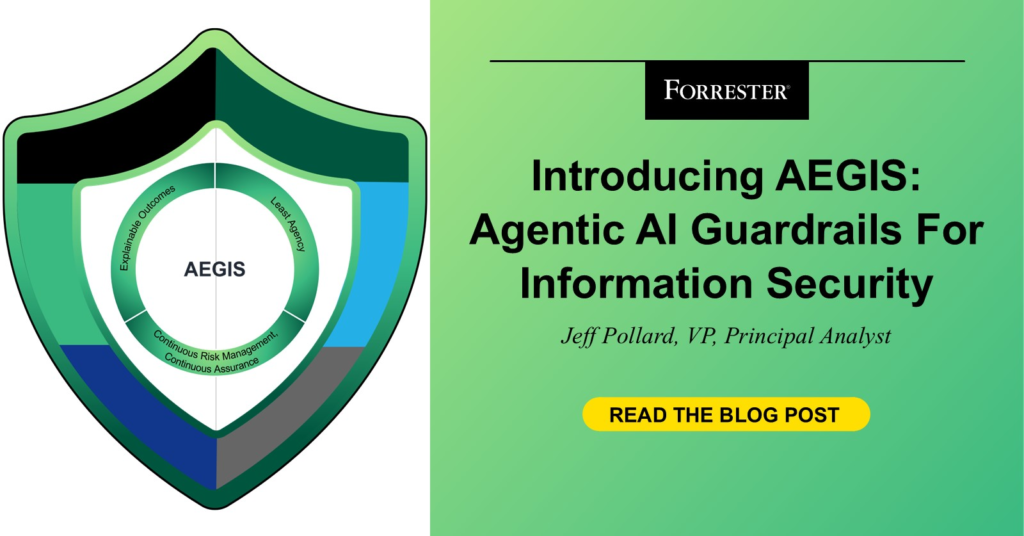
AI agents aren’t coming … they’re already here. And they’re not waiting for your security architecture to catch up. As enterprises race to deploy agentic AI, CISOs must pivot from securing systems to securing intent. That’s why Forrester built AEGIS. Forrester clients can read the full report, Introducing Forrester’s AEGIS Framework: Agentic AI Enterprise Guardrails For Information Security. Why AEGIS, And Why Now? Agentic AI is more than just another emerging tech trend. It represents a fundamental shift in how enterprises operate. These systems are distributed, autonomous, scalable, and designed to exhibit emergent behavior. They don’t just follow instructions; they adapt, plan, and act. Traditional cybersecurity models, built for human-centric systems, are ill-equipped to handle this. Agentic AI introduces: Emergent behavior that can bypass entitlements and escalate privileges. Cascading failures triggered by hallucinated or corrupted data. Obscured causal provenance, making post-incident forensics nearly impossible. Decision fatigue for humans in the loop, overwhelmed by agentic scale. CISOs must now secure intent, not just infrastructure. Cybersecurity Loses One Of Its Biggest Luxuries Cybersecurity (like IT), has a long history of blaming the user: “If only the user hadn’t clicked on the link, put in their password, or opened that PDF, then the breach wouldn’t have happened.” Now that the agentic enterprise is here, cybersecurity pros, ironically, are about to discover that user behavior was one of their biggest luxuries. Here’s why: Users are predictable. Willpower is finite. Agents are relentless. Willpower is infinite. People want to do their job. If they encounter resistance, they might try a few different ways to get things done (hence the birth of shadow IT and BYOAI), but there’s a limit to their motivation and, most importantly, their ability. If they don’t succeed, they’ll escalate, call the helpdesk, or give up. Kiss that luxury goodbye, because agents are code. Agentic systems take this to another level because they are programmed to overcome obstacles and exhibit emergent behavior by design. Agent ability increases with each action. Soon, CISOs will opine about the “good ol’ days” when all we had to worry about was a user in finance opening every email no matter how suspicious; that was so much easier than dealing with thousands of ephemeral agents completing tasks autonomously. What Is AEGIS? AEGIS — Agentic AI Guardrails For Information Security — is Forrester’s six-domain framework designed to help CISOs secure, govern, and manage AI agents and agentic infrastructure. The six AEGIS domains are: Governance, risk, and compliance (GRC) Identity and access management (IAM) Data security and privacy Application security Threat management Zero Trust architecture Each domain is built to evolve with the technology, not lag behind it. AEGIS introduces principles such as least agency, continuous assurance, and explainable outcomes to help security leaders adapt to this new paradigm. How To Get Started AEGIS includes a phased implementation roadmap, because this isn’t an overnight uplift. It is, however, an urgent one. Organizations still struggling with securing generative AI will find that AI agents are on their way. CISOs have to act now. AEGIS recommends that security leaders: Start with GRC. Leverage minimal tech for maximum impact. Establish governance, build inventory systems, and define acceptable use. Build IAM and data security. Treat agents as a new identity class. Secure data provenance, memory, and enclaves. Advance to DevSecOps and threat management. Secure the agent lifecycle, detect hallucinations, and deploy circuit breakers. Optimize with Zero Trust principles. Enforce least agency, monitor emergent behavior, and isolate rogue agents. Each domain builds on the last to accelerate your readiness. Why This Matters Agentic AI changes the game: Intent becomes your biggest challenge. Emergent behavior becomes a new threat vector. CISOs become the new architects of trust. Security leaders must shift from “block or allow” to “probability of success,” and CISOs need to realize that challenges also create opportunities. AEGIS equips them to lead with confidence, not caution. Forrester clients can read the full report. — Attend our Security & Risk Summit, November 5–7, in Austin, Texas, to learn more about how security will be transformed by AI agents and agentic AI in two keynotes. The first will be led by Allie Mellen, titled The Security Singularity and covering how AI will transform the way that attackers and defenders operate. The second keynote, which I’ll deliver with my colleague Jess Burn, is called The CISO Of The Agentic Future; we’ll discuss how AI agents will transform your security program. To discuss the report in detail and strategize on how to make the best use of our new framework, Forrester clients can set up a guidance session or inquiry with me. source

Introducing AEGIS — The Guardrails That CISOs Need For The Agentic Enterprise Read More »
US Economic Outlook H2 2025: Steady Growth, Growing Caution

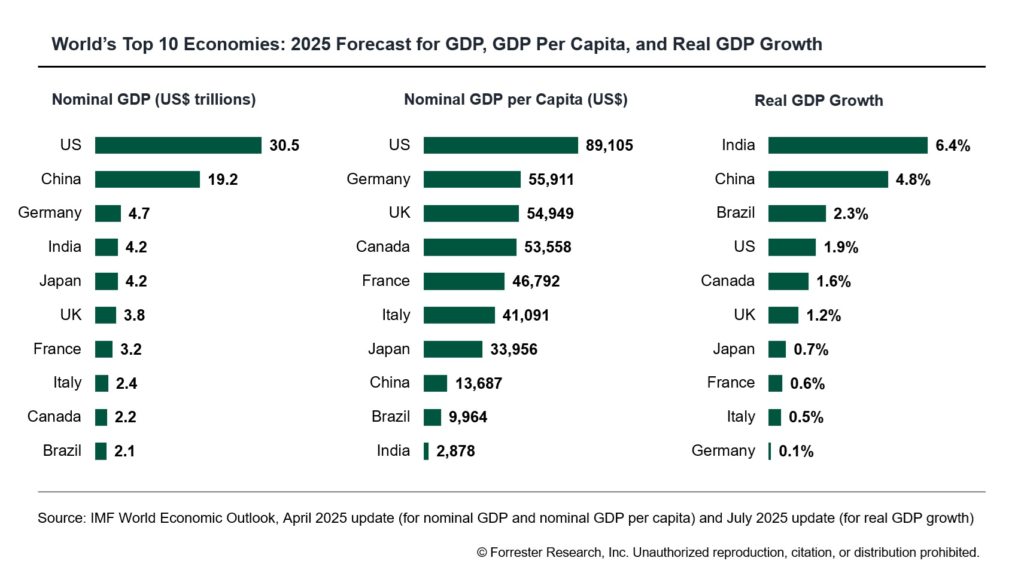
We’ve just published Forrester’s US Economic Trends And Outlook, H2 2025, report. Following is a recap of H1 and a peek at what we see ahead for H2. The US Economy Is Strong And Continues To Grow In 2025, the US is the biggest (nominal GDP), richest (nominal GDP per capita), and — among the G7 — fastest growing (real GDP growth) major economy. The IMF projects that the US economy will exceed $30 trillion in 2025, with 1.9% real GDP growth outpacing other large, developed economies.   How The US Economy Fared In H1 2025 The US economy performed relatively well in the first half (H1) of 2025. That’s despite worries of a potential recession, rising tariff uncertainty, and delayed decision-making by businesses, households, investors, and central banks. Import front-loading boosted spending in H1 as households and businesses accelerated purchases in anticipation of tariff impacts. After declining by 0.5% in the first quarter (Q1) due to strong import growth, US real GDP grew by 3.0% quarter-on-quarter at a seasonally adjusted annual rate (QoQ SAAR) in the second quarter (Q2). In H1, US macroeconomic indicators were generally stable. Headline CPI inflation averaged 2.6%. Modest price increases in durable and nondurable goods were offset by declining energy costs and easing inflation in services. The US national unemployment rate averaged 4.1% in H1, which is low by historical standards. Interest rates remained unchanged in 2025. Still, consumers, businesses, and investors remain concerned about the economic outlook for the rest of the year. Forrester’s monthly Consumer Pulse survey data indicates that consumers remain concerned about the direction of the economy, inflation, and their personal financial situation. The US Outlook For H2 2025 In the second half (H2) of 2025, economists expect that: Real GDP growth will moderate, although it is still projected to grow. Headline CPI inflation may increase to 3.0% in Q3 and 3.1% in Q4, up from 2.5% in Q2. The unemployment rate may edge up slightly to 4.3% in Q3 and 4.4% in Q4, from 4.2% in Q2. Interest rates will decrease by 0.5%. Take The Next Step If you’re a Forrester client, see further insights in the US Economic Trends And Outlook, H2 2025 report and schedule a guidance session or inquiry with me to learn how this could impact your organization. If you’re not yet a client but are in the midst of — or about to start — annual budgeting, consult our Budget Planning Guides 2026 resources to help you plan for 2026. source

US Economic Outlook H2 2025: Steady Growth, Growing Caution Read More »

The Dawn Of A New B2B Sales Supercycle

Innovation occurs in waves. Often, these waves drive extended periods of growth and transformation — supercycles that engulf businesses, governments, and societies. Minicomputers, PCs, the internet, social, mobile, and cloud were at the heart of prior technology waves. Now comes the Seventh Wave, driven by generative and agentic artificial intelligence. Indeed, a new supercycle has emerged. In our recent report, The Dawn Of A New B2B Sales Supercycle, we define the characteristics of this next decade of topline growth: Intelligent. Smart, efficient AI agents will be organized in reporting hierarchies and will co-sell with sales reps. Similarly, buyers will use AI in every phase of the purchasing process. We’ve entered an era of white-collar automation. Accelerated. Customers and competitors will move faster than ever, creating uncertainty for sales teams. Expect shorter planning and executing sprints that address operating realities — with fast, frequent improvements. Adaptive. Buyers will have more control and expect personalization at scale. As a result, sales must make agile, customer-centric adjustments. Large companies will use M&A as an instrument to keep up with startups and SMBs. Integrated. Interdependence among go-to-market teams continues to increase. Future roles, cadences, org designs, tech stacks, and processes will be more integrated than ever. With AI, teams must rethink and rebuild approaches. Networked. Revenue is earned in networks, and sales teams rely on commercial webs and ecosystems to sell their product. In the future, artificial neural networks will mimic human cognition and solve complex sales problems. Seller Roles Will Merge In This New Supercycle As part of this research, we predict that the cost of sales will rise during this AI-driven supercycle. AI investments, combined with integrated and accelerated work to meet customer needs, will force senior leaders to merge some sales and go-to-market roles. Specifically, the research highlights that “ … the [account executive] or customer success manager role of tomorrow could be staffed by the sales engineer of today, who is paired with an AI agent to sell with deep domain and solution expertise.” One early example of this merging of sales roles is happening at Microsoft. A few months after this report was published, Microsoft announced that it was cutting thousands of relationship-based sales jobs and refreshing some of them with solution engineers. An MSN article summarized it well: “Microsoft’s recent layoffs, which eliminated thousands of sales positions, reflect a larger shift away from traditional, soft-skill sales and toward more technical, AI-driven selling.” As sales teams invest in AI and connect customers to product experts, we expect this trend to continue. Expect A Dramatic Change In The Sales Landscape The pace of change is accelerating, and the buying and selling landscape is shifting. Self-service, AI influence, generational change, and buying complexity reshape the interactions between buying groups and revenue teams. In Forrester’s B2B Sales Survey, 2024, 37% of sales professionals say that being slow to recognize and adapt to changing buying behaviors is one of the top revenue growth challenges for their direct sales team. With disruption on the doorstep, sales teams with deep customer empathy and a willingness to self-disrupt will commercially outperform their rivals. To understand how these trends affect B2B sales and go-to-market teams, explore more insights in the report The Dawn Of A New B2B Sales Supercycle (client access required) and schedule a guidance session. You can also connect with me in person and see my upcoming keynote on this topic live at B2B Summit EMEA in London, October 6–8, 2025. source

The Dawn Of A New B2B Sales Supercycle Read More »

Meet The AI Agents Redefining B2B GTM Strategies And Approaches At B2B Summit EMEA

Goal-oriented, self-improving, sometimes autonomous AI agents purpose-built for B2B buying and selling will soon impact every interaction during the purchasing journey and postsale path to value. Investment is on the rise, with 74% of B2B and B2B2C organizations adopting AI agents and 14% planning to adopt them, according to Forrester’s State Of Customer Obsession Survey, 2025. While most are “agentish” or agentic-adjacent (for now), AI agents are already augmenting the B2B go-to-market workforce — and workflows — at a rapid pace, interacting directly with internal and external audiences and impacting both the customer and employee experience. Unlike a conversational interface, general-purpose chatbot, or personal productivity assistant, go-to-market (GTM) AI agents are specialized by focus area and role, with more distinctly agentic capabilities as the technology continues to evolve. These AI agents will autonomously research, identify, and engage prospects to qualify opportunities, negotiate, and even execute complex deals. But for an AI agent to be successful on the job, its work must align to how buyers buy and how customers engage, based on demand type, purchase complexity, audience personas, opportunity types, the makeup of decision-making groups, and how a product is utilized postsale. Agent Casting Call: Select, Align, And Integrate B2B AI Agents To Fit Your GTM Objectives Plan for a mixed group of specialized AI agents to support B2B marketing and sales processes. Match B2B AI agents to use cases based on their focus area, scope of work, technical capabilities, and collaboration requirements based on the GTM function supported. Start by breaking down sales and marketing workflows into steps and tasks (or have an agentic AI agent do that for you), then determine which are best performed by human, AI agent, or hybrid human-AI approach. AI agents purpose-built for B2B GTM broadly align to seven archetypes, each tailored to specific business contexts, audience needs, interaction scenarios, and training data and tooling requirements: the rule-follower, producer, savant, influencer, choreographer, planner, or innovator. Use these archetypes to create a well-rounded cast of AI agents connected to key B2B GTM initiatives and the work to be done based on use case, specialization, capabilities, constraints and limitations, interaction style, and target business outcomes. In an ideal state, these AI agents could work together to deliver, for example, personalized B2B buying experiences by blending domain expertise and adaptability with creativity and process optimization. The rule-follower automates repetitive tasks within predefined workflows, while the producer generates custom content and messaging at scale for diverse audience segments and personas. The savant analyzes buying signals and offers actionable insights for optimizing buying interactions, complemented by the influencer’s role in crafting buying group experiences that accelerate decision-making. Behind the scenes, the choreographer ensures ongoing collaboration among AI agents and human stakeholders. As autonomy continues to increase, so too does the need for AI agent alignment, accountability, governance, and human-first change management. Join Anthony McPartlin and me at Forrester’s B2B Summit EMEA in London this October to learn more about AI agents and what they mean for GTM strategies and teams in the breakout session, “AI Agents: Hype Vs. Reality And Implications For B2B.” source

Meet The AI Agents Redefining B2B GTM Strategies And Approaches At B2B Summit EMEA Read More »

Announcing The Forrester Wave™: Privileged Identity Management Solutions, Q3 2025

Our latest evaluative research on privileged identity management (PIM) solution providers, The Forrester Wave™: Privileged Identity Management Solutions, Q3 2025, is now live! Forrester’s evaluation was completed prior to Palo Alto Networks’ announced intention to acquire CyberArk, a seismic shock to the PIM market. From an industry perspective, last week’s news further validates that identity security, including PIM, is core to cybersecurity and that PIM capabilities will play an instrumental role in the future of agentic AI security. It also serves as a reminder of how far PIM solutions have advanced in recent years. Once rooted primarily in compliance and IT administrator access control, PIM solutions are evolving into intelligent, AI-driven platforms to address the complexities stemming from diverse computing environments, an expanding set of use cases, and a spectrum of identity types spanning human, machine, and AI agents. PIM solutions are a foundational component for addressing identity security challenges and preventing identity-based attacks. At their core, the PIM solutions we evaluated operationalize Zero Trust principles by enabling organizations to enforce least privilege access, proactively manage risk across their identity landscape, and accelerate identity threat detection. They deliver deep visibility into privileged identities, apply risk-based analytics, and integrate across the enterprise ecosystem. Organizations planning a PIM deployment or enhancing their existing PIM deployment should consider these three important factors: The journey to just-in-time privilege. Today’s PIM solutions emphasize end-to-end privileged identity lifecycle management to help reduce standing access, minimize attack surface, and proactively contain privilege identity sprawl. PIM vendors employ the powerful combination of least privilege access and just-in-time privilege to accomplish these goals. This means evaluating how the ephemeral approaches to privilege provided by PIM solutions, especially for cloud and SaaS applications, can be applied to your environment. Compliance remaining as a PIM cornerstone. For many customers, audit compliance and incident investigations are still their most common PIM use cases. Do not overlook the basics of session management and monitoring and endpoint privilege management. Advanced analytics and generative AI features have created differentiation in these areas, too. PIM’s role in improving end-user productivity and operational efficiencies. Another common theme from the customer interviews conducted during the evaluation was the importance of keeping the end-user perspective top of mind, particularly as your PIM user base expands and diversifies. To this end, orchestration and integration are now paramount. PIM vendors have responded by significantly stepping up workflow integrations with enterprise and developer tools, including third-party credential vaults. Explore how privileged task automation capabilities can drive productivity gains while reinforcing security and compliance. Forrester clients can read the full evaluation, The Forrester Wave™: Privileged Identity Management Solutions, Q3 2025, now! Use this report for more insights on the market and the 10 providers that matter most. Have questions about the evaluation’s findings or the changes happening in the PIM market? Book an inquiry or guidance session with me. source

Announcing The Forrester Wave™: Privileged Identity Management Solutions, Q3 2025 Read More »

Palo Alto Networks Enters The Identity Security Market With $25B Purchase Of CyberArk

Palo Alto Networks has announced definitive plans to acquire privileged identity management vendor CyberArk for $25 billion, making it the third-largest cybersecurity M&A deal in history. This follows Google’s $32B buy of Wiz earlier this year and Cisco’s $28B acquisition of Splunk in 2024. Founded in 1999 and IPO’d in 2014, CyberArk’s annual revenues passed the $1B mark in 2024, which places this acquisition price around an 18–20x revenue multiple. The company cited three main drivers for its interest in CyberArk: The convergence of identity and security The need for platformization in identity security The rise of machine identities and AI agents This acquisition highlights Palo Alto Networks’ continued mission to become a major security platform player. There are areas where this acquisition makes sense: Both Palo and CyberArk focus on large enterprise customers in North America and EMEA, both have strong sales forces, both provide a multitenant SaaS offering, and both have strong partner ecosystems. Given Palo’s recent choice to pivot Prisma Cloud to Cortex Cloud and merge the offerings into one platform, it’s likely that it will pursue a similar strategy with this acquisition. This approach has some major challenges, however: namely, that the users for Cortex are security operations-focused while the users for CyberArk are identity security-focused and typically led by the goal of protection and identification, with detection and response as secondary. On the plus side, identity security alerts and telemetry are highly valuable, as they provide critical telemetry and alerts that improve detection and speed up response. For Cortex and CyberArk customers, this could be a valuable consolidation if done right. But the track record on mega security and identity tie-ups is incomplete and unproven. One can point to EMC/RSA or Broadcom/CA as examples, but those were from different eras and CA was not a security pure-play. The sensitive nature of IAM protections (and associated vendor liabilities) as well as the fact that IAM is deeply embedded within business processes and infrastructure makes identity security-related acquisitions inherently riskier and with more complex sales cycles. This doesn’t mean that the Palo Alto/CyberArk merger cannot be successful, but it will require more operational support, as Palo is not integrating a 100-person VC-backed startup but a global billion-dollar-plus company with thousands of employees and customers. Palo Alto Networks’ Multiplatform Push For Dominance Continues Palo Alto Networks was one of the first mega security vendors to go all in on “security platform” messaging, and this acquisition deepens its commitment to being a one-stop shop for its customers. Integrating smaller acquisitions to deliver on platform promises isn’t entirely easy, but this acquisition takes that to another level. In fact, given the disparate nature of these technologies in terms of users and administrators, this seems to be more of a platform-of-platforms approach. Nikesh Arora doubled down on this in the investor call about the acquisition, commenting that this acquisition helps Palo Alto bring “the most comprehensive set of platforms across the industry that deliver against the customers’ need of security.” Palo Alto Networks is clearly assembling a platform-of-platforms to compete with the likes of CrowdStrike in a module-by-module sell-off. The challenge for Palo Alto Networks is that, with the products in its portfolio, these operational domains and budgets live in deeply segregated areas. This makes it more difficult to sell modules … at least initially. CyberArk’s product-line focus on identity does not match neatly with Palo Alto’s legacy core capabilities in network and cloud. This can yield both potential pitfalls and promise, the greatest of which is unifying integrations to create a shared data model and centralized control plane. This will challenge Palo Alto Networks for years to come. Forrester research shows that bundling discounts and a one-stop shop were the least important reasons for security leaders to select a platform provider. Instead, ease of integration, ease of use, and more productivity topped the list. Integration is a multifaceted exercise that covers 1) sales, professional services, and support processes and 2) centralized policy management and reporting across heritage Palo Alto and CyberArk product lines. There is still a lot of integration debt from previous acquisitions that built the Cortex/ex-Prisma Cloud product family (Twistlock, Evident.io, and others). Similarly, CyberArk has been dealing with of its own integration debt, stemming from its recent acquisitions of Venafi (October 2024) and Zilla Security (February 2025). CyberArk’s Zilla acquisition and Palo Alto’s SaaS and cloud infrastructure CSPM/CIEM capabilities also overlap to a degree. Emerging Technology Opportunities: Agents, Agentic, And Post-Quantum The Palo Alto Networks investor call featured the machine identity and AI agent/agentic market opportunity as a key reason for the acquisition — as AI agents will require just-in-time access controls and need privileged credentials to connect to back-end data sources. Despite investing in securing AI, Palo Alto Networks’ platform lacked an identity component. This closes that gap in a segment that is expected to grow as AI agents and agentic architectures proliferate across enterprises in the coming years. At present, identity is one of the pillars of agent and agentic security while observability, logging, lineage, and provenance are yet to fully form across protocols like MCP and A2A. Even then, identity security will face new challenges based on ephemeral, scalable, and task-oriented identities springing up to execute portions of a workflow. Identity security for the agentic AI future will rely on a backbone of cryptography and Palo Alto Networks will benefit from CyberArk’s subject matter expertise in key management, PKI, and quantum security. Some of CyberArk’s offerings could align well with Palo Alto’s investments in application and quantum security, though some work will be needed to bring them together. For example, businesses looking to adapt to consumer interest in AI agent use cases will need to better understand the identity and intent of inbound agent traffic. A combination of agent identity via CyberArk and traffic analysis via Palo Alto’s WAF and bot management components could be compelling, though the integration will take some work. The IAM Market Faces Further Disruption Palo Alto’s acquisition is bound

Palo Alto Networks Enters The Identity Security Market With $25B Purchase Of CyberArk Read More »

Quantum Security: Three Questions State And Local Government Leaders Must Ask Themselves TODAY

If you are a security or technology leader in state or local government, you might be looking at the influx of quantum security readiness guidelines with trepidation. There are old algorithms to deprecate, new algorithms to implement, aggressive deadlines, and no absolute certainty on when a quantum computer powerful enough to break today’s encryption will be viable. Unfortunately, we cannot wait for that certainty. The process of upgrading systems to be quantum secure will take years. Additionally, the dual threats of “harvest now, decrypt later” and compromised digital signatures mean that government entities at all levels — that often handle sensitive customer (citizen and beyond!) data or restricted information — will be attractive targets. Luckily, you don’t need to justify your agency’s quantum security investment just by pointing to the threats as government mandates across the globe work their way to state and local levels. To start getting your arms around what to do next, ask yourself and your team these three questions: “What Regulations Do We Need To Prepare For?” Almost every country has issued guidance around migration to quantum safe algorithms and technology. The guidance usually specifies algorithms and timelines. In the US, NIST and CISA have released guidelines calling for classical algorithms like RSA and ECC to be deprecated by 2030 and disallowed by 2035. State and local governments and agencies must follow along. Other countries have their own mandates, and the provinces and regions under those jurisdictions will need to follow and match those guidelines. Security leaders at the state and local level will want to closely track quantum security migration plans for federal agencies with which they share information or resources. Expect that shared technology and communications channels with federal agencies will largely be quantum secure by that country’s deprecation deadline. To interoperate, the supporting systems at the state and local level will also need to support quantum security. “What Do I Have?” The first step in the quantum security migration process is cryptographic discovery and inventory, in which you determine the algorithms and protocols used by the applications, systems, third parties, and devices in your environment. This may seem like an overwhelming task. It’s OK to start small with a subset of your environment and then work your way out. According to Forrester’s Security Survey, 2025, 73% of security decision-makers have already begun the discovery process. When we first started talking about cryptographic discovery, this seemed like a very manual exercise, with questionnaires and spreadsheets. Today, several companies offer cryptographic discovery tools to help automate the process. Such tools are available from larger vendors like IBM and specialists like Keyfactor and SandboxAQ. “What About My Third Parties?” Whether it’s open-source software, third-party software providers, enterprise IT vendors, device manufacturers, or agency partners that you share data with, your agency relies on a broad ecosystem of third parties whose quantum security readiness is beyond your control. Start asking third parties about their quantum security migration plans, track their responses, and get regular updates. Third parties’ timelines and plans will create additional dependencies for your migration. In some cases, vendor timelines may mean adjusting your refresh plans. For vendors that have no plans to make a legacy product quantum safe, you’ll need to look into other mitigation options. Keep in mind that your third parties have dependencies of their own: fourth or fifth parties that must provide a quantum-secure component back through the supply chain. As you go through the cryptographic discovery process, start asking how to prioritize different systems for migration, what are your implementation options, and why you should invest in cryptographic agility. I’ll be answering those questions and more at Forrester’s Security & Risk Summit in November. My keynote, “The Quantum Security Mystery,” will address the evolving quantum risk landscape and offer a path forward to assessing your risk and developing a plan for action. I hope to see you there. In the meantime, if you’re a Forrester client and want to know more, please reach out and set up an inquiry or guidance session. If you’re a Forrester Decisions client, you can also work with your CSM to set up an education session on quantum security for your team. source

Quantum Security: Three Questions State And Local Government Leaders Must Ask Themselves TODAY Read More »

Disney Plays More Sports

Indeed, sports is the big headline coming out of Disney’s latest earnings report, and for good reason: Live sports programming (such as WWE Premium Live Events) amasses captive audiences that advertisers crave. Disney is prioritizing programming with the highest ad revenue potential. ESPN (Stand-Alone App) To Launch Early Expect the earlier-than-planned launch of Disney’s ESPN streaming service to give Disney’s direct-to-consumer business a notable lift in revenue. Disney is racing full force to sign sports rights with the company’s NFL and WWE announcements. This is yet another signal that the latest battle in the streaming war is all about live sports programming. But as streaming companies jockey for sports rights, it’s further fragmenting where to watch what — exacerbating user confusion. The NFL now has streaming deals that include Netflix, Prime Video, Disney, and YouTube. Farewell, Subscriber Trends Unsurprisingly, Disney is once again following Netflix’s lead by no longer reporting streaming subscriber numbers, starting in 2026. While the company will continue to report financial numbers, subscriber growth is a key comparative indicator on user behavior to which the markets will no longer have access. While a total revenue metric is the ultimate indicator of company growth, without visibility into subscriber trends, it’s difficult to determine churn rates. The Demise Of Legacy TV Is Imminent Disney’s profitable growth in its streaming business starts to cement this segment as a core business driver for Disney. What’s not growing is Disney’s linear business, showing year-over-year revenue losses. This trend will only continue as more and more people cut or shave their linear subscriptions in favor of streaming. As more exclusive streaming sports deals get announced (and they will), this accelerates the shift in the balance of power away from linear TV networks. Goodbye, Hulu App? While Disney CEO Bob Iger touted the company’s plan to completely unify Disney+ and Hulu in 2026 as one that’s consumer-led, make no mistake, a “one-app experience” is first and foremost a cost-savings measure — reducing a number of operational redundancies and helping to make Disney’s streaming business more profitable. This is just the beginning of what will be more consolidation in the streaming market as scale becomes the number one driver to lure big-brand advertisers. Whether less choice in streaming platforms ends up a good or bad thing for consumers is yet to be determined. It will all come down to the quality of content and the degree of price savings. source

Disney Plays More Sports Read More »

Master Risk And Conquer Chaos At Forrester’s Security & Risk Summit

Many leaders in security, risk, and privacy have seen some things. But this year has been marked with … something different. A different level of volatility has reigned, including geopolitically motivated attacks, new regulatory hurdles, relentless AI disruption, and looming quantum threats. Security, risk, and privacy leaders must be empowered to look around the corner to stay ahead of the chaos and equip their teams with the insights and knowledge to take the right risks, secure their organizations, and propel the organization forward. Forrester’s Security & Risk Summit 2025 is designed to empower you. You will not only learn from visionary keynotes but also breakout sessions, workshops, roundtables, and special programs that will give you the right insights to bolster your security, risk, and privacy programs. You’ll get the right practical strategies, roadmaps, case studies, and tools to accelerate your current tactical plans and prepare you to tackle what’s next in the face of churn. Here are some of the topics we’ll cover at the Summit in our keynote presentations. The Agentic Enterprise Is Right Around The Corner — Are You Ready? Security and risk are often the barrier to what organizations want to do with generative AI (genAI). Twenty-seven percent of enterprise AI decision makers say that data privacy and security concerns are the greatest barriers to adoption of AI in their organization, while 20% say governance and risk. Now is not the time to be the blocker of this change. Even if it’s difficult to secure what the organization wants to do with genAI, agentic AI is the next wave. And it’s coming soon. The near future will bring even more disruption that will stress your current controls to the limit. Jeff Pollard and Jess Burn will present the road forward on the skills, staffing, and controls you need to meet the genAI challenge today and the agentic AI challenge tomorrow. Can You Deprioritize Quantum Security? Organizations that pigeonhole the danger that quantum computing presents as only a “steal now, decrypt later” problem might believe this is a problem to solve in the future. But quantum computing threatens the very foundation of today’s cryptographic foundations. All digital signatures that the internet uses will become suspect. You won’t be able to confirm that signed emails, documents, and code haven’t been tampered with. Then what? Sandy Carielli will tackle this problem head on and show how making a few critical, risk-based architectural choices today can start you on the way to a quantum-safe future. And The Winner Is … You? Application for our annual Security & Risk Enterprise Leadership Award is still open! All nominations must be submitted by August 13, 2025. This award recognizes organizations that have transformed their security, privacy, and risk management functions into capabilities that fuel the organization’s reputation for trust and its long-term success. This award celebrates the organization rather than a single individual and rewards based on the program’s impact to the business, recognizing that while no organization is perfect, all can improve. Joseph Blankenship will be at the event to hand out this award and host the award winner for a conversation on the mainstage to pass on highlights from their journey. This could be you! Start your application today! See You In Austin There is opportunity, even in times of chaos, when you have the right strategy, insights, and connections. Bring your team to Forrester’s Security & Risk Summit in Austin, Texas, on November 5–7, 2025, to not only hear the valuable information from the keynotes but also to experience the breadth of tracks focused on practical guidance and tactical execution. See you there! source

Master Risk And Conquer Chaos At Forrester’s Security & Risk Summit Read More »

Introducing AEGIS – The Guardrails CISOs Need For The Agentic Enterprise

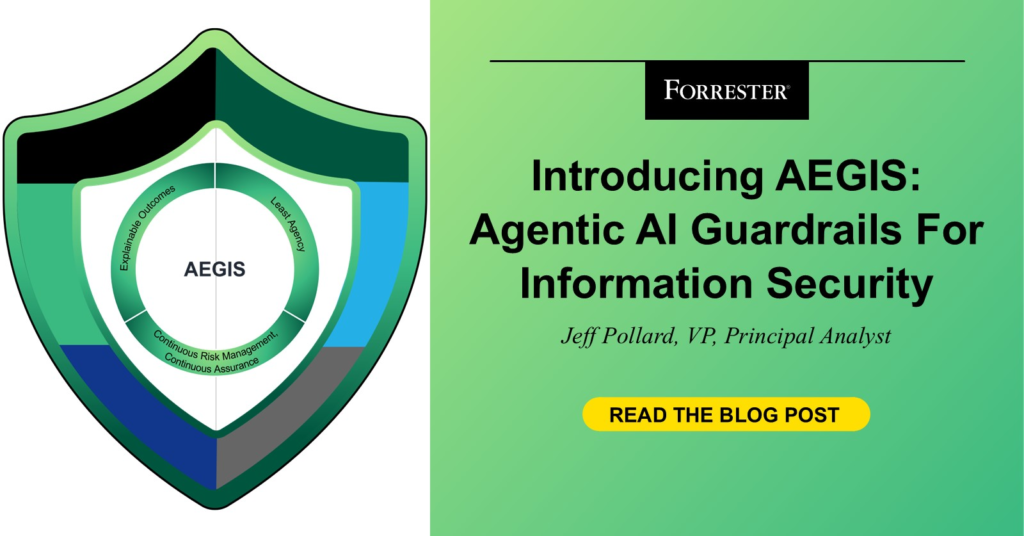
AI agents aren’t coming … they’re already here. And they’re not waiting for your security architecture to catch up. As enterprises race to deploy agentic AI, CISOs must pivot from securing systems to securing intent. That’s why Forrester built AEGIS. Forrester clients can read the full report, Introducing Forrester’s AEGIS Framework: Agentic AI Enterprise Guardrails For Information Security. Why AEGIS, And Why Now? Agentic AI is more than just another emerging tech trend. It represents a fundamental shift in how enterprises operate. These systems are distributed, autonomous, scalable, and designed to exhibit emergent behavior. They don’t just follow instructions; they adapt, plan, and act. Traditional cybersecurity models, built for human-centric systems, are ill-equipped to handle this. Agentic AI introduces: Emergent behavior that can bypass entitlements and escalate privileges. Cascading failures triggered by hallucinated or corrupted data. Obscured causal provenance, making post-incident forensics nearly impossible. Decision fatigue for humans in the loop, overwhelmed by agentic scale. CISOs must now secure intent, not just infrastructure. Cybersecurity Loses One Of Its Biggest Luxuries Cybersecurity (like IT), has a long history of blaming the user: “If only the user hadn’t clicked on the link, put in their password, or opened that PDF, then the breach wouldn’t have happened.” Now that the agentic enterprise is here, cybersecurity pros, ironically, are about to discover that user behavior was one of their biggest luxuries. Here’s why: Users are predictable. Willpower is finite. Agents are relentless. Willpower is infinite. People want to do their job. If they encounter resistance, they might try a few different ways to get things done (hence the birth of shadow IT and BYOAI), but there’s a limit to their motivation and, most importantly, their ability. If they don’t succeed, they’ll escalate, call the helpdesk, or give up. Kiss that luxury goodbye, because agents are code. Agentic systems take this to another level because they are programmed to overcome obstacles and exhibit emergent behavior by design. Agent ability increases with each action. Soon, CISOs will opine about the “good ol’ days” when all we had to worry about was a user in finance opening every email no matter how suspicious; that was so much easier than dealing with thousands of ephemeral agents completing tasks autonomously. What Is AEGIS? AEGIS — Agentic AI Guardrails For Information Security — is Forrester’s six-domain framework designed to help CISOs secure, govern, and manage AI agents and agentic infrastructure. The six AEGIS domains are: Governance, risk, and compliance (GRC) Identity and access management (IAM) Data security and privacy Application security Threat management Zero Trust architecture Each domain is built to evolve with the technology, not lag behind it. AEGIS introduces principles such as least agency, continuous assurance, and explainable outcomes to help security leaders adapt to this new paradigm. How To Get Started AEGIS includes a phased implementation roadmap, because this isn’t an overnight uplift. It is, however, an urgent one. Organizations still struggling with securing generative AI will find that AI agents are on their way. CISOs have to act now. AEGIS recommends that security leaders: Start with GRC. Leverage minimal tech for maximum impact. Establish governance, build inventory systems, and define acceptable use. Build IAM and data security. Treat agents as a new identity class. Secure data provenance, memory, and enclaves. Advance to DevSecOps and threat management. Secure the agent lifecycle, detect hallucinations, and deploy circuit breakers. Optimize with Zero Trust principles. Enforce least agency, monitor emergent behavior, and isolate rogue agents. Each domain builds on the last to accelerate your readiness. Why This Matters Agentic AI changes the game: Intent becomes your biggest challenge. Emergent behavior becomes a new threat vector. CISOs become the new architects of trust. Security leaders must shift from “block or allow” to “probability of success,” and CISOs need to realize that challenges also create opportunities. AEGIS equips them to lead with confidence, not caution. Forrester clients can read the full report. — Attend our Security & Risk Summit, November 5–7, in Austin, Texas, to learn more about how security will be transformed by AI agents and agentic AI in two keynotes. The first will be led by Allie Mellen, titled The Security Singularity and covering how AI will transform the way that attackers and defenders operate. The second keynote, which I’ll deliver with my colleague Jess Burn, is called The CISO Of The Agentic Future; we’ll discuss how AI agents will transform your security program. To discuss the report in detail and strategize on how to make the best use of our new framework, Forrester clients can set up a guidance session or inquiry with me. source

Introducing AEGIS – The Guardrails CISOs Need For The Agentic Enterprise Read More »