Are We Too Scared To Fly?
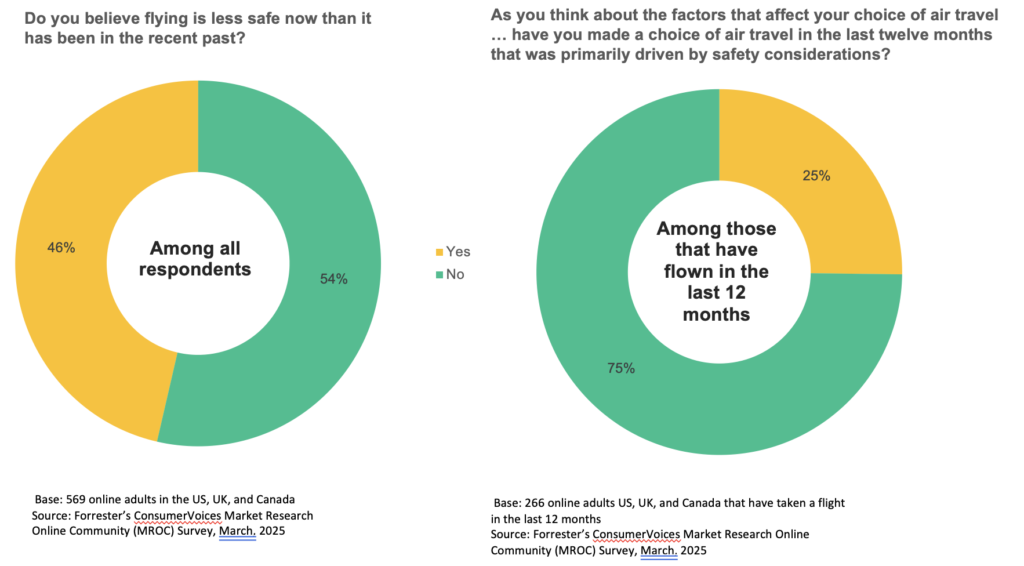
46% of consumers believe air travel is less safe now but only 25% of flyers are making safety-based decisions source
Are We Too Scared To Fly? Read More »

46% of consumers believe air travel is less safe now but only 25% of flyers are making safety-based decisions source
Are We Too Scared To Fly? Read More »

Celebrating Excellence: The 2025 Enterprise Architecture Awards Forrester is thrilled to announce the opening of nominations for the 2025 global Enterprise Architecture Awards. In partnership with The Open Group, this year’s awards will again celebrate exceptional enterprise architecture (EA) practices that drive business transformation, enhance risk management, and improve customer experiences. As we embark on a new year of technological advancements, the importance of enterprise architecture in shaping organizational success has never been clearer. The awards recognize organizations that demonstrate how their EA frameworks have helped navigate challenges and fueled innovation. The EA Awards are part of Forrester’s global Technology Awards, which spotlight organizations pushing the boundaries of technology to drive business growth, and remain one of the key accolades in enterprise architecture. A Prestigious Legacy Of Excellence The Enterprise Architecture Awards have been an integral part of Forrester’s awards program since 2010. Last year’s winners, including Scotiabank in North America, DRÄXLMAIER Group in EMEA, and Contact Energy in APAC, demonstrated the depth of impact that a strong EA practice can have on an organization. These organizations were recognized for their ability to use EA to streamline operations, improve agility, reduce costs, and enhance customer and employee experiences. They exemplify the core pillars of successful enterprise architecture: accountability, collaboration, agility, and innovation. As we move forward into 2025, we continue to see a shift in the role of EA from a disengaged ivory tower to a hands-on, outcome-driven practice. In an era of rapid technological evolution, organizations with strong EA capabilities can better align their IT strategies with business objectives, empowering them to stay ahead of the curve. The Award Categories The 2025 Enterprise Architecture Awards will focus on the following criteria: Risk management: how effectively the EA practice manages and mitigates organizational risks, ensuring business continuity and compliance Cost efficiency: the impact of EA in driving operational savings, reducing waste, and maximizing resource allocation Customer experience and employee experience: the role of EA in improving both customer-facing services and internal organizational operations Business transformation: demonstrating how EA has supported the transformation of business models, technologies, and organizational processes to achieve measurable outcomes The awards will also feature special categories for innovations in generative AI and platform engineering, which are becoming increasingly vital in modern enterprise architectures. Last Year’s Winners In 2024, Forrester, in collaboration with The Open Group, recognized outstanding EA practices in three global regions. For example, Scotiabank in North America earned accolades for its use of EA to support its digital transformation, aligning its architecture with business goals to streamline operations and reduce costs. The DRÄXLMAIER Group in EMEA stood out for its commitment to agile, accountable, and influential EA practices, while Contact Energy in APAC demonstrated how EA can be a strategic enabler of both operational efficiency and business growth. Steve Nunn, president and CEO of The Open Group, shared his thoughts on the importance of EA, saying, “The importance of enterprise architecture is as great as it has ever been, so we are glad to be part of celebrating best practice in the discipline. We look forward to seeing the innovative entries submitted this year and rewarding the outstanding work being done.” Why Enter? Winning the Enterprise Architecture Award not only brings global recognition but also provides valuable exposure to peers, industry experts, and stakeholders. It’s a chance to highlight the hard work, innovation, and transformation driven by EA teams. The 2025 winners will set the standard for excellence in the discipline, showcasing the vital role of EA in modern business operations. For more information and to submit your nomination, visit Forrester’s Technology & Innovation Summit websites for your region. How To Apply Organizations worldwide that have demonstrated success in applying outcome-driven enterprise architecture are encouraged to submit their nominations. The awards are open to companies with 1,000 or more employees, and submissions will be evaluated across the North America; Europe, the Middle East, and Africa (EMEA); and Asia Pacific (APAC) regions. The nomination deadline for each region will be as follows: APAC. Organizations in APAC can visit here to apply for Forrester’s Technology Strategy Impact and Enterprise Architecture Awards, with a submission deadline of May 27, 2025. Award recipients will be announced prior to and honored at Forrester’s Technology & Innovation Summit APAC, being held in Sydney and digitally, August 19, 2025. EMEA. Organizations in EMEA can visit here to apply for Forrester’s Technology Strategy Impact and Enterprise Architecture Awards, with a submission deadline of July 16, 2025. Award recipients will be announced prior to and honored at Forrester’s Technology & Innovation Summit EMEA, being held in London and digitally, October 8–10, 2025. North America. Organizations in North America can visit here to apply for Forrester’s Technology Strategy Impact, Enterprise Architecture, and Data & AI Impact Awards, with a submission deadline of July 16, 2025. Award recipients will be announced prior to and honored at Forrester’s Technology & Innovation Summit North America, being held in Austin, Texas, and digitally, November 2–5, 2025. Winners will be announced at Forrester’s Technology & Innovation Summits in each region later in the year. We invite technology leaders, including chief information officers, enterprise architects, and chief technology officers, to submit their entries and share how their EA practices have contributed to their organizations’ success. Resources Learn more about Forrester’s 2025 Technology Awards program. Register to attend Forrester’s Technology & Innovation Summits this year in North America, EMEA, and APAC. About Forrester Forrester (Nasdaq: FORR) is one of the most influential research and advisory firms in the world. We empower leaders in technology, customer experience, digital, marketing, sales, and product functions to be bold at work and accelerate growth through customer obsession. Our unique research and continuous guidance model helps executives and their teams achieve their initiatives and outcomes faster and with confidence. To learn more, visit Forrester.com. source
Call For Entries: The 2025 Forrester Enterprise Architecture Awards Read More »

The AI Transformation In AP Our latest report, Top AI Use Cases For Accounts Payable Automation In 2025, delves into the transformative power of AI in accounts payable (AP), highlighting the most impactful use cases. It provides a sneak peek into the future of AP automation as AI is making waves across various AP processes, from invoice data capture to fraud management. Based on our research we identified six key areas where AI is delivering significant value for accounts payable: Invoice data capture. Traditional optical character recognition technologies are being outpaced by AI-driven solutions. Companies such as Billerud and Adyen have seen remarkable improvements in accuracy and cost reduction by leveraging AI for invoice data capture. Invoice matching. AI models, particularly ML and robotic process automation, are revolutionizing invoice matching. These technologies handle complex multiway matching and reduce repetitive tasks, ensuring greater efficiency and accuracy. Reporting and dashboarding. Predictive analytics and generative AI (genAI) are providing real-time financial insights and visualizations. Companies like GameStop are using these technologies to benchmark their AP workflows and achieve significant efficiencies. Fraud management. AI’s role in fraud detection is growing, with ML and genAI being used to identify noncompliant invoicing and suspicious activities. Solutions from Coupa and Serrala are helping companies save costs and enhance security. Payment management. AI technologies analyze historical payment behaviors to identify early payment discount opportunities. Predictive and prescriptive analytics from companies such as Vic.ai and SoftCo are optimizing payment processes and improving cash flow management. E-invoicing and tax compliance. AI is streamlining e-invoicing and tax compliance by automating tax code determination and eliminating repetitive tasks. Companies like Coupa and Basware are leading the way with innovative AI-based compliance solutions. Choose The Right AI Use Case Our report also features two insightful heatmaps that illustrate AI’s impact on AP automation. These heatmaps provide a clear visual representation of AI adoption and future investment priorities across various AP use cases, helping finance and technology leaders make informed decisions about their AI strategies. The future of AP is bright with AI at the helm. By adopting the right AI technologies, companies can achieve unprecedented efficiency, accuracy, and cost savings in their AP processes. Dive into our comprehensive report, Top AI Use Cases For Accounts Payable Automation In 2025, to explore these insights in detail and prepare your organization for the AI-driven future of finance. Forrester clients can schedule a guidance session and inquiry with me to discuss it more. source
Top AI Use Cases For Accounts Payable Automation In 2025 Read More »

Technology service spending will reach $2 trillion in 2028, rising 4.6% year over year globally, much faster than GDP growth. We recently analyzed the earnings of six technology service providers and surveyed over 2,300 enterprise service decision-makers (with both business and IT titles) from 11 countries around the world to find out what’s going on out there. We have done a three-part analysis of the state of technology services: 1) co-innovation services; 2) provider selection, pricing, and management; and 3) strategic partnerships. Here are some highlights: Strategic service providers must be co-innovation partners, not just job shops. The primary driver of change in services is co-innovation. In this model, providers share risk and are motivated to achieve specific outcomes. They help you coordinate internal stakeholders and orchestrate cloud, software, and AI ecosystem providers. At the heart of co-innovation partner relationships is trust, which, at 47%, is the most important factor in selecting a provider. Providers’ growth stems from demand for core transformations … The days of random projects that didn’t move the needle on business growth or profitability are over. After 15 years of projects, firms are consolidating into core systems and laying the software, data, and process groundwork for the next wave of growth. In a recent earnings call, Cognizant emphasized “large deals” (code word for transformation or outsourcing) driving “fourth-quarter bookings [increasing] 11% year over year.” … and for a new wave of AI business investment. Almost half of respondents we surveyed say that AI is the most important technology for third-party services help — internet of things came in a distant second at 9%. During a December 2024 earnings call, Accenture CEO Julie Sweet reported $1.2 billion in new AI bookings and went on to say, “Those who really want to go into AI are more prioritizing spending as opposed to spending more.” Firms want results — not just people — and they’re willing to pay to achieve it. The survey reveals how prominent performance-based pricing models have become as a way to achieve outcomes, motivate providers, and share risk. In 2024, 45% of services decision-makers expected to expand their use of performance-based pricing and 46% expected to increase fixed-price contracts. We expect providers to make more fixed-price bids as they build generative AI-powered delivery platforms that improve delivery speed, quality, and predictability. Providers respond by amping up asset-driven business models. Thirty-five percent of North American and 38% of Asia Pacific respondents see data, content, and software assets as key benefits to working with service providers. Interestingly, only 25% of European services decision-makers are focused on a provider’s assets. With genAI disrupting service delivery economics — more value at lower cost — it’s important that providers bring more assets and solutions to help enterprises gain an AI advantage. Manage Service Providers To Maximize The Value They Bring The survey provides solid benchmarks for effectively managing providers, including these best practices: Regularly meet with your providers. Fifty-two percent of service decision-makers hold quarterly or even monthly meetings with providers to plan the roadmap for the next phase of their projects. By maintaining open lines of communication between providers and employees, organizations establish an integration strategy that fosters collaboration and ensures a cohesive approach toward objectives. Track quality and financial metrics to assess provider engagement levels. Survey respondents report that their organizations monitor key metrics such as quality (54%), financial performance (48%), and end user experience (47%). Organizations should develop a repeatable scoring method based on these metrics as a best practice to align their organizational goals with their partner’s plan. Ensure that providers satisfy stakeholders. Forty-one percent of decision-makers assess providers’ engagement using senior stakeholder satisfaction. Involving stakeholders in the evaluation process provides diverse senior-level management perspectives and helps gather insight into their performance and partnership qualities. If you want to dig deeper into co-innovation to maximize the value of partners, please reach out to me by scheduling a guidance session or an inquiry via email: [email protected]. If you have an offering that moves the needle on co-innovation, performance-based pricing, AI-powered delivery, or ecosystem orchestration, please consider scheduling a briefing: [email protected]. source
The State Of Services, 2025: Co-Innovation And Performance Pricing Set The Bar Read More »
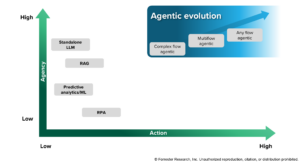
In the ever-evolving landscape of artificial intelligence, businesses are moving beyond traditional AI agents toward something far more transformative: agentic AI. Standalone foundation models (with retrieval-augmented generation [RAG] added) can assist with summarization and question-and-answer tasks, but agentic AI systems can go much further: They can plan, decide, and act autonomously, orchestrating complex workflows with minimal human intervention. They can also access a variety of tools to accomplish their work, which gives them the ability to reach into the digital and, eventually, the physical world. Agentic AI systems are poised to not only become the backbone of the knowledge economy but will completely redefine how organizations operate and compete. Our latest research explores what enterprises need to know about this shift and how to navigate the journey toward agentic AI. Agentic AI Potential Takes Enterprises Beyond Traditional AI And Automation Technologies Process automation tools, predictive analytics, standalone large language models, and RAG systems have delivered significant efficiency gains, but these technologies still require human oversight and structured input. Agentic AI moves beyond these constraints, enabling self-directed decision-making and execution. For enterprises seeking to harness AI’s full potential, understanding this transition is critical. Agentic AI is not just a step in the evolution of automation; it is a breakthrough capability that will become a competitive necessity. Early adopters will gain a substantial advantage — but success requires a strategic and experimental approach. We are still in the early stages of agentic AI’s market impact; companies must test, learn, and iterate because these powerful systems can be misaligned, creating actions that are at best undesirable and at worst harmful to your customers and critical applications. Preparing Your Organization For Agentic AI Success with leveraging agentic AI for AI-led transformation will depend on how leaders from various parts of the organization come together: CEOs must architect the autonomous enterprise. Business leaders must redesign operating models to fully leverage agentic AI as a differentiator for the company and empower employees and customers. This includes rethinking workflows, governance, and engagement strategies that go beyond simple process efficiency. Business leaders must prioritize high-impact use cases. Focus on applications with clear value, but don’t stop at ROI; think bigger about how agentic systems can help your firm grow while controlling costs at the same time. Whether it’s automating complex customer interactions or enhancing supply chain decision-making, start with well-defined objectives. Technology leaders must lay the foundation for process orchestration. Enterprises must build the right technology and infrastructure for agentic AI, including robust data pipelines, AI-driven insights, automation frameworks, and real-time decisioning engines. Take The Next Step The shift to agentic AI is already underway, and organizations that act now will shape the future. For a deeper dive into how agentic AI can revolutionize your business, access our comprehensive report and much more to come on this topic. Forrester clients can schedule an inquiry to dig deeper and learn how to implement agentic AI effectively and stay ahead in the AI revolution. source
Agentic AI Is The Next Competitive Frontier Read More »

The rapid shift to all-digital customer interactions during the COVID-19 pandemic drove considerable demand and innovation for high-fidelity digital-only identity verification (IDV) solutions that organizations could leverage to confirm an individual’s identity and eligibility for certain services. These IDV solutions often rely on the rich functionality available on mobile devices to conduct tasks such as facial recognition, liveness detection, data extraction from an identity document, and scanning of an identity document. These solutions have become a key aspect of many organizations’ digital interactions, helping to reduce fraud and data losses without impairing the user experience. With online identity verification well understood and maturing, the next brewing verification battle is around age verification, a subset of identity verification. Age verification is needed to enable a range of digital activities such as purchasing age-restricted products (such as alcohol), determining if someone meets an age minimum for using a service, or flagging if a user is subject to additional children’s privacy protection laws. The challenge is that not all minors possess an acceptable form of identity (such as a driver’s license or passport) to complete an age verification process successfully. In response, providers offer a mishmash of ineffective age verification mechanisms, including: Self-asserted consent. This approach relies on the user to enter the birth date. This is an honor system and generally used for giving consent to enter a site and browse content (such as a tobacco or alcohol product site) and not necessarily for purchasing items. Consent-based functionality. This model asks other individuals to confirm an individual’s age. Meta introduced this approach several years ago. Facial-recognition age estimation. This is an emerging method that leverages AI to determine an individual’s age based on a selfie. This approach provides an age estimate. National And State Regulations Are Increasing Given concerns around minors accessing inappropriate content or services, regulators have introduced different regulations to govern minors’ access to digital content. In the US, the Children’s Online Privacy Protection Act (COPPA) was passed in 2000. COPPA requires parental-consent online operators for collecting or using personal data for any child under 13 years of age. COPPA also provides penalties for noncompliance. While COPPA is more than 20 years old, it has not eliminated controversies around age verification. Last year, the Senate passed two similarly controversial updates to COPPA, the Kids Online Safety Act and COPPA 2.0, but the bills stalled in the House of Representatives. In the UK, the Online Safety Act was passed in 2023 and introduced similar requirements around age verification. The EU’s GDPR also has certain provisions around consent for children between ages 13 and 16. Australia also recently passed a similar age verification law. Despite these regulations, governments are still concerned about enforcing age verification and consent for minors. In the US, several states have now introduced legislation that would require app-store operators (namely, Apple and Google) to conduct age verification and, if necessary, require parental consent before users can download a new app from their respective app stores. Last week, Utah passed such a law requiring app store owners to conduct age verification. Utah’s law awaits the governor’s signature and, if approved, would go into effect on May 7. Enforcement Challenges Remain Unanswered While there is broad consensus on the importance and need for age verification, there is much less consensus on who is best positioned to conduct that verification. These latest state legislative efforts in the US aim to put the onus on app-store operators, arguing that they are already collecting user information and are best positioned to verify age. Apple and Google have resisted prior attempts, claiming privacy concerns about collecting this information. But in the last few weeks, both Apple and Google have announced efforts aimed at addressing these age verification challenges. First, Google announced plans to test the use of AI to determine users’ ages. And last week, Apple announced a series of capabilities to protect minors, including age assurance. Apple’s white paper outlined a new Declared Age Range API as a tool to assist app developers by sharing an age range but only when parental consent is given. This is a privacy-centric approach that minimizes users having to share specific information but also places the burden on obtaining a specific age on the individual app developer and not the app-store provider. Apple also announced updated age ratings for apps that will come into effect later this year. Given the ongoing immaturity of the technologies involved in age verification and the growing regulatory initiatives, app developers and privacy leaders at B2C firms will need to pay close attention to this space in 2025 and beyond to avoid potential privacy or compliance violations, both of which could affect customer loyalty and retention. Expect IDV vendors to add to or enhance existing age verification capabilities to meet the growing demand for age verification solutions. Special thanks to Senior Analyst Stephanie Liu, who provided some additional input for this blog. source
The Brewing Battle For Digital Online Age Verification Read More »

AI’s Escalating Demands On Data Centers Rapidly progressing AI initiatives coupled with new sustainability regulations have sparked increasing demand for computing power, distribution, and technology capabilities in data centers. Tech leaders are addressing these computing power demands by turning to advancements such as new cooling methods, semiconductors, power sources, digital twins, and internet-of-things (IoT) monitoring capabilities. In light of these advancements and increasing demand from data centers, tech leaders are reassessing their data centers and looking to implement innovative approaches to meet power demands and sustainability goals. The Transformative Potential Of Microgrids One innovation gaining momentum to address increasing data center energy demands is the emergence of microgrids. Microgrids are local power systems that use renewable energy integration to allow for reliable and resilient energy operations. Accordingly, this allows organizations to meet their sustainability goals and can help reduce energy costs. Optimized energy utilization: Microgrids facilitate the integration of various distributed energy resources (DERs) — e.g., solar, wind, and combined heat and power systems — to optimize clean energy supply, distribution, and efficiency, as well as reduce energy waste. Since microgrids are localized, they ensure that generated energy is utilized more efficiently, along with reducing transmission and distribution losses that are inevitable in traditional energy systems. Sustainability and cost-savings: Through the integration of DERs, microgrids lower reliance on fossil fuels and decrease greenhouse gas emissions, ultimately contributing to sustainable energy goals. Additionally, harnessing the use of renewable energy sources can help reduce energy costs by avoiding peak electricity prices and lowering the constant dependency on the traditional power grid. Enhanced reliability: Microgrids can operate both with the main data center power grid and autonomously, which enhances reliability by reducing the risk of outages and ensuring uninterrupted operations. The ability for microgrids to act autonomously allows for maintenance of continuous power to the localized area in the event of an outage, such as natural disasters or cyber attacks. This is critical infrastructure for services that require uninterrupted power supply. Microgrids have already been adopted by numerous organizations, including The Home Depot, JFK Airport, Southern California Gas Company, Kaiser Permanente Richmond Medical Center, and the University of California San Diego, all of which are paving the way toward a more sustainable and resilient energy future. This Is Just The Start The implementation of microgrids is one innovation that organizations are turning toward to meet power demands, improve resiliency, and move closer to a more sustainable future. Alongside microgrids, we have identified and discussed nine additional emerging innovations in the data center in our new report, Top 10 Emerging Innovations In The Data Center, 2025. This report dives deeper into innovations in types of cooling methods, semiconductors, power sources, digital twins, and IoT monitoring to meet changes in power demands, cooling needs, sustainability reporting, technology capabilities, local regulations, and performance requirements. For in-depth insights into AI’s impact, data center trends, and sustainability strategies, Forrester clients can access our exclusive reports and set up guidance sessions to continue to explore current trends and solutions. source
Microgrids & Data Centers: A Sustainable Power Duo Read More »

Late last year, my colleagues and I authored a report on the future of AI computing titled Change The Interface; Change The World. We predicted how AI-powered interfaces and agents will change everyday life and work. This transformation has begun, and we can see its impact on IT operations. Agentic AI — AI systems capable of autonomous decision-making and adaptation — is leading this transformation. As vendors race to integrate AI-driven solutions, let’s explore how agentic AI is revolutionizing service management, why it matters now, and what the future holds for service management automation. The Power Of Agentic AI In Service Management Traditional IT support often relies on reactive approaches — waiting for an issue to arise before addressing it. This results in downtime, increased costs, and frustrated users. Agentic AI changes this by enabling autonomous issue resolution, bringing the benefits of AIOps and observability to all service delivery. These AI-driven systems continuously monitor IT environments, analyze patterns, and proactively resolve problems before they occur. For example, AI-powered service desks can diagnose system errors, apply fixes, and learn from past incidents to improve problem-solving capabilities. This automation significantly reduces the need for human intervention, allowing IT teams to focus on higher-value tasks and projects. Faster response times, improved system uptime, and cost savings make agentic AI an essential component of adaptive and resilient service management. Beyond troubleshooting, agentic AI also enhances service management through intelligent automation of workflows. Tasks such as software provisioning, access management, and service request fulfillment can be assembled and executed autonomously, minimizing bottlenecks and improving operational efficiency. With AI at the helm, service management is shifting from a reactive to a proactive and self-sustaining model. Enhancing User Experiences Service management isn’t just about keeping IT systems running — it’s also about optimizing user experiences. Agentic AI is playing a pivotal role in transforming service management by personalizing interactions and automating repetitive processes. One of the most impactful applications is in employee onboarding. New hires often face delays in accessing necessary systems, leading to productivity losses. AI-driven automation streamlines this process by handling paperwork, granting system access, and ensuring that compliance requirements are met without manual intervention. This reduces onboarding time from days to hours, allowing employees to be productive from day one. Beyond onboarding, AI-powered service desks analyze user behavior to deliver personalized support. By understanding patterns in service requests and user preferences, AI can provide tailored solutions, anticipate needs, and enhance overall engagement. Whether it’s an IT support chatbot that instantly resolves queries or an AI-driven recommendation system that proactively suggests best practices, agentic AI ensures a seamless and efficient user experience. As organizations increasingly prioritize digital transformation, AI agents are becoming a strategic necessity. Automating HR, finance, and customer service processes through agentic AI reduces operational overhead and enhances overall business agility. The Competitive Landscape: AI Acquisitions And Future Trends With the undeniable potential of agentic AI in service management, major players in the tech industry are racing to build and acquire AI-driven capabilities. For example, ServiceNow has invested about $3 billion in AI startups alone (Moveworks and Cuein) to layer their reasoning systems into its platforms. These acquisitions complement ServiceNow’s already significant investments into AI agents and its own self-developed agentic capabilities. This significant monetary commitment signals a larger industry shift toward AI-first service management strategies. Further evidence comes from investments into data layers and knowledge graphs. Vendors such as Atlassian and ServiceNow have been investing in integrated, “AI-understandable” data layers to ensure that their AI’s decision-making can bridge multiple technology ecosystems through their respective teamwork graph and Workflow Data Fabric. “Good” (complete and accurate) data is essential for good agentic systems. The future of service management will be defined by AI systems that can intuitively automate tasks and continuously learn, adapt, and improve. Additionally, AI-driven predictive analytics will enable IT teams to prevent outages and security threats before they happen, further improving service reliability. Organizations that invest in agentic AI today will gain a significant advantage in efficiency, cost savings, and user satisfaction. As AI technology evolves, businesses that fail to adapt risk falling behind in the rapidly accelerating service management race. IT operations has struggled in the past to fully embrace automation. Agentic AI makes automation seamless and easier to adopt. The Agentic AI Race Is On The service management landscape is no longer just about automation — it’s about intelligence, adaptability, and autonomy. Agentic AI is pushing the boundaries of what’s possible in service management, enabling businesses to operate with unprecedented efficiency. From proactive issue resolution to personalized user experiences, the race to AI-driven service management is in full swing. Companies that embrace this transformation will be at the forefront of innovation, while those that hesitate risk being left behind. The question is no longer whether AI will dominate service management but how quickly organizations can implement and leverage its full potential. The race has begun — is your organization ready? Let’s Connect Have questions? That’s fantastic. Let’s connect and continue the conversation! Please reach out to me through social media or request a guidance session. Follow my blogs and research at Forrester.com. source
Let The Service Management Agentic AI Race Begin Read More »

Last week, we published two data snapshot reports from Forrester’s State Of Customer Engagement Survey, 2024. Focused on US-based respondents at B2B firms that primarily sell software, these short reports give a bit of a unique look into the more sophisticated side of customer engagement. They highlight some generative AI (genAI) findings, technology usage, and a (possible?) connection between the two that I’d like to begin exploring in this post. Customer Success Respondents Appear A Bit Less Bullish About GenAI While most respondents generally agree that genAI stands to have a significant impact on their team’s future, there was a curious difference between responses from customer success compared to customer marketing and B2B customer experience. Almost all (95%) of customer marketers expect short-term impact, followed closely by 85% of customer experience respondents. Customer success (CS) respondents, however, responded a bit less enthusiastically, with 77% agreeing that it will impact them significantly. This trend continues when we asked whether these postsale pros use genAI today in their daily work: An almost identical percentage of customer experience (92%) and customer marketing (91%) say they use genAI everyday. CS respondents, while showing a high overall degree of daily use at 85%, are not quite in the same place as their customer engagement counterparts. Does Technology Use Indicate A Lack Of CS Familiarity With AI/GenAI Solutions? While CS respondents use a blend of general-purpose and CS-specific technologies, a quick look at the data shows technologies commonly used by more than one function group near the top and those in a dedicated-use group closer to the bottom. Customer success platforms (dedicated), for example, rank only third on the list. More interestingly, standalone generative AI and sales/conversational intelligence rank in the bottom five, each earning only single-digit percentages. This is surprising, since Forrester expects genAI-dominant technologies to play more prominent roles in customer-facing strategy and use. Is It Time For CS To Step Up Its GenAI Game? While the sample size is insufficient to show a statistically valid correlation, juxtaposing the 27% of CS respondents who don’t think genAI will impact their function against the relatively low reported use percentages of conversational intelligence, standalone genAI, and other AI-heavy technologies such as journey mapping and journey orchestration leads me to wonder: Are CS teams less excited about genAI because they have yet to adopt it in ways that could show them its full potential? In the coming months, I plan to investigate both popular and leading-edge uses of genAI in customer success and other postsale engagement activities to learn whether more CS-specific tech would help speed adoption — or it could be a case of the tech being available, but promoting its use to postsale business functions is not a high priority for the vendors just yet. Feel free to reach out if you see this as a missed opportunity (or not) to help enhance the postsale B2B customer experience with the efficiency gains and personalization that genAI promises the market. source
Is Customer Success Paying Enough Attention to GenAI Today? Read More »

In the rapidly evolving landscape of software development, one month can be enough to create a trend that makes big waves. In fact, only a month ago, Andrej Karpathy, a former head of AI at Tesla and an ex-researcher at OpenAI, defined “vibe coding” in a social media post. This approach to software development uses large language models (LLMs) to prioritize the developer’s vision and user experience, moving away from conventional coding practices. The code no longer matters. Vibe coding is less about writing code in the conventional sense and more about making the right requests to generative AI (aka a Forrester coding TuringBot) to produce the desired outcome based on the developer’s “vibe” or intuition about how the application should look, feel, and behave. The Future Of Software Development Is Already Here As cited in a YouTube video from Y Combinator (YC) titled “Vibe coding is the future,” a quarter of startups in YC’s current cohort have codebases that are almost entirely AI-generated (85% or more). The essence of vibe coding lies in its departure from meticulously reviewing TuringBot LLMs’ suggested code line by line. Instead, developers quickly accept the AI-generated code. And if something doesn’t work or fails to compile, they simply ask the LLM to regenerate it or fix the errors by prompting them back into the system. This method has gained traction for several reasons, notably the significant improvements in integrated development environments and agent platforms such as Cursor and Windsurf; voice-to-text tools like Superwhisper; and LLMs such as Claude 3.7 Sonnet. These advancements have made AI-generated code more reliable, efficient, and, importantly, more intuitive to use, keeping developers’ hands off the keyboard and eyes on the bigger picture. The viral reaction to Karpathy’s concept of vibe coding, with close to 4 million instant views and countless developers identifying with the practice, underscores a broader shift in the software development paradigm. This shift aligns with Forrester’s insights on TuringBots, which predicted a surge in productivity through AI by 2028. The reality is outpacing expectations, however, with significant impacts occurring much sooner. Vibe coding won’t fade away. The Role Of The Software Developer Will Bifurcate The advent of vibe coding and the proliferation of TuringBots are creating two distinct types of developers. On one side, developers will transform into product engineers who, while perhaps adept at traditional coding, excel in utilizing generative AI (genAI) tools to produce “apparently working” software based on domain expertise and some knowledge on the steps and tools needed to build software. These developers focus on the outcome, continuously prompting AI to generate code and assessing its functionality with no understanding of the underlying technology and code. The philosophy is to just keep accepting code until it does what you want. Not only that, but they don’t spend hours fixing a bug or finding the problem, since they can ask a well-trained coder TuringBot to do that for them or can just ask it to roll back and regenerate the code again. This approach may challenge our classical view of computer science skills, suggesting a shift toward developers who are more orchestrators of software development process steps than coding craftsmen. The concern of how we’ll develop good developers over the years is gone, because you’ll trust AI to do a good job. And if you want good developers, genAI will help those on the development trajectory learn faster. On the other side of the spectrum are the high-coding architects. These individuals possess a deep understanding of coding principles and are essential for ensuring that software meets crucial service-level agreements such as security, integration, and performance before deployment. It’s kind of what good developers do today. Their role becomes increasingly critical as the reliability and complexity of AI-generated code grows. For only the super-critical IT capabilities, most likely for back-end code, these high-coding capable architects need to write, review, and edit code while also making sure that the TuringBots have all the context they need to do a better job. A Bigger Role For Testing And Testers As AI-generated code becomes more trusted, the barrier to entry for software development lowers, giving rise to a growing population of vibe-coding developers. These individuals use natural language, not as a specification language but as the only interface to generate substantial portions of code and entire applications. As a result, high coding democratizes software development, just as low-code did for businesspeople. As I’ve always recommended for TuringBots, testing should once more be relaunched as a key validation step. For building a weekend project or a product demo to get funding, vibe coding would work just fine, but it requires more scrutiny for being adopted by enterprises and mature product vendors. In fact, this approach necessitates a reassessment of testing and quality assurance processes for everything that comes out of vibe coding. Organizations must place a greater emphasis on end-to-end functional testing, which, ironically, can also be facilitated by LLMs at the request of the product engineers. In fact, product engineers and/or testers could just ask the LLM to both generate and execute the end-to-end tests for them. Some Critical Questions Remain Unanswered Looking at AI-enabled software development through a traditional lens and for enterprise use highlights significant risks. Is it wise to deploy unreviewed (and, at best, automatically tested) code directly into production? As AI improves, many of these concerns may diminish, but here are some critical considerations: Debugging versus coding. Developers may find themselves spending more time debugging code when genAI fails to resolve errors. This emphasizes the continued need for strong developer skills (but, I’d add, less than what we’ve traditionally needed). Yet the ratio between coding and debugging time inverts. Energy consumption. Does the obsessive generation and regeneration of code via LLMs lead to higher energy use compared to structured software development lifecycle (SDLC) methods? Accurate cost assessments are yet to be conducted. Application complexity. Vibe coding currently seems to work for front-end development because LLMs have a lot of front-end code to be