Forrester

When Buzzwords Collide: From A(I) To Z(ero Trust)

One of the perils of covering technology in general, and cybersecurity in particular, is separating hype from reality. Zero Trust is nearly 15 years old (it’s hard to believe it will soon be old enough to drive). In that time, it has become the dominant cybersecurity model, even if idealized implementations remain aspirational for many organizations. It has also become another term in a long list of buzzwords masquerading as cybersecurity’s long sought-after silver bullet. AI is much younger but if the optimists — and the hype — are to be believed, it shows as much or more promise to revolutionize cybersecurity than Zero Trust ever did. But there is also skepticism and confusion that lead to natural questions about what AI actually can do, as well as what it realistically should do. But those questions don’t appear to be much of a barrier. In fact, 43% of organizations reported at least one genAI production use case for the IT function and, of those, 41% reported full production — as opposed to a limited rollout or alpha launch — for “identifying and mitigating security and compliance risks” in Forrester’s State Of AI Survey, 2025. With that kind of uptake, it is impossible not to think about how AI will impact Zero Trust — it’s also fraught. According to Forrester’s Security Survey, 2025, one-third of organizations are still struggling with how to leverage their existing technology to advance their Zero Trust initiatives, let alone incorporate emerging technologies. In that same survey, more than a quarter of organizations also reported a lack of technical skills causing delays or disruptions. GenAI Is An Assistant On The Zero Trust Journey In the short term, genAI is well positioned to help bridge at least some of the gaps in technology and technical skills. Both general-purpose AI services such as ChatGPT, Claude, and Gemini as well as vendor-specific models will play a role in driving Zero Trust adoption and maturity, because organizations can use them to: Translate natural language into configurations. Like many areas of technology, making an implementation match the letter and spirit of the requirements can be a challenge. LLM-based tools provide a convenient mechanism for practitioners to convert written policies into the policies and configurations required by the various components in a Zero Trust architecture. Think of the difference in the “expressiveness” of high-level programming languages such as Python and low-level languages like Assembly or C/C++. LLMs provide a way to define the desired outcome or end state of a policy or configuration without requiring an architect or engineer to commit esoteric command line arguments to memory — and then correctly type them. Translate configurations between different systems. Many reference architectures depict the policy decision point (PDP) as a monolith, but that is almost never the reality. GenAI tools can streamline the process of converting configurations and policies from one platform or system to an equivalent on a different platform or system. Leveraging AI tools in this way ensures that — in the absence of a single authoritative source — disparate PDPs will produce consistent authorization decisions. Apply best practices and identify areas that require attention. Historically, the extent to which vendors have codified and presented best practices has varied widely. The result has been that practitioners may or may not implement those practices and, more significantly, may not really know whether they have done so or what the gaps are. Vendor-specific models provide an interface to an interactive body of knowledge that enables practitioners to implement and maintain their deployments more easily: they take the concepts of “configuration wizard” and “health check” to an entirely new level. Use natural language for reporting and auditing. Security tools are notorious for each having their own domain-specific languages (DSLs) to query data in the system. As vendors increasingly include chatbots in their management consoles, operators will be able to access the information they need more quickly and easily without the idiosyncrasies of DSLs or overlaying other reporting tools. AI Agents Will Become The “Officers” Of Policy Enforcement In the longer term, AI agents can help resolve one of the biggest issues in Zero Trust policy enforcement. Today, most authorization decisions are made and reevaluated at specific intervals: An entity authenticates, some attributes are evaluated, access is granted, a timer starts, and when it expires, the process begins again. But the real promise of Zero Trust is a continuous feedback loop. As AI agents become more widely deployed and capable, they will be able to tighten that feedback loop because: AI agents will be able to communicate with a wide range of systems. Anthropic’s Model Context Protocol (MCP) enables agents to communicate with different data sources. Google’s Agent2Agent (A2A) protocol provides a standardized interface for agents to communicate with each other. These communication paths will make gathering and updating context — like the attributes used in authorization decisions — a much easier proposition than the existing approaches to Zero Trust system integration. AI agents will be able to “see something, do something.” The benefits of MCP and A2A don’t stop at enrichment. These interfaces also provide a mechanism for agents to act. Rather than the current model of reevaluating authorization at set intervals and rendering a binary (allow/deny) decision, AI agents will be able to make provisional judgements about access and continuously monitor and update access in close to real time. Dive Deeper At The Security & Risk Summit There is a lot to unpack in both AI and Zero Trust. And there is still more to unpack when it comes to using AI for Zero Trust. That’s why I hope you’ll join me and my Forrester colleagues in Austin, Texas, on November 5–7 for the Forrester Security & Risk Summit. I’ll be presenting a session titled, “The Role Of AI In Zero Trust Architectures” as part of the Zero Trust, data, and cloud track. The rest of the agenda is full of keynotes, breakouts, workshops, roundtables, and special programs to help you master risk and conquer

When Buzzwords Collide: From A(I) To Z(ero Trust) Read More »

Partner for Progress: Security And HR Must Team Up For Insider Risk Management

Managing insider risk is a challenge for many reasons, one of the largest being that it’s a very human problem. Security pros are accustomed to dealing with cybersecurity threats, most of which are technical in nature, even if they resulted from a human-element breach. Forrester data shows that 22% of data breaches are the result of insider incidents. Those incidents can be broken down into three broad categories. Malicious insiders: purposeful acts committed by insiders to steal data, sabotage systems or infrastructure, or commit fraud Accidental insiders: accidental or negligent actions taken by insiders that result in data loss or harm to the organization Compromised accounts: external actors who have taken control of legitimate user credentials Identifying which of these occurred during an investigation is crucial to determining the next steps. Much of insider risk management (IRM), however, takes place well ahead of an incident. To make that happen, the IRM team must establish a strong working relationship with HR. Partnering For Progress And Innovation September is National Insider Threat Awareness Month, and this year’s theme is “Partnering For Progress.” Successful IRM requires a number of partnerships, but none is more important than the partnership with HR. Some IRM experts even advocate that IRM should report into HR. Much of IRM happens well before an insider incident occurs. HR helps IRM by: Conducting background checks and onboarding. Successful IRM starts before the user is hired. Providing user data to identify risky users. HR has critical information about users that can be used to identify those at high risk of causing an incident. Enabling user education and human risk management programs. Changing behavior and creating a positive security culture helps reduce insider risk. Supporting insider incident investigations. HR works with investigators during the response process to provide data and support — and follows up with outcomes after the investigation. Managing offboarding. Ensuring that an offboarding process exists and is rigidly followed, including revocation of access credentials, is critical to avoid incidents from insiders who have been terminated. Organizations that don’t believe they have an insider risk problem likely aren’t looking. After all, every insider — employee, contractor, vendor, or partner — carries a level of risk. That risk increases due to a variety of factors such as access to sensitive data or systems, disgruntlement, and intent to leave the organization. IRM teams and security pros can only get visibility to some of these by breaking down silos and partnering with HR. Connect With Us Jess Burn will join me in leading a session in the prevention, detection, and response track at this year’s Forrester Security & Risk Summit, taking place in Austin, Texas, from November 5–7. Our session is titled “Incident Response For Insider Threats,” in which we will provide guidance about insider incident response, including HR’s role. I’ll also be hosting a roundtable at the event called “Turning Insider Risk Inside Out: Protecting Against Insider Incidents.” We hope to see you there! Forrester clients can also request an inquiry or guidance session with Jess (incident response) or me (insider risk management) to dive further into these topics. source

Partner for Progress: Security And HR Must Team Up For Insider Risk Management Read More »

CX Cast Roundup, August 2025: Journey Innovation In Action

In August’s episodes of the Forrester CX Cast, we focused on how customer experience (CX) leaders can evolve their CX strategies by sparking innovation, scaling journey management, and aligning marketing with CX. Learn from practitioners and Forrester analysts. Episode 415: Journey Innovation Joana de Quintanilha joined Angelina Gennis and Martin Gill to unpack how journey innovation goes beyond fixing broken experiences. This episode is ideal for CX leaders looking to embed creativity into their strategy. Why listen: Understand what journey innovation really means — and why it’s more than just problem-solving. Learn how to balance short-term fixes with long-term innovation. Explore how AI and tech can fuel imaginative CX design. Get tips on making innovation a repeatable habit. Episode 416: Can Employees Keep Up With Customers’ Tech Expectations? J. P. Gownder introduced Forrester’s Technology Change Quotient (TCQ), a framework for assessing how ready your teams are to adapt to tech-driven change. Why listen: Discover how TCQ helps leaders guide change effectively. Hear strategies for bridging the gap between customer expectations and employee capabilities. Learn how CX pros can stay ahead of tech trends without overwhelming their teams. Read more in J. P.’s blog post and explore the TCQ assessment. Episode 417: Practitioner Stories — Scaling Journey Management At Grundfos Cecilie Kobbelgaard shared how Grundfos built a scalable journey management framework from the ground up. This episode is a must for CX practitioners navigating organizational complexity. Why listen: Learn how to build CX maturity across diverse business units. Hear how Cecilie’s team created a journey mapping “cookbook” and standardized practices. Understand how to measure progress and overcome internal resistance. Get inspired by a real-world example of CX transformation. Episode 418: How Accurate Marketing Management Improves Customer Experience Brad Haag joined Angelina to explore how marketing analytics can enhance CX. This episode is perfect for CX pros collaborating with marketing teams. Why listen: Discover how marketing measurement intersects with CX. Learn how marketing mix modeling has evolved — and what it means for customer impact. Understand how data science supports smarter, more customer-centric marketing. Gain insights into aligning marketing efforts with CX goals. source

CX Cast Roundup, August 2025: Journey Innovation In Action Read More »

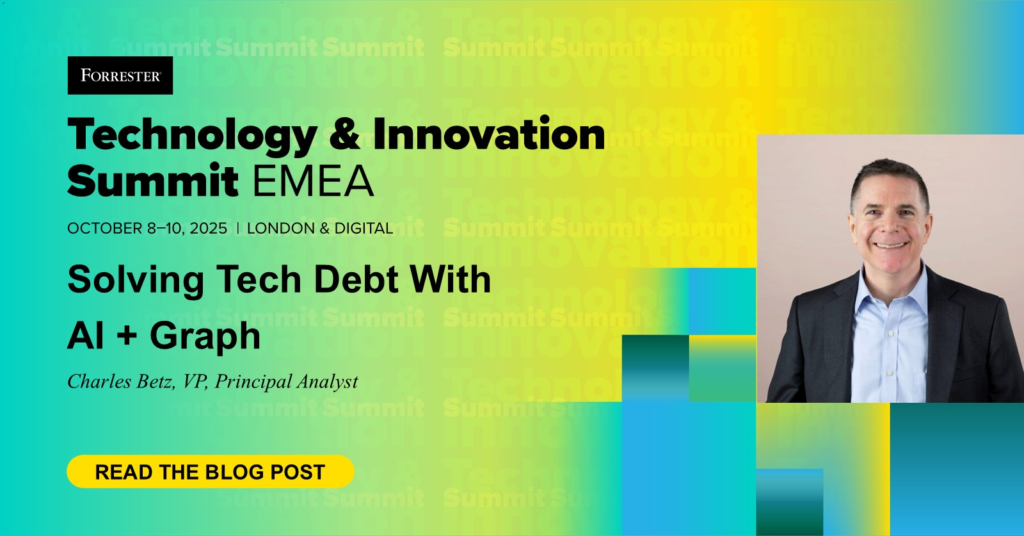
Solving Tech Debt With AI + Graph

This has been an extraordinary year for technology leaders, with a chaotic storm of technology change and global market volatility. I’ve been fortunate enough to travel around the world and speak to technology leaders in a variety of regions about the challenges they are facing. For example, last month I was in Sydney at Forrester’s Technology & Innovation Summit APAC and delivered a keynote on defining IT’s role in this new era which spurred a number of rich conversations with event attendees, partners, and clients in that region. And while there are certainly some region-specific challenges and nuances to contend with, I have identified four broader challenges which are converging this year to put more pressure on technology organizations and leaders: artificial intelligence, graph-based data management, IT management, and technical debt. Next month, at Forrester’s Technology And Innovation Summit EMEA in London, I’ll present a keynote that incorporates what I’ve been hearing and aligns these challenges in a unified and seamless story. For decades, IT has struggled with some persistent challenges. I’m talking about things like security, visibility, responsiveness, resilience, and perhaps most of all, technical debt — the ongoing decay and entropy of our systems. Today, as more new AI-driven technology enters the fray we face even more risk of redundancy, sprawl, and critical systems that no longer meet business needs but cannot simply be ripped and replaced. These are wicked problems. Yet I believe we are starting to see real progress in how we understand and manage them with some specific tools rising to help. Long Live Graphs Perhaps not surprisingly, AI is both part of the challenge and part of the solution. For starters, you have to remember that AI today is far more than just the large language models we all hear so much about. It also includes: retrieval-augmented generation (RAG) vector databases graph databases AI agents, which are the orchestration of all these ingredients into purposeful, goal-directed capabilities. But the graph, in particular, is really fascinating to me. Since publishing my blog The Graphical Future of IT Management earlier this year (my most-read post as a Forrester analyst), I’ve continued to reflect on its promise and discuss it with Forrester clients and colleagues. We’re now seeing IT management vendors — ServiceNow, Atlassian, Dynatrace, Datadog, Planview, and others — doubling down on managing, representing, and analyzing information as interconnected graphs. Increasingly, these vendors are also stitching their data together, forming what I believe is a powerful new substrate: a unified IT knowledge graph. This may be the true successor to the long-troubled configuration management database (CMDB). To put it plainly: CMDB is dead. Long live the IT knowledge graph. Seven Domains Of The IT Knowledge Graph Within this knowledge graph, we see seven critical domains converging to create a unified and interconnected framework. Each domain represents a vital aspect of modern organizational operations, and their integration unlocks new levels of efficiency, insight, and decision-making power. These domains include: Systems of work User experience IT operations & AIOps Core portfolio data Information security IT finance Data and knowledge representation itself These domains are becoming more coherent and interconnected. But the real question is: why connect them? Because integrated data creates real, actionable value. What kind of value? Well, earlier in this blog I talked about the growing tech debt challenge. I believe the first major proof point for graphs will come in the form of technical debt modeling — simulating technical debt, analyzing doom loops, and providing clear and reliable guidance to help organizations break out of destructive cycles before they compound into technical bankruptcy. Looking Ahead These are exciting times. The convergence of AI, graph data, and IT management gives us tools to address long-standing challenges in ways that were impossible just a few years ago. If you really want to dig into this, I hope you can join me at Forrester’s upcoming Technology & Innovation Summits in London October 8-10 and in Austin November 2-5, where you’ll get exposed to the latest leading-edge IT research from across our analyst teams on all of these topic. source

Solving Tech Debt With AI + Graph Read More »

Introducing The Experience Research Platforms Landscape, Q3 2025

I’ve previously discussed the idea that good research must be connected, continuous, and timely. To achieve this, researchers need strong partnerships with their stakeholders and access to the right resources, including the right research tools. Yet research teams often face roadblocks that prevent this from happening. Clients often tell me: “We don’t have access to our customers, and even if we did, we can’t bother them for each study.” “We conduct research, but we struggle to communicate it effectively to the broader organization.” “We need to do more qualitative research to understand our customers but don’t have time and resources.” If this sounds like your team or organization, it may be a time to pause and think whether your current research tools support your goals, as well as how using the right experience research platform (XRP) could make a difference. Forrester defines XRPs as: Platforms used by companies to collect qualitative data to weigh alongside quantitative data in the decision-making process when building products or services. What’s The Value Of An Experience Research Platform? XRPs help companies discover and define opportunities in a target market, test concepts and prototypes, and evaluate the user and customer experience of their products and services. XRPs do this by facilitating recruitment of customers and target audiences, offering moderated and unmoderated remote research methods to observe their behavior and collect feedback, and increasing speed to insights by providing powerful features for data analysis. They help you understand customers in depth, reduce risk in product and service decisions, and scale your experience research in your company. To choose the right experience research platform for your organization, you must understand your current and future research needs along with the current dynamics in the experience research market. My latest report, The Experience Research Platforms Landscape, Q3 2025, helps you understand the benefits you can expect from an XRP and decide the type of platform that’s right for your company. It includes a list of 16 notable vendors offering these platforms, the key use cases that these vendors support, and functionalities to look for when evaluating potential offerings. What’s Next For This Research? Next on my research agenda is a Forrester Wave™. This in-depth evaluation of the top XRP vendors will serve as a detailed guide for buyers considering their options. How Do I Get In Touch? If you’re a Forrester client, read my latest report, The Experience Research Platforms Landscape, Q3 2025. After you take a look, if you’d like to ask me questions or work through your buying decision, you can set up a conversation with me. You can also follow or connect with me on LinkedIn if you’d like. source

Introducing The Experience Research Platforms Landscape, Q3 2025 Read More »

Starbucks: One Year Later

On September 9, 2024, Brian Niccol took the helm of a beleaguered Starbucks as its CEO, amid much hope for a reversal of its flagging fortune. One year later, Starbucks is digging itself out of a hole, one pumpkin spice latte at a time. Here’s our take on Starbucks’ growth prognosis and strategy for 2025 and beyond: Foundational, Not Transformational A $35 billion company with over 40,000 stores does not get rebuilt in a year. Brian Niccol’s one-year tenure has been about laying the foundation and stabilizing the company, and the results are showing: Starbucks has returned to growth. Yet same-store sales are down, both globally and in the US (albeit not as dramatically as they had been in the last couple of years), indicating that Starbucks is not out of the woods yet. Headwinds Are Par For The Course As Niccol sets about transforming Starbucks, the business must contend with myriad headwinds such as tariff-related uncertainty, input cost increases, dampening consumer sentiment, unionization pressure, and Gaza-related boycotts, particularly in global markets. But these types of pressure are endemic in any business; the exact nature changes depending on the environment, and Niccol must take them in his stride. In any case, this is a time to sow — the benefits come later. This transformation, like any transformation of this scale, has resulted in significant margin compression, and today’s bottom line has rightly taken a back seat to the promise of future growth and profitability. The Experience Is Changing Niccol’s first strike has been at the heart of the operations, which has not only addressed cost and efficiency but also customer experience. A new Green Apron Service model focused on enhancing speed, accuracy, and operational fluidity is hitting its efficiency targets and cutting down on customer wait times. Starbucks is converting pickup-only stores to ones with a cafe experience and is testing a new prototype closer in spirit to the cozy community cafe. For now, this is all cost and effort and a burden on financials, but they will likely bear fruit in the second year of Niccol’s tenure. The New Product Portfolio Will Drive Profitable Growth One of Niccol’s primary efforts has been to shed complex and underperforming products that bog down the operational workflow, aggravate customers, and hurt revenue and margins. A leaner portfolio will make room for lean operations, a better experience, and improved financials. A leaner portfolio will also create space for smart innovation in high-margin, highly popular items like protein-based offerings, which will drive frequency and margin. Starbucks Needs To Figure Out What It Wants To Be Any transformation of this magnitude is also about transforming the character of a brand. Starbucks created a cafe culture with a veneer of affordable exclusivity and the promise of a “third place,” then eroded it with frenetic stores and serpentine drive-through lines. As Starbucks embarks upon yet another transformation, it must decide whether it can find a happy medium between a community cafe where, like in “Cheers,” everybody knows your name, with the frill-free efficiency of a Dunkin’. More importantly, is there a place on this spectrum that will deliver the requisite financial results to shareholders? It’s Only Been A Year, But It’s The Long Game That Matters Habits are hard to break, and customers broke their Starbucks habit. More than anything else, this undoing of habit spelled doom for Starbucks. It is no longer the routine first stop on the way to work. It isn’t where you hash out a presentation with your coworker. Your realtor doesn’t meet you there to discuss house comps. Habits are sticky because they are what Daniel Kahneman would call “fast thinking” — you skip the rational and go with the emotional. Starbucks needs to win back these habits, and doing that requires time and the determination to rebuild meaningful, differentiated, and credible equity. More Resources Learn more: The Starbucks growth strategy closely aligns with Forrester’s “five levers” framework for growth: salience, product, price, experience, and access. Follow my work: Go to my Forrester bio and click “Follow.” Chat with me: If you are a Forrester client interested in discussing these topics, please schedule time with me for an inquiry or a guidance session. Plan a session: If you are a Forrester client looking to host a growth strategy session, please contact your account team or email me at [email protected]. source

Starbucks: One Year Later Read More »

Partner Attribution Is Broken—Here’s Why B2B Executives Must Lead the Fix

In today’s B2B landscape, partner ecosystems are a strategic priority for driving growth, maintaining competitive advantage, and enabling innovation. Yet most B2B organizations still rely on outdated attribution models that obscure partner value, misguide investment, and impede future growth. My latest report, Plotting The Path For Partner Attribution, delivers a clear message to executive leaders: Attribution is broken in most B2B organizations, and it’s time to rethink how partner impact is measured. The Partner Attribution Problem Creates A Major Executive Blind Spot Legacy attribution models — especially those focused solely on sourced revenue — fail to capture the full spectrum of partner impact on the business. These models either oversimplify and/or completely ignore the broader partner contribution to the organization’s success. This leaves executives blind to the broader value and influence that partners have across the buyer’s journey and their strategic impact on growth and success. These blind spots in measurement undervalue strategic partnerships across the ecosystem, especially for nontransacting partners such as strategic alliances, technical partners, system integrators, and influencers. Successful Partner Ecosystem Strategy Depends On Precise Measurement As the report emphasizes, the future of partner ecosystem success hinges on our ability to measure fully what truly matters. Without accurate attribution, partner ecosystem strategies risk falling short. Organizations must evolve from: A distorted to an accurate vision of what really drives direct and indirect revenue and success. An incomplete to a holistic view of partner impact on business success. An underleveraged to a fully leveraged partner ecosystem. Poor to positive partner experience that builds loyalty and trust. Stalled or stagnant offerings to those driven by partner innovation and growth. Misdirected future decisions and investments to aligned investments for future growth and innovation. The Partner Attribution Path Forward Emphasizes Precision Over Tradition B2B suppliers should follow a four-step journey to achieve more precise, holistic partner attribution: Discover your organization’s partner ecosystem strategy, goals, and objectives. Define your various partner classifications (partner types/business models). Assign key values for each unique partner classification. Align metrics for partner values to quantify partner ecosystem attribution. What To Do Next Partner attribution is no longer a back-office concern — it’s a leadership mandate. CEOs, chief revenue/sales officers, CMOs, and partner ecosystem leaders must be armed with models that reflect reality, recognize and reward true impact, and fuel strategic growth. Those who embrace comprehensive partner contribution measurement will gain clearer insights, stronger partnerships, and a competitive edge in an increasingly interconnected market. To explore this leadership imperative in more detail, Forrester clients can read the full report and reach out to schedule a call for tailored advice on how to establish a more holistic contribution methodology for your partner ecosystem. source

Partner Attribution Is Broken—Here’s Why B2B Executives Must Lead the Fix Read More »

Three Takeaways From HubSpot's InBound 2025

Last week, I attended HubSpot’s INBOUND conference in San Francisco. Many recaps will focus on the product announcements, strategy, and feature releases, but what stood out to me were the broader themes woven through CEO Yamini Rangan’s keynote: AI, our jobs, the uncertainty many are feeling in this moment, the need to remain relevant, and the reminder that this isn’t just about human productivity but about human identity. Her keynote didn’t lean on hype (I’m looking at you, AI warriors in my LinkedIn feed). Instead, it centered on how humans and technology will work together, what the future of work will look like, and why customers expect outcomes, not just software. These themes shaped the conference and, more importantly, point to how companies should think about creating value going forward. Here are the three themes that stood out to me: AI isn’t just about productivity; it’s about identity. While AI was positioned as a great accelerant, the deeper tension was more personal: “If AI can do this, what’s left for me?” As Rangan reminded the audience, “humans lead — AI accelerates.” The challenge isn’t solely adoption; it’s helping people see where their creativity, judgment, and leadership remain essential. Hybrid work is the future. If AI accelerates, humans must define the direction. The future of work isn’t one or the other — it’s both. Machines will automate and support scale, but only people can provide vision, empathy, and decision-making. When we lead with these uniquely human strengths, AI becomes an amplifier, not a threat. Customers buy outcomes, not tools. The message was clear: Companies don’t just invest in another tool — they invest in results such as retention, growth, and efficiency. To compete, vendors must align across functions to deliver impact. The differentiator won’t be the software itself but the tangible value that it delivers to customers. INBOUND 2025 was more than a product showcase. It reflected both the possibilities and anxieties of the moment. As attendees return to their companies and customers this week, they must remember to treat AI as a partner and not a threat, step into the future of work with confidence, and keep customer outcomes at the center of strategy. That isn’t just the direction HubSpot is signaling — it is the direction that we must take to compete and grow. source

Three Takeaways From HubSpot's InBound 2025 Read More »

Your Postsale Customer Data Unwrapped

Every December, Spotify users go wild when the streaming service drops its annual Wrapped feature. It’s not just a recap of what you listened to: It’s a mirror of your preferences, moods, and moments. Spotify doesn’t just use this data for entertainment; it uses it to predict what you’ll love next, personalize your experience, and keep you coming back. (Shoutout to their AI-enabled DJ!) What if B2B companies did the same? They already have rich postsale data. They know what customers use, what they ignore, what drives outcomes, and what causes churn. But most of that data lives with CS teams that sit on goldmines of customer insights often overlooked by those in other functions, like marketing and sales, who are out chasing new business without the benefit of these insights. We’ve been thinking a lot about how postsale customer data is used for retention and expansion efforts, but it is underutilized in shaping how companies target, engage, and convert prospects earlier in the buyer’s journey. But what if these insights are the missing link in your demand strategy? Using these insights, frontline teams can: Refine ICPs with usage data. Your best-fit customers aren’t theoretical; they’re already using your product. By analyzing how they engage and where they find value, you can sharpen your targeting and prioritize prospects who look like your most successful customers. Improve messaging with onboarding feedback. Onboarding highlights customers’ needs, expectations, and the friction they experience in a critical phase of the lifecycle. Understanding where there might be misalignment and what drives value helps frontline teams better personalize outreach to support growth. Guide campaign strategy with advocacy signals. Your advocates are already telling you what works. Their stories, reviews, and referrals are rich with insights that can be used to build trust and create campaigns that reflect real customer outcomes. When marketing, sales, and CS teams each understand what success looks like for customers, they can work backwards to attract and convert the right prospects that are most likely to thrive and grow, and doing that starts by leveraging the wealth of insights you already have. To learn more about postsale insights, Forrester clients can read Activate Postsale Customer Insights To Win, Retain, And Grow Revenue Across The Opportunity Lifecycle. And if you are ready to dig in further, reach out to your account team to book guidance sessions with me or my colleague Nora Conklin. source

Your Postsale Customer Data Unwrapped Read More »

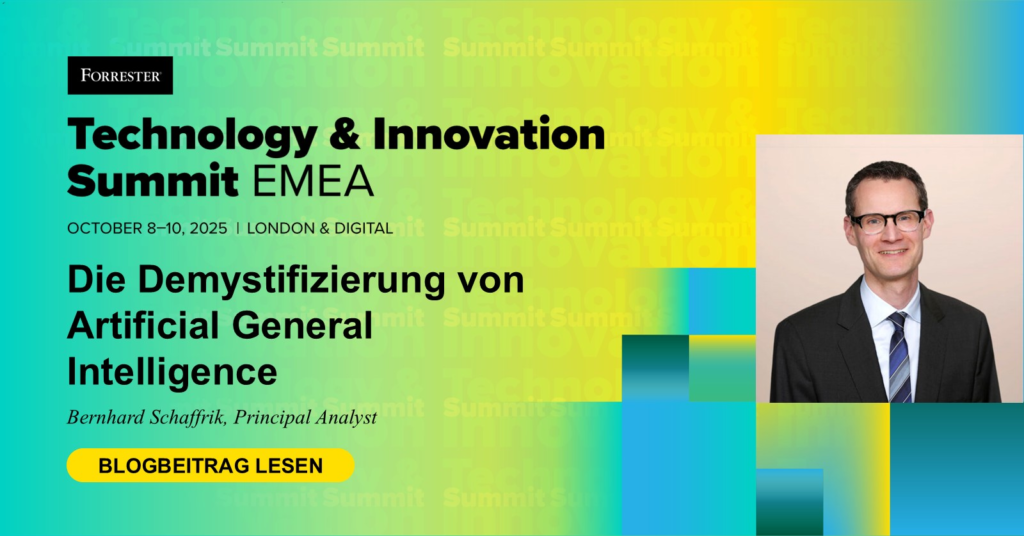
Die Demystifizierung von Artificial General Intelligence

Artificial General Intelligence (AGI) ist ein Konzept, das seit Jahrzehnten Faszination und Ängste auslöst. Aber erst seit nun viele Unternehmen damit begonnen haben, die Voraussetzungen für agentenbasierte KI zu schaffen oder ihre ersten KI-Agenten einsetzen, macht AGI wirklich Schlagzeilen und sorgt bei einigen Technologie-Führungskräften für Verwirrung.  Im Gegensatz zu anderen Arten von KI steht AGI für hoch autonome Systeme, die Menschen bei der Ausführung einer breiten Vielzahl an wirtschaftlich wertvollen Aufgaben überlegen sind. Es war noch nie wichtiger, AGI zu verstehen, da sich ihre Auswirkungen bereits in den fortschrittlichen agentenbasierten Systemen von heute zu entfalten beginnen.  Für viele hat die Darstellung von AGI in den Massenmedien das Narrativ einer existenziellen Bedrohung zementiert, begleitet von Geschichten über Maschinen, die menschlicher Intelligenz weit überlegen sind und eine weltweite Katastrophe auslösen. Eine wissenschaftliche Auseinandersetzung erscheint dagegen oft zu theoretisch. So ist es für Tech-Verantwortliche schwer, die Anwendungsfälle oder die Relevanz von AGI in der heutigen Zeit zu sehen. Dadurch ergeben sich zwei gleichermaßen problematische Fallstricke: Entweder tun wir AGI als fernes Fantasiegebilde ab oder wir begegnen ihr mit unnötiger Angst. Es gibt jedoch einen gangbaren Mittelweg in die Zukunft.  Beim Technology & Innovation Summit EMEA von Forrester vom 8. bis 10. Oktober in London werden wir diesen Weg aufzeigen und in einer Keynote mit allen Mythen über AGI aufräumen. So erhalten Führungskräfte alle Insights, die sie brauchen, um überlegte Entscheidungen treffen zu können. Anstatt dem Hype oder der Angst zu erliegen, werden wir uns bei diesen Gesprächen darauf konzentrieren, AGI als ein bevorstehendes Ereignis darzustellen: eine kontinuierliche Entwicklung von den heutigen agentenbasierten Systemen hin zu autonomeren und intelligenteren Systemen. Wenn wir diese Perspektive einnehmen, können wir AGI als Trend und nicht als Endpunkt wahrnehmen. So können wir uns mit konkreten Schritten auf die Zukunft vorbereiten.  Die Keynote startet mit einer Definition von AGI: Was ist das eigentlich und – was vielleicht noch wichtiger ist – was ist es nicht? Anschließend werden die Auswirkungen aus verschiedenen wissenschaftlichen und wirtschaftlichen Perspektiven erörtert. Beispielsweise wird AGI zwar häufig mit dem Konzept der Singularität verknüpft (der Moment, an dem Maschinen die menschliche Intelligenz übertreffen), der Schwerpunkt liegt jedoch zunehmend auf ihrer wirtschaftlichen Leistungsfähigkeit. OpenAI definiert AGI als „hoch autonome Systeme, die den Menschen bei den wirtschaftlich wertvollsten Aufgaben übertreffen.” Wenn Entscheidungsträger diese Definition von AGI heranziehen, können sie ihre greifbaren Auswirkungen auf Geschäftstätigkeit, Innovation und Gesellschaft betrachten.  Statt sich auf Zeitpläne oder eine theoretische Superintelligenz zu fixieren, plädieren wir dafür, dass Sie sich auf die vor Ihnen liegenden Meilensteine konzentrieren. Indem wir KI als Journey und nicht als Endziel sehen, können wir alle Störgeräusche ausblenden und uns darauf konzentrieren, worauf es wirklich ankommt. Dann können wir die praktischen Schritte unternehmen, die uns auf den langen Weg, der vor uns liegt, vorbereiten. Mit den folgenden Themen werden wir uns auf dem Summit ausführlicher beschäftigen:  Legen Sie das Augenmerk nicht auf das Ziel, sondern auf die Journey. AGI ist nicht auf einmal da, sondern wird allmählich eingeführt, angefangen mit den heutigen agentenbasierten Systemen. Wenn wir diese Phasen verstehen, können wir jetzt die richtigen Maßnahmen ergreifen und für die Zukunft planen.  Achten Sie nicht auf den Hype, sondern bereiten Sie sich auf die bevorstehende Journey vor. Wenn Sie heute handeln, z. B. die Funktionsweise der IT verbessern, Ihre Daten KI-fähig machen und in eine Vertrauensbasis investieren, positionieren Sie sich bei jedem Schritt des Prozesses als Vorreiter.  Vermeiden Sie eine künftige Bindung an nur einen Anbieter und bleiben Sie souverän. Wenn Sie heute realistische Szenarien und Signale für Meilensteine ausarbeiten, können Sie morgen bessere Entscheidungen treffen.  Indem Sie AGI nicht als Ziel, sondern als Trend sehen, der auf immer leistungsstärkeren Agenten basiert, können Sie den aktuellen Agentenwahn als nur eine Phase in einer kontinuierlichen Entwicklung betrachten. Dies gibt Ihnen die Möglichkeit, mehr Zeit in der jetzigen Phase zu verbringen und zu lernen, zwischen Hype und Realität zu unterscheiden, während sich Agenten von simplen Tool-gestützten Assistenten (Level 1) in autonomere und entscheidungsfähige Systeme (Level 2) entwickeln, die auch als „Proto-AGI“ bezeichnet werden.  Es stimmt, dass wir Analysten gerne sagen: „Das wird das nächste große Ding“. Wir bei Forrester sind aber davon überzeugt, dass AGI größer als das Internet, soziale Medien, mobile Lösungen, die Cloud oder Big Data ist. Es handelt sich um den größten technologischen Umbruch, den wir je erlebt haben, und er beginnt genau jetzt.  Dadurch eröffnen sich grenzenlose Möglichkeiten: Die Geschäftswelt kann sich komplett neu aufstellen. Über die Automatisierung von Zahlungen oder den Handel zwischen Agenten hinaus verspricht AGI auf Führungsebene wissenschaftliche Fortschritte, neues Wissen und reibungslose Customer Experience – während gleichzeitig alle Prozesse von Ineffizienzen befreit werden.  Erfahren Sie mehr über unseren nächsten Technology & Innovation Summit EMEA und nehmen Sie an dem Gespräch teil, in dem wir die Zukunft von AGI umreißen.  source

Die Demystifizierung von Artificial General Intelligence Read More »