Forrester

It’s 2025, And The Consumer Is Hurting

For those of us in the US who track the economy and its implications for consumers and the brands that sell to them, it’s been a head-spinning couple of months. Policies have been coming at us fast and furious as a new administration looks to stamp its mark on the economy. Of course, the US is not alone in its volatility; the Canadians are going through their own brand of turmoil and looking at fresh elections early in the year, and in the UK, a different party is now at the helm of an economy that is proving to be extremely sluggish. In the eye of these political storms sits consumers at their kitchen tables, working out what all of this means for them and their families. That is what interests us, and it’s what interests brands that sell to these consumers. To better understand these kitchen-table discussions, we surveyed consumers in the US, Canada, and the UK using Forrester’s ConsumerVoices Market Research Online Community earlier this month. Here’s what we found. By The Numbers   Only a quarter of the respondents in the US feel like their financial situation in 2025 will be better than that in 2024; in Canada (19%) and the UK (14%), the outlook is far more grim. A third of US respondents feel that 2025 will be worse than the year before; yet again, Canada and the UK are more pessimistic (nearly half the respondents in Canada believe their financial situation will be worse!). The three-year outlook gets better for US respondents than the current expectation, as 38% expect to be better off in the next three years versus their current situation. In Canada and the UK, however, one doesn’t see that same improvement in outlook (19% and 14%, respectively, expect to be better off in the next three years — that’s pretty close to how they feel today). In Their Own Words When listening to consumers, it can often be hard to extricate the kitchen-table reality from the political polemic. This is especially true in the US, where emotions are running high as a new administration is widely cheered or jeered, depending on the audience. We asked consumers several questions about their outlook and spending expectations and have tried to abstract away from the political undertones to get at underlying sentiment and economic behavior. Here are some of the key themes that emerged: Pessimism weighs down the consumer (much as it has for the last couple of years), and a sense of fait accompli pervades their outlook. Consumers tell us that they “feel like inflation and price of goods was high last year and believe it will continue to be that way for this year” and that while they are “hoping for improvements, the current economic climate makes [them] think things will likely stay pretty similar.” High prices are hurting, and in the US, a flurry of tariffs (implemented and threatened) has stoked fears of what consumers describe as “pouring gasoline on the inflation fire.” Most economists worry equally about the adverse effects of such trade policies on consumer pricing and economic growth (as we have described in a separate note about tariffs). Consumers are belt-tightening, and those who are not are resigned to forking out more for the same things. Some say they will economize by spending “less on eating out, entertainment — not taking a vacation this year,” while others expect to spend more because “streaming subscriptions go up in price regularly and food costs are going up, so restaurant prices will, too.” Increased spending is more about being resigned to higher costs than about sparking joy from purchases. Big purchases are becoming inevitable — while many consumers are “delaying a car purchase due to inflation” or making fewer purchases “unless absolutely needed … [of] home appliances and renovations and vacations,” others face the inevitable. After deferring big-ticket items for several years while they hunkered down during a tough economy, they’ve arrived at the end of the tether: “I just moved into a smaller but newer home, so now renovations — possibly an appliance purchase unless I can fix my existing appliance.” (Tyler Castro contributed to the analyses and research for this post.) Learn more: Read more about how tariffs will affect kitchen-table economics, consumer behavior, and brand strategy. Follow my work: Go to my Forrester bio and click “Follow.” Chat with me: If you are a Forrester client interested in discussing these topics, please schedule time with me for an inquiry or a guidance session. Plan a session: If you are a Forrester client looking to host a strategy session on a related topic (for example, “the future of digital consumer experience related to AI”), please contact your account team or email me at [email protected]. source

It’s 2025, And The Consumer Is Hurting Read More »

Announcing The Forrester Wave™: Managed Detection And Response Services, Q1 2025!

The third installment of The Forrester Wave™: Managed Detection And Response Services is now live, and there’s so much to love about the managed detection and response (MDR) services market: fantastic providers, engaged clients, and meaningful outcomes. This year is no different. Forrester clients can access the full report here. As we mentioned in Choose Your Own MDR Adventure Amid Ever-Expanding Services, the MDR market continues to evolve. New services have launched, vendors have consolidated, and some providers have taken a few steps backward as legacy managed security services provider-style services enter the MDR space to cloud an already fragmented market. Two of the biggest trends hitting MDR today are detection engineering and security posture management. Detection as code is all the rage for providers and rightfully so. Put simply, the only way to scale detection meaningfully as an MDR provider is to adopt detection-as-code methodologies. While MDR was born as a reactive service, it needs to become more proactive by assisting clients in making choices that improve their security posture. Providers are taking a key step forward in 2025 through a combination of exposure management, attack surface management, and system prioritization that helps teams improve their overall security posture. Stats About The Evaluative Research Process This blog is more than just a research announcement. I also want to share some statistics about what goes on behind the scenes during the evaluation process. And it is a process, not only within Forrester but also across the providers that participate. Throughout the Wave evaluation process, we: Read 290,000 characters of text or approximately 40,000+ words (many, many times). Attended approximately 13.5 hours of demonstration briefings. Interviewed customer references over 13.5 hours of calls. Reviewed over 400 slides. Examined 46 case studies. Assessed quotes for 10,000 endpoints ranging in price from $400K to $1,000,000+. Demonstration Scenarios As part of the evaluation, we asked providers to cover four scenarios during the demonstration portion. These also make excellent potential proof-of-concept cases. The four scenarios that participating vendors demonstrated during the evaluation are mapped to recent incidents happening around the time our research kicked off. The four scenarios are: Scenario 1: Insider Threat A threat actor poses as a newly hired employee and gains access. The employee passes through several rounds of interviews and background checks. Upon receipt of their corporate laptop, their user activity includes suspicious/anomalous login activity, system actions, and attempts at file transfers. Scenario 2: Account Takeover In SaaS Platform A threat actor gains access to an enterprise software-as-a-service (SaaS) platform via a valid user account and performs actions to gain access to and exfiltrate sensitive corporate data. Scenario 3: Social-Engineering Help Desk Teams To Gain Access A threat actor uses various social engineering techniques to obtain credentials and gain access, using existing or installing new remote access tools to persist with the goals of exfiltrating data and extorting funds from the compromised company. Scenario 4: Software Supply Chain Poisoning A threat actor takes over a commonly used third-party library that an enterprise uses in an application it sells and hosts via SaaS platforms for its customers. The third-party library is compromised and allows the adversary to access the client’s on-premises continuous integration and continuous delivery platform, as well as access to the source code for the application. Customize The Wave Based On What You Care About Forrester clients can browse to this site when logged in and select “Help me find a vendor” and then select what they care about most in an MDR provider. The site will return a ranked list that aligns to their selected priorities. Forrester’s transparency policy — we detail the full criteria, scale explanations, and scores — allows us to offer an interactive experience to help inform the choices our clients make about their providers. Unfortunately, I can’t show you the results, so there’s some blurring in the image that’s intentional. But as an example, let’s say that you care most about which providers are strongest at a few specific parts of MDR. Here, it’s core MDR capabilities: detection, investigation, and response. Here’s a screenshot of exactly those items prioritized:   Maybe you are more interested in the providers that can help you improve your metrics, security posture, and vulnerability management processes the most:   You can customize these as much as necessary to narrow down the right vendor for your circumstances. Forrester clients can read the full report, The Forrester Wave™: Managed Detection And Response Services, Q1 2025. If you have any additional questions, request an inquiry or guidance session with me. source

Announcing The Forrester Wave™: Managed Detection And Response Services, Q1 2025! Read More »

Microsoft Tips Its Quantum Hand With Majorana 1

Quantum computing has long promised revolutionary breakthroughs, but progress has been slow. Recently, Google announced its latest superconducting chip, Willow. Now, Microsoft has unveiled the Majorana 1 chip, its answer to building scalable, fault-tolerant quantum computers. To back up its claims, Microsoft published a paper in the scientific journal Nature. We see these announcements as steps in the long road to quantum advantage — the point at which a quantum computer becomes commercially practical. As I pointed out in my blog on Willow, most demonstrations so far are experiments using hypothetical problems. Microsoft claims that its approach will enable an accelerated path to a million-qubit machine, more than enough to solve real problems. Yet today, it has only demonstrated eight qubits. Given that IBM and Google have pursued superconducting qubits for decades and are now at hundreds of qubits, does Microsoft’s alternative strategy have the potential to leap ahead, or will it encounter the same scalability hurdles? Microsoft’s Qubit Approach Is A Big Gamble Quantum computing’s biggest challenges are error correction and scalability. Microsoft’s new chip is built on topological qubits, leveraging exotic Majorana particles for inherent stability. The physical properties of topological qubits are less prone to noise than superconducting qubits. If successful, this design could cut down the overhead needed for error correction — one of the biggest barriers to practical quantum computing. As for scalability, Microsoft’s digital control approach may allow it to fabricate quantum chips with thousands of qubits on a single substrate. Microsoft has spent a decade developing the theory and engineering that the new superconducting material needed. Competitors have long been skeptical of Microsoft’s ambitions, taking a “Good luck with that” position. To this, Microsoft counters, “superconducting vendors have been at it for 30 years; look what we have done in 10!” While we think that this recent announcement is a significant step, it is not yet a full proof point that Microsoft is right. But it’s a significant step — Microsoft now has a chip and some evidence that it works as expected. Historically, we have seen early pioneers pave the way for competitors that rethink technology and run away with the competition. In fact, Watson pioneered natural language interfaces, only to be upstaged by Google DeepMind, OpenAI, and others. Are we seeing this happen again? Maybe. IBM and Google refine existing architectures, while Microsoft bets on unproven scalability. IBM’s Heron and Google’s Willow chips improve qubit fidelity and seek to reduce errors within established superconducting architectures. Microsoft, in contrast, is pursuing a ground-up rethink of quantum computing that could encounter unforeseen bottlenecks. There are still many unknowns. Significantly, Microsoft’s Nature paper (link above) admits that it has yet to prove the existence of the particles used to construct its qubits. Microsoft’s Azure integration may accelerate software readiness but limit ecosystem flexibility. Without software and algorithms, quantum chips are useless to most. IBM has built robust programming models and cloud-based quantum access with a strong partner network and open-source Qiskit. Microsoft’s approach embeds quantum computing into Azure, streamlining development but creating a walled garden that may limit middleware partners buying in, slowing uptake. What This Means For Tech Leaders Microsoft’s Majorana 1 chip represents a bold bet on a high-risk, high-reward approach. While the potential is significant, real-world applicability is still years away. The goal is reaching scalable, fault-tolerant quantum computers that can solve hard problems exponentially faster than classical computers. Most experts agree that this is still at least a decade away; Microsoft aims to cut that timeline in half. This announcement is Microsoft putting its game on the line because it’s now convinced that this approach will work. This means tech leaders should: Plan for post-quantum security. Regardless of which architecture wins, organizations should prepare for quantum computing’s impact on encryption and cybersecurity. If Microsoft accelerates progress, the Y2Q (years to quantum) timeline will shrink significantly. Read Forrester’s reports, The State Of Quantum Security and The Future Of Quantum Security, or listen to our webinar on the topic. Monitor progress carefully. Microsoft’s success depends on demonstrating stable qubit operations at scale. Keep an eye on its next milestones. Having experts who understand the details of quantum progress will be essential. Diversify quantum investments as necessary. Given uncertainty, firms with promising use cases for quantum solutions should engage with multiple qubit providers and platforms, including IBM, Google, Microsoft, and AWS, to avoid betting on a single technology and ecosystem. Final Take: It’s Still Too Early To Call If Microsoft’s approach succeeds, it could accelerate the field significantly — but if it encounters the same scaling barriers, it may need to slow down considerably, giving competitors time to solve their superconducting challenges. All the while, there are other approaches such as ion traps, silicon spin, and neutral atoms all racing to demonstrate value. Will Microsoft’s topological qubit strategy break through, or will it face the same bottlenecks as its competitors at some point and slow down? It’s an interesting time to watch the race that is still too early to call. source

Microsoft Tips Its Quantum Hand With Majorana 1 Read More »

Lessons From The Inaugural Conference Of The International Association for Safe and Ethical AI

Last week’s inaugural conference of the International Association for Safe & Ethical AI in Paris started with a dire warning from renowned computer scientist Stuart Russell: “There are two potential futures for humanity — a world with safe and ethical AI or a world with no AI at all. We are currently pursuing a third option.” He said we’re in a moment where the entire human race is about to board an airplane that needs to stay aloft forever, and we have no safety standards in place. This sense of existential urgency was echoed throughout the event by AI luminaries as diverse as recent Nobel Prize winner Geoffrey Hinton, Margaret Mitchell from Hugging Face, Anca Dragan from DeepMind, and Turing Award recipient Yoshua Bengio from the University of Montreal. The overwhelming consensus among these experts was that we should not be pursuing artificial general intelligence without knowing how to control it. While most enterprises aren’t immediately concerned with AI’s existential questions, the conference also touched on several themes that are relevant to businesses today: AI alignment. At this point, most folks in the AI world are familiar with the paperclip maximizer thought experiment that demonstrates the catastrophic potential of AI misalignment. At the same time, they tend to discount it as science fiction. During her keynote, Anca Dragan demonstrated, “There is a clear technical path to misalignment.” Forrester’s research shows that misalignment is inevitable and poses an existential threat to your business today. Avoid catastrophe by adopting an align by design approach. Fairness. The intractable problem of bias in AI was a hot topic at the event, and opinions ranged from fatalistic (“there is no way to remove bias; we need to live with it”) to slightly more sanguine. One of the more compelling potential solutions to the problem came from Derek Leben, professor at Carnegie Mellon, who proposed a Rawlsian approach to algorithmic justice that combines and prioritizes several fairness metrics. While participants disagreed on the correct way to measure bias, there was widespread agreement that the best way to mitigate it is through proactive stakeholder engagement. Explainability. Fortunately, the fatalism around fairness did not extend to explainability, as well. Large language models are massive, complex, and entirely opaque … today. But promising research in mechanistic interpretability may eventually yield explanations of how large language models work. In the meantime, companies should strive for traceability and observability in their generative AI deployments. While the event brought together academics, governments, and thought leaders from top AI vendors, enterprises were conspicuously absent. This was an unfortunate miss. It is the companies investing in AI that have the most leverage today in demanding that it is safe and ethical. Right now, these companies have the most to win and the most to lose. By demanding safety and ethical standards from AI vendors today, you may not only safeguard the future of your business … but potentially the future of humanity. source

Lessons From The Inaugural Conference Of The International Association for Safe and Ethical AI Read More »

How US Federal Leaders Can Find Mission Order Amidst Upheaval

As technology leaders in the US Federal Government, you are no strangers to the complexities and challenges of machinery-of-government (MoG) changes. These changes, akin to mergers and acquisitions (M&A) in the private sector, involve restructuring agencies, merging departments, and redistributing functions to align with evolving mission priorities. The recent directives from the Trump Administration, particularly under the guidance of the Department of Government Efficiency (DOGE), have intensified these changes, prompting significant upheaval across federal agencies. Regardless of political views or legal basis, leaders must be prepared and remain true to the core values of the US civil service.  As President John F. Kennedy said in 1958, “Let us not despair but act. Let us not seek the Republican answer or the Democratic answer, but the right answer. Let us not seek to fix the blame for the past – let us accept our own responsibility for the future.“  Understanding MoG Changes  MoG changes, even in jurisdictions where they are common, are often sudden, rarely smooth, and can reduce morale or worse burnout. But if actively managed by public service leaders, they can enhance organizational effectiveness and efficiency by tailoring structures to serve current mission needs. In my latest report, Master The Public Sector’s Machinery-Of-Government Change), my colleague Bobby Cameron and I identified three major mission shifts that US federal agencies are facing and need to respond to:  Establishing a new mission. This involves creating new agencies or reorienting existing ones to address emerging priorities. For example, the establishment of the DOGE itself is a response to the administration’s focus on eliminating government waste and improving efficiency.  Reinforcing an existing mission. This includes merging or rebranding agencies to strengthen their mission. Recent news highlights the consolidation efforts within the Environmental Protection Agency (EPA), where significant workforce reductions are being planned to streamline operations.  Modifying the mission objective. This occurs when the scope of an agency’s work changes, often leading to the splitting or abolishing of departments. The recent memo from the Office of Management and Budget (OMB) and the Office of Personnel Management (OPM) instructing agencies to submit reorganization plans and prepare for significant reductions in force (RIF) is a clear example of this type of change.  Common Challenges In MoG Changes  Regardless of the type of mission shift that is driving the MoG change, IT departments in impacted agencies face common challenges:  Duplicate systems and infrastructure. Each agency has its own set of applications and technology, leading to increased costs and complexity when integrating systems. Addressing this duplication is crucial for achieving operational efficiency.  Legislative and policy barriers. Government policies for data protection, security, and privacy can inhibit successful integration. Ensuring that supporting legislation is in place or exceptions are obtained through proper channels is essential for smooth transitions.  Distinct IT organizations. Different agencies have unique operating processes and decision-making structures. Transitioning to a unified IT organization requires careful planning and coordination.  Diverse criteria for success. While IT management focuses on operational stability, agency management looks for mission effectiveness. Aligning these criteria is vital for achieving overall success.  Strategies For Successful MoG Changes  To navigate these challenges, we recommend technology leaders in the US Federal Government, and their stakeholders, adopt the following strategies:  Early planning and due diligence. Begin planning as soon as a MoG change becomes probable. Some patterns are already emerging that can predict the areas DOGE will focus on. Assess existing IT capabilities and develop integration principles and templates to guide decision-making in response to evolving directives.  Align IT with mission goals. Understand the IT investments required by the new mission and revise the IT strategy accordingly. Develop a clear investment plan to build the necessary capabilities and technologies or decommission others.  Establish robust governance. Define the decision-making structure and fill key organizational positions early. Form an integration project team to manage the transition and ensure knowledge transfer or preservation.  Stage integration deliverables. Plan critical milestones in phases to manage implementation risk. Prioritize early savings and synergies while balancing long-term goals. Iterate if necessary, or if directed, to reduce the risk of unintended consequences of the rapid reform models adopted by DOGE.  Measure success based on intentions: Evaluate the success of MoG changes based on improved customer and employee experiences, reduced risk exposure, cost efficiency, and mission success.  Remain Committed To Serving The People  The current wave of MoG changes under the Trump Administration presents both challenges and opportunities for the US Federal Government. By mastering the principles of high-performance IT and aligning technology strategies with mission goals, you can navigate these changes effectively and ensure continuity of operations. Throughout these transformations, it is crucial to remain steadfast in upholding the core values of civil service, ensuring integrity, accountability, and dedication to the public. Stay proactive, plan early, and focus on delivering value through well-managed change. Forrester remains committed to being at your side, and by your side.  Feel free to reach out if you have any questions or need further insights on managing changes in your agency. Forrester has a proud team of analysts that make up our public sector and government community of practice.  Let’s work together to help you achieve mission success.  source

How US Federal Leaders Can Find Mission Order Amidst Upheaval Read More »

Announcing Forrester’s “AI Platform” Coverage

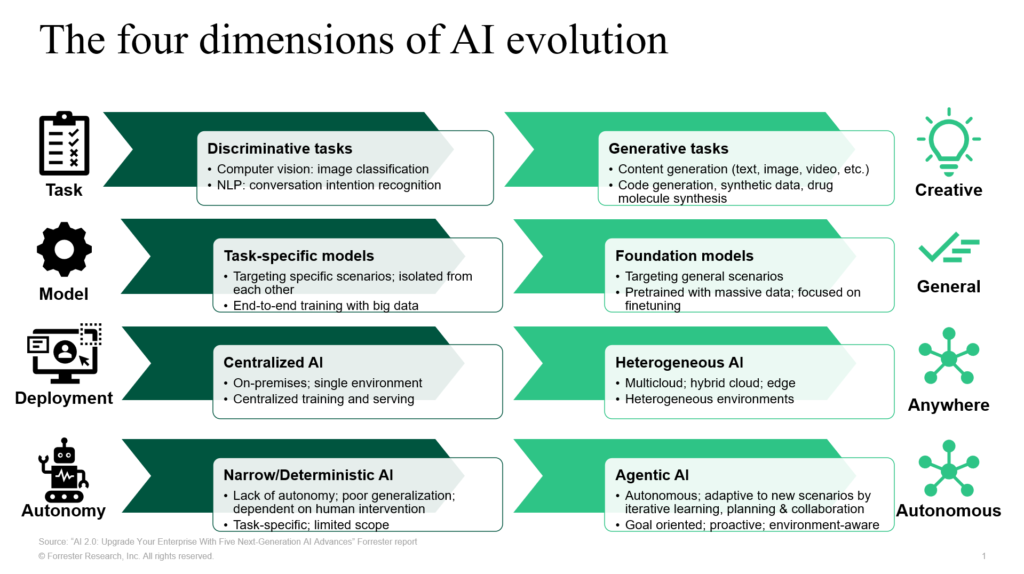
For more than a decade, Forrester has been committed to researching AI and ML technologies and platforms. During my 13-year tenure at Forrester, I had the privilege of working alongside our talented AI analysts. Together, we have continuously refined our market definitions and research focus to stay aligned with emerging tech trends and business needs. In this blog, we introduce a new branding approach for the AI and ML platform market, ensuring our insights remain relevant and valuable for our clients. A Decade-Long Journey In Helping Clients Innovate With AI Here is a quick snapshot of Forrester’s coverage of AI and ML technologies and platforms: In 2015, we (kudos to Mike Gualtieri and Rowan Curran) pioneered Forrester’s research in the discriminative AI field named predictive analytics. This research helped enterprise clients by providing actionable insights to anticipate customer behavior and optimize decision-making to drive efficiency and revenue growth. In 2017, we rebranded the market as predictive analytics and machine learning in response to the rise of ML and deep learning (DL). This rebranding helped enterprise clients assess tools that also leverage advanced ML and DL techniques. In 2022, we expanded this definition to AI/ML platforms, reflecting a broader view of AI with ML/DL at the core. This offered our enterprise clients a broader perspective to adopt full-lifecycle AI/ML solutions, including integrating them seamlessly into their environment to drive AI innovation in business processes. In 2023, in the China version of AI/ML platform Forrester Wave™, we incorporated more functionalities of foundation model support to reflect the market trends of generative AI (genAI). This Chinese market research focuses on enterprise clients in China or doing business in China to harness genAI capabilities, unlocking new opportunities for content creation, automation, and personalized customer experiences. In 2024, in Forrester’s global AI/ML platform Landscape and Wave, we formally defined genAI as one core use case with dedicated evaluation criteria. We also emphasized AI readiness by incorporating DataOps into our framework. Also in 2024, we published the dedicated Landscape and Wave research on AI foundation models (FMs) for languages (AI-FML, aka large language models [LLMs]). This genAI-focused research assists enterprise clients to evaluate LLMs to help support numerous genAI use cases. Over the past 18 months, AI technology has seen remarkable advancements. FMs have emerged as a cornerstone of modern AI, driving innovation and scalability. These models have led to breakthroughs in various domains, including model algorithms, retrieval-augmented generation (RAG), AI agents, and AI hardware infrastructure. Businesses worldwide are actively experimenting with these technologies, integrating AI into various applications to enhance efficiency and drive growth. The Convergence Of AI/ML Platforms And FMs The AI/ML platform and FM markets are rapidly converging through two key trends. AI/ML platform providers are expanding their FM capabilities across the entire AI development lifecycle — from data management to model development, deployment, and AI application development (particularly in agents, app generation, and agentic workflows). These platforms are also integrating with popular third-party models to better serve developers. Meanwhile, FM vendors are broadening their offerings to include comprehensive platform features like API integration, knowledge retrieval, and agent development tools. As our research shows, enterprises typically don’t rely on a single LLM but rather integrate multiple models as essential components of their broader AI infrastructure. The convergence of AI/ML platforms and FMs signifies a profound transformation in AI adoption across four key dimensions: From discriminative tasks to more generative tasks. AI has transitioned from primarily performing predictive analytics to generating new content of various modalities. GenAI is being applied in various fields, such as content creation, customer service, document automation, and TuringBots. This trend highlights the growing importance of AI in augmenting human capabilities, automation, and expanding the boundaries of what machines can achieve. From task-specific models to FMs. Enterprise AI has evolved from specialized models requiring domain-specific training to large-scale FMs pretrained on vast datasets that can be adapted for multiple use cases through fine-tuning and prompting. These FMs function as versatile building blocks that can be customized through fine-tuning and compression techniques. Organizations can adapt these pretrained models for specific use cases without the extensive data and computational requirements of traditional training approaches. This paradigm shift has dramatically accelerated AI development cycles and optimized resource utilization, enabling rapid deployment of AI applications across diverse business contexts. From centralized deployment to heterogeneous architecture options. AI deployment has evolved from centralized approaches to a variety of heterogeneous options across multicloud, hybrid cloud, and edge. This shift offers architecture options to achieve the right balance of scalability, resilience, and adaptability. This allows AI platforms to operate efficiently in diverse and dynamic environments, respecting data gravity and optimizing performance and cost. This trend is particularly important for applications that require real-time processing and low-latency responses, such as autonomous vehicles and IoT edge workloads. From tightly prescribed behavior to greater autonomy and self-improvement. AI systems are moving from predetermined scenarios that rely heavily on human design and planning, to more autonomous approaches. With sufficient intelligence, AI agents have the potential to adapt to new scenarios through iterative learning, planning, and collaboration, making them goal-oriented, proactive, and environment-aware. This autonomy allows AI to handle complex and dynamic tasks with greater efficiency and effectiveness, reducing the need for constant human oversight. The development of autonomous AI is paving the way for advanced applications in robotics, healthcare, and other fields where adaptability and decision-making are crucial.   Rebranding The Market To “AI Platform” As a result of this convergence, starting from this year we will fold in the AI-FML into this larger platform and further evolve our market terminology into “AI platform.” We will continuously refine our research around business use cases, key functionalities, and evaluation criteria design, aiming to help our enterprise clients in refactoring or redefining your technology strategies in AI adoption. For more details, or if you would like to share your thoughts on this, please book an inquiry or guidance session with us to discuss. source

Announcing Forrester’s “AI Platform” Coverage Read More »

Drive Scale And Speed With The Platform Org Model

Ever felt like your organization is a maze of disconnected teams, each working in its own bubble? You’re not alone. Many companies have tried to increase delivery speed with small, agile teams but have ended up with a bunch of siloed squads instead of a cohesive unit. Enter the platform org structure — an increasingly popular option to break down silos and deliver scale. Small, Autonomous Teams Have Failed To Deliver On Their Promise In their search for more customer focus and speed, many organizations have turned to the promise of small delivery teams. Multiple incarnations of small, agile team models have emerged, such as holacracy, teal, or podularity. These models have failed to deliver on their promises, however, as agile was often not embraced “end to end,” especially in larger organizations, and infrastructure and operations were kept out of the game. Hence, while expecting speed, organizations ended up with: Siloed squads: autonomous teams that became quasi-standalone entities with a build bias, duplicating efforts and creating tech debt during product development. Speedboats in molasses: teams sprinting toward deployment in an ocean of bottlenecks due to dependency sprawl and lack of reusable modular capabilities. Governance nightmares: increased bureaucracy to force alignment and resolve dependencies, adding frustration and slowing down progress. Platform Teams Complement Product Teams High-performing IT organizations are increasingly turning to platform teams to drive speed, scale, and alignment across their product teams. Consolidating shared capabilities that are consumed by multiple product teams drives scale through standardization and speed through modularity and developer experience. The result? Faster, more adaptive organizations that can compose new products and experiences with ease. Shared capabilities: Platform teams deliver shared capabilities with a product mindset, ensuring consistent governance and reducing the need for custom solutions. Speed and scale: By reusing existing platform capabilities, organizations can scale quickly and efficiently. Matrix challenges resolved: Platform teams orchestrate demand from product teams, replacing complex dependency management with streamlined prioritization. Standardization and automation: Platform teams drive standardization and automation of shared capabilities, incrementally increasing efficiency and effectiveness. But You Must Overcome These Common Challenges Of course, no model is perfect. The platform org model comes with its own set of challenges. Firstly, crafting a platform strategy is no simple task. Secondly, finding the right skills to drive a platform culture can be tricky, especially as platform teams need to walk a fine line between driving standardization and catering to the needs of product developers. But organizations that are willing to put in the work are rewarded with greater speed and scale while simultaneously driving stronger alignment around business outcomes throughout the delivery organization. The platform org model is not just another buzzword; it’s a proven model to break down silos and deliver scale. Ready to dive deeper? Check out the full report, and get in touch for a comprehensive guide to transforming your organization with platform teams. source

Drive Scale And Speed With The Platform Org Model Read More »

Announcing Forrester's "AI Platform" Coverage

For more than a decade, Forrester has been committed to researching AI and ML technologies and platforms. During my 13-year tenure at Forrester, I had the privilege of working alongside our talented AI analysts. Together, we have continuously refined our market definitions and research focus to stay aligned with emerging tech trends and business needs. In this blog, we introduce a new branding approach for the AI and ML platform market, ensuring our insights remain relevant and valuable for our clients. A Decade-Long Journey In Helping Clients Innovate With AI Here is a quick snapshot of Forrester’s coverage of AI and ML technologies and platforms: In 2015, we (kudos to Mike Gualtieri and Rowan Curran) pioneered Forrester’s research in the discriminative AI field named predictive analytics. This research helped enterprise clients by providing actionable insights to anticipate customer behavior and optimize decision-making to drive efficiency and revenue growth. In 2017, we rebranded the market as predictive analytics and machine learning in response to the rise of ML and deep learning (DL). This rebranding helped enterprise clients assess tools that also leverage advanced ML and DL techniques. In 2022, we expanded this definition to AI/ML platforms, reflecting a broader view of AI with ML/DL at the core. This offered our enterprise clients a broader perspective to adopt full-lifecycle AI/ML solutions, including integrating them seamlessly into their environment to drive AI innovation in business processes. In 2023, in the China version of AI/ML platform Forrester Wave™, we incorporated more functionalities of foundation model support to reflect the market trends of generative AI (genAI). This Chinese market research focuses on enterprise clients in China or doing business in China to harness genAI capabilities, unlocking new opportunities for content creation, automation, and personalized customer experiences. In 2024, in Forrester’s global AI/ML platform Landscape and Wave, we formally defined genAI as one core use case with dedicated evaluation criteria. We also emphasized AI readiness by incorporating DataOps into our framework. Also in 2024, we published the dedicated Landscape and Wave research on AI foundation models (FMs) for languages (AI-FML, aka large language models [LLMs]). This genAI-focused research assists enterprise clients to evaluate LLMs to help support numerous genAI use cases. Over the past 18 months, AI technology has seen remarkable advancements. FMs have emerged as a cornerstone of modern AI, driving innovation and scalability. These models have led to breakthroughs in various domains, including model algorithms, retrieval-augmented generation (RAG), AI agents, and AI hardware infrastructure. Businesses worldwide are actively experimenting with these technologies, integrating AI into various applications to enhance efficiency and drive growth. The Convergence Of AI/ML Platforms And FMs The AI/ML platform and FM markets are rapidly converging through two key trends. AI/ML platform providers are expanding their FM capabilities across the entire AI development lifecycle — from data management to model development, deployment, and AI application development (particularly in agents, app generation, and agentic workflows). These platforms are also integrating with popular third-party models to better serve developers. Meanwhile, FM vendors are broadening their offerings to include comprehensive platform features like API integration, knowledge retrieval, and agent development tools. As our research shows, enterprises typically don’t rely on a single LLM but rather integrate multiple models as essential components of their broader AI infrastructure. The convergence of AI/ML platforms and FMs signifies a profound transformation in AI adoption across four key dimensions: From discriminative tasks to more generative tasks. AI has transitioned from primarily performing predictive analytics to generating new content of various modalities. GenAI is being applied in various fields, such as content creation, customer service, document automation, and TuringBots. This trend highlights the growing importance of AI in augmenting human capabilities, automation, and expanding the boundaries of what machines can achieve. From task-specific models to FMs. Enterprise AI has evolved from specialized models requiring domain-specific training to large-scale FMs pretrained on vast datasets that can be adapted for multiple use cases through fine-tuning and prompting. These FMs function as versatile building blocks that can be customized through fine-tuning and compression techniques. Organizations can adapt these pretrained models for specific use cases without the extensive data and computational requirements of traditional training approaches. This paradigm shift has dramatically accelerated AI development cycles and optimized resource utilization, enabling rapid deployment of AI applications across diverse business contexts. From centralized deployment to heterogeneous architecture options. AI deployment has evolved from centralized approaches to a variety of heterogeneous options across multicloud, hybrid cloud, and edge. This shift offers architecture options to achieve the right balance of scalability, resilience, and adaptability. This allows AI platforms to operate efficiently in diverse and dynamic environments, respecting data gravity and optimizing performance and cost. This trend is particularly important for applications that require real-time processing and low-latency responses, such as autonomous vehicles and IoT edge workloads. From tightly prescribed behavior to greater autonomy and self-improvement. AI systems are moving from predetermined scenarios that rely heavily on human design and planning, to more autonomous approaches. With sufficient intelligence, AI agents have the potential to adapt to new scenarios through iterative learning, planning, and collaboration, making them goal-oriented, proactive, and environment-aware. This autonomy allows AI to handle complex and dynamic tasks with greater efficiency and effectiveness, reducing the need for constant human oversight. The development of autonomous AI is paving the way for advanced applications in robotics, healthcare, and other fields where adaptability and decision-making are crucial.   Rebranding The Market To “AI Platform” As a result of this convergence, starting from this year we will fold in the AI-FML into this larger platform and further evolve our market terminology into “AI platform.” We will continuously refine our research around business use cases, key functionalities, and evaluation criteria design, aiming to help our enterprise clients in refactoring or redefining your technology strategies in AI adoption. For more details, or if you would like to share your thoughts on this, please book an inquiry or guidance session with us to discuss. source

Announcing Forrester's "AI Platform" Coverage Read More »

Four Tactics To Manage Through Change

An unwritten truth in large organizations is that the only constant is change. But as the US’s largest employer faces widespread transformation, even the most seasoned leaders may find that their usual leadership playbooks no longer apply. As a small resource for those leading teams during this time of big uncertainty, I’ve rounded up Forrester’s top-read resources on change tactics and leadership to help you guide your teams on their change journeys. Implement These Four Tactics Now Define your sphere of control. Successful transformations happen from the middle out, which means that middle managers have a critical role to play. Identify the decisions and actions that are within your control, and coach employees to do the same. Create a continuous cycle of listening and response. Determine who will represent the face of the change within your organization and provide a single source of truth for questions. Then leverage a consistent, continuous cadence of communication to build and reinforce trust through transparency. Embrace uncertainty (with empathy). As your employees navigate their personal change experience, they may find themselves somewhere between shock and uncertainty. Uncertainty often leads to anxiety, so work to minimize the unknown by identifying and resolving points of uncertainty, big or small, wherever possible. Prepare for the future. When changes come fast, it can be hard to break out of reactive mode. Carve out time for proactive planning, including: Near-term prioritization. How will we maintain mission-critical functions if program capacity is reduced? Strategic communication. If a new leader steps in tomorrow, how will we communicate the strategic value of our work? Realignment. As new priorities become clear, how will we align activities and resources to maximize impact? Read Forrester’s Essential Research On Change Leadership Connect With Us The Forrester team is here to help. Schedule time with us to develop a personalized plan of action to meet your unique challenges and context. source

Four Tactics To Manage Through Change Read More »

Key Findings From The Forrester Digital Experience Review™: US Retail Mobile Apps, Q1 2025

Among US online adults, 37% regularly use retailer mobile apps to make a purchase. Retailers’ mobile apps help shoppers who want to research a potential purchase, find promotions and coupons, and buy products or services. Forrester’s newly published report, The Forrester Digital Experience Review™: US Retail Mobile Apps, Q1 2025, evaluates how well retailers are meeting customers’ needs and expectations with their mobile app capabilities. In late 2024, Forrester evaluated 10 leading US retail mobile apps to gauge their utility and effectiveness, as well as best practices that retail digital leaders should learn from. This review uncovers the leaders in US retail mobile apps, highlights key findings within the mobile app experience, and explores best-in-class features. Here are three main takeaways from the top Digital Experience Review performers: High scorers add innovative features where it makes sense. Top scorer Lowe’s offers its mobile app users a holistic shopping experience and has added functionality to enhance its search offering. The brand’s “Style Studio” offering allows customers to take a picture of their space and scroll through different design offerings to find new products that fit within it. Shoppers can then view the products they are interested in within the Style Studio page. Utility features go beyond management and offer added value. Kroger shines in the utility category: Shoppers can manage their accounts on the mobile app and track prior purchases. Kroger shoppers are also able to use the saved data from past purchases with “OptUP,” which gives holistic health scores to their purchases. App users also get product recommendations to improve the health score of their cart. Shoppers enjoy easy browsing regardless of how they choose to fulfill their purchase. Sephora makes it easy for mobile app shoppers to browse product result pages and see if the item is available for “buy online, pick up in store” or same-day delivery. Filter options allow users to only see items that they can pick up in the store or that qualify for same-day or next-day delivery. Shoppers may add all items to their cart, regardless of which fulfillment option the customer chooses, and can buy products in one transaction, regardless of the delivery type that they’ve chosen for each item in the cart. Sephora enables Apple Pay and PayPal as options for one-click checkout. If you’re a Forrester client, you can explore these findings in detail by downloading the full report. And if you’d like to discuss this topic further or understand how your mobile app measures up, please schedule an inquiry or guidance session with me. source

Key Findings From The Forrester Digital Experience Review™: US Retail Mobile Apps, Q1 2025 Read More »