Forrester

Unlocking Go-To-Market Momentum Through Strategic Campaign Alignment

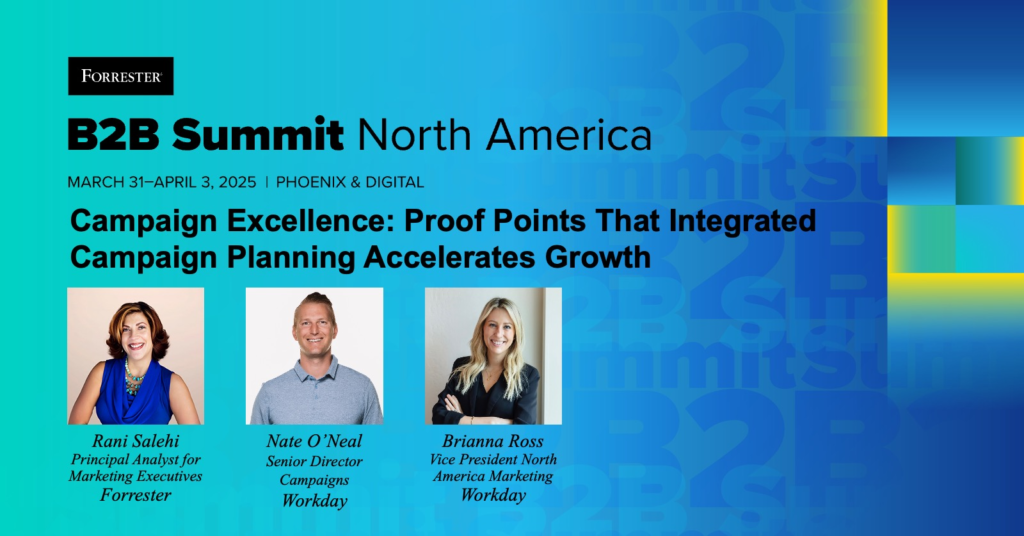
To prove the value of marketing, marketers need to deliver growth. Delivering sustainable growth hinges on a transformative go-to-market (GTM) strategy that prioritizes impact. This demands a fundamental shift: moving beyond a litany of disconnected product messages and reactive, short-term activities — the marketing activity trap — toward a long-term focus on engaging buyers and customers throughout their entire journey. It’s about moving from simply doing marketing to driving business impact. An Integrated Campaign Framework Sets The Foundation For Success Forrester defines integrated campaigns as marketing initiatives specifically designed to drive quantifiable growth — whether in revenue, customer retention, market share, or customer satisfaction — to achieve broader marketing goals. Organizations can achieve a distinct business advantage by implementing scalable campaigns that relentlessly prioritize buyer needs and target both revenue and non-revenue outcomes. By engineering campaigns with specific buying audiences in mind — through detailed target audience definitions and robust personas — organizations unlock significantly better results than those taking a less targeted, more scattershot approach. An integrated campaign framework and process provides the bedrock for strategic alignment and impactful execution, offering key benefits such as: Fewer, more effective campaigns. A buyer-centric approach enables fewer, more efficient campaigns by focusing on evergreen content that addresses buyer needs. Unified and amplified programs. Reputation building and demand acceleration are aligned with revenue enablement to maximize campaign effectiveness. Elimination of redundant effort. Buyer-focused campaigns eliminate duplicate programs and tactics targeting the same buyers, providing opportunities to evaluate and reduce non-campaign activities. Clear roles and responsibilities. Campaign adoption clarifies marketing roles and responsibilities through functional and regional representation. Forrester’s Framework In Action: Workday’s Experience Workday, a leading provider of cloud-based human capital management and financial management applications, provides a compelling example of a successful application of the Forrester Campaign Implementation Process. Workday developed a sophisticated campaign architecture that maps to the full scope of its target markets and balances resource and investment across the campaign hierarchy and all four program families (i.e., reputation, demand, customer engagement, and enablement) during annual planning. The company also innovated its operational processes by developing an interlock process across all functions with a stake in marketing campaign outcomes. Workday identified an opportunity to increase agility and regional relevance through a more integrated GTM planning approach. This transformation streamlined GTM planning and execution, empowered regional teams, fostered collaboration, and ultimately drove greater focus and measurable business outcomes. Orchestrating Growth: The Power Of Integrated Campaign Governance This integrated campaign governance empowers organizations to plan, develop, and execute with a precise focus on overarching marketing goals supporting business outcomes. The Forrester Campaign Framework and the Forrester Campaign Implementation Process provide a distinct go-to-market strategic advantage, fostering seamless coordination between development and execution teams and ensuring alignment across marketing, sales, sales enablement, partner enablement, and product groups. This unified approach not only streamlines operations but also maximizes impact by ensuring that everyone is working in concert toward common objectives. In our experience, the approach is particularly beneficial for organizations that are: Shifting to a solutions-focused approach. They facilitate the transition from a product-centric to a customer-centric go-to-market strategy. Expanding product portfolios. They support growth through the effective introduction and promotion of new offerings. Navigating audience segmentation. They enable targeted engagement with buyer groups spanning multiple geographies, solutions, verticals, or company sizes. Managing marketing technology infrastructure. They provide a consistent framework for leveraging marketing automation platforms and other technologies. Achieving centralized and field marketing alignment. They ensure consistent program delivery across central and regional teams, maximizing ROI. Join The Movement: Elevate Your Campaign Strategy At B2B Summit Join me at Forrester’s B2B Summit North America in Phoenix, Arizona, or online, from March 31 to April 3. I’ll be leading a session titled “Campaign Excellence: Proof Points That Integrated Campaign Planning Accelerates Growth” that explains how the Forrester Campaign Framework helped Workday advance its operating model and accelerate time to market. I’ll be joined by Workday’s Senior Director of the Campaign Center of Excellence Nate O’Neal and Vice President of North America Marketing Brianna Ross, who will describe how they implemented best practices to streamline workflows, improve efficiency, and maximize ROI. source

Unlocking Go-To-Market Momentum Through Strategic Campaign Alignment Read More »
Customer Success Plays A Crucial Role In Revenue Process Transformation

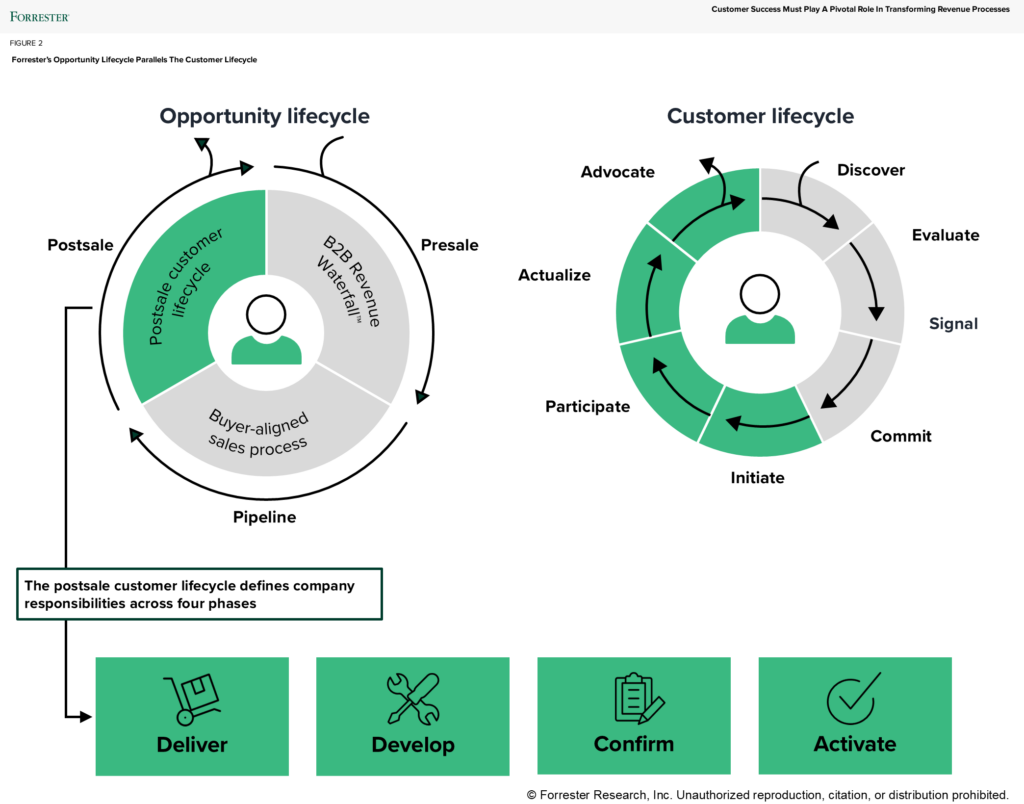
The Forrester Opportunity Lifecycle is a framework for transforming revenue processes to maximize value for B2B customers. As my colleague Amy Hawthorne explains, top revenue transformers: Share signals and create a common view of the customer — throughout the postsale. This is so you can achieve a true understanding of what makes customers succeed, as well as when they are deviating from or toward that goal. Adopt opportunities and retention/buying groups. Managing an opportunity (not just leads, marketing-qualified leads, or customer-success-qualified leads) is what vendors should do to support a customer’s journey from signed contract to loyal advocate. Retention groups are the postsale counterpart to the buying group — and they can become buying groups when expansion opportunities arise. Align marketing, sales, and customer success around shared, customer-centered goals and metrics. All frontline teams must play a coordinated, highly collaborative role in engaging customers. This ensures that customers achieve expected results faster and in more measurable, meaningful ways. Customer Success’s Important Role Customer success (CS) is uniquely positioned to help customers adopt offerings and achieve those meaningful results. Customer success managers enjoy close contact with customers, which puts them in touch with the signals and information that better inform customer understanding. They play a key role in all four postsale stages of the Forrester Opportunity Lifecycle framework, providing the management needed to guide customers to succeed. And when aligned with marketing and sales, they ensure that the business promises made during the presale and postsale stages turn into the results that customer expect — and more.   Four Steps Move Customers From Delivery To Activation In a recently published report (subscription required), Forrester outlines the role of customer success in the opportunity lifecycle. Whether or not you have a distinct customer success function — or teams dedicated to account management, onboarding, training, retention, or value engineering — anyone responsible for supporting customers along their journey will help make your growth more predictable and increase customer longevity when they: Deliver: Set the stage for the customer’s success. Leading CS teams put goals and processes in place to formalize the transition from sales to postsale to make the customer experience more consistent. They document vital information about customer accounts and make it easily accessible across frontline teams, and they make customers step up to ensure their success. Develop: Ensure practical and meaningful offering adoption. To scale operations and generate measurable value, CS teams need to make sure that customers have at minimum a digital destination that gets them off to a fast start. This hub also becomes the place to connect with other customers, form a community, and elevate best practices across the customer ecosystem. Confirm: Help customers see that they’ve achieved a reasonable ROI. Top CS teams show they create value for customers when they help conquer the measurement obstacles presented by revenue process transformation, crystallize for customers the link between using their offerings and making measurable progress, and show the rest of the company that customers are really getting the results they want. Activate: Expand the relationship to reinforce loyalty. To turn happy customers into raving fans, CS teams help create community interactions that customers crave, show advocate customers appreciation through personally relevant experiences, and invite them to show off their achievements or report results that make leaders care. Does Your Postsale Strategy Set Your Customers Up For Success? Ensuring that customers get the value they want requires dedicated postsale resources. It’s time for customer success to earn the right to gain equal footing with marketing and sales along the journey to transformed revenue processes. To learn more, join us at Forrester’s B2B Summit North America from March 31–April 3 in Phoenix, where you can attend our workshop or sessions on customer success. Forrester Decisions clients: You can access this report and related ones, or reach out to your account manager to schedule an inquiry or guidance session with an analyst, if you want to explore this topic further. source

Customer Success Plays A Crucial Role In Revenue Process Transformation Read More »

A Simple Definition Of “Platform”

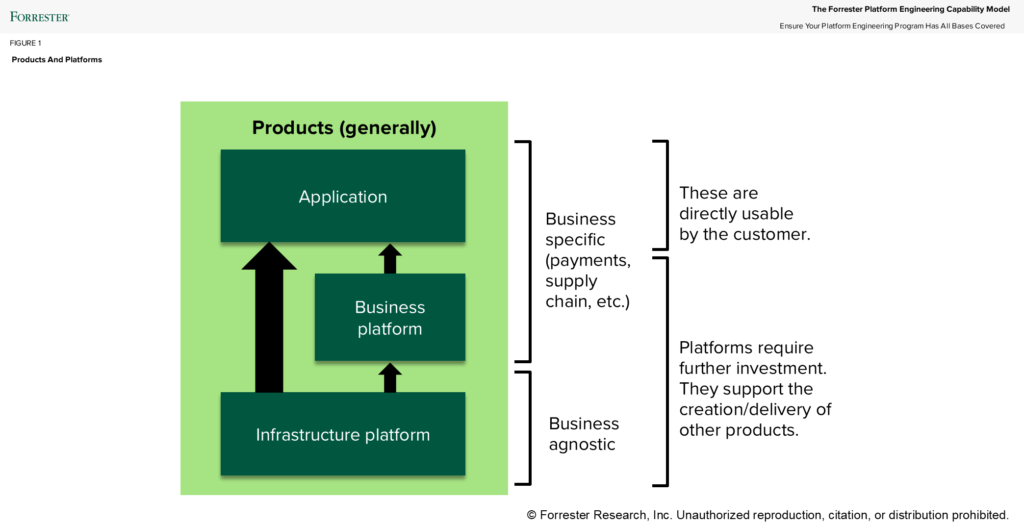
“The only simplicity for which I would give a straw is that which is on the other side of the complex.” — Oliver Wendell Holmes Jr.* At Forrester, we’ve periodically debated the meaning of the word “platform,” and it’s been challenging. Common ground has eluded those who cover ecosystems such as Amazon and Salesforce versus those covering platform engineering. Recently, we’ve been discussing this common definition of platform: “a product that supports the creation and/or delivery of other products.” The following diagram illustrates this concept: The acid test for a unified definition of “platform”: What can we say that would be true both of the Amazon retail ecosystem as well as Amazon Web Services? Well, what do a new Amazon storefront and a new AWS account have in common? Both of them are going to require a lot more investment by their owners to deliver any value. An empty Amazon storefront? You need to figure out your product mix, supply chain, pricing, marketing, etc. Amazon gives you a lot of help, but you have much work ahead of you in configuring the platform for value. An AWS account? Empty EC2 virtual machines or Lambda functions? Not doing anyone much good until you install and run software and surround those workloads with a lot of additional capabilities. So we can say that platforms, in general, require further investment, and the result of such investment is typically value-generating capability. It’s also well established that platforms are products (see Team Topologies and other sources). Therefore, in a world pivoting to the product model, it seems reasonable to simply say that the platform is a product that is creating, or supporting the delivery of, other products. We also see platforms as either “infrastructure” or “business.” Sometimes a given vendor provides both — Salesforce with Force.com as an infrastructure platform (a platform as a service, in the classic definition), Agentforce for CRM, etc. Note that both require serious investment to get going (and this is not a criticism of Salesforce; it’s just a general observation that you’re not going to have a functioning CRM capability without investing substantial setup effort). The boundary here is simple: Infrastructure is business-agnostic (in general, it could work in various industry verticals) while a business platform embeds business-meaningful semantics in the form of APIs, data, or services. Customer relationship management, supply chain, pricing, payment sales funnels — these are all business-specific concepts, and if that’s what’s on offer, you have a business platform. (Some nuance in the above diagram: Business platforms may support constructed apps or be directly configured for consumer access, but in either case, it’s effort, and for me, it’s “application” by definition if the end consumer is interacting directly.) Finally, I can already feel the eyebrows raising at the inclusion of “application.” I’ll be talking more about this as we update Forrester’s Four-Lifecycle Model, but for now, I’ll just say: If platforms are “products,” then we need a specific label for products that are not platforms (data geeks will recognize the subtyping problem). And with due respect to Team Topologies, I have not seen the term “stream-aligned” get traction in portfolio management. Conversely, the term “application” is here to stay and has a reasonably consistent industry meaning, at least in the discussions I have with IT leaders — more on this later. Finally, this model is part of the Forrester Platform Engineering Capability Model, just released last week. I’ll be doing another blog on the core of that work. Also, be sure to check out Embrace Platform Org Structures To Break Down Silos And Deliver Scale, also just out this month, which I coauthored with Manuel Geitz! *Wikiquote notes: “Often quoted as ‘I wouldn’t give a fig for the simplicity on this side of complexity; I would give my right arm for the simplicity on the far side of complexity’ and attributed to Oliver Wendell Holmes, Sr.” source

A Simple Definition Of “Platform” Read More »

Contract Lifecycle Management Is The Bridge Between Strategy And Reality — Choose Wisely To Thrive In Uncertainty

In under two months of 2025, organizations face a battery of changing regulations, new tariffs, and economic uncertainty … all while trying to stay competitive, remain resilient, and execute on their AI strategy. Here’s the good news: How well your organization deals with risk, crisis, and operations opportunity will largely depend on … you guessed it … contracts! The reason is simple and also complex. Your business depends on a vast ecosystem of suppliers, providers, and customers, and the only leverage, accountability, and recourse that you have is dictated in the contract. AI creates even more urgency, because an AI strategy relies on the purchase of foundation models, pretrained data, open-source large language models, and new generative AI capabilities of existing third parties. To thrive in this new environment, organizations must adapt contract language and the contracting process, and to help sort out the best of the best, I’ve just completed The Forrester Wave™: Contract Lifecycle Management Platforms, Q1 2025. Three Contract Lifecycle Management Capabilities To Look For Beyond Contract Creation Contract lifecycle management (CLM) has existed for decades as a digital contract repository with basic workflow for contract creation and execution. Today, these capabilities are table stakes. With uncertainty the new status quo, business leaders and especially contract management professionals need to level up with CLM that: Offers robust contract governance features. The post-signature process is as important as the pre-signature process. A key function of a contract is to assign accountability and define recourse. What’s the purpose of going through the lengthy and painstaking negotiation process if you don’t plan to ensure that the terms are being followed? For example, did you receive what you paid for? Provide what you promised? Are there no surprises as to each counterparty’s responsibility when (not if) a disruption or crisis occurs? To be successful at assigning accountability and defining recourse, you’ll need AI obligations extraction, automated scheduling, event-triggered notifications, and features to track milestones and deliverables. Supports emerging or edge use cases. Whether you’re buying, selling, or partnering, changes in risk and/or regulation require adjustments and amendments to your playbook, templates, and workflow. As new operational resilience requirements lean into contractual provisions, CLM becomes a secret weapon to identify risk exposure and enforce ongoing compliance. M&A activity requires contract harmonization across the new entity. The frequency and scale of technology disruption calls for an update to clauses that assign accountability during disruptive events and clearly outline timeframes for vendors to patch and remediate. Keep an eye out for CLM providers that create solutions today to address tomorrow’s challenges. Provides default product security settings and configurations. CLM is a technology containing highly sensitive, confidential, and proprietary information, which makes it a lucrative target for cyberattacks. Although different companies have their own security requirements and will customize product security settings, vendors that support default settings/configurations and provide guidance on security best practices enable customers to mitigate the risk of a cyber incident or breach. Use The Graphic, But Dig Into The Details It’s true that a picture is worth a thousand words, but to sum up nearly five months of research, including product demos, executive briefings, written responses, and customer reference feedback, in a single graphic would be an oversimplification of how far this market has come and where it is today. Every one of the 12 vendors in this evaluation is a leading product in the CLM space and deserves contextual consideration. Read the full report for more details on selecting a CLM vendor. Also, schedule a guidance session with me for deeper insights into this market, to discuss your CLM program, or to get additional details about the process or findings from this research. source

Contract Lifecycle Management Is The Bridge Between Strategy And Reality — Choose Wisely To Thrive In Uncertainty Read More »

Imagine A World Where Innovation Never Sleeps

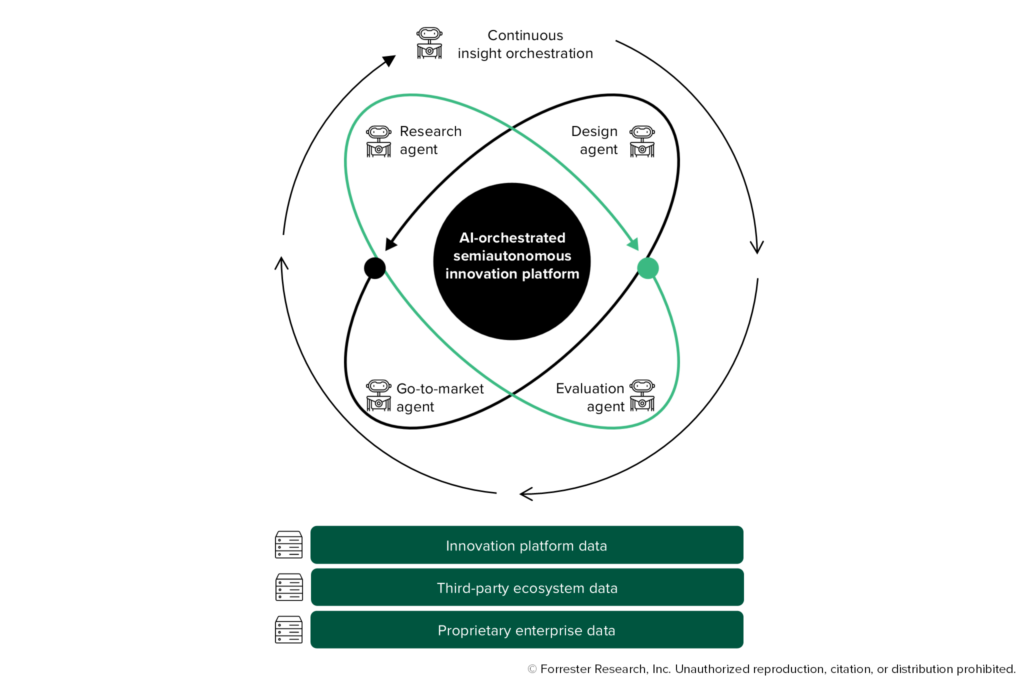
Picture an innovation team that continuously screens market trends, translates them into product designs, and assesses manufacturability and pricing scenarios — all in real time. This is the promise of the AI-orchestrated, semiautonomous innovation lifecycle. GenAI Rehapes Different Stages Of The Innovation Process Generative AI (genAI) is already reshaping the different stages of the innovation process by augmenting creative productivity. From idea generation to commercialization, genAI’s ability to create text, code, audio, images, and videos is transforming how we innovate. Fossil Group, for example, is using retrieval-augmented image generation to create novel watch designs, showcasing how AI can turbocharge the creative process. Importantly, the most common downsides of genAI aren’t an issue in creative use cases; hallucinations are a feature, not a bug, in creative design. Dialing up the model’s temperature results in less conventional output. Damian Fernandez-Lamela, former VP of data science and analytics at Fossil Group, highlighted this point:  GenAI Adoption Moves Beyond Phase-Specific Innovation Tools While such phase-specific tools have driven significant productivity gains, they are not the full story. The real challenge lies in reimagining the entire innovation process. Increasing speed to design is great, but as long as speed to market remains slow, there is little value upside for the enterprise. Simply, more designs, more code, and more content are unlikely to unlock significant value. The more important question lies in determining which designs, which code, and which content are most likely to create value that you can monetize. The Future Of Innovation Lifecycles: AI-Orchestrated And Semiautonomous Picture a system in which new designs can be assessed for manufacturability by analyzing the inventory of parts, supply chains, and distribution networks. The resulting products can be presented to a synthetic client panel while marketing material and product documentation are prepared automatically. Multiagent innovation platforms where AI-powered agents drive continuous market screening, design, evaluation, and commercialization make such a future accessible.   Prepare Now For The GenAI-Infused Future Of Innovation In a world where innovation never sleeps, old ways of working will seize to be effective. The traditional lifecycle stage will amalgamate into a continuous flow of insights, feedback loops, and refinement. To benefit, innovation leaders must break down internal silos, adjust skill strategies, articulate data strategies, and codify organizational context and brand identity. The AI-orchestrated, semiautonomous innovation lifecycle is set to redefine how we innovate. By leveraging genAI and multiagent platforms, organizations can achieve unprecedented speed, quality, and success in their innovation efforts. To uncover more details about this emerging trend and how to prepare your organization, read our report on semiautonomous innovation. Don’t hesitate to get in touch in case you have any questions. Watch this space for more updates on multiagentic innovation platforms and case studies of early adopters. Related Forrester Content Introducing The AI-Orchestrated, Semiautonomous Innovation Lifecycle source

Imagine A World Where Innovation Never Sleeps Read More »

Balanced Benefits Give Loyalty Programs A Competitive Advantage

Loyalty programs are struggling to deliver an engaging member experience. In Forrester’s Consumer Benchmark Survey, 2024, 34% of US online adults who belong to a customer loyalty program agreed that they frequently forget to use loyalty programs to which they belong. To maximize program effectiveness, loyalty programs need a balanced mix of transactional benefits that offer monetary value and nontransactional benefits that spark more emotional connections. Financially tied benefits such as points and discounts are table stakes for modern loyalty. They motivate program members to share more information about themselves and drive desired purchase behaviors. But they are also easy for other brands to copy and for consumers to forget. Lower prices often drive switching behavior. To create meaningful and durable customer connections, loyalty marketers need to include benefits that drive more emotional connections with the brand. In Forrester’s Customer Experience Benchmark Survey, 2024, 82% of consumers indicated that they will spend more with brands that make them feel appreciated. To strike the right balance of benefits and drive engagement, check out our recently published report, How To Balance Your Loyalty Program Benefits, in which we delve into the following topics: How to assess your program benefit mix. Use our calculation to quickly assess how balanced your program benefits are by using existing member data. Inspiration for rewarding beyond the transaction. Even a well-balanced loyalty program can discover new opportunities to wow members and increase engagement. For example, programs can offer members exclusive behind-the-scenes experiences, invitations to attend partner events, or access to members-only merchandise. A five-step framework for balancing benefits. Follow our five-step framework to develop a focused plan to evaluate and incorporate a balanced mix of member benefits. This approach starts with an audit to define gaps and opportunities followed by company effort to uncover new and unique engagement elements. Winnow the list to the most impactful items by validating each benefit through research and feasibility. The goal is to develop a process that promotes continuous improvement of benefits that align with the brand and resonate emotionally with members. Check out the full report for top strategies to make members feel valued and appreciated. Questions? We’d love to help you with your loyalty initiatives. Connect with us by scheduling a guidance session. source

Balanced Benefits Give Loyalty Programs A Competitive Advantage Read More »

Contract Lifecycle Management Is The Bridge Between Strategy And Reality. Choose Wisely To Thrive In Uncertainty.

In under two months of 2025, organizations face a battery of changing regulations, new tariffs, and economic uncertainty … all while trying to stay competitive, remain resilient, and execute on their AI strategy. Here’s the good news: How well your organization deals with risk, crisis, and operations opportunity will largely depend on … you guessed it … contracts! The reason is simple and also complex. Your business depends on a vast ecosystem of suppliers, providers, and customers, and the only leverage, accountability, and recourse that you have is dictated in the contract. AI creates even more urgency, because an AI strategy relies on the purchase of foundation models, pretrained data, open-source large language models, and new generative AI capabilities of existing third parties. To thrive in this new environment, organizations must adapt contract language and the contracting process, and to help sort out the best of the best, I’ve just completed The Forrester Wave™: Contract Lifecycle Management Platforms, Q1 2025. Three Contract Lifecycle Management Capabilities To Look For Beyond Contract Creation Contract lifecycle management (CLM) has existed for decades as a digital contract repository with basic workflow for contract creation and execution. Today, these capabilities are table stakes. With uncertainty the new status quo, business leaders and especially contract management professionals need to level up with CLM that: Offers robust contract governance features. The post-signature process is as important as the pre-signature process. A key function of a contract is to assign accountability and define recourse. What’s the purpose of going through the lengthy and painstaking negotiation process if you don’t plan to ensure that the terms are being followed? For example, did you receive what you paid for? Provide what you promised? Are there no surprises as to each counterparty’s responsibility when (not if) a disruption or crisis occurs? To be successful at assigning accountability and defining recourse, you’ll need AI obligations extraction, automated scheduling, event-triggered notifications, and features to track milestones and deliverables. Supports emerging or edge use cases. Whether you’re buying, selling, or partnering, changes in risk and/or regulation require adjustments and amendments to your playbook, templates, and workflow. As new operational resilience requirements lean into contractual provisions, CLM becomes a secret weapon to identify risk exposure and enforce ongoing compliance. M&A activity requires contract harmonization across the new entity. The frequency and scale of technology disruption calls for an update to clauses that assign accountability during disruptive events and clearly outline timeframes for vendors to patch and remediate. Keep an eye out for CLM providers that create solutions today to address tomorrow’s challenges. Provides default product security settings and configurations. CLM is a technology containing highly sensitive, confidential, and proprietary information, which makes it a lucrative target for cyberattacks. Although different companies have their own security requirements and will customize product security settings, vendors that support default settings/configurations and provide guidance on security best practices enable customers to mitigate the risk of a cyber incident or breach. Use The Graphic, But Dig Into The Details It’s true that a picture is worth a thousand words, but to sum up nearly five months of research, including product demos, executive briefings, written responses, and customer reference feedback, in a single graphic would be an oversimplification of how far this market has come and where it is today. Every one of the 12 vendors in this evaluation is a leading product in the CLM space and deserves contextual consideration. Read the full report for more details on selecting a CLM vendor. Also, schedule a guidance session with me for deeper insights into this market, to discuss your CLM program, or to get additional details about the process or findings from this research. source

Contract Lifecycle Management Is The Bridge Between Strategy And Reality. Choose Wisely To Thrive In Uncertainty. Read More »

The State Of Trust In US Health Insurers Is Fragile

For US health insurers, the current state of trust should set off alarm bells. Trust is the cornerstone of a successful relationship. But only 56% of consumers trust their health insurer to act in their best interest. This puts consumer trust in US health insurers at a three-year low during a watershed moment for the industry. Health insurers must create value with customers to earn their trust. They need to curate personalized, positive experiences that sustain engagement, building relationships that foster trust and encourage more engagement. Trust Is The Glue That Binds: Building Success In Health Insurance Building and maintaining trust not only improves customer satisfaction but also ensures the long-term success of the business. Trust shapes customers’ actions and perceptions, including: Data sharing. High-trust customers are 1.7x more likely to share personal data, which is crucial for creating personalized, valuable customer experiences. Thus, trust feeds a virtuous cycle; without trust and the data sharing it makes possible, member experiences fall flat. Customer satisfaction. High-trust customers report significantly higher ratings in three dimensions: ease, effectiveness, and emotion. This group is nearly twice as likely to feel happy about their insurer, a key driver of loyalty. Emotion carries the most weight of the three dimensions for health insurers. By increasing the incidence of positive emotions associated with customers’ experiences, health insurers can remedy a decline in CX. Churn rates. Low-trust customers with the option to switch health insurers are twice as likely to leave their current carrier compared to their high-trust peers. As consumers’ options to switch increase — whether due to aging into the Medicare market or because of employment or coverage changes — the premium that customers place on loyalty will increase. Controlling churn among low-trust customers who experience higher levels of frustration and annoyance will have immediate short- and long-term impacts. Prioritize Trust Now For Future Success Building trust can improve customer experience, foster loyalty, and drive value for both customers and the business. Health insurers must repair the current fractured state of trust by targeting key levers and drivers of trust to optimize efforts and investments. Forrester clients can read our full report to learn more about the current state of trust in US health insurers, understand which levers and drivers influence trust the most, and discover actionable insights that will strengthen the bonds of trust. Schedule time with us now to dig deep into the data and build the business case for improving customer trust. Join us at CX Summit North America from June 23–26 in Nashville to delve into these topics and more. Reserve your spot to join the conversation. source

The State Of Trust In US Health Insurers Is Fragile Read More »

Why We’re Moving From ZTE To SASE Terminology

As software-defined wide-area networks (SD-WANs) hit the peak of excitement, Forrester analysts noticed that the hype wasn’t turning into deployments. Many of the SD-WAN investigations were being held up by security teams that put a pause on the projects as the teams tried to wrap their heads around the shift in security architecture and controls from data center to cloud. At the time, networking and security were becoming interdependent, yet organizations and solutions were not quite there. Forrester put together a model that would help clients build a single, integrated networking and security model, coining a term that we thought was fitting — Zero Trust edge (ZTE) — as these changes made way for providing Zero Trust security via networking at the edge. But we weren’t the only ones naming this same new phenomenon; the term secure access service edge (SASE) rose around the same time. It didn’t set the bar quite at the same threshold as ZTE, but it described the same change. At the time, the market was full of partnerships between networking and security vendors, and only a few vendors had started to create a single solution with management and monitoring delivered from the cloud. Why Now? Five years later, the market is full of integrated solutions. It is also clear at this time that SASE (pronounced “sassy”) is the preferred market term. As such, we are going to switch over to this market-preferred term while pushing that term to meet the same bar we set for ZTE. For me, this is an easy decision, as customer-first has always been my one key truth to live by. Why? Please indulge me as I take a trip down memory lane, as my career is shaped by two prior experiences: Engineering aircraft components. Straight out of college, I spent time at a small aircraft company engineering new capabilities and improving the manufacturing, safety, or quality of existing parts. In that world, a slight change in dimension of component, such as landing-gear tube thickness, could cause a crash. I spent a lot of time talking to the pilots to see what improvements would drive them to buy the next model or lure new buyers. My greatest contribution: a curved dashboard. The costs of manufacturing the dashboard increased, but current and potential clients loved it. It made the aircraft feel personalized, and the instruments were easier to read. Launching ProVision ASIC and 5400. While I was at HP ProCurve (before the HP split into HPE and HP Inc.), account managers heavily pushed client visits to promote the previous launch (5400 and ProVision ASIC). Not only did I get a lot of direct feedback from customers about the new products (and launch) that helped shape the next cycle, but they also weren’t shy about sharing their thoughts about other products. Many of these thoughts were about real barriers they faced that made their day-to-day or real-world scenarios challenging. Hence, I try to create and release information as if I’m walking in the customer’s shoes, removing any hurdles to getting the best information to make the right decision for their organizations. If clients search “SASE” looking for best practices, design guides, and vendor comparisons, then that is the term we must use to get them what they need. Rather than waste cycles drawing comparisons between the two, we will simply push SASE to be better and achieve a higher standard to meet clients’ needs. We will be pivoting our original definition to now define SASE this way: A solution that combines security and networking functionalities — such as software-defined wide-area networks (SD-WANs), cloud access security brokers (CASBs), Zero Trust network access (ZTNA), and secure web gateways (SWGs) — delivered and supported by a single vendor with any combination of cloud, software, or hardware components. Tactically, this means that over the next few weeks, our current research with ZTE will be relabeled with SASE, along with any future research listed. A big thank you to my friend and former colleague, David Holmes, for his collaboration on this research. It was truly a pleasure. source

Why We’re Moving From ZTE To SASE Terminology Read More »

The UK Government Is Ready To Embrace AI, But Without Trust It Risks Disaster

Internationally, The UK Is Prioritizing AI Security Over Safety Last week, together with the US, the UK refused to sign an international agreement on artificial intelligence at a global AI summit in Paris. The agreement aims to align 60 countries on a commitment to develop AI in an open, inclusive, and ethical way. According to the UK government, however, it fails to address global AI governance issues and leaves questions on national security unanswered. Yes, these types of agreements rarely produce any immediate changes to policy or practices (in fact, this is not what they are for!), but it’s an odd justification, and it’s puzzling that the UK, which championed “AI safety” globally and promoted the adoption of a range of agreements in the past, is walking away from it now. Meanwhile, the UK Department for Science, Innovation, and Technology announced that the global “AI Safety Institute” changed its name to become the “AI Security Institute.” Make no mistake: This is more than a name change. The new focus of the AI Security Institute is primarily on cybersecurity, and previous goals — such as understanding societal impacts of AI and mitigating risks such as unequal outcomes and harming individual welfare — are no longer explicit parts of its mission. Domestically, The UK Wants To Drive Public-Sector AI Innovation Not only was the UK government busy building new tech/geopolitical relationships, it also made some domestic decisions that UK citizens and consumers should be watching. These include: An agreement with Anthropic to start building AI-powered services. Last week, the UK government and AI provider Anthropic signed a memorandum of understanding, marking the beginning of a collaboration that will enable the UK public sector to harness the power of AI for a range of services and experiences. The immediate goal is to use Claude, Anthropic’s family of large language models (LLMs), to launch a chatbot that will improve the way citizens in the UK access public-sector information and services. Bold future plans. This is just the beginning. Future plans include the use of Anthropic’s LLMs across a range of public-sector activities, from scientific research to policy-making, supply chain management, and much more. As the UK government embraces over 50 different initiatives that bring AI to the core of its public sector and government activities, according to the latest “AI opportunities action plan,” future collaboration with other AI providers beyond Anthropic is the obvious next step. New AI guidelines for government departments. To complete the fray of AI-related activity, new guidelines for the use of AI and generative AI in the public sector also saw the light of day last week. The Artificial Intelligence Playbook for the UK Government expands the 2024 Generative AI Framework for His Majesty’s Government, but it substantially remains a set of basic, common-sense principles that public servants should apply when using AI and genAI. It seems to be too little, though, especially if compared with the volume and magnitude of the UK’s AI ambitions and projects. Innovation Without Citizen Trust Will Be Meaningless AI is an incredible opportunity for virtually every organization, including the public sector. The enthusiasm that the UK government is putting into its current and future AI projects is refreshing to see, but a commitment to trustworthy AI is paramount to keep the enthusiasm going and avoid backlash — especially in a country where there currently aren’t, and in the future probably won’t be, any rules and governance for trustworthy AI. As Forrester’s government trust research shows, when trust in institutions is strong, governments reap social, economic, and reputational benefits that enable them to expand and extend their relationship with the people they serve. When trust is weak, they lose those benefits and must work harder to create and maintain economic well-being and social cohesion in order for people to prosper. According to the latest Forrester data, overall trust in UK government organizations is weak, with a score of 42.3 on our 100-point scale. There are two main priorities for the UK public sector and its partners as they embrace AI: Establish and follow a trustworthy framework for every AI project. The new AI playbook is a good starting point. Other AI risk frameworks can further increase the effectiveness of the playbook to deliver responsible and trustworthy AI. The EU AI Act, which is not binding for the UK public sector and its partners, for example, can still provide a set of valid principles to assess AI risks and select risk mitigation strategies. Design and build AI applications that engender citizen trust. It’s vital that you understand and act on the drivers that impact how UK citizens trust the UK government the most as well as the effects that trust has on specific governmental mission-critical activities. Once the dynamics that govern trust are clear, public servants can more effectively develop strategies that specifically address the “trust gap” and help grow and safeguard citizens’ trust. If you want to know more about Forrester’s government trust research or AI trustworthy frameworks, please schedule a guidance session with us. source

The UK Government Is Ready To Embrace AI, But Without Trust It Risks Disaster Read More »