marketing interactive

Canva’s latest 'thing'? A squirrel and a lot of questions

Canva is leaning into absurdity to make a point about creativity, rolling out a new brand campaign titled “The thing that makes anything a thing”, and kicking it off with a giant squirrel statue that appeared, unbranded, in Brooklyn Bridge Park in the U.S. The stunt, which quickly drew attention across New York, was surrounded by a fictional “Squirrelites” movement. Knitting circles made acorn hats, performers held squirrel choir sessions, and balloon vendors sold squirrel-shaped creations. Billboards, street posters, social content and influencer posts added fuel to the mystery, all asking the same question: what is going on with the squirrels? Canva has now revealed it was behind the activation, using the unfolding narrative as a lead-in to its hero film launch. Don’t miss: Canva turns designers’ inside jokes into cheeky larger-than-life billboards   The film follows a woman whose fleeting encounter with a squirrel escalates into an overnight cultural movement. What starts as a small spark of inspiration snowballs into a full-blown community, complete with merch, posters, social content and public gatherings. The tone blurs the line between surreal and believable, reinforcing Canva’s core positioning that ideas do not need scale or polish at the outset to gain traction— only execution to bring them into reality. Across the campaign, Canva positions itself as the bridge between idea and execution, particularly for users who feel held back by tools or self-doubt. The company said many people still feel “not creative enough” to bring ideas to life, leaving concepts stuck in the gap between imagination and execution. With Canva AI 2.0, it is pushing a more conversational design experience, where users can describe an idea, rough concept or goal and have it translated into designs across formats in one place. The campaign extends beyond film and stunt work into experiential, social, influencer, out-of-home, digital and audio channels in the US. Canva is also launching a themed template collection tied to “The Squirrelites”, allowing users to recreate elements of the fictional movement inside the platform. At its core, the campaign reinforces Canva’s long-standing positioning that, with the right tools, even a fleeting or unconventional idea can be turned into something tangible, at times evolving into unexpected cultural moments, as seen in the squirrel-led narrative. “‘The thing that makes anything a thing’ is more than a campaign; it’s an invitation for anyone, anywhere to take their ideas, no matter how big or bold, and turn them into something the world can see, share, and engage in,” said Kristine Segrist, global head of consumer marketing at Canva.   “Because every breakthrough, whether it’s a movement, a business, or something in between, starts as an imagined possibility,” she added.  Canva’s latest campaign builds on a broader push to position itself as a workplace creativity enabler. This follows an earlier brand campaign launched last year, “Put imagination to work”, which highlighted how the platform helps professionals overcome day-to-day creative blocks. The campaign rolled out three fantasy-inspired brand films, including a sales-themed story where a realtor channels a medieval warrior to attract buyers, a vampire-themed ice cream truck owner revamping his social content, and an HR professional transforming presentations into witch-inspired interactive experiences. It also spotlighted Canva’s Visual Suite 2.0, alongside AI-powered tools such as Bulk Create, designed to help teams and freelancers produce content faster across formats. Related articles: Canva’s #DigordeninCanva activates Jakarta’s streets with Ramadan warung makeover   Canva names new SEA head of marketing    Canva moves deeper into marketing stack with Simtheory and Ortto acquisitions source

Canva’s latest 'thing'? A squirrel and a lot of questions Read More »

Singapore’s AI image boom moves from experimentation to execution

Singapore is fast emerging as one of Asia’s strongest growth markets for ChatGPT Images 2.0, OpenAI’s latest image generation model that can create, refine and iterate visuals from simple prompts, as both consumers and marketers begin integrating the tool into everyday workflows. According to OpenAI, usage in Singapore jumped more than 80% week-on-week, alongside a more than 90% increase month-on-month, making it one of the region’s top-performing markets behind Taiwan. The surge is not only driven by existing users. In the past week alone, 50% of image generation activity in Singapore came from first-time users, pointing to strong early curiosity coupled with growing practical adoption. Singapore joins Japan, Thailand and Taiwan as key high-growth markets for the tool across Asia. Don’t miss: ChatGPT Go rolls out globally, ads to be tested on free and Go tiers The momentum comes as competition in the generative visuals space heats up. ByteDance has been developing Goku AI, an AI-driven video creation framework that transforms text, images and motion signals into fully synthesised video content. Built on a multimodal architecture, it combines inputs such as static images, video and audio cues to generate lifelike human animations, reducing the need for traditional filming and editing workflows. Adobe is also doubling down on the space with Adobe Firefly, its generative AI suite embedded across Creative Cloud apps. Positioned as a commercially safe model trained on licensed content, Firefly is designed to help creatives generate images, text effects and design assets directly within tools like Photoshop and Illustrator, targeting enterprise and professional users looking for production-ready outputs. In conversation with MARKETING-INTERACTIVE, Jennifer Lien, head of marketing, APAC, at OpenAI, said the pace of adoption of ChatGPT Images 2.0 signals a broader shift in how users are engaging with AI-generated visuals, moving from experimentation to utility. “Every major technology shift starts with experimentation. People first ask, ‘Can this do something surprising?’ Then eventually the question becomes, ‘Can this help me work better?’,” she said, adding that image generation is now clearly entering that second phase. Unlike earlier tools, ChatGPT Images 2.0 introduces what Lien described as “thinking capabilities”, allowing it to search for real-time information, generate multiple outputs from a single prompt, and refine results. This has expanded its role from simple image creation to something more embedded in marketing and communication workflows. That shift is already reflected in how users are engaging with the tool. Early trends across Singapore and the wider region range from colour analysis and hairstyle simulations to experimenting with makeup looks. At the same time, users are creating product mockups and campaign concepts, blurring the line between casual exploration and commercial application. Lien said this behaviour is beginning to influence how brands think about creativity and engagement. “We’re seeing people naturally use Images 2.0 in highly visual, identity-driven ways. I believe those same behaviours will increasingly shape how brands think about personalisation and creative engagement,” she said. In marketing teams, the impact is becoming more tangible. What previously took days of production can now be explored in hours, whether that is testing multiple creative directions, visualising campaign ideas or prototyping packaging concepts. Lien noted that the tool is also helping brands localise content at scale, particularly in a region as diverse as Asia Pacific, where campaigns often need to adapt across languages and cultural contexts. Improvements in multilingual understanding and non-Latin text rendering are making it easier to produce visuals that feel locally relevant without the same level of production effort. At the same time, always-on content demands are pushing social teams to produce more with fewer resources. Lien said AI image generation is helping to reduce that burden while still allowing for creative experimentation. Closing the gap between capability and usage  Despite the rapid uptake, she noted that a gap still exists between what AI tools are capable of and how widely those capabilities are being used. OpenAI’s research shows that power users are tapping into significantly more advanced features than average users, highlighting the role of experimentation and familiarity. “With image generation, it makes advanced AI feel much more intuitive and accessible. You don’t need to be technical to start communicating ideas visually,” she said, pointing to the influx of new users in Singapore and other markets as a sign that the barrier to entry is lowering. Brands, too, are beginning to move beyond using AI purely for internal ideation. Lien said improvements in text rendering, layout consistency and multilingual outputs are making AI-generated visuals increasingly viable for actual campaign development. “Historically, many image generation tools were great for inspiration, but struggled with text rendering, consistency, or multilingual outputs,” she said. “With Images 2.0, we’re seeing meaningful improvements, which makes the outputs far more usable within actual campaign development workflows.” Still, she stressed that AI is not replacing creative teams. Instead, its biggest impact will be on compressing the operational layers of the creative process, from early-stage visualisation and mockups to localisation and iterative revisions. This reduces the friction between idea and execution, allowing teams to move faster and explore more directions. Lien added:  The value isn’t just speed. It’s reducing blank-page starts, helping teams iterate more fluidly, and identifying workflow bottlenecks. For marketers, the opportunity lies in how the technology is approached. Lien said the teams seeing the strongest results are those treating AI as a collaborator rather than a replacement, using it to accelerate ideation, test creative directions quickly and build fluency across organisations. As experimentation continues to grow, she added that everyday users may offer the clearest signal of where the space is headed next. “When everyday users start adapting a tool creatively on their own, it’s usually a sign that something bigger is changing in how people create and communicate,” she said. That shift also brings new expectations around transparency. A recent study by YouGov and Meltwater found that 84% of Singaporeans believe AI-generated content should be clearly labelled, with 49% saying their trust in a brand would decrease if such use is not disclosed. The “Trust in

Singapore’s AI image boom moves from experimentation to execution Read More »

Samsung scores with Thierry Henry in 20-year TV crown play

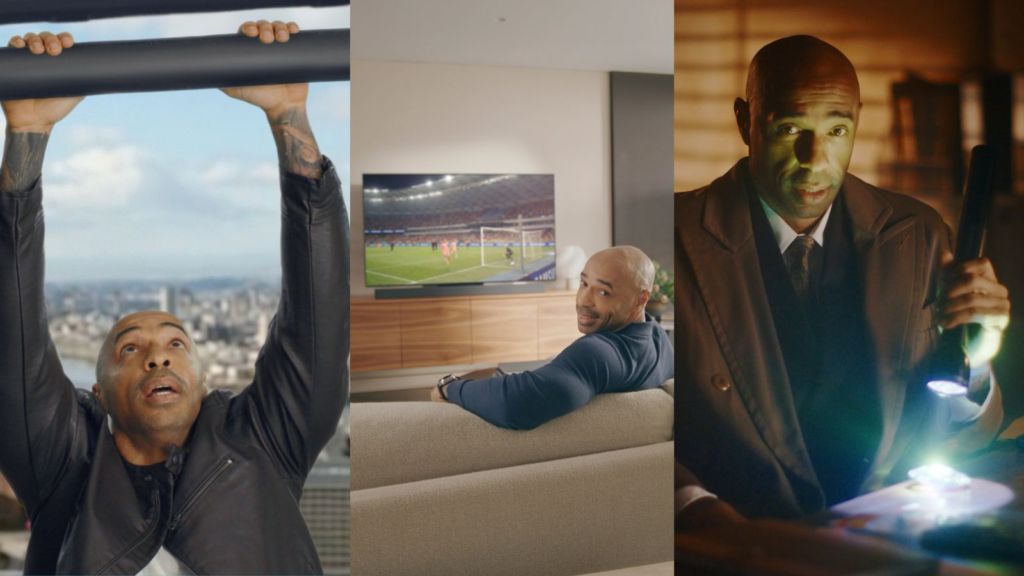
Samsung is marking 20 years as the world’s number one TV brand, according to Omdia, with a new global campaign built around a simple positioning: when it matters what you’re watching, watch it on Samsung. Created in collaboration with BBH Singapore, the campaign leans heavily into the 2026 FIFA World Cup moment, which Samsung is framing as the biggest football viewing event yet, reinforcing the role of premium TV experiences for high-stakes live sport. At the centre of the campaign is football legend and pundit Thierry Henry, who features in a series of humorous social sketches. Don’t miss: Coca‑Cola gets fans jumping with its FIFA World Cup 2026 anthem The concept plays on a tongue-in-cheek idea: Henry frequently sees himself on screen, so he needs a TV that makes him look and sound at his best. The films show him watching himself in different “TV personas”, including an action star, a K-drama heartthrob, and a football presenter. Across each vignette, Samsung highlights different TV features designed to elevate picture and audio quality, positioning the device as a way to “upgrade” even familiar content. The campaign is rolling out across 25 European markets through a fully integrated approach spanning digital, social, and in-store activations. Samsung Electronics is anchoring the work around its long-term leadership in the category, using the milestone to reinforce its premium positioning ahead of a major global sports moment. “Our TVs have been crowned the global number 1 TV for 20 years in a row. That consistency speaks for itself, but we wanted to dramatise it in a visually memorable way that football fans would instantly relate to,” said Benjamin Braun, chief marketing officer, Samsung Electronics Europe. In tandem, Sascha Kuntze, chief creative officer at BBH Singapore said, “As a global icon who demands nothing less than technical brilliance, Henry knows that for the moments that define history, you need the gold standard of television. If it’s worth watching, it’s worth watching on a Samsung.” The campaign lands as brands continue to double down on football-led storytelling ahead of the 2026 FIFA World Cup, where fan culture is increasingly central to marketing narratives. Last month, Pepsi rolled out its global platform “Pepsi football nation”, positioning football fandom as an everyday culture rather than a matchday-only moment. Fronted by a roster of players including David Beckham, Vinícius Júnior, Mohamed Salah, Alexia Putellas, Lauren James and Florian Wirtz, the campaign film imagines a fictional “nation” where fans set the rules of the game. Related articles: LEGO builds its own World Cup lineup of football heavyweights    Lenovo taps David Beckham to power its AI play ahead of World Cup   Heineken unites football, F1 and music under new sponsorship platform   source

Samsung scores with Thierry Henry in 20-year TV crown play Read More »

In conversation: How Airwallex channels sports energy into B2B impact

In an increasingly crowded fintech landscape, Airwallex is leaning into a challenger mindset to rewrite the rules of B2B marketing. Speaking on Marketing Connected’s In Conversation, Jon Stona, VP of global marketing at Airwallex, made a clear case for why B2B needs to move beyond its traditionally “dry” playbook. At its core, he argues, marketing fundamentals remain unchanged. “You need to generate insights, craft compelling stories, find the most efficient way to distribute them, measure, iterate and repeat,” said Stona. The difference, lies in execution. Catch the full interview here:  For Stona, too many B2B marketers over-index on lead generation while neglecting brand and product marketing. “If you’re storytelling to the wrong people about the wrong thing, everything else is blah,” he said, calling for a more unified approach across product, brand and growth. Central to this shift is a more human approach. “We tend to approach it from the sentiment that you’re a human that we’re marketing to, not a business decision maker that we’re trying to talk to,” he explained. Don’t miss: In Conversation: Are we forgetting what makes marketing work? That means borrowing from B2C, building connection first, and delivering value in formats audiences actually want, whether that is video or long-form written content delivered at the right moment. A lot of what we do is based on trust building. We think about trust first, and frame our marketing around that, on a human level. The same way you build trust with the people around you. This philosophy also shapes how Airwallex approaches its positioning as a challenger brand. Competing against legacy financial systems and established fintechs, Stona emphasised the need to think differently. That mindset extends to its high-profile sports partnerships with McLaren and Arsenal. Initially sceptical of sports marketing, Stona said the turning point came from recognising its “multifaceted and dynamic” nature. Beyond logo placements, these partnerships offer IP, storytelling opportunities, and real product integration. It’s not about just the logo on the car. It’s about being a challenger and a pioneer, shifting what your perspective on what’s possible. “It’s not put logo on surface and go home. We ask ourselves, ‘how do we really become a partner’,” he said. By embedding its solutions into partners’ operations, Airwallex aims to demonstrate tangible value. “I want to be able to authentically say that we’ve saved McLaren so much time and money. I’m not just going to tell you that, I’m going to show you that,” he added. Crucially, success lies in activation. Brands must “squeeze every single point of value” by integrating partnerships across channels, from performance marketing to internal culture. Also tune in to the full conversation on Spotify: Tune into the rest of this conversation on your favourite podcast platforms, by searching up Marketing Connected. For all the visual people out there, we’ve got your back as well, with our vodcasts on YouTube.Related articles: ‘Signing is the easy part’: How Airwallex turned sport into a global growth engine Airwallex smashes ‘clunky’ business banking in new brand push Airwallex signs multi-year Arsenal deal to fuel brand push  source

In conversation: How Airwallex channels sports energy into B2B impact Read More »

AI adoption still stuck at the starting line for most firms in Singapore

Singapore may be betting big on artificial intelligence (AI), but most businesses are still on the sidelines. This is according to a new report by the Ministry of Manpower (MOM), which found that 71.5% of firms have yet to adopt AI. Among the 28.5% that have, only a small fraction have embedded it into core operations, suggesting adoption remains early and uneven. The inaugural study, conducted by MOM’s Manpower Research and Statistics Department between January and March 2026, surveyed 2,560 private sector establishments employing about 486,600 workers. Even among adopters, most firms are still testing the waters. Only 3.8% have fully integrated AI into core processes, while others remain in planning (7.4%) or pilot stages (6.0%). This points to a gap between awareness and execution, with firms showing interest in AI but struggling to scale it meaningfully. Don’t miss: AI momentum builds across Southeast Asia, but gaps persist Singapore also trails other digitally competitive economies such as Denmark, Finland and Sweden in firm-level AI adoption, despite its strong digital readiness. According to the report, AI adoption is far from equal across the business landscape. Larger firms are leading the charge, with adoption rates rising from 23.9% among companies with fewer than 25 employees to 76.4% among those with more than 500 employees. These organisations are more likely to have the infrastructure and internal capabilities needed to deploy AI at scale. Sector-wise, uptake is highest in digitally intensive industries. Information and communications leads at 74.1%, followed by professional services (57.5%) and financial and insurance services (56.4%). In contrast, more operationally heavy sectors such as retail (23.4%) and food and beverage (21.9%) lag behind, where physical tasks are less suited to automation. For many firms, the barriers are less about intent and more about execution. The report noted that high implementation costs (44.9%) and lack of in-house expertise (42.4%) emerged as the biggest hurdles. Smaller firms also cited unclear strategy (32.4%) and low trust in AI (30.8%) as key challenges. Larger firms, meanwhile, face a different set of headaches, including integration complexity (56.1%) and data security concerns (55.4%). Despite concerns around job losses, the report found little evidence of widespread displacement. Only 6.2% of firms reported reduced headcount due to AI. Instead, businesses are redesigning roles (18.9%) and creating new AI-related jobs (13.9%), signalling a shift towards task transformation rather than job elimination. Higher-skilled roles, particularly those involving analytical and cognitive work, are seeing the biggest changes. For firms that have adopted AI, the payoff is already visible. About 70.7% reported improvements in worker productivity, alongside gains in decision-making (13.3%) and innovation (11.9%). Some sectors also saw improvements in employee well-being and reduced stress levels. Additionally, there are early signs that companies are gearing up for broader adoption. Smaller firms are focusing on foundational steps such as training (46.6%) and providing access to AI tools (41.1%). Larger firms are moving towards more structured approaches, including governance frameworks (37.5%) and workflow redesign. This uneven adoption comes as AI usage in marketing accelerates globally, even as questions around transparency persist. Research by the World Federation of Advertisers (WFA) found that 78% of multinationals are already using AI-generated or AI-enhanced content in consumer-facing campaigns, highlighting how quickly the technology has become embedded in marketing workflows. However, clarity remains a sticking point. Eight in 10 brands are calling for clearer global guidance on AI disclosure, even as 67% have introduced internal policies. The tension, WFA noted, lies in balancing scale with scrutiny, with widespread use across product images (87%), marketing copy (80%) and background visuals (77%) still outpacing consensus on what consumers expect in terms of transparency. Related articles: AI use rises, but so do trust demands from Singaporeans  More companies miss revenue targets as AI and volatility reshape B2B growth   Are AI chatbots building the next walled garden? source

AI adoption still stuck at the starting line for most firms in Singapore Read More »

Lazada Group CMO Marcus Chew steps down

Marcus Chew (pictured), group chief marketing officer at Lazada Group, has stepped down from his role, MARKETING-INTERACTIVE understands. Chew joined Lazada in 2021 as group CMO, overseeing the eCommerce platform’s end-to-end marketing strategy across Southeast Asia and South Asia, including its Daraz business. In the role, he led brand strategy, creative development, media execution and go-to-market planning across 11 markets. During his tenure, Chew drove efforts to centralise marketing operations and in-house key capabilities, including media strategy and execution. He also focused on building scalable, insight-led marketing processes, with an emphasis on measurement frameworks tied to both business impact and creative effectiveness. Don’t miss: Shopee regional marketing head departs Prior to Lazada, Chew was CMO at NTUC Income from 2013 to 2021. As part of the insurer’s executive leadership team, he led the transformation of its marketing function, including building out its martech stack and scaling its digital business. His remit spanned brand, media, CRM, analytics, PR and internal communications, alongside responsibility for eCommerce growth. Earlier in his career, Chew held regional marketing leadership roles at adidas, where he oversaw brand marketing and PR across China and Southeast Asia. He was responsible for integrated campaign planning, media investment and talent partnerships, as well as localising global campaigns for regional markets. Chew began his career at Unilever, where he led the home and personal care portfolio across Singapore and Malaysia. He managed brands such as Sunsilk, Dove and Lux, and held full P&L responsibility for the division. During his time there, he launched several products, including CLEAR and Lifebuoy, and achieved category leadership milestones in both markets. He also previously served as regional marketing director at Sime Darby. His departure comes amid a broader wave of senior marketing leadership changes in the region. Last month, Peilin Lee, head of marketing at Nespresso Singapore, exited after seven years to start her own business focused on leadership development and strategic communication. At Nespresso, Lee led the full marketing function across both B2C and B2B.  Her role spanned brand strategy, product innovation, customer experience and partnerships. A key part of her role involved translating global direction into locally relevant growth, building both the business and the brand in a way that could sustain long-term relevance.  In Malaysia, Foodpanda marketing director Steff Yong has also stepped down from her role, marking yet another leadership change for the delivery platform’s local team. Announcing her departure in a LinkedIn post, Yong described her tenure as “a wild and memorable” experience, expressing gratitude to her team and colleagues. Related articles: What does eCommerce have to do with running? Lazada’s CMO Marcus Chew explainsStryv picks Razer’s Asia regional marketing director as CMOKenvue appoints former KFC Asia CMO as VP and marketing chief for APAC       source

Lazada Group CMO Marcus Chew steps down Read More »

Flexar debuts in Singapore with point-to-point offering

Mobility platform Flexar has officially launched in Singapore, positioning itself as a purpose-built point-to-point car-sharing service aimed at improving flexibility and convenience for urban commuters. The launch comes as Singapore continues to push towards a car-lite future, with Flexar offering an alternative to car ownership through a mix of electric (EV) and internal combustion engine (ICE) vehicles. The platform follows a beta phase in April which saw close to 10,000 registrations within two weeks. According to the company, repeat usage during the trial reflected growing demand, with users citing vehicle variety, ease of sign-up, and flexible payment options as key strengths. Don’t miss: foodpanda makes a move into ride-hailing through TADA tie-up Flexar’s launch also builds on learnings from the strategic pause of BlueSG, with the company introducing a redesigned point-to-point model focused on reliability and scalability. Its features include fleet and parking optimisation to improve vehicle availability, alongside tools such as a radar search function and fare calculator developed based on user feedback. The service debuts with more than 200 vehicles across 100 stations, located in residential neighbourhoods and commuter corridors across central, northern, northeastern and eastern Singapore. Flexar said it plans to expand its network monthly, with the aim of achieving nationwide coverage. At full scale, the platform is expected to support thousands of vehicles across an islandwide station network. Flexar operates on an asset-light model, working with fleet management providers to supply vehicles. The company said this approach allows it to scale efficiently and adjust its vehicle mix based on demand. The platform is open to users aged 18 and above with a valid driving licence, with onboarding completed via Singpass. No deposits or membership fees are required. Its fleet includes a mix of sedans and SUVs such as the Hyundai Avante, Honda Fit, Toyota Sienta and Opel Corsa-e. Trips are charged on a per-minute block pricing model, with fuel included. Users can also opt for additional coverage through a collision damage waiver. Flexar said it will continue to refine its platform following user feedback, with planned updates including improvements to rental processes, in-app notifications, and customer support features. To mark the launch, the company is offering vouchers to beta users and a SG$10 welcome credit for new users as part of a two-week promotion. Weekly launch promotions and referral rewards will also roll out throughout May. Fon Supannakul, CEO of Flexar, said car sharing will play a central role in Singapore’s mobility future as urban needs shift from ownership to access. “As urban needs evolve, access is becoming more important than ownership. We built this platform listening to user feedback,” she added.  Supannakul pointed to strong beta traction as evidence of demand for a more practical point-to-point model, with early users valuing flexibility and ease of use. Early testing over the past six months also allowed Flexar to refine operations and fine-tune on feedback. “Our focus now is on expanding the network responsibly and strengthening availability so that point-to-point car sharing becomes affordable, flexible, reliable and convenient for more Singaporeans,” she said. MARKETING-INTERACTIVE has reached out for more information.  Separately, developments in the wider mobility space continue to reshape how cross-border and on-demand transport services are being offered in the region. Southeast Asia superapp Grab has been granted the first cross-border ride-hailing operator licence under the enhanced Cross-border Taxi Scheme jointly introduced by Singapore’s Ministry of Transport and Malaysia’s Ministry of Transport. The licence allows Grab to offer cross-border taxi bookings directly via its app, with a pilot service enabling door-to-door rides between Singapore and Johor, including Johor Bahru, Iskandar Puteri, Forest City, Kulai and Senai. Related articles: TADA taps pop culture references and Singlish to redefine its push notifications Grab to expand into Taiwan via foodpanda acquisition   Grab takes SEA tourism to the world with Times Square spotlight source

Flexar debuts in Singapore with point-to-point offering Read More »

'It’s not about the biggest title in the room': Love, Bonito co-founder Rachel Lim on CLOSER conversations

At a time when most brands are still figuring out how to build communities, Rachel Lim, co-founder of Love, Bonito, is focused on something else entirely: how close those communities actually feel.  As the founder of CLOSER, part of her broader RachReflects universe, Lim is moving beyond transactional content and surface-level metrics such as reach and virality. Instead, she’s prioritising proximity.  “Most brands today are still optimising for reach, I’m far more interested in how close people actually feel to you,” Lim said during a fireside chat at Content360 Singapore 2026.  Don’t miss: Content360: How CHAGEE replaces traditional media with content ecosystems “I realised I’ve always been building community,” she added. “It just evolved from fashion into conversation.”  Speaking of her early years launching Love, Bonito as a blogshop, Lim shared that content creation was always a way to express herself and build trust with her audience.  The instinct didn’t begin with CLOSER. It started in the early days of Love, Bonito.  Taking the audience back to the early 2010s, Lim recalled a time when eCommerce was still in its infancy, with orders sent via mail and cash payments tucked into envelopes. Blogging became a way to bridge that gap.  “Back then, we needed people to feel like they knew us and trust us,” she said. “So we shared everything, the process, behind-the-scenes moments, even my weekends, so people understood who we were.”  Today, that instinct has evolved into CLOSER, a community and conversation platform spanning live experiences, content and storytelling, centred on identity, wellness and personal transition. The goal, she said, is to build intimacy at scale.  Fast forward to today, Lim says this shift is tied to her personal “zone of genius”, a term coined by Gay Hendricks in his book The Big Leap.  For Lim, this meant recognising where her natural strengths and energy align, and moving away from areas where she may be effective, but ultimately depleted.  That realisation led her towards live conversations, storytelling and building deeper connections with her audience.  While grateful for everything Love, Bonito gave her as a platform to understand how women express confidence externally, CLOSER was designed to explore what sits beneath that confidence. Lim said:  I stay close to my community, I listen deeply, and I build from there. Redefining the self   Building CLOSER also required Lim to step back from the day-to-day operations of Love, Bonito, a shift that became inevitable as the business scaled.  Today, under CEO Dione Song, the brand has grown to approximately 27 stores across Singapore, Malaysia, Indonesia, Cambodia, Hong Kong, Thailand and the Philippines, alongside a steady stream of campaigns celebrating women across Asia.  But for Lim, the transition was not just operational. It was deeply personal.  “I had to be honest with myself that I wasn’t necessarily the best person to take it into the next stage of growth,” she said.  Letting go of that role meant confronting an identity she had held for nearly two decades.  “My self-worth, my sense of who I was, was all tied to the brand. I realised I had been known as the co-founder of Love, Bonito for so long that I didn’t really know who I was outside of it,” she said.  The shift, she added, was not about losing relevance, but redefining it. Lim noted:  It’s not about having the biggest title in the room. It’s about having the courage to pursue what feels true to you. Trust in the community  By 2024, Lim began intentionally carving out time away from Love, Bonito to build something new. The decision marked a clear turning point.  It came with a pay cut, and a level of uncertainty that extended beyond business. At the same time, her husband had lost his job of nearly three decades during the pandemic.  “It was a very difficult period,” she said. “I was asking myself if I should go back to stability or continue building something with no certainty.”  She chose the latter.  The principle guiding that decision was simple: value first, monetisation second.  “I’ve never been afraid of starting early,” she said. “If I stay close to my community, I trust things will follow.”  Today, Lim sees Love, Bonito and CLOSER not as separate ventures, but as parts of the same ecosystem, one built on product, the other on conversation.  Both, she said, are anchored in a shared goal: not just scale, but intimacy at scale.  Related articles: Is community the new currency for Love, Bonito?   Women who lead: Love, Bonito’s Dione Song on redefining Asian fashion leadership   Love, Bonito and LinkedIn tackle career questions women hesitate to ask   source

'It’s not about the biggest title in the room': Love, Bonito co-founder Rachel Lim on CLOSER conversations Read More »

Grab secures first cross-border licence, pilots SG-JB ride-hailing service

Southeast Asia superapp Grab has been granted the first cross-border ride-hail services operator licence, paving the way for a new taxi booking service between Singapore and Malaysia. The licence, issued under the enhanced “Cross-border taxi scheme” jointly announced by the Ministry of Transport Singapore and Ministry of Transport Malaysia, enables Grab to offer cross-border taxi services directly through its app. As part of this, Grab will roll out a pilot service named allowing passengers to book door-to-door rides between anywhere in Singapore and key areas in Johor. These include Johor Bahru, Iskandar Puteri, Forest City, Kulai and Senai. Set to rollout from 4 May, the pilot will allow users to schedule rides between 12 hours and up to seven days in advance. The move targets one of the world’s busiest land crossings, where hundreds of thousands of commuters travel daily for work, business and leisure. Don’t miss: Grab to expand into Taiwan via foodpanda acquisition Alex Hungate, president and COO of Grab, said the service responds to growing demand for more seamless transport options across the border. “Our passengers and business customers in both Singapore and Malaysia are eagerly awaiting door-to-door cross-border taxi services,” he said, adding that the company will refine the offering based on feedback from drivers and users during the pilot phase. The new service introduces several features aimed at improving the cross-border travel experience. These include fixed upfront fares at the point of booking, with an introductory discount of up to 20 percent, as well as a choice between four- and six-seater vehicles, including premium options. Safety features such as AudioProtect, trip monitoring and emergency SOS services will remain active throughout journeys, alongside comprehensive insurance coverage for cross-border trips. The rollout also marks a first for Grab’s taxi fleet, GrabCab, with a number of its drivers now licensed to operate cross-border journeys. In total, the Singapore and Malaysian governments are expected to issue 300 licences each to taxi drivers in 2026 to support the initiative. Grab is currently onboarding licensed cross-border taxis from its own fleet and other operators, while also streamlining backend processes to help drivers manage cross-currency earnings and differing regulatory requirements across both markets. Under the scheme, Singapore-licensed taxis can pick up passengers anywhere in Singapore and drop them off within the designated Malaysian zones. However, return trips are limited to advance bookings from fixed points such as Toppen Shopping Centre, Mid Valley Southkey, Angsana Mall and Larkin Sentral. Similarly, Malaysia-licensed taxis can pick up passengers within Johor and drop them off anywhere in Singapore, with return pick-ups restricted to designated locations including areas near VivoCity, Century Square, Joo Koon MRT station and Ban San Street Terminal. Back in April 2025, GrabCab, a subsidiary of Grab Rentals and sister company of GrabCar, had been awarded a street-hailing service operator license (RSOL). The licence will be valid for 10 years. Singapore’s Land Transport Authority said GrabCab’s entry into the street-hail sector brought the total number of taxi operators in the country to six, providing drivers and commuters with more choices and an expected boost to taxi supply. Meanwhile, earlier this 2026, Grab Holdings announced that it was set to enter Taiwan for the first time through the acquisition of Delivery Hero’s foodpanda delivery business in the market, marking a major milestone in its regional expansion strategy. The deal, valued at US$600 million on a cash-free and debt-free basis, will see Grab establish a presence in its ninth market and its first outside Southeast Asia. The transaction remains subject to regulatory approvals and is expected to close in the second half of 2026.Related articles: A billboard that changes at night: Grab campaign highlights the lives behind each orderGrab asks: Wait… whose CNY ad is this? Grab obtains street-hail service license in SG, enters taxi market  source

Grab secures first cross-border licence, pilots SG-JB ride-hailing service Read More »

Here are the brands strutting The Devil Wears Prada 2 runway

Nearly two decades after The Devil Wears Prada first turned fashion into a cultural shorthand for ambition, its sequel has made a sharp, high-heeled return. The Devil Wears Prada 2 hit theatres on 1 May 2026, reuniting its original cast at a time when nostalgia is doing serious box office heavy lifting. Early numbers suggest the appetite is very real. The film debuted at number one globally, pulling in about US$233 million over its opening weekend, with US$77 million from North America alone. However, the real story is happening off-screen. The sequel has quickly become a marketing playground, with fashion-led playlists, character-driven menus, and even vodka-fueled runway cocktails all pulling from the same cultural playbook. From bathroom routines reframed as red carpet prep to coffee orders reimagined as personality tests, the film has sparked a wave of brand activations that blur entertainment, commerce and nostalgia. Here are the campaigns that have officially clocked in. Don’t miss: Brands defying gravity with trendjacks as ‘Wicked: For Good’ premieres 1. The Coffee Bean & Tea Leaf Malaysia The Coffee Bean & Tea Leaf Malaysia is taking a tongue-in-cheek approach, reimagining Miranda Priestly as its mocha mint ice blended. In an Instagram post that leans into the character’s icy authority, the brand riffs on the divisiveness of mint chocolate with a familiar dose of fashion-world sarcasm. Paired with Julie’s wafers and a caption that channels Miranda’s signature bite, the activation taps neatly into both product promotion and pop culture recall, proving that even a cult drink can get the high-fashion treatment. 2. Diet Coke  Diet Coke is going all in on the glamour, positioning itself as the ultimate on-set accessory for The Devil Wears Prada 2. The brand has rolled out special edition slim cans alongside a bespoke ad set within Runway’s offices, blurring the line between film integration and campaign execution. Leaning into its long-standing association with fashion and effortless cool, the collaboration frames Diet Coke as more than just a drink, it’s part of the uniform. 3. Google  Google is keeping things slick and self-aware with a reel tied to The Devil Wears Prada 2, featuring the instantly recognisable devil-inspired heel motif. The activation riffs on a simple prompt: “Have you searched ‘the devil wears prada 2’ yet?”, before promptly correcting itself with a Miranda-esque mic drop: “That wasn’t a question”. It’s a minimal but sharp nod to how cultural moments now begin, and spread, through search behaviour, with Google quietly inserting itself into the film’s hype cycle without breaking character. 4. Grey Goose Grey Goose is leaning into its fashion credentials with a full-scale collaboration around the movie, blending film, fashion and cocktail culture into one polished serve. The brand has rolled out a multi-market campaign that spans limited-edition packaging, pop-ups, in-theatre activations and out-of-home placements across key cities. At the centre is “The Devil’s roast,” a reimagined espresso martini-inspired serve crafted with Grey Goose vodka and finished with gold-dusted coffee beans, a nod to the original film’s iconic coffee obsession. Adding star power, supermodel Heidi Klum fronts an original content piece set inside the sequel’s universe, riffing on Runway’s exacting standards while spotlighting the drink as a fashion-forward indulgence. The campaign also extends into retail with a limited-edition bottle design, reinforcing Grey Goose’s long-standing ties to fashion week circuits and luxury culture. 5. Lancôme Lancôme is tapping directly into the beauty-meets-power narrative of The Devil Wears Prada 2, positioning itself as the film’s signature skincare presence both on and off screen. The collaboration anchors the launch of its newest innovation, Absolue Longevity MD, a dermatologist-validated skincare range built around longevity science. Beyond product placement, Lancôme has woven the formula into the film’s universe, with the range appearing during production and integrated into character-led storytelling. A standout activation, “The Absolue impossible task,” features talent from the film in a narrative-led campaign that blends Runway-style pressure with product discovery. The partnership also extends into editorial and retail touchpoints, including a Vogue-led feature starring Pauline Chalamet and global ambassador Isabella Rossellini. Together, it positions Lancôme not just as a beauty brand riding the moment, but as part of the film’s wider language of ambition, influence and endurance. 6. Samsung Samsung Electronics is fusing fashion fantasy with everyday utility in its global campaign for The Devil Wears Prada 2, fronting the activation with its Galaxy S26 Ultra and a storyline built around AI-powered “Circle to Search.” The hero spot, led by actress Helen J. Shen in character, leans into Runway-level urgency as a fashion emergency unfolds on set, with the device used to identify and source looks in real time, neatly tying product capability to the franchise’s high-pressure aesthetic. Beyond the screen, Samsung extended the campaign to the film’s New York premiere with a first-of-its-kind “Runway cam #withGalaxy,” capturing red carpet moments through a social-first lens. Celebrities and influencers including Simone Ashley, Justin Theroux and Heidi Klum activated the feature on-site, positioning the device as both a creative tool and cultural accessory. 7. Spotify Spotify is leaning into character-driven nostalgia with a playlist activation tied to The Devil Wears Prada 2, pairing iconic tracks with personalities from the Runway universe. The Instagram post taps into a “POV: you walk into Runway” framing, asking users to pick their personality before revealing the official film playlist on Spotify. It’s a simple but effective extension of the film’s cultural pull, translating character archetypes into listening habits, and giving fans a way to soundtrack their own inner Miranda Priestly moment. 8. Starbucks Starbucks is serving up a character-led collaboration with film, turning its menu into a Runway-inspired personality test. The brand has rolled out four secret menu customisations in its app, each tied to an iconic character from the franchise. From Miranda’s strict “no foam, extra shot, extra hot” latte to Andy’s oatmilk cappuccino and Nigel’s bold doppio, the drinks mirror the personalities that defined the original film’s cultural footprint. Emily’s iced chai rounds out the lineup with a slightly more indulgent twist. Beyond the menu, the collaboration extends

Here are the brands strutting The Devil Wears Prada 2 runway Read More »