marketing interactive

Here are the brands strutting The Devil Wears Prada 2 runway

Nearly two decades after The Devil Wears Prada first turned fashion into a cultural shorthand for ambition, its sequel has made a sharp, high-heeled return. The Devil Wears Prada 2 hit theatres on 1 May 2026, reuniting its original cast at a time when nostalgia is doing serious box office heavy lifting. Early numbers suggest the appetite is very real. The film debuted at number one globally, pulling in about US$233 million over its opening weekend, with US$77 million from North America alone. However, the real story is happening off-screen. The sequel has quickly become a marketing playground, with fashion-led playlists, character-driven menus, and even vodka-fueled runway cocktails all pulling from the same cultural playbook. From bathroom routines reframed as red carpet prep to coffee orders reimagined as personality tests, the film has sparked a wave of brand activations that blur entertainment, commerce and nostalgia. Here are the campaigns that have officially clocked in. Don’t miss: Brands defying gravity with trendjacks as ‘Wicked: For Good’ premieres 1. The Coffee Bean & Tea Leaf Malaysia The Coffee Bean & Tea Leaf Malaysia is taking a tongue-in-cheek approach, reimagining Miranda Priestly as its mocha mint ice blended. In an Instagram post that leans into the character’s icy authority, the brand riffs on the divisiveness of mint chocolate with a familiar dose of fashion-world sarcasm. Paired with Julie’s wafers and a caption that channels Miranda’s signature bite, the activation taps neatly into both product promotion and pop culture recall, proving that even a cult drink can get the high-fashion treatment. 2. Diet Coke  Diet Coke is going all in on the glamour, positioning itself as the ultimate on-set accessory for The Devil Wears Prada 2. The brand has rolled out special edition slim cans alongside a bespoke ad set within Runway’s offices, blurring the line between film integration and campaign execution. Leaning into its long-standing association with fashion and effortless cool, the collaboration frames Diet Coke as more than just a drink, it’s part of the uniform. 3. Google  Google is keeping things slick and self-aware with a reel tied to The Devil Wears Prada 2, featuring the instantly recognisable devil-inspired heel motif. The activation riffs on a simple prompt: “Have you searched ‘the devil wears prada 2’ yet?”, before promptly correcting itself with a Miranda-esque mic drop: “That wasn’t a question”. It’s a minimal but sharp nod to how cultural moments now begin, and spread, through search behaviour, with Google quietly inserting itself into the film’s hype cycle without breaking character. 4. Grey Goose Grey Goose is leaning into its fashion credentials with a full-scale collaboration around the movie, blending film, fashion and cocktail culture into one polished serve. The brand has rolled out a multi-market campaign that spans limited-edition packaging, pop-ups, in-theatre activations and out-of-home placements across key cities. At the centre is “The Devil’s roast,” a reimagined espresso martini-inspired serve crafted with Grey Goose vodka and finished with gold-dusted coffee beans, a nod to the original film’s iconic coffee obsession. Adding star power, supermodel Heidi Klum fronts an original content piece set inside the sequel’s universe, riffing on Runway’s exacting standards while spotlighting the drink as a fashion-forward indulgence. The campaign also extends into retail with a limited-edition bottle design, reinforcing Grey Goose’s long-standing ties to fashion week circuits and luxury culture. 5. Lancôme Lancôme is tapping directly into the beauty-meets-power narrative of The Devil Wears Prada 2, positioning itself as the film’s signature skincare presence both on and off screen. The collaboration anchors the launch of its newest innovation, Absolue Longevity MD, a dermatologist-validated skincare range built around longevity science. Beyond product placement, Lancôme has woven the formula into the film’s universe, with the range appearing during production and integrated into character-led storytelling. A standout activation, “The Absolue impossible task,” features talent from the film in a narrative-led campaign that blends Runway-style pressure with product discovery. The partnership also extends into editorial and retail touchpoints, including a Vogue-led feature starring Pauline Chalamet and global ambassador Isabella Rossellini. Together, it positions Lancôme not just as a beauty brand riding the moment, but as part of the film’s wider language of ambition, influence and endurance. 6. Samsung Samsung Electronics is fusing fashion fantasy with everyday utility in its global campaign for The Devil Wears Prada 2, fronting the activation with its Galaxy S26 Ultra and a storyline built around AI-powered “Circle to Search.” The hero spot, led by actress Helen J. Shen in character, leans into Runway-level urgency as a fashion emergency unfolds on set, with the device used to identify and source looks in real time, neatly tying product capability to the franchise’s high-pressure aesthetic. Beyond the screen, Samsung extended the campaign to the film’s New York premiere with a first-of-its-kind “Runway cam #withGalaxy,” capturing red carpet moments through a social-first lens. Celebrities and influencers including Simone Ashley, Justin Theroux and Heidi Klum activated the feature on-site, positioning the device as both a creative tool and cultural accessory. 7. Spotify Spotify is leaning into character-driven nostalgia with a playlist activation tied to The Devil Wears Prada 2, pairing iconic tracks with personalities from the Runway universe. The Instagram post taps into a “POV: you walk into Runway” framing, asking users to pick their personality before revealing the official film playlist on Spotify. It’s a simple but effective extension of the film’s cultural pull, translating character archetypes into listening habits, and giving fans a way to soundtrack their own inner Miranda Priestly moment. 8. Starbucks Starbucks is serving up a character-led collaboration with film, turning its menu into a Runway-inspired personality test. The brand has rolled out four secret menu customisations in its app, each tied to an iconic character from the franchise. From Miranda’s strict “no foam, extra shot, extra hot” latte to Andy’s oatmilk cappuccino and Nigel’s bold doppio, the drinks mirror the personalities that defined the original film’s cultural footprint. Emily’s iced chai rounds out the lineup with a slightly more indulgent twist. Beyond the menu, the collaboration extends

Here are the brands strutting The Devil Wears Prada 2 runway Read More »

From discovery to conversion: The success stories from GrabAds’ Trailblazer Awards

This post is sponsored by GrabAds. The strongest marketing today is not defined by how widely it reaches, but by how brands turn everyday interactions into meaningful engagement. Winners of the inaugural GrabAds Trailblazer Awards 2026 in Singapore showed the answer lies not in more media, but in being present where consumers are most engaged – both online and offline. Across categories, brands weren’t just capturing attention on screens. They adopted bold and creative strategies that pushed the boundaries of advertising across Grab’s platform, while ensuring relevance, intent, and ultimately, customer conversion. Intent is the new currency in retail media Retail media networks such as GrabAds have become a mainstay for advertisers looking to connect media exposure to business outcomes, whether that’s purchases, repeat orders or store visits. In an environment shaped by fragmented attention and declining third-party data, their advantage is clear: the ability to engage consumers when they are already in a decision-making mindset. As a super-app used daily across transport, deliveries, and payments, Grab offers a unique layer of context. These everyday interactions generate high-frequency and real-world intent signals – from planning meals to commuting or running errands. With more than 60% of users across the region transacting each time they open the app, discovery and conversion can happen within the same session, reducing friction across the funnel. What sets these moments apart isn’t just where brands show up, but when consumers are already primed to act. Turning everyday moments into action The Trailblazer Awards showed how brands are using multiple Grab touchpoints together – from in-app ads to rides and rewards – to move consumers from discovery to action. For Coca-Cola, that meant turning everyday food delivery into discovery. Its “Foodmarks” campaign tapped into real ordering behaviours to surface curated local favourites best paired with Coca-Cola, enabling consumers to move from inspiration to instant purchase. Meanwhile, ERA Singapore demonstrated how precision and scale can work hand in hand. By leveraging automated placements across key in-app surfaces, and layering incentives through GrabGifts, the brand drove sign-ups for its VIP programme with clear and measurable results. The power of integrated storytelling was most evident in HBO Max’s Grand Prix-winning “IT: Welcome to Derry” campaign. By combining high-impact formats such as home page takeovers, Splash Ads and a native video with offline extensions such as in-car tablets and vehicle wraps, the campaign turned everyday journeys into immersive brand experiences. Even public sector campaigns demonstrated the same principle. The Singapore Food Agency’s “Farm-to-Table Recognition Programme” combined visibility with incentives to drive trials of F&B brands that used local produce on GrabFood – lowering barriers to entry while achieving a broad reach. A simple formula behind standout campaigns Despite varied objectives and formats, the strongest campaigns shared a common approach: showing up at the right moment, in the right context, and making the next step feel natural. From Warner Bros Discovery being named “Brand of the Year” to Hearts & Science taking “Agency of the Year”, the winning work reinforced that effectiveness isn’t about complexity, it’s about bold ideas and a flawless orchestration. Raveena Udasi Mathew, group business director of Hearts & Science, said the success reflected “a team that refuses to play it safe” – bringing together multiple touchpoints across the Grab ecosystem to create a more connected and immersive experience. By aligning formats, incentives and context, brands were able to guide consumers seamlessly from discovery to action. When O2O comes to life Across the region, brands are already pushing these ideas further and using Grab’s ecosystem to connect digital engagement with physical experiences and driving even stronger results. A standout example was from Samsung Vietnam, which effectively leveraged GrabAds’ offerings to demonstrate its Galaxy AI feature as a culturally relevant and intelligent assistant for users. Every stage in a passenger’s journey was a step towards a “Techritage” experience, designed to show how technology and heritage can be melded for a culturally resonant campaign. Consumers were engaged from in-app ads featuring local celebrities, and received incentive nudges that directed them to visit cultural sites to rediscover Vietnam’s history with Galaxy AI. In-car AI education showrooms also turned idle journey times into discovery journeys, where passengers experienced how Galaxy AI understands local context, culture, and place in real-time. In addition, the scale and visibility of the campaign was enhanced with 100 fully wrapped Grab cars, which operated as roving billboards in the cities. The campaign drove increased brand awareness and purchase consideration, which resulted in significant sales growth for the Galaxy S25 series in 2025. More than media, but an ecosystem for action For advertisers, the takeaway is clear. GrabAds is no longer just about in-app placements or in-vehicle screens. It’s an ecosystem where discovery, decisions, and transactions converge. From search and native formats to rewards, rides, and real-world activations, brands have the tools to design campaigns that move with consumers – not chase them. As the Trailblazer winners showed, the opportunity isn’t just to be seen. It’s to be acted on. Ready to launch your next Trailblazing campaign? Connect with the GrabAds team at https://www.grab.com/sg/business/ads/get-in-touch. source

From discovery to conversion: The success stories from GrabAds’ Trailblazer Awards Read More »

Visa names new APAC head of media, social, data, content, and digital innovation

Visa has appointed Danny Irsyaduddin Osman (pictured) as its new head of media, social, data, content, and digital innovation for Asia Pacific. In his new role, Danny will be responsible for bringing together Visa’s media, social, content, and data strategies to deliver more seamless and engaging brand experiences across the region. His remit spans all Visa markets in Asia Pacific, including Southeast Asia, Australia and New Zealand, India and South Asia, Japan, Korea, Mongolia, Greater China, and the Pacific Islands. “Visa sits at a unique intersection of commerce, technology, and culture, and that presents a significant opportunity to strengthen how the brand connects with consumers in Asia Pacific,” Danny told MARKETING-INTERACTIVE.  He added, “We believe that consumers today don’t experience brands in silos; instead, they engage through culture, community, and content in real-time. I look forward to continuing my journey at Visa, and unlocking new ways to drive cultural relevance and business growth with the team.” Don’t miss: Meta APAC head of comms for product and partnerships steps down  The appointment comes as Visa looks to strengthen its social-first and data-driven approach to connect with the next generation of consumers, leveraging Danny’s experience in translating cultural relevance into measurable business outcomes. He joins from TikTok, where he was previously head of brand partnerships for Singapore and hub markets. Danny first joined the social media platform in 2021 as a financial services and energy lead within the Southeast Asia brand partnerships team before taking on new leadership roles.  Prior to TikTok, he was senior account manager for advertising, media and strategic partnerships, APAC at Carousell, working with brands and agencies on managed services and programmatic solutions targeting mobile-first audiences across the region. He has also held roles at SPH Radio and Sphere Exhibits. Danny is not the only newcomer to join Visa. Earlier in February this year, Visa Asia Pacific named Alvina Seah as head of Visa Design and Creative Studio. In this newly created role, Seah will build and lead an in-house creative team aimed at strengthening Visa’s brand, driving marketing innovation, and supporting business growth across the region. She will also play a strategic role in enhancing Visa’s creative capabilities, setting new standards of excellence, and delivering high-quality work at scale to support the company’s evolving business needs. Seah was previously partner and executive director at GOVT VCCP.  Related articles:  Visa backs BTS comeback as worldwide sponsor of ‘ARIRANG’ tour  Visa Malaysia wants you to ditch wallet wads for phone taps  How Visa’s M7 play signals a broader rethink of eSports as a serious brand channel  source

Visa names new APAC head of media, social, data, content, and digital innovation Read More »

China blocks Meta’s acquisition of AI start-up Manus

China’s state planner has blocked tech giant Meta from acquiring Chinese agentic AI start-up Manus.  The National Development and Reform Commission of China reportedly said in a statement that it was prohibiting the foreign acquisition of Manus and had required all parties to withdraw from the deal.  The decision was made by the commission’s Office of the Working Mechanism for Security Review of Foreign Investment in accordance with Chinese laws and regulations, the statement added.  When MARKETING-INTERACTIVE reached out, Meta said that the transaction “complied fully with applicable law.” “We anticipate an appropriate resolution to the inquiry,” Meta added.  Don’t miss: Meta APAC head of comms for product and partnerships steps down  The block comes less than a month before US President Donald Trump’s planned visit to Beijing in May. Additionally, the move emphasises China’s commitment to stop AI talent and intellectual property from being acquired by US companies, reported CNBC. The block could also be in response to the US’ export controls designed to cut off China’s access to US chips.  Meta, which owns Facebook, first acquired Manus in December for more than US$2 billion. However, in March, Manus CEO Xiao Hong and chief scientist Ji Yichao were not allowed to leave China as regulators reviewed the deal.  Since the acquisition, Manus employees have joined Meta and its expanding AI team, and have moved into Meta offices in Singapore, reported The Straits Times. Meanwhile, capital has been transferred and exiting investors such as Tencent Holdings, ZhenFund and Hongshan have received their proceeds.  It is unclear how Meta would unwind the deal.  In July last year, Manus relocated its headquarters to Singapore, just four months after its global debut in March. Its acquisition by Meta in December was a strategic effort in accelerating AI innovation and integrating advanced automation into Meta’s consumer and enterprise products, including Meta AI.  The acquisition was later followed by the tech giant’s Moltbook buy, the social media platform for artificial intelligence agents.  The acquisition will see the Moltbook team join Meta Superintelligence Labs. Superintelligence Labs is a new division that houses all of the tech giant’s AI teams and initiatives.  Related articles:   Meta set to overtake Google in global digital ad revenue   Meta gives parents visibility into teens’ AI use as scrutiny grows Meta and YouTube lose key battle in social media addiction trial   source

China blocks Meta’s acquisition of AI start-up Manus Read More »

Gatorade benches the ad shoot and lets Son Heung-min do the sweating

Gatorade has opted not to film a new advertisement with footballer Son Heung-min ahead of the first half of 2026, instead choosing to reuse its existing campaign assets with the athlete. In an Instagram post on 22 April, Gatorade Korea said, “We believe history is made through sweat, not on set.” “That’s why, in the first half of 2026, we chose not to film new ads. Instead, we will reuse last year’s campaign to give Son time to focus on what matters most. Because when the moment comes, no ad can match the drama of sweat,” the brand added.  Son Heung-min, who has been an ambassador for the brand since 2023, also appeared in the post with a personal message addressing fans and his preparation for the upcoming season. Don’t miss: Lenovo taps David Beckham to power its AI play ahead of World Cup “As a footballer, I can already feel how important this summer will be for me,” he said. “That’s why I’m doing everything I can to prepare, not only physically, but mentally as well.” He added, “In the face of a challenge, whether it leads to despair or joy ultimately depends on our will, as Gatorade says. I trust the time, the effort, and the sweat I’ve put into chasing this dream.” The footballer shared that he hopes to deliver “joy and unforgettable moments” for fans, while thanking Gatorade and supporters for their continued backing. The 2026 North American tournament is viewed to be Son’s last major international stage.  Two days later, a follow-up Instagram post on 24 April showed continued activation around the partnership with South Korean-based football YouTube channel and charity organisation Shoot for Love, suggesting ongoing campaign extensions even without new filmed assets. The move marks a shift in execution approach for the brand, which typically maintains high-output storytelling around its athlete partnerships. Since signing Son in 2023 in a multi-year deal under its “Fuels you forward” platform, Gatorade has rolled out multiple campaigns featuring the Tottenham Hotspur forward, including its 2025 “Despair of joy” campaign. That campaign focused on willpower and resilience in sport, drawing inspiration from Son’s emotional performance at the 2022 FIFA World Cup, where he played through injury and was seen in tears after South Korea’s match against Portugal. Instead of producing new creative for a key sporting moment, the latest approach signals a leaner content strategy centred on existing assets and athlete preparation, rather than fresh production output. MARKETING-INTERACTIVE has reached out for more information.  The approach also reflects a wider trend in sports marketing, where brands continue to rely on star footballers as the primary face of global campaigns. Earlier this month, Pepsi rolled out “Pepsi football nation”, a multi-year campaign bringing together football stars including David Beckham, Florian Wirtz, Lauren James, Vinícius Júnior, Alexia Putellas and Mohamed Salah. The initiative positions a fictional “nation” where fans set the rules of the game, shifting focus from matchday performance to the cultural conversations, rituals and debates that surround football. Similarly, The LEGO Group is also leaning into star-driven football storytelling with a new global campaign ahead of the FIFA World Cup 2026. The brand is tapping four of the world’s biggest football stars – Cristiano Ronaldo, Kylian Mbappé, Lionel Messi and Vini Jr. – for a campaign under its LEGO Editions platform, which turns football fandom into a buildable experience. The initiative introduces football-themed sets and activations aimed at letting fans “build their dream team brick by brick”, with campaign visuals showing the four players together assembling the LEGO Editions FIFA World Cup official trophy set, along with a one-minute spot that brings the concept to life.  Related articles: Coca-Cola pops the lid on fan emotions in high-drama World Cup film   FIFA Museum kicks off football frenzy in Hong Kong   World Cup sponsors see lift in brand perception, says YouGov source

Gatorade benches the ad shoot and lets Son Heung-min do the sweating Read More »

How Expedia is streaming its way into Gen Z travel with IShowSpeed

Expedia has named IShowSpeed as its official travel partner, in a new global campaign aimed at Gen Z audiences and creator-led discovery. The multi-phase partnership will tap into IShowSpeed’s audience of more than 150 million followers, positioning travel as a real-time, community-driven experience. Expedia said the move reflects a broader investment in creator-led storytelling designed to drive both inspiration and bookings. The campaign kicks off with a 12-hour livestream across YouTube and Twitch, following IShowSpeed on a one-day Caribbean tour spanning Dominica, Guadeloupe, St. Kitts and Nevis, and St. Maarten. The stream tracks his journey across air, land and sea, featuring Expedia-branded transport including planes, boats and jet skis. Don’t miss: Is Sprite’s Gen Z play the freshest in the game? At the centre of the campaign is Exspeedia.com, a dedicated digital hub built for IShowSpeed’s fanbase. The platform allows users to explore his past travels, access bookable flights, stays and activities, and vote on future destinations. It also features gamified elements designed to drive engagement, including unlockable content and interactive experiences. In a further push to convert engagement into bookings, fans in the US, Canada and Mexico who complete a trip via the platform will be eligible to enter a draw to meet IShowSpeed during a future tour. Two winners will be selected by September 2026, with each able to bring a guest. The campaign will be supported across social and streaming platforms, including a dedicated @Exspeedia_ TikTok account, alongside Expedia’s owned channels. Content will expand beyond the Caribbean, with IShowSpeed set to travel across North America as part of the ongoing partnership. The move comes as travel brands increasingly lean into creator ecosystems and fandom-driven engagement to capture younger audiences, particularly those seeking more immersive and personalised travel experiences. “Travel inspiration today comes from creators who bring their audiences along in real time. IShowSpeed has redefined how the younger generation discovers culture, entertainment, and experiences.” said Natalie Wills, SVP of brand marketing and creative at Expedia Group. She added, “By partnering with IShowSpeed as his official travel partner, Expedia is meeting young travelers where they already are and showing them that no matter how big or small their travel ambitions are, Expedia is the one place to make them happen.” In tandem, IShowSpeed said, “Travel should be for everybody. My fans come from everywhere, and a lot of them don’t always think seeing the world is possible. For me, travel is about really experiencing local culture and being part of the place you’re visiting. That’s what this Caribbean journey is all about.” “Expedia makes travel feel accessible and easy, and together we’re showing my community that the world is open to them. I’m excited to bring my fans along for the journey and help them start their own travel adventures,” he added.  The move comes as travel brands increasingly lean into creator ecosystems and fandom-driven engagement to capture younger audiences, particularly those seeking more immersive and personalised travel experiences. This shift is underscored by broader travel trends seen earlier this year. According to Klook’s Travel Pulse 2026, 88% of Millennial and Gen Z travellers plan to maintain or increase their travel budgets, despite ongoing economic uncertainty. The study found younger travellers are prioritising experiences over shopping, embracing multi-destination trips, and turning to social media and AI to discover destinations beyond traditional hotspots. Asia Pacific is leading this growth, with travellers in the region 50% more likely than those in Europe or the US to increase travel spending. Related articles: Is Formula 1 the right track for Disney’s Gen Z ambitions? These are the trends shaping Gen Z in 2026     How Coach is winning over Gen Z one experience at a time source

How Expedia is streaming its way into Gen Z travel with IShowSpeed Read More »

Dentsu Singapore CXM and media MD steps down

Rahul Thappa (pictured) has stepped down from his role as managing director, media and customer experience management (CXM) at dentsu Singapore. Speaking to MARKETING-INTERACTIVE, Thappa said the move is driven by a return to India for personal and family reasons, alongside what he described as an “exciting next chapter” professionally. He is set to return to Gurgaon, India, where he will continue within the media ecosystem, with a focus on technology and solutions. Don’t miss: Dentsu dials back international sale plans, to slash 8% of workforce “India represents extraordinary momentum, deep technology talent, entrepreneurial energy, and significant opportunity in the marketing and media ecosystem,” he said, adding that he intends to stay within the industry while focusing on structural challenges such as complexity, effectiveness, productivity, and growth. “This is not a step away from the industry. It is a move back home, and closer to the kind of problem-solving that will define the next phase of marketing,” he added. In an initial LinkedIn post announcing his departure, Thappa described his time at the agency as a “short but meaningful stint”. He said a combination of personal and professional ambitions ultimately shaped his decision to move on. During his tenure at dentsu Singapore, Thappa highlighted the quality of talent and clients as one of the most meaningful aspects of his stint, noting that client expectations pushed teams to rethink traditional media operations. “It forced us to think beyond conventional media operations and ask how we could create better systems for strategy, planning, orchestration, optimisation, and performance,” he said. A key milestone, he added, was the development of “Vulcan”, an AI-driven media orchestration platform now being adopted across dentsu Southeast Asia. Thappa described Vulcan as an early but significant step towards building “intelligent operating systems” for media teams, aimed at improving productivity, decision-making and performance in an increasingly complex ecosystem. “It emerged from a clear belief that media teams need more than incremental workflow improvements,” he said. Beyond the platform, Thappa said he leaves with strong relationships across the organisation, adding that the experience gave him “friendships, learning, and enormous respect for the people who made the journey meaningful.” When asked how he would like his tenure to be remembered, Thappa said legacy is ultimately defined by others, but hoped to be seen as someone who was “approachable, solution-oriented, and willing to take on difficult problems with sincerity.” He added:  I would also hope to be remembered as someone who cared about people as much as performance. Looking ahead, Thappa will be moving back to India to join an AI-driven adtech company focused on media orchestration and analytics, where he will take on a partner role overseeing revenue and growth. He said the focus will be on solving long-standing industry challenges around productivity and performance in an increasingly complex media environment, where he believes agentic AI and automation will play a critical enabling role. “Ultimately, the math has to be solved first, understanding causality, allocating budgets intelligently, and connecting signals across platforms,” he said. “Technology then becomes the layer that scales those decisions.” Prior to dentsu Singapore, Thappa was managing director at Naviga in India. He also held senior roles at FOX Networks Group Asia and Astro, where he led functions across ad sales strategy, data analytics, and business intelligence. Earlier in his career, he spent several years at Mindshare Malaysia, where he held multiple leadership roles across client leadership, partnerships and business direction, after starting as a planning and buying director for Team Unilever. Thappa’s departure also comes amid broader changes within dentsu’s global leadership. Earlier this year, the network unveiled a leadership restructure, appointing Takeshi Sano as global CEO, effective 27 March. Sano, who currently serves as CEO of Dentsu Japan and deputy global COO, has been with the company since 1992, holding senior roles across business transformation, digital consulting and growth strategy. Meanwhile, Hiroshi Igarashi stepped down after more than 40 years with the company. The reshuffle also saw Yoshimasa Watahiki take on an expanded leadership role, while Arinobu Soga exited as global chief governance officer. Related articles: dentsu Indonesia names new CEO, Creative   Uday Desai exits dentsu Creative Malaysia dentsu names new APAC CEO  source

Dentsu Singapore CXM and media MD steps down Read More »

45 years on, Pizza Hut SG refreshes brand for a slice of everyday life

Pizza Hut Singapore is marking its 45th anniversary with a brand refresh anchored on its global “Feed good times” platform, as it shifts from being associated with special occasions to becoming part of everyday dining habits. The move reflects changing consumer behaviour, with the brand aiming to show up more frequently across day-to-day moments such as solo meals, midweek breaks and spontaneous gatherings. It is positioning itself as a go-to option beyond traditional group occasions. As part of the refresh, Pizza Hut has introduced an updated visual identity spanning its logo, typography and in-store and digital touchpoints. The changes extend across restaurant design, packaging, menu boards and its app, with a focus on creating a more cohesive and recognisable experience. Don’t miss: Pizza Hut quietly rolls out new logo The brand said the refresh also reinforces its core role of bringing people together over food, while improving accessibility across dine-in, takeaway and delivery channels. Alongside the rebrand, Pizza Hut is relaunching its Hut Rewards programme, with a stronger focus on frequency and everyday engagement. The updated programme will offer more personalised deals, bundled offerings and a smoother cross-channel experience to encourage repeat visits. To kick off its anniversary celebrations, the brand will roll out a “45 days of good times” campaign from 15 May, featuring a series of activations designed to drive community participation. This includes a search for “Instigators of joy”, where customers can nominate individuals who bring people together. Selected participants will be given the opportunity to host Pizza Hut-sponsored parties. In tandem, Pizza Hut will introduce a limited-time menu item, the ‘otah laksa’ (steamed fish cake and spicy noodle soup) pizza, available from 7 May to 5 July. The product combines local flavours, featuring a ‘laksa’ base paired with ‘otah’, in line with the brand’s push for locally inspired innovation. The company added that a range of dine-in, takeaway and delivery deals will also be rolled out as part of the anniversary campaign. “As we mark 45 years in Singapore, this is more than a brand refresh. It’s a reset in how we show up for our customers today,” said Jayss Rajoo, director of marketing and food innovation at Pizza Hut Singapore. She added, “‘Feed good times’ has always been part of who we are. Now, we are building it for how people live today – more spontaneous, more everyday and across more moments. Because when it comes to good times and pizza, Pizza Hut is still the OG (original).” The move also comes as other markets adopt a more localised approach to the global refresh. Earlier this year, Pizza Hut Malaysia rolled out its iteration through a culture-first strategy focused on everyday moments, playful social interactions and experiential touchpoints, rather than a single large-scale reveal. Anchored in the same “Feed good times” platform, the campaign repositioned the brand as a connector of social moments, particularly among younger audiences, while remaining accessible to families. According to Aileen See, chief marketing officer of Pizza Hut Malaysia, the refresh offered greater clarity to an approach the brand had already been practising, rather than requiring a full reset. Related articles: KFC and Pizza Hut conclude media pitch for SG   Pizza Hut SG teams up with POP MART for exclusive Molly merchandise   Pizza Hut SG stretches into pop culture with Fantastic Four-inspired pizza source

45 years on, Pizza Hut SG refreshes brand for a slice of everyday life Read More »

Stressed out? Timezone asks you to press pause and play

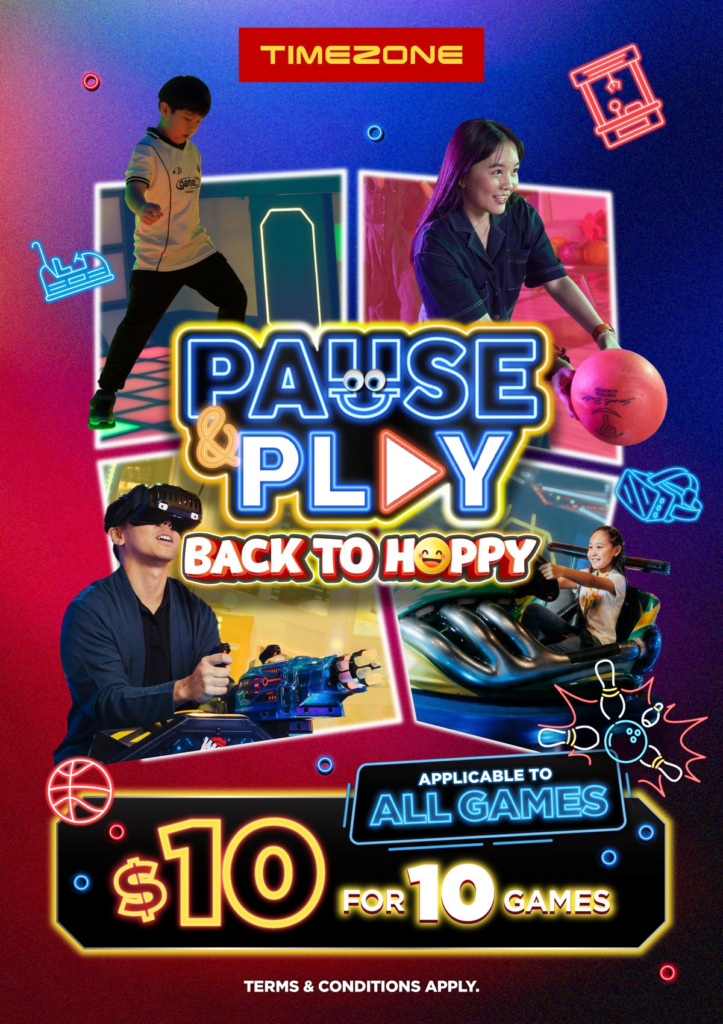
Timezone Singapore is tapping into Singapore’s hustle culture and screen fatigue with a new campaign title “Pause & play.” The campaign aims at getting people of all ages to consciously step away from work, study and devices, and reconnect through play. Running across April, May and June 2026, the campaign positions Timezone as a space for simple and restorative play, targeting students, working adults, families and seniors. The idea is built around intergenerational play, highlighting moments such as a student putting down her phone, a parent challenging a child at basketball, colleagues going head-to-head over arcade games, and seniors moving and laughing together. The campaign is anchored on three forms of play across Timezone venues islandwide: physical play (including basketball, ColorGrid and music games), creative play (such as Connect 4 and Animal Kaiser), and social play (including attraction games, shooting games and other group favourites).  Don’t miss: Can a NLB card game bring Singapore’s library history to life?  To drive trial and lower the barrier to entry, Timezone has introduced a limited-time “Pause & play” pack offering 10 games for SG$10, valid across all game categories. The pack will be available over two weekends at selected venues, and limited to the first 1,000 packs per location. On 25–26 April, the pack will be offered at Jurong Point, Waterway Point and Pasir Ris Mall, followed by Westgate, Northpoint City and Our Tampines Hub on 2–3 May. With games effectively priced from SG$1 each, the offer is positioned as one of the most accessible entry points into a full Timezone experience. To build buzz around the campaign, Timezone is also leaning heavily on social, created in collaboration with BDSA Marketing. A series of short-form videos across platforms taps trending audio, familiar formats and lighthearted comedy to show how different groups “press pause” and play. The content blends nostalgia with newness, spotlighting classic titles such as the anime-inspired Initial D drifting game alongside favourites such as Super Mario, timed to ride the buzz around The Super Mario Galaxy Movie theatrical release. By mixing retro throwbacks with current IP and platform-native humour, Timezone is positioning “Pause & play” as a socially led brand moment that feels at home in Singaporeans’ feeds, not just on the arcade floor. Beyond families and individuals, Timezone is also extending “Pause & play” into the workplace through the “Timezone corporate challenge”, described as a first-of-its-kind inter-company competition. The initiative is designed to encourage working adults to step away from their desks and compete in a friendly, high-energy showdown against colleagues and rival firms. Teams will face off in a five-game line-up featuring NBA Hoops, Skee-Ball, Color Grid, driving games and air hockey. Companies must win at least three out of five games to advance, with new match-ups each round. Organisations can express interest via Timezone Singapore’s social channels, with selected teams invited to upcoming rounds. At the end of each month, the top-performing company will be named monthly champion and awarded a hosted team-building experience at Timezone worth over SG$1,500, reinforcing the campaign’s message that shared moments of play can be just as valuable in the office as they are at home. Terms and conditions apply. Timezone said “Pause & play” will extend beyond its venues into communities where Singaporeans live and work, as the brand continues to position itself as a go-to destination for birthday parties, family gatherings and corporate team bonding and in essence, a place to pause from the demands of daily life and experience genuine, joyful connection through play.  “At Timezone, we have always believed that play has the power to bring people together and lift the everyday,” said Jacquline Ong, head of marketing, Timezone Singapore. “’Pause & play’ is our reminder that joy does not need to be planned or elaborate. It can be as simple as stepping away for an hour, laughing with the people around you, and leaving feeling just a little lighter,” Ong added.  The campaign comes as more brands tap into play as a response to rising screen fatigue and always-on lifestyles. From digital experiences to physical spaces, marketers are increasingly reframing play not as idle entertainment, but as a low-pressure way for audiences to disconnect and recharge. Earlier this month, Sanrio, for instance, introduced its gaming label alongside its first title “Sanrio party land”, positioning gameplay as a shared, feel-good experience built around nostalgia and social interaction. Similarly, a Baby Shark-themed staycation at Fairmont Singapore transformed hospitality into an immersive, play-led escape, blending themed rooms and activities to encourage families to unwind together.  Related articles:      M&M’S powers up Marvel tie-up with APAC gaming adventure AI has changed the game, now gaming marketers must fight harder to be seen Sentosa evolves brand to inspire wellness and balance with new campaign   source

Stressed out? Timezone asks you to press pause and play Read More »

APAC trust gap hits record high as income disparity doubles

The income-based trust gap in the Asia-Pacific (APAC) region has reached a historic high, more than doubling over the last 14 years. According to the Edelman Trust Barometer 2026, the disparity between high- and low-income earners has surged from seven points in 2012 to 16 points today. The 26th annual survey, which gathered insights from nearly 34,000 respondents across 28 countries, highlights a regional shift toward insularity—a defensive mindset where trust is reserved for the familiar and denied to the “different.” The report identifies four critical factors currently reshaping the psychological and economic landscape of APAC. First is a stronger preference for the familiar: trust in companies headquartered in respondents’ own country is higher than trust in foreign-headquartered companies in all seven APAC markets included in the analysis including China, Japan, Singapore, Malaysia, Australia, Indonesia and Thailand. Second is a more inward-facing information environment, reflected in a six-point year-on-year decline globally in getting information from sources with a different political leaning at least weekly.  Third is a widening mass-class divide, with the regional trust gap between high- and low-income respondents now at 16 points.  Fourth is the uneven optimism across APAC markets. Just 31% in Singapore and 36% in Thailand say the next generation will be better off than today, with double-digit year-on-year declines in Singapore, Thailand, India, and China. Concern about foreign actors spreading falsehoods has also risen by double digits in 6 of 9 APAC markets since 2021. The rise of domestic bias The “domestic trust advantage” has become a defining feature of the regional business environment. This preference for homegrown brands is most pronounced in Japan (29 points), followed closely by Singapore and South Korea (28 points). Furthermore, a “protectionist” sentiment is emerging; many respondents now support reducing the number of foreign companies in their country, even if it results in higher prices for goods and services. The APAC materials also include broader Trust Barometer findings showing globally, among those who say major societal events in the past five years have impacted their trust, institutional leaders have experienced net trust losses, led by national government leaders (–16pt net change), major news organisations (–11), and foreign business leaders (–6), while the net trust change was an increase for neighbours, family and friends (+11), coworkers (+11, among employees), and one’s CEO (+9, among employees).  Despite the challenges, the workplace remains a glimmer of hope. While government and media suffer from nearly 40-point gaps between public expectation and actual performance in “bridging divides,” 54% of employees believe their employers are successfully facilitating trust between groups. Rakesh Thukral, Edelman’s CEO for Asia Pacific, says: “The APAC findings show that trust is becoming more selective. When optimism weakens and concerns about falsehoods rise, people place greater weight on what feels known and close to home.” “This is also reflected in stronger trust in domestic companies across APAC markets, and in a more cautious outlook for the next generation in several markets. In that environment, organisations will need to focus more on bridging trust across divides by building safe spaces for dialogue, understanding and shared progress,” Thukral added. Mark your calendars for 24 June! #Content360 Hong Kong returns with a dynamic, one-day event dedicated to pivotal trends—from the silver economies to breakthrough IP collaborations, sports, and beyond. Let’s dive into the art of curating content with creativity, critical thinking and confidence! Related articles: How we can address healthcare’s trust gap with effective communicationAIA bucks the ‘trust gap’ trend in social source

APAC trust gap hits record high as income disparity doubles Read More »