marketing interactive

YouGov: Here are the brands winning hearts in SG this year

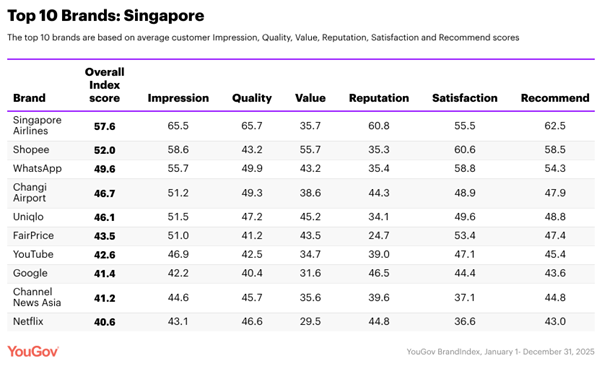
Singapore Airlines has emerged as the strongest brand in Singapore, topping YouGov’s 2026 “Best brand rankings” with an overall Index score of 57.6, according to the latest data from YouGov BrandIndex. The national carrier stood out for its performance across multiple metrics, including impression (65.5), quality (65.7), reputation (60.8) and recommendation (62.5), underscoring its continued strength in consumer trust and perception. The rankings are powered by YouGov BrandIndex and draw on over six million consumer surveys conducted across 28 markets. Brands are assessed using an overall Index score, calculated from six metrics: quality, value, consideration, satisfaction, reputation and recommendation, based on data collected between 1 January 2025 and 31 December 2025. Don’t miss: Consumers demand values and personalisation, but brands are falling short  Shopee ranked second overall with an Index score of 52.0, driven by strong perceptions of value (55.7) and satisfaction (60.6). Messaging platform WhatsApp followed closely at 49.6, performing well on satisfaction (58.8) and recommendation (54.3). Trusted local and regional brands also featured prominently. Changi Airport placed fourth with a score of 46.7, while FairPrice (43.5) and Channel News Asia (41.2) reflected sustained confidence in essential retail and news brands. Japanese apparel retailer UNIQLO (46.1) benefited from balanced perceptions across quality, value and recommendation. Digital and entertainment platforms rounded out the top 10, with YouTube (42.6), Google (41.4) and Netflix (40.6) highlighting the role of always-on platforms in Singaporeans’ daily lives. Separately, YouGov’s rankings also tracked brands with the fastest year-on-year improvement in brand health. Japan Airlines recorded the largest gain among major brands, posting a +5.9-point increase in its Index score. Top improvers are ranked based on year-on-year Index score improvement between January 1, 2024, and December 31, 2024. Brands must have scores available for at least six months to qualify for the top 10 and at least 18 months to qualify as most-improved. Quick-service restaurants dominated the most-improved list, led by KFC (+5.5), followed by McDonald’s (+3.6), Pizza Hut (+3.3) and Burger King (+3.9), pointing to strengthening consumer sentiment towards fast-food brands. Travel, digital and platform-led brands also saw notable momentum. Trip.com (+4.2) benefited from the continued recovery in travel demand, while TikTok (+4.2) reflected strong engagement with entertainment-led platforms. Taobao (+3.1), Deliveroo (+3.0) and Singtel TV (+2.9) completed the top 10 most-improved brands. “This year’s ‘Best brand rankings’ in Singapore show strong momentum not only for airlines, but also for quick-service restaurants and digital platforms, highlighting consumers’ growing focus on convenience, value and reliability, particularly for brands that are embedded in daily routines,” said Chi Wei Teo, general manager at YouGov.  She added, “At the same time, the continued strength of national champions such as Singapore Airlines, Changi Airport and Fair Price highlights the importance of trust and consistent performance in driving long-term brand health.” The YouGov rankings arrive as marketers navigate a rapidly evolving consumer landscape. According to Omnicom Media Asia Pacific’s latest trends report, 2026 marks a shift from passive audiences to active participants, with one in four consumers more likely to advocate for brands they feel engaged with. Interactive experiences, co-creation, and two-way engagement are becoming critical for brand relevance. Technology, particularly AI, is accelerating this change. From AI-driven search and smart sensors to livestreaming and social commerce, audiences increasingly control discovery and interaction, while digital and physical identities converge across platforms. In this environment, brands that combine personalisation, trust, and culturally relevant experiences stand to capture attention, loyalty, and advocacy in a market where consumers expect more than products—they seek meaningful connection. Related articles:   How brands can thrive, not just survive, on social media in 2026      Masculinity in Asia is being rewritten, and brands need to keep up   Study: 49% of women feel misunderstood by brands despite driving global spending source

YouGov: Here are the brands winning hearts in SG this year Read More »

5 new esteemed judges added to the Inaugural Content360 Awards

Following our previous announcement of the first 10 judges for the inaugural Content360 Awards, we’re thrilled to reveal that five new judges have joined the powerhouse roster of senior marketing and content leaders who will define excellence in the region’s content marketing landscape. As Asia’s new premier awards dedicated to content strategy, creativity and impact, the Content360 Awards champions the most innovative and effective work across brands and agencies. To uphold the rigorous standards of evaluation and ensure diverse perspectives across sectors, we’ve added five distinguished judges. We also sat down with Soren Beaulieu, regional content and strategy director at MARKETING-INTERACTIVE, to discuss what sets the Content360 Awards apart, how the judging process works, and what kinds of content the jury is excited to see. Meet our latest additions to the panel: Don’t miss: Meet your first 10 jury members for the inaugural Content360 Awards Linda Hassan, former chief marketing officer, Domino’s Malaysia / Singapore, Cambodia A results-driven marketing leader with over 25 years of experience, Linda Hassan played a central role in shaping growth strategies at Domino’s across Southeast Asia. She led across marketing, sales, digital, e-commerce, analytics, brand, CRM, operations and product development, driving measurable business impact. Passionate about digital transformation, Hassan is known for building high-performing teams and leading large-scale, data-driven change initiatives. Brenda Maderazo, deputy director, marketing – healthy lifestyle, Health Promotion Board (Singapore) Brenda Maderazo provides strategic leadership for integrated marketing communications at the Health Promotion Board, advancing Singapore’s national health agenda through public education and consumer engagement. Her career spans health, government, not-for-profit, education and media organisations, with multiple award-winning campaigns and large-scale fundraising initiatives. She also occasionally guest lectures at the National University of Singapore’s Saw Swee Hock School of Public Health. Lynn Chong, head of marketing, Samsung Electronics Singapore As head of marketing at Samsung Electronics Singapore, Lynn Chong leads integrated marketing across mobile, TV & AV, digital appliances, and Samsung’s connected ecosystem. She focuses on translating global innovation into culturally relevant, human-centric brand experiences for the local market. Known for premium brand building and data-led transformation, Chong pairs creative ambition with strong commercial discipline. Rachel Ma, director, group marketing, Yeo Hiap Seng (Yeo’s) Rachel Ma leads group marketing, insights and innovation at Yeo’s, shaping the next phase of growth for the heritage beverage brand. Her career spans beverages, nutrition, retail and fuels, with roles at Nestlé, Suntory (BRAND’S), Dairy Farm Group and Shell. Experienced across both established brands and emerging spaces, she brings a personal passion for nurturing local brands and talent. Tim Lindley, managing director, VaynerMedia Asia Pacific Tim Lindley leads VaynerMedia Asia Pacific, overseeing a 250-strong team across seven markets. A pioneer in social and culture-led marketing, his career spans Sony Music, Red Bull and BBH, where he helped scale brands into global content and media powerhouses. A 40 Under 40 winner, Lindley is known for spotting work that drives cultural relevance, creativity and measurable impact. Keen to see if your work is a cut above the rest? Enter the awards here. source

5 new esteemed judges added to the Inaugural Content360 Awards Read More »

Gen Z perspectives: The hype around BLACKPINK's Lisa & Brand Beckham

Happy Friday, MARKETING-INTERACTIVE readers and welcome back to Gen Z Perspectives, your go-to feature where we unpack the week’s top stories and trending topics through the eyes of Gen Z. From the biggest industry moves to viral moments and marketing controversies worth dissecting, we’re bringing the heat with authenticity, awareness and probably a few unfiltered takes. This week, BLACKPINK’s Lisa was everywhere. She was dancing her way into a NikeSKIMS campaign and sparking AI chatter for Tourism Authority of Thailand. Meanwhile, David Beckham’s calculated silence on his family drama was on point. Grab your popcorn, this is one you won’t want to miss. Don’t miss: Gen Z perspectives: SG govt pitches, Coca-Cola’s new digital chief & ChatGPT ads 1. Lisa pirouettes into NikeSKIMS’ ballet-inspired campaign NikeSKIMS is back with its latest Spring ’26 campaign, starring BLACKPINK’s Lalisa “Lisa” Manobal alongside professional ballerinas performing to a modern, breathy reimagining of Queen of the Night from Mozart’s The Magic Flute. Directed by Sergio Reis and filmed in Paris, the campaign celebrates the grace and strength of motion while highlighting Lisa’s artistry and passion for dance. The professional dancers help bring the Spring ’26 collection lookbook to life, showcasing how the pieces move with the body. Read more here.  2. Lisa’s ‘Amazing Thailand’ campaign gets scrutinised as perfect images breed AI suspicion The Tourism Authority of Thailand (TAT) has denied using artificial intelligence (AI) in its latest campaign featuring Thai pop star and BLACKPINK member Lalisa “Lisa” Manobal. The image, released under TAT’s “Amazing Thailand” banner, shows Lisa sitting in a wooden boat, gazing into the camera as she drifts along the Red Lotus Sea in Udon Thani province. The poster quickly became a topic of debate online, with some questioning whether the image had been digitally manipulated beyond traditional post-production. Read more here.  3. Why David Beckham’s response to CNBC post-family feud was a total win When football legend David Beckham sat down for an interview with CNBC this week, he did so under an unusually heavy shadow. A day prior, his eldest son Brooklyn Beckham had publicly accused David and his wife Victoria Beckham of prioritising “Brand Beckham” over the family, triggering a global media storm and renewed scrutiny of one of the world’s most carefully managed personal brands. Yet in the interview, Beckham did not address the situation head-on. Instead, he spoke broadly about the pressures of social media, mental health, his UNICEF work, and the idea that “children are allowed to make mistakes”. For PR and marketing leaders watching closely, the moment became a case study in restraint. Read more here.  Showcase your most innovative content and gain recognition from a panel of industry leaders by entering the inaugural Content360 Awards. Submit your work today and be part of the celebration that honours the campaigns defining the future of content marketing. Related articles: Why silence isn’t key to managing PropertyLimBrothers’ alleged scandal   lululemon names new SEA regional head of marketing  Why Sika Malaysia’s tiling competition is more than a trade event, it’s B2B marketing in action source

Gen Z perspectives: The hype around BLACKPINK's Lisa & Brand Beckham Read More »

Why marketers might be missing out banking only on big festive moments

The festive season is already in full swing with brands such as Coca-Cola, Starbucks, McDonald’s, Lalamove, and Astro, just to name a few, all unveiling their Chinese New Year campaigns in recent weeks, a flurry of activity that mirrored the Christmas surge in brand marketing.  Globally, advertising spend is on track to pass US$1 trillion for the first time in 2026, according to Dentsu’s December 2025 Global Ad Spend Forecast, with a projected 5.1% rise outpacing the global economy’s expected 3.1% growth, a reflection of how marketers continue to invest heavily in campaigns despite ongoing macroeconomic uncertainty. In Singapore, shopper behaviour also reflects the commercial weight of festive periods. Research shows that 43% of Singaporeans are more likely to purchase certain products, such as soft drinks, during the Lunar New Year period, with online advertising influencing 77% of consumers’ holiday shopping decisions and many planning purchases well ahead of peak dates. Yet, running campaigns during quieter festive periods could help brands cut through the clutter. So why do brands continue to cluster around the busier seasons? Industry players MARKETING-INTERACTIVE spoke to say this clustering around major festivals is no accident. Jayss Rajoo, director of marketing at Pizza Hut Singapore, described it as “part comfort, part muscle memory,” with big seasons offering predictable planning and measurable results. She added:  It’s safe, it’s convenient, it looks good in PowerPoint. Don’t miss: Singapore, here are the top festive films that reeled us in this CNY Nonetheless, all of the marketers we spoke to agree that the quieter moments in daily life offer opportunities for engagement that go beyond festive peaks. In fact, Rajoo pointed to payday dinners, rainy-day comfort food, or post-exam pizza parties as examples of micro-moments where brands can connect. “Every. Single. Day… That’s where connection lives,” she added. Meanwhile, brands such as Julie’s focuses on human storytelling that resonates across cultural lines. Tzy Horng Sai, director of Julie’s Biscuits, described these major festivals as “safe zones”, reliable spikes in attention and purchase intent. But he noted this focus on scale can come at the expense of depth, leaving smaller yet meaningful occasions largely underexplored. For example, this year, the brand’s Deepavali short film The Duel explored awkward family dynamics rather than spectacle, creating resonance that extends beyond the festival itself. Sai added:  The goal isn’t to occupy the festive calendar, but to live within people’s emotional calendars. Marketers must also embrace a layered approach, explained Linda Hassan, former group chief marketing officer at Domino’s Pizza Malaysia and Singapore. She said combining headline campaigns at peaks with steady, lower-cost touchpoints year-round would give the best bang for the buck. This includes social series, newsletters, evergreen videos, and loyalty activations, all designed to maintain relevance and build brand equity between major campaigns. She explained that ultimately, markets with strong cultural observances attract heavier investment because consumers are more inclined to buy, give gifts, or celebrate during these periods. Practical drivers such as historical sales data, retail calendars, and media-buy efficiencies also shape decisions. Representation isn’t a festival prop  Cultural representation is another key consideration for marketers. Rajoo warned that representation shouldn’t be treated as a festival prop. “If your ‘diversity’ only appears during Lunar New Year or Deepavali, you’re not being inclusive, you’re being seasonal,” she said. For Rajoo, achieving authentic representation means embedding diverse perspectives into team rooms, brainstorms, and briefs so that inclusion happens naturally rather than as an afterthought. When a team reflects the audience, cultural authenticity shows up effortlessly in campaigns, as she noted:  The best brands treat representation like seasoning, it should flavour everything, not just garnish the dish. Sai highlighted the importance of grounding campaigns in human stories that resonate across cultures. Julie’s short films, such as The Duel, focus on awkward family dynamics rather than spectacle, while campaigns such as Kisah Raya P.E.R.I.T. and The Worst Feng Shui Master explore single parenthood or hope after lockdown. “Every culture holds a mirror to human behaviour,” he said. “When we treat these stories with sincerity and respect, they begin to speak beyond their own boundaries. This isn’t a once-a-year exercise; it’s an ongoing dialogue with the people we serve.” For the experts, the takeaway is consistent: Thoughtful representation is a continuous effort. It’s not about checking boxes during high-profile festivals, but integrating authenticity and cultural nuance into the brand’s everyday voice and storytelling. Rethinking the marketing calendar Looking ahead to 2026, experts suggest that brands could benefit from a more balanced and layered approach to campaign planning. Rajoo likened it to a Spotify playlist, “Bangers for the big moments, mood tracks that keep the rhythm, and those deep emotional cuts you replay when no one’s watching.” For her, the key is consistency. “Festive spikes create attention, but everyday stories create affection. The real win is in staying in tune, not just when the lights are on, but when no one’s watching. Great brands don’t wait for the next chorus — they keep the track alive, remix it, and stay on people’s playlists all year,” she added.  Sai offered a similar perspective, comparing the approach to a symphony. “Festive moments serve as powerful crescendos, but the melody plays all year,” he said. He emphasised emotional resonance over spectacle, pointing to campaigns such as The Duel.  Hassan outlined a practical framework for balancing peak campaigns with ongoing engagement, recommending a three-layered calendar. “Start with strategic peaks for major campaigns tied to festivals or product launches, amplified with media and experiential elements. Layer that with a steady foundation of year-round storytelling and purpose-led content, product education, community initiatives,” she said. Finally, brands must insert short bursts for smaller cultural or interest-driven moments, such as Mother’s Day or Valentine’s, delivered through low-cost, high-frequency formats that give people reasons to engage. At the end of the day, brands may have mastered the fireworks moments, but they must remember that it is the quieter moments, when consumers are living their everyday lives, that holds the key to consistent engagement and long-term relevance. Related articles: Hari Raya 2025: Brand campaigns

Why marketers might be missing out banking only on big festive moments Read More »

Chasing tomorrow with today’s budget

As marketers enter 2026, the landscape continues to shift at a breakneck pace. Technology is fragmenting the ways consumers engage with brands, while generative AI and new devices are reshaping what a “presence” means in the market. The real question for brands and marketing leaders today isn’t just what’s new, but what’s worth investing in as technology evolves. Nick Seckold, regional vice president at Microsoft Advertising APAC, sees a balance emerging between the old and the new. “The audience is still the most important part of any marketing strategy because brands want to connect with consumers,” he said. However, he is cognizant that technology is enabling far greater fragmentation, making it harder for brands to remain relevant across multiple touchpoints. Seckold points to a key tension that has been engulfing the marketing industry in recent years: the tilt towards performance over brand. “In many cases, brand marketing has taken a backward seat to performance marketing – which I’m not sure is always a good thing,” he said. CMOs are under pressure to show measurable ROI, yet an over-reliance on short-term performance can often undermine long-term brand equity, he further explained. Meanwhile, search and content are evolving as entry points for consumers. “Five years ago, there were a couple of major search engines where people would typically start their journey, and then navigate to wherever they needed to go. Now, there are a lot more avenues consumers use to access the information for the content they are looking for.” The growing importance of platforms beyond traditional search, including AI-driven tools, is forcing marketers to rethink where they invest for maximum reach and influence. Generative AI is another force driving change. Seckold highlights how automation is now embedded across workflows in marketing: “We’ve been doing this for 18 months to two years. A lot of automation in workflows, whether at work or in advertising, is happening and will continue, including copy creation, content creation, optimisation, building campaigns, reporting, and insights.” For marketers, this means considering which technologies are essential for scaling productivity and which are “nice to have”. Taken together, these shifts make 2026 a year for careful decision making. With technology evolving rapidly and new channels constantly emerging, Seckold suggests marketers focus on understanding their audiences, investing in measurement, and diversifying their partners to avoid over-concentration. In an interview with MARKETING-INTERACTIVE, Seckold delves further into the key trends, strategies and tools marketers should prioritise – and where budgets should be allocated – as they plan for the year ahead. MARKETING-INTERACTIVE: With marketing being skewed heavily towards performance for so long, what do you think will ultimately prompt the shift back to brand building? Seckold: Well, the performance will probably start to decay over time. It will get more and more difficult to drive new consumers into the funnel and expose the brand or product to a new set of audiences. Where we see our customers and advertisers doing the best on our platform is when they have a mix of both mid-funnel or upper-funnel brand activity. We can directly see search lift, for example, when you’re interacting with a display or video ad on our network and then we see that user come in on search, and they typically perform or convert better. Marketers sometimes choose one or the other when it should be a mix of both, and it’s up to the marketers to decide what that right mix looks like. MARKETING-INTERACTIVE: With search no longer a predictable starting point for consumers, how do you see search evolving in the future, especially from Microsoft’s perspective? Seckold: Search is a big part of what we do. There’s no doubt that it is changing. Five years ago, there were a couple of major search engines where people would typically start their journey, and then navigate to wherever they needed to go. Now, there are a lot more avenues consumers use to access the information or content they are looking for. Search capabilities have expanded across many digital platforms, and new AI-powered tools such as Copilot now offer alternative ways for people to look up information. With consumers able to find answers from so many different entry points, the landscape has become far more complex. The 10 blue links on a search page are still really relevant. Our search volume has actually increased since the rise of Copilot, as more people come into our ecosystem. Search is not dead or dying, it’s evolving. As the Gen AI search experience improves and gets more intelligent, we’ll likely see more transactions happening through it. Search will continue to evolve over the next three to five years, and we see a really exciting future for search. MARKETING-INTERACTIVE: With so much technology out there, how can marketers decide what is a nice to have versus what’s a must have? And, of course, which vendors to trust? Seckold: Brands have to decide which partners and technologies they feel comfortable with and that follow the same business ethos as themselves. Valuing trusted brands is important if you’re giving away data to an LLM. You want organisations that are trustworthy, reputable, audited and follow responsible AI principles. Brand marketers must know what the problem is that they are trying to solve. Really understand that, and have a view of where AI might play a role. That will help direct the conversation, as opposed to saying, “come and tell me what you can do for me”. I’d always have a very clear view of the problem you’re trying to solve. MARKETING-INTERACTIVE: Which countries in the region are seeing the fastest adoption of Microsoft’s solutions and which ones are leading the way? Seckold: Our business is growing quite a lot. We are benefiting from the growth of Microsoft Windows, Copilot, and our solutions over time. For example,

Chasing tomorrow with today’s budget Read More »

AXS launches rewards programme

Singapore-based payments platform AXS has launched a new rewards programme, ‘AXS Rewards’, aimed at incentivising routine bill payments. AXS Rewards allows customers to earn and redeem rewards for bills paid via the AXS mobile app, building on the company’s long-running use of lucky draws and other incentives. The move reflects a broader trend in digital finance to recognise everyday financial habits. Under the programme, users earn AXS Coins for every bill payment, which can be redeemed for AXS vouchers to offset future bills. To mark the launch, users completing a single payment can redeem a guaranteed-win mystery box, with vouchers worth up to SG$88. Don’t miss: Loyalty marketing gets cute with plushie strategy  AXS plans to expand the rewards catalogue by the second quarter of 2026, including deals on food, beverages, travel, routine services and special experiences. The programme is now live on the AXS mobile app, with full eligibility and redemption details available within the app. As Singapore’s largest bill aggregator, with over 800 billing organisations across government, utilities, financial services and telecommunications, AXS said its platform remains a daily tool for millions of users. An internal survey of both AXS and non-AXS users found that more than half of respondents said utilities and telecommunications make up the bulk of their regular bill payments. In addition, nearly 53% of survey respondents prefer cashback and 41% eye loyalty points.  “Paying bills is an essential but uncelebrated part of daily life, and there’s always a desire for more value from services our users already rely on. AXS has always tried to incentivise it through our very popular lucky draws, and ‘AXS Rewards’ is another further step in the same direction to improve the bill management experience,” said Quah Chun Han, chief executive officer of AXS Payments. “When 1 in 3 working adults use our platform to pay and manage their bills, it only makes sense to make it worthwhile and gratifying for them,” he added.  Last year, AXS expanded its ecosystem through a partnership with Motorist, Singapore’s leading automotive technology platform. The collaboration enabled Motorist Super App users to make seamless AXS-powered payments for road tax, traffic offence fines, season parking, and eDay licences, removing the need to repeatedly enter vehicle details across multiple platforms. The integration also provides drivers with instant access to key motoring information, simplifying daily vehicle management for over 250,000 users. The tie-up demonstrates AXS’ broader focus on enhancing convenience and digital payments beyond traditional bill payments, extending its services into everyday automotive transactions and further embedding its platform into Singaporeans’ daily routines. Related articles:   Re-writing a contract of trust: Why SIA’s KrisFlyer overhaul feels personal How is SIA’s KrisFlyer programme revamp impacting consumer sentiment?   Will the Chocolate Finance’s CEO note post withdrawal blunder rebuild trust?  source

AXS launches rewards programme Read More »

Lisa pirouettes into NikeSKIMS' ballet-inspired campaign

NikeSKIMS is back with its latest Spring ’26 campaign, starring BLACKPINK’s Lalisa “Lisa” Manobal alongside professional ballerinas performing to a modern, breathy reimagining of Queen of the Night from Mozart’s The Magic Flute. Directed by Sergio Reis and filmed in Paris, the campaign celebrates the grace and strength of motion while highlighting Lisa’s artistry and passion for dance. The professional dancers help bring the Spring ’26 collection lookbook to life, showcasing how the pieces move with the body. The collection debuts a head-to-toe system of dress, featuring footwear, apparel, and accessories designed for women who want to move confidently and elegantly in every aspect of daily life. Drawing inspiration from modern ballerinas, the line offers a fresh take on performance silhouettes, blending style, comfort, and function. Footwear joins the system with the NikeSKIMS Rift Satin, a reinterpretation of the iconic Nike Rift. It features a satin upper, minimalist midsole, textured logo outsole, quick-entry strap, and the signature tabi-toe design, available in red and black. The Rift Satin completes the collection’s cohesive wardrobe, balancing style and performance from head to toe. “This Spring ’26 Collection celebrates the timeless poise and elegance of ballerinas with a modern twist. We obsessed over every detail – from soft lines and feminine colours to premium materials. Each piece is a statement of beauty and lets women move with confidence and grace,” Kim Kardashian, co-founder and chief creative officer, SKIMS, said. “When I’m performing, it’s all about looking great while still being able to move and dance,” Lisa said. “The NikeSKIMS collection is so comfortable and light that I feel confident wearing it everywhere, from rehearsals to travelling or even relaxing at home. It’s easy to move in, looks amazing, and fits perfectly into my everyday life.” In tandem, Jamie Jeffries, VP, global apparel, Nike, added: “The NikeSKIMS Spring ’26 Collection is a true head-to-toe system of dress, designed to make women feel confident and feminine. Every detail – style, function, and comfort – is considered so the pieces work seamlessly together. By combining Nike’s expertise in performance innovation with SKIMS’s inclusive fit and sculpting technologies, we’re delivering something truly unique for women everywhere.” Don’t miss: Lisa’s ‘Amazing Thailand’ campaign gets scrutinised as perfect images breed AI suspicion  Nike and SKIMS first joined forces in February last year, combining Nike’s expertise in sports innovation with SKIMS’ form-flattering design. The collaboration aims to revolutionise training apparel, footwear and accessories for female athletes worldwide.  Its first global campaign made waves in September last year, with the film titled “Bodies at work” featuring more than 50 athletes from Nike’s portfolio including  Jordan Chiles, Romane Dicko, Beatriz Hatz, Chloe Kim, Nelly Korda, Sha’Carri Richardson, Madisen Skinner and Serena Williams. The campaign also featured Kardashian who modelled the new NikeSKIMS collection while engaging in various sports.  Meanwhile, NikeSKIMS is not the only brand putting Lisa front and centre. Earlier this week, the Tourism Authority of Thailand released campaign images featuring the K-pop idol, which sparked social media debate over their “too perfect” appearance, with some users accusing the authority of using AI. Related articles:   Nike investigates alleged data breach following leak claims  Nike blends sports and Cantonese soup culture with pop-up in Guangzhou Kylie Cosmetics opens first standalone store in Singapore  source

Lisa pirouettes into NikeSKIMS' ballet-inspired campaign Read More »

Standard Chartered shifts gears with Formula 1 partnership

Formula 1 has appointed Standard Chartered as its official wealth management and corporate and investment banking partner under a multi-year agreement starting in 2026. Under the partnership, Standard Chartered will tap Formula 1’s global race calendar to engage clients and stakeholders, with the bank operating in nearly all markets where the sport hosts races. This includes enhanced trackside activations and hospitality experiences. The appointment comes as Formula 1 continues its commercial and fan growth, with the sport reaching 827 million fans worldwide, according to the organisation. Don’t miss: How Standard Chartered ditches the numbers to tell real stories of wealth As part of the deal, Standard Chartered will also extend its support to F1 Academy, the all-female racing series, with a focus on developing female talent and skills across motorsport, both on and off the track. “I am thrilled to welcome Standard Chartered, an incredible financial powerhouse, as a new partner to Formula 1. We are both truly global in nature, sharing fantastic locations around the world with the desire to drive performance and create experiences that excite people and bring them together. With Standard Chartered’s support for F1 Academy, I can’t wait to have them join us in the paddock and see what we can achieve together,” said Stefano Domenicali, president and CEO of Formula 1.  In tandem, Roberto Hoornweg, CEO, corporate and investment banking, Standard Chartered, said, “We’re proud to become an official partner to F1, which shares our relentless commitment to high performance, innovation, a world-class client experience, and distinctive global connectivity.” “F1’s footprint reflects our own cross-border network, with our presence in 19 out of 21 F1 race markets and many other countries where clients enjoy watching one of the most exciting, fastest-growing sports in the world,” he added.  Judy Hsu, CEO, wealth and retail banking at Standard Chartered said the partnership will allow Standard Chartered to leverage its international network to connect clients more closely with Formula 1, through exclusive and premium experiences. She added that the bank’s support of F1 Academy reflects its broader commitment to championing female talent and nurturing the next generation of motorsport professionals across its global footprint. The move comes as Formula 1 continues to draw major brand partners across categories. Last week, KitKat rolled out a multi-year global partnership with the sport, starting in Australia with a limited-edition F1-shaped chocolate product timed to the Australian Grand Prix in Melbourne from 6 to 8 March. The Nestlé-owned brand will launch the KitKat F1 Chocolate Car across major Australian retailers from January, backed by in-store activations, exclusive merchandise, consumer promotions and trackside fan experiences, with Australia and New Zealand acting as early test markets for the global deal. Related articles:   PepsiCo deepens F1 push with multi-brand Mercedes partnership   Mastercard drives into fast lane as McLaren’s F1 naming partner  Revolut revs up as title partner of Audi’s F1 team from 2026   source

Standard Chartered shifts gears with Formula 1 partnership Read More »

NAC brings climate grief and memory to life in hybrid metaverse exhibition

The National Arts Council (NAC) has launched “AfterForms,” a hybrid metaverse exhibition exploring climate grief, memory, and digital responsibility, as the third pilot project under its Project Arts Metaverse (PAM) initiative. Created in collaboration with TBWASingapore, “AfterForms” introduces four newly commissioned immersive virtual environments, alongside a physical exhibition at The Arts House. It also falls under NAC’s “Our SG arts plan”.  Positioned as a digital arts incubator, “AfterForms” examines how digital worlds inherit what physical ones erase. Rather than framing the metaverse as escapism or spectacle, the project treats it as a space where consequence, loss, and responsibility continue to accumulate. Don’t miss: National Arts Council spotlights creativity as a catalyst for confidence and curiosity  Visitors move between physical installations and virtual realms, shifting from observation to participation. Presence, movement, and breath actively shape each environment, with every interaction leaving a trace. The works explore how digital spaces can carry emotional residue, unresolved histories, and ecological grief forward. The exhibition features four commissioned works by Singapore-based and international artists. “Land erosion” by cultural medallion recipient Han Sai Por pairs sculptural installations with a corresponding metaverse environment. Visitors first encounter material traces of environmental loss before entering a virtual landscape shaped by erosion, where ecological collapse is experienced as embodied and inescapable. In “Drift alley”, artist Debbie Ding draws from the back lanes of Little India to create a fragmented digital environment of glitching shophouses and informal spaces. The work reflects precarious economies shaping both physical cities and emerging digital worlds. Spang and Lei’s “The wound is bigger than your Handyplast” transforms climate grief into an active condition. Set in a virtual rainforest, the environment responds to visitors’ breath and movement, with each interaction accumulating damage and memory rather than repair. “Memory factory” by LiteWerkz presents memory as a navigable digital structure. Visitors move through architectural fragments shaped by migration, misremembered homes, and speculative artefacts, positioning memory as mutable and continuously reshaped through participation. Alongside the virtual worlds, “AfterForms” also features a physical exhibition, an artists’ talk, workshops, and a digital art toolkit aimed at enabling artists with no coding experience to build their own virtual environments. “AfterForms” runs from 22 to 31 January 2026 at the Blue Room, The Arts House, Singapore. An artists’ talk titled “Worlds that refuse to disappear” will take place on 25 January. “’Project Arts Metaverse’ reflects NAC’s commitment to support new modes of artistic creation in the virtual space while building the sector’s digital capabilities. We empower artists to experiment with technology and explore ideas through the virtual worlds they are developing. ‘AfterForms’ demonstrates how digital environments can become sites of memory and cultural reflection that engage new audiences,” said Victor Ang, director, technology and innovation at NAC.  In tandem, Spang and Lei said, “Technology promises reinvention, but it cannot erase consequence. The metaverse exposes what we have already neglected. ‘AfterForms’ approaches it as a living archive of unresolved histories, emotional residue, and ecological memory. Every action becomes trace. Every choice persists. The future is not elsewhere. It is already sedimenting in the worlds we build.” The launch of “AfterForms” aligns with NAC’s wider engagement push. Earlier this month, the council rolled out a multi-year brand campaign, “Life. Better with the arts“, also developed with TBWASingapore, which encourages Singaporeans to see the arts as part of everyday self-improvement. Running from 9 December 2025 to 31 January 2026, the campaign spans social media, digital platforms, and digital out-of-home touchpoints, highlighting how encounters with the arts can unlock new perspectives, skills, and personal growth. Related articles: Singapore Repertory Theatre reimagines Macbeth in the metaverse through Roblox collaboration   Gaming meets grub: McDonald’s foray into the Minecraft world   AI has changed the game, now gaming marketers must fight harder to be seen source

NAC brings climate grief and memory to life in hybrid metaverse exhibition Read More »

MLBB redraws global eSports map as brands follow expanding audience

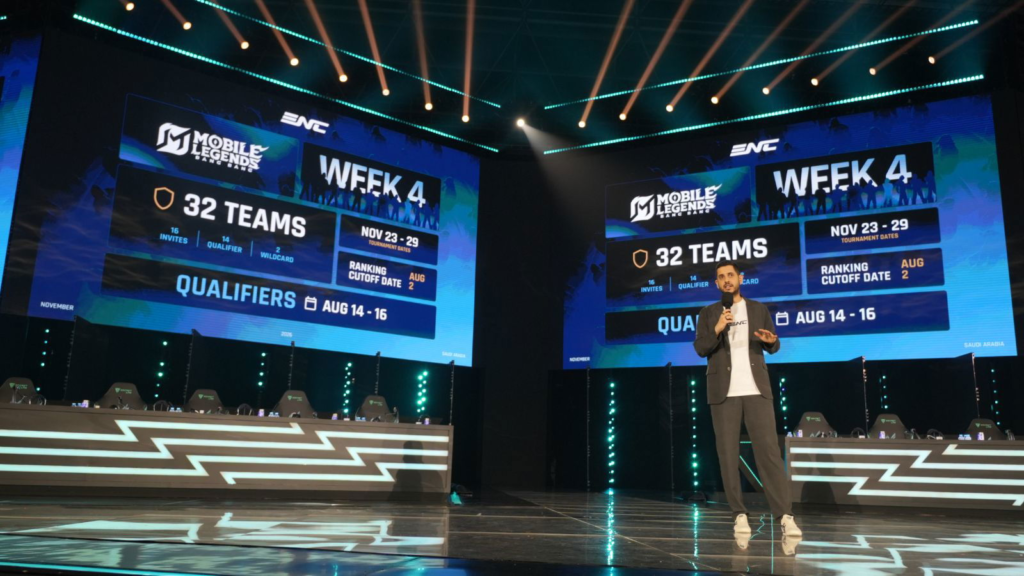
Mobile Legends: Bang Bang (MLBB) is accelerating its transformation from a Southeast Asia-centric gaming phenomenon into a globally scalable eSports and marketing platform, as publisher MOONTON Games rolls out a five-region overhaul designed to attract new audiences, partners and markets. Unveiled during the M7 World Championship Grand Finals in Jakarta, the 2026 MLBB Esports Roadmap sets out an ambitious blueprint that blends competitive restructuring with cultural localisation and commercial scale. At the centre of the strategy is a push into Europe and the Middle East, with Türkiye confirmed as the host of the M8 World Championship Finals in January 2027 – the first time the flagship M Series will be staged in Europe. Cloud Zhang, CEO of MOONTON Games, framed the roadmap as a decisive step in turning MLBB into a truly global entertainment property, rather than a regional eSports success story. Don’t miss: GOODSTUPH, Free Fire turn Indonesia’s bullet train into record-breaking esports arena The scale is already evident. The recently concluded M7 World Championship became the most-watched mobile eSports event in history, peaking at 5.68 million concurrent viewers, according to Esports Charts. For brands, those numbers reinforce MLBB’s appeal as a mass-reach, youth-driven platform at a time when traditional media continues to fragment. A five-region model built for scale From 2026, MLBB Esports will operate under a five-region structure: Southeast Asia (SEA); Eastern Europe and Central Asia (EECA); Europe, the Middle East and Africa (EMEA); East Asia (EA); and the Americas (AMER). The aim is to balance global integration with local relevance – a structure that mirrors how global brands increasingly organise their marketing operations. Central to this model is the Championship Tour, an intercontinental tournament piloted across AMER, EA and SEA. Designed to raise competitive standards while surfacing new talent, the tour also provides a consistent narrative and sponsorship asset across multiple markets. “With this blueprint, we’re taking a long-term view of what MLBB Esports can be. Every community will have the chance to grow and develop its own identity while remaining connected to a larger ecosystem. This transition is as much about integration as it is about expansion. By bringing emerging regions into the fold, we ensure that every market plays a central role in the competitive landscape. Layering development, competition, and community in this way allows each region to contribute meaningfully while strengthening the ecosystem as a whole,” said Tiger Xu, global head of MLBB Esports at MOONTON Games. For marketers, the region-led approach creates clearer entry points for partnerships – from local league integrations to global tournament sponsorships – while maintaining a unified global brand. Europe beckons, Thailand activates Türkiye’s role as host of the M8 World Championship Finals marks a symbolic shift in MLBB’s geographic focus. Long dominant in Southeast Asia, the title is now betting on emerging growth in Europe, Eastern Europe and the Middle East, regions where mobile gaming adoption is rising but large-scale eSports ecosystems are still maturing. “Hosting the M8 World Championship in Türkiye is a defining moment for MLBB Esports. For the first time in M Series history, we’re stepping beyond our Southeast Asian strongholds and expanding its footprints in a new region. This move reflects our confidence in the growth of emerging MLBB regions and our focus on integrating them into a broader, connected ecosystem,” Xu said. “Strategically, the M8 World Championship shapes MOONTON Games’ approach to regional integration and reinforces our vision for a unified, global competitive ecosystem. It also lays the foundation for sustainable, long-term development, positioning MLBB Esports for continued leadership in the years ahead.” Thailand will simultaneously host the M8 Wild Card, its first-ever M Series event, reinforcing Southeast Asia’s continued importance as both a competitive and commercial core. From eSports to sporting legitimacy Beyond standalone tournaments, MLBB is also deepening its presence on the global sporting stage – a move that significantly enhances its brand proposition. The title has been confirmed as the first game for the inaugural Esports Nations Cup (ENC) 2026 in Riyadh, Saudi Arabia, where 32 national teams will compete under a nation-based format. MLBB will also debut as a medalled event at the 20th Asian Games Aichi-Nagoya 2026, placing it alongside traditional sports in one of Asia’s most prominent multi-sport events. “Our participation at the Esports Nations Cup 2026 and 20th Asian Games Aichi-Nagoya 2026 are defining moments for MLBB Esports. Competing on stages built around national representation elevates the meaning of what our athletes are playing for. It places MLBB in the same conversation as traditional sports, where competition carries cultural significance, national pride, and long-term sporting value,” Xu added. For brands, these appearances signal a shift in eSports from subculture to mainstream sporting entertainment – expanding the pool of non-endemic sponsors willing to invest. Brands, broadcasters and a record-breaking M7 The commercial momentum was on full display at M7 in Jakarta. Global brands including Visa, Red Bull and realme came onboard as partners, underlining MLBB’s growing appeal beyond gaming-native advertisers. According to Esports Charts, the Grand Finals between Aurora Gaming PH and Indonesia’s Alter Ego peaked at more than 5.68 million concurrent viewers, with strong performance across Indonesian, Tagalog and Malaysian language broadcasts, as well as TikTok Live. “The record peak shows how quickly mobile eSports is growing and attracting mainstream audiences. The tournament also broke multiple viewership records across platforms and regions… These results set a new benchmark for future mobile eSports events,” said Artyom Odintsov, co-founder and CEO of Esports Charts. Indonesia, in particular, remains a cornerstone market. MPL Indonesia has recorded over 100 million hours watched in each of its past five seasons, reinforcing the country’s role as both a fan and revenue engine. Building long-term business models MOONTON Games is also refining its league economics. From 2026, MLBB Professional League Malaysia will shift to a partnership programme, granting eight strategic partners guaranteed slots and greater access to commercialisation opportunities – a model increasingly favoured by publishers seeking financial sustainability. Alongside MLBB, MOONTON is also expanding its competitive portfolio. Magic Chess: Go Go staged its first offline global championship

MLBB redraws global eSports map as brands follow expanding audience Read More »