marketing interactive

Opera Academy Singapore names new director of marketing communications

The Opera Academy Singapore has appointed Jon Tan as its new director of marketing communications.  In his new role, Tan will oversee integrated marketing, institutional communications, long-term brand strategy, and audience growth through digital pathways. He will also spearhead the development of the Academy’s Chinese Opera portfolio from curriculum and programme design to talent pathways and corporate collaborations. This is part of a long-term roadmap to develop a multi-operatic ecosystem that mirrors Singapore’s diversity and positions the academy for the next wave of cultural innovation, Tan told MARKETING-INTERACTIVE.  Don’t miss: People movements that caught Singapore’s eye in 2025  The appointment carries a personal resonance for Tan whose grandparents were early troupe members of the Chit Hoon Teochew Opera Company in the 1950s. “Discovering that my grandparents had performed with one of Singapore’s early Teochew opera troupes reminded me that tradition and innovation do not sit on opposite ends of a spectrum; they can fuel each other,” he said. Tan brings years of experience in branding and communications, with prior collaborations with the academy’s founders dating back to the mid-2000s through creative start-ups and national community programmes at the Singapore Sports Council. “The shared history, trust, and clarity built over two decades gives us the momentum to build something meaningful for the next generation,” he added. In his previous roles, Tan was senior vice president, brand, communication and partnerships at OrangeTee, marketing team lead at Far East Organisation and senior vice president, corporate communications at ERA Singapore among others.  “Stepping into this role marks both a professional milestone and a deeply personal journey. At Opera Academy, we have the opportunity to bring Asian operatic arts into a new era, shaped by technology, fresh storytelling, and an inclusive spirit,” Tan said.  Looking ahead, Tan will lead the launch of the Asian Operatic Museum, an ambitious project in partnership with SCAVAI Alliance, blending immersive storytelling, AR, VR, and interactive media to reimagine Singapore’s Five Kings and regional legends. The academy will also continue community-level engagement campaigns, youth programmes, and collaborations with orchestral and cultural institutions. Opera Academy has built a track record of engaging the community and reviving traditional operatic art forms. Its Malay Bangsawan programmes have proven especially successful, and past initiatives include the Singapore Bangsawan Festival, a multi-day festival featuring performances, workshops, and digital exhibitions that bring traditional opera to modern audiences across community venues. Related articles:   Pixlr Group names new marketing director   Klook bolsters leadership with new SVP of growth marketing role PUMA restructures brand marketing, names new chief brand officer   source

Opera Academy Singapore names new director of marketing communications Read More »

Bata elevates Malaysia's head of marketing to dual Malaysia–Singapore role

Footwear retailer Bata has expanded the remit of its head of marketing for Malaysia, Iman Zulkifli, to also lead Singapore in a dual-market role. Iman, who was appointed Bata Malaysia’s head of marketing in July 2024, first joined the brand in 2022 as a regional marketing project manager for APAC. She previously held positions at Media Prima, including head of audience for Gen Z, and roles at Fly FM, Ais Kacang, Likely, Studio8, TV3, and TV9, as well as stints at Voila, Don’t Panic/Aesthetics, Astro, and Hotshoes Malaysia. Officially stepping into her expanded role in November 2025, Iman now oversees brand, retail marketing, CRM, digital, social, visual merchandising, and customer service across both markets. Beyond the title, she sees the role as a chance to redefine what Bata stands for: “The real job is to rebuild what Bata stands for. In product, in experience, and in culture. We want every interaction to feel intentional, modern, and considered. Whether a teen discovers us on TikTok in KL or a commuter buys work shoes in Singapore, the reaction we’re aiming for is: ‘This is Bata now?’” Don’t miss: Bata Malaysia and artist Arif Rafhan blend heritage and art for exclusive Raya packets Iman emphasised that while Malaysia and Singapore are geographically close, they are very different markets. “My goal isn’t to force sameness; it’s to create one brand truth expressed in two distinct ways. Singapore is intentional and fast. Malaysia is expressive and value-smart. The magic happens when customers feel like the brand understands their world, not a generic Southeast Asian consumer. “That’s where marketing becomes meaningful,” she said. Looking ahead to 2026, Iman said the focus will be on reinvigorating curiosity and redefining Bata’s value proposition. “2026 is the year we stop being modest about our strengths. Value-driven doesn’t mean low-end. Comfort doesn’t mean boring. Heritage doesn’t mean outdated.” “Our job next year is to tell real product stories and elevate the shopping experience, make people look at Bata and think, ‘I didn’t expect this.’ That spark is what will power our next chapter,” she added.  Iman will report directly to Rabi Hasnabi, Bata’s managing director of Singapore and Malaysia.   Iman’s expanded role comes after Bata Malaysia country manager Rabi Hasnabi (pictured far right) was promoted in June to managing director for both Malaysia and Singapore. The move reflects a broader company restructure, consolidating the previously separate country manager positions into a single MD role overseeing both markets. He had been the country manager of Malaysia for a year and a half. Prior to that, he was the country manager and head of franchising for APAC based in Singapore. Hasnabi also spent four years as the country manager for Singapore.  “We’re entering a new era for Bata. One where the brand, the product, and the experience finally move in the same direction. Singapore is our biggest opportunity for reinvention, a market waiting to be upgraded. Malaysia is our anchor—strong, familiar, and full of momentum.” Hasnabi added that the aim is to align the fundamentals first. “A sharper brand. A stronger, more modern product story. A shopping experience that feels warm, seamless, and unmistakably Bata.” When we get those fundamentals right, growth isn’t forced, it becomes inevitable. In a parallel move, the Czech brand has also appointed former Ecco CEO Panos Mytaros (pictured centre) as its new group CEO, succeeding Sandeep Kataria. The appointment, made in September, marks four months since Mytaros assumed the role. Prior to joining Bata, he spent nearly 30 years with Ecco, bringing extensive industry experience to his new position. Related articles: AI is reshaping beauty, but can fashion keep its soul?Beyond the clapback: How humour and rivalry are winning Malaysian consumers Bata Malaysia steps forward with new eCommerce website source

Bata elevates Malaysia's head of marketing to dual Malaysia–Singapore role Read More »

What's truly driving conversion in performance marketing?

Performance marketing in Southeast Asia is changing fast. Instead of just focusing on small optimisations, marketers now have to adapt to bigger shifts such as new technologies, changing consumer habits, and the rise of creator-led commerce. Across large companies and small businesses, teams are turning to AI tools, affiliate programmes, and new ways of working with partners to get results they can actually measure. The shift has been years in the making, shaped by rising digital adoption, the normalisation of short-form video consumption, and heightened pressure on budgets. But 2025 marked a decisive break from the past: performance is no longer a question of efficiency alone. It is increasingly about adaptive systems that learn, personalise, and predict at speed – and about strategies that move fluidly across content, conversation, and commerce. According to Sandhya Devanathan, VP for India and Southeast Asia at Meta, these changes are happening everywhere in the region. “This year, we saw a real shift in how businesses approach performance marketing,” she said. “AI isn’t just a buzzword anymore, it’s something advertisers of all sizes are actually using to get better results.” This article unpacks where the region is headed and what marketers should be prioritising in 2026. Don’t miss: Meta to use AI chats to personalise ads and content across platforms Why AI became the performance engine AI’s impact on content creation has been widely discussed, but in performance marketing its influence has been deeper – and more foundational. Devanathan described the shift simply as “speed to value.” AI now decides, at pace, which creative resonates with which person and at what moment. It keeps relevance high and wasted spend low. Automated systems such as Meta’s Advantage+ handle the operational heavy lifting – budget pacing, creative rotation, and audience signals – allowing teams to focus on strategy and storytelling. The shift is particularly evident in Southeast Asia, where adoption of platform-based AI tools has surged. Deloitte’s “AI for Business: APAC Trends in AI Platform Adoption“, commissioned by Meta, found that Vietnam leads the region, with 93% of businesses using AI tools in platforms, primarily for customer communication (66%) and new customer acquisition (63%). Indonesia follows at 79%, using AI largely for marketing new products (65%) and customer communication (61%). Malaysia sits at 78%, with usage driven by communication (51%) and product marketing (50%). Thailand is at 77%, leaning heavily on customer communication (69%) and discovery of new customers (51%). Despite this, the study also highlights familiar barriers: data privacy concerns (up to 69% in Vietnam), connectivity issues (notably 50% in Malaysia and 42% in Indonesia), and, in some markets, a degree of platform scepticism. Devanathan acknowledged these concerns: “The concerns I hear most are about data privacy, connectivity, and trust in platforms. These are real issues, and they vary by market.” Her view is that growth and governance must coexist – and that privacy-safe tools such as Conversions API and robust measurement frameworks help bridge the gap. The performance funnel is now a loop One of the most significant changes AI has introduced is the collapse of the traditional funnel. Discovery, validation, and purchase are no longer separate phases. “The funnel has become a loop,” Devanathan said, noting that a single user journey can now move from Reel to product research to chat-based clarification to purchase – all within one platform and sometimes a single session. AI makes this possible by translating signals into action instantly: it senses intent, selects the right creative, and routes the person to the next best step, whether that’s a message thread, a shop, or a lead form. This fluidity places new pressure on creative variety and responsiveness. AI-driven personalisation means the “winning” ad is constantly refreshed, allowing campaigns to stay contextually relevant across placements and formats. For marketers, the mandate is shifting: define objectives clearly, maintain high-quality signals, and supply a diverse creative palette – then allow automation to compound gains over time. Lessons from Southeast Asia’s messaging-first markets No region has leaned into conversational commerce quite like Southeast Asia. Businesses here routinely rely on chat to close sales, answer enquiries, and build trust – making AI-powered business messaging a high-impact lever for performance outcomes. Consider the Philippines, where small and mid-sized businesses often operate with lean teams. White Coat Manila, a family-run medical apparel brand, integrated Business AI on Messenger and quickly saw operational gains. As co-founder Franco Ongkingco shared: “AI for business messaging is a true game-changer. It handles hundreds of basic inquiries from our customers swiftly and accurately. The savings for us in both time and expense have helped us focus our efforts on growing our business.” Peculiar Eyewear in the Philippines has reported similar outcomes, citing the ability to manage surges in customer questions while maintaining conversion momentum. Across the region, the logic is consistent: the faster a question is answered, the less likely a basket is abandoned. Automation that compounds, not replaces Some of the strongest traction in Southeast Asia is coming from AI systems that turn complexity into sustained performance advantage. Devanathan pointed to several examples. Advantage+ automation has been a standout, with Singapore’s Allies of Skin demonstrating how automated creative selection, flexible audience expansion and signal-driven optimisation can deliver measurable results without the need for constant human intervention. Conversational AI is also reshaping the path to purchase: Business AI on Messenger and WhatsApp is closing the gap between interest and conversion, a pattern seen repeatedly among local businesses. Meanwhile, generative AI creative tools are helping marketers feed the system with the diverse creative assets required to uncover new audience pockets – a shift that is quickly becoming central to modern performance playbooks. Yet Devanathan stressed that automation doesn’t replace human talent. Execution may be automated, but the strategic decisions remain deeply human. AI excels at scale, speed, and pattern

What's truly driving conversion in performance marketing? Read More »

Lufthansa Group unveils new brand identity

Lufthansa Group is rolling out a new brand identity, featuring a refreshed logo, broader colour palette, and dedicated font, all reflecting its evolution into a unified airline group. The goal of the new brand identity is to make the strength of the Lufthansa Group more visible. For customers, service offerings will be bundled under the group brand, making them more clearly recognisable. The rebrand reflects Lufthansa Group’s evolution from a collection of airlines into an integrated airline group, according to Dieter Vranckx, chief commercial officer, Lufthansa Group. He said: “In a challenging environment, this step creates a visual anchor of trust for our customers. A visual identity in aviation must do much more than just create an eye-catching appearance. It will reflect our strategic brand values and a promise we want to make to our passengers across all our brands.”  The new brand identity seeks to enable a holistic brand experience, provides orientation, and strengthens identification with the Lufthansa Group. It is recognisable by the iconic crane logo, which will be used for the group in the future without the surrounding circle. In addition, there is a new font and a colour palette expanded by six new tones. The latter represents different heights from the ground to the sky to reflect the diversity of the Lufthansa Group.   The airlines of the Lufthansa Group will keep their own brands under the umbrella of the strengthened group brand. The endorsement of “Member of Lufthansa Group,” which will appear on all aircraft belonging to the group’s airlines, signals the unity of the individual airlines that operate under a brand name other than Lufthansa. The addition was already introduced this year on digital boarding passes, websites, and 160 aircraft of various Lufthansa Group airlines. Next year, the Lufthansa Group brand will also be visible at lounge entrances worldwide, as is already the case in Rome, Milan, and Brussels. The “Member of Lufthansa Group” label will also be visible on materials at airports, such as baggage tags, and on board aircraft.  MARKETING-INTERACTIVE has reached out to Lufthansa Group for more information. Don’t miss: PepsiCo unveils new global brand identity after 25 years Back in November, Lufthansa Group partnered with digital bank Klarna and financial technology platform Adyen to offer travellers flexible payment options. Lufthansa Group customers can gain access to Klarna’s payment solutions—powered by Adyen’s global payments infrastructure—when booking travel experiences. The collaboration highlights Lufthansa Group’s commitment to customer-centric innovation, Klarna’s mission to provide smarter payment solutions, and Adyen’s role as a reliable payments partner facilitating seamless global commerce. Together, these three companies are reimagining the travel booking experience to enhance transparency, convenience, and control for passengers. Related articles: Lufthansa Group names new APAC marketing headPepsiCo unveils new global brand identity after 25 yearsUpper House refreshes brand identity for global expansion source

Lufthansa Group unveils new brand identity Read More »

Paul Soon takes helm as McCann and MullenLowe Singapore merge

Following the news of the Omnicom-IPG merger, McCann and MullenLowe Singapore are set to combine under the leadership of Paul Soon (pictured center). Soon, who was previously CEO of MullenLowe Singapore will continue as CEO of the combined agency (McCann Singapore), managing local client continuity and integrating MRM and MullenLowe Singapore tech teams. He will also guide AI, Adobe and other technology partnerships. In addition, Gonzalo Olivera (pictured right) will become president of the merged organisation from 1 January, overseeing creative, strategy, delivery, and operations to align the two teams into a single, seamless structure for clients and international accounts. He was previously managing partner of MullenLowe Singapore for over three years and has been with the agency since 2008, initially based in Madrid before relocating to Singapore in 2013. Don’t miss: DDB SG CEO Jeff Cheong parts ways with Omnicom as merger retires legacy brands   Brandon Cheung (pictured left), CEO of McCann Singapore and Southeast Asia, will support the transition into early 2026, ensuring stability for teams and clients. Cheung has been with McCann for nearly 12 years, joining in 2013 as digital strategy director for the McCann Cathay Pacific Central Team. He later became managing partner at McCann Worldgroup Hong Kong, overseeing the global creative and media business for Cathay Pacific Airways. He was promoted to Hong Kong CEO in 2019, then to regional director of global clients and business leadership in 2021, before stepping into the role of CEO, Southeast Asia in April this year. With more than a decade in the network, Cheung is deeply familiar with the Southeast Asia region, where many of McCann Worldgroup’s global clients are headquartered. Before joining McCann, he held roles at Tribal DDB as regional digital strategy director and at Isobar as strategic planning director. While MullenLowe is joining TBWA in most markets globally, Singapore is a strategic exception. The move reflects the size, nature, and complementary strengths of the two agencies locally, according to Sean Donovan, president of Omnicom Advertising Asia. “This decision follows a detailed, market-by-market review conducted by Omnicom. In Singapore, the size and nature of the businesses made McCann and MullenLowe a more natural fit. The two agencies have a proven history of collaboration in pitching and client work in the market, they bring complementary strengths and share a longstanding IPG heritage,” said Donovan. “Bringing them together creates a future-ready creative powerhouse for Singapore and the broader region,” he added.  The merged agency will offer clients a broader suite of capabilities, underpinned by strengthened creative leadership and deeper regional infrastructure. MullenLowe Singapore brings a track record of award-winning creative work, while McCann contributes a global network and regional scale. Together, the agencies create a single, integrated partner capable of delivering faster problem-solving across multiple markets. Leveraging Omnicom’s intelligence platform, Acxiom’s data, and its connected content engine, the new agency aims to enhance its capabilities in data, technology, and production, enabling more targeted and efficient campaigns across the region. “Our priority right now is continuity. The two teams have worked together before, and this integration simply formalises a partnership that already existed in practice,” Donovan said. “Clients will continue to receive uninterrupted support from the senior leaders they already know well. The integration will strengthen client service with stronger tools, deeper expertise, and greater senior attention,” he added. The merger builds on a long-standing collaboration between the two teams, including recent regional campaigns such as Singapore’s Ministry of Digital Development and Information’s “Together, for better” and Philips’ “Effortless rush hour” in Thailand. The move comes amid a sweeping post-merger restructure by Omnicom following its US$13.3 billion acquisition of Interpublic. The integration will retire several longstanding agency brands, including DDB, FCB and MullenLowe, consolidating overlapping networks into three global creative networks: BBDO, McCann and TBWA. Reports indicate more than 4,000 jobs will be cut as part of the immediate post-merger realignment. Omnicom’s own announcement did not reference the retirement of these brands, but the updated organisational structure on its new website confirms the shift, with DDB, FCB and MullenLowe no longer appearing. Related articles:    TBWA’s leadership for Greater China, SG and MY unchanged amid Omnicom-IPG merger   James Hawkins departs IPG Mediabrands APAC as merger reshapes region Omnicom Media unveils new leadership structure for APAC   source

Paul Soon takes helm as McCann and MullenLowe Singapore merge Read More »

Gen Z perspectives: Your top stories of 2025

Happy Friday, MARKETING-INTERACTIVE readers and welcome back to Gen Z Perspectives, your go-to feature where we unpack the week’s top stories and trending topics through the eyes of Gen Z. From the biggest industry moves to viral moments and marketing controversies worth dissecting, we’re bringing the heat with authenticity, awareness and probably a few unfiltered takes. As the year winds down, we’re looking back at the stories that had everyone talking: big moves, bold campaigns and the agency shakeups that made headlines. Thanks for riding along this year. We’ll see you in 2025. Don’t miss: Gen Z perspectives: Omnicom-IPG restructure, Agency Agenda & Shangri-La’s global media pitch 1. 5 people movements that caught the Malaysian industry’s attention Leadership transitions have taken centre stage in Malaysia’s corporate and marketing landscape this year, with key organisations strengthening their communications, customer experience, and brand strategy capabilities. Across sectors ranging from telecommunications and finance to FMCG, automotive, and national institutions, companies are appointing leaders who bring deep expertise in stakeholder engagement, transformation, and reputation-building. In this roundup, we spotlight five influential people moves shaping Malaysia’s leadership landscape—highlighting the appointments, the experience behind them, and the signals they send for the year ahead. Read more here.  2. 2025 in review: Campaigns that turned heads in Singapore 2025 has been a wild ride for marketers. From nostalgia-fuelled activations that brought memories back to life, to unexpected collaborations that had Singaporeans stopping in their tracks, and food-focused campaigns that turned ordinary moments into shareable experiences, brands pulled out all the stops this year. Creativity has been at an all-time high, and the results prove that you don’t need a screen to make an impact. Here’s our roundup of the five campaigns that truly defined the year, proving that marketing isn’t just about selling; it’s about creating moments people actually remember. Read more here.  3. When scale meets strategy: Agency shake-ups that shaped 2025 2025 has been a transformative and highly dynamic year for the global marketing and advertising industry. Holding companies and major agencies moved aggressively, reshaping the landscape through mergers, acquisitions, realignments, and rebrandings. Longstanding rivalries ended, reporting structures were overhauled, and global networks expanded its creative and data capabilities in pursuit of scale and efficiency. We have tracked five of the biggest agency shake-ups this year, highlighting just how fast the landscape is evolving. Read more here.  Related articles: AI tools and innovations that reshaped marketing in 2025    2025 in review: Malaysia’s campaigns that won hearts and feeds  People movements that caught Singapore’s eye in 2025 source

Gen Z perspectives: Your top stories of 2025 Read More »

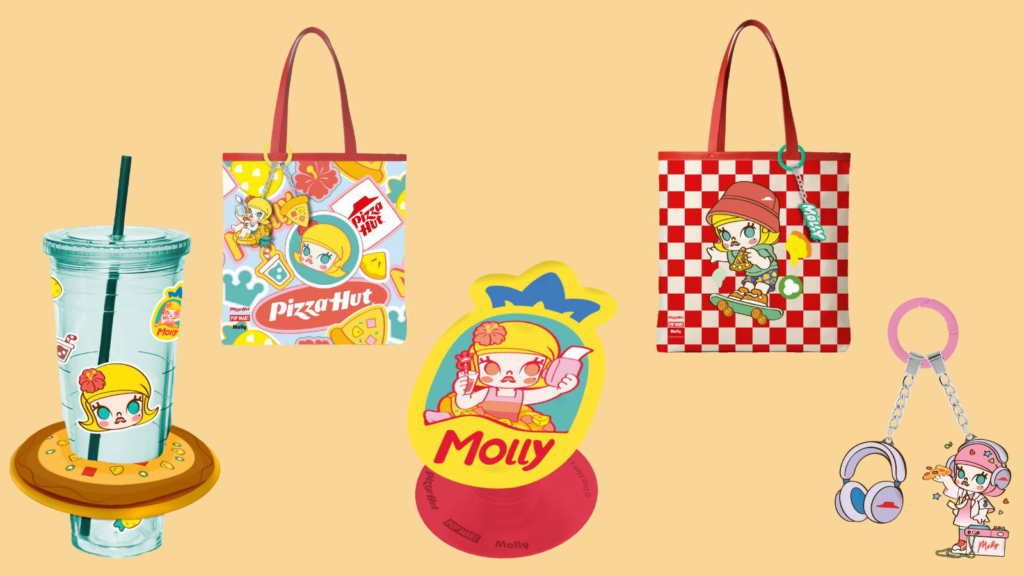
Pizza Hut SG teams up with POP MART for exclusive Molly merchandise

Pizza Hut Singapore has teamed up with designer toy brand POP MART to launch a limited-edition Molly merchandise collaboration exclusive to the local market. Launching on 15 December, the collection will be available only via Pizza Hut’s website and app, with no retail or POP MART store distribution. The collaboration features three original Molly designs created exclusively for the brand: Tropical Molly, Skater Molly and DJ Molly. The merchandise lineup includes a Tropical Molly water tumbler, Skater Molly and Tropical Molly tote bags with charms, as well as a DJ Molly keychain and Tropical Molly PopSocket. All items are available while stocks last. Don’t miss: POP MART cracks open SEA’s collectibles craze with Lazada partnership To purchase the collectibles, customers must order any cheesy bites bundle via the Pizza Hut app or website and select the “Molly add-on” within the bundle. The merchandise is limited to delivery and self-collection orders and will not be available for walk-in purchases. In conversation with MARKETING-INTERACTIVE, Jayss Rajoo, director of marketing and food innovation at Pizza Hut, said the choice of Molly was driven by the rising appetite for pop-culture collectibles among Gen Z and millennial consumers. She said the collaboration is designed to enhance meal appeal while tapping into the collector market to drive traffic. “Molly embodies the spirit of fun, independence, and celebration,” Rajoo said, adding that the partnership aligns with Pizza Hut’s festive theme of “Do merry your way” by encouraging consumers to celebrate in ways that reflect their personal identity. She added that the primary audience includes Molly collectors, pizza lovers and consumers seeking festive collectibles, with the broader aim of attracting new fans while deepening loyalty among existing customers. Marketing efforts for the campaign are centred on digital and social platforms, which Rajoo said closely mirror Molly’s audience behaviour. The app- and website-exclusive mechanics are intended to create a seamless digital purchase journey, supported by social content designed to build excitement around the collaboration. While Rajoo said Pizza Hut continues to explore different partnership formats that resonate with customers, she described the POP MART collaboration as a way for the brand to extend beyond the dining experience by offering exclusive collectibles that add “an extra layer of excitement and delight.” She added that the brand remains open to future collaborations with other designer toy partners. The festive collaboration taps into the growing popularity of collectible culture while giving fans a Pizza Hut-exclusive take on the globally recognised Molly character. The POP MART collaboration builds on Pizza Hut Singapore’s broader push into collectible-led marketing this year. In April, the brand launched a limited-edition plushie named “Sir Melts-a-Lot”, inspired by its cheeseburger melts, as part of a strategy to tap into nostalgia and self-expression among Gen Z and millennial consumers. Positioned as more than a novelty item, the plushie was part of Pizza Hut’s wider effort to reclaim joy and play in 2025. Designed with a detachable patty and multiple customisation options, “Sir Melts-a-Lot” was packaged in a bespoke box tailored for its style-conscious audience. Beyond Pizza Hut, POP MART has also ramped up brand partnerships across Southeast Asia as lifestyle collectibles continue to gain traction in mainstream F&B marketing. In September, modern tea brand CHAGEE teamed up with POP MART’s Hacipupu character to launch a limited-time green grape milk tea alongside exclusive merchandise across Singapore, Malaysia, Indonesia and Thailand. The regional campaign was designed to fuse the ritual of tea drinking with collectible culture, anchored by “CHAGEE’s little champion”, a tennis-inspired pop-up experience aimed at driving foot traffic and social sharing. Related articles: Pizza Hut SG stretches into pop culture with Fantastic Four-inspired pizza    Pizza Hut SG serves style with first streetwear collab    From crust to cuddles: Pizza Hut SG launches cheeseburger-inspired plushie source

Pizza Hut SG teams up with POP MART for exclusive Molly merchandise Read More »

McCann APAC and Singapore chief creative Valerie Madon steps down

Valerie Madon has stepped down from her role as chief creative officer for Asia Pacific and Singapore at McCann Worldgroup. Going forward, creative leadership will sit fully within the Singapore model under Daniel Kee, augmented with additional Omnicom Advertising talent where appropriate, confirmed Sean Donovan, president, Omnicom Advertising Asia. Donovan added that Madon has been “a tremendous ambassador for the agency and for creativity across the region, shaping work, teams and culture with heart and conviction. We are deeply grateful for her impact and leadership through a period of transformation.” Madon said, “The incredible clients and team I’ve worked with have reinforced how precious human creativity still is, even in an AI-driven world.” “I’m grateful for my time at McCann and am excited to see where my creative hunger and brand-building experience will take me,” she added. Madon most recently served as chief creative officer for Singapore from March 2025, alongside her role as chief creative officer for APAC, which she has held since August 2023. She was also appointed chief creative officer for Southeast Asia in May 2023. During her time at McCann, Madon was the APAC creative lead for Mastercard and Ferrero. Drawing on her experience at Meta, she has also strengthened McCann Content Studios APAC by blending data-driven insights with platform creativity, securing social-led wins for brands such as L’Oréal Thailand and Chick-fil-A Singapore. Don’t miss: How are industry players coping with the consolidation wave? At McCann, Madon launched and led the ‘Ambition Collective’, an APAC programme designed to train and showcase emerging talent. She was also instrumental in the success of ‘Shape My Portfolio’, a mentorship platform she introduced in 2024 that offered aspiring creatives one-on-one portfolio reviews from industry leaders. Madon joined McCann from Meta, where she was director of creative shop for SEA and emerging markets. Before that, she was chief creative officer, Asia at VMLY&R, where she also served as global creative lead for Zespri.  Her earlier roles include SEA chief creative officer at Havas, head of creative shop, SEA at Facebook, and chief creative officer at JWT Singapore, with previous stints at Publicis Modem Singapore, Leo Burnett and XM Asia Pacific. Madon’s departure comes as McCann and MullenLowe Singapore are set to combine under the leadership of Paul Soon. Soon was previously CEO of MullenLowe Singapore and will continue as the new CEO of McCann Singapore. Leading alongside Soon is Gonzalo Olivera who will become the merged organisation’s new president from 1 January. Olivera was previously managing partner of MullenLowe Singapore.  Brandon Cheung, CEO of McCann Singapore and Southeast Asia, will support the transition into early 2026. The move follows the Omnicom–IPG merger, which is streamlining roles across the new combined group and retiring several longstanding agency brands, including DDB, FCB and MullenLowe, as networks consolidate into three global creative networks: BBDO, McCann and TBWA. Despite the consolidation across several global networks, TBWA’s leadership structure for Greater China, Singapore and Malaysia will remain unchanged following the merger. Under the current structure, Joanne Lao will continue as CEO of TBWA Greater China, Mandy Wong will remain as president of TBWA Singapore, while Yee Hui Tsin stays on as CEO of TBWA Malaysia. In a statement to MARKETING-INTERACTIVE, a spokesperson from Omnicom Advertising said its leadership structure in Asia remains unchanged due to the complementary footprint of the Omnicom Advertising and IPG creative agency brands. Some new roles will be announced in January. Related articles:  DDB SG CEO Jeff Cheong parts ways with Omnicom as merger retires legacy brands Leigh Terry exits IPG Mediabrands APAC amid Omnicom–IPG integration   James Hawkins departs IPG Mediabrands APAC as merger reshapes region      source

McCann APAC and Singapore chief creative Valerie Madon steps down Read More »

Sanrio brings Mr. Men Little Miss to the big screen

Mister Men, a Sanrio Group company, is set to develop a Mr. Men Little Miss feature film in collaboration with production company Heyday Films and studio STUDIOCANAL. Originally launched as a series of children’s books in 1971, Mr. Men Little Miss celebrates emotions, individuality, and universal storytelling, values established by Roger Hargreaves. Since its acquisition by Sanrio in 2011, the brand has expanded globally while staying true to its original spirit. Today, its colourful cast now spans over 90 characters, including special editions inspired by cultural figures.  In collaboration with the studios and producers behind Paddington, the film adapts the beloved, globally iconic characters created by British writer and illustrator Roger Hargreaves. It brings the ambition, humour, and imaginative world of Mr. Men Little Miss to the big screen for the first time, offering a visual and emotional family experience that delights both children and adults. This film builds on two recent developments in the Mr. Men Little Miss universe: the animated series currently streaming on YouTube and a second animated series in production for television. Together, these initiatives highlight Sanrio’s strategy to expand the brand into dynamic entertainment platforms while maintaining publishing as its foundation. Blending a rich heritage with fresh storytelling, the film will honour the humour, personality and warmth that made the original characters iconic, while inviting new audiences around the world to discover Mr. Men Little Miss in a bold, contemporary and cinematic way. Don’t miss: Sanrio’s Hangyodon makes a splash at the Singapore Oceanarium Tomokuni Tsuji, president and CEO, Sanrio, said: “We are thrilled to share Mr. Men Little Miss—one of Sanrio’s strongest IPs with British iconic roots—with audiences worldwide through this film. With more than 90 characters, Mr. Men Little Miss stories will serve as ambassadors of joy, creating smiles and widening the circle of happiness.” “In collaboration with STUDIOCANAL and Heyday Films, whose award‑winning creativity we deeply admire, this project advances our long‑term vision to build an IP platform delivering next‑generation joy as a global entertainment company,” he added.  David Heyman, producer, Heyday Films, said: “The globally beloved books of Mr. Men and Little Miss offer an irresistible opportunity for a bold and imaginative feature film adaptation.  I’m delighted to be partnering with STUDIOCANAL and Sanrio on what promises to be a captivating new creative adventure in the evergreen world of Mr. Men and Little Miss.” Anna Marsh, CEO of STUDIOCANAL, chief content officer of CANAL+ and deputy CEO of CANAL+, said: We are so thrilled and honoured to be working with our close friends and partners at Heyday and Sanrio in bringing Hargreaves’ wonderful and iconic characters to the big screen for the very first time. An incredible privilege, and an undeniable opportunity for joy, mischief, and adventure – that we know will inspire and delight theatrical audiences, young and old, around the world today. We can’t wait to get started!” MARKETING-INTERACTIVE has reached out to Sanrio for more information. Related articles: CHAGEE and Sanrio sweeten the holidays with Tanned Hello Kitty collabFestival Walk taps Sanrio and Baby Mirror to celebrate ChristmasSanrio’s Hangyodon makes a splash at the Singapore Oceanarium source

Sanrio brings Mr. Men Little Miss to the big screen Read More »

Global advertising revenue to grow 8.8% in 2025, APAC second largest

The global advertising revenue is expected to grow by 8.8% in 2025, reaching US$1.14 trillion, with a 7.1% growth projected for 2026, according to a report by WPP. Titled “This year next year”, the 2025 end-of-year advertising forecast aims to provide a fresh perspective on how global trends in culture, commerce, government, and technology are shaping the industry and what this means for marketers in the months and years ahead. The report focuses on media owner revenue, tracking top sellers across over 60 markets. The top 350 advertisers account for less than a quarter of total industry revenue, while the top 25 media sellers represent over 70%. The methodology evaluates economic factors and channel-level revenue for a precise advertising forecast. The global economy has stabilised despite US tariffs, with the International Monetary Fund (IMF) projecting GDP growth of 7.4% in 2025 and 6.8% in 2026. Inflation is estimated at 4.2% in 2025, decreasing to 3.7% in 2026. Key drivers of this improvement include the reduced impact of tariffs and the AI investment boom. Consequently, WPP now expects ad revenue growth of 8.8% in 2025, up from 7.7% predicted in December 2024. Regional advertising revenue forecasts Following Latin America, APAC is the second-largest region for advertising, accounting for 31.6% of global revenue and featuring four of the top 10 markets: China, Japan, India, and Australia. Ad revenue is projected to grow by 6.4% in 2025 to US$361.8 billion, followed by 6.6% in 2026, stabilising around 5% growth through 2030. While geopolitical tensions may pose challenges, reduced tariff impacts and rising consumer confidence, along with new AI-driven businesses, could further boost growth. China’s advancements in AI and robotics are expected to create opportunities first in Asia before expanding to Europe or North America. North America’s total advertising is projected to grow by 12.3% in 2025, reaching US$452.9 billion, with further growth of 7.5% anticipated in 2026. Meanwhile, the advertising market in the Middle East and Africa is expected to grow by 6.9% in 2025, reaching US$21.6 billion, followed by a 7.4% increase in 2026.  The European advertising market is also set for robust growth, projected to expand by 5.8% in 2025 to US$257.6 billion, with an additional 5.5% increase expected in 2026. Media forecast The media forecast is divided into four main segments reflecting clients’ motivations for allocating their media budgets. The largest segment, content-driven advertising, is expected to account for 58% of total ad revenue in 2025, decreasing to 55.1% by 2030. This segment includes forecasts for TV, audio, newspapers, magazines, social media, and gaming. Social and digital platforms represent the primary growth engine for content-driven advertising, reaching US$413 billion in 2025 (+12.8%) before advancing to US$445.4 billion in 2026 (+7.8%). Gaming is the fastest-growing content advertising channel, projected to reach US$8.5 billion in 2025 (+29.5%) and US$10.7 billion in 2026 (+25.6%), though it will account for only 0.7% of total ad revenue in 2025, rising to 0.9% in 2026. Meanwhile, traditional linear channels continue to face structural declines, with magazine advertising experiencing the steepest drop in the content sector, projected to fall by 7.2% to US$15.6 billion in 2025, and a further 10.7% decline to US$14 billion in 2026. The next largest component, accounting for 21.4% in 2025, is intelligence—primarily derived from search ad revenue but expanding to include ad revenue from AI platforms. Meanwhile, commerce is expected to account for 15.6% of total global ad revenue in 2025, reaching US$178.2 billion and surpassing total TV ad revenue for the first time. Commerce is projected to account for 15.6% of global ad revenue in 2025, reaching US$178.2 billion and surpassing TV ad revenue for the first time. This reflects the transition of commerce media from an experimental channel to a key component for many advertisers. Growth is expected at 11.6% in 2025, slowing to high single digits through 2030, when the segment may reach US$268.3 billion (17.2% of total ad revenue). Finally, location-based advertising, comprising out-of-home (OOH) and cinema, is expected to grow 6.3% in 2025 to reach US$56.9 billion globally. This category continues to demonstrate resilience relative to other traditional media, with OOH maintaining its share of total advertising at 4.8% in 2025 and projected to remain stable at between 4.6% and 4.8% through 2030. Category trends In addition to tracking the financials of the world’s leading advertising sellers, the report also maintains composites of the largest global advertisers across nine categories: consumer packaged goods (CPG), retail, media and entertainment, technology, financial services, automotive, pharmaceuticals, luxury, and business-to-business (B2B). The CPG advertising landscape is set to enter a more normalised phase of growth in 2026 following years of pandemic-driven volatility and inflation-driven margin pressure. For CPG companies excluding alcoholic beverages, the 2024 median advertising as a percentage of revenue stood at 7.8%. WPP expects the 2025 advertising ratio to be slightly lower as companies adapt to tariffs, input cost pressures, and some consumer weakness in key markets.  In terms of media, total advertising spend is estimated to grow 8.3% in 2025, with an additional 9.9% increase anticipated in 2026. The median advertising share of total revenue is expected to be broadly similar at 4.6%.  However, retailers face a challenging environment with tariff-driven pricing pressures, increased competition from smaller players, and the balance between short-term sales and long-term brand building. Holiday sales forecasts are mixed, as consumers expect higher prices due to inflation but remain open to promotions. Retailers are prioritising omnichannel strategies to engage customers at all touchpoints and are increasingly focusing on brand heritage through anniversary campaigns and archival creative. While digital channels are key, retailers are also expanding their evaluation of social platforms beyond the largest media owners. Advertising growth in the media and entertainment category is forecast to be 2.6% in 2025 and 6.3% in 2026. This is projected to outpace overall category revenue growth in 2025 (+1.8%) and match it in 2026 (+6.3%). The technology category composite includes hardware-focused companies such as HP, Xiaomi, LG, Samsung, Apple, Lenovo, Dell, and Nintendo. Median advertising as

Global advertising revenue to grow 8.8% in 2025, APAC second largest Read More »