EMBARGOED REPORT: Decline of Christianity in the U.S. Has Slowed, May Have Leveled Off
source
EMBARGOED REPORT: Decline of Christianity in the U.S. Has Slowed, May Have Leveled Off Read More »


Americans are deeply divided over Donald Trump’s plans and the way he is handling his job in the early weeks of his return to the presidency. Overall, 47% of U.S. adults approve of how Trump is handling his job as president, while 51% say they disapprove. And most of these views are strongly held: 37% strongly approve of his performance, while 40% strongly disapprove. Roughly a third (35%) say they support all or most of Trump’s policies and plans, with 17% saying they support some of them. Nearly half of adults (47%) say they support only a few or none of his plans. Most Americans (73%), including majorities of both Republicans and Democrats, say Trump has clear goals for where he wants to lead the country. But Republicans are more likely to say he’ll be successful at achieving those goals. How does Trump’s approval so far stack up against his first term? Trump’s current 47% approval rating is higher today than it was at the beginning of his first term in office. His rating is also higher than at any other point in his first four-year term, and far higher than when he left office in early 2021 (Trump’s approval fell to 29% in the wake of the 2020 presidential election and his rejection of its results). Trump’s job ratings remain as polarized by party as ever: 84% of Republicans and Republican-leaning independents currently approve of the job Trump is doing. By comparison, just 10% of Democrats and Democratic leaners approve of Trump’s job performance. The current partisan gap in Trump’s approval ratings is on par with much of his first term, though wider than in the last weeks of his term (when 60% of Republicans approved of his job performance). Trump’s job approval among demographic groups Today, Trump’s job approval stands at 47%, including 37% who say they strongly approve of the way he is handling his job as president. About half of Americans (51%) say they disapprove of Trump’s job performance so far, including four-in-ten who say they strongly disapprove. Trump’s ratings are more positive than negative among: Men (52% approve) White adults (55%) Adults 50 years and older (51%) High school diploma or less (53%) Trump’s ratings are more negative than positive among: Women (42% approve) Black adults (19%) Hispanic adults (36%) Under 50 years old (43%) College degree or more (40%) Trump’s personal traits, skills, fitness for office The public offers mixed assessments of Trump’s personal traits – including his leadership skills, mental fitness and physical fitness. 40% of Americans are extremely or very confident Trump has the leadership skills to do the job, while 43% are not too or not at all confident he does (16% are somewhat confident). Similarly, 39% have high confidence in Trump’s mental fitness for the presidency, while 44% have little or no confidence in this and 16% have some. And while 35% are extremely or very confident Trump is physically fit for the job, 41% are not too or not at all confident of this (24% express some confidence). On the three other dimensions asked about on the survey (choosing good advisers, acting ethically in office and respect for U.S. democratic values), substantially more Americans express little or no confidence in Trump than say they are extremely or very confident in him. 29% of Americans are at least very confident he acts ethically in office. A majority (54%) are not too or not at all confident he does. 31% are extremely or very confident he respects the country’s democratic values. A 53% majority lacks confidence in Trump on this trait. 31% are confident he picks good advisers, while 51% have little or no confidence that he does. Republicans’ views of some of Trump traits more positive than during 2024 campaign Among Republicans Today, a majority of Republicans are at least very confident in Trump across all six traits asked about on the survey. In particular, Republicans express a great deal of confidence when it comes to his leadership skills (76%), mental fitness (75%) and physical fitness (65%). Smaller majorities of Republicans express confidence that he acts ethically in office (55%), picks good advisers (60%) or respects the country’s Democratic values (60%). Still, Republican confidence that Trump acts ethically and picks good advisers is higher than it was in April 2024. Among Democrats Democrats express little to no confidence in Trump on any of the dimensions asked about on the survey. These views are nearly identical to Democratic opinion in April 2024. Will Trump be a successful or unsuccessful president in the long run? Americans are divided in their views of whether the Trump administration will be successful in the long run. While 35% say they think Trump will be successful in the long run, a similar share (33%) say they think he will be unsuccessful. Roughly three-in-ten (31%) say it is still too early to tell whether he will be successful. In a Center phone survey from January 2017, at the start of Trump’s first administration, most Americans (58%) said it was too early to tell whether or not he would be a successful president. About equal shares predicted he would be successful (21%) as said he’d be unsuccessful (20%). Today, far smaller shares say it is too early to tell what kind of president Trump will be – though those who offer a prediction remain divided about whether he will be successful or unsuccessful. As has long been the case for presidents, partisans have very different predictions: About two-thirds of Republicans say Trump will be successful, while 63% of Democrats say he will be unsuccessful. The reverse was true when Joe Biden took office. Trump’s agenda, plans and early executive actions Americans are also split in their support for Trump’s policies and plans, though more say they support few or none of Trump’s plans than say they support all or most of them. About a third (35%) of U.S. adults say they support all (9%) or most
1. Trump’s second term: Early ratings and expectations Read More »
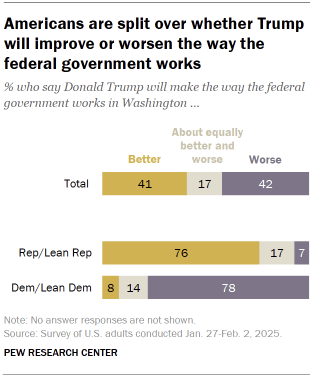
Americans are split over what impact Donald Trump will have on the way the federal government works: About as many say he’ll improve it as say he’ll make it worse. And more Americans expect ethics and honesty in government to fall (rather than rise) with his administration. The public is also split – and divided along partisan lines – in its assessments of Vice President JD Vance, Trump’s other high-level appointments and most congressional leaders. Elon Musk is viewed more negatively than positively. Trump’s influence on the way government works When it comes to the way the federal government in Washington works, 41% of Americans say Trump will make things better, while a nearly identical share (42%) say he will make things worse. Far fewer (17%) say his impact will be an equal mix of better and worse. 76% of Republicans and Republican-leaning independents say Trump will improve the way government works. By contrast, 78% of Democrats and Democratic leaners say Trump will worsen the way government works. More Americans expect ethics and honesty in the federal government to fall, rather than rise, with Trump as president Nearly half of Americans (47%) think the overall level of ethics and honesty in the federal government will fall with Trump as president, while 31% say ethics and honesty will rise. Roughly two-in-ten (22%) say the level of ethics and honesty in the federal government will stay about the same. Republicans and Democrats diverge over how the level of ethics and honesty in government will shift during Trump’s administration: 59% of Republicans say it will rise with Trump as president, 29% say it will not change and 11% say it will fall. By comparison, 82% of Democrats say it will fall with Trump as president, 12% say it will stay the same and 5% say it will rise. Views of Trump’s Cabinet and other high-level selections Public approval of Trump’s Cabinet picks and other high-level appointees closely tracks his overall approval rating: 46% of Americans say they approve of Trump’s selections, while 52% disapprove. Roughly eight-in-ten Republicans (83%) approve of Trump’s choices, compared with just 11% of Democrats. Public evaluations of Trump’s staffing choices today are similar to views of his choices on the eve of his first term. In a phone survey conducted in the weeks before he first took office eight years ago, 41% of Americans said they approved of Trump’s appointments. By contrast, clear majorities of Americans approved of the Cabinet and high-level appointments of Trump’s recent predecessors in surveys conducted as each began their terms: George H.W. Bush (59% approved), Bill Clinton (64%), George W. Bush (58%), Barack Obama (66%) and Joe Biden (57%). Views of Vice President JD Vance Americans are divided over Vice President JD Vance’s qualifications to be president: 47% say he is qualified, while 49% say he is not. Evaluations of former Vice President Kamala Harris were also fairly evenly split as she took office in early 2021 (50% qualified, 47% not). Former Vice President Mike Pence was, on balance, seen as qualified by the public (54% qualified, 30% not) in a phone survey conducted shortly after the 2016 election. Evaluations of Vance largely track with partisanship: 80% of Republicans say Vance is qualified for the job of president, while 82% of Democrats say he is not. Vance’s influence in the administration A majority of Americans (58%) say Vance will have about the right amount of influence within the Trump administration. About three-in-ten (28%) say he will have too little influence, and even fewer (13%) say he will have too much. Republicans overwhelmingly expect Vance to have the right amount of influence within the administration: 82% say this. Democrats are divided in their views: 43% say Vance will have too little influence, 34% say he will have the right amount of influence and 22% say he will have too much. Favorability of congressional leadership House Speaker Mike Johnson Three-in-ten adults rate House Speaker Mike Johnson favorably, while about as many (33%) view him unfavorably. Roughly a third (35%) say they have never heard of Johnson. (Congressional leaders weren’t identified by title or party in the survey.) Johnson’s ratings have improved somewhat since spring of last year, when 24% rated him positively and 37% rated him negatively. This improvement is largely due to shifting Republican views: 51% of Republicans now rate Johnson favorably, up from 39% last year. Senate Majority Leader John Thune Of the top congressional leaders, new Senate Majority Leader John Thune is the least well known: 60% of Americans say they have not heard of him. Those who do know Thune are divided in their evaluations of him: 17% of all adults view him favorably, 20% unfavorably. House Minority Leader Hakeem Jeffries Ratings of Democratic House leader Hakeem Jeffries are also relatively evenly split (28% favorable, 26% unfavorable). More than four-in-ten Americans (44%) have never heard of Jeffries – down from 51% who had never heard of him a year ago. Senate Minority Leader Chuck Schumer Ratings of Chuck Schumer, who has led Senate Democrats since 2017, remain more negative than positive: 28% view him favorably, while 46% view him unfavorably. A quarter have not heard of Schumer. Views of Robert F. Kennedy Jr. and Elon Musk Robert F. Kennedy Jr. The public is split in its evaluations of Robert F. Kennedy Jr., Trump’s nominee to lead the Department of Health and Human Services: 47% have a favorable opinion, 45% an unfavorable opinion. Kennedy, a former Democrat, is viewed negatively by nearly three-quarters of Democrats (74%), while 77% of Republicans view him positively. Elon Musk Trump recently appointed Elon Musk – the owner of Tesla, SpaceX and X (formerly Twitter) – to lead the new Department of Government Efficiency, a team within the administration. Musk is viewed more negatively than positively overall. More than half of Americans (54%) express unfavorable views of the billionaire, while 42% view him favorably. 73% of Republicans view Musk favorably, while about a quarter (24%) view him
2. Views of Trump administration, congressional leadership Read More »

Classifying parties as populist Although experts generally agree that populist political leaders or parties display high levels of anti-elitism, definitions of populism vary. We use three measures to classify populist parties: anti-elite ratings from the 2019 Chapel Hill Expert Survey (CHES), Norris’ Global Party Survey and The PopuList. We define a party as populist when at least two of these three measures classify it as such. CHES, which was conducted from February to May 2020, asked 421 political scientists specializing in political parties and European integration to evaluate the 2019 positions of 277 European political parties across all European Union member states. CHES results are regularly used by academics to classify parties with regard to their left-right ideological leanings, their key party platform positions and their degree of populism, among other things. We measure anti-elitism using an average of two variables in the CHES data. First, we used “PEOPLE_VS_ELITE,” which asked the experts to measure the parties with regard to their position on direct vs. representative democracy, where 0 means that the parties support elected officeholders making the most important decisions and 10 means that “the people,” not politicians, should make the most important decisions. Second, we used “ANTIELITE_SALIENCE,” which is a measure of the salience of anti-establishment and anti-elite rhetoric for that particular party, with 0 meaning not at all salient and 10 meaning extremely salient. The average of these two measures is shown in the table below as “anti-elitism.” In all countries, we consider parties that score at or above a 7.0 as “populist.” The Global Party Survey, which was conducted from November to December 2019, asked 1,861 experts on political parties, public opinion, elections and legislative behavior to evaluate the ideological values, issue position and populist rhetoric of parties in countries on which they are an expert, classifying a total of 1,051 parties in 163 countries. We used “TYPE_POPULISM,” which categorizes populist rhetoric by parties. We added only “strongly populist” parties using this measure. In Italy, experts were asked to categorize the Center-Right coalition instead of individual parties within the coalition. The coalition includes Lega, Forza Italia and Brothers of Italy. For all three parties, we have used the coalition rating of “strongly populist.” The PopuList is an ongoing project to classify European political parties as populist, far right, far left and/or euroskeptic. The project specifically looks at parties that have “been represented in their country’s national parliament at least once” since 1989. It is based on collaboration between academic experts and journalists. The PopuList classifies parties that emphasize the will of the people against the elite as populist. This appendix uses The PopuList 3.0. Classifying parties as left, right or center We can further classify these traditional and populist parties into three groups: left, right and center. When classifying parties based on ideology, we relied on the variable “LRGEN” in the CHES dataset, which asked experts to rate the positions of each party in terms of its overall ideological stance, with 0 meaning extreme left, 5 meaning center and 10 meaning extreme right. We define left parties as those that score below 4.5 and right parties as those above 5.5. Center parties have ratings between 4.5 and 5.5. source
Appendix: Classifying European political parties Read More »

Küresel standartlara göre ABD’de dini milliyetçilik nispeten düşük düzeydedir ancak diğer yüksek gelirli ülkelere kıyasla öne çıkmaktadır Bu basın bülteni orijinal İngilizceden Türkçeye çevrilmiştir. Otuz altı ülkeyi kapsayan yeni bir Pew Research Center anketinde orta gelirli ülkelerde yaşayan insanların yüksek gelirli ülkelerde yaşayan insanlara göre “dinî milliyetçi” (religious nationalists) olma olasılıklarının daha yüksek olduğu bulundu. Ancak dinî milliyetçiler anket yapılan hiçbir ülkede nüfusun çoğunluğunu oluşturmuyordu. Bu raporda, anketimizde dinin ulusal kimlik ve yönetimdeki rolüyle ilgili dört temel sorunun tamamına karşı güçlü bir dindar tavır takınan ve ülkelerinin tarihsel olarak baskın diniyle özdeşleşen kişiler “dinî milliyetçi” (religious nationalists) olarak sınıflandırılmaktadır. Anket yapılan ülkeler arasında dinî milliyetçiliğin yaygınlığı büyük ölçüde farklılık göstermektedir: Almanya ve İsveç’te ankete katılan yetişkinlerin yüzde 1’den azı kriterleri karşılarken, Endonezya’da (%46) ve Bangladeş’te (%45) bu oran yüzde kırkın üzerindeydi. Bu analizde ABD’li yetişkinlerin yalnızca %6’sı “dinî milliyetçi” (religious nationalists) olarak sınıflandırılırken, ABD’li yetişkinlerin ankete katılan diğer yüksek gelirli ülkelerdeki insanlara göre ülkelerinin tarihsel olarak baskın dinî metinin (bu durumda İncil) şu anda ulusal yasalar üzerinde büyük veya bir miktar etkisi olduğunu söyleme olasılıkları daha yüksektir. Ayrıca ABD halkı diğer yüksek gelirli ülkelerdeki insanlara kıyasla İncil’in (yine diğer ülkelerde sorulan kutsal metinlere kıyasla) bu tür bir etkiye sahip olması gerektiğini söylemeye daha meyillidirler. Türklerin büyük çoğunluğu dinin topluma yardımcı olduğunu (%84) ve hoşgörüyü teşvik ettiğini (%90) söylüyor. Üçte ikisi aynı zamanda Türkiye’nin hem Müslüman hem de demokratik bir devlet olabileceğini düşünüyor. Ancak Kuran’ı sorduğumuz diğer ülkelerle karşılaştırıldığında Türkiye’de Kuran’ın ulusal yasayı etkilemesini isteyen kesim çok daha az. Aslında yetişkinlerin yüzde 31’i İslam dininin kutsal kitabının Türk hukuku üzerinde hiçbir etkisinin olmaması gerektiğini düşünüyor. Ankete katılan ve Müslüman nüfusun baskın olduğu diğer ülkelerin aksine, Müslüman Türklerin yalnızca %32’si şeriatın veya İslam hukukunun ülkelerindeki Müslümanlar için resmî yasa olması fikrini kısmen veya güçlü bir şekilde desteklerken, neredeyse yarısı (%48’lik bir çoğunluk) buna güçlü bir şekilde karşı çıkıyor. (“Dini milliyetçileri” (Religious nationalists) nasıl sınıflandırdığımız ve farklı dinler ve dini metinler hakkında nasıl sorular sorduğumuz hakkında daha fazla bilgi.) Ek bulgular: Dinin toplum üzerindeki etkisi Dünya genelinde dine ilişkin görüşler genel olarak olumludur ancak orta gelirli ülkelerde bu durum daha da geçerlidir. Ankete katılan 18 orta gelirli ülkedeki katılımcıların ortalama %87’si, ankete katılan 18 yüksek gelirli ülkedeki katılımcıların ise ortalama %56’sı dinin topluma büyük ölçüde yardımcı olduğunu söylüyor. İnsanlar ayrıca büyük ölçüde dinin hoşgörüsüzlükten ziyade hoşgörüyü teşvik ettiğini düşünüyorlar. Ancak orta gelirli ülkelerdeki insanların, yüksek gelirli ülkelerdeki insanlara kıyasla dinin hoşgörüyü teşvik ettiğini söyleme olasılıkları daha yüksek. İsveç, Almanya, Hollanda, Birleşik Krallık ve Avustralya’daki küçük bir çoğunluk ise dinin hoşgörüsüzlüğü teşvik ettiğini söylüyor. Dünya genelinde dinin batıl düşünceyi teşvik edip etmediği konusunda insanlar ikiye bölünmüş durumda. 36 ülkenin tamamında ortalama %52’lik bir kesim batıl düşünceyi teşvik etmediğini söylerken, %42’si ise teşvik ettiğini söylüyor. Ulusal liderler ve dinle bağlantıları Birçok ülkede, insanların dinî inançlarını savunan bir lidere sahip olmak, kendi dinî inançlarını paylaşan bir lidere sahip olmaktan daha önemli görülüyor. Bu soruları sorduğumuz 35 ülkedeki katılımcıların ortalama %30’u, dinî inançları olan insanların haklarını savunan bir lidere sahip olmanın çok önemli olduğunu düşünüyor. Ortalama %22’lik bir kesim, bir liderin kendi dinî inançlarını paylaşmasının çok önemli olduğunu düşünüyor. Din ve ulusal kimlik İnsanların dinin ulusal kimlik açısından önemine ilişkin görüşleri büyük ölçüde farklılıklar gösteriyor. Örneğin Tunus’ta ankete katılanların %86’sı gerçek anlamda Tunuslu olmak için Müslüman olmanın çok önemli olduğunu söylerken, İsveç’te ise %3’ü gerçek anlamda İsveçli olmak için Hristiyan olmanın çok önemli olduğunu söylüyor. Orta gelirli ülkelerdeki büyük bir kesim, ülkelerinde tarihsel olarak baskın olan dine mensup olmanın, ulusal kimliği gerçek anlamda paylaşmak açısından çok önemli olduğunu söylüyor. Ancak yüksek gelirli ülkelerde pek çok kişi dinin ulusal kimlik açısından hiç önemli olmadığını söylüyor. İsrail, ankete katılanların en azından üçte birinin baskın dine (bu durumda Yahudilik) bağlı olmanın ulusal kimliğin çok önemli bir unsuru olduğunu söylediği tek yüksek gelirli ülke olarak öne çıkıyor. Ankete katılan diğer yüksek gelirli ülkelerin ise dörtte birinden azı bu görüşe katılıyor. Bazı Avrupa ülkelerinde sağcı popülist partilerin taraftarlarının, taraftar olmayanlara göre dine ulusal kimliğin önemli bir unsuru olarak önem verme olasılıkları daha yüksek. Bunların arasında Fransa, Macaristan, İtalya, Polonya, İspanya ve Birleşik Krallık’taki popülist parti taraftarları da yer alıyor. Orta gelirli ülkelerde bile, tarihsel olarak baskın olan dine mensup olmak genellikle o ülkede doğmak, ülkenin gelenek ve göreneklerini paylaşmak ve özellikle yerel dili konuşmak gibi sorulan diğer faktörlere kıyasla ulusal kimlik açısından daha az önemli görülüyor. Bu görüşler hakkında daha fazla bilgi için [Bir insanı “gerçekten” bir ülkeye ait kılan şey nedir?] makalesine bakabilirsiniz. Diğer yüksek gelirli ülkelerdeki insanlarla karşılaştırıldığında Amerikalılar, gerçek anlamda bir Amerikalı olmak için neyin önemli olduğuna dair değerlendirmeler söz konusu olduğunda ideolojik açıdan özellikle bölünmüş durumdalar. Dinî metinlerin ulusal yasalar üzerindeki etkisi Ankete katılan orta gelirli ülkelerin çoğunda yetişkinlerin çoğunluğu, dinî metnin ülkelerinin yasalarını etkilemesi gerektiğine inanıyor. Bu, farklı ülkelerdeki insanlara farklı metinler hakkında soru sorulmasına rağmen genel olarak geçerliliğini sürdürüyor. Avustralya, Kanada, Almanya, Fransa, İtalya, Hollanda, İspanya, İsveç ve Birleşik Krallık gibi birçok yüksek gelirli ülkede, nüfusun yaklaşık yarısı veya daha fazlası İncil’in ülkelerinin yasaları üzerinde hiçbir etkisi olmaması gerektiğini söylüyor. Çoğu ülkede, tarihsel olarak baskın olan dinin mensuplarının, diğer dinlere mensup insanlara kıyasla kendi dinlerine ait metinlerin ülke yasalarını etkilemesi gerektiğini söyleme olasılıkları daha yüksek. Örneğin Hindistan’daki Hinduların %57’si Hindu öğretilerinin Hindistan yasaları üzerinde büyük bir etkiye sahip olması gerektiğini düşünürken, Hindistanlı Müslümanların sadece %26’sı bu görüşü paylaşıyor. Müslüman İsraillilere (%5) göre daha yüksek oranda Yahudi İsrailli (%19), Yahudi kutsal kitabının İsrail yasaları üzerinde büyük bir etkiye sahip olması gerektiğini söyleme eğiliminde. Ancak Haredi (“ultra Ortodoks”) ve Dati (“dindar”) Yahudilerin yaklaşık yarısı (%52), Yahudi kutsal kitabının İsrail yasası üzerinde büyük bir etkiye sahip olmasını isterken, Masorti (“geleneksel”) Yahudilerin yalnızca %10’u ve Hiloni (“laik”) Yahudilerin %2’si bu görüşte. Dinî metinlere ilişkin görüşler Tarihsel olarak baskın dinin kutsal metninin hukuk üzerinde büyük veya orta düzeyde bir etkiye sahip olması gerektiğini söyleyenlere şu soru soruldu: Dinî metin ile halkın iradesi çatışırsa ülkelerinin yasaları üzerinde hangisinin daha fazla etkiye sahip olması gerekir? Görüşler bölünmüş durumda ancak birçok ülkede ideolojik olarak sağ görüşlü insanlar, sol görüşlü insanlara göre yasa yapma sürecinde dinî metinlerin halkın iradesinden daha öncelikli olması gerektiğini söylemeye daha
Dünya Çapında Dinî Milliyetçilik Düzeylerinin Karşılaştırılması Read More »

By global standards, the U.S. has a relatively low level of religious nationalism, but it stands out from other high-income countries National and royal flags fly outside religious sites in Thailand, Turkey, the U.S. and Israel. (Clockwise from top left: Vera Tikhonova, Westend61, Samuel Corum and Paul Souders, all via Getty Images) Pew Research Center conducted this survey to examine the role of religion in public life in 36 countries across the Asia-Pacific region, Europe, Latin America, the Middle East-North Africa region, North America and sub-Saharan Africa. The countries have a variety of historically predominant religions, including Buddhism, Christianity, Hinduism, Islam and Judaism. For non-U.S. data, this report draws on nationally representative surveys of 41,503 adults conducted from Jan. 5 to May 22, 2024. All surveys were conducted over the phone with adults in Canada, France, Germany, Greece, Italy, Japan, Malaysia, the Netherlands, Singapore, South Korea, Spain, Sweden and the United Kingdom. Surveys were conducted face-to-face in Argentina, Bangladesh, Brazil, Chile, Colombia, Ghana, Hungary, India, Indonesia, Israel, Kenya, Mexico, Nigeria, Peru, the Philippines, Poland, South Africa, Sri Lanka, Thailand, Tunisia and Turkey. In Australia, we used a mixed-mode, probability-based online panel. In the United States, we surveyed 12,693 adults from Feb. 13 to 25, 2024. Most of the respondents (10,642) are members of Pew Research Center’s American Trends Panel (ATP), an online survey panel recruited through national random sampling of residential addresses, which gives nearly all U.S. adults a chance of selection. The remaining U.S. respondents (2,051) are members of three other panels: the Ipsos KnowledgePanel, the NORC Amerispeak Panel and the SSRS Opinion Panel. All three are national survey panels recruited through random sampling (not “opt-in” polls). We used these additional panels to ensure that the survey would have enough Jewish and Muslim respondents to be able to report on their views. Additional survey questions were asked on a follow-up survey conducted from April 1 to 7, 2024, among 3,600 ATP members who had previously participated in the February survey. The U.S. data is weighted to be representative of the U.S. adult population by gender, race, ethnicity, partisan affiliation, education, religious affiliation and other categories. Read more about the ATP’s methodology. Throughout the report, we analyze respondents’ attitudes based on where they place themselves on an ideological scale, their support for populist parties, their religious identification, their educational attainment, their income, and whether they live in high- or middle-income countries. For more on each of these measures, visit the methodology. Religious nationalism index In this report, we classify some people as “religious nationalists.” Scholars do not fully agree on how to define religious nationalism, and the challenge is even more complicated when one tries to study the concept in multiple countries – and for multiple religious groups – concurrently. For example, scholars who measure Christian nationalism in the U.S. may consider whether the government should allow prayer in public schools, while those measuring Hindu nationalism in India may consider whether the government should regulate the protection of cows, which are sacred to many Hindus. For the purpose of making cross-national comparisons, we focused on two concepts in our definition of religious nationalism: How important people think identifying with the country’s historically predominant religion is for belonging – e.g., for being “truly” part of the country’s nationality The role people want religion to play in their country’s leader and laws We measured these two concepts among followers of each country’s historically predominant religion using four questions. For more information on how we designed our religious nationalism index and assessed its statistical reliability, go to the methodology. This analysis was produced by Pew Research Center as part of the Pew-Templeton Global Religious Futures project, which analyzes religious change and its impact on societies around the world. Funding for the Global Religious Futures project comes from The Pew Charitable Trusts and the John Templeton Foundation (grant 63095). This publication does not necessarily reflect the views of the John Templeton Foundation. Here are the questions used for this report, along with responses, and the survey methodology. In many countries, religion and politics are deeply intertwined. The belief that a country’s historically predominant religion should be a central part of its national identity and drive policymaking is sometimes described as “religious nationalism.” A wide range of movements have been described as religious nationalism, including in India, where Prime Minister Narendra Modi has campaigned and governed on the idea that Hindu faith and culture should shape government policies; and in Israel, where Prime Minister Benjamin Netanyahu is backed by a coalition that includes ultra-Orthodox and national religious parties. But there is no universally accepted definition of religious nationalism, leaving lots of room for debate over who is, say, a Christian nationalist or a Hindu nationalist. This has made it difficult to assess how common such views are around the world. To help fill this gap, Pew Research Center set out to measure – in an impartial, consistent way – what share of people in different countries view the dominant religious tradition as central to their national identity, want their leaders to share their religious beliefs, and want religious teachings to guide their laws. We asked four key questions in nationally representative surveys of nearly 55,000 people, conducted from January to May 2024 in three dozen countries: How important is belonging to the historically predominant religion to being truly part of your national identity? (For example, how important is being a Muslim to being truly Indonesian, or being a Christian to being truly American?) How important is it to you for your national leader to share your religious beliefs? How much influence do you think the historically predominant religion’s sacred text should have on the laws of your country? (For example, how much influence should the Quran have on the laws of Turkey, or should the Bible have on the laws of Italy?) When the sacred text conflicts with the will of the people, which should have more influence on the laws of your country? (This
Comparing Levels of Religious Nationalism Around the World Read More »

Según los estándares mundiales, Estados Unidos tiene un nivel relativamente bajo de nacionalismo religioso, pero se destaca entre otros países con ingresos altos. Este comunicado de prensa se ha traducido del inglés original al español. Una nueva encuesta de Pew Research Center realizada en tres docenas de países revela que las personas que viven en países con ingresos medios tienen más probabilidades que las que viven en países con ingresos altos de ser “nacionalistas religiosos” (religious nationalists), aunque esta población no constituye una mayoría en ninguno de los países encuestados. En este informe, se clasifica a las personas como “nacionalistas religiosos” (religious nationalists) si se identifican con la religión históricamente predominante en su país, y adoptan una postura marcadamente religiosa en cuatro preguntas clave de nuestra encuesta, todas relacionadas con el papel de la religión en la identidad nacional y el gobierno. La prevalencia del nacionalismo religioso varía mucho entre los países encuestados: Menos del 1 % de los adultos encuestados cumplen los criterios en Alemania y Suecia, frente a más de cuatro de cada diez en Indonesia (46 %) y Bangladesh (45 %). Aunque solo el 6 % de los adultos en Estados Unidos se clasifican en este análisis como “nacionalistas religiosos” (religious nationalists), esta población tiene mayor probabilidad, que los de cualquier otro país encuestado con ingresos altos, de decir que el texto religioso históricamente predominante en su país (en este caso, la Biblia) tiene actualmente mucha o alguna influencia sobre las leyes nacionales. Y el público estadounidense también se inclina más que el de otros países con ingresos altos a decir que la Biblia debería tener ese tipo de influencia (de nuevo, en relación con los textos sagrados por los que se pregunta en otros lugares). En seis países latinoamericanos encuestados, las mayorías tienen en general una opinión positiva de la religión, afirmando que fomenta la tolerancia y, en la mayoría de los casos, beneficia a la sociedad. En Brasil, Colombia y Perú, la mitad de los adultos o más dicen que la Biblia debería tener mucha influencia en las leyes de su país; porcentajes menores en Argentina, Chile y México están de acuerdo. (Consulte los enlaces de “Metodología” para obtener más información sobre cómo clasificamos a los “nacionalistas religiosos” (religious nationalists), y cómo preguntamos sobre las distintas religiones y textos religiosos.) Hallazgos adicionales: El impacto de la religión en la sociedad. La opinión sobre la religión es globalmente positiva en todo el mundo, pero más en los países con ingresos medios. Una mediana del 87 % en los 18 países encuestados con ingresos medios afirma que la religión ayuda sobre todo a la sociedad, frente a una mediana del 56 % en los 18 países con ingresos altos. Las personas también consideran que la religión fomenta más la tolerancia que la intolerancia. Pero las personas en países con ingresos medios son más propensas que las de países con ingresos altos a afirmar que la religión fomenta la tolerancia. Y pequeñas mayorías en Suecia, Alemania, Países Bajos, Reino Unido y Australia afirman que la religión fomenta la intolerancia. A escala mundial, las opiniones están divididas sobre si la religión fomenta o no el pensamiento supersticioso. Una mediana del 52 % en 36 países afirma que la religión no fomenta el pensamiento supersticioso, mientras que el 42 % opina que sí lo hace. Los líderes nacionales y su relación con la religión En muchos países, tener un líder que defienda las creencias religiosas de las personas se considera más importante que tener un líder que comparta las propias creencias religiosas. Una mediana del 30 % en los 35 países en los que formulamos estas preguntas piensa que es muy importante tener un líder que defienda a las personas con sus creencias religiosas. Una mediana del 22 % piensa que es muy importante que un líder comparta sus creencias religiosas. Religión e identidad nacional Las opiniones de las personas sobre la importancia de la religión para la identidad nacional varían mucho. Por ejemplo, en Túnez el 86 % dice que ser musulmán es muy importante para ser verdaderamente tunecino, mientras que en Suecia el 3 % dice que ser cristiano es muy importante para ser verdaderamente sueco. Gran parte de los países con ingresos medios afirman que pertenecer a la religión históricamente predominante en su país es muy importante para compartir realmente la identidad nacional. En los países con ingresos altos, sin embargo, son muchos los que afirman que la religión no es en absoluto importante para la identidad nacional. Israel destaca como el único país con ingresos altos donde al menos un tercio de su población afirma que seguir la religión predominante, el judaísmo, en este caso, es un elemento muy importante de la identidad nacional. En los demás países con ingresos altos encuestados, menos de una cuarta parte está de acuerdo. En algunos países europeos, los simpatizantes de partidos populistas de derecha son más propensos que los que no lo son a conceder gran importancia a la religión como aspecto clave de la identidad nacional. Entre ellos se encuentran simpatizantes de partidos populistas en Francia, Hungría, Italia, Polonia, España y el Reino Unido. Incluso en los países con ingresos medios, ser miembro de la religión históricamente predominante suele considerarse menos importante para la identidad nacional que otros factores por los que se pregunta, como haber nacido en el país, compartir sus costumbres y tradiciones y, sobre todo, hablar la lengua local. Para obtener mayor información sobre estos puntos de vista, consulte “¿Qué hace que alguien pertenezca “realmente” a un país?”. En comparación con los habitantes de otros países con ingresos altos, los estadounidenses están particularmente divididos por líneas ideológicas en cuanto a la consideración de lo que es importante para ser verdaderos ciudadanos. La influencia de los textos religiosos en la legislación nacional La mayoría de los adultos en gran parte de los países con ingresos medios encuestados cree que un texto religioso debe influir en las leyes de su país. En general, esto es así
Comparando los niveles de nacionalismo religioso en el mundo Read More »

In a number of countries with sizable Muslim and Jewish populations, we asked Muslim and Jewish adults for their views on religion and governance – specifically, whether religious law should be the official or state law for people who share their religion, and whether their country can be both a democratic country and a Muslim or Jewish country. We find that large majorities of Muslims in Bangladesh, Indonesia, Malaysia and Nigeria believe sharia, or Islamic law, should be the official law for Muslims in their country. Much smaller shares of Muslims in Israel and Turkey agree. Among Israelis who are Jewish, about a third support making halakha, or Jewish law, the state law for Jews in Israel. When it comes to whether states can have a religious character and be a democracy: Majorities of Bangladeshis, Indonesians, Malaysians, Tunisians and Turks say their country can be both a democracy and a Muslim state. A minority of Nigerians think Nigeria can be both democratic and Muslim. A majority of Israelis think Israel can be both democratic and Jewish – though Jewish Israelis are more than twice as likely as Muslim Israelis to say this. Should Muslims be governed by sharia? Support for Islamic religious law, also known as sharia, is widespread in several of the Muslim-majority countries surveyed. Sharia, or Islamic law, offers moral and legal guidance for nearly all aspects of life for Muslims, from marriage and divorce, to inheritance, contracts and criminal punishments. Sharia in its broadest definition refers to the ethical principles set down in Islam’s holy book (the Quran) and by examples of actions by the Prophet Muhammad (sunna). The Islamic jurisprudence that comes out of the human exercise of codifying and interpreting these principles is known as fiqh. Muslim scholars and jurists continue to debate the boundary between sharia and fiqh as well as other aspects of Islamic law. About nine-in-ten Muslims in Bangladesh, Indonesia and Malaysia say they favor a legal system in which Muslims are bound by Islamic law. Roughly three-quarters of Nigerian Muslims agree. At least half of Muslims in each of these countries say they strongly favor making sharia the official law for those who share their religion. Israeli Muslims, who make up about a fifth of their country’s population, are evenly split on the question: 46% favor making sharia the official law for Muslims in Israel, while 45% oppose this. An additional 9% did not answer the question. Over 90% of Turkey’s population is Muslim. Yet only about a third of Turkish Muslims (32%) favor granting official status to Islamic law. Almost half – a 48% plurality – say they strongly oppose making sharia the law for Muslims in their country. Support for making sharia the official law for Muslims is somewhat correlated with religiousness. Muslim populations with higher rates of daily prayer are more in favor of making sharia the law for Muslims in their country. For example, among Malaysian Muslims, 90% say they pray at least daily, and 93% are in favor of making sharia the official law. Meanwhile, in Israel, 58% of Muslims pray at least daily, and 46% support sharia. Among Muslims in Israel and Turkey, opinions vary by age. In both countries, Muslims ages 50 and older are more likely than those ages 18 to 34 to favor making sharia the official law for Muslims. In Turkey, about four-in-ten adults with lower levels of education believe sharia should be the law for Muslims. Only 22% of Turks with higher levels of education agree. Also in Turkey, Muslim supporters of the governing Justice and Development Party are more than twice as likely as Muslims who don’t support the party to favor a legal system based on sharia (55% vs. 20%). (For more on religion and governance in Turkey, read our October report: “Turks Lean Negative on Erdoğan, Give National Government Mixed Ratings”) Should halakha be the law for Jews? In Israel, the world’s only majority-Jewish country, we asked Jews whether halakha – the traditional set of rules and regulations that govern Jewish life – should be the state law for people who share their religion. Halakha, or Jewish law, refers to the set of rules and practices that govern Jewish life. They originate from the Torah (the first five books of the Hebrew Bible), the Oral Torah, other Jewish scripture and their interpretations by Jewish scholars over the years. There are halakhic laws to regulate how Jews pray, celebrate holidays, work, eat, dress and conduct their relationships with other Jews and non-Jews. Attitudes towards halakha generally follow the spectrum of religious observance: Haredim and other Orthodox Jews consider it essential to follow these rules, while less religious Jews tend to oppose enforcing halakha. About a third of Israeli Jews say they favor a legal system for Jews based on Jewish law, while six-in-ten or so oppose such a system. A plurality of 37% strongly oppose being legally bound by halakha. Jews in Israel differ significantly in their views of halakha: Haredi (“ultra-Orthodox”) and Dati (“religious”) Jews are significantly more likely to favor making halakha the official law for Jews in Israel than either Masorti (“traditional”) Jews or Hiloni (“secular”) Jews. About nine-in-ten Haredi and Dati Jews express this opinion, while 20% of Masorti Jews and 4% of Hiloni Jews agree. Haredim and Datiim, as well as Hilonim, feel strongly on the subject: Half of Haredim and Datiim strongly favor a legal system for Jews based on Jewish law, while 70% of Hilonim strongly oppose this. Similarly, more than eight-in-ten Israeli Jews who pray at least daily say halakha should be the law for Jews in Israel. Only 13% of Jews who pray less often express this opinion. Younger Jews (ages 18 to 34) are twice as likely as Jews ages 50 and older to say they strongly favor making halakha the official law for Jews in Israel (24% vs. 12%). Only a quarter of Israeli Jews with a postsecondary education favor making halakha the state law for
5. What role should religion play in Muslim- and Jewish-majority countries? Read More »

Large shares of adults in most of the 36 countries we surveyed say religion helps society rather than harms it. Most also say religion encourages tolerance, not intolerance. But people are slightly more divided about whether religion encourages superstitious thinking. Religion is generally seen more positively by: People in middle-income countries, compared with those in high-income countries Religiously affiliated people, compared with those who are unaffiliated People who say they pray daily, compared with those who pray less often Does religion help society? Views of religion’s impact on society are broadly positive. A 36-country median of 77% say religion mostly helps society, while a median of 19% say it mostly hurts. Views are particularly positive in parts of Asia, the Middle East and Africa. For example, at least 90% of adults surveyed in Bangladesh, Indonesia, Kenya, Malaysia, Sri Lanka, Thailand and Tunisia say religion helps society. Elsewhere, people are somewhat more divided. Around six-in-ten or more adults in some high-income countries – Chile, Greece, Hungary, Israel, Italy, Poland, Singapore, South Korea and the U.S. – see religion as a positive force. But in Australia, the Netherlands, Sweden and the United Kingdom, around half or more say religion hurts society. Does religion encourage tolerance? People also broadly view religion as encouraging tolerance rather than intolerance. Adults in middle-income countries have more positive views of religion than adults in high-income countries. Nearly all Tunisians (98%) and Indonesians (95%) say religion encourages tolerance. So do majorities across most countries surveyed in South and Southeast Asia, Latin America, and sub-Saharan Africa. High-income nations are divided on whether religion encourages tolerance or intolerance. Large shares in some high-income countries, including Singapore (79%), Hungary (72%), Italy (70%) and Israel (70%), say religion encourages tolerance. At the same time, small majorities in Sweden (62%), Germany (57%), the Netherlands (57%), the UK (57%) and Australia (56%) say religion encourages intolerance. Does religion encourage superstitious thinking? Globally, people are more divided when it comes to whether religion encourages superstition. A 36-country median of 52% say religion does not encourage superstition, while 42% say it does. While people in middle-income countries are relatively more positive about religion’s impact on superstitious thinking than those in high-income ones, the gap is less pronounced than on the other two questions about religion’s impact on society. For example, three-quarters of adults or more in middle-income countries like Bangladesh, Indonesia, Malaysia, Thailand, Tunisia and Turkey say religion does not encourage superstitious thinking. But in other middle-income countries – such as Argentina, Brazil, Colombia and the Philippines – views of religion’s impact are more evenly divided. Among the high-income countries, Hungary, Italy, Poland and Singapore stand out as the only places where majorities say religion does not encourage superstition. In the other high-income countries surveyed, much smaller shares say this. And majorities in Australia, France, Germany, the Netherlands, Spain, Sweden and the UK say religion encourages superstition. How do views of religion’s impact on society differ? Overall, people who pray at least daily are more positive about the impact of religion on society than those who pray less often. This is consistent across all three of the questions about religion and public life discussed in this chapter. Similarly, people who say they belong to a religion themselves also tend to see religion in more positive terms – again, across all three questions – than those who are religiously unaffiliated (those who identify as atheist, agnostic or “nothing in particular”). Views by religiousness People who say they pray daily are more likely than others to say religion helps society, encourages tolerance and does not encourage superstitious thinking. In many cases, these differences are sizable. For example, 85% of Australians who pray at least once a day say religion mostly helps society, compared with 37% of Australians who pray less frequently. These differences tend to be particularly large in less religious, high-income countries like the Netherlands and France. The differences are generally less pronounced or not significant in highly religious, middle-income countries like Bangladesh and Malaysia. Views by religion The religiously affiliated tend to be more positive about religion than the unaffiliated in all countries where this analysis is possible – and across all questions asked about religion’s impact on society. For example, in Peru, 82% of Christians say religion encourages tolerance, compared with 53% of Peruvians who do not have a religious affiliation. Peru exemplifies another pattern: In some middle-income countries, even the unaffiliated express mostly positive views of religion. Across the 36 countries surveyed, certain religious groups stand out. Muslims are generally the most likely to say religion helps society, encourages tolerance and does not encourage superstition. For example, nearly all Muslims in Tunisia (99%) and Indonesia (95%) say religion encourages tolerance. But it’s also the case in countries where Muslims are in the minority: Muslim Israelis are more likely than Jewish Israelis to say religion encourages tolerance and helps society. In the U.S., both Muslims (83%) and Christians (77%) overwhelmingly agree that religion encourages tolerance, compared with 52% of Jewish Americans and 32% of religiously unaffiliated Americans. In India, similar majorities of Hindus and Muslims say that religion encourages tolerance. Only in Sri Lanka are Muslims significantly less likely than other religious groups to say religion encourages tolerance, even though a large majority of Sri Lankan Muslims (75%) take this position. Particularly in the Sub-Saharan African, Latin American and Asia-Pacific countries surveyed, large majorities of Christians also generally say religion helps society and encourages tolerance. For example, 96% of South Korean Christians say religion mostly helps society. In some European countries, though, Christians are less positive about religion’s role in society – even if they remain more positive than unaffiliated people. In Sweden, only about one-third of Christians say religion encourages tolerance, and 54% of Swedish Christians say religion encourages intolerance. Buddhists across Southeast Asia overwhelmingly say religion helps society and encourages tolerance. This is especially the case in Sri Lanka, where at least nine-in-ten Buddhists agree with each statement. Smaller majorities of Buddhists
1. What impact do people around the world think religion has on their society? Read More »