1. Global perceptions of inequality and discrimination
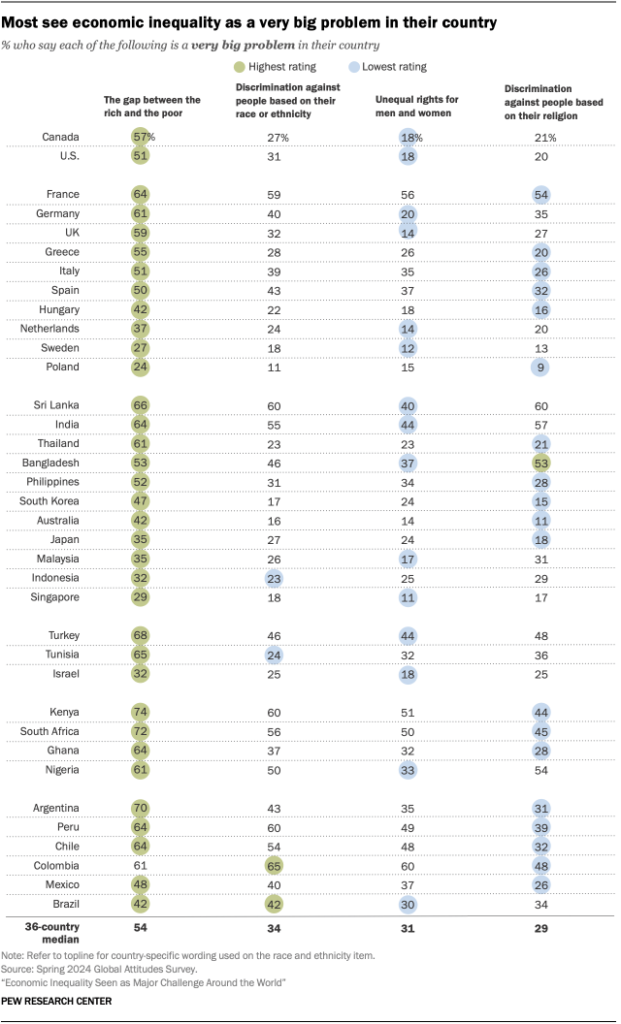
In our 36-country survey, we asked respondents how large a problem various types of inequality are in their nation, including the gap between the rich and the poor, unequal rights for men and women, discrimination based on a person’s race or ethnicity, and discrimination based on a person’s religion. Here are some key takeaways: A median of 54% across the countries surveyed say the gap between the rich and the poor is a very big problem. Smaller median shares say the same about the other types of inequality. In general, people in middle-income countries are more likely than those in high-income countries to see each form of inequality as a very big problem where they live. In some countries, people on the ideological left are especially likely to see economic inequality, gender inequality, and racial and ethnic discrimination as very big problems when compared with those on the right. The gap between the rich and the poor A majority in every country surveyed says the gap between rich and poor is at least a moderately big problem. However, the median share who see economic inequality as a very big problem is higher in middle-income countries than in high-income ones (62% vs. 48%). (Read Appendix A for a classification of middle- and high-income nations.) Argentina, Kenya and South Africa are among the countries where people are most likely to say economic inequality is a very big problem: Seven-in-ten or more hold this view in each. By contrast, three-in-ten or fewer say the same in Poland, Singapore and Sweden. Few people in each survey country say the gap between rich and poor is not a problem at all where they live. Views by ideology In about half of the countries surveyed, people on the ideological left are more likely than those on the right to say the gap between the rich and the poor is a very big problem. The largest ideological gap is in the U.S., where 76% of liberals hold this view, compared with 30% on the right – a 46-point difference. There are also large left-right gaps on this question in Australia (40 points) and South Korea (35 points). Views by income In 12 countries, people with lower annual incomes express greater concern about economic inequality than those with higher incomes. For example, 47% of Israelis who earn the national median annual income or less say economic inequality is a very big problem in their country, compared with 28% of those who earn more than the national median income. Racial or ethnic discrimination Across the countries surveyed, a median of 34% of adults say racial or ethnic discrimination is a very big problem where they live. Another 34% consider it a moderately big problem. Concerns are especially high in the sub-Saharan African and Latin American countries surveyed, as well as in Turkey and in the Asia-Pacific nations of Bangladesh, India and Sri Lanka. Roughly four-in-ten or more in France, Germany, Italy and Spain also say this is a very big problem. But fewer than two-in-ten in Australia, Singapore, South Korea and Sweden – and only around one-in-ten in Poland – feel the same. (For this question, respondents in most countries were asked about discrimination based on “race or ethnicity.” In Hungary, Indonesia, Sweden, Tunisia and Turkey, the question used “ethnicity.” In India, the question used “caste or ethnicity.” In Kenya, the question used “ethnicity or tribe.”) Views by ideology In about half the countries surveyed, people on the ideological left are more likely than those on the right to say racial or ethnic discrimination is a very big problem in their country. The largest ideological gap is in the U.S., where 51% of liberals say this type of discrimination is a very big problem, compared with 33% of moderates and 15% of conservatives. However, there are also left-right differences exceeding 20 points in France, Germany and Israel. Views by ethnicity In Israel, Arab adults are about four times as likely as Jewish adults to say that racial or ethnic discrimination is a very big problem in their country (63% vs. 15%). And in Brazil, Black and mixed-race adults (49% and 45%) are more likely than White adults (36%) to hold this view. In the U.S., roughly two-thirds of Black Americans (64%) say racial or ethnic discrimination is a very big problem, a much higher share than Hispanic Americans (36%), Asian Americans (35%), and White Americans (23%). Gender inequality Across the 36 countries, a median of 31% of adults say unequal rights for men and women is a verybigproblem in their country. Another 31% say it is a moderately big problem. People in some middle-income countries are particularly likely to view gender inequality as a very big problem. In Latin America, for example, six-in-ten Colombians consider it a very big problem, as do roughly half of Peruvians. In sub-Saharan Africa, about half of Kenyans and South Africans hold this view, too. Of the high-income nations surveyed, people in France, Spain and Italy express the highest levels of concern about gender inequality. On the other hand, only about one-in-ten adults in the high-income nations of Singapore and Sweden see unequal rights for men and women as a very big problem where they live. Views by gender In half the countries surveyed, women are more likely than men to say gender inequality is a very big problem. For example, 34% of women in Greece hold this opinion, compared with 17% of men. There are also large gender gaps on this question in Italy, Peru and Colombia. Views by ideology In about a third of the countries surveyed, people on the ideological left are more likely than those on the right to see unequal rights for men and women as a very big problem. For instance, 38% of Israelis on the left say this, compared with 23% in the center and 8% on the right. Ideological gaps also exceed 20 points in Brazil, Poland, Spain, Turkey and the U.S. Religious discrimination Overall,
1. Global perceptions of inequality and discrimination Read More »