Pew Research Center

1. Number of countries with ‘very high’ government restrictions increases in 2022

Government restrictions on religion The Government Restrictions Index (GRI) gives a score from 0.0 to 10.0 to each country and territory analyzed in this study based on how much they limit or control religious activity such as public preaching or worship, and how much they harass or use force against religious groups. The first section below discusses countries with the highest GRI scores (i.e., those with the most extensive levels of government restrictions in 2022) and countries with large changes in their GRI scores from the previous year.  Among the 198 countries and territories analyzed in this study, 59 had either “high” or “very high” levels of government restrictions on religion in 2022. This figure was an increase from 55 countries in 2021 and a new peak level for the study. Of these countries, 24 had “very high” scores on the GRI, an increase from 19 countries in 2021. And 35 countries had “high” GRI scores, down from 36 countries the previous year. (A score of 4.5 to 6.5 – out of 10.0 – is classified as a “high” score for a country, while a score of 6.6 to 10.0 is classified as “very high.” For more information on how the “high” and “very high” categories are defined for the GRI, refer to the Methodology.) Countries with the most extensive government restrictions Seven countries moved from the “high” GRI category to the “very high” category in 2022, including Iraq, Israel, Mauritania, Morocco, Turkey, Vietnam and Western Sahara. Most of these countries had small changes in their GRI scores (increases of 0.1 to 0.9 on the index) that pushed them from one category to the other. For example, Mauritania’s score on the GRI rose by 0.5 points (from 6.1 to 6.6), due in part to the April arrest of a man in the border town of Rosso after his son brought Bibles and other Christian literature into Mauritania across the country’s border with Senegal. (The man claimed ownership of the materials as a way to deflect blame from his son, and was released from detention by the end of the year, according to the U.S. State Department.)   Israel’s GRI score increased by 1.0 point in 2022, from 5.7 to 6.7, partly due to new reports of violations of prisoners’ religious freedom, which said that Israeli authorities prevented prisoners from praying; ate in front of detainees while they were fasting during the Muslim holy month of Ramadan; and removed the headscarves of women prisoners.  In 2022, both Kazakhstan and Turkmenistan moved in the other direction on the GRI, from the “very high” category to “high.” Kazakhstan’s score fell by less than 1.0 point, from 7.0 to 6.3, while Turkmenistan’s score fell by more than 2.0 points, from 7.1 to 4.8. In Turkmenistan, unlike in the previous year, there were no reported arrests in 2022 of people for holding religious gatherings or for being conscientious objectors to military service, according to the sources analyzed for the study. Although religious people in the country still faced harassment and many religious prisoners remained incarcerated in Turkmenistan, minority religious groups reported facing fewer barriers to practicing their faith freely. For example, there were improved relations with authorities and fewer hurdles to register as religious groups, according to the U.S. State Department. For a full list of countries in each GRI category, refer to Appendix A. Changes in scores on Government Restrictions Index In 2022, a total of 97 countries had increases of 0.1 point or more on the GRI, while 63 countries had decreases of 0.1 point or more. Looking at changes in classification, about two-thirds of the countries analyzed (134 out of 198) had small changes (0.1 to 0.9) in their GRI scores in 2022: 85 were small increases, and 49 were small decreases. An additional 38 countries had no increase or decrease, while 25 had modest changes (1.0 to 1.9 points) in 2022, including 12 with modest increases and 13 with modest decreases. Only Turkmenistan had a large decrease (2.0 points or more). No country had a large increase in its GRI in 2022. Social hostilities related to religion The Social Hostilities Index (SHI) gives a score to each country based on reports of incidents of religion-related hostilities carried out by nongovernment actors (such as private individuals and social groups). These acts can include verbal and physical harassment, mob violence, tensions between religious groups, or violence carried out in the name of religion. This section of the report discusses countries with the most extensive levels of social hostilities and large changes in SHI scores from 2021 to 2022. In total, 45 countries had “high” or “very high” levels of social hostilities in 2022, compared with 43 countries in 2021. Among these countries, seven had “very high” SHI scores in 2022, the same number as in the previous year. A total of 38 countries had “high” levels of social hostilities, up from 36 in 2021. On the Social Hostilities Index, scores of 3.6 to 7.1 (out of 10.0) are categorized as “high,” while scores of 7.2 to 10.0 are considered “very high.” (Refer to the Methodology to learn about how these categories are defined.) Countries with the most extensive social hostilities Nigeria was one of the seven countries with “very high” levels of social hostilities in 2022. The U.S. State Department reported that “general insecurity was prevalent throughout the country” in 2022, with multiple reports of religion-related mob violence, kidnappings and mass killings of Muslims and Christians by armed gangs. In addition, the militant groups Boko Haram and ISIS-West Africa burned churches and mosques in the northeast part of the country. Of the seven countries with “very high” SHI scores in 2022, only one (Iraq) moved into this category. An additional country (Israel) moved out of the category and instead into the “high” category. In Iraq, part of the SHI increase was related to activities of sectarian armed groups such as the Iran-backed Popular Mobilization Forces (PMF), which detained religious minorities and kept

1. Number of countries with ‘very high’ government restrictions increases in 2022 Read More »

3. Median scores for government restrictions and social hostilities stay the same in 2022

In 2022, global median scores on both the Government Restrictions Index (GRI) and the Social Hostilities Index (SHI) were the same as they were in 2021. Some geographic regions scored higher on one or both indexes, but other regions had lower scores or showed no overall change. This chapter examines the year-over-year changes in the regional scores on both indexes. Government restrictions on religion, by region The global median score for the 198 countries and territories analyzed in this study remained 3.0 out of 10.0 on the Government Restrictions Index, tied for the highest median score registered since 2007, the first year of the study. Median GRI scores increased in three regions – Asia and the Pacific, sub-Saharan Africa, and the Middle East and North Africa – while declining in two regions: the Americas and Europe. In the Asia-Pacific region, the median GRI score rose from 4.2 to 4.6 in 2022, the highest score in this region since the beginning of the study. More than half of all the countries in the world with “very high” levels of government restrictions in 2022 were in the Asia-Pacific region (14 out of 24). In this study, the Asia-Pacific region encompasses 50 countries and stretches across a vast area, from Australia to Turkey. It includes some of the most populous countries in the world, such as India, China and Indonesia. In 2022, more governments in Asia-Pacific countries interfered in worship, restricted public preaching and used violence against religious groups than in 2021. For example, in Cambodia, a former Buddhist monk was sentenced to five years in prison – and barred from becoming a monk again – for posting messages on social media that were critical of the prime minister. The monk was charged with “conspiracy to commit treason and incitement to commit a felony or cause social unrest.” In Afghanistan, the Taliban in 2022 were in power for the first full calendar year after having overthrown the previously elected government in August 2021. After their takeover in 2021, the group declared the country an Islamic emirate and ordered that all laws must be in accordance with sharia, or Islamic law. According to the U.S. State Department, minority groups such as the Shiite ethnic Hazara said that the Taliban’s targeting of their community and failure to defend them from attacks by a militant group (ISIS-K) in 2022 “deepened marginalization and the erasure of the Hazara from society.” Other minorities, such as Sikhs, Hindus, Christians and Ahmadi Muslims, sought to leave the country in growing numbers in 2022, fearing the Taliban’s enforcement of sharia. In 2022, sub-Saharan Africa’s median GRI score increased from 2.6 to 3.0, also hitting its peak level on the index, with nearly all countries in the region (46 out of 48) reporting at least one case of harassment of religious groups. More of these countries interfered in worship, limited public preaching, and used physical violence against religious groups (by detaining religious leaders, for example) in 2022 than did so in 2021. For example, the government in Equatorial Guinea enforced new mandates requiring religious groups to obtain a “theological certificate” in order to operate, leading some groups to be disbanded, according to the U.S. State Department. Also, an ordained Pentecostal leader in the country, who was a former ambassador and minister, was arrested for criticizing the government and calling it tyrannical. And in Mauritius, 12 Rastafarians were arrested in 2022 for protesting restrictions on marijuana usage in religious ceremonies. Neither of these countries had reports of arrests related to religion in 2021. The median GRI score in the Middle East-North Africa region climbed from 5.9 to 6.1 in 2022. As has been the case in every year of the study, this region had the highest levels of government restrictions in the study, largely driven by preferential status given to religious groups. Of the 20 countries in the region, all except Sudan recognized a favored or official religion; all except Lebanon required some type of religious education in public schools; and all except Western Sahara had at least one type of physical harassment, according to the sources analyzed. And all 20 countries in the Middle East-North Africa region had reports of interference in worship and either physical or verbal harassment (or both types) toward religious groups. In Oman, for example, authorities sentenced two people – Maryam al-Nuaimi and Abdullah Hassan – to prison for three years and five years, respectively, for online discussions about religious freedom that the government found to be “denigrating Muslim values,” according to the U.S. State Department. And in Morocco, a blogger was fined and sentenced to two years in prison for satirical comments on social media about Quranic verses that authorities charged were “insulting to Islam.” The U.S. State Department reported that the blogger has been held in solitary confinement since her detention. In 2022, the median GRI score for Europe fell from 3.1 to 2.9, while the score in the Americas fell from 2.1 to 1.8. Of all five major regions, the Americas had the lowest median score for government restrictions in 2022. In Europe, Russia was the only country with “very high” levels of government restrictions in 2022. According to the U.S. State Department, Russian authorities sentenced people from multiple religious groups to prison on charges of extremism. Those sentenced included Jehovah’s Witnesses, followers of a Turkish Muslim theologian named Said Nursi, and members of Falun Gong (an illegal religious group), the Church of Scientology, evangelical Protestant groups, and a transnational Islamic political group called Hizb ut-Tahrir. Russian Orthodox priests and members of other religious groups also were fined and banned from their positions for criticizing the Russian government’s war in Ukraine. In the Americas, Cuba was the only country with “high” GRI levels in 2022, while all other countries in the region had “moderate” or “low” scores. According to the United States Commission on International Religious Freedom (USCIRF), the Cuban government restricted the freedom of religious groups “through surveillance, harassment of religious leaders and

3. Median scores for government restrictions and social hostilities stay the same in 2022 Read More »

2. Number of countries where religious groups were harassed reached new peak level in 2022

In 2022, harassment of religious groups by governments or social actors occurred in 192 out of the world’s 198 countries and territories, according to sources analyzed in our study. This was an increase by two countries from 2021 and a new peak level for the study. Here are the key findings: Governments harassed people for their religious beliefs and practices in 186 countries in 2022, up from 183 in 2021. Social groups or private individuals harassed people due to their religion in 164 countries, the same number as in 2021. Governments and/or social actors harassed religious groups in 192 countries, including 158 countries where both governments and social groups or private individuals engaged in harassment. In this study, harassment includes a range of actions, from disparaging verbal remarks to the physical use of force against religious groups or their property. The findings in this chapter reflect the number of countries where at least one occurrence of any type of religion-related harassment was reported in the sources analyzed. The figures, therefore, show how geographically widespread harassment of religious groups is and whether the number of countries where it occurs is increasing or decreasing. But they do not address which religious groups face the most persecution around the world, because a country is counted whether it had a single instance of harassment against a religious group or numerous ones. To place a lens on the most serious cases, this chapter examines physical harassment faced by religious groups. It also looks at the number of countries where specific religious groups faced harassment more broadly (either physical or verbal). By physical harassment we mean cases in which physical force was used against religious groups and their property, including damage to property, detentions or arrests, assaults on people, displacements and killings. By verbal harassment, we mean insults and disparaging public remarks and statements or articles about religious groups in the media. The figures also include countries where there was harassment of atheists, agnostics or others who do not affiliate with a religion, if the sources analyzed reported that they were harassed due to their beliefs or nonbeliefs. Humanists are included in a different category from the religiously unaffiliated. Physical harassment against religious groups This section focuses on five types of physical harassment faced by religious groups: property damage, assaults, detentions, displacements and killings. In 2022, at least one of the five types was reported in 145 out of 198 countries and territories (73% of all places analyzed), up from 137 countries in 2021. This included 111 countries where governments used physical force against religious groups (up from 100 in 2021) and 111 countries where social groups or private individuals carried out such incidents (up from 101 in 2021), according to our sources. According to the sources analyzed, damage to property was the most common type of physical harassment against religious groups in 2022, occurring in 120 of 198 countries and territories (61%). Detentions were reported in 93 countries (47%) and physical assaults in 89 countries (45%). Displacements due to religious tensions or violence occurred in 51 countries (26%), while religion-related killings were reported in 49 countries (25%). Property damage Religion-related property damage – including raids, evictions, closures, vandalism and unresolved restitution claims for properties confiscated in the past – occurred in 120 countries in 2022, according to our sources. This includes 78 countries where governments targeted properties and 89 countries where social groups or private individuals were behind such incidents. The Middle East-North Africa region had the highest share of countries with property damage targeting religious groups (85% of the 20 countries and territories in the region). Such incidents also were reported in 76% of Europe’s 45 countries, 58% of sub-Saharan Africa’s 48 countries, 54% of the 50 countries in the Asia-Pacific region, and 40% of the 35 countries in the Americas. For example, in Jordan, authorities shut down 30 Quran teaching centers for not complying with new conditions set by the ministry in charge of Islamic affairs, such as limits on how many hours the centers could be open and a requirement that the centers’ teachers pass an official exam. Activists protested the decision and claimed it was linked to a legislative attempt “to dispense with religious and traditional social norms.” In Iraq, which has a large Shiite Muslim population, Shiite militias and the Shiite Endowment (one of three national-level offices that distribute government funds to recognized religious groups) sought control over properties owned by the Sunni Endowment in the country, leading to sectarian tensions. For example, in Mosul, political parties tried to shift ownership and control of Sunni religious sites to the Shiite Endowment, according to Sunni members of parliament. Also in Iraq, a Syriac Catholic Church leader in Bartella, a historically Christian town in Ninewa Province, said militias sought to “seize and occupy Christian properties” in an attempt to drive out Christians and alter the religious composition of the town. Detentions Detentions related to religion (including kidnappings or arrests that are reported as arbitrary or carried out without due process) occurred in 93 countries in 2022. This included 88 countries where governments detained people and 22 countries where nongovernmental actors arrested or abducted people, according to our sources.    The Middle East-North Africa region again had the highest share of countries with religion-related detentions (85%), compared with 60% of countries in sub-Saharan Africa and 58% of countries in the Asia-Pacific region. Lower shares of countries in the Americas (31%) and Europe (16%) had reports of detentions related to religion. In Israel, during the Islamic holy month of Ramadan, police on April 15 raided the Al-Aqsa mosque in the compound known as Haram al-Sharif to Muslims and the Temple Mount to Jews. The raid, which occurred after early-morning prayers, reportedly resulted in more than 300 detentions and 150 injuries. Police said they entered the mosque compound to stop a crowd from throwing stones. Videos showed the police using tear gas and stun grenades. A similar raid occurred in 2021 during the month

2. Number of countries where religious groups were harassed reached new peak level in 2022 Read More »

4. Restrictions in the 25 most populous countries in 2022

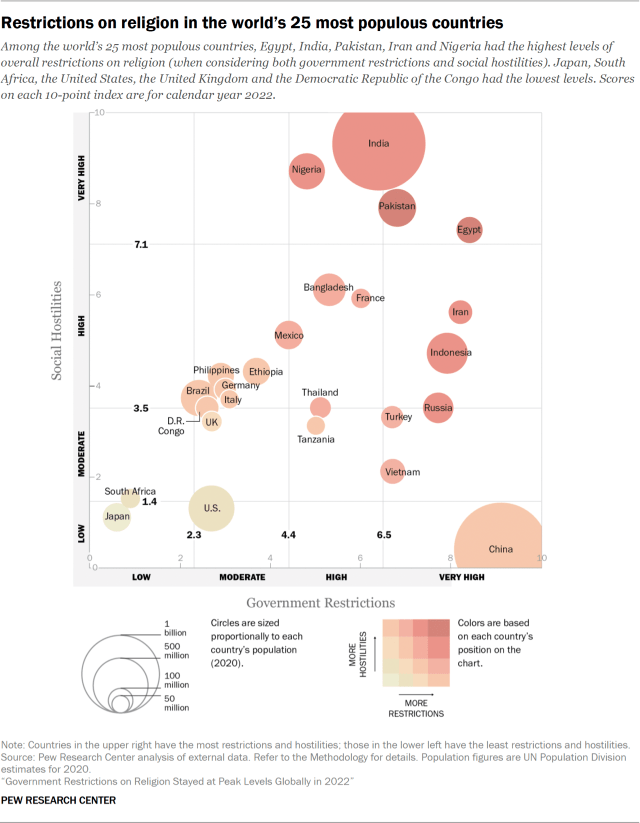
This chapter examines government restrictions and social hostilities in the world’s 25 most populous countries. Looking separately at these populous countries – which are home to about three-quarters of the world’s population – allows us to see how government restrictions and social hostilities impact a large portion of the world’s population. While each country has a national score on the Government Restrictions Index (GRI) and Social Hostilities Index (SHI), it is important to note that the restrictions measured on these indexes don’t affect all inhabitants in a country equally. For example, restrictions can often target minority groups more than majority groups. In 2022, among the 25 most populous countries, Egypt, India, Pakistan, Iran and Nigeria had the highest overall levels of restrictions (meaning, combined government restrictions and social hostilities scores for a country). Japan, South Africa, the United States, the United Kingdom and the Democratic Republic of the Congo had the lowest overall levels of restrictions among these countries. Government Restrictions Index (GRI) China, Egypt, Iran, Indonesia and Russia had the highest levels of government restrictions among the most populous countries, with all five scoring in the “very high” GRI category. Japan, South Africa, Brazil, the Democratic Republic of the Congo and the UK had the lowest levels of government restrictions among this set of countries. Japan and South Africa were in the “low” category on the GRI, while the other three countries were in the “moderate” range. Social Hostilities Index (SHI) In 2022, India, Nigeria, Pakistan, Egypt and Bangladesh had the highest levels of social hostilities among the 25 most populous countries. All of these countries had “very high” SHI scores except for Bangladesh (which had a “high” score). Meanwhile, China, Japan, the U.S., South Africa and Vietnam had the lowest SHI scores. South Africa and Vietnam were in the “moderate” SHI category, while the other three countries were in the “low” range. In seven of these 25 countries, the GRI and SHI scores fell into the same exact categories. For example, Egypt had “very high” scores on both the GRI and SHI; Bangladesh had “high” levels of both government restrictions and social hostilities; and the Democratic Republic of the Congo had “moderate” scores on both indexes. At the same time, a few of the 25 most populous countries had “high” GRI scores but “moderate” or “low” SHI scores. China, for example, had “very high” levels of government restrictions but “low” levels of social hostilities in 2022, as it did the previous year. Vietnam and Turkey had “very high” levels of government restrictions in 2022 (both up from “high” GRI scores in 2021) and “moderate” levels of social hostilities. And Russia had a “very high” GRI score but “moderate” levels of social hostilities in 2022. For more information about how GRI and SHI scores correspond for other countries, refer to this report’s Overview. How GRI scores changed from 2021 to 2022 Most populous countries had a small change (i.e., of less than 1.0 point) in their GRI scores in 2022. Only the Democratic Republic of the Congo had a modest increase (i.e., of 1.0 to 1.9 points) in its GRI score, which shifted the country from the “low” category to the “moderate” range of the GRI. None of the world’s 25 most populous countries had a large change (i.e., of 2.0 points or more) on the index. However, even small changes on the index pushed some countries into different categories. For example, the GRI score for the Philippines rose from 2.2 to 2.9, moving it from the “low” to the “moderate” level. The small increase was partly due to reports that the Philippine government sought to arrest more religious people perceived to be threats. For example, in August 2022, authorities issued an arrest warrant for 16 members of the Rural Missionaries of the Philippines for sending funds to the armed wing of the country’s Communist Party. It was unclear whether the charges were legitimate, according to the U.S. State Department, which reported that the government engaged in a practice – known as “red-tagging” – of publicly associating critics of the government with insurgent, terrorist or separatist groups in an effort to discredit them.   How SHI scores changed from 2021 to 2022 In 2022, a majority of the world’s 25 most populous countries had small changes in their SHI scores. Five countries had modest changes, and one country – Iran – had a large increase in social hostilities. Italy had a small change in its SHI score, from 3.1 to 3.7, enough to shift it from the “moderate” to the “high” category. This was partly due to new reports of recruitment to religion-related terrorist groups within the country. In June, a married couple in Italy was arrested for planning an attack “on behalf of” the militant group ISIS, according to the U.S. State Department. The couple was reported to have been “radicalized to violence online” and was charged with “recruitment, association, and training for the purpose of terrorism.” Iran’s SHI score went up from 2.8 to 5.6 in 2022, moving it from the “moderate” to the “high” SHI category. For more information on incidents that led to Iran’s SHI change and on other countries that had large changes (outside of the 25 most populous), go to Chapter 1. source

4. Restrictions in the 25 most populous countries in 2022 Read More »

1. Job satisfaction

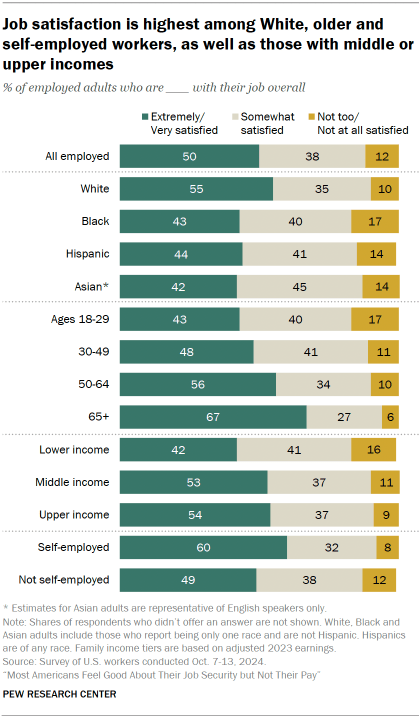
Half of U.S. workers say they are extremely or very satisfied with their job overall. Another 38% say they are somewhat satisfied, and 12% are not too or not at all satisfied with their job. As was the case in 2023, self-employed workers (60%) are more likely than those who are not self-employed (49%) to be highly satisfied with their job. There are also differences in the shares who say they are extremely or very satisfied by: Race and ethnicity: 55% of White workers versus 44% of Hispanic workers, 43% of Black workers and 42% of Asian workers. Age: 67% of workers ages 65 and older versus 56% of those 50 to 64, 48% of those 30 to 49 and 43% of those under 30. Income: 54% of workers with higher family incomes and 53% of those with middle incomes versus 41% of those with lower incomes. How workers feel about specific aspects of their job Majorities of workers say they are highly satisfied with: Their relationship with their co-workers (64%) Their relationship with their manager or supervisor (59%) Their commute (58% among those who have a commute) When it comes to the amount of flexibility workers have, more say they are extremely or very satisfied with their flexibility to choose when they work their required hours (49%) than with their flexibility to work remotely (37%). In fact, 40% of workers express dissatisfaction with the amount of flexibility they have to work remotely. Pay and opportunities for promotion are the two areas where workers express the lowest levels of satisfaction. Only 30% say they are extremely or very satisfied with how much they’re paid. And about a quarter (26%) are highly satisfied with their opportunities for promotion at work. Differences by race and ethnicity, age, and income Just as overall job satisfaction varies across demographic groups, so do ratings of some specific aspects of work. Among those who are not self-employed, White workers are more likely than Black, Hispanic and Asian workers to say they are extremely or very satisfied with their relationship with their co-workers, their relationship with their manager or supervisor, their opportunities for training and ways to develop new skills, and how much they are paid. Workers ages 65 and older are the most likely to express high levels of satisfaction with their flexibility to choose when to work their required hours and with the amount of feedback they receive from their manager or supervisor. And a larger share of higher-income workers than with those with middle or lower incomes say they are extremely or very satisfied with eight of the 11 items we asked about. The gaps between those with upper and lower incomes are particularly wide when it comes to benefits, flexibility to work remotely and pay. Changes in satisfaction since 2023 On seven of the nine items that were also asked last year, the shares of workers who express high levels of satisfaction have dropped by margins of 3 to 7 percentage points. For example, 37% of workers now say they are extremely or very satisfied with their opportunities for training or ways to develop new skills, down from 44% in February 2023. And about a quarter (26%) say they are highly satisfied with their opportunities for promotion, compared with the already small share of 33% measured last year. There have also been drops in the shares saying they are extremely or very satisfied with the amount of feedback they get (-5 points), the benefits their employer provides (-4), how much they are paid (-4), their relationship with their coworkers (-3), and their relationship with their manager or supervisor (-3). Reasons for pay dissatisfaction One of the aspects of work that employed adults express the least satisfaction with is how much they are paid. Large majorities of workers who are not self-employed and who are not too or not at all satisfied with their pay cite each of the following as major reasons: Their pay hasn’t kept up with increases in cost of living (80%) Their pay is too low for the quality of work they do (71%) Their pay is too low for the amount of work they do (70%) Just over half (54%) say a major reason for their dissatisfaction with their pay is that they don’t earn enough to pay their bills. A smaller share (28%) say they are paid less than co-workers who do similar work. Differences by gender Majorities of men and women who are not too or not at all satisfied with how much they are paid cite their wages being too low for the quality and amount of work they do as major reasons for their dissatisfaction. But women are more likely than men to say these are major reasons. Additionally, women are more likely than men to point to not earning enough to pay their bills as a major reason for their dissatisfaction (61% vs. 47%). And while relatively small shares of both men and women say a major reason they’re dissatisfied is because they are paid less than co-workers who do similar work, women are more likely than men to cite this (32% vs. 24%). Differences by income For the most part, workers across levels of family income who are dissatisfied with their pay give similar reasons for feeling this way. For example, about eight-in-ten workers with lower, middle and upper incomes say a major reason is that their pay hasn’t kept up with cost-of-living increases. There are significant differences, however, in the shares that cite not earning enough to pay their bills. About seven-in-ten workers with lower incomes (69%) say this is a major reason they are dissatisfied with how much they are paid. Roughly half (51%) of those with middle incomes – and 30% of upper-income workers – say the same. Do workers feel respected? By their supervisor, co-workers, customers or clients In addition to being highly satisfied with their workplace relationships, large shares of workers also say their co-workers (86%) and

1. Job satisfaction Read More »

2. How different groups of U.S. Hispanics describe ‘machismo’

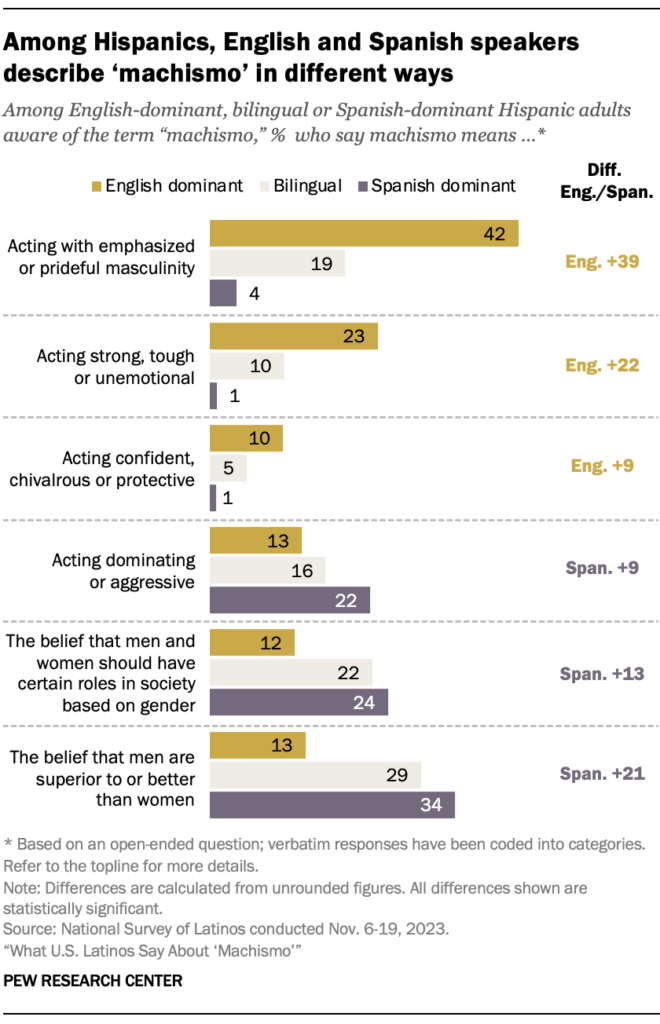
“Machismo” doesn’t have a single meaning among Hispanic adults who have heard of the term. However, certain groups of Hispanics are more likely to describe the concept in some ways than others. This chapter explores patterns among Hispanic adults in what machismo means to them. By language Machismo has its roots in the Spanish language, but the concept is prevalent in both Spanish- and English-speaking contexts. Survey findings show that views of machismo differ across Latinos’ language dominance.   Latinos who have heard of machismo and primarily speak English are more likely than primary Spanish speakers to say machismo means: Acting with emphasized masculinity or having masculine pride (42% of English-dominant Latinos say this vs. 4% of Spanish-dominant Latinos) Acting strong, tough or unemotional (23% vs. 1%) On the other hand, Spanish-dominant Latinos are more likely than English-dominant Latinos to say machismo is: The belief that men are superior to or better than women (34% of Spanish-dominant Latinos describe machismo this way vs. 13% of English-dominant Latinos) The belief that certain roles in society should be based on gender (24% vs. 12%) By nativity and immigrant generation Hispanics’ birthplace and the number of generations their family has lived in the U.S. are also linked to their views of machismo. For instance, among those who have heard of “machismo,” immigrants are twice as likely as U.S.-born Hispanics to say machismo is the belief that men are superior to women (34% vs. 16%). Among the U.S. born, there are also differences by generation: 20% of second-generation Latinos – those with at least one immigrant parent – define machismo this way, while 10% of Latinos with two U.S.-born parents do. By spouse or partner ethnicity Hispanics who are married to or living with a Hispanic partner hold different views about machismo than those with a non-Hispanic spouse or partner. For example, among Hispanic adults aware of the concept, those with a Hispanic partner are more likely than those with a non-Hispanic partner to describe machismo as the belief that men and women should have gender-based roles (25% vs. 12%). This pattern appears among both men and women: Among Hispanic men, 23% with a Hispanic partner say machismo is the belief that roles in society should be based on gender, versus 7% with a non-Hispanic partner. Among Hispanic women, 27% with a Hispanic partner describe machismo this way, versus 16% with a non-Hispanic partner. By gender There are only modest differences in how Hispanic men and women who have heard of machismo describe the concept: Hispanic men are more likely than Hispanic women to say machismo means emphasized or prideful masculinity (26% vs. 18%). Meanwhile, Hispanic women are more likely to say machismo is the belief that men and women should have gender-based roles (23% vs. 16%) or that it means acting dominating or aggressive (20% vs. 13%). When describing machismo in other ways, however, Hispanic men and women are closely aligned. For example, similar shares say machismo means acting strong, tough or unemotional (13% of men and 11% of women). By political party Latinos across political parties define machismo in similar ways. For example, 17% of Democrats and Democratic-leaning independents say machismo means acting dominating or aggressive, as do 15% of Republicans and Republican leaners. For more details on how other groups of Latinos describe machismo, including by age and education, refer to the appendix. U.S. Hispanics’ views of the pressures Hispanic men face The survey also asked Hispanic adults related questions about the pressures that Hispanic men face in the U.S. today: 46% say that in general, Hispanic men in the U.S. today face a great deal or fair amount of pressure to avoid talking about their feelings. 33% say Hispanic men face pressure to join in when other men are talking about women in a sexual way. 28% say Hispanic men face pressure to physically intimidate others. Overall, Hispanic adults are more likely to say that Hispanic men face each of these pressures than Hispanic women do. For example, 29% say Hispanic women in the U.S. today face a great deal or fair amount of pressure to avoid talking about their feelings – smaller than the 46% who say the same about Hispanic men. However, Hispanic adults are more likely to say Hispanic women face pressure than Hispanic men on other topics asked about in the survey. Some of these include doing the cooking and cleaning at home, being physically attractive and having few sexual partners. For additional survey findings on the pressures that Hispanic women and men face in the U.S. today, read “A Majority of Latinas Feel Pressure to Support Their Families or To Succeed at Work.” source

2. How different groups of U.S. Hispanics describe ‘machismo’ Read More »

1. U.S. Latinos’ awareness of ‘machismo’ and how they describe it

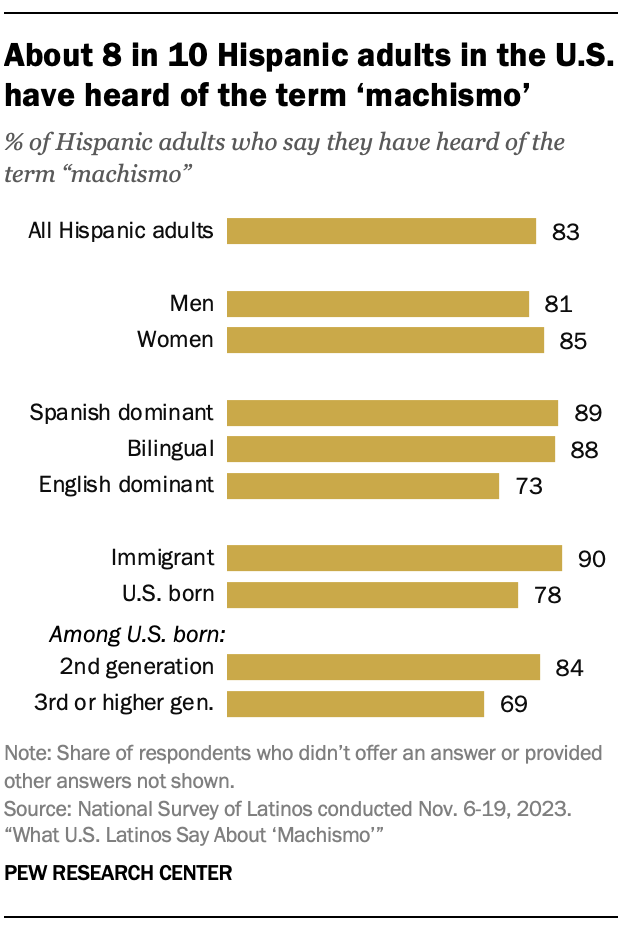
Most Hispanic adults in the U.S. have heard of the term machismo, but the concept can mean many things. This chapter explores the different ways that Hispanic adults describe machismo. Awareness of the term ‘machismo’ Roughly eight-in-ten Hispanic adults (83%) say they have heard of the term machismo, while 16% say they have not heard of it before. Majorities of Latinos across most demographic subgroups are familiar with the term. Similar shares of men and women say they have heard of it (81% and 85%). However, awareness differs somewhat by other factors: Language: Awareness of machismo is higher among Latinos who primarily speak Spanish (89%) or are bilingual in English and Spanish (88%), compared with those who are English dominant (73%). Immigrant generation: 90% of Latinos who are immigrants and 84% who are second-generation Americans have heard the term – higher than the share of third-generation or higher who have (69%). Education: 92% of Latinos with a bachelor’s degree are familiar with the term, versus 86% with some college experience and 78% with a high school diploma or less. What ‘machismo’ means to U.S. Latinos, in their own words The survey asked Hispanic adults who know the term an open-ended question about what machismo means, in their own words. ‘Machismo’ and ideas about gender in society Many respondents associate machismo with broader ideas about gender in society. A quarter of Hispanic adults who are aware of the term said machismo is the belief that men are superior to or better than women. Some 19% said machismo is the belief that men and women should have certain roles in society based on gender. This includes 13% who specify that machismo is the belief that men’s role should be as leaders or decision makers and 6% who say machismo means women’s role should be taking care of the home or children. “Para algunos hombres hay labores que son solo para hombres y creen que la mujer está solo para cuidar niños, y limpiar la casa,” said one immigrant woman in her late 40s. Additionally, 10% of responses were about men and women being treated unequally in society. One immigrant man in his early 50s described machismo as “men [being] above women in many social, political and economic matters.” And 7% said machismo is the result of social or cultural expectations around masculinity and the pressure it puts on men and women to act certain ways. One U.S.-born man in his mid-20s described machismo as “a social construct where men are expected to be strong, intimidating [or] stoic along with several other stereotypical traits. … Historically, there has been an expectation for Hispanic men to be masculine which has led to toxic behavior within the culture.” ‘Machismo’ and specific behaviors or characteristics Some respondents described machismo by specific behaviors or characteristics. About a quarter of Latino adults who have heard of machismo (22%) say it means acting with emphasized masculinity or having masculine pride, or as one immigrant man in his early 60s put it, “behaving manly or like a macho man.” Acting dominating or aggressive appeared in 17% of responses. This includes 5% who said machismo means acting violent, abusive or threatening. One U.S.-born woman in her early 20s said that machismo is “a culture where violence and sexism are deeply intertwined.” Some 12% said machismo means acting strong, tough or unemotional. One man said machismo is the “stereotypical strong, in-command Spanish male [who] shows little softness in action or emotion” like the “strong silent type [that] was depicted in the movies” (U.S.-born, early 70s). Additionally, 11% of Latino adults aware of machismo said the concept means acting self-important or egotistical. A small share (6%) also described machismo as acting confident, chivalrous or protective. As one respondent put it, machismo is about being “a man other men can look up to” (U.S.-born man, early 50s). Respondents often named several characteristics in their answer. For example, one respondent said machismo “usually refers to men who are puffing out their chests or are overbearing to their female counterparts or family. I see it as [having] a negative connotation, but I have heard it used in the chivalric context, referring to a gentlemanly action; like holding a woman’s bag or protecting a woman from another man” (U.S.-born man, mid-30s). source

1. U.S. Latinos’ awareness of ‘machismo’ and how they describe it Read More »

Teens, Social Media and Technology 2024

YouTube, TikTok, Instagram and Snapchat remain widely used among U.S. teens; some say they’re on these sites almost constantly Two teenage boys use their smartphones in Vail, Colorado. (Robert Alexander/Getty Images) Pew Research Center conducted this study to better understand teens’ use of digital devices, social media and other online platforms. The Center conducted an online survey of 1,391 U.S. teens from Sept. 18 to Oct. 10, 2024, through Ipsos. Ipsos recruited the teens via their parents, who were part of its KnowledgePanel. The KnowledgePanel is a probability-based web panel recruited primarily through national, random sampling of residential addresses. The survey was weighted to be representative of U.S. teens ages 13 to 17 who live with their parents by age, gender, race and ethnicity, household income, and other categories. Here are the questions used for this report, along with responses, and the survey methodology­­­. This research was reviewed and approved by an external institutional review board (IRB), Advarra, an independent committee of experts specializing in helping to protect the rights of research participants. Amid national concerns about technology’s impact on youth, many teens are as digitally connected as ever. Most teens use social media and have a smartphone, and nearly half say they’re online almost constantly, according to a new Pew Research Center survey of U.S. teens ages 13 to 17 conducted Sept. 18-Oct. 10, 2024. YouTube tops the list of the online platforms we asked about in our survey. Nine-in-ten teens report using the site, slightly down from 95% in 2022. TikTok, Instagram and Snapchat remain widely used among teens. Roughly six-in-ten teens say they use TikTok and Instagram, and 55% say the same for Snapchat. Facebook and X use have steeply declined over the past decade. Today, 32% of teens say they use Facebook. This is down from 71% in 2014-15, though the share of teens who use the site has remained stable in recent years. And 17% of teens say they use X (formerly Twitter) – about half the share who said this a decade ago (33%), and down from 23% in 2022. Roughly one-quarter of teens (23%) say they use WhatsApp, up 6 percentage points since 2022. And 14% of teens use Reddit, a share that has remained stable over the past few years. We asked about Threads, launched by parent company Meta in 2023, for the first time this year. Only 6% of teens report using it. How often do teens visit online platforms? Debates about teen social media use often center on how much time teens spend on these platforms. As lawmakers explore potential regulations, our 2023 survey found a majority of Americans support time limits for minors on social media. Our current survey asked teens how often they use five platforms: YouTube, TikTok, Instagram, Snapchat and Facebook. Overall, 73% of teens say they go on YouTube daily, making YouTube the most widely used and visited platform we asked about. This share includes 15% who describe their use as “almost constant.” About six-in-ten visit TikTok daily. This includes 16% who report being on it almost constantly. Roughly half of teens say they go on Instagram or Snapchat every day, including about one-in-ten who say they’re on each of these platforms almost constantly. The share of teens who say they use Instagram almost constantly has increased slightly, from 8% in 2023 to 12% today.   Relatively few teens report using Facebook daily (20%). Across all five platforms, one-third of teens use at least one of these sites almost constantly. These findings are largely similar to what we’ve found the past two years. By gender As in previous surveys, teen girls are more likely than boys to say they use TikTok almost constantly (19% vs. 13%). Inversely, teen boys are more likely than girls to use YouTube this often. While 19% of boys say they use it almost constantly, that share drops to 11% among girls. Unlike last year, similar shares of boys (13%) and girls (12%) today say they use Snapchat almost constantly. There are also no gender differences in the shares of teens who report using Instagram and Facebook almost constantly. By race and ethnicity Roughly one-quarter of Black (28%) or Hispanic (25%) teens say they visit TikTok almost constantly. This share drops to 8% among White teens. Black and Hispanic teens are also more likely than White teens to say they constantly use YouTube or Instagram. There are few to no racial or ethnic differences in the shares visiting Snapchat and Facebook on a near constant basis. How does the use of online platforms differ across demographic groups? While many teens engage with online platforms, usage varies by gender, race and ethnicity, age, and household income. By gender Instagram and TikTok are used more widely by teen girls than teen boys. For example, 66% of girls say they use TikTok, compared with 59% of boys. Instagram use follows a similar pattern (66% vs. 56%). On the other hand, boys are more likely than girls to say they use YouTube (93% vs. 87%). By race and ethnicity Among teens, a larger share of those who are Black (79%) or Hispanic (74%) than White (54%) say they use TikTok. Black and Hispanic teens also stand out compared with White teens in their use of Instagram and X. When it comes to the messaging platform WhatsApp, Hispanic teens are more likely than Black or White teens to say they use it. By age Older teens are more likely than younger teens to use each of the platforms we asked about. Notably, teens ages 15 to 17 are more likely than those ages 13 to 14 say they use Instagram (72% vs. 43%) or Snapchat (63% vs. 44%). Differences are more modest for platforms like YouTube, which most older (92%) and younger (87%) teens use. By household income As was true in prior studies, Facebook remains more commonly used among teens in lower-income households. For example, 45% of teens in households earning less than $30,000 a year say they

Teens, Social Media and Technology 2024 Read More »

Most Americans Feel Good About Their Job Security but Not Their Pay

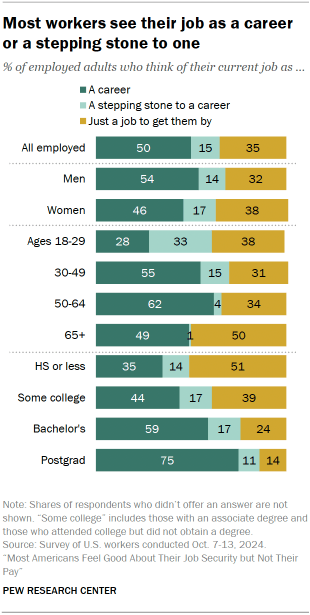
Younger and lower-income workers are among the least satisfied with their jobs; majorities say it would be hard to find the kind of job they’d want if they were looking today From left: Spencer Platt/Getty Images; Brett Coomer/Houston Chronicle; MoMo Productions, all via Getty Images. Pew Research Center conducted this study to better understand the experiences of American workers. For most of the analysis in this report, we surveyed 5,273 U.S. adults who are employed part time or full time and who have only one job or have more than one but consider one of them to be their primary job. The survey was conducted Oct. 7-13, 2024. Everyone who took part is a member of the Center’s American Trends Panel (ATP), a group of people recruited through national, random sampling of residential addresses who have agreed to take surveys regularly. The survey was conducted either online or by telephone with a live interviewer. The survey is weighted to be representative of the U.S. adult population by gender, race, ethnicity, partisan affiliation, education and other factors. Read more about the ATP’s methodology. This report also includes an analysis of job availability, job characteristics and workforce demographics based of federal government data. Visit the methodology section for more information on these data sources. Here are the questions used for this report, the topline and the survey methodology. References to workers include those who are employed part time or full time and who have only one job or have more than one but consider one of them to be their primary job. References to White, Black and Asian adults include those who are not Hispanic and identify as only one race. Hispanics are of any race. References to college graduates or people with a college degree comprise those with a bachelor’s degree or more education. “Some college” includes those with an associate degree and those who attended college but did not obtain a degree. “High school” refers to those who have a high school diploma or its equivalent, such as a General Educational Development (GED) certificate. “Middle income” is defined here as two-thirds to double the median annual family income for panelists on the American Trends Panel. “Lower income” falls below that range; “upper income” falls above it. Read the methodology for more details. Amid low unemployment nationwide, U.S. workers are feeling good about their level of job security, and relatively few expect to look for a new job in the coming months, according to a new Pew Research Center survey. At the same time, only half of workers say they are extremely or very satisfied with their job overall. And a much smaller share are highly satisfied with their pay – 30%, down from 34% last year.  The survey, conducted Oct. 7-13 among 5,273 employed U.S. adults, explores how workers see various aspects of their jobs, including how they assess the importance of certain skills and their own opportunities for further training. Key findings White and older workers are among the most satisfied with their job overall. 55% of White workers say they are extremely or very satisfied, compared with 44% of Hispanic workers, 43% of Black workers and 42% of Asian workers. Among workers ages 65 and older, two-thirds say they are highly satisfied with their job. Just 43% of workers ages 18 to 29 say the same.  Workers with middle and upper family incomes are more likely than those with lower incomes to express high levels of job satisfaction (53% and 54% vs. 42%). Among the 29% of workers who are not too or not at all satisfied with their pay, the top reason given is that their wages haven’t kept up with increases in cost of living. Large shares also say their pay is too low for the quality (71%) or amount (70%) of work they do. 54% say a major reason they are dissatisfied is that they don’t earn enough to pay their bills. Lower-income workers who are dissatisfied with their pay are far more likely than those with middle and upper incomes to cite the fact that they don’t earn enough to pay their bills (69% vs. 51% and 30%). Large majorities of workers across all family income levels say their pay hasn’t kept up with cost-of-living increases. Half of workers think of their current job as a career, while 15% say it’s a stepping stone to one. About a third (35%) say it’s just a job to get them by. 58% of workers with lower incomes say their job is just something to get them by, compared with 31% of those with middle incomes and 17% of those with higher incomes. Workers ages 18 to 29 are less likely than those in older age groups to say they see their job as a career. Still, a majority of young workers say their job is either a career or a stepping stone. Half of workers ages 65 and older say their job is just something to get them by, larger than the shares of workers ages 50 to 64 (34%), 30 to 49 (31%) and 18 to 29 (38%) who say the same. Most workers (69%) feel that they have a great deal or a fair amount of job security. Another 17% say they have some job security, and 13% say they have little or none. 75% of White workers say they have at least a fair amount of job security, compared with smaller majorities of Asian (62%), Black (58%) and Hispanic (57%) workers.  While about seven-in-ten or more among upper- and middle-income workers say they have a great deal or a fair amount of job security (78% and 71%), a smaller share of lower-income workers (54%) say the same. Workers are now much more likely than in 2022 to say it would be difficult for them to get the kind of job they’d want if they were to look for a new one. 52% of workers say this would be difficult, compared with 37%

Most Americans Feel Good About Their Job Security but Not Their Pay Read More »

2. How Americans view their jobs

When we asked workers how they see their job, half say they consider their current job as a career, while 15% say it is a stepping stone to a career. About a third (35%) say it’s just a job to get them by. Young workers are less likely than older workers to see their jobs as a career. Some 28% of workers ages 18 to 29 say this, while about half or more of those in older age groups say the same. Still, a majority of young workers say their job is either a career or a stepping stone. Workers’ attitudes about their job also differ by education. Most of those with a postgraduate degree (75%) view their job as a career, compared with 59% of those with a bachelor’s degree only, 44% of those with some college education, and 35% of those with a high school diploma or less education. About half of workers with a high school diploma or less (51%) say their job is just something to get them by. There is a moderate gender difference on this question. More than half of men (54%) consider their job a career, compared with 46% of women. How older workers see their jobs Workers ages 65 and older are the most likely age group to say their job is just something to get them by. Half say this is the case, compared with about four-in-ten or fewer in younger age groups. To further explore older workers’ views, we asked those ages 65 and older why they are currently working. The majority (56%) say they work both because they need the money and because they want to work. Another 26% say they work mainly because they want to, while 17% say it’s mainly because they need the money. Older workers’ reasons for working vary by education. Those with at least a bachelor’s degree are more likely than those with some college or less education to say they work mainly because they want to (33% vs. 21%). In turn, older workers with some college or less education are more likely than those with at least a bachelor’s degree to say they work mainly because they need the money (20% vs. 12%). Meeting expectations at work Most workers (76%) say they do more than what’s expected of them at their job. Some 23% say they do only what’s expected, while 2% say they do less than what’s expected of them. Older workers are more likely than younger workers to say they do more than what’s expected of them. The vast majority of workers ages 50 and older (84%) say this, compared with 75% of workers ages 30 to 49, and 64% of workers 18 to 29. In turn, workers ages 18 to 29 are the most likely to say they do only what’s expected of them (33%) when compared with all older groups. For the most part, there are no significant differences by gender or education. Are workers being monitored – and how do they feel about it? More than half (54%) of workers who are not self-employed say their employer monitors the time they start and finish working. About a third or more also say their employer monitors: Messages they send through employer-provided email accounts or messaging platforms (44%) How quickly they complete their tasks (43%) Their location while they are working (37%) How they use their work computer, such as the time they spend using apps or the websites they visit (35%) A much smaller share (12%) says their employer monitors their activity on social media. The shares of workers who say they are monitored by their employer vary widely by workers’ educational attainment. For example, workers with some college or less education are more likely than those with at least a bachelor’s degree to say that their employer monitors the time they start and finish working (64% vs. 40%), how quickly they complete tasks (48% vs. 34%), and their location while working (41% vs. 32%). For the most part, workers feel the amount of monitoring from their employer is appropriate: 69% say they think their employer monitors what they are doing about the right amount. Some 12% think their employer monitors them too closely, while 6% say their employer doesn’t monitor them closely enough; 13% aren’t sure. Perhaps unsurprisingly, workers who say their employer monitors each of the activities listed above are more likely than those who say their employer is not tracking them to think their employer monitors them too closely. Those who say their employer monitors their social media use are especially likely to say they are tracked too closely (28% hold this view, compared with 20% or fewer among those who say their employer monitors other aspects of their work). Still, even among those who say their employer monitors them, majorities describe it as the right amount. source

2. How Americans view their jobs Read More »