Pew Research Center

Global Elections in 2024: What We Learned in a Year of Political Disruption

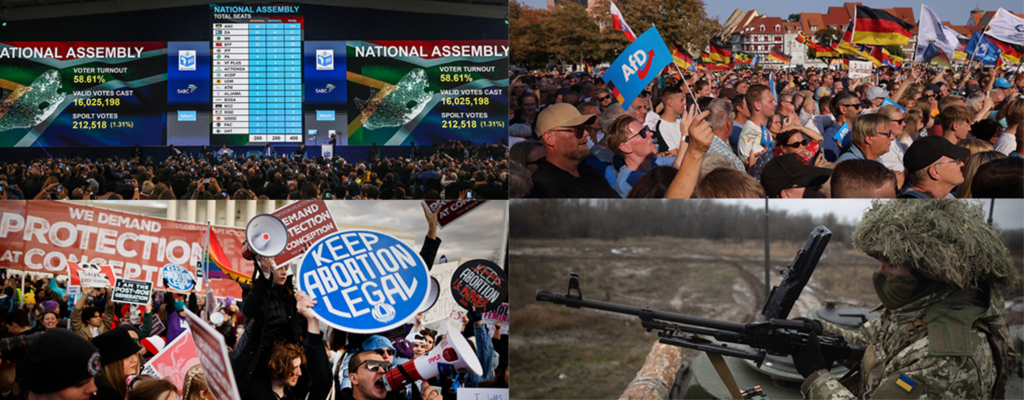
December 11, 2024 2024 was a remarkable year for elections as voters in more than 60 countries went to the polls. It also turned out to be a difficult year for incumbents and traditional political parties. Rattled by rising prices, divided over cultural issues and angry at the political status quo, voters in many countries sent a message of frustration. This analysis of the 2024 election year is based on global public opinion data from surveys conducted by Pew Research Center and independent research. Links to original sources of data – including the methodologies of individual surveys and the specific questions asked – are available here: In this essay, we analyze four major themes that emerged from this year’s busy slate of elections around the world: A tough year for incumbents South Africa’s general election results come in at the Gallagher Convention Center in Midrand on June 2, 2024. The African National Congress failed to win a majority of National Assembly seats for the first time since the end of apartheid. (Phill Magakoe/AFP via Getty Images) In one of the year’s highest-profile elections, Democrats in the United States lost the presidency, with Donald Trump, the Republican former president, defeating Vice President Kamala Harris. Republicans also won majorities in both houses of Congress. It was the third straight U.S. presidential election in which the incumbent party lost. And it was one of many notable losses for incumbents around the world in 2024: In the United Kingdom – unlike in the U.S. – political power swung to the left. The Labour Party won an overwhelming parliamentary majority, bringing 14 years of Conservative Party rule to an end. The most dramatic defeat for a longtime incumbent party may have occurred in the southern African nation of Botswana, where the Botswana Democratic Party lost power for the first time in nearly 60 years. In April, South Korean voters gave the opposition Democratic Party a majority of seats in the National Assembly in what was seen as a check on President Yoon Suk Yeol of the People Power Party. In early December, President Yoon imposed martial law and accused Democratic Party leaders of “anti-state” activities. The National Assembly quickly reversed Yoon’s decision, voting unanimously to lift martial law. Opposition parties of various ideological stripes won power in a diverse set of nations, including Ghana, Panama, Portugal and Uruguay. Elsewhere, incumbent parties held on to power but still suffered significant setbacks: What made 2024 such a tough year for incumbents? While every election is shaped by local factors, economic challenges were a consistent theme across the globe. That included the U.S., where the economy was the top issue for registered voters – especially for those who supported Trump. A survey we conducted in 34 countries earlier this year illustrated the extent of global economic gloom. Across these nations, a median of 64% of adults said their national economy was in bad shape. In several nations that held elections in 2024 – including France, Japan, South Africa, South Korea and the UK – more than seven-in-ten expressed this view. Inflation was an especially important issue in this year’s elections, although economic concerns were prevalent in many countries before the post-pandemic wave of global price increases. The past two decades have seen financial crises, the Great Recession, the COVID-19 economic downturn, inflation and ongoing economic inequality, all of which may have shaped the mood in nations around the globe. But the economy wasn’t the only thing driving voter discontent. Our global surveys over the past few years have highlighted a broader frustration with the functioning of representative democracy. Across 31 nations we surveyed in 2024, a median of 54% of adults were dissatisfied with the way democracy is working in their country. And in several high-income nations, dissatisfaction has increased significantly over the past three years. Our surveys have shown that many people feel disconnected from political leaders and institutions. Large majorities in many nations believe elected officials don’t care what people like them think. Many say there is no political party that represents their views well. And large shares say people like them have little or no influence on politics in their country. The staying power of right-wing populism Supporters of the Alternative for Germany (AfD) political party gather at a campaign rally in Erfurt, Germany, on Aug. 31, 2024. AfD went on to win in Thuringia, becoming Germany’s first far-right party to win a state election since World War II. (Sean Gallup/Getty Images) Frustrations with the political class have created opportunities for right-wing populists and other challengers to traditional parties and the political status quo. Several elections this year in Europe highlighted this trend: Right-wing populist parties, many of which campaigned on sharply anti-immigration platforms, gained ground in this year’s European parliamentary elections. Parties on the left and in the center worked together to keep Marine Le Pen’s right-wing populist National Rally out of power in France in this year’s parliamentary elections. But Le Pen’s party nonetheless significantly increased the number of seats it holds in the National Assembly. In early December, National Rally voted with New Popular Front, a coalition of left-leaning parties, to end the government of conservative Michel Barnier after just three months. In Austria, the far-right Freedom Party won 29% of the vote in September elections – a higher share than any other party and its best-ever result. It is unlikely, however, that any governing coalition will include the party. Three far-right parties had a strong showing in Romania’s Dec. 1 parliamentary elections. Also, right-wing candidate Calin Georgescu received the most votes in the first round of the country’s presidential elections. However, on Dec. 6, Romania’s Constitutional Court annulled the first-round results after evidence emerged of substantial Russian interference in the election. Portugal joined the list of European nations with a significant right-wing party following Chega’s success in the March elections. The party won 50 out of 230 parliamentary seats, up from just 12 in 2022 and one in 2019. Reform

Global Elections in 2024: What We Learned in a Year of Political Disruption Read More »

5. Key labor force trends

Given how central work is to the lives of many Americans, the federal government carefully and consistently collects information on job availability, job characteristics and the demographics of the workforce. This chapter presents some of the key indicators collected by federal agencies and, when available, how they have changed over the past couple of decades. These topics include: The share of U.S. workers who are looking for work, and how long employees have worked for their current employer How much workers earn, how they are paid, and how much control they have over their work goals and processes How the age diversity, racial and ethnic diversity, and education of the U.S. workforce has changed in recent decades How easy is it to find and keep a job? National unemployment rate The standard measure of the availability of jobs is the national unemployment rate, or the share of the labor force who is looking for work. A low unemployment rate implies that it is relatively easy for job seekers to secure employment. In 2023, unemployment was 3.6%. Over the past seven decades, there have been very few years with an unemployment rate lower than that. Though unemployment has ticked up during 2024, it remains relatively low – 4.1% in October 2024. By comparison, unemployment peaked at 9.7% in 2010 after millions of workers lost their jobs in the Great Recession that began in December 2007. Job tenure Job tenure data collected by the government also indicates that jobs have become more secure over the last few decades and that workers are not job-hopping more than in the past. Every other January, the U.S. Census Bureau asks workers how long they have been with their current employer. In January 2022, about a third of workers ages 18 and older (34%) reported that they had been with their current employer less than three years, while about one quarter (27%) had been with their employer 10 years or more. The average tenure of today’s workers is not much different than what was reported by workers 20 years ago. The tenure data captures workers who choose to leave their job (if they quit or job-hop) as well as those who leave involuntarily (if they get fired). Job tenure appears to have increased during the Great Recession. For example, in January 2008, 35% of workers had been with their employer less than three years. But by 2010, 31% of workers reported that short of tenure. During economic downturns, workers may stick with their current employer due to the lack of good alternative job opportunities. Furthermore, employees with short tenures are the ones who are most likely to be terminated during a recession and thus no longer included in the tenure calculation. Job tenure among adult workers partly reflects the characteristics of the workforce. Over many decades, the workforce has aged; that tends to boost the average job tenure, as older workers generally stay in their jobs longer than younger workers. Still, the job tenure of 18- to 34-year-old workers has not changed much over time. This suggests that today’s young workers do not job-hop to a greater extent than young workers of the past. Job characteristics How has pay changed over time? The past decade or so has been beneficial for workers in general. Unemployment has been trending down and employers have had difficulty finding workers to fill both lower-skilled and higher-skilled jobs. As a result employers have had to pay higher wages to find the workers they need. Today the typical adult working full-time, year-round earns about $60,000 a year. That’s a 12% pay boost above what they earned in 2000 ($53,480 after adjusting for inflation). Earnings outcomes are less rosy, however, over the short term. Since 2020, inflation has heated up and workers’ pay overall has not kept up. In 2021, the median adult full-time, year-round worker earned $64,321 after adjusting for inflation, above the $60,000 earned today. The 2021 figure refers to the earnings of workers during calendar year 2020. In 2020 there were 14 million fewer full-time, full-year workers than in 2019, the largest year-to-year decline on record. The Census Bureau asserts that the employment decline and earnings increase from 2019 to 2020 together suggest that many of the jobs lost due to the pandemic were lower-paying jobs, bumping up the estimated 2021 median earnings. How are workers paid? By far, wages and salaries are the most common type of pay arrangement. In 2023, 97% of workers ages 18 and older reported receiving this type of pay. Other types of pay included: Bonuses (10% of workers received this type of pay) Commissions (5%) Overtime pay (5%) Tips (2%) Pay arrangements vary by occupation, and workers can report multiple types of earnings. Decision-making on the job Another important aspect of work is the degree to which workers make their own decisions, or their autonomy on the job. The Federal Reserve has recently begun collecting information on job autonomy. In 2023, workers said they had more autonomy to choose how to complete their tasks than to choose which tasks to complete. Among workers ages 25 and older:  58% said they often or always chose how to complete tasks. 36% said they often or always chose which tasks to work on. Workers with more formal education reported greater autonomy on the job than their counterparts with less education. For example, 40% of workers with at least a bachelor’s degree said they often or always choose which tasks to work on versus 27% of workers who have not completed high school. Having multiple jobs In 2023, just 5% of workers ages 25 and older had multiple jobs. This share has not changed much over time: In 2000, 6% of workers ages 25 and older held multiple jobs. Surprisingly, workers in this age group who have completed at least a bachelor’s degree are more likely to work multiple jobs (6% in 2023) than those who have not completed high school (3%). Industry of employment Employment growth

5. Key labor force trends Read More »

4. Job skills and training

Most workers (70%) say they currently have the education and training they need to get ahead in their job or career. Still, a sizable share (30%) say they need more education and training. Not surprisingly, older workers are more likely to say they have the training needed. The vast majority of workers ages 65 and older (86%) say this, larger than the shares among younger groups. Views also differ by educational attainment. While 80% of workers with postgraduate degree say they have the education and training needed, smaller shares of those with a bachelor’s degree only (70%) or with some college education (64%) say the same. Workers with a high school diploma or less education are more likely than those with some college education to say they have the education and training they need (70% vs. 64%). The best way to get training and education Of the workers who say they need more education and training to get ahead, views are mixed on what would be the best way to get it. 28% point to learning on the job as the best way. 24% point to a certificate program. 24% point to more formal education, such as a two-year, four-year or postgraduate degree. 13% point to classes or online tutorials. Another 10% of workers say they are not sure what would be the best way for them to get training. Preferences about the best approach for further skills development differ by age. Among workers who say they need more training, those ages 18 to 29 (31%) are more likely than those ages 30 to 49 (22%) or 50 and older (21%) to say the best way would be for them to get more formal education. In turn, workers ages 30 to 49 (15%) and those 50 and older (18%) are more likely than the younger group (7%) to say taking classes or watching online tutorials would be the best way to get the training they need. Workers with a high school diploma or less education stand out in their views about the best way to get further education and training. They are less likely than workers with some college or a bachelor’s degree only to see formal education as the best way to get the training they need (19% vs. 26% and 30%). Workers with a high school diploma or less education are also more likely than other groups to say they are not sure what would be the best way for them to get the training the need (15% vs. 7% to 9% among other groups). Who’s most likely to get training? Regardless of whether they say they need additional training, about half of workers (51%) say they have taken a class or gotten extra training in the past 12 months to learn, maintain or improve their job skills. Roughly the same share (49%) say they have not done this. Among workers who say they need more education and training: 53% say they have taken a class or gotten training in the past 12 months, while 47% say they have not. Most with a postgraduate degree (73%) say they got training in the past year, compared with 53% of those with a bachelor’s degree only and 50% of those with some college or less education. Reasons for getting training Among all workers who have taken a class or gotten extra training in the last 12 months, a majority say a major reason they did so was to keep up with field or industry requirements (62%). Many also point to employer requirements as a reason (45%). About half (52%) say a major reason they took a class or received training is to improve their job performance. And about three-in-ten or fewer point to wage or job opportunities – such as earning more money (31%), helping them get a new job (20%) or advancing them toward a promotion (19%) – as major reasons. Younger workers are more likely than older workers to point to wages and job opportunities as major reasons they got training. Among workers who have gotten training in the past year, those ages 18 to 29 are the most likely age group to say each of the following is a major reason they did so: Earning more money: 44% versus 34% of those ages 30 to 49, 16% of those 50 to 64, and 10% of those 65 and older. Helping them get a new job: 34% versus 21%, 9% and 3%. Getting a promotion: 30% versus 21%, 8% and 2%. Reasons for not getting training We also asked workers who have not taken a class or gotten training the past 12 months why they haven’t done this. About a third (35%) say they didn’t feel they needed to. Among workers who say they need more training but haven’t taken a class or gotten extra training in the last 12 months, many point to time and resource constraints as major reasons. 43% say they couldn’t find the time to do it. 38% say they couldn’t afford it. 28% say their employer wouldn’t cover the cost. Some 23% say a major reason is that they haven’t found the type of training they need, and a smaller share (16%) say they didn’t feel they needed it. Workers with lower and middle incomes are more likely than those with upper incomes to face economic barriers to training. Sizable shares of lower- and middle-income workers (41% and 43%) who report they need but didn’t get training say they couldn’t afford it. Just 11% of those with upper incomes say the same. What are the most important skills in today’s economy? We asked workers to rate the importance of nine skills a worker might need to be successful in today’s economy. Workers rate the following skills as the most important: Interpersonal skills (85% say this is extremely or very important) Written and spoken communication skills (85%) Critical thinking skills (84%) Smaller majorities place great importance on basic computer skills (72%) and management

4. Job skills and training Read More »

3. Job security

Most workers (69%) feel that they currently have at least a fair amount of job security, with 33% saying they have a great deal of security. Another 17% say they have some job security, and 13% say they have little to none. White workers and those with upper incomes are among the most likely to say they have a great deal of job security. About four-in-ten White workers (39%) say this, compared with 25% of Black workers and 22% each among Hispanic and Asian workers. And among upper-income workers, 43% say they have a great deal of security in their job. About a third of those with middle incomes (34%) and a smaller share of those with lower incomes (22%) say the same. Perceptions of job security also vary by the type of employer workers have. Government workers are the most likely to say they have a great deal of job security (47%), followed by those who work at nonprofits (39%). The survey was conducted before the announcement of possible cuts to the federal workforce in the next presidential administration. About three-in-ten of those who work at a private company (29%) or who are self-employed (28%) feel they have a great deal of security in their job. These patterns also hold when looking at those who say they have at least a fair amount of job security. Workers’ sense of job security is virtually unchanged from 2022, when we last asked this question. In that survey, 69% said they had at least a fair amount of job security, with 35% saying they felt a great deal of security. Some 16% felt they had some job security, while 15% said they had little or none. Looking for a new job For the most part, workers have no near-term plans to look for a new job: At the time of the October survey, 63% said they were unlikely to do so in the next six months. A quarter said they were at least somewhat likely to look for a new job, while 12% said they were neither likely nor unlikely to do so. These figures are similar to what they were in 2022. The shares who said they’re very or somewhat likely to look for a new job in the coming months are higher among some groups: 37% of Black workers and 30% each among Hispanic and Asian workers versus 20% of White workers 37% of workers ages 18 to 30 versus 26% of those ages 30 to 49, 16% of those 50 to 64 and 10% of workers 65 and older 37% of workers with lower incomes versus 23% of those with middle incomes and 17% of those with upper incomes It’s perhaps not surprising that workers who are not too or not at all satisfied with their job are far more likely than those who are extremely or very satisfied to say they’re likely to look for a new job (64% vs. 11%). About a third of those who are somewhat satisfied with their job (31%) say the same. The share saying they’re likely to look for a new job decreases as perceptions of job security grow more optimistic. About six-in-ten of those who say they have no job security at all (58%) say they’re likely to look for a new job, compared with: 50% of those with a little job security 33% of those with some job security 21% of those with a fair amount of job security 14% of those with a great deal of job security How easy or difficult would it be to find a new job? While the shares of workers who feel their job is secure and who say they’re likely to look for a new job in the near future are unchanged from two years ago, workers are now much more likely than in 2022 to say it would be very or somewhat difficult for them to get the kind of job they would want if they were to look for a new one today. About half of workers (52%) now say it would be difficult for them to find the kind of job they want, while 26% say this would be easy and 21% say it would be neither easy nor difficult. In 2022, similar shares of workers said it would be difficult (37%) as said it would be easy (39%) for them to find the kind of job they want if they were to look for a new one. The shares of workers saying it would be difficult for them to find a new job are up by double digits among men and women and across racial and ethnic groups, income tiers, and levels of educational attainment. This is also the case among workers in most age groups. (The increase has been more modest, at 8 points, among workers ages 65 and older.) Still, some groups are more likely than others to say it would be difficult for them to find a new job if they were to look for one. A majority of workers ages 18 to 29 (58%) say this would be difficult, compared with about half of those in older age groups. And while 62% of those with lower incomes say it would be difficult for them to find a new job, 51% of those with middle incomes and 45% of those with upper incomes say the same. source

3. Job security Read More »

How Americans View Climate Change and Policies to Address the Issue

Mixed views of how climate policies impact the U.S. economy The coal-fired Oak Grove Power Plant in Robertson County, Texas, in April 2024. (Brandon Bell/Getty Images) Pew Research Center conducted this study to understand how Americans view climate change and policies to address the issue. For this analysis, we surveyed 9,593 U.S. adults from Oct. 21 to 27, 2024. Everyone who took part in the survey is a member of the Center’s American Trends Panel (ATP), a group of people recruited through national, random sampling of residential addresses who have agreed to take surveys regularly. This kind of recruitment gives nearly all U.S. adults a chance of selection. Surveys were conducted either online or by telephone with a live interviewer. The survey is weighted to be representative of the U.S. adult population by gender, race, ethnicity, partisan affiliation, education and other categories. Read more about the ATP’s methodology. Here are the questions used for this report, the topline and the survey methodology. The United States and countries around the world continue to grapple with the impacts of climate change, including record heat and more intense extreme weather events. A Pew Research Center survey of 9,593 U.S. adults conducted Oct. 21-27, 2024, takes stock of Americans’ views on climate change, including its impact on their own lives, their support for policies to address the issue and the emotional reactions they have to climate news. Key findings Americans are split over the economic impact of climate policies Economic issues like inflation have been front of mind for many voters in this year’s election. The survey finds that U.S. adults are just as likely to say that policies aimed at reducing the effects of climate change usually help the economy as they are to say these policies usually hurt it (34% each). Among Republicans and those who lean to the Republican Party, 56% think climate policies usually hurt the economy. By contrast, 52% of Democrats and those who lean Democratic say they usually help. Large businesses and corporations seen as doing too little on climate change Overall, 69% of Americans say large business and corporations are doing too little to help reduce the effects of global climate change. Six-in-ten also say state elected officials are doing too little on climate. Broad support for a number of policies to address climate change Sizable majorities favor tax credits for Americans who improve their home’s energy efficiency (83%) and tax credits for businesses that develop carbon capture technologies (79%). Notably, majorities of both Republicans and Democrats support these policy actions. Widespread frustration with political disagreement over climate change Eight-in-ten Americans say climate news makes them feel frustrated about the level of political disagreement on the issue. A large share (73%) also say climate news has made them feel sad about what’s happening to the Earth. At the same time, 51% of U.S. adults say they’ve felt suspicious of the groups pushing for action on climate change (a view expressed by 75% of Republicans). 64% say climate change currently affects their local community either a great deal or some Among Republicans, 41% say climate change is currently impacting their own community. For Democrats, a large majority (86%) holds this view. These wide partisan differences in perceptions exist across geographic regions. Relatively few expect to make major sacrifices in their lifetime due to climate change Three-quarters of U.S. adults expect they’ll have to make at least minor sacrifices in their everyday life during their lifetime because of global climate change. But the share who expect to make major sacrifices remains modest, at 23%. Emotional reactions to climate change news Climate change news and information sparks a mix of feelings among Americans. Large shares express frustration with the partisan nature of climate debate. Eight-in-ten say they’ve felt frustrated by the level of political disagreement when they’ve seen news and information about climate change. Climate change is not an easy subject for all Americans to make sense of: 48% report feeling confused about all the information out there on the issue. For some, climate news sparks a sense of skepticism: 51% say they have felt suspicious of the groups and people pushing for action on the issue. A 2023 Center analysis of qualitative interviews with U.S. adults who do not see climate change as an urgent issue found one theme was skepticism about the motives of those calling for more action on climate change. Many express sadness about what’s happening to the Earth. About three-quarters (73%) say climate news has made them feel this way. A sense of anxiety about the future because of climate news also registers with 56% of Americans. Just under half (45%) say climate news and information has made them feel optimistic we can address the issue. The share who say climate news has made them feel optimistic is 7 percentage points higher than it was in an October 2023 Center survey. Partisan differences in reactions to climate news There continue to be wide differences between Republicans and Democrats – including those who lean to each party – in their reactions to climate news and information. Large majorities of Democrats say climate news has made them feel sad about what’s happening to the Earth (91%), and 75% say it has made them feel anxious about the future. At the same time, 75% of Democrats also say climate news has made them feel motivated to do more to address the issue. For Republicans, a top reaction is a sense of suspicion toward the groups and people pushing for action on the issue (75% say they’ve felt this way). And 52% say they’ve felt annoyed there is so much attention on the issue. Republicans are much less likely than Democrats to say climate news has made them feel sad about what’s happening to the Earth; still, 54% of Republicans say they’ve felt this way. Large majorities of Democrats and Republicans share a sense of frustration over the level of political disagreement over climate change: 88% of Democrats

How Americans View Climate Change and Policies to Address the Issue Read More »

2. Voters’ and nonvoters’ experiences with the 2024 election

Voters in the November 2024 election were about equally likely to vote in person on Election Day (34%), vote early in person (32%) or use an absentee or mail-in ballot (35%). Election Day voting Roughly a third of voters (34%) report having cast their ballot on Election Day, a smaller share than the 44% of 2022 midterm voters who did this, but substantially more than the 27% who did so in 2020, in the midst of the coronavirus pandemic. While the share of voters casting ballots in person on Election Day has steadily declined over the last two decades, it was the method used by a majority of voters until 2018. Early in-person voting Early in-person voting hit a high point this year: 32% of voters report having cast their ballots this way, up from 27% in 2020 and 21% in 2022. Absentee and mail-in voting The share who voted by absentee or mail-in ballot in this election is identical to the share of voters who voted by this method in the 2022 midterms. In 2020, 46% of voters voted by absentee or mail-in ballot. Republicans continue to be more likely than Democrats to vote on Election Day, less likely to vote by mail. But rising shares in both parties voted early in person. 39% of Republican voters say they cast their vote in person on Election Day, compared with 28% of Democratic voters. In contrast, 44% of Democratic voters say they voted by mail or absentee, compared with 26% of Republican voters. 35% of Republican voters and 28% of Democratic voters report having voted early in person this year. Some voters switched vote methods this year An overwhelming majority of voters who had voted in elections prior to 2024 (87%) report having used a voting method that was familiar to them in this election. Yet about 13% used a new method of voting this November: 27% of early in-person voters say this was the first time they voted in person before Election Day. 9% of absentee or mail voters say this was their first time voting by absentee or mail-in ballot. 2% of voters who voted in person on Election Day say this was their first time doing so. Most voters say it was easy to vote in the election An overwhelming majority of voters (94%) say it was easy to vote in the election this November. About eight-in-ten (79%) describe voting as very easy, while 15% say it was somewhat easy. Just 6% of voters say voting was somewhat (5%) or very (2%) difficult. Similar shares of voters who backed Donald Trump (95%) and Kamala Harris (93%) say that voting was easy. In 2020, 93% of Trump voters and 95% of Joe Biden voters said it was easy for them to cast their ballots. Most in-person voters had little or no wait to vote Roughly seven-in-ten voters who voted in person (72%) – either on Election Day or earlier – say they waited less than 10 minutes to vote, including 42% who report not waiting at all. About three-in-ten in-person voters (28%) waited at least 10 minutes to vote, including 11% who waited for more than 30 minutes and 4% who waited more than an hour. Voters report shorter wait times this year than in 2020. Wait times of demographic groups Race and ethnicity Black, White, Hispanic and Asian in-person voters report similar wait times this year. In 2020, Black in-person voters reported waiting somewhat longer to vote than White or Hispanic in-person voters. Age Older and younger in-person voters reported similar wait times to cast their ballots. Community type As was the case four years ago, urban and suburban in-person voters had to wait somewhat longer to vote on average than in-person voters living in rural communities. Urban and suburban in-person voters are each about 10 percentage points more likely than those in rural areas to have waited more than 10 minutes. Vote method Those who voted in person before Election Day waited somewhat longer than those who voted on Election Day: 33% of early in-person voters waited more than 10 minutes, compared with 24% of Election Day in-person voters. Candidate preference In-person voters who backed Trump and those who backed Harris report nearly identical wait times. By contrast, in 2020 in-person Biden voters reported waiting longer to vote than Trump voters. Nonvoters’ views of the election Among those eligible to vote who say they did not cast a ballot, 42% say they wish they had voted while 57% say they do not. These shares are similar to other recent presidential elections: 45% of nonvoters said they wished they had voted following the 2020 election, and 44% said this postelection in 2016. Nonvoters point to a number of reasons for their decisions not to vote: 35% say thinking their vote would not make a difference was a major reason why they did not vote. 31% say that not liking politics was a major reason. 18% say it was that they are not registered or not eligible to vote. 17% say a major reason was that they did not care about the outcome. 15% say voting was inconvenient. 8% say a major reason was they forgot to vote. source

2. Voters’ and nonvoters’ experiences with the 2024 election Read More »

2. How we created a list of popular news influencers, and where they post

Social media is vast, with several distinct sites and innumerable accounts spread across them. Because of this complexity, researchers cast a wide net across the most popular sites to create an inclusive list of influencers who discuss news. First, we developed a set of keywords related to current events and civic issues across 45 topics that were relevant to broad audiences in the U.S. in early 2024. Then we used a set of social media marketing tools to find social media accounts with over 100,000 followers that used those keywords in early 2024. While the keywords used were focused on issues important to the United States, we could not verify the location of the individuals running these accounts. One thing quickly became clear: Discussion of news, politics and civic issues is widespread on social media. This initial screening led to a list of more than 28,000 accounts across Facebook, Instagram, TikTok, X and YouTube. Many of these 28,000 accounts are not focused on news most of the time. Researchers examined recent posts from each account to determine if they were talking about news, politics and civic issues regularly, and not just rarely. We also verified that accounts were run by individuals and not organizations. Just over 2,500 accounts – and 2,058 influencers, since influencers can have an account on multiple sites – met these criteria. To create a more manageable group to analyze, researchers then sampled 500 news influencers from this set of 2,058. These 500 form the set of popular news influencers who are examined in this report. Our analysis includes: Detailed human coding of all 500 news influencers to determine where they post and who they are. This includes a look at other places they may post beyond the five major sites we searched for influencers on. Human-validated machine coding of over 100,000 posts from these news influencers during three weeks in July and August 2024, to determine what these accounts are posting about. For more information, refer to the methodology. Where are news influencers found? While news influencers can be found on a wide range of social media sites, they are concentrated on a few. The vast majority of news influencers studied (85%) have an account on X, formerly known as Twitter. Half are on Instagram, while a slightly smaller share (44%) are on YouTube. Roughly three-in-ten are on Facebook (32%), Threads (30%) and TikTok (27%). And smaller shares are on several other sites, including 5% who are on Donald Trump’s site, Truth Social. (A 2022 study found that most prominent accounts on Truth Social were individuals.) More Americans say they regularly get news (in general, not just from news influencers) from Facebook (33%) and YouTube (32%) than other social media sites, while smaller shares get news on Instagram (20%), TikTok (17%) and X (12%). At the same time, a much larger share of X users than users of other sites say getting news is a reason they use the site. Altogether, about two-thirds of news influencers are on more than one social media site, including 27% who are on five or more sites. Meanwhile, 34% are on just one site – most often X. Other ways news influencers connect with their audiences We also looked at other ways that news influencers connect with their audiences beyond social media. About a third (34%) host a podcast, and nearly a quarter (22%) send an email newsletter to subscribers. A small share of news influencers in the sample (6%) have an official Discord server, a chat site on which they can often have private, ongoing chats with fans. Most news influencers (59%) also make direct financial appeals to their followers. About half (49%) offer a paid subscription to their content, 29% solicit donations, and 21% sell branded merchandise like stickers, coffee mugs and apparel. source

2. How we created a list of popular news influencers, and where they post Read More »

3. Voters’ reflections on the 2024 campaign

Reflecting on the 2024 presidential campaign, a large majority of voters say it was interesting rather than dull (74% vs. 24%). But evaluations of the campaign are more negative than positive on other dimensions. Roughly three-quarters of voters (74%) say the 2024 campaign was too negative, similar to the share of registered voters who said this in an October preelection survey. More than six-in-ten voters (64%) say the 2024 campaign was not focused on important policy debates. In October, a nearly identical 62% of registered voters said this. Seven-in-ten voters say the 2024 campaign did not make them feel proud of the country, while 29% say it did. These views are somewhat more positive than they were in October, when 19% of registered voters said the campaign made them feel proud of the country. How Trump and Harris voters view the campaign Trump voters are more likely than Harris voters to describe the 2024 campaign in positive terms. This reflects a shift from before the election: In October, there were only slight differences between Trump and Harris supporters’ views of the campaign. Was the campaign focused on policy debates? About half of Trump voters (52%) now say the 2024 campaign was focused on important policy debates. Just 18% of Harris voters share this view. In October, 37% of Trump supporters and 38% of Harris supporters said the campaign was focused on important policy debates. Did the campaign make you feel proud of the U.S.? Half of Trump voters now say the 2024 campaign made them feel proud of the country, while only 8% of Harris voters say the same. Last month, the same percentage of both Trump and Harris supporters (20%) said the campaign made them proud. Was the campaign too negative? While majorities of both candidates’ voters say the 2024 campaign was too negative, Harris voters (81%) are more likely than Trump voters (68%) to say this. Before the election, about seven-in-ten in both groups said this. Was the 2024 campaign interesting or dull? Majorities of both Harris (66%) and Trump supporters (83%) say the campaign was interesting. But Harris supporters are twice as likely as Trump supporters (32% vs. 16%) to say the campaign was dull, a reversal from before Election Day. In October, Trump supporters (34%) were more likely than Harris supporters (24%) to say the campaign was dull. Satisfaction with the presidential candidates About half of voters (53%) say they were very or fairly satisfied with the choice of presidential candidates this year, while 47% say they were not too or not at all satisfied with the choice of presidential candidates. A slightly smaller share of voters say they were satisfied with the choice of presidential candidates compared with four years ago, when 57% said they were very or fairly satisfied. As in prior election years, supporters of the winning candidate express more satisfaction with the choice of candidates than supporters of the losing candidate. More than eight-in-ten Trump voters (85%) say they were very or fairly satisfied with the choice of presidential candidates, compared with 22% of Harris voters. Trump voters in 2024 are 11 percentage points more likely than Biden voters were in 2020 to say they were satisfied with the choice of candidates (85% vs. 74%). The share of Harris supporters who express satisfaction with the candidates is lower than the share of Trump supporters who did so four years ago. When did voters make up their minds about who to vote for? About eight-in-ten voters (81%) say they made up their mind about who they were going to vote for in the 2024 presidential election before September. This is similar to the share who said this in 2020 (84%), and higher than the share who reported having made up their minds before September in 2016 (67%). This year, 7% of voters say they made up their mind about their vote in the last week before Election Day. In 2020, 5% said they had made their mind up in the last week. Similar shares of Trump (7%) and Harris voters (6%) say they decided about their vote in the last week before Election Day. Trump voters are slightly more likely than Harris voters to report having made up their mind before September (84% vs. 79%). source

3. Voters’ reflections on the 2024 campaign Read More »

1. Voters’ evaluations of the 2024 election process

Most voters say that the 2024 elections were run and administered well, both in their local communities and across the country. 95% of those who report having voted this year say that elections in their community were run and administered at least somewhat well, including 69% who say they were run very well. 88% of voters also say the elections across the United States were run and administered well, though a smaller share (43%) say they were administered very well. While voters have long had highly positive views about election administration locally, that is not the case for evaluations of how elections were conducted across the country. In 2020, 59% of voters said elections across the country were run and administered at least somewhat well. This was a sharp drop from assessments of the 2018 midterm election and came amid Donald Trump’s challenge to the 2020 election results. Views rebounded in the 2022 midterm, with 74% saying that election was run and administered well. Evaluations of this year’s election administration around the country were even more positive, with 88% saying this. Views of election administration among Trump and Harris voters About nine-in-ten Trump voters (93%) say elections around the country were run well this year. A smaller share of Kamala Harris voters – though still an overwhelming majority (84%) – also say this. This is a departure from both the 2020 and 2022 elections, when Democratic candidate voters were much more likely than Republican candidate voters to say that elections around the country were run and administered at least somewhat well. Following the 2020 presidential election, 94% of Joe Biden voters said elections around the U.S. were run and administered well, while just 21% of Trump voters said this. And voters who selected a Democratic candidate for the U.S. House in 2022 were 43 percentage points more likely than Republican voters to say the elections around the country that year were run well. Most voters are confident in the accuracy of this year’s vote counts Large majorities of voters express confidence that both votes cast in person at polling places and those cast by absentee or mail-in ballot were counted as voters intended this year. Confidence in count of votes cast in person Nine-in-ten voters say they are at least somewhat confident that votes cast in person were counted accurately, including 45% who say they are very confident. More than nine-in-ten Trump voters (94%) say they are confident in-person ballots were counted accurately, including 41% who say they are very confident of this. Trump voters this year are 30 points more likely to say they are confident that in-person ballots were counted accurately than Trump voters were in 2020. A large majority of Harris voters (86%) also say they are confident in the vote count for in-person ballots, including 49% who are very confident. The share of Harris voters expressing confidence in the in-person vote count is lower than the 98% of Biden voters who said this when he won in 2020. Confidence in count of votes cast by absentee or mail-in ballot Voters today are more confident than they were four years ago that absentee and mail-in ballots were counted as voters intended. This is the result of a substantial increase in confidence in absentee vote counts among Republican candidate voters. Overall, 75% of voters say they are very (28%) or somewhat (47%) confident that absentee or mail-in ballots were counted accurately this year, compared with 59% who said this after the last presidential election. Today, 72% of Trump voters say they are confident in the accuracy of mail-in ballot counts. In 2020, just 19% expressed confidence. While Democratic candidate voters remain broadly confident in counts of votes cast using this method, they express lower levels of confidence than they did after the 2020 and 2022 elections. Today, 78% of Harris supporters are at least somewhat confident in the mail ballot count. Following Biden’s 2020 victory, 95% of his voters said they were confident. Most voters are confident their own vote was counted accurately Most voters (92%) say they are very (59%) or somewhat (33%) confident their own vote was accurately counted in this year’s presidential election. This reflects a modest uptick from the share who said this following the 2020 election (85%). Trump voters (96%) are more likely than Harris voters (89%) to say they are at least somewhat confident their own vote was counted accurately. Four years ago, Biden voters (97%) were more likely than Trump voters (72%) to say this. Before-and-after views of election administration Confidence that ineligible voters were prevented from casting a ballot About two-thirds of voters (66%) now say they are very or somewhat confident that people who were not legally qualified to vote were prevented from casting a ballot. In an October preelection survey, a smaller majority of registered voters (59%) said they were confident unqualified voters would be prevented from voting. Trump voters’ confidence that ineligible voters did not vote is much higher than it was before the election. Still, a majority continue to say they are not confident of this: Today, 45% of Trump voters say they are at least somewhat confident ineligible voters were prevented from voting, while 55% say they are not too or not at all confident of this. Before the election, just 30% Trump supporters said they were confident ineligible voters would be prevented from voting. By contrast, an overwhelming share of Harris voters (88%) are confident that ineligible voters were prevented from voting. This is nearly identical to the share of Harris supporters (87%) who had confidence in this in October. Confidence that all eligible voters were able to cast a ballot The share of voters who say they are very or somewhat confident that all legally qualified voters who wanted to cast a ballot were able to do so is nearly identical to the share who predicted this in the preelection survey (91% now, 90% in October). Large majorities of both Trump voters

1. Voters’ evaluations of the 2024 election process Read More »

Voters Broadly Positive About How Elections Were Conducted, in Sharp Contrast to 2020

Trump voters’ skepticism about election administration and voting by mail declines sharply after their candidate’s 2024 victory Pew Research Center conducted this study to understand how U.S. voters view the 2024 presidential election and the voting process. For this analysis, we surveyed 9,609 U.S. adults, including 8,072 U.S. citizens who reported having voted in the November election. The survey was conducted Nov. 12-17, 2024. Everyone who took part in this survey is a member of the Center’s American Trends Panel (ATP), a group of people recruited through national, random sampling of residential addresses who have agreed to take surveys regularly. This kind of recruitment gives nearly all U.S. adults a chance of selection. Surveys were conducted either online or by telephone with a live interviewer. The survey is weighted to be representative of the U.S. adult population by gender, race, ethnicity, partisan affiliation, education and other factors. Read more about the ATP’s methodology. Here are the questions used for this report, the topline and the survey methodology. American voters overwhelmingly say the 2024 elections across the country and in their own communities were run well this year, and they express high levels of confidence that votes were counted accurately. This stands in stark contrast to four years ago, when far fewer voters expressed confidence. Today, 88% of voters say that elections across the United States were run and administered at least somewhat well, up from 59% of voters in 2020. This year’s rosier view of election administration is entirely driven by a shift in views among those who voted for Donald Trump for president: 93% of Trump voters say the 2024 elections were run and administered at least somewhat well. Four years ago, as Trump was contesting his defeat by Joe Biden, just 21% of his supporters said the elections were run well. Voters who supported Kamala Harris for president are less likely today to say the elections this November were run well than Biden’s voters were four years ago. Still, a wide majority of Harris voters (84%) this year say elections across the country were run well. It’s not unusual in presidential elections for voters who supported the winning candidate to express more confidence in the outcome than those who supported the losing candidate, but the size of the gap in 2020 was particularly large. Jump to read more about views of the voting process. The latest national survey by Pew Research Center – conducted Nov. 12-17, 2024, among 9,609 adults (including 8,072 adults who say they voted in the 2024 election) – finds that more positive perceptions of election administration and accuracy this year extend to several specific aspects of elections, including confidence in different voting methods. In the 2020 presidential election, Trump voters were far less confident than Biden voters in the accuracy of both in-person and mail-in ballot counts. While Republican voters’ confidence in the accuracy of vote counts rebounded somewhat in the 2022 midterm, wide gaps remained.  Today, Trump voters are somewhat more likely than Harris voters to express confidence in the vote counts of in-person ballots, and Harris voters are just 6 percentage points more likely than Trump voters to have confidence in mail-in ballot vote counts. In-person voting 94% of Trump voters are at least somewhat confident that votes cast in person were counted as voters intended, up 30 points from 2020. 86% of Harris voters are confident in the counts of in-person ballots. This is 12 points lower than the nearly unanimous confidence in these counts among Biden’s 2020 voters. Absentee or mail-in voting In 2020, just 19% of Trump voters expressed confidence in the count accuracy of ballots cast by mail. Today, 72% of Trump voters are confident that mail and absentee votes in the 2024 election were counted as voters intended. Nearly all 2020 Biden voters (95%) were confident in the count of absentee ballots in 2020. A narrower, though still clear, majority of Harris voters (78%) say this about the 2024 election. Many Trump voters continue to have concerns about people voting illegally While Trump voters express more confidence about most aspects of election administration and voting, a sizable share continue to register concerns about people who are ineligible casting ballots. Today, 45% of Trump voters say they are at least somewhat confident that people who were not legally qualified to vote were prevented from casting ballots. While there is more confidence in this than before the election, 55% of Trump voters still say they have little to no confidence ineligible voters were kept from voting. As was the case before the election, an overwhelming majority of Harris supporters are confident that those not eligible to vote were prevented from casting ballots. Jump to read more about how preelection expectations match up to postelection perceptions. Other findings: Voting methods in the 2024 presidential election, views of the campaign and choice in vote Harris voters were much more likely than Trump voters to cast a ballot by mail. Roughly a third of voters cast their ballots absentee or by mail (35%), while similar shares voted in person before Election Day (32%) and in person on Election Day (34%). Voters were less likely to vote by mail than in 2020. But, as in 2020, Democratic voters were much more likely than Republican voters to cast their ballot by mail (44% vs. 26%). For more on voting in the 2024 election, see Chapter 2. Trump voters express more positive views of the presidential campaign after the election. A month prior to the election, just two-in-ten of both Harris and Trump supporters said the 2024 campaign made them feel proud of the country, while about four-in-ten in both groups said it was focused on important policy debates (37% of Trump supporters, 38% of Harris supporters). Trump voters now reflect on the campaign in rosier terms, while the views of Harris voters have grown more negative. Half of Trump voters now say the campaign made them feel proud, but just 8% of Harris

Voters Broadly Positive About How Elections Were Conducted, in Sharp Contrast to 2020 Read More »