Appendix B: Detailed tables for analysis of sample of news influencers
source
Appendix B: Detailed tables for analysis of sample of news influencers Read More »

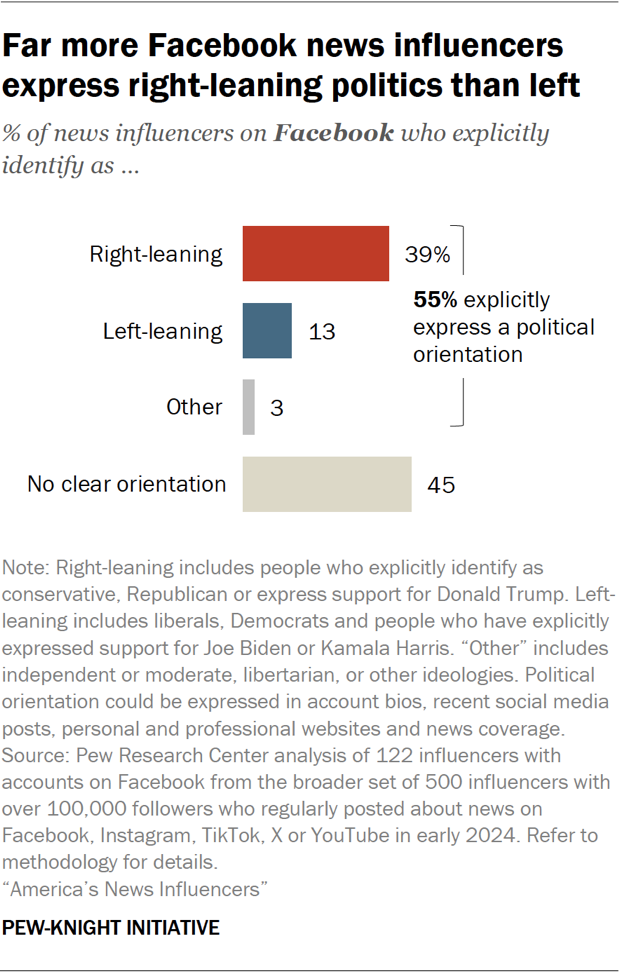
News influencers – People who regularly post about current events and civic issues on social media and have at least 100,000 followers on any of Facebook, Instagram, TikTok, X (formerly Twitter) or YouTube. Political orientation – A measure of a news influencer’s partisan or ideological views. A right-leaning news influencer is one who publicly expresses that they identify as a Republican or conservative or support Donald Trump in the 2024 presidential election. A left-leaning news influencer is one who publicly expresses that they identify as a Democrat, liberal or progressive or support Vice President Kamala Harris (or supported President Joe Biden before he dropped out of the race) in the 2024 election. This information was found in the bio, profile picture, banner image, pinned posts or recent posts on an influencer’s social media account, any personal website or professional page, and prominent media coverage. Values and identities – Language or imagery in the bio, profile picture, banner image or pinned posts on an influencer’s social media account that expresses specific beliefs or identities. News organization affiliation – An influencer with this affiliation is one who either currently works for or previously worked for a news organization, as well as freelancers who have regularly contributed to news organizations. A news organization can be any news outlet that has a staff and multiple bylines. Researchers considered affiliated influencers to have this background regardless of their news organization’s political orientation, audience size or primary publishing method (digital, TV, print, etc.). Major social media sites – The five primary sites we studied, chosen based on audience size and the presence of discussion about news: Facebook, Instagram, TikTok, X (formerly Twitter) and YouTube. Just over half of news influencers on Facebook explicitly express a clear political orientation. And three times as many say they are right-leaning (39% of all Facebook news influencers) as say they are left-leaning (13%). Influencers were categorized by whether they identify with a political party or ideology or expressed support for the Democratic or Republican presidential candidate in their social media profile, posts, personal website or media coverage. About this chapter This chapter looks at news influencers on Facebook. Virtually all of them also have accounts on other sites. For analysis of news influencers in general across social media sites, read the report overview. In this report, news influencers are people with large followings on social media sites who regularly post about current events or civic issues. Refer to the methodology for details. Related: Facebook users’ experiences with news Smaller shares of Facebook news influencers identify specific values or identities on their pages. This includes 6% who say they are pro-LGBTQ+ (or express an LGBTQ+ identity), 6% who say they are pro-Palestinian and 4% who identify as pro-Israeli. These positions can be indicated in a variety of ways, whether through words, images or emojis (including flags). Some Facebook news influencers also prominently declare their opposition to (3%) or support for (1%) abortion rights. Similar to news influencers in general, those on Facebook are mostly men. Two-thirds of Facebook news influencers are men, while three-in-ten are women. (Refer to the methodology for details on how we coded news influencers by gender.) This is a reversal of the gender dynamic of news consumers on Facebook: 60% of U.S. adults who regularly get news on Facebook are women, while 39% are men. About a quarter of news influencers on Facebook (24%) have a current or former affiliation with a media organization. This is roughly the same as the share of news influencers on X who have links to the news industry, and higher than some other sites. Still, about three-quarters of news influencers on Facebook (76%) do not have a background or affiliation with a news organization. For more details on the differences between influencers with and without links to the news industry, read Chapter 4. What are Facebook news influencers posting about? To get a sense of what news influencers are posting about, researchers collected and analyzed all public posts by the 500 news influencers in our sample for three separate weeks: July 15-21, July 29-Aug. 4 and Aug. 19-25. There were many major events related to the election in or around these weeks, including the first assassination attempt on Donald Trump on July 13, the Republican National Convention July 15-18, President Joe Biden’s withdrawal from the race July 21 and the Democratic National Convention Aug. 19-22. Most posts by Facebook news influencers that addressed current events (58%) focused on the U.S. government, politics or the presidential election. Facebook stands out for a relatively high share of posts by news influencers focused on technology (9%). Most of these were about cryptocurrencies (8%). What other sites are Facebook news influencers on? For most news influencers on Facebook, the site is just one piece of a larger social media presence. Only 2% of news influencers on Facebook are only on Facebook, while two-thirds are on at least four other social media sites (five or more in total). X, YouTube and Instagram are the most common other sites that Facebook news influencers have a presence on. Around three-quarters or more have an account on each of these three sites, while 42% are also on TikTok. Similar to other sites, many Facebook news influencers (44%) host a podcast, while a somewhat smaller share (26%) maintain an email newsletter that they send out to subscribers. Most news influencers on Facebook are trying to bring in money from their online presence, whether through paid subscriptions to additional content, donations or merchandise sales. About three-quarters of news influencers on the site (77%) use at least one of these monetization strategies. In part this might be due to the structure of the site: Facebook offers subscription tools for page owners. Roughly one-in-ten Facebook news influencers (11%) have a public Discord server, where they can further connect with fans and followers. source
6. News influencers on Facebook Read More »

News influencers – People who regularly post about current events and civic issues on social media and have at least 100,000 followers on any of Facebook, Instagram, TikTok, X (formerly Twitter) or YouTube. Political orientation – A measure of a news influencer’s partisan or ideological views. A right-leaning news influencer is one who publicly expresses that they identify as a Republican or conservative or support Donald Trump in the 2024 presidential election. A left-leaning news influencer is one who publicly expresses that they identify as a Democrat, liberal or progressive or support Vice President Kamala Harris (or supported President Joe Biden before he dropped out of the race) in the 2024 election. This information was found in the bio, profile picture, banner image, pinned posts or recent posts on an influencer’s social media account, any personal website or professional page, and prominent media coverage. Values and identities – Language or imagery in the bio, profile picture, banner image or pinned posts on an influencer’s social media account that expresses specific beliefs or identities. News organization affiliation – An influencer with this affiliation is one who either currently works for or previously worked for a news organization, as well as freelancers who have regularly contributed to news organizations. A news organization can be any news outlet that has a staff and multiple bylines. Researchers considered affiliated influencers to have this background regardless of their news organization’s political orientation, audience size or primary publishing method (digital, TV, print, etc.). Major social media sites – The five primary sites we studied, chosen based on audience size and the presence of discussion about news: Facebook, Instagram, TikTok, X (formerly Twitter) and YouTube. What is a news influencer? In this study, we use the term “news influencers” to refer to individuals who regularly post about current events and civic issues on social media and have at least 100,000 followers on any of Facebook, Instagram, TikTok, X (formerly Twitter) or YouTube. News influencers can be journalists who are or were affiliated with a news organization or independent content creators, but they must be people and not organizations. Refer to the methodology for more about how we identified news influencers. Once we had a sample of 500 popular news influencers to analyze, our researchers combed through each account to characterize who these influencers are. This chapter looks at news influencers’ gender, political orientation, and expression of particular values and identities. We also looked at whether each influencer is or used to be affiliated with a news organization; details are discussed in Chapter 4. We were unable to code for other attributes of news influencers, such as race, ethnicity and age. Gender There is a wide gender gap among news influencers in this study. Almost two-thirds of news influencers (63%) are men, about twice the share who are women (30%). A small number (fewer than 1%) identify as nonbinary in their online profiles. (For details on how researchers coded news influencers’ gender, refer to the methodology.) The gender gap among news influencers is present on most major social media sites, with men outnumbering women by about two-to-one or more on YouTube, Facebook, X and Instagram. For instance, 67% of news influencers on Facebook are men, compared with 30% who are women. However, the gender gap is much smaller on TikTok, where half of the news influencers on the site are men and 45% are women. Political orientation Slightly more news influencers explicitly identify with the political right than the left. About half of news influencers in this study (52%) publicly express a political orientation – including party affiliation, political ideology or support for a presidential candidate – in their social media profile, posts, personal and professional websites or media coverage. Researchers also considered other specific keywords or groups: For example, someone with “MAGA” in their account profile would be categorized as right-leaning, while someone who says they are “progressive” would be coded as left-leaning. Left-leaning news influencers include “progressive political host” Brian Tyler Cohen and V Spehar from Under the Desk News, while right-leaning news influencers include radio host and YouTuber Dan Bongino and podcaster Ben Shapiro. A slightly larger share of these influencers say they are Republican, conservative or Donald Trump supporters (27% of all news influencers) than say they are Democrats, liberals or supporters of Joe Biden or Kamala Harris (21%). An additional 3% of news influencers have other political orientations, including independents or Libertarians. Similar to its more balanced mix of genders among popular news influencers, TikTok also has the most even balance of news influencers who explicitly identify with either the political left or right: 28% identify as liberal, progressive or Democratic, while 25% are conservative or Republican. There are more news influencers who identify with the right than the left on all other major social media sites. This difference is particularly stark on Facebook, where about four-in-ten news influencers (39%) explicitly identify as right-leaning, triple the share who say they are left-leaning (13%). Values and identities Researchers also assessed accounts for additional political stances or personal identities through an examination of the banner image, profile photo and bio of news influencers’ social media account profiles. In these spaces, it’s difficult to distinguish between a value and an identity: A rainbow flag, for instance, could be an expression of support for LGBTQ+ rights or a declaration of the influencer’s LGBTQ+ identity. The content of the posts themselves (except for pinned or featured posts) was not assessed for these values, because we wanted to find influencers who make these values and identities a key part of their public persona. About two-in-ten news influencers (18%) openly associate themselves with certain political or social causes, values or personal identities. Among the most common are LGBTQ+ identity or support (6%) and support for Palestinians (5%), Israelis (3%) or Ukrainians (3%). Additionally, 2% prominently declare their opposition to abortion, while only a handful of news influencers in the sample (less than 1%) express support for abortion rights in
3. A profile of news influencers: Gender, politics and more Read More »

Americans’ ratings of Donald Trump on some dimensions have ticked up modestly since preelection surveys. For example, 59% now express confidence in Trump to make good decisions about economic policy, up from 55% in September. On other evaluations, such as whether Trump is a good role model, public views are identical or nearly identical to those expressed before the election. And across a wide range of issues and personal characteristics, Republicans and Democrats remain sharply divided in their assessments of the president-elect. Views of Trump’s ability to handle key issues Nearly six-in-ten Americans (59%) express confidence in Trump to make good decisions about economic policy, including 35% who say they are very confident. Narrower majorities express confidence in Trump to effectively handle law enforcement and criminal justice issues (54%), make wise decisions about immigration policy (53%) or make good decisions about foreign policy (53%). By contrast, 54% say they are either not too confident (18%) or not at all confident (36%) in Trump’s ability to make good decisions about abortion policy. And 59% express little confidence in his ability to bring the country closer together. Wide partisan gaps in confidence in Trump on issues As is often the case for presidents, Republicans and Democrats express very different levels of confidence in Trump’s ability to handle several key issues facing the nation. Seven-in-ten Republicans and Republican-leaning independents say they are at least somewhat confident in Trump on all six of the issues asked about in the survey, while fewer than three-in-ten Democrats and Democratic leaners express this level of confidence in Trump on any of these issues. For example: Republicans and Democrats alike have the most confidence in Trump when it comes to the economy. Yet while 92% of Republicans are confident in Trump to make good decisions about economic policy, 27% of Democrats say the same. Republicans are also 58 percentage points more likely than Democrats to express confidence in Trump’s ability to bring the country closer together: 70% of Republicans and just 12% of Democrats say they are very or somewhat confident in Trump to do this. Views of Trump’s personal traits A 55% majority of Americans say the phrase “mentally sharp” describes Donald Trump very (28%) or fairly (27%) well, nearly identical to the 53% who said this in September. Roughly half of the public (51%) says that Trump keeps his promises, including 22% who say this describes Trump very well. Slightly fewer than half of Americans (45%) say the phrase “cares about the needs of ordinary people” describes Trump well; 54% say this phrase does not describe Trump. Roughly four-in-ten (42%) say Trump is honest, while 37% describe him as even-tempered. Trump receives his lowest ratings on whether he is a good role model – about a third of Americans (34%) describe the president-elect this way. Several of these traits have been asked in prior Pew Research Center surveys in both 2020 and 2024, and views of Trump’s mental sharpness, empathy and whether he is a good role model are largely unchanged. But ratings of his honesty and temperament are more positive than they were before the election: 42% say “honest” describes him at least fairly well today, up from 37% in September. 37% say “even-tempered” describes him at least fairly well, up from 30% in September. Republican and Democratic views of Trump’s personal traits Just as partisans are sharply divided in their views of Trump’s ability to handle key issues, they are similarly divided in their views of his personal characteristics. Republicans are consistently much more likely than Democrats to say that positive descriptions apply to Trump. In particular, eight-in-ten or more Republicans say he is mentally sharp (89% very/fairly well), keeps his promises (84%) and cares about the needs of ordinary people (82%). By comparison, narrower majorities of Republicans say he is a good role model (60%) and even-tempered (64%). Fewer than a quarter of Democrats say any of these positive traits describe Trump. Views of Trump’s ideology Today, 64% of Americans say Trump has conservative views on most or almost all issues, 26% say he holds a mix of conservative and liberal positions on issues and 7% say his views are largely liberal. The public’s perception of Trump’s ideological positioning has shifted substantially over time: Shortly after he was first elected in 2016, fewer than half (46%) of Americans said Trump was conservative on most or almost all issues. Republicans and Democrats both view Trump as more conservative than they did eight years ago. The share of Democrats describing Trump’s views as conservative has increased to 68% from 46% in 2016. Among Republicans, the share describing Trump’s views this way has increased to 64% from 48% before his first term. Feelings about Trump Americans’ feelings about Trump are modestly more positive than they were at most other points since he entered political life. On a “feeling thermometer” where 0 is the coldest rating and 100 is the warmest, 48% give him a “cold” rating (0-49), while a smaller share (43%) rate him warmly (51-100). Roughly one-in-ten give him a neutral rating (50). As has been the case since Trump first ran in the GOP primary in 2016, Democrats and Republicans take starkly different views of the president-elect. Republicans’ views of Trump In May 2016, about half of Republicans and Republican-leaning independents (53%) expressed a warm view of Trump. By December 2016, after his first win, a much higher share of Republicans (73%) rated him warmly. GOP views of Trump remained fairly stable through his first term in office – but warmed up during the height of the COVID-19 pandemic in April 2020. Then, roughly eight-in-ten rated him warmly, including 61% who expressed very warm feelings toward the president. Republican feelings toward Trump cooled again after his election defeat in November 2020. Then, roughly seven-in-ten expressed warm feelings toward him – including about half who rated him very warmly (53%). Today, Republicans and Republican leaners feel very warm toward Trump. About eight-in-ten (78%) rate
1. Views of Trump: Personal traits, confidence on issues, ideology Read More »

With President-elect Donald Trump set to return to the White House in January, Americans are narrowly divided over his policies and plans for the future. A narrow majority of U.S. adults (53%) say they approve of his plans, including 27% who strongly approve. 46% say they disapprove, including 30% who disapprove strongly. Republicans and Democrats are deeply divided over the president-elect’s plans. 88% of Republicans and Republican-leaning independents say they approve of Trump’s plans, with more than half (54%) saying they strongly approve. 82% of Democrats and Democratic leaners disapprove of Trump’s plans. About six-in-ten (59%) strongly disapprove. Confidence the presidential transition will go smoothly In contrast to 2020, most Americans (70%) today are at least somewhat confident the transition from the Biden administration to the Trump administration will go smoothly, including 26% who are very confident. Four years ago, only about a quarter of Americans (26%) were confident that there would be a smooth transition from the Trump administration to the incoming Biden administration. Both Republicans and Democrats are more confident in an orderly transition now than they were in 2020. 79% of Republicans are very or somewhat confident in a smooth transition, up from 32% in 2020. Democrats are less confident than Republicans that the transition will go well (64% say they are very or somewhat confident), but the share who say this is about three times higher than it was in 2020 (21%). Trump’s conduct since the election seen more positively than in 2020 Trump and Vice President Kamala Harris receive similar marks from the public for their conduct since Election Day. 53% say Trump’s conduct has been good or excellent in the post-election period, while 45% say his behavior has been only fair or poor. 56% say Harris’ conduct has been excellent or good, while 42% rate her conduct as only fair or poor. Both Trump and Harris receive somewhat lower marks for their conduct than President Joe Biden did after the 2020 election, when 60% of adults said Biden’s conduct was excellent or good. Ratings of Trump’s conduct are significantly more positive now than after the 2020 election. The share of Americans who rate his conduct as excellent or good is 25 percentage points higher than it was in the 2020 post-election period, when just 28% viewed his behavior positively amid his campaign’s legal challenges to the vote and ballot counting in several states. Today, the overwhelming majority of Republicans (85%) give Trump positive marks for his behavior since Nov. 5. Four years ago, slightly more than half of Republicans (54%) characterized Trump’s behavior as excellent or good. Democrats are overwhelmingly negative about Trump’s post-election conduct. Still, 22% give positive ratings, which is up from just 6% four years ago. Trump’s outreach to Harris supporters Most Americans – regardless of political party – say it is at least somewhat important that Trump reach out to Harris’ supporters to try to bring the country together. Overall, 22% say it is extremely important that Trump reach out to Harris’ supporters, while 30% say it is very important. Three-in-ten say reaching out is somewhat important, while just 17% say it is not too (10%) or not at all (7%) important for Trump to try to unify the country. Democrats (58%) are somewhat more likely than Republicans (48%) to say it is very or extremely important for Trump to reach out to Harris’ supporters. Voters see Trump’s efforts to reach out to Harris’ supporters as lacking so far. Overall, just 31% of Americans rate Trump’s efforts at reaching out to Harris’ supporters as excellent (6%) or good (25%). About two-thirds say his efforts have been only fair (28%) or poor (38%). Republicans are more positive about Trump’s outreach than Democrats: 54% in the GOP say he’s done a good or excellent job reaching out, while only 9% of Democrats say this. Two-thirds of Democrats say Trump’s efforts have been poor; just 10% of Republicans say the same. Expectations for bipartisan relations in Washington Nearly half of Americans (45%) expect relations between Republicans and Democrats in Washington to get worse in the coming year. By comparison, just 14% except relations between the two parties to get better, while 41% expect them to stay about the same. A greater share of Americans expect worsening party relations now than after the 2020 election (45% today vs. 37% then). Pessimism about relations between the two parties is now roughly on a level with where it was after the 2018 midterm elections, when 44% expected them to get worse. Democrats (69%) are far more likely than Republicans (23%) to say they expect things to get worse between Republicans and Democrats over the next year. About half of Republicans (53%) expect things to stay the same, compared with 27% of Democrats. And while about a quarter of Republicans (23%) say partisan relations will get getter next year, just 5% of Democrats say this. source
2. Views of President-elect Trump’s plans and transition conduct Read More »

News influencers – People who regularly post about current events and civic issues on social media and have at least 100,000 followers on any of Facebook, Instagram, TikTok, X (formerly Twitter) or YouTube. Political orientation – A measure of a news influencer’s partisan or ideological views. A right-leaning news influencer is one who publicly expresses that they identify as a Republican or conservative or support Donald Trump in the 2024 presidential election. A left-leaning news influencer is one who publicly expresses that they identify as a Democrat, liberal or progressive or support Vice President Kamala Harris (or supported President Joe Biden before he dropped out of the race) in the 2024 election. This information was found in the bio, profile picture, banner image, pinned posts or recent posts on an influencer’s social media account, any personal website or professional page, and prominent media coverage. Values and identities – Language or imagery in the bio, profile picture, banner image or pinned posts on an influencer’s social media account that expresses specific beliefs or identities. News organization affiliation – An influencer with this affiliation is one who either currently works for or previously worked for a news organization, as well as freelancers who have regularly contributed to news organizations. A news organization can be any news outlet that has a staff and multiple bylines. Researchers considered affiliated influencers to have this background regardless of their news organization’s political orientation, audience size or primary publishing method (digital, TV, print, etc.). Major social media sites – The five primary sites we studied, chosen based on audience size and the presence of discussion about news: Facebook, Instagram, TikTok, X (formerly Twitter) and YouTube. A majority of Instagram news influencers (57%) explicitly claim a clear political party or ideology. Within this group, slightly more say they are on the political right (30% of all Instagram news influencers) than the left (25%). Influencers were categorized by whether they identify with a political party or ideology or expressed support for the Democratic or Republican presidential candidate in their social media profile, posts, personal website or media coverage. About this chapter This chapter looks at news influencers on Instagram. Virtually all of them also have accounts on other sites. For analysis of news influencers in general across social media sites, read the report overview. In this report, news influencers are people with large followings on social media sites who regularly post about current events or civic issues. Refer to the methodology for details. Related: Instagram users’ experiences with news Some news influencers on Instagram also identify with specific groups or causes. For instance, 7% identify as LGBTQ+ or pro-LGBTQ+ rights, and 7% are pro-Palestinian, while 3% are pro-Israeli. These positions can be expressed in words, images or emojis (including flags). About twice as many Instagram news influencers are men (63%) as are women (32%). By contrast, among Americans who regularly get news on Instagram, 59% are women. Refer to the methodology for details on how researchers categorized news influencers by gender. Eight-in-ten news influencers on Instagram (80%) do not have a current or former affiliation with a news organization. But 20% have worked in the news industry in some capacity. For more details on the differences between influencers who have worked for a news organization and those who have not, read Chapter 4. What are Instagram news influencers posting about? To get a sense of what news influencers are posting about, researchers collected and analyzed all public posts by the 500 news influencers in our sample for three separate weeks: July 15-21, July 29-Aug. 4 and Aug. 19-25. There were many major events related to the election in or around these weeks, including the first assassination attempt on Donald Trump on July 13, the Republican National Convention July 15-18, President Joe Biden’s withdrawal from the race July 21 and the Democratic National Convention Aug. 19-22. While 43% of posts by Instagram news influencers that focused on current events during this period were about politics or the election, this was lower than the share of political posts on other sites. Instead, a relatively high share of Instagram posts focused on social issues (21%) and international issues (18%). Many of the posts about social issues focused on race (7% of all news-related posts) or LGBTQ+ issues (3%). And a large majority of the internationally focused posts were about the Israel-Hamas war (14%). Instagram had a much higher percentage of posts about this war than any other site during this period. What other sites are Instagram news influencers on? Virtually all news influencers on Instagram are also on at least one other site. In other words, there are almost no influencers whose presence is entirely on Instagram. In fact, about three-quarters (78%) of all Instagram news influencers are on at least three other sites, including about half (51%) who are on four or more sites (in addition to Instagram). The most common other social media site for Instagram news influencers is X: 83% of Instagram news influencers are also on the site, formerly known as Twitter. About two-thirds (65%) are also on YouTube, and more than half (56%) are on Facebook. Fewer Instagram news influencers are also on TikTok (45%). Not only are Instagram news influencers on other sites, but many also have other ways of connecting with their audiences beyond social media. About four-in-ten (43%) host a podcast, and a quarter have a newsletter that fans can subscribe to. Like news influencers on other social media sites, most of those on Instagram seek financial support from their audiences. This includes 57% who offer subscriptions (Instagram offers a subscription tool), 39% who solicit donations and 31% who sell merchandise. Overall, 72% use at least one of these methods to bring in money. A small share of Instagram news influencers (8%) also have a public Discord server where they can further connect with fans and followers. source
7. News influencers on Instagram Read More »

As the wider political and media world has taken notice of news influencers, Americans have begun to incorporate these individuals’ posts into their news habits: About one-in-five (21%) say they regularly get news from news influencers on social media. This data comes from a survey of more than 10,000 U.S. adults conducted in late July and early August 2024. The term “news influencers” was defined for survey respondents as “individuals who have a large following on social media and often post about news or political or social issues.” This is similar to how we define this group in our analysis of a sample of 500 news influencers. This chapter dives into the attitudes and experiences of Americans who regularly get news from news influencers. Similar to other patterns of social media use and news consumption on social media, younger adults are much more likely to get news from news influencers on social media. Nearly four-in-ten Americans ages 18 to 29 (37%) say they regularly get news from news influencers, compared with just 7% of those 65 and older. Virtually identical shares of Republicans (21%) and Democrats (22%), including independents who lean toward each party, say they regularly get news from news influencers. White Americans are less likely than other racial or ethnic groups to get news from news influencers. Only 17% of White U.S. adults say they do this, versus higher shares among Hispanic (30%), Asian (29%) and Black adults (27%). In addition, adults with lower incomes are more likely to get news from news influencers. About a quarter of those with lower incomes (26%) do this, compared with 21% of those in the middle-income category and 16% of those with higher incomes. What types of information do Americans get from news influencers? It is common for Americans who regularly get news from news influencers to see several types of information from these creators. Overwhelming majorities say they get all four types of content asked about in the survey: basic facts (90%), opinions (87%), funny posts (87%) and breaking news (83%). To gauge whether people are seeking out influencers whose opinions align with their own, we asked all Americans who say they get opinions from news influencers whether or not they mostly agree with these opinions. Most people who get opinions from news influencers (61%) say they see opinions that they agree and disagree with about equally. Three-in-ten say they mostly see opinions they agree with from news influencers, while just 2% say they mostly disagree with them. Similarly, a 2023 Pew Research Center study of news and information on podcasts found that podcast listeners who hear political opinions are much more likely to say those opinions line up with their own opinions than that they are different (47% vs. 7%). Most Americans who get news from news influencers see the content as helpful, unique Adults who regularly get news from news influencers generally say content from news influencers has helped them better understand current events and civic issues and that it is at least somewhat different from the news they get from other sources. Among those who get news from news influencers: 65% say news influencers on social media have helped them better understand current events and civic issues, while just 9% say they have made them more confused. About a quarter (26%) say they have not made much of a difference. Seven-in-ten say the news they get from news influencers is at least somewhat different from the news they get from other sources, including roughly a quarter who say it is extremely or very different (23%). About three-in-ten (29%) say news from news influencers is not too or not at all different from news from other sources. Americans’ connections with news influencers Among U.S. adults who regularly get news from news influencers, 58% say they follow or subscribe to at least one news influencer on social media. The substantial share who do not follow an influencer may be a reflection of algorithmic social media feeds that show people posts from accounts they do not follow. A smaller share of those who get news from news influencers (31%) say they feel personally connected to one of these content creators. When asked if there are any news influencers they feel they have a personal connection to, about seven-in-ten say no (69%). Political ideology linked with differing views on news influencers While Republicans and independents who lean toward the Republican Party get news from news influencers at the same rate as Democrats and Democratic leaners, Republicans who get news from news influencers are more inclined to say this news is extremely or very different from the news they get from other sources (28% vs. 19%). On the other hand, Democrats who get news from news influencers are slightly more likely than Republicans to say it helps them better understand current events and civic issues (69% vs. 62%). People at either end of the ideological spectrum are particularly likely to express this view. Among those who regularly get news from influencers, Republicans who identify as conservative are more inclined than those who say they are moderate or liberal to say news influencers have helped them better understand current events and civic issues (67% vs. 55%). And liberal Democrats are more likely than moderate or conservative Democrats to say this (76% vs. 60%). Among those who get opinions from news influencers, similar shares of Republicans (31%) and Democrats (32%) say they mostly get opinions they agree with. Again, however, those at the ends of the ideological spectrum are more likely to express this view. Among those who regularly get news from news influencers and say opinions are one thing they see, identical shares of conservative Republicans and liberal Democrats (42% each) say they mostly see opinions they agree with. By contrast, much smaller shares of conservative or moderate Democrats (20%) and moderate or liberal Republicans (13%) say this is the case. Instead, these groups are more likely to say they agree and
1. Americans’ experiences with social media news influencers Read More »

As has been the case for nearly two decades, a majority of Americans are expressing dissatisfaction with the current state of the nation. Today, 29% of Americans say they are satisfied with the way things are going in the country, while 70% of Americans say they are dissatisfied. While overall public satisfaction has risen since before the election, this increase is entirely driven by Republicans and Republican-leaning independents: Just 10% of Republicans said they were satisfied with the state of the nation in early October, but 35% of Republicans say this today. While ratings have spiked among Republicans, Donald Trump’s win has had the opposite effect on Democrats: In October, 38% of Democrats and Democratic leaners expressed satisfaction with the way things are going in the country, compared with about a quarter (24%) who say this today. Partisans’ national satisfaction ratings typically shift with change in control of the White House. For example, Democrats’ views improved markedly after the election and inauguration of President Joe Biden. Feelings about the country: Fear, hope, anger, pride For the most part, Americans’ feelings about the state of the country are not dramatically different from their feelings after the 2020 election. Yet partisans’ views are very different: Republicans are now far more likely to be hopeful and proud, while the share of Democrats who feel hopeful has declined sharply. After Biden won the 2020 presidential election, Democrats (67%) were considerably more likely than Republicans (41%) to say they felt hopeful about the state of the country. Following Trump’s win, partisans’ feelings have reversed: Now, 76% of Republicans say they are hopeful, while 29% of Democrats say the same. The share of Republicans who say they feel proud of the country also has risen sharply, from 25% after the previous election to 46% today. Democrats’ views have shown less change; 14% feel proud about the country, compared with 23% four years ago. Republicans also are far less likely to feel fearful and angry about the country than they did after Biden’s win. Roughly a third say they feel fearful, nearly 30 percentage points lower than four years ago. The decline in the share saying they feel angry has been about as large, from 56% then to 29% today. Democrats are somewhat more likely to say they feel fearful than in November 2020, when Trump was disputing the results of the 2020 election. Nearly three-quarters of Democrats (73%) feel fearful, compared with six-in-ten in 2020. A narrow majority of Democrats (54%) feel angry – about the same share who felt this way after the election four years ago (53%). How does the public feel about Trump’s win? Americans are divided in their reactions to Donald Trump winning the presidency. Half of all adults say they are excited (22%) or relieved (28%) about his victory, while roughly the same share say they are disappointed (33%) or angry (15%). Among Republicans Republicans’ reactions to Trump’s win are roughly similar to how they felt after Trump’s first victory in 2016. Today, 46% say they feel relieved, roughly the same as the share who said this in 2016 (48%). Republicans are somewhat more likely to say they are excited today than they were eight years ago (43% vs. 38%). Among Democrats As in 2016, Democrats have overwhelmingly negative reactions to Trump’s victory. However, they are somewhat more likely to say they are angry this year and less likely to feel disappointed. Today, 31% of Democrats say they are angry about Trump’s win. In 2016, 26% felt angry. At the same time, fewer Democrats say they feel disappointed (56%) than after the election eight years ago (64%). Most Americans say they aren’t surprised by Trump’s victory When asked if they are surprised Donald Trump won the presidential election, about a third of Americans (32%) say they are surprised by his win. About two-thirds (68%) say they are not surprised. Republicans are less likely than Democrats to say that they are surprised that Trump won the election. Only about a quarter of Republicans (24%) say they are surprised by the election results, compared with 42% of Democrats. In 2016, sizable majorities of those who voted for both Trump and Hillary Clinton said they were surprised that Trump won. source
3. Americans’ feelings about the state of the nation, reactions to the 2024 election Read More »