Pew Research Center

Public Narrowly Approves of Trump’s Plans; Most Are Skeptical He Will Unify the Country

Americans express ‘warmer’ feelings toward Trump today than after the 2020 or 2016 elections Donald Trump addresses supporters at the Palm Beach Convention Center in the early hours of Nov. 6, 2024, in West Palm Beach, Florida. (Joe Raedle/Getty Images) Pew Research Center conducted this study to understand Americans’ views of Donald Trump, his conduct since the election and their feelings about the country. For this analysis, we surveyed 9,609 U.S. adults from November 12 to 17, 2024. Everyone who took part in this survey is a member of the Center’s American Trends Panel (ATP), a group of people recruited through national, random sampling of residential addresses who have agreed to take surveys regularly. This kind of recruitment gives nearly all U.S. adults a chance of selection. Surveys were conducted either online or by telephone with a live interviewer. The survey is weighted to be representative of the U.S. adult population by gender, race, ethnicity, partisan affiliation, education and other factors. In addition, this survey is also weighted to benchmarks for voter turnout and presidential vote preference. Read more about the ATP’s methodology. Here are the questions used for this report, the topline and the survey methodology. Following Donald Trump’s victory in the Nov. 5 presidential election, Americans narrowly approve of the president-elect’s plans and policies for the future. Roughly half of U.S. adults (53%) approve of his plans, while 46% disapprove. As was the case during the presidential campaign, Trump draws broad confidence for his handling of the economy. Nearly six-in-ten Americans (59%) say they are very or somewhat confident in the president-elect to make good decisions about economic policy. Majorities also express confidence in Trump on law enforcement and criminal justice (54%), immigration (53%) and foreign policy (53%), while fewer (45%) are confident in Trump’s handling of abortion policy. Jump to Chapter 1 for more on Americans’ views of Trump Following a divisive presidential contest, 41% are confident in Trump to bring the country closer together; 59% express little or no confidence that Trump can do this. And Americans give Trump low marks for his efforts to date to reach out to those who supported Kamala Harris in the election. Roughly half of Americans (52%) say it is extremely or very important for Trump to reach out to Harris’ supporters to try to unify the country. Another 30% say this is somewhat important. Only 17% say this is not too or not at all important. Just 31% of Americans say Trump has done an excellent or good job reaching out to the vice president’s supporters to try to bring the country together; more than twice as many (66%) say he has done only a fair or poor job. Jump to Chapter 2 for more on expectations of the transition and Trump’s conduct The latest national survey by Pew Research Center, conducted among 9,609 adults from Nov. 12 to 17, 2024, finds that Trump’s personal image is more positive than it was shortly after the 2020 or 2016 elections. (Note: Most interviews were completed before Trump announced several of his nominees for Cabinet positions, including Robert F. Kennedy Jr. for secretary of Health and Human Services, and his initial selection of Matt Gaetz for attorney general) When asked to indicate their feelings toward Trump on a “feeling thermometer” ranging from 0 to 100, 43% give Trump a “very warm” or “warm” rating (between 51 and 100 on the 0-100 scale). Somewhat more (48%) give Trump a “cold” rating (below 50), including 40% who rate him “very cold” (between 0 and 24). Still, the share of Americans rating Trump warmly today (43%) is higher than it was after the 2020 (34%) or the 2016 (36%) elections. Fewer than four-in-ten describe Trump as even-tempered and a good role model. In evaluating Trump’s personal traits and characteristics, a 55% majority say the phrase “mentally sharp” describes Trump very or fairly well, while nearly as many (51%) say he keeps his promises. Fewer than half describe the president-elect as caring about the needs of ordinary Americans (45%) or honest (42%). And as was the case during the presidential campaign, Trump draws relatively low ratings for being even-tempered (37%) and a good role model (34%). How Americans feel about the country after the election The share of Americans who are satisfied with the way things are going in the country has increased since October, from 23% to 29%. As has been the case for the past several years, a large majority (70%) remains dissatisfied with national conditions. Jump to Chapter 3 for more on Americans’ feelings about the state of the nation Republicans and Democrats have traded places in their views of the country since Trump’s victory: 35% of Republicans and Republican-leaning independents express positive views of national conditions, up from just 10% last month. About a quarter of Democrats and Democratic leaners (24%) have positive views, compared with 38% in October. Fear and anger are dominant emotions among Democrats. Nearly three-quarters of Democrats (73%) say they are “fearful” about the state of the country, while 54% say they feel “angry.” Just 29% of Democrats feel “hopeful” and even fewer (14%) feel “proud.” Republicans are more hopeful, less fearful. Most Republicans (76%) say they feel hopeful about the state of the country, while nearly half (46%) say they are proud. Fear and anger are less widespread among Republicans than Democrats. Related: After Trump’s victory, Democrats are more pessimistic about their party’s future Other findings: Presidential transition, emotional reactions to Trump’s win, the state of partisan relations Smooth presidential transition anticipated, in contrast with 2020. A sizable majority of Americans (70%) say they are very or somewhat confident that the transition to the Trump administration will go smoothly. Republicans (79%) are more likely than Democrats (64%) to say the transition will go well. At a similar point four years ago, when Trump was contesting the election results, just 26% expected the transition to go smoothly. Trump’s post-election conduct viewed much more positively than four years

Public Narrowly Approves of Trump’s Plans; Most Are Skeptical He Will Unify the Country Read More »

America’s News Influencers

The creators and consumers in the world of news and information on social media Pew Research Center illustration; photos via Getty Images The Pew-Knight Initiative supports new research on how Americans absorb civic information, form beliefs and identities, and engage in their communities. Pew Research Center is a nonpartisan, nonadvocacy fact tank that informs the public about the issues, attitudes and trends shaping the world. Knight Foundation is a social investor committed to supporting informed and engaged communities. Learn more > This study uses a multimethod approach to understanding news influencers, an emerging part of the news and information landscape. The project includes three different research components: a nationally representative survey of U.S. adults conducted through Pew Research Center’s American Trends Panel (ATP), an in-depth examination of a sample of 500 news influencers identified across five major social media sites, and a content analysis of 104,786 posts they produced during three distinct time periods in summer 2024. Survey The survey portion of this analysis was conducted from July 15 to Aug. 4, 2024, among 10,658 U.S. adults. Everyone who completed the survey is a member of the Center’s ATP, a group of people recruited through national, random sampling of residential addresses who have agreed to take surveys regularly. This kind of recruitment gives nearly all U.S. adults a chance of selection. Surveys were conducted either online or by telephone with a live interviewer. The survey is weighted to be representative of the U.S. adult population by gender, race, ethnicity, partisan affiliation, education and other factors. Read more about the ATP’s methodology. Respondents were asked about whether they regularly get news from news influencers on social media. Those who reported doing so were also asked about what types of information they get from news influencers, how they feel about news influencers and more. Here are the questions used for this report, the topline and the survey methodology.  News influencers analysis The analysis of news influencers examines a sample of 500 news influencers, derived from a review of 28,266 accounts across five social media sites: Facebook, Instagram, TikTok, X and YouTube. To compile this sample, researchers searched for social media accounts with over 100,000 followers that used news-related keywords in early 2024. A team of trained researchers then reviewed these accounts and found 2,058 news influencers who regularly posted about news and were run by people (not organizations). We then used a stratified list-based sampling strategy to sample 500 news influencers from this set for in-depth analysis. A team of trained coders then examined where these news influencers have accounts and various aspects of their public-facing identity. Here is a list of the 500 news influencers analyzed in the study. For more details on how news influencers were identified, sampled and analyzed, refer to the methodology. Content analysis The content analysis of posts from news influencers examines a sample of 104,786 posts by the sampled news influencers. Researchers gathered posts from the same five major social media sites – Facebook, Instagram, TikTok, X and YouTube – across three one-week periods: July 15-21, July 29-Aug. 4 and Aug. 19-25, 2024. The titles, text and captions of the posts were used for human-validated machine coding. The audio from video content on Instagram and TikTok was transcribed using audio-to-text and video-to-text models, and closed captioning was collected for YouTube videos. Researchers then passed this text-based data to OpenAI’s GPT-4 model, along with an instruction prompt to obtain the applicable topic for each post. Two coders were trained to code posts and then validated approximately 1% of the full dataset of posts that had been run through the GPT-4 model. This is a Pew Research Center report from the Pew-Knight Initiative, a research program funded jointly by The Pew Charitable Trusts and the John S. and James L. Knight Foundation. Find related reports online at https://www.pewresearch.org/pew-knight/. News influencers – People who regularly post about current events and civic issues on social media and have at least 100,000 followers on any of Facebook, Instagram, TikTok, X (formerly Twitter) or YouTube. Political orientation – A measure of a news influencer’s partisan or ideological views. A right-leaning news influencer is one who publicly expresses that they identify as a Republican or conservative or support Donald Trump in the 2024 presidential election. A left-leaning news influencer is one who publicly expresses that they identify as a Democrat, liberal or progressive or support Vice President Kamala Harris (or supported President Joe Biden before he dropped out of the race) in the 2024 election. This information was found in the bio, profile picture, banner image, pinned posts or recent posts on an influencer’s social media account, any personal website or professional page, and prominent media coverage. Values and identities – Language or imagery in the bio, profile picture, banner image or pinned posts on an influencer’s social media account that expresses specific beliefs or identities. News organization affiliation – An influencer with this affiliation is one who either currently works for or previously worked for a news organization, as well as freelancers who have regularly contributed to news organizations. A news organization can be any news outlet that has a staff and multiple bylines. Researchers considered affiliated influencers to have this background regardless of their news organization’s political orientation, audience size or primary publishing method (digital, TV, print, etc.). Major social media sites – The five primary sites we studied, chosen based on audience size and the presence of discussion about news: Facebook, Instagram, TikTok, X (formerly Twitter) and YouTube. In the heat of the 2024 election, news influencers seemed to be everywhere. Both Republicans and Democrats credentialed content creators to cover their conventions – and encouraged influencers to share their political messages. Influencers also interviewed the candidates and held fundraisers for them. What is a news influencer? In this study, we use the term “news influencers” to refer to individuals who regularly post about current events and civic issues on social media and have at least 100,000 followers on any of Facebook, Instagram, TikTok, X

America’s News Influencers Read More »

4. How news influencers who have worked for news organizations differ from those who haven’t

News influencers – People who regularly post about current events and civic issues on social media and have at least 100,000 followers on any of Facebook, Instagram, TikTok, X (formerly Twitter) or YouTube. Political orientation – A measure of a news influencer’s partisan or ideological views. A right-leaning news influencer is one who publicly expresses that they identify as a Republican or conservative or support Donald Trump in the 2024 presidential election. A left-leaning news influencer is one who publicly expresses that they identify as a Democrat, liberal or progressive or support Vice President Kamala Harris (or supported President Joe Biden before he dropped out of the race) in the 2024 election. This information was found in the bio, profile picture, banner image, pinned posts or recent posts on an influencer’s social media account, any personal website or professional page, and prominent media coverage. Values and identities – Language or imagery in the bio, profile picture, banner image or pinned posts on an influencer’s social media account that expresses specific beliefs or identities. News organization affiliation – An influencer with this affiliation is one who either currently works for or previously worked for a news organization, as well as freelancers who have regularly contributed to news organizations. A news organization can be any news outlet that has a staff and multiple bylines. Researchers considered affiliated influencers to have this background regardless of their news organization’s political orientation, audience size or primary publishing method (digital, TV, print, etc.). Major social media sites – The five primary sites we studied, chosen based on audience size and the presence of discussion about news: Facebook, Instagram, TikTok, X (formerly Twitter) and YouTube. On social media, many news consumers get news directly from journalists and news organizations, including both individual reporters and institutional feeds. But news influencers are mostly voices from beyond the newsroom: About three-quarters (77%) have no background or affiliation with a news organization. Roughly a quarter (23%) of news influencers work for a news organization (or did so in the past). To compare news influencers with experience producing journalism within the news industry and those who came to prominence outside of it, researchers looked for past or present affiliations with news media organizations. These groups have different career experiences and potentially different levels of formal journalistic training. News influencers with a news organization affiliation include former CNN analyst Chris Cillizza, who now has his own Substack newsletter, as well as people with a current affiliation like Fox News host Jesse Watters and local journalists like Olivia DiVenti. Those without an affiliation have a wide variety of backgrounds, including podcaster Mike Figueredo and activist Charlie Kirk. How we define ‘news organization affiliation’ Researchers categorized all news influencers based on whether they are currently or were previously employed by a news organization. The list of news organizations that people in this category work for (or used to work for) is broad, ranging from long-standing newspapers to cable news channels to newer digital outlets. News organizations are defined as all outlets with a staff and multiple bylines. Researchers considered affiliated influencers to have this background regardless of their news organization’s political orientation, audience size or primary publishing method (digital, TV, print, etc.). News influencers from the news industry are more reserved in expressing political views There are several differences between news influencers who have worked for a news organization and those who have not. For one, news influencers with a connection to the news industry are less likely to explicitly advertise their political orientations. About two-thirds of those who’ve worked for a news organization (64%) do not express a clear political orientation in their social media profile, posts, personal website or media coverage, compared with 44% of those without that background. Similar shares of news influencers with and without connections to news organizations identify as right-leaning (25% and 27%, respectively). But news influencers from news organizations are less likely to explicitly identify as left-leaning. Just 9% of news influencers with a current or former connection to a news organization say they are liberal or Democratic. Among those with no such background, 25% identify with the political left. It is also much more common for news influencers without a background in the news industry to openly link themselves to certain values or identities in their social media profiles. About one-in-five influencers who have not worked for a news organization (22%) do this, compared with just 2% of those who have worked for a news organization. In particular, news influencers not tied to the news industry are more likely to show support for LGBTQ+ rights or identify as LGBTQ+ (8%). None of those with news industry backgrounds express this appeal.  No news influencers in the sample who have worked for news organizations express a position on abortion or a pro-Ukraine stance in their accounts, while small shares of those with no affiliation with a news organization identify with these positions. News influencers who have not worked for a news organization are more likely to be on video sites and manage fan communities News influencers with and without links to news organizations also differ in where and how they engage with audiences. X is the most widely used social media site among all news influencers overall, but those who have been affiliated with news organizations are more likely to use the site than other news influencers (96% vs. 82%). A previous Pew Research Center survey also indicates that the site formerly known as Twitter ranks at the top of social media sites for work-related tasks among journalists. And U.S. adults who regularly get news on X also are more likely to say they get news from journalists and news organizations than those who regularly get news on other social media sites. By contrast, news influencers without a background in the news industry are more likely to be on YouTube and TikTok than those with that background. Half of these news influencers have a YouTube presence, roughly twice

4. How news influencers who have worked for news organizations differ from those who haven’t Read More »

5. A closer look at the topics of news influencers’ posts

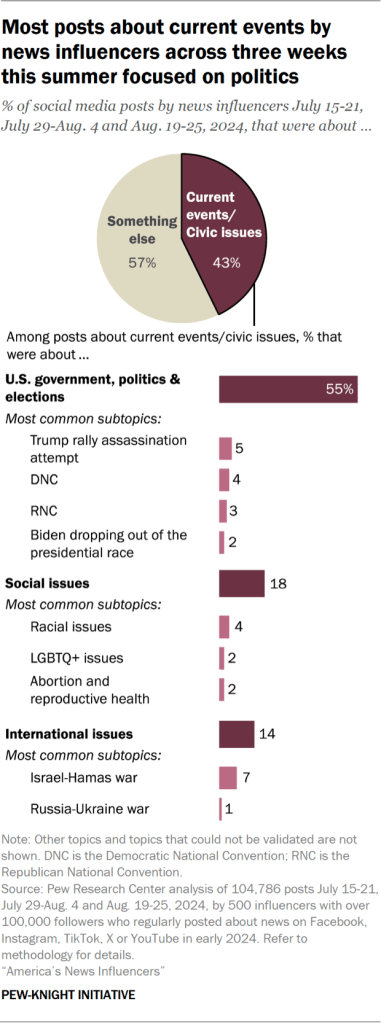
News influencers – People who regularly post about current events and civic issues on social media and have at least 100,000 followers on any of Facebook, Instagram, TikTok, X (formerly Twitter) or YouTube. Political orientation – A measure of a news influencer’s partisan or ideological views. A right-leaning news influencer is one who publicly expresses that they identify as a Republican or conservative or support Donald Trump in the 2024 presidential election. A left-leaning news influencer is one who publicly expresses that they identify as a Democrat, liberal or progressive or support Vice President Kamala Harris (or supported President Joe Biden before he dropped out of the race) in the 2024 election. This information was found in the bio, profile picture, banner image, pinned posts or recent posts on an influencer’s social media account, any personal website or professional page, and prominent media coverage. Values and identities – Language or imagery in the bio, profile picture, banner image or pinned posts on an influencer’s social media account that expresses specific beliefs or identities. News organization affiliation – An influencer with this affiliation is one who either currently works for or previously worked for a news organization, as well as freelancers who have regularly contributed to news organizations. A news organization can be any news outlet that has a staff and multiple bylines. Researchers considered affiliated influencers to have this background regardless of their news organization’s political orientation, audience size or primary publishing method (digital, TV, print, etc.). Major social media sites – The five primary sites we studied, chosen based on audience size and the presence of discussion about news: Facebook, Instagram, TikTok, X (formerly Twitter) and YouTube. While it’s important to shed light on who these new social media news providers are, a full understanding of the modern news environment also requires getting a sense of what these news influencers are posting about. What is a news influencer? In this study, we use the term “news influencers” to refer to individuals who regularly post about current events and civic issues on social media and have at least 100,000 followers on any of Facebook, Instagram, TikTok, X (formerly Twitter) or YouTube. News influencers can be journalists who are or were affiliated with a news organization or independent content creators, but they must be people and not organizations. Refer to the methodology for more about how we identified news influencers. Given the sheer volume of posts, this is not an easy task. The seemingly endless stream of content coming from these accounts would be exceedingly time-consuming for a group of human coders to analyze, so we used automated tools to collect these posts and turned to OpenAI’s GPT-4 model for classification. The output of this model was validated by a team of trained human coders. We collected all public posts by the 500 news influencers in our sample for three weeks over the summer of 2024: July 15-21, July 29-Aug. 4 and Aug. 19-25. Some of these weeks included major election-related events. The first week started just days after an assassination attempt on Donald Trump at a campaign rally and included the Republican National Convention, as well as President Joe Biden dropping out of the race. And the third week included the Democratic National Convention. We provided the model with the text from all posts, as well as transcriptions of videos on TikTok, Instagram and YouTube, but we did not include videos on other sites or images on any site. Each post was supplied on its own, without the surrounding context, which may limit the ability to categorize the post. Replies – posts directly responding to another message – in particular have less meaning when standing on their own. The model did not recognize any mentions of current events or civic issues in 57% of the posts by the news influencers in our sample during these three weeks. This may be due to a mix of factors: the analysis limitations mentioned above, as well as news influencers posting about other topics. Still, 43% of the posts did address these kinds of issues. The remainder of this chapter looks in more detail at these posts. Among the posts that referenced current events or civic issues, a majority (55%) were about government, politics or the presidential election. This includes posts on several specific events that occurred during the weeks studied, including the first assassination attempt on Trump in July (5%), the Democratic National Convention (DNC) in August (4%), the Republican National Convention (RNC) in July (3%) and Biden’s withdrawal from the race on July 21 (2%). The presence of these topics suggests that news influencers are incorporating discussion of real-time events in their posts. About one-in-five of the posts about current events (18%) focused on social issues such as racial issues (4%), LGBTQ+ issues (2%) and abortion (2%). Other topics that fell into this category include guns, education and culture war issues. A slightly smaller share (14%) were about international issues – a sometimes small but often important component of the current events discussion in America. Many internationally focused posts were about the Israel-Hamas war (7% of all news-related posts), while 1% of all posts were about the Russia-Ukraine war. No other topic was discussed in more than 4% of all posts by news influencers about current events during the study period: 3% of posts were about technology and 3% were about crime. News influencers often respond to the news of the day The weeks we chose to collect posts for analysis – and even the year we did this study – impact the findings. The study was conducted not only in the midst of a presidential election year but also during a period of major election-related news events, perhaps contributing to the high percentage of politics-related posts. Compared with other weeks studied, posts from July 15-21 were more likely to be about government and the election: 64% of all posts focused on current events and civic issues had this focus, compared

5. A closer look at the topics of news influencers’ posts Read More »

9. News influencers on X (formerly Twitter)

News influencers – People who regularly post about current events and civic issues on social media and have at least 100,000 followers on any of Facebook, Instagram, TikTok, X (formerly Twitter) or YouTube. Political orientation – A measure of a news influencer’s partisan or ideological views. A right-leaning news influencer is one who publicly expresses that they identify as a Republican or conservative or support Donald Trump in the 2024 presidential election. A left-leaning news influencer is one who publicly expresses that they identify as a Democrat, liberal or progressive or support Vice President Kamala Harris (or supported President Joe Biden before he dropped out of the race) in the 2024 election. This information was found in the bio, profile picture, banner image, pinned posts or recent posts on an influencer’s social media account, any personal website or professional page, and prominent media coverage. Values and identities – Language or imagery in the bio, profile picture, banner image or pinned posts on an influencer’s social media account that expresses specific beliefs or identities. News organization affiliation – An influencer with this affiliation is one who either currently works for or previously worked for a news organization, as well as freelancers who have regularly contributed to news organizations. A news organization can be any news outlet that has a staff and multiple bylines. Researchers considered affiliated influencers to have this background regardless of their news organization’s political orientation, audience size or primary publishing method (digital, TV, print, etc.). Major social media sites – The five primary sites we studied, chosen based on audience size and the presence of discussion about news: Facebook, Instagram, TikTok, X (formerly Twitter) and YouTube. A somewhat higher share of news influencers on the social media site X explicitly identify with the political right (28%) than the left (21%). A small share (3%) express some other political affiliation, while about half (48%) do not express any clear political lean. Influencers were categorized by whether they identify with a political party or ideology or expressed support for the Democratic or Republican presidential candidate in their social media profile, posts, personal website or media coverage. About this chapter This chapter looks at news influencers on X (formerly Twitter). Virtually all of them also have accounts on other sites. For analysis of news influencers in general across social media sites, read the report overview. In this report, news influencers are people with large followings on social media sites who regularly post about current events or civic issues. Refer to the methodology for details. Related: X users’ experiences with news Fewer news influencers on X identify specific values or identities on their accounts. This includes 6% who say they are pro-LGBTQ+ (or express a LGBTQ+ identity), 4% who express a pro-Palestinian viewpoint and 3% who identify as pro-Israeli. In addition, 3% of X news influencers express views favoring Ukraine. These positions can be indicated in a variety of ways, whether through words, images or emojis (including flags). Some X news influencers also prominently identify as opposing (2%) or supporting abortion rights (fewer than 1%). Among news influencers posting on X, 64% are men, while 29% are women. Previous research has found that 64% of Americans who regularly get news on X are men, while 35% are women. Refer to the methodology for details on how researchers coded news influencers by gender. Most news influencers on X have not worked for a news organization, but about a quarter (26%) have a current or former affiliation with a news outlet. These organizations range from more traditional news outlets like CNN to newer digital news sources such as The Daily Wire. For more details on the differences between influencers who have worked for a news organization and those who have not, read Chapter 4. What are news influencers on X posting about? To get a sense of what news influencers are posting about, researchers collected and analyzed all public posts by the 500 news influencers in our sample for three separate weeks: July 15-21, July 29-Aug. 4 and Aug. 19-25. There were many major events related to the election in or around these weeks, including the first assassination attempt on Donald Trump on July 13, the Republican National Convention July 15-18, President Joe Biden’s withdrawal from the race July 21 and the Democratic National Convention Aug. 19-22. More than half of X posts by news influencers that were about current events or civic issues during those weeks addressed politics or the election (55%). Social issues were the focus of 18% of all news-focused posts, covering a range of topics from race to abortion to LGBTQ+ issues to the culture wars. And 15% of posts were about international topics, with about half of these covering the Israel-Hamas war (8%). What other sites are X news influencers on? Although a higher percentage of news influencers are on X than any other social media site, most news influencers on X are also on at least one other site. About a third of news influencers on X (34%) are only on X, while about two-thirds are on at least one other site. This includes 31% who are on four or more other social media sites (five or more in total). Roughly half of news influencers on X are also on Instagram (49%), while smaller shares are on YouTube (44%), Facebook (35%) and TikTok (21%). The study also looked at how many news influencers on each site host a podcast or a newsletter. Roughly a third of news influencers on X (37%) host a podcast, while one-quarter send out an email newsletter. A majority (62%) also seek financial support from their audience in at least one way. This includes 52% who offer subscriptions to additional content (some through subscription tools that X provides), 32% who ask for donations, and 23% who sell merchandise. A relatively small share of X news influencers (6%) also have a public Discord server where they can further connect with fans and followers. source

9. News influencers on X (formerly Twitter) Read More »

Appendix D: GPT-4 Topic classification instructions

You are an AI assistant trained to look at social media posts and determine what the post is about. [IF POST IS FROM YOUTUBE:] You will receive two fields: the post title and a transcript of the first 3 minutes of the video. If the topic is unclear from the title, include the transcript in your determination. Otherwise ignore the transcript. [IF POST IS FROM INSTAGRAM:] You will receive the post text, and, if it was a video, the transcript. Rely on both. [IF POST IS FROM TIKTOK:] You will receive both the post text and the transcript of the video. Give more weight to the video text. [ALL SITES] You will be given a list of topics. Please tell us what this post is about. Respond in a JSON with the subtopic number, e.g. 8.5. Call that field “subtopic.” Topic list: 1. Crime     1.1. Crime generally 2. Environment     2.1. Climate change     2.2. Other environmental issues 3. Immigration     3.1. Immigration generally 4. Social issues     4.1. Abortion and reproductive health     4.2. Guns and gun control     4.3. LGBTQ+ issues, including transgender issues     4.4. Racial issues, including affirmative action and racial discrimination     4.5. Education     4.6. Other social issues, including culture war issues, labor, and other social issues that are not covered above 5. Public health     5.1. Covid, including covid vaccines     5.2. Other vaccines     5.3. Other public health issues 6. Economy     6.1. Economy generally 7. Technology     7.1. AI, LLMs     7.2. Crypto     7.3. Other technology issues 8. Government, politics and elections     8.1. Assassination attempt on Donald Trump     8.2. Republican National Convention (RNC)     8.3. Democratic National Convention (DNC)     8.4. Biden dropping out of the presidential race     8.5. Other political or government related posts that do not fit into other categories 9. International issues     9.1. Israel, Gaza or Palestine, including anything about Netanyahu or Hamas     9.2. Ukraine war     9.3. Anything outside the US or involve US foreign relations except for Israel, Gaza, Ukraine, or immigration 10. No topic     10.1. None of the above topics Some other things to keep in mind:     – There is an election in November, so many posts will be about that. The Democratic candidates were Joe Biden and Kamala Harris, but Joe Biden dropped out and it’s Kamala Harris and Tim Walz. The Republican candidates are Donald Trump and JD Vance. The independent candidates are Robert F Kennedy Jr (RFK Jr), Cornel West, and Jill Stein.     – Anything about an assassination attempt on Trump goes into Politics and elections.     – If there are multiple topics, go with whatever seems the most prominent. If there are two relatively equal topics, go with whatever is mentioned first.     – If a post seems political, first see if it goes into another category. For example a post about politics and race would go into the race category. Fall back on politics if none other fits, as long as there is something political.     – With the exception of immigration, most posts that reference a foreign country will go into 10.1.     Please adhere to the categories listed in the codebook and provide the name of the topic in a machine readable json. Do not provide any additional context or response. source

Appendix D: GPT-4 Topic classification instructions Read More »

10. News influencers on YouTube

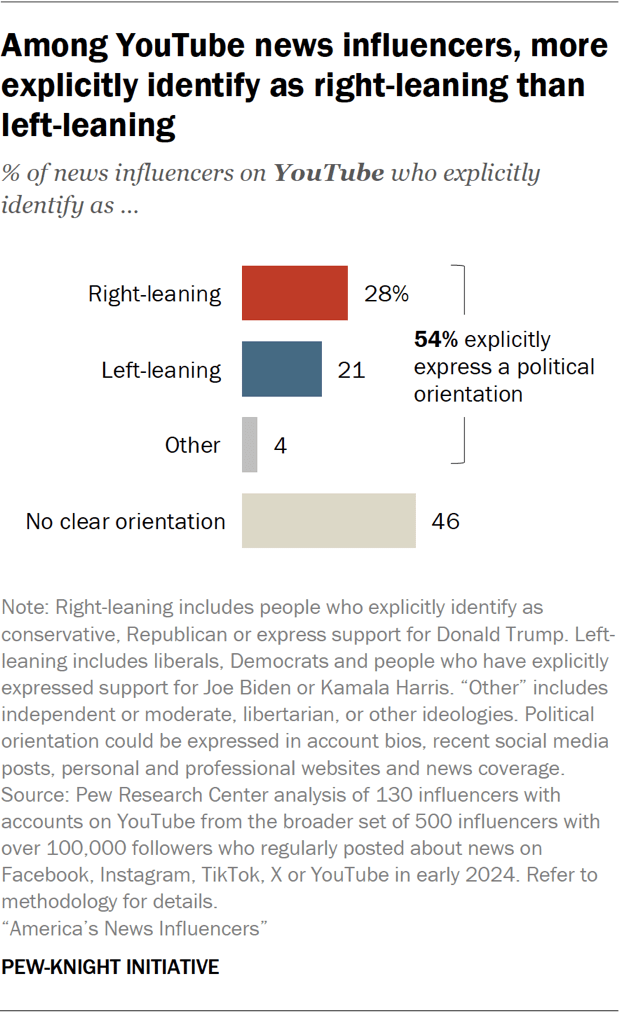
News influencers – People who regularly post about current events and civic issues on social media and have at least 100,000 followers on any of Facebook, Instagram, TikTok, X (formerly Twitter) or YouTube. Political orientation – A measure of a news influencer’s partisan or ideological views. A right-leaning news influencer is one who publicly expresses that they identify as a Republican or conservative or support Donald Trump in the 2024 presidential election. A left-leaning news influencer is one who publicly expresses that they identify as a Democrat, liberal or progressive or support Vice President Kamala Harris (or supported President Joe Biden before he dropped out of the race) in the 2024 election. This information was found in the bio, profile picture, banner image, pinned posts or recent posts on an influencer’s social media account, any personal website or professional page, and prominent media coverage. Values and identities – Language or imagery in the bio, profile picture, banner image or pinned posts on an influencer’s social media account that expresses specific beliefs or identities. News organization affiliation – An influencer with this affiliation is one who either currently works for or previously worked for a news organization, as well as freelancers who have regularly contributed to news organizations. A news organization can be any news outlet that has a staff and multiple bylines. Researchers considered affiliated influencers to have this background regardless of their news organization’s political orientation, audience size or primary publishing method (digital, TV, print, etc.). Major social media sites – The five primary sites we studied, chosen based on audience size and the presence of discussion about news: Facebook, Instagram, TikTok, X (formerly Twitter) and YouTube. About half of all YouTube news influencers explicitly express a clear political orientation. Among those who do, a higher share are right-leaning (28% of all YouTube news influencers) than left-leaning (21%). Just 4% have some other kind of political orientation, and about half (46%) do not express any lean. News influencers were categorized by whether they identify with a political party or ideology or expressed support for the Democratic or Republican presidential candidate in their social media profile, posts, personal website or media coverage. In addition to political ideology, researchers evaluated accounts for any expressed values or identities, finding that 8% of YouTube news influencers express a pro-LGBTQ+ position or identify as LGBTQ+ on their page. An identical share indicate a pro-Palestinian position, while 5% are pro-Israeli. These positions can be indicated in a variety of ways, whether through words, images or emojis (including flags). Some YouTube news influencers also prominently display their opposition to abortion (3%) or support for abortion rights (less than 1%). On YouTube, roughly two-thirds of news influencers (68%) are men, compared with 28% who are women. For details on how researchers categorized news influencers by gender, refer to the methodology. Almost nine-in-ten YouTube news influencers (88%) have not been affiliated with a news organization. About one-in-ten (12%) currently work for (or used to work for) digital, TV and other news organizations. For more details on the differences between influencers with a news industry background and those without one, read Chapter 4. What are YouTube news influencers posting about? In order to get a sense of what news influencers are posting about, researchers collected and analyzed all public posts by the 500 news influencers in our sample for three separate weeks: July 15-21, July 29-Aug. 4 and Aug. 19-25. There were many major events related to the election in or around these weeks, including the first assassination attempt on Donald Trump on July 13, the Republican National Convention (RNC) July 15-18, President Joe Biden’s withdrawal from the race July 21 and the Democratic National Convention (DNC) Aug. 19-22. Among all YouTube posts that addressed current events and civic issues during these weeks, 68% were about politics or the election – a higher share than other sites. This includes posts about the DNC (11%), the first Trump assassination attempt (8%) and the RNC (6%). The next-most common topics were social issues (17% of all posts), including racial issues (6%), and international issues (8%), mostly the Israel-Hamas and Russia-Ukraine wars. What other sites are YouTube news influencers on? Very few news influencers on YouTube are only on YouTube. The vast majority have a presence on at least four social media sites, including about half (54%) who are on four or more sites in addition to YouTube (five or more in total). The most common sites where YouTube news influencers can also be found are X, formerly known as Twitter (86%), and Instagram (74%). Smaller shares are also on Facebook (54%) and TikTok (44%). About half of all news influencers on YouTube (49%) also host a podcast, slightly higher than the share on any other major social media site we studied. Our previous study of podcasts found that about half of top-ranked podcasts also have a video component, often on YouTube. A smaller share of YouTube news influencers (28%) have a newsletter that they send out to subscribers or fans. Although a majority of news influencers across social media sites (59%) seek financial support from their audiences, this is especially common on YouTube, where 80% of news influencers do this in some way. This includes 68% who offer subscriptions, often providing content that goes beyond their YouTube videos (YouTube has built-in subscription tools for creators). One-in-ten YouTube news influencers have a public Discord server where they can further connect with audiences. source

10. News influencers on YouTube Read More »

8. News influencers on TikTok

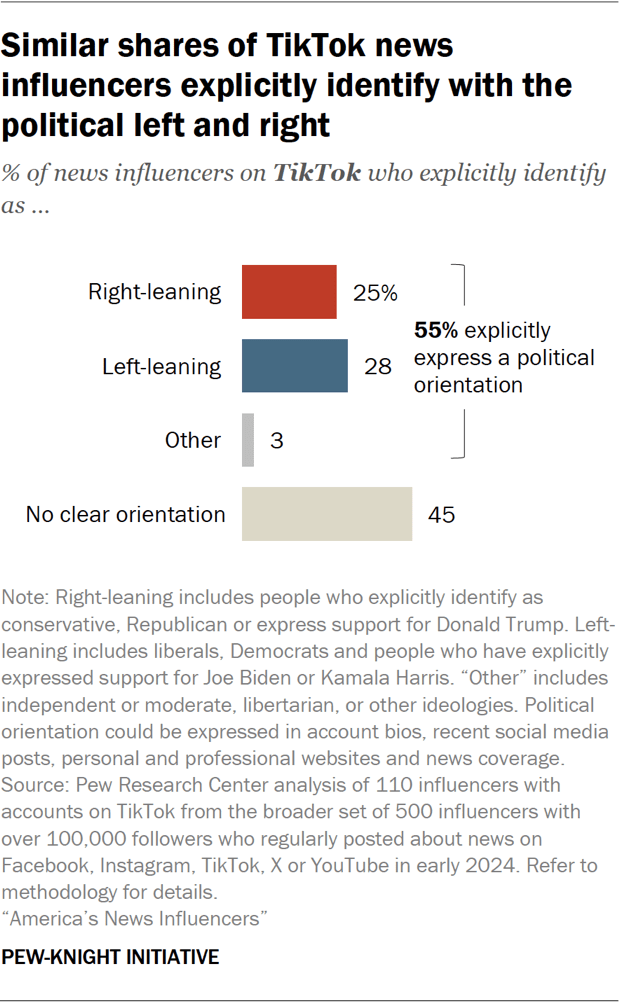
News influencers – People who regularly post about current events and civic issues on social media and have at least 100,000 followers on any of Facebook, Instagram, TikTok, X (formerly Twitter) or YouTube. Political orientation – A measure of a news influencer’s partisan or ideological views. A right-leaning news influencer is one who publicly expresses that they identify as a Republican or conservative or support Donald Trump in the 2024 presidential election. A left-leaning news influencer is one who publicly expresses that they identify as a Democrat, liberal or progressive or support Vice President Kamala Harris (or supported President Joe Biden before he dropped out of the race) in the 2024 election. This information was found in the bio, profile picture, banner image, pinned posts or recent posts on an influencer’s social media account, any personal website or professional page, and prominent media coverage. Values and identities – Language or imagery in the bio, profile picture, banner image or pinned posts on an influencer’s social media account that expresses specific beliefs or identities. News organization affiliation – An influencer with this affiliation is one who either currently works for or previously worked for a news organization, as well as freelancers who have regularly contributed to news organizations. A news organization can be any news outlet that has a staff and multiple bylines. Researchers considered affiliated influencers to have this background regardless of their news organization’s political orientation, audience size or primary publishing method (digital, TV, print, etc.). Major social media sites – The five primary sites we studied, chosen based on audience size and the presence of discussion about news: Facebook, Instagram, TikTok, X (formerly Twitter) and YouTube. About an even balance of TikTok news influencers explicitly identify with the political left and right: 25% of TikTok news influencers publicly express a right-leaning political orientation, while 28% lean left. Influencers were categorized by whether they identify with a political party or ideology or expressed support for the Democratic or Republican presidential candidate in their social media profile, posts, personal website or media coverage. About this chapter This chapter looks at news influencers on TikTok. Virtually all of them also have accounts on other sites. For analysis of news influencers in general across social media sites, read the report overview. In this report, news influencers are people with large followings on social media sites who regularly post about current events or civic issues. Refer to the methodology for details. Related: TikTok users’ experiences with news TikTok also has a higher share of news influencers (relative to other sites studied) who identify as LGBTQ+ or support LGBTQ+ rights (13%). Meanwhile, more TikTok news influencers express a pro-Palestinian view (9%) than a pro-Israeli viewpoint (2%). These values and identities can be indicated in a variety of ways, whether through words, images or emojis (including flags). TikTok news influencers are more evenly split between men (50%) and women (45%) than news influencers on other sites, who tend to be mostly men. For details on how we coded news influencers by gender, refer to the methodology. The vast majority of news influencers on TikTok (84%) do not have a background with a news organization. But 16% do have links to the news industry, including people who formerly worked for a news organization (e.g., a newspaper, TV station or news website) but are now independent. For more details on the differences between influencers with and without a news industry background, read Chapter 4. What are TikTok news influencers posting about? To get a sense of what news influencers are posting about, researchers collected and analyzed all public posts by the 500 news influencers in our sample for three separate weeks: July 15-21, July 29-Aug. 4 and Aug. 19-25. There were many major events related to the election in or around these weeks, including the first assassination attempt on Donald Trump on July 13, the Republican National Convention (RNC) July 15-18, President Joe Biden’s withdrawal from the race July 21 and the Democratic National Convention (DNC) Aug. 19-22. Among posts by TikTok news influencers that addressed current events and civic issues, 52% were focused on U.S. government, politics or elections. Other common topics were social issues (including racial issues), international issues, crime, and technology (such as cryptocurrencies). What other sites are TikTok news influencers on? It is very common for news influencers on TikTok to also have accounts on several other social media sites. In fact, more than half (57%) have accounts on four or more other sites in addition to TikTok, while only 11% are on TikTok alone. TikTok news influencers are slightly more likely to have an account on Instagram (82%) than any other site. But a majority also have accounts on YouTube (71%) and X, formerly known as Twitter (64%). And half of influencers on TikTok also have a Facebook account. Some TikTok news influencers also engage with their audiences in other ways. Nearly four-in-ten (37%) host a podcast, and 22% produce an email newsletter. Six-in-ten news influencers on TikTok offer paid subscriptions, often to additional content beyond just videos on TikTok, while four-in-ten solicit donations and a similar share (38%) sell branded merchandise. All told, about three-quarters (74%) seek financial support in at least one of these ways. (TikTok has tools to help all creators – not just news influencers – monetize content.) More than one-in-ten TikTok news influencers (14%) also have a public Discord server where they can further connect with fans and followers. source

8. News influencers on TikTok Read More »

Most Americans back cellphone bans during class, but fewer support all-day restrictions

Students unlock their cellphones from pouches that secure them during the school day at Bayside Academy in San Mateo, California. The school district banned cellphones on its four middle school campuses in 2022. (Lea Suzuki/San Francisco Chronicle via Getty Images) As lawmakers and educators crack down on cellphone use in schools, most Americans back bans on using phones in classrooms but are less supportive of full-day restrictions. Overall, 68% of U.S. adults say they support a ban on middle and high school students using cellphones during class, according to a Pew Research Center survey conducted Sept. 30-Oct. 6, 2024. This includes 45% who strongly support this. Another 24% oppose this, while 8% say they aren’t sure. Pew Research Center conducted this study to understand Americans’ views of cellphone bans for middle and high school students. For this analysis, we surveyed 5,110 adults from Sept. 30 to Oct. 6, 2024. Everyone who took part in this survey is a member of the Center’s American Trends Panel (ATP), a group of people recruited through national, random sampling of residential addresses who have agreed to take surveys regularly. This kind of recruitment gives nearly all U.S. adults a chance of selection. Surveys were conducted either online or by telephone with a live interviewer. The survey is weighted to be representative of the U.S. adult population by gender, race, ethnicity, partisan affiliation, education and other factors. Read more about the ATP’s methodology. Here are the questions used for this analysis, the topline and the survey methodology. Some school districts have called for banning cellphone use entirely, not just during class. Our survey finds the public is far less supportive of a full-day ban on cellphone use than a classroom ban. About one-third (36%) support banning middle and high school students from using cellphones during the entire school day, including at lunch as well as during and between classes. By comparison, 53% oppose this more restrictive approach. Jump to read more about why Americans support or oppose classroom cellphone bans. Views by age Young adults are less likely than older age groups to support a cellphone ban in middle or high school, either during class or the entire school day. Less than half of adults under 30 (45%) say they support banning students from using cellphones during class. This share rises to 67% among those ages 30 to 49 and 80% among those ages 50 and older. There are similar age differences in views about daylong cellphone bans. Only 18% of adults under 30 support preventing students from using cellphones throughout the school day. By comparison, 36% of those ages 30 to 49 and 44% of those 50 and older favor this type of ban. Views by whether someone is a K-12 parent While some media headlines focus on parents’ resistance to cellphone bans, our survey shows few differences in views between those who have school-age children and those who don’t. For example, 65% of parents with a K-12 child support banning students from using their cellphone during class. This compares with 69% of those without children in these grades. And identical shares (36% each) support a ban for the entire school day. Views by party Majorities of Republicans and Democrats – including independents who lean toward either party – favor banning students from using cellphones during class. Still, support is somewhat higher among Republicans than Democrats (74% vs. 64%). A similar pattern exists for views on bans that span the entire school day. While 42% of Republicans back full-day restrictions, 31% of Democrats do. Why Americans support cellphone bans during class We also asked people about possible reasons they support or oppose a cellphone ban. Among those who support a ban during class, nearly all (98%) say a reason they back it is because students would have fewer distractions in class. This includes a whopping 91% who say it’s a major reason. Previous Center findings show that most U.S. high school teachers say cellphone distractions are a major problem in their class. Majorities of supporters also point to each of the other reasons we asked about. But fewer describe each as a major reason. Among those who support a ban: 70% say a major reason is students would develop better social skills. 50% say a major reason is students would be less likely to cheat. 39% say a major reason is it would reduce bullying in schools. There are only modest differences by age and political party in the shares of people who cite each of these as major reasons. Views by whether someone is a K-12 parent The only reason where parents of K-12 students differ from those who are not K-12 parents is bullying. Among cellphone ban supporters, 44% of K-12 parents say a major reason they favor it is that it would reduce bullying in schools, compared with 37% of those who are not K-12 parents. Why Americans oppose cellphone bans during class Of those who oppose a ban, majorities cite each of the four reasons we asked about. Six-in-ten – the highest share for any reason we asked about – say a major reason they oppose a ban is because parents should be able to reach their child when needed. Another 26% say this is a minor reason they oppose cellphone bans during class. Looking at the three other reasons we asked about: 37% say a major reason is that it would be too difficult for teachers to enforce. 32% say a major reason is parents should decide if their child can use their cellphone in class. 31% say a major reason is that cellphones can be a useful tool for teaching. Views by whether someone is a K-12 parent Parents of K-12 students are especially likely to stress a parent’s ability to reach their child. Among opponents of a ban, most K-12 parents (70%) say this is a major reason. This share drops to 57% among those who are not K-12 parents. K-12 parents are also more likely

Most Americans back cellphone bans during class, but fewer support all-day restrictions Read More »