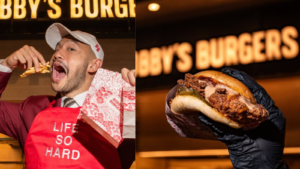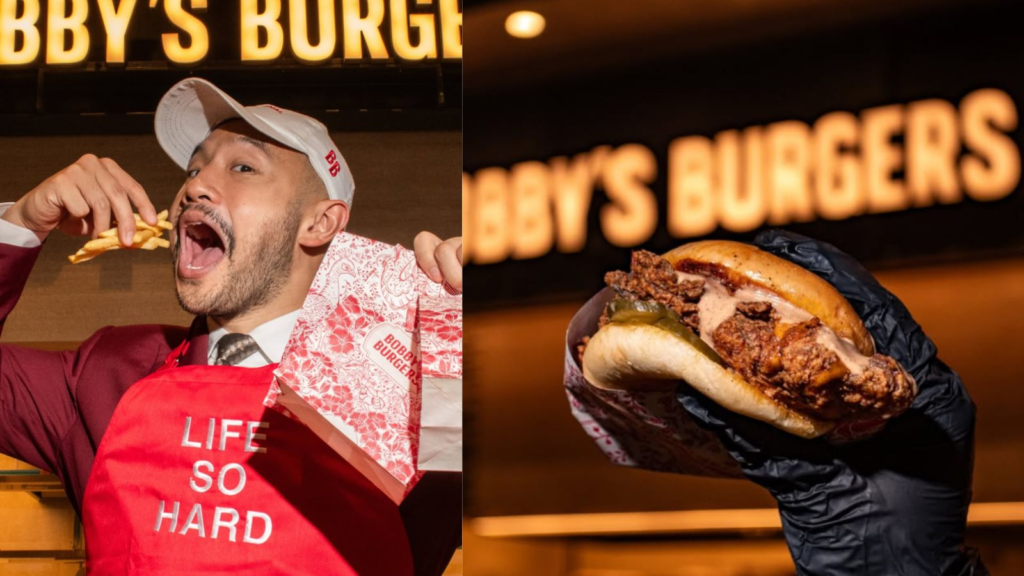
Bobby’s Burgers, the burger joint sensation with four locations in Indonesia, has officially landed in Malaysia, opening its first international outlet at The Exchange TRX in Kuala Lumpur, which officially launched on 26 March, yesterday.
Serving wagyu smash burgers, fries and fried chicken cooked in 100% beef tallow, the brand also leans into occasional indulgence with limited-edition toppings such as caviar or foie gras.
But who’s behind Bobby’s Burgers? The brand is the brainchild of content creator Ben Sumadiwiria (@supercoolben), best known for his comedic persona Bobby Saputra, an Indonesian “billionaire” and fictional heir to a bottled water empire. If you’ve come across his content, you’d know the drill, Lamborghinis, Ferraris, caviar on everything, and a wardrobe of luxury watches, all delivered with tongue firmly in cheek.
What started as satire poking fun at ultra-wealthy lifestyles has since evolved into something much bigger, a full-fledged F&B business. Aptly named Bobby’s Burgers, the brand leans heavily into the character, using Bobby as its ambassador, complete with catchphrases such as “99 China points” and “Eat like a billionaire”.
Even the details are on-brand, from takeaway bags reading “The burger you brag about” to gold-lined burger boxes and staff aprons stamped with “Life so hard, this bite’s easy”. On selected days, Bobby himself even shows up for fan meet-and-greets in full character.
Don’t miss: YouTuber Uncle Roger to open his first restaurant in Malaysia
It’s a model that’s becoming increasingly familiar. We’ve seen Nigel Ng turn his viral persona into Fuiyoh! It’s Uncle Roger, a fried rice chain built around the “Haiyah”-spouting uncle character. However, while the concept drew crowds early on, the brand recently shuttered its IPC outlet, with the team admitting it had expanded “too quickly” to capitalise on initial momentum. It has since shifted towards a leaner operation, even as Ng looks to open a new concept, Kawan, in London.
Across the causeway in Singapore, rapper Yung Raja has been running his Indian-Mexican fusion cafe The Maha Co, located at Fusionopolis Link, successfully for the past four years. At the time, Yung Raja told MARKETING-INTERACTIVE that his venture into F&B with his partner Quan came from his love for food and how it brings people together. “It’s always been a dream of mine to have a space to catch a vibe at. A place to chill with family and friends- a place that’s an extension of me,” he said.
Over the past few years, influencer monetisation has clearly moved beyond merchandise drops and brand deals into full-scale businesses. More recently, we’re seeing a new layer to that evolution, where creators are building F&B brands not just around themselves, but around distinct on-screen personas, from Uncle Roger to Bobby Saputra. At the same time, others such as Malaysian food content creator Khairul Aming and British influencer collective The Sidemen have found success with ventures rooted in their real-life identities.

A not-so-coincidental shift
This shift is no coincidence. The creator economy today offers far more ways to turn influence into business. MARKETING-INTERACTIVE spoke to industry professionals in the content creator and influencer space, to dig deeper.
As Karl Mak, co-founder and CEO of HEPMIL Media Group, explained, “The way influencers monetise their audiences has evolved significantly over the past five years. Beyond sponsorships, creators can now activate their communities through live commerce, affiliate sales, merchandise, and increasingly, their own entrepreneurial ventures in categories like F&B.”
F&B, in particular, stands out because it brings something tangible into the mix. “It allows creators to translate their personal brand, taste, community, and even content into something audiences can experience and buy into,” Mak added. More importantly, audiences themselves have changed. “They are no longer just passive viewers.”
Audiences are increasingly willing to spend to support creators they feel connected to.
Similarly, Lee Li Ping, director of strategic partnerships at Gushcloud International, points to a broader cultural shift. “We’re seeing a move toward identity-led branding. Consumers are gravitating to brands that resonate with them on deeper cultural and personal levels,” she said.
Food is no longer just functional, it’s a form of self-expression and belonging.
The challenge of lasting beyond novelty
However, while persona-led brands may be great at grabbing attention, the real question is whether they can last.
According to Shermaine Wong, co-founder and CEO of Cult Creative, personas are powerful, but only to a point. “Personas are rocket fuel for launch. Authentic identity is what keeps the engine running,” she said. “A fictional character is an incredible acquisition machine. But a character doesn’t evolve the way a real person does. When the cultural moment shifts, and it always does, you lose your narrative engine. You’re essentially running a theme park. And theme parks need constant reinvestment just to stay relevant.”
Wong explained further, that the ones who fail are the ones who believe the character is the business. “It’s not. It’s the marketing budget.”
Mak echoed this, noting that while creators may enjoy a strong head start, “sustaining a long-term business requires much more than initial hype, consumers may be drawn in by the personality, but they will only return if the product genuinely delivers.”
He added, “Ultimately, the brands that move beyond hype are the ones that turn creator influence into genuine consumer trust and product relevance. Feastables by MrBeast is a strong example of the scale this model can unlock when audience connection is paired with disciplined brand-building and mass-market appeal.”
Meanwhile, Lee said that ultimately, the fundamentals still apply. “Creators can use fame as a springboard for attention, but fundamentals don’t change, strong product, clear positioning, and solid execution.”
And in the F&B space, those fundamentals matter even more. As Wong pointed out, creator fame can drive footfall, but it can also mask deeper issues.
Fame gets you the line outside the door. Everything after that is just business.
Wong pointed to Uncle Roger as a case where early hype didn’t necessarily translate into repeat visits. “That’s not a content problem. That’s a product problem.” Operational discipline is equally critical. “F&B is unforgiving. Location decisions, lease structures, unit economics. your audience can’t save you from a bad lease,” she added.
Ultimately, for any creator-led or persona-led venture to scale, it has to stand on its own. “The rise of startup and D2C (direct-to-consumer) brands across Southeast Asia reflects how much opportunity exists in the market, but it also highlights how competitive the space has become. For influencer-backed brands to break through, they need more than a strong launch,” shared Mak.
Why Malaysia?
So how does all of this play out in practice? In conversation with MARKETING-INTERACTIVE, Sumadiwiria shared why Malaysia was the top pick for Bobby’s first international expansion. “Bobby’s character has a large following in Indonesia, but the second largest audience is Malaysia, with 12.5% of the 100 million viewers coming from there. Plus, we love Malaysia,” he said.
A trained chef who graduated from Le Cordon Bleu Malaysia, Sumadiwiria explained that the concept also filled a gap he saw in Indonesia. “There was something missing in Jakarta, something from Europe. So, I started smashing burgers, and it became one of the most popular burgers there. So, I had to continue.”
On why the brand is built around a persona, he was candid.
Normal marketing is no longer enough nowadays, so we built it around our online persona.
That said, he was quick to stress that the product comes first. “Our burger game is very strong. In the beginning, we used very little of our online persona branding to make sure we had a solid product. Bobby’s Burgers works without Bobby, because the product itself is restaurateur- and chef-driven.”
And in a space as competitive as F&B, that may be the deciding factor. Because while personas can get people through the door, it’s the product, and everything behind it, that keeps them coming back.
“The challenge is not to make fine dining food good, because it is already incredibly accessible to people, but to make simple food good. The challenge is to make everyone happy, from the super-rich to the average customer,” said Sumadiwiria.
Be part of #Content360 Malaysia, 13 May 2026, where creativity and community collide. Explore how AI-powered imagination, culturally resonant storytelling, and platform-savvy strategies are shaping the future of content. Gain practical insights, discover new tactics, and learn how the region’s top creators and brands are crafting campaigns that truly resonate.
Related articles:
Is bigger no longer better in the APAC influencer scene?
Study: 62% of Singaporeans engage with sponsored influencer content
Malaysians prefer influencer-led short videos, in-game ads grab attention