Move over Moo Deng, it’s Punch’s time to shine. IKEA Singapore has sold out its Djungelskog orangutan plushie across its physical and online stores, after a viral baby macaque in Japan named Punch captured hearts worldwide.
In a statement to MARKETING-INTERACTIVE, IKEA Singapore said it was delighted to see how much comfort the soft toy brought to little Punch, and how their touching bond resonated globally.
“At IKEA, we believe in creating a better everyday life for the many and sometimes, that starts with something as simple as a soft hug. While moments like these are never planned, we see them as a reflection of how our products live beyond the showroom and become part of people’s (and sometimes even primates’) stories,” said the IKEA Spokesperson.
Don’t miss: No thumbs, no problem: How pets are stealing the brand spotlight
The global response also reinforces something the brand have long believed – that everyday products can carry emotional meaning far beyond their function. “A soft toy may be simple by design, but it can represent nostalgia, companionship and comfort. Many of us remember a favourite childhood item, or have seen children cling to a toy for reassurance – it’s a universal story,” explained the spokesperson, adding that:
In a fast-moving and sometimes overwhelming world, people are naturally drawn to moments of warmth and authenticity, and we’re grateful to see that these small moments have sparked just that.
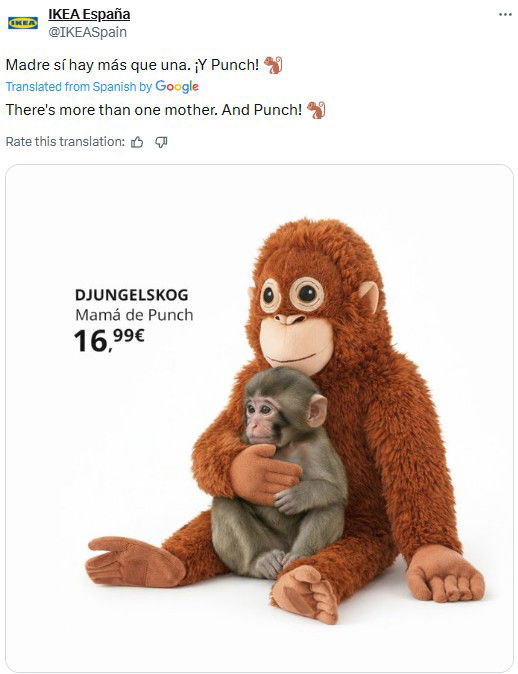
IKEA markets globally have also joined the conversation. IKEA Japan donated additional stuffed toys to the zoo, reinforcing the brand’s presence without overshadowing Punch. Meanwhile, IKEA Spain shared an image of Punch alongside the plush toy with the caption, “There’s more than one mother. And Punch.”

In addition, IKEA US posted a photo of a monkey plush hugging the orangutan plush with the text: “Sometimes, family is who we find along the way.”
IKEA Singapore followed suit with a post of a monkey plush embracing the orangutan plush, captioned: “Turns out, we’re all softies.”
How social media drove global attention
Punch, a seven-month-old macaque at Ichikawa City Zoo, gained international attention after videos showed him clinging to the IKEA Djungelskog orangutan plushie for comfort while struggling to integrate with his troop. Clips of Punch carrying the toy around the enclosure and seeking comfort after being rejected by other monkeys continued to gain traction online throughout February.
The videos spread widely across TikTok and other platforms over the past week, prompting consumers worldwide to buy the same toy in solidarity with Punch. Media intelligence firm CARMA reported that the story generated 16.5K mentions and 2.2M engagements during the week of 16 to 23 February.
“Overall, the traction reflects strong short-term virality driven by emotional storytelling,” said Divika Jethmal, head of marketing, Asia, CARMA. Social media sentiment around the IKEA-Punch story skewed positive at 57.6%, with just 2.7% negative, showing the episode was widely received as a feel-good moment.
In addition, analysis by media intelligence firm Truescope found that conversations peaked on 20 and 21 February. The earlier peak was driven by posts of Punch seeking comfort in his stuffed toy, while the latter was fuelled by news of IKEA donating a plush to Punch.

The viral story of Punch and his IKEA Djungelskog orangutan plushie also sparked conversations that went far beyond cute animal videos, touching on corporate responsibility, consumer behaviour, and the nuances of digital storytelling, said Truescope.
For instance, IKEA’s response positioned the brand as an accidental hero: while some viewers questioned whether the posts were cause-marketing in disguise, many connected with the sentiment behind the tagline “Sometimes, family is who we find along the way.” Meanwhile, the plushie itself evolved from a simple product into a cultural artifact, selling out globally and appearing on resale platforms as purchases shifted from functional use to gestures of solidarity with Punch’s narrative.
The macaque’s enclosure at Ichikawa City Zoo also drew public scrutiny, sparking calls for improved animal welfare standards and highlighting broader questions about the care of abandoned animals in captivity. Complicating the conversation further, AI-generated content and speculative posts circulated widely, underscoring the challenges audiences face in distinguishing verified updates from misinformation within viral stories.
Moreover, the hashtag #HangInTherePunch became a rallying cry, encapsulating collective encouragement. The Japanese #がんばれパンチ (Ganbare Punch) statement also bridged Japanese and English-speaking audiences, reflecting the story’s cross-cultural resonance. Other key phrases include “Ichikawa City Zoo”, “Baby monkey”, “Orangutan toy” and “Viral baby monkey Punch”.
Punch isn’t the only zoo animal turned viral sensation in recent times. In September 2024, a baby pygmy hippo in the Khaw Keow Open Zoo went viral after pictures of her were posted on the zoo’s Facebook page. Brands quickly jumped on Moo Deng’s popularity with silly inspired posts. Beauty retailer Sephora Thailand made a post recommending blush products that matched the colour of Moo Deng’s cheeks while foodpanda Singapore posted an edited photo of its mascot Pau Pau chasing after a screaming Moo Deng, jabbing at avoidance of workplace emails.
A month later, Singaporean game developer and publisher Free Fire made Moo Deng an exclusive in-game collectable for a new battle royale shooter game that it was reportedly signed on.
Towards the end of 2024, hygiene brand Lifebuoy collaborated with Moo Deng in an ad titled “Confessions of Moo Deng”. The content video sees the viral baby pygmy hippopotamus humorously declare that she doesn’t want to follow her family’s footsteps as “H for hippo” in the alphabet book, instead proposing that the letter H should stand for handwashing.
Through the campaign, viewers were invited to scan a QR code to interact with Lifebuoy’s AI-powered Hippo Teacher, which teaches kids handwashing via games, activities and songs, marking a new step in Lifebuoy’s global #HforHandwashing movement. The campaign was developed with creative agencies MullenLowe Singapore and MullenLowe Lintas India.
Showcase your most innovative content and gain recognition from a panel of industry leaders by entering the inaugural Content360 Awards. Submit your work today and be part of the celebration that honours the campaigns defining the future of content marketing.
Related articles:
How IKEA is making trendjacking part of its personality
IKEA HK celebrates 50 years with gamified durability hunt
IKEA Malaysia’s ‘House party’ turns stores into immersive celebration of home living