Top Tech Conferences & Events to Add to Your Calendar in 2025

April 1: CISO Perth in Perth, Australia [in person] April 1-2: Generative AI Summit in London, UK [in person] April 3-4: TECHSPO in Los Angeles [in person] April 4-5: HBS/MIT Sloan Technology and National Security Conference in Cambridge, Mass. [in person] April 7-8: Gartner Security & Risk Management Summit in Dubai, UAE [in person] April 7-9: QCon in London, UK [hybrid] April 9-11: Google Cloud Next ’25 in Las Vegas [in person] April 9-10: SecureWorld in Philadelphia [in person] April 9-17: SecureWorld in Toronto, ON [in person] April 10-11: TECHSPO in Vancouver, BC [in person] April 13-18: SANS Cybersecurity Training in Orlando, FL [in person] April 14-16: Quantum Tech USA in Washington DC [in person] April 14-16: Gitex Africa in Morocco [in person] April 16: Georgia Technology Summit in Atlanta, GA [in person] April 16-17: Generative AI Summit in San Jose, Calif. [in person] April 17: Women Impact Tech in Chicago [in person] April 23-25: Gitex Asia in Singapore [in person] April 24: Data Architecture in Singapore [in person] April 28-29: Gartner Conferencia Data & Analytics in Sao Paulo, Brazil [in person] April 28-May 1: RSA Conference in San Francisco [in person] April 28-May 2: The Web Conference 2025 in Sydney, Australia [in person] source

Top Tech Conferences & Events to Add to Your Calendar in 2025 Read More »

Process Intelligence: The CIO's secret weapon for unlocking value

CIOs are under intense pressure to deliver massive digital transformation initiatives with limited resources under tight time constraints. Boards of directors are placing a high priority on deploying generative AI as fast as possible so their organizations don’t lose competitive advantage. Meanwhile, organizations running SAP ERP platforms have until 2027 to upgrade from ECC and R3 to S/4HANA, when support will end. These are just two examples of the many challenges CIOs have on their plate. Enter process intelligence, a data-driven approach that’s revolutionizing how CIOs navigate these challenging transformations. By providing a fact-based view of how systems and processes flow within organizations, it enables more informed decision-making at both strategic and tactical levels. Here’s how it works. The platform uses process mining and augments it with business context to give companies a living digital twin showing the way their business operates. It’s system-agnostic and without bias, which means companies share a common language for understanding and improving how their business runs, connecting them to their processes, their teams to each other, and emerging technologies to their business. Meaning employees and teams can better collaborate to optimize their business within and across processes. Process intelligence can be applied to every process in every industry, allowing processes to scale to the level of your ambition, and drive the results we all know are possible. Consider a large system migration challenge. Process intelligence helps CIOs tackle the complexity by providing clear visibility into current operations. For instance, a major alcohol distributor uses process intelligence to create detailed heat maps of their requirements across regions and geographies, an analysis that would have been prohibitively expensive and time-consuming using traditional methods. Process intelligence provides a common language between stakeholders by objectively documenting how work flows through the organization, helping managers to make data-driven decisions. The technology also provides common language for the often-challenging gap between business and IT teams. During an upgrade, when custom code often needs to be retired and bespoke processes need to be standardized, business units may resist change With facts and data, this decision making becomes simpler. When it comes to generative AI initiatives, many organizations rush in without a proper understanding of their processes and risk implementing a large language model that doesn’t produce the ROI the business expects. Deployments are often extremely complex, involving specialized, high-performance hardware, rollout of use cases, change management and lengthy training cycles to help people adjust to new ways of working. Process intelligence identifies where slowdowns and bottlenecks occur so managers can speed up and, where appropriate, simplify the deployment process. Real-world success stories demonstrate the technology’s impact. HARMAN, a wholly-owned subsidiary of Samsung Electronics, leveraged process intelligence for business case planning during its transformation journey and currently uses it for fit-gap, custom code analysis and master data cleanup. As a result, accelerating progress towards completing its system migration. Another large consumer products company employed process intelligence to monitor user adoption during hyper care phases of their implementation, quickly identifying and resolving challenges in order execution and fulfillment. The end result? Happier customers. The benefits of process intelligence extend beyond technical considerations. Project Management Offices (PMOs) find that process intelligence helps define clearer program scope, reducing the risk of scope creep and budget overruns. Systems integrators can bid more accurately on projects and complete them faster when they have detailed process insights at their disposal. Celonis is the global leader in process mining and process intelligence. Well-known brands such as PepsiCo, Uber, ExxonMobil, Diageo, Mars, Calor Gas, Pfizer   and many more employ their platform for system transformation and execute initiatives faster. To find out how Celonis can help your organization, visit here.   source

Process Intelligence: The CIO's secret weapon for unlocking value Read More »

Preparing For The New Restrictions On Investment Into China

By Steven Franklin, David Wang and Greg Kinzelman ( December 9, 2024, 7:00 PM EST) — The U.S. recently finalized a new regulatory program governing investments by U.S. persons in China-related companies involved in three technology sectors of national security concern — semiconductors and microelectronics, quantum information technologies and artificial intelligence systems…. Law360 is on it, so you are, too. A Law360 subscription puts you at the center of fast-moving legal issues, trends and developments so you can act with speed and confidence. Over 200 articles are published daily across more than 60 topics, industries, practice areas and jurisdictions. A Law360 subscription includes features such as Daily newsletters Expert analysis Mobile app Advanced search Judge information Real-time alerts 450K+ searchable archived articles And more! Experience Law360 today with a free 7-day trial. source

Preparing For The New Restrictions On Investment Into China Read More »

Entrepreneurs Don't Need to Be Tech Savvy to Build Their Own Apps Anymore

TL;DR: Twidget is a no-code API and app builder that’s on sale for $39 (reg. $600). Entrepreneurs especially need an extra layer of control over their digital presence. However, that usually requires a level of tech expertise that would be reserved for skilled IT workers. However, there’s a new tool that makes the entire process simpler. Twidget is a no-code platform designed to simplify the process of creating web apps, APIs, and websites. You don’t need to be a tech expert to manage your digital presence anymore, and a lifetime subscription to Twidget is even on sale for only $39 (reg. $600). What can Twidget do? Twidget gives you intuitive tools to build digital solutions without writing a single line of code. Its flexibility enables you to create custom projects, prototype apps, and even connect third-party APIs to expand your app’s functionality. With Twidget, you can easily build, customize, and launch applications that meet your business needs, from automating marketing campaigns to integrating complex data pipelines. One of Twidget’s core tools is its API builder, which enables professionals to seamlessly integrate data between multiple systems and platforms. Whether you’re connecting your CRM to an email marketing platform or syncing inventory management with an e-commerce site, Twidget makes it simple to automate these processes. Twidget also excels in data management, offering secure storage and real-time synchronization. Twidget goes beyond just building apps. It also enables you to monitor and optimize performance. You can track the effectiveness of your apps and APIs in real-time, too. Twidget’s event scheduling tool even allows you to automate actions based on specific triggers. You could schedule posts for social media campaigns or automate inventory updates for e-commerce businesses, reducing the need for manual intervention. Create the tools you need to succeed and get a lifetime subscription to Twidget.io while it’s still on sale for $39. Prices and availability are subject to change. source

Entrepreneurs Don't Need to Be Tech Savvy to Build Their Own Apps Anymore Read More »

Realtime AI video analysis app Lloyd will offer developer kit after passing 50,000 users

Join our daily and weekly newsletters for the latest updates and exclusive content on industry-leading AI coverage. Learn More Disclaimer: EndlessAI previously published a contributor piece on VentureBeat announcing the launch of Lloyd in early October. Four-year-old AI startup EndlessAI isn’t a household name — yet. But its founders and leaders believe they have a bonafide hit on their hands: Their freemium iOS app Lloyd, which uses proprietary video streaming and encoding tech to feed the user’s live video view to underlying AI models including OpenAI’s GPT-4o for help with a wide variety of tasks, from bicycle repair to telling bedtime stories, has achieved 50,000+ users three months after a stealth launch. Forty-one percent of those users engage with the app daily, according to data provided to VentureBeat by EndlessAI. While it’s no ChatGPT — which became the fastest product in history to cross the 100 million user mark in January 2023, just two months after launch — it is nonetheless encouraging enough to EndlessAI CEO Roi Ginat and executive chairman Thomas Pompidou, who told VentureBeat in a recent video call interview they planned to open their platform up to third-party developers in early 2025 and launch a consumer-facing Android app in January. Also, EndlessAI has already begun upgrading Lloyd with what it calls “Powers,” or as Pompidou describes them, “basically fine-tuned large language models (LLMs) that provide deep dive to consumer on specific use case[s].” For example, the first Lloyd Power live now in the app is “Chef,” which provides a real-time, entirely AI coach for you that watches you as you cook (if you point your smartphone camera at your stove top or cooking area) and provides step-by-step guidance. Another Lloyd Power planned to launch shortly is Tour Guide, which allows users to hold up their phone and see real-time contextual information about their surroundings. By capturing a video of a location, it identifies points of interest, provides relevant details, and can even recommend nearby attractions or activities. Making realtime video analysis accessible at scale While current LLMs have struggled to process live video efficiently due to high computational costs. EndlessAI’s technology overcomes this limitation, reducing the cost of video analysis by over 99%. Pompidou underscored the app’s broader mission: “Our mission is to scale AI to the real world. The real world is visual and live, and today’s large language models, as they’re architected, face challenges in analyzing video accurately, at scale, and cost-effectively. That’s what we make possible.” Enabling real-time video analysis allows users to interact with their environment in novel ways, from diagnosing mechanical issues to creating personalized bedtime stories. Lloyd’s core differentiation lies in its ability to process video data through LLMs at a fraction of the cost typically associated with such tasks. Traditional LLM architectures are not optimized for video, making real-time video analysis prohibitively expensive and slow. “Analyzing video with ChatGPT, assuming it could, would cost over $300 per hour,” Pompidou said. “With Lloyd, we deliver the same level of accuracy for just tens of cents per hour.” This cost-efficiency is achieved without sacrificing accuracy, setting Lloyd apart from competitors that rely on reduced frame rates or lower resolutions to cut costs, often at the expense of reliability. “Our communication layer is robust in ways other solutions aren’t. It lets developers integrate real-time AI services like speech-to-text, text-to-speech, and video analysis with unmatched reliability and performance.” As Pompidou envisions the future, he offered a glimpse into the app’s potential: “Imagine a finely tuned LLM trained on every IKEA instruction manual, guiding customers step by step with video and recognizing errors in real time. It’s just one example of how our technology can transform user experiences.” Another big arena that EndlessAI plans to court through Lloyd and its underlying video encoding tech: law enforcement, specifically analysis of police bodycam footage. “If there is someone who has a heart attack, it is going to recognize that and provide the officer with instructions on what to do right away,” said Pompidou. Privacy and security Even though Lloyd itself sees exactly whatever you point your smartphone camera at, EndlessAI prioritizes user privacy. “Data stays private to [user] accounts, and we only access it for support if users explicitly request assistance,” Ginat said. This approach ensures robust safeguards while enabling seamless interactions. But as a consequence, EndlessAI isn’t exactly sure what the most popular uses for Lloyd are among its users. Anecdotally, it says that its surveys and feedback forms have shown interest in food preparation, household repairs, fashion and lifestyle coaching, and more. While Lloyd’s consumer-facing features gain traction, EndlessAI is also building tools to empower developers and enterprises to harness its technology. “Our long-term roadmap includes an SDK for developers, starting early next year,” Pompidou said. “It will empower them to create unique visual AI solutions with extreme simplicity.” The SDK will allow developers to integrate AI vision capabilities into their own applications. “The first offering for developers will be a robust platform for real-time API communication, connecting to OpenAI and other backends,” Ginat told VentureBeat. “Developers can pick and choose which components they want to use, such as audio services or speech-to-text.” Applications for these tools span industries, from creating AI-enhanced chat applications to integrating video analysis into production lines and safety monitoring systems. EndlessAI aims to offer scalable solutions that adapt to different performance and cost requirements. “Our developer tools will allow on-the-fly adjustments — choosing between backend services or lightweight, on-device solutions depending on the use case and cost requirements,” Ginat added. By combining robust APIs with an intuitive SDK, EndlessAI envisions a new wave of AI-driven applications that go beyond traditional text or image processing. “We’ll offer developers the ability to integrate various services, including side-processing video, enhancing their sessions with additional capabilities,” Ginat said. Transforming consumer and enterprise AI Lloyd’s ability to leverage existing smartphones — without requiring additional hardware — makes it uniquely accessible. By reducing barriers to entry, EndlessAI is redefining what’s possible with AI in daily


Realtime AI video analysis app Lloyd will offer developer kit after passing 50,000 users Read More »

New LLM optimization technique slashes memory costs up to 75%

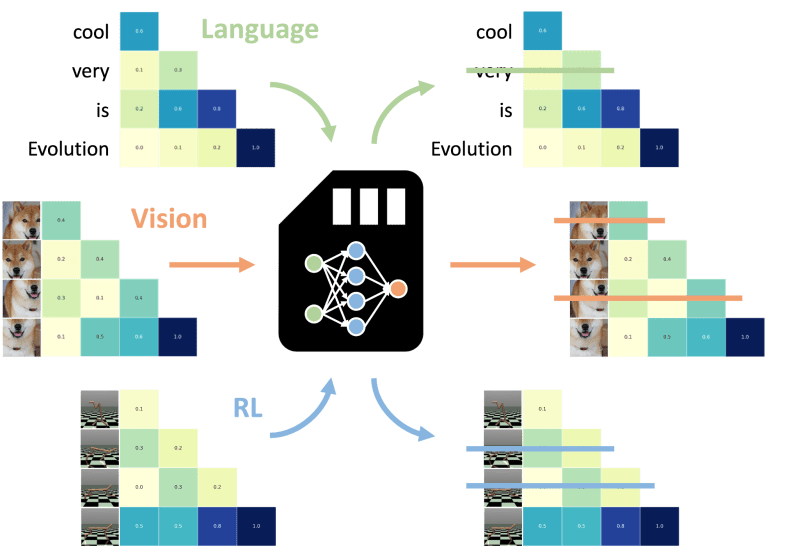
Join our daily and weekly newsletters for the latest updates and exclusive content on industry-leading AI coverage. Learn More Researchers at the Tokyo-based startup Sakana AI have developed a new technique that enables language models to use memory more efficiently, helping enterprises cut the costs of building applications on top of large language models (LLMs) and other Transformer-based models. The technique, called “universal transformer memory,” uses special neural networks to optimize LLMs to keep bits of information that matter and discard redundant details from their context.  Optimizing Transformer memory The responses of Transformer models, the backbone of LLMs, depend on the content of their “context window” — that is, what they receive as input from users. The context window can be considered the model’s working memory. Tweaking the content of the context window can have a tremendous impact on the model’s performance, which has given rise to an entire field of “prompt engineering.” Current models support very long context windows with hundreds of thousands, or even millions, of tokens (an LLM’s numerical representations of the words, word parts, phrases, concepts and numbers inputted by users in their prompts). This enables users to cram more information into their prompts. However, longer prompts can result in higher compute costs and slower performance. Optimizing prompts to remove unnecessary tokens while keeping important information can reduce costs and increase speed. Current prompt optimization techniques are resource-intensive or require users to manually test different configurations to reduce the size of their prompts. Neural attention memory modules Universal transformer memory optimizes prompts using neural attention memory models (NAMMs), simple neural networks that decide whether to “remember” or “forget” each given token stored in the LLM’s memory.  “This new capability allows Transformers to discard unhelpful or redundant details, and focus on the most critical information, something we find to be crucial for tasks requiring long-context reasoning,” the researchers write. Universal transformer memory (source: Sakana AI) NAMMs are trained separately from the LLM and are combined with the pre-trained model at inference time, which makes them flexible and easy to deploy. However, they need access to the inner activations of the model, which means they can only be applied to open-source models. Like other techniques developed by Sakana AI, NAMMs are trained through evolutionary algorithms instead of gradient-based optimization methods. By iteratively mutating and selecting the best-performing models through trial and error, evolution algorithms optimize NAMMs for efficiency and performance. This is especially important since NAMMs are trying to achieve a non-differentiable goal: keeping or discarding tokens. NAMMs operate on the attention layers of LLMs, one of the key components of the Transformer architecture that determines the relations and importance of each token in the model’s context window. Based on attention values, NAMMs determine which tokens should be preserved and which can be discarded from the LLM’s context window. This attention-based mechanism makes it possible to use a trained NAMM on various models without further modification. For example, a NAMM trained on text-only data can be applied to vision or multi-modal models without additional training. Neural attention memory models (NAMMs) examine attention layers to determine which tokens should be kept or discarded from the context window (source: Sakana AI) Universal memory in action To test the universal transformer memory concept in action, the researchers trained a NAMM on top of an open-source Meta Llama 3-8B model. Their experiments show that with NAMMs, Transformer-based models perform better on natural language and coding problems on very long sequences. Meanwhile, by discarding unnecessary tokens, NAMM enabled the LLM model to save up to 75% of its cache memory while performing the tasks. “Across our benchmarks, NAMMs provide clear performance improvements to the Llama 3-8B transformer,” the researchers write. “Furthermore, our memory systems yield notable side benefits, reducing the context size of each layer, while never being explicitly optimized for memory efficiency.”  NAMM models compete with leading prompt optimization techniques while improving the model’s performance (source: Sakana AI) They also tested the model on the 70B version of Llama as well as Transformer models designed for other modalities and tasks, such as Llava (computer vision) and Decision Transformer (reinforcement learning).  “Even in these out-of-distribution settings, NAMMs retain their benefits by discarding tokens such as redundant video frames and suboptimal actions, allowing their new base models to focus on the most relevant information to improve performance,” the researchers write. Task-dependent behavior Another interesting finding is that NAMMs automatically adjust their behavior based on the task. For example, for coding tasks, the model discards contiguous chunks of tokens that correspond to comments and whitespaces that don’t affect the code’s execution. On the other hand, in natural language tasks, the model discards tokens that represent grammatical redundancies and don’t affect the meaning of the sequence. The researchers released the code for creating your own NAMMs. Techniques such as universal transformer memory can be very useful for enterprise applications that process millions of tokens and can benefit from speed boosts and cost reduction. The reusability of a trained NAMM also makes it a versatile tool to use across different applications in an enterprise. For the future, the researchers suggest more advanced techniques, such as using NAMMs during the training of LLMs to further extend their memory capabilities. “This work has only begun to tap into the potential of our new class of memory models, which we anticipate might offer many new opportunities to advance future generations of transformers,” the researchers write.   source

New LLM optimization technique slashes memory costs up to 75% Read More »

What we learned after taking part in a 100-day innovation sprint

On a warm day in October, three corporates and two startups gathered together in the TNW offices for the conclusion of the one-hundred-day Vodafone IoT Challenge. Innovation is something all businesses want, but few actually have time for. We read about the advanced new tools and technologies collecting richer insights and making things faster and easier than ever before. But, when it comes down to it, day-to-day tasks always end up taking precedence over the effort and progress we could make for tomorrow. The real challenge is simply committing to the time it takes to innovate. That’s why Facilicom Group, Vodafone Ziggo, and the Heineken Experience joined the 2024 edition of the Vodafone IoT Challenge. The Vodafone IoT Challenge began in 2018, as Vodafone Business IoT experts sought to address some of the most common customer challenges in new ways. The idea behind the initiative was to discover innovative solutions through the collective power of major industry players and cutting edge, young tech companies. After a successful first edition, the Challenge has gone on to welcome partners from different sectors. Webinar: Unicorn DNA: The Blueprint for Scaling Success What does it take to build a unicorn? Top executives of unicorn companies reveal the mindset, strategies, and innovative thinking that propelled their companies to the top. Much like a fitness boot camp, the Vodafone IoT Challenge connects each participant to a startup in the IoT space and gives them the support and motivation to complete a one-hundred-day sprint in which they develop and demo a solution to one key challenge they’re facing. The challenge kicked off on June 20 with the participants being matched up with two startups: Sensing Feeling and PFM Intelligence. On October 17, everyone came together for Demo Day to share results and compare notes. Here’s what we learned: Challenge One: How can we see without seeing? As the EU takes a leading role in promoting data privacy rights across the bloc, this has also presented challenges for businesses that want to use technology to gain more insights, without infringing on data privacy. This is the challenge Ron Knaap, Director of Platform Technology at Facilicom, was faced with. Focused on enhancing building occupant experience, Knaap and his team needed to develop a way to monitor factors such as occupancy levels, air quality, and occupants’ sentiments to improve well-being within buildings. Through the programme, he was partnered with Jag Minhas, CEO of Sensing Feeling. Together, they developed a project that uses 3D sensors to create heat maps within buildings. In this way, they were able to gather rich data on things like whether crowds are gathering or dispersing, the velocity with which people are moving, and more. This information can then be used to provide real-time insights and even predict behaviours. For Minhas, this challenge provided a new use case in which to deploy Sense Feeling’s technology and expertise, “Usually our use cases are outdoors or in industrial centres. This time we were able to focus on human behaviour in relatively compact spaces like reception areas and corridors.” Challenge Two: Can we analyse people’s behaviour and match it to online reviews? The Heineken Experience is an immersive experience with interactive exhibits that bring visitors closer to one of the Netherlands’ most beloved brands. Benjamin David, Sales & Marketing Manager at the Heineken Experience, wanted to gain deeper insights into visitor satisfaction by understanding what was going on inside the attraction and comparing it to what visitors were saying online. Bart Schmitz of PFM Intelligence was their solution partner for this challenge. Together, they analysed the key insights which could help Heineken to improve the experience. Based on these required data, PFM designed a sensor-based system that could gather information on visitor behaviour, flow, and interactions within their exhibition space. One learning David took from the experience is that, although they started big, aiming to gain insights from the entire location ultimately, they realised they needed to limit the demo to a few key spaces. However, both partners are confident that, when deployed this December, the insights gained by the system will aid strategic decision-making on refurbishments and routing, enhance the overall visitor experience, and allow them to test ideas that can be scaled up later. Challenge Three: How can we optimise a store layout? Vodafone Retail has recently introduced a new shop concept in their Bijlmer Arena location. As Hein van Hell, Channel Manager Vodafone Retail, explained, they wanted to be able to analyse the store in a data-driven way allowing them to optimise the layout and drive more traffic into the store. They wanted to dive deeper into questions like: How are people interacting with the products on the different shelves in the shop? How busy is the street outside the shop at different times of the day/week? How many store clerks do we need to deploy at different times during the day? At the same time, they needed to ensure this data could be collected according to privacy and GDPR guidelines. To gain these types of insights, they needed a solution that could monitor customer patterns, understand crowd composition, and engagement levels in their physical locations. Additionally, they needed a platform capable of aggregating diverse sets of data for comprehensive insights. Van Hell and his solution partner, Christiaan van Rooijen of PFM, came up with a concept that combined technologies to get the insights Vodafone Ziggo wanted. “Although they already had a store counter, we installed sensors that could capture data on shoppers coming into the store. We also installed sensors focused on street traffic so we could understand how many people walked by the store compared to how many people went in. Once shoppers stepped inside, we were able to track every step they took in the store,” said van Rooijen. Through this demo, they were able to confirm that their new shop concept is more appealing and also gain insights into how they could customise their portfolio of products based on customer insights. Learnings

What we learned after taking part in a 100-day innovation sprint Read More »

What You Can Do About Software Supply Chain Security

Truly secure software supply chains require the IT industry to do much more than a stitch together a patchwork of SBOMs — as speakers at this week’s Forrester Security and Risk Summit will discuss. Yet, what role do software bills of materials play today, and what else must CISOs, software developers, regulators, and others do to avoid widespread security incidents? Janet Worthington, Forrester principal analyst, gave InformationWeek a preview of her keynote panel session, “From Fragile to Agile: Reimagining Software Supply Chain Security,” taking place both live in Baltimore and online Wednesday, Dec. 11. Worthington will be joined by Rosa Underwood, acting Senior Cybersecurity Advisor for the U.S. General Services Administration, Cassie Crossley, Vice President, Supply Chain Security in the Global Cybersecurity & Product Security Office, of Schneider Electric, and Dr. Allan Friedman, Senior Advisor and Strategist of Cybersecurity and Infrastructure Security Agency (CISA). source

What You Can Do About Software Supply Chain Security Read More »