Microsoft Finally Expands Copilot+ AI Features to Intel and AMD-Powered PCs

Accessibility features in Copilot+ PCs. Image: Microsoft Windows announced major updates to its portfolio, including Copilot+ PC experiences and Voice Access capabilities across Copilot+ PCs with AMD and Intel processors. A Windows Experience Blog, released Monday, described the AI-enhanced experiences that will soon be available on more devices, including Copilot+ PCs powered by AMD Ryzen AI 300 series, Intel Core Ultra 200V, and Snapdragon X Series processors. AI-powered experiences Upon its release in 2024, Microsoft’s Copilot + PC has delivered exclusive features for Qualcomm’s Snapdragon X platform devices. Now, nearly a year later, Microsoft is broadening access to select Copilot+ PC features to machines powered by AMD’s Ryzen AI 300 and Intel’s Core Ultra 200 series processors. Over the coming month, Windows will introduce these features via its Controlled Feature Rollout (CFR), with several experiences already accessible through the March 2025 Windows non-security preview update. Although the blog announcement provides details regarding the upcoming enhancements, these updates may vary by device and region, and the releases’ timing may also vary. PCs powered by AMD Ryzen AI 300 series and Intel Core Ultra 200V processors will gain access to new AI-powered features and experiences, including Cocreator, Image Creator, Restyle Image, and Live Captions. Additionally, upgraded Voice Access capabilities for Copilot+ PCs will become available to more devices later this year. Microsoft Copilot resources from TechRepublic Accessibility updates Windows will offer accessibility features to its Copilot+ PCs powered by AMD and Intel, including live captions and translation services. The Live Caption feature, which provides real-time translations in English for video and audio content, will soon support simplified Chinese and support additional AMD- and Intel-powered devices. The Voice Access feature — currently available on Snapdragon X Series Copilot+ PCs — will also receive an update, enabling more natural, flexible user interactions. Creative tools Windows provides AI-enabled creativity features for Snapdragon X Series Copilot+ PCs, and will soon make them available on Intel- and AMD-powered devices. Updated Microsoft Paint and Photos applications will include access to the Cocreator feature in Paint and the Image Creator and Restyle Image features in Photos. Paint’s Cocreator offers enhanced drawing and editing capabilities to support users’ creative expression. With AI support, users can combine text-based prompts with freehand artwork to generate more dynamic, personalized designs. The Photos app will include access to two new tools, Restyle Image, and Image Creator. Restyle Image lets users modify their photos into interpretations in different creative mediums and art styles. The Image Creator feature creates visuals based on detailed prompts. source

Microsoft Finally Expands Copilot+ AI Features to Intel and AMD-Powered PCs Read More »

Anthropic flips the script on AI in education: Claude’s Learning Mode makes students do the thinking

Join our daily and weekly newsletters for the latest updates and exclusive content on industry-leading AI coverage. Learn More Anthropic introduced Claude for Education today, a specialized version of its AI assistant designed to develop students’ critical thinking skills rather than simply provide answers to their questions. The new offering includes partnerships with Northeastern University, London School of Economics, and Champlain College, creating a large-scale test of whether AI can enhance rather than shortcut the learning process. ‘Learning Mode’ puts thinking before answers in AI education strategy The centerpiece of Claude for Education is “Learning Mode,” which fundamentally changes how students interact with AI. When students ask questions, Claude responds not with answers but with Socratic questioning: “How would you approach this problem?” or “What evidence supports your conclusion?” This approach directly addresses what many educators consider the central risk of AI in education: that tools like ChatGPT encourage shortcut thinking rather than deeper understanding. By designing an AI that deliberately withholds answers in favor of guided reasoning, Anthropic has created something closer to a digital tutor than an answer engine. The timing is significant. Since ChatGPT’s emergence in 2022, universities have struggled with contradictory approaches to AI — some banning it outright while others tentatively embrace it. Stanford’s HAI AI Index shows over three-quarters of higher education institutions still lack comprehensive AI policies. Universities gain campus-wide AI access with built-in guardrails Northeastern University will implement Claude across 13 global campuses serving 50,000 students and faculty. The university has positioned itself at the forefront of AI-focused education with its Northeastern 2025 academic plan under President Joseph E. Aoun, who literally wrote the book on AI’s impact on education with “Robot-Proof.” What’s notable about these partnerships is their scale. Rather than limiting AI access to specific departments or courses, these universities are making a substantial bet that properly designed AI can benefit the entire academic ecosystem — from students drafting literature reviews to administrators analyzing enrollment trends. The contrast with earlier educational technology rollouts is striking. Previous waves of ed-tech often promised personalization but delivered standardization. These partnerships suggest a more sophisticated understanding of how AI might actually enhance education when designed with learning principles, not just efficiency, in mind. Beyond the classroom: AI enters university administration Anthropic’s education strategy extends beyond student learning. Administrative staff can use Claude to analyze trends and transform dense policy documents into accessible formats — capabilities that could help resource-constrained institutions improve operational efficiency. By partnering with Internet2, which serves over 400 U.S. universities, and Instructure, maker of the widely-used Canvas learning management system, Anthropic gains potential pathways to millions of students. While OpenAI and Google offer powerful AI tools that educators can customize for innovative educational purposes, Anthropic’s Claude for Education takes a distinctly different approach by building Socratic questioning directly into its core product design through Learning Mode, fundamentally changing how students interact with AI by default. The education technology market projection of $80.5 billion by 2030 according to Grand View Research suggests the financial stakes. But the educational stakes may be higher. As AI literacy becomes essential in the workforce, universities face increasing pressure to integrate these tools meaningfully into curriculum. Challenges remain significant. Faculty preparedness for AI integration varies widely, and privacy concerns persist in educational settings. The gap between technological capability and pedagogical readiness continues to be a major obstacle to meaningful AI integration in higher education. As students increasingly encounter AI in their academic and professional lives, Anthropic’s approach presents an intriguing possibility: that we might design AI not just to do our thinking for us, but to help us think better for ourselves — a distinction that could prove crucial as these technologies reshape education and work alike. source

Anthropic flips the script on AI in education: Claude’s Learning Mode makes students do the thinking Read More »

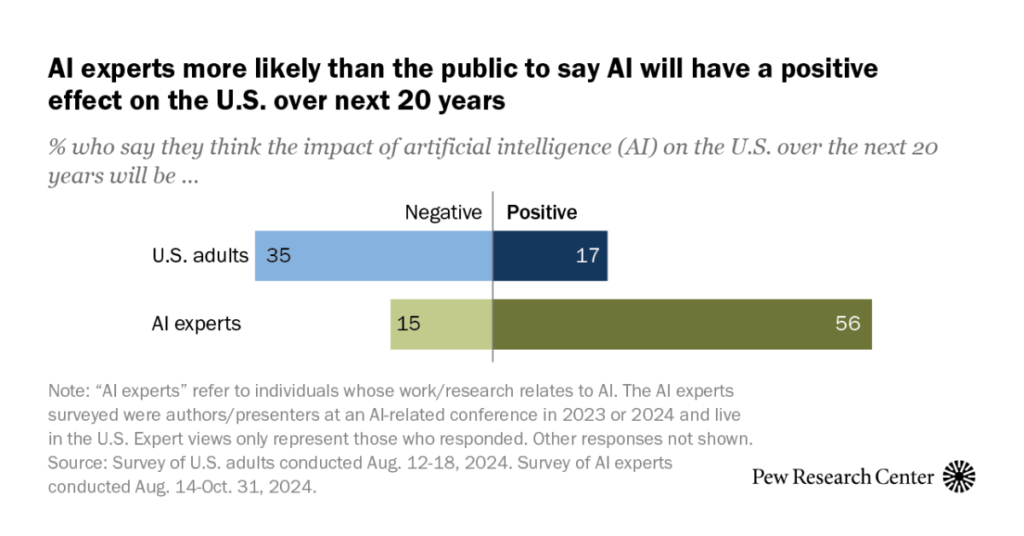
Appendix A: Demographic makeup of AI experts surveyed

ABOUT PEW RESEARCH CENTER Pew Research Center is a nonpartisan, nonadvocacy fact tank that informs the public about the issues, attitudes and trends shaping the world. It does not take policy positions. The Center conducts public opinion polling, demographic research, computational social science research and other data-driven research. Pew Research Center is a subsidiary of The Pew Charitable Trusts, its primary funder. source

Appendix A: Demographic makeup of AI experts surveyed Read More »

Calif. Banking Brief: All The Notable Legal Updates In Q1

By Stephen Britt ( April 3, 2025, 4:16 PM EDT) — In this Expert Analysis series, attorneys provide quarterly recaps discussing the biggest developments in California banking regulation and policymaking…. Law360 is on it, so you are, too. A Law360 subscription puts you at the center of fast-moving legal issues, trends and developments so you can act with speed and confidence. Over 200 articles are published daily across more than 60 topics, industries, practice areas and jurisdictions. A Law360 subscription includes features such as Daily newsletters Expert analysis Mobile app Advanced search Judge information Real-time alerts 450K+ searchable archived articles And more! Experience Law360 today with a free 7-day trial. source

Calif. Banking Brief: All The Notable Legal Updates In Q1 Read More »

AI lie detector: How HallOumi’s open-source approach to hallucination could unlock enterprise AI adoption

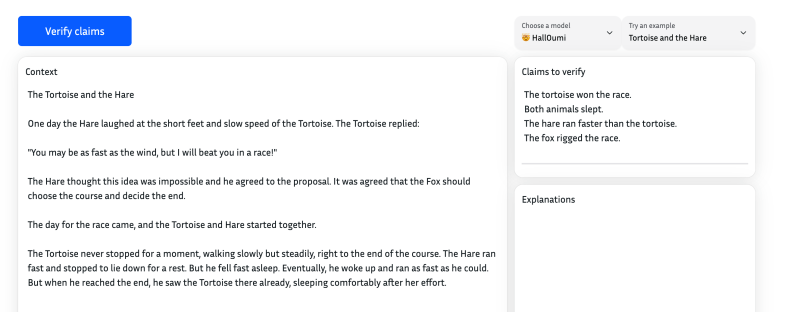
Join our daily and weekly newsletters for the latest updates and exclusive content on industry-leading AI coverage. Learn More In the race to deploy enterprise AI, one obstacle consistently blocks the path: hallucinations. These fabricated responses from AI systems have caused everything from legal sanctions for attorneys to companies being forced to honor fictitious policies.  Organizations have tried different approaches to solving the hallucination challenge, including fine-tuning with better data, retrieval augmented generation (RAG), and guardrails. Open-source development firm Oumi is now offering a new approach, albeit with a somewhat ‘cheesy’ name. The company’s name is an acronym for Open Universal Machine Intelligence (Oumi). It is led by ex-Apple and Google engineers on a mission to build an unconditionally open-source AI platform. On April 2, the company released HallOumi, an open-source claim verification model designed to solve the accuracy problem through a novel approach to hallucination detection. Halloumi is, of course, a type of hard cheese, but that has nothing to do with the model’s naming. The name is a combination of Hallucination and Oumi, though the timing of the release close to April Fools’ Day might have made some suspect the release was a joke – but it is anything but a joke; it’s a solution to a very real problem. “Hallucinations are frequently cited as one of the most critical challenges in deploying generative models,” Manos Koukoumidis, CEO of Oumi, told VentureBeat. “It ultimately boils down to a matter of trust—generative models are trained to produce outputs which are probabilistically likely, but not necessarily true.” How HallOumi works to solve enterprise AI hallucinations  HallOumi analyzes AI-generated content on a sentence-by-sentence basis. The system accepts both a source document and an AI response, then determines whether the source material supports each claim in the response. “What HallOumi does is analyze every single sentence independently,” Koukoumidis explained. “For each sentence it analyzes, it tells you the specific sentences in the input document that you should check, so you don’t need to read the whole document to verify if what the [large language model] LLM said is accurate or not.” The model provides three key outputs for each analyzed sentence: A confidence score indicating the likelihood of hallucination. Specific citations linking claims to supporting evidence. A human-readable explanation detailing why the claim is supported or unsupported. “We have trained it to be very nuanced,” said Koukoumidis. “Even for our linguists, when the model flags something as a hallucination, we initially think it looks correct. Then when you look at the rationale, HallOumi points out exactly the nuanced reason why it’s a hallucination—why the model was making some sort of assumption, or why it’s inaccurate in a very nuanced way.” Integrating HallOumi into Enterprise AI workflows There are several ways that HallOumi can be used and integrated with enterprise AI today. One option is to try out the model using a somewhat manual process, though the online demo interface.  An API-driven approach will be more optimal for production and enterprise AI workflows. Manos explained that the model is fully open-source and can be plugged into existing workflows, run locally or in the cloud and used with any LLM. The process involves feeding the original context and the LLM’s response to HallOumi, which then verifies the output. Enterprises can integrate HallOumi to add a verification layer to their AI systems, helping to detect and prevent hallucinations in AI-generated content. Oumi has released two versions: the generative 8B model that provides detailed analysis and a classifier model that delivers only a score but with greater computational efficiency. HallOumi vs RAG vs Guardrails for enterprise AI hallucination protection What sets HallOumi apart from other grounding approaches is how it complements rather than replaces existing techniques like RAG (retrieval augmented generation) while offering more detailed analysis than typical guardrails. “The input document that you feed through the LLM could be RAG,” Koukoumidis said. “In some other cases, it’s not precisely RAG, because people say, ‘I’m not retrieving anything. I already have the document I care about. I’m telling you, that’s the document I care about. Summarize it for me.’ So HallOumi can apply to RAG but not just RAG scenarios.” This distinction is important because while RAG aims to improve generation by providing relevant context, HallOumi verifies the output after generation regardless of how that context was obtained. Compared to guardrails, HallOumi provides more than binary verification. Its sentence-level analysis with confidence scores and explanations gives users a detailed understanding of where and how hallucinations occur. HallOumi incorporates a specialized form of reasoning in its approach.  “There was definitely a variant of reasoning that we did to synthesize the data,” Koukoumidis explained. “We guided the model to reason step-by-step or claim by sub-claim, to think through how it should classify a bigger claim or a bigger sentence to make the prediction.” The model can also detect not just accidental hallucinations but intentional misinformation. In one demonstration, Koukoumidis showed how HallOumi identified when DeepSeek’s model ignored provided Wikipedia content and instead generated propaganda-like content about China’s COVID-19 response. What this means for enterprise AI adoption For enterprises looking to lead the way in AI adoption, HallOumi offers a potentially crucial tool for safely deploying generative AI systems in production environments. “I really hope this unblocks many scenarios,” Koukoumidis said. “Many enterprises can’t trust their models because existing implementations weren’t very ergonomic or efficient. I hope HallOumi enables them to trust their LLMs because they now have something to instill the confidence they need.” For enterprises on a slower AI adoption curve, HallOumi’s open-source nature means they can experiment with the technology now while Oumi offers commercial support options as needed. “If any companies want to better customize HallOumi to their domain, or have some specific commercial way they should use it, we’re always very happy to help them develop the solution,” Koukoumidis added. As AI systems continue to advance, tools like HallOumi may become standard components of enterprise AI stacks—essential infrastructure for separating AI fact from fiction. source

AI lie detector: How HallOumi’s open-source approach to hallucination could unlock enterprise AI adoption Read More »

Financial Firms Offer Laid-Off Government Employees A Chance To … Spend More Money?!

As a former US federal employee, I’m a customer of two financial services companies that focus on current and former feds. Within the past couple of months — as millions of federal employees have been subject to on-again, off-again layoffs — these companies have emailed their customers with essentially the same message. It goes something like this: We know that in these uncertain times you’re worried about your finances. Our personal financial advisors can help you understand your finances and plan for the future. Unspoken, but obvious to everyone, is that you have to pay for this personal financial advice. So what these emails really offer is a chance for feds who may lose their jobs to spend more money! You may respond that this is how business works: Identify a need — such as financial stress — and offer a product to solve it. But there’s a better way, a way that builds longer-term customer loyalty, contributes more to business performance, and aligns more closely with these companies’ stated values — which I’ll paraphrase as things like “members first,” “service,” and “community.” This approach proved itself during the COVID-19 pandemic: Remove customer stress and offer benefits that align with the long-cultivated brand, instead of adding another expense and contradicting stated corporate values. For example, during the pandemic, companies in financial services helped customers with financial hardships by deferring loan and credit card payments, canceling various fees, and adding overdraft protection. Even better for financial services companies: Helping customers in these and other ways improves the uptake for additional paid services (like pricey personal financial advisors), as improving customer experience (CX) boosts customer loyalty in financial services and other industries. Has your company made a similar blunder, pitching an expensive upsell without first offering loyalty-building assistance to customers in need? It’s not too late to fix the problem. A few quick pieces of advice: Reaffirm your brand. It’s unlikely that market volatility affects any of your brand fundamentals. Hastily upending a well-determined brand strategy will only cause trouble once the volatility subsides. Instead, modulate your brand’s value proposition by considering all four possible types of value that your brand can provide: economic, functional, experiential, and symbolic. Recommit to CX fundamentals. Ensure that you use driver analysis for targeted CX improvements, qualitative research to plug key holes in customer understanding, data storytelling to drive action from insights, and cross-functional collaboration to ensure a journey-centric approach. Provide customers with consistent, on-brand experiences. Start by reaffirming your CX vision to ensure that it aligns with your business strategy. Use The Forrester CX Vision Development Template to speed your vision review. Balance customer and business needs to serve customers sustainably. Use an enterprisewide metrics framework to help maintain a long-term balance between the value for the customer and the business. It can also help you decide when to lean toward value to the customer in the short term, such as when people are losing their jobs. Want to talk in greater detail? Forrester clients can schedule a guidance session or contact their account team. source

Financial Firms Offer Laid-Off Government Employees A Chance To … Spend More Money?! Read More »

Trump's Tariffs: Will They Affect Your Tech Prices?

Image: Gage Skidmore/Flickr/Creative Commons U.S. President Donald Trump has announced a new 10% baseline tariff on all imports to the U.S., taking effect on April 5. He is also imposing additional “reciprocal” levies on approximately 60 countries that represent the largest contributors to the U.S. trade deficit —  a move that significantly impacts tech prices. These include: 46% tariff on goods from Vietnam. 32% tariff on goods from Taipei and Taiwan. 26% tariff on goods from India. 25% tariff on goods from South Korea. 24% tariff on goods from Japan. 20% tariff on goods from the E.U. China faces a 34% reciprocal tariff, in addition to the 20% tariff already in place. These percentages were calculated to generate revenue equal to the trade deficit with each country and then halved. The reciprocal tariffs will come into effect on April 9. Trump says that trade deficits — in which the U.S. spends more on imports from these nations than it earns through exports — are the result of higher foreign tariffs, non-tariff barriers, and economic policies abroad that depress wages and limit domestic consumption. Tariffs have also been applied to countries with low tariff rates but high trade surpluses with the U.S. like the U.K. and Australia. The president managed to pass them without congressional approval, declaring a national emergency and claiming that persistent trade imbalances undermine national security by weakening U.S. manufacturing and exposing supply chains to foreign dependence. SEE: Trump’s Import Tariffs: How They’ll Shake Prices, Jobs, and Trade Separately, Trump has revoked tariff exemptions on Chinese imports valued at $800 or less and intends to extend this policy to other countries with comparable exemptions. Canada and Mexico will not face higher rates than what they were given in February, and goods compliant with the United States–Mexico–Canada Agreement (USMCA), including auto parts from Canada and Mexico, remain exempt. In response, the U.K. has  reportedly offered major U.S. tech firms reductions to its digital services tax in exchange for relief from new trade barriers, according to The Guardian. Meanwhile, European Commission President Ursula von der Leyen said that the EU is “prepared to respond” with countermeasures and that it “holds a lot of cards, from trade to technology to the size of our market,” via The Associated Press. How will these tariffs affect you? While these tariffs were brought to restore economic fairness, boost manufacturing, and create more jobs in the U.S., they are also expected to trigger price increases in tech products. According to CNBC, after Trump’s announcement on April 1, NVIDIA’s stock fell by 5%, while Apple and Amazon fell by 6%. This is due to fears that their operational costs will rise and supply chains, which rely heavily on overseas manufacturing and imports, will be disrupted. U.S. chipmaker NVIDIA should be somewhat shielded from the impact due to Trump’s exemption on semiconductors, sparing it from the 32% tariff on chips manufactured in Taiwan by TSMC. However, it remains unclear whether the semiconductor exemption will also cover the 10% baseline tariff on all imports. Apple products, mostly manufactured in China, India, and Vietnam, are likely to become more expensive as the company passes increased import costs on  o U.S. consumers. Amazon might do the same, as a high proportion of the goods listed on its marketplace are from Chinese sellers. The e-commerce giant will especially be impacted by the removal of the tax exemption on products under $800. The U.S. relies on China and Taiwan for approximately 80% of its foundry capacity for 20 to 45nm chips and about 70% for 50 to 180nm chips. Tech firms may attempt to shift sourcing to reciprocal tariff-free countries, but many will pass the additional costs to consumers instead. First tariffs were set in February These new tariffs come after those imposed in February — 25% on all imports from Canada and Mexico except energy resources and minerals, 20% on Chinese goods, and 25% on European Union tech components like semiconductors. With 80% of U.S. foundry capacity for key semiconductor sizes currently reliant on China and Taiwan, experts predicted ripple effects across the entire tech sector, impacting everything from smartphones and cloud services to AI infrastructure. At the time, Gil Luria, head of technology research at D.A. Davidson, told Bloomberg that part of the reason Trump is implementing tariffs on goods from the E.U. is in retaliation for the region “making a habit” of fining major U.S. companies, such as Apple, Google, and Meta, for “whatever behavior they choose to penalize.” He added that the E.U. may become “combative” in response, and the level to which it does will determine the scale of the tariffs’ impact on the big tech players. SEE: Were the White House’s Tariffs Calculations Done By AI? Data centers and AI infrastructure face higher costs The expanded tariffs on aluminium and steel from February are predicted to sting data center companies, as these materials are essential for server racks, cooling systems, and other infrastructure, driving up construction and equipment costs. The additional expenditure and potential supply chain disruption may be reflected in cloud storage prices from companies like AWS, Google Cloud, and Microsoft Azure, as well as SaaS and AI companies that utilise large-scale data processing. It could also delay plans to build new data centers that companies have earmarked to meet the growing demand for AI. Nevertheless, the stated intention is to reduce dependence on foreign adversaries. While this may result in higher prices for consumers in the short term, it could also drive investment in domestic industries and boost supply chain resilience. SEE: Microsoft to Invest $80 Billion in AI Data Centers in Fiscal 2025 Tech companies ramp up U.S. manufacturing Even prior to the tariffs, many companies have been announcing plans to build new facilities within the U.S., which is a trend likely to continue. In March, TSMC pledged to expand its spend on building data centers in the U.S. to $160 billion, which it deems the “largest single foreign direct investment in


Trump's Tariffs: Will They Affect Your Tech Prices? Read More »

So There Won’t Be A Wiz IPO — What Does That Mean For Cyber IPOs In 2025?

Last week’s mega deal of Google acquiring CNAPP provider Wiz for $32 billion has some lamenting the future of IPOs in the cybersecurity space. Wiz was on a high growth trajectory, and given that Wiz had previously rebuffed Google’s interest in the summer of 2024, many assumed Wiz was on target for a 2025 IPO, the success of which was meant to serve as a bellwether for the overall health of the cybersecurity market. With Wiz no longer an IPO candidate, has momentum for cybersecurity IPOs stalled? In the short term, the answer is yes, but that is more to do with the health of the overall tech IPO market, not just cybersecurity. Genesys, a provider of AI-driven call center software, recently postponed its planned spring 2025 IPO, citing market uncertainty, with plans to revisit an IPO in the second half of 2025. And despite last year’s uneven macroeconomic environment, there were still over 220 IPOs in the US stock markets last year, up from 150 in 2023. While approximately 10% of the 2024 IPOs were of the SPAC (special-purpose acquisition company) variety, there were still several significant tech IPOs in 2024, including Reddit, OneStream, Ingram Micro, and ServiceTitan, to name a few. Rubrik’s April 2024 IPO also marked the first cybersecurity-related IPO in two years. While the cybersecurity IPO market may be muted right now, there are still several possible cybersecurity IPO candidates for 2025. While there is a lot of discussion on tariffs and the current market volatility hindering IPOs, indexes such as the Cboe’s VIX Index (which analyzes S&P 500 index options to derive a forward-looking projection of volatility) have not moved as much as the overall market indices. Some have suggested that this is because much of current volatility is derived from policy decisions (like tariffs), meaning they can be quickly reversed and are also not tied as directly to structural economic factors. Despite this current uncertainty, the resilience of the US stock market, and the fact that there are still several cybersecurity companies seeking a liquidity event, mean that cybersecurity IPOs could still happen in 2025, especially in the second half of the year. The current tech IPO bellwether is AI darling CoreWeave. Despite a tepid initial trading day, CoreWeave has since rebounded and its shares are up. This current (but by no means comprehensive) list of potential cybersecurity IPO candidates for the fall of 2025 can be put into two distinct categories: Category one: venture-backed, with $500 million or more in VC funding and high annual recurring revenue (ARR) growth of over 40% Netskope: In October 2024, Netskope CEO Sanjay Beri indicated plans to proceed with an IPO in the second half of 2025, depending on market conditions and investor appetite. Netskope has raised over $1 billion in venture capital, reported over $500 million in ARR, and competes in the high demand Zero Trust edge network security segment. While Netskope has not filed an S-1 form with the SEC yet, it is a vendor to watch in 2025 as a strong contender for an IPO. Snyk: Like Netskope, application security developer Snyk has raised over $1 billion in venture capital, hit $300 million in ARR last year, and is growing ARR 40% annually. While Snyk has not filed an S-1 with the SEC, it is long rumored to be an IPO candidate and fits the criteria for this category. Application security remains a high growth area. OneTrust: This privacy management company has raised over $1 billion and is exceeding $500 million in ARR. While the firm has been mum on any IPO plans, it meets the size, valuation, and growth metrics for an IPO. Armis has not reached the $500 million ARR milestone yet but is growing rapidly and has raised over $800 million in venture capital. According to Bloomberg, it is looking at 2026 for an IPO, so continued success and growth in 2025 will position the company for an IPO next year. Category two: established cybersecurity firm owned by private equity (PE) firms for two or more years and seeking exit This category already has a successful 2025 IPO: identity management and governance vendor SailPoint, which PE investor Thoma Bravo took public in February, raising $1.4 billion in the IPO at a $12 billion valuation. Some other IPO candidates in this category include: Proofpoint: Email and data security vendor Proofpoint was taken private by Thoma Bravo for $12 billion in 2021. Last fall, Proofpoint indicated plans to return to public markets within 12 to 18 months. Thoma Bravo has held Proofpoint for five years; this would be a good IPO candidate once market conditions improve. Illumio: Also owned by Thoma Bravo since 2021, Illumio has raised more than $500 million in funding, is growing fast, and had a $2 billion-plus valuation when acquired by Thoma Bravo. Illumio was a Leader in The Forrester Wave™: Microsegmentation Solutions, Q3 2024, last year and competes in the high-demand cloud security and Zero Trust segments. Delinea: Last week, the PE owner of privileged identity management vendor Delinea indicated that it’s considering IPO plans. TPG has owned Delinea since 2021 when it merged Thycotic and Centrify and renamed the new entity Delinea. With Delinea’s ARR at almost $400 million, it fits the criteria, especially if the PE owner is looking to exit this investment in 2025. While macroeconomic factors or geopolitical events could affect the public market’s appetite for tech IPOs, this post has hopefully shown that there are plenty of well-funded and capitalized cybersecurity companies capable of going public in the next 12 months based on market conditions. And seeing as all these companies are growing and investing in their product offerings, security professionals should view pending cybersecurity IPOs as a positive validation of the overall cybersecurity market and their supplier’s position within that market. source

So There Won’t Be A Wiz IPO — What Does That Mean For Cyber IPOs In 2025? Read More »