DC Circ. Won't Let Apple Intervene For Google Search Fix Trial

By Matthew Perlman ( March 21, 2025, 4:24 PM EDT) — A D.C. Circuit panel on Friday rejected Apple’s appeal seeking to participate in the remedy trial for the U.S. Department of Justice’s search monopolization case against Google next month…. Law360 is on it, so you are, too. A Law360 subscription puts you at the center of fast-moving legal issues, trends and developments so you can act with speed and confidence. Over 200 articles are published daily across more than 60 topics, industries, practice areas and jurisdictions. A Law360 subscription includes features such as Daily newsletters Expert analysis Mobile app Advanced search Judge information Real-time alerts 450K+ searchable archived articles And more! Experience Law360 today with a free 7-day trial. source

DC Circ. Won't Let Apple Intervene For Google Search Fix Trial Read More »

大灣區家族辦公室協會論港發展 會長李慧芬喚港府舉辦另類投資展覽會

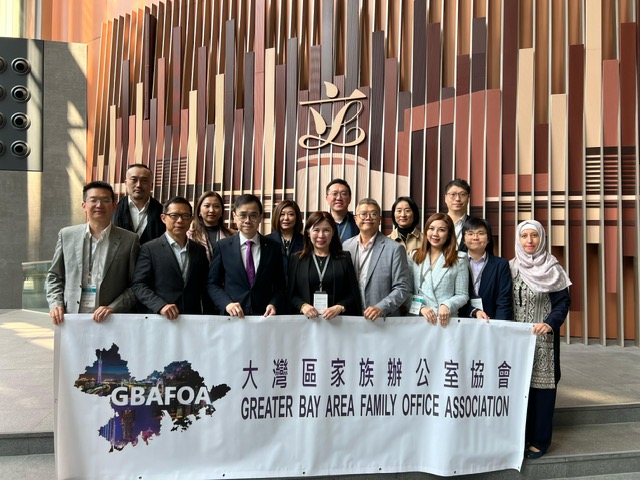
(相前排左四)大灣區家族辦公室協會會長李慧芬。 香港特區政府陳茂波司長在2月下旬公佈的財政預算案,當中關於金融服務方面,有不少篇幅都提到推動「家族辦公室」。日前,大灣區家族辦公室協會會長李慧芬,與協會顧問林俊傑,以及各理事及會員,跟黃俊碩立法會議員會面,探討如何進一步推動家族辦公室(家辦)在香港的發展。 陳茂波表示,今年內就有關單一家族辦公室和附帶權益的稅務優惠制訂方案,增加單一家族辦公室享有稅務寬減的合資格交易種類、優化私募基金分發附帶權益的稅務寬減安排。陳茂波稱,香港將繼續吸引環球資金來港,豐富家族辦公室生態圈,並報告投資推廣署已協助超過一百六十家家族辦公室在港設立或擴展業務。 在該會議之上,首先,各理事陳述現時服務家辦時的痛點,例如海外家辦較難在港開立銀行戶口;亦提到清楚列明單一家辦可獲免稅的投資產品等。亦有會員表示,中東資金似乎對香港不太有興趣,較傾向前往新加坡。 另外,會長李慧芬表示,家族辦公室較喜歡另類投資產品,建議港府每年以家族辦公室名義舉辦展覽會,讓服務提供者如律師、會計師、信託、資產管理、另類投資產品、保險、教育等參展,一來可以讓香港市民更了解家辦,亦可吸引內地及海外單一家辦來港參觀,將整個行業推向世界各地。 李慧芬展望,未來會陸續與顧問、理事及會員向各政府部門及立法會議員提供意見,共同推動家族辦公室。 LinkedIn Email Facebook Twitter WhatsApp The post 大灣區家族辦公室協會論港發展 會長李慧芬喚港府舉辦另類投資展覽會 appeared first on VeriMedia. source

大灣區家族辦公室協會論港發展 會長李慧芬喚港府舉辦另類投資展覽會 Read More »

Meitar-Led Navina Wraps $55M Series C Funding Round

By Jade Martinez-Pogue ( March 25, 2025, 12:01 PM EDT) — Artificial intelligence-powered clinical intelligence company Navina, advised by Meitar, announced on Tuesday that it clinched a $55 million Series C funding round, bringing its total amount raised to $100 million…. Law360 is on it, so you are, too. A Law360 subscription puts you at the center of fast-moving legal issues, trends and developments so you can act with speed and confidence. Over 200 articles are published daily across more than 60 topics, industries, practice areas and jurisdictions. A Law360 subscription includes features such as Daily newsletters Expert analysis Mobile app Advanced search Judge information Real-time alerts 450K+ searchable archived articles And more! Experience Law360 today with a free 7-day trial. source

Meitar-Led Navina Wraps $55M Series C Funding Round Read More »

Meta's $800M Offer To Chip Startup Was Rejected

Image: James Martin/CNET Cutting‐edge South Korean AI chip startup FuriosaAI has turned down Meta’s $800 million acquisition offer, choosing its own ambitious roadmap over becoming part of the tech giant’s sprawling portfolio. This decision highlights the startup’s confidence in its technology and a broader industry trend of maintaining independence in a rapidly evolving market. Deal talks and breakdown Discussions between Meta and FuriosaAI began early this year, with Meta aiming to bolster its AI chip capabilities amid fierce competition from Nvidia and emerging players worldwide. However, as negotiations progressed, disagreements arose over post-acquisition business strategy and organizational structure rather than price considerations. FuriosaAI’s management believed that integration into Meta’s ecosystem might compromise its long-term vision and operational autonomy. The rejection of the offer reflects a strategic decision to preserve control over its innovative chip development and business model. More must-read AI coverage Strategic rationale behind the rejection FuriosaAI’s decision to remain independent appears driven by a desire to focus on its core expertise — developing AI inference chips that challenge the industry’s status quo. By declining the acquisition bid, the startup aims to continue investing in its proprietary RNGD chip, which is designed to offer superior performance per watt compared to existing solutions. The company is prioritizing its long-term strategy to scale operations and secure additional funding for future growth rather than settling for an attractive exit offer. Meta’s interest in acquiring FuriosaAI fits within a larger plan to reduce its reliance on third-party suppliers like Nvidia. The company has been aggressively investing in AI infrastructure, with CEO Mark Zuckerberg recently outlining plans to allocate up to $65 billion this year toward AI initiatives, including custom chip development. These efforts are part of Meta’s broader strategy to enhance the performance of its platforms, ranging from social media to virtual reality, by integrating advanced, in-house AI processing capabilities. Beyond the bid: What’s next for FuriosaAI? FuriosaAI now turns its focus to ramping up production and expanding its market presence. With its Series C funding round reportedly nearing closure, the startup is well-positioned to invest further in R&D and secure strategic partnerships with major industry players. This independent path is expected to enable FuriosaAI to sharpen its competitive edge in the global AI semiconductor market, where rapid innovation and scalability are key to long-term success. source

Meta's $800M Offer To Chip Startup Was Rejected Read More »

Judge Incredulous At Defense Raised In OpenAI TM Fight

By Dorothy Atkins ( March 21, 2025, 9:16 PM EDT) — A California federal judge doubted Friday certain defenses in OpenAI’s trademark battle against a man who runs a website called “open.ai,” telling the man’s counsel repeatedly during a hearing it’s “incredible” that he’s claiming the court can’t legally order him to transfer the domain if he doesn’t own the mark…. Law360 is on it, so you are, too. A Law360 subscription puts you at the center of fast-moving legal issues, trends and developments so you can act with speed and confidence. Over 200 articles are published daily across more than 60 topics, industries, practice areas and jurisdictions. A Law360 subscription includes features such as Daily newsletters Expert analysis Mobile app Advanced search Judge information Real-time alerts 450K+ searchable archived articles And more! Experience Law360 today with a free 7-day trial. source

Judge Incredulous At Defense Raised In OpenAI TM Fight Read More »

Siemens Data Center Analyst Event Touches On A Variety Of Topics

Forrester was invited to a Siemens Industry Analyst Day event focused on data centers in Zug, Switzerland and received presentations covering a wide variety of data center topics, as well as a tour of Siemens’ facilities showcasing the practical application of its strategy and products. There were a variety of key topics covered at the event. Market Strategy Siemens showcased its product solutions across several categories: power solutions, automation, infrastructure management, thermal optimization, physical security, fire safety, digital twins, microgrids, lifecycle services, and financial services. This included how the company is leveraging its Xcelerator platform, open protocols, and partnerships to benefit customers in the most flexible way. Impactful Sustainability Siemens’ data center sustainability efforts are centered on three points: decarbonization and energy efficiency; resource efficiency and circularity; and a focus on impacts to people and society. The company has established the DEGREE framework guiding Siemens’ sustainability ambitions, as well as for its customers. The presentation highlighted how its solutions address these three points on sustainability with specific solutions, along with case studies showing the real impact seen by customers. Scalability From Modular Power Siemens presented the challenges seen from changes in the requirements of data centers: bigger campuses, the need to be environmentally friendly, and the difficulties in design standardization with different standards and across regions. Siemens’ modular power presentation highlighted its solutions and how they can be used to accelerate delivery and reduce costs for data center buildouts. This is achieved by leveraging global centers of competence and customizable prefabricated modular power solutions, from e-houses to kiosks and skids. Digital Twins Driving Design To Operations Siemens showcased how it is leveraging digital twins for infrastructure and building management. The benefits of using the digital twin approach for data centers is not just for operations but also for design and construction, as well. The presentation outlined how Siemens enables and uses digital twins, the different levels of digital twin maturity that it sees (cognitive, prescriptive, predictive, informative, and descriptive), and a case study with the actual value realized by this approach. Siemens’ customers are still at the beginning of the journey on this topic. Automation And Operations Siemens presented different solutions for data center-automated management of infrastructure, power, thermals, and HVAC systems. The presentation included different reference architectures for automated control, as well as how the company addresses challenges with brownfield scenarios, evolving technologies, and the need for a multidisciplinary approach. Monitoring For Secure And Reliable Operations Siemens’ energy and power quality monitoring solutions target future data center needs in terms of performance, sustainability, and resiliency. The presentation illustrated how its solutions address security, reporting, integration with other vendors, and power quality issues, with resiliency being a clear Siemens priority. If you have more questions about Siemens or how its solutions address data centers and sustainability, please submit an inquiry request or reach out to your account team. source

Siemens Data Center Analyst Event Touches On A Variety Of Topics Read More »

23andMe bankruptcy: Can EU and UK laws protect your DNA data?

San Francisco-based 23andMe, which sells at-home DNA testing kits, has filed for bankruptcy in the US and is looking for a new buyer — heightening concerns about the personal data of millions of people.     23andMe experienced a major data breach in 2023, which exposed personal information like family trees, birth years, and geographic locations of approximately half of the company’s 15 million users.    Now, with the company sinking, 23andMe customers are considering deleting their accounts amid fears of another hack or changes to the company’s privacy controls under a new owner.  In the EU and the UK, 23andMe users are covered by versions of the GDPR. The Information Commissioner’s Office (ICO), Britain’s data privacy watchdog, stresses that despite the insolvency, customers remain protected by the same data privacy laws. The 💜 of EU tech The latest rumblings from the EU tech scene, a story from our wise ol’ founder Boris, and some questionable AI art. It’s free, every week, in your inbox. Sign up now! “As a matter of UK law, the protections and restrictions of the UK GDPR continue to apply and 23andMe remains under an obligation to protect the personal information of its customers,” said Stephen Bonner, the ICO’s deputy commissioner.  However, the ICO has previously ruled that 23andMe may have violated its privacy rules.  The 23andMe track record After the 2023 breach, the ICO and the Privacy Commissioner of Canada launched a joint investigation into 23andMe. Earlier this month, the ICO issued a notice of intent to fine the company £4.59mn ($5.93mn).   “Genetic information is among the most sensitive personal data that a person can entrust to a company[,] and organisations handling such data are required to uphold a very high standard of security and governance in accordance with [the law],” Bonner said in response to the bankruptcy filing.  In the US, meanwhile, the legal protections vary. While users in the UK and EU have GDPR protections, data privacy laws in the US are less comprehensive and vary considerably from state to state.  23andMe claims that the company does not share the personal or medical information of any of its customers without consent. Yet with 23andMe’s track record, neither the company’s assurances nor legal protections may quell customers’ fears. During bankruptcy proceedings, the company may also have fewer resources at its disposal to fight off hackers. And under new ownership, things look even more uncertain. According to 23andMe’s own privacy statement, if the company undergoes bankruptcy, merger, acquisition, reorganisation, or sale of assets,  “your Personal Information may be accessed, sold or transferred as part of that transaction.”  How to delete your 23andMe data Given the sensitivity of the data people have shared with 23andMe, the previous breach, and the company’s financial problems, customers may decide to just delete their data entirely. California Attorney General Rob Bonta has urged them to do just that.  “I remind Californians to consider invoking their rights and directing 23andMe to delete their data and destroy any samples of genetic material held by the company,” Bonta said. Users in Europe, meanwhile, have the “right to erasure,” which allows individuals to request that 23andMe deletes their personal data and destroys any medical samples in the company’s possession.   Here’s how to do it:  Log in to your account and go to “Settings,” then scroll to “23andMe Data” and click “View.” From there, select “Delete Data,” confirm your request, and your data will be permanently removed. You can also download a copy of your genetic data before deleting it. To delete your test sample, go to “Settings,” then “Preferences,” where you can manage your options.   Europe’s tech regulations will come under the microscope at TNW Conference, Tickets for the event are now on sale. Use the code TNWXMEDIA2025 at the check-out to get 30% off the price tag. source

23andMe bankruptcy: Can EU and UK laws protect your DNA data? Read More »

‘Insane’: OpenAI introduces GPT-4o native image generation and it’s already wowing users

Join our daily and weekly newsletters for the latest updates and exclusive content on industry-leading AI coverage. Learn More We’re coming up on the one year anniversary since OpenAI released its first “omni” or multimodal model, GPT-4o back in May 2024, but that old standby still has some tricks up its sleeve. Case-in-point, today OpenAI finally turned on the native multimodal image generation capabilities of GPT-4o for users of its hit chatbot ChatGPT on the Plus, Pro, Team, and Free usage tiers, though the company said it would also soon be made available for Enterprise, Edu, and through its application programming interface (API). Unlike the previous generative AI image model available in ChatGPT — OpenAI’s DALL-E 3, a classic diffusion transformer model that was trained to reconstruct images from text prompts by removing noise from pixels — this new image generator is part of the same model that spits out text and code, as OpenAI trained the entire model to understand all these forms of media at once. OpenAI president Greg Brockman had long ago previewed this native capability of GPT-4o back in May 2024, but for reasons that still remain unknown publicly, the company held onto it until now — following the public release of what many AI power users saw as a similar feature from Google AI Studio with its Gemini 2 Flash Experimental model. This has resulted in a much higher quality image generator that produces far more lifelike images and accurate text baked in, and it’s already impressing users — one of whom calls the quality “insane.” By the same token (pun intended), OpenAI still hasn’t said precisely what data GPT-4o’s image generation capabilities were trained on — and given the history of the company and other model providers, it likely includes many artworks scraped from the web, some of which are presumably copyrighted, which is likely to anger the artists behind them. Bringing Image Generation to ChatGPT and Sora OpenAI has long aimed to make image generation a core capability of its AI models. With GPT-4o, users can now generate images directly in ChatGPT, refining them through conversation and adjusting details on the fly. The model also integrates into Sora, OpenAI’s video-generation platform, further expanding multimodal capabilities. In an announcement on X, OpenAI confirmed that GPT-4o’s image generation is designed to: Accurately render text within images, allowing for the creation of signs, menus, invitations, and infographics. Follow complex prompts with precision, maintaining high fidelity even in detailed compositions. Build upon previous images and text, ensuring visual consistency across multiple interactions. Support various artistic styles, from photorealism to stylized illustrations. Users can describe an image in ChatGPT, specifying details such as aspect ratio, color schemes (hex codes), or transparency, and GPT-4o will generate it within a minute. As independent AI consultant Allie K. Miller wrote on X, it’s a “Huge leap in text generation,” and is “the best” AI image generation model she’s seen. Key capabilities and use cases GPT-4o is designed to make image generation not just visually stunning but also practical. Some of the key applications include: Design & Branding – Generate logos, posters, and advertisements with precise text placement. Education & Visualization – Create scientific diagrams, infographics, and historical imagery for learning. Game Development – Maintain character consistency across different design iterations. Marketing & Content Creation – Produce social media assets, event invitations, and digital illustrations tailored to brand needs. How GPT-4o improves generative images over DALL-E According to OpenAI’s official thread on X, GPT-4o introduces several improvements over previous models: Better text integration: Unlike past AI models that struggled with legible, well-placed text, GPT-4o can now accurately embed words within images. Enhanced contextual understanding: GPT-4o leverages chat history, allowing users to refine images interactively and maintain coherence across multiple generations. Improved multi-object binding: While previous models had difficulty correctly positioning many distinct objects in a scene, GPT-4o can now handle up to 10-20 objects at once. Versatile style adaptation: The model can generate or transform images into a variety of styles, from hand-drawn sketches to high-resolution photorealism. Limitations Despite its advancements, GPT-4o still has some known challenges: Cropping Issues: Large images, such as posters, may sometimes be cropped too tightly. Text Accuracy in Non-Latin Scripts: Some non-English characters may not render correctly. Detail Retention in Small Text: Highly detailed or small-font text may lose clarity. Editing Precision: Modifying specific parts of an image may inadvertently affect other elements. OpenAI is actively addressing these issues through ongoing model refinements. Safety and labeling measures As part of OpenAI’s commitment to responsible AI development, all GPT-4o-generated images include C2PA metadata, allowing users to verify their AI origin. Moreover, OpenAI has built an internal search tool to help detect AI-generated images. Strict safeguards are in place to block harmful content and prevent misuse, such as prohibiting explicit, deceptive, or harmful imagery. OpenAI also ensures that images featuring real people are subject to heightened restrictions. OpenAI CEO Sam Altman described the release as a “new high-water mark for creative freedom”, emphasizing that users will be able to create a wide range of visuals, with OpenAI observing and refining its approach based on real-world usage. As AI-generated images become more precise and accessible, GPT-4o represents a significant step forward in making text-to-image generation a mainstream tool for communication, creativity, and productivity. source


‘Insane’: OpenAI introduces GPT-4o native image generation and it’s already wowing users Read More »

4. Teens’ future plans and goals

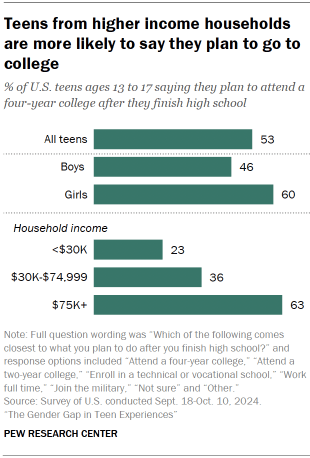
Given the current gender gap in college completion and the growing share of adults who don’t want to have children, we were curious about teens’ long-term goals and plans for adulthood.  Plans after high school When we asked teens what they plan to do after they finish high school, 53% said they plan to attend a four-year college. Among teens, plans for attending college after high school differ by key demographics: Gender: 60% of girls, compared with 46% of boys, say they plan to attend a four-year college. Household income: Teens from households that make over $75,000 annually are the most likely to say they plan to go to a four-year college after high school (63%). A much smaller share of teens from households with incomes under $30,000 say the same (23%). Some teens have other plans for after high school, including: Attending a two-year college (10%) Enrolling in a technical or vocational school (9%) Working full time (6%) Joining the military (3%) About one-in-five teens (18%) are unsure of their plans. Boys are more likely than girls to say they plan to enroll in a technical school, work full time or join the military after high school. Boys and girls are about equally likely to say they aren’t sure of what they plan to do after high school. There are also racial and ethnic differences on a couple of items. A 55% majority of White teens say they plan to attend a four-year college, while Hispanic teens are less likely to say this (43%). Among Black teens, 50% say they’ll attend a four-year college (not significantly different from White or Hispanic teens). In turn, Black and Hispanic teens are more likely than White teens to say they plan to attend a two-year college (13% and 15% vs. 7%). The sample size for Asian teens is too small for separate analysis. Future goals We also asked teens about some long-term goals – specifically, what they hope to achieve as adults. A large majority of teens (86%) say it’s extremely or very important to them to have a job or career they enjoy when they’re an adult. This includes 41% who say this is extremely important. Majorities also say having close friends (69%) and having a lot of money (58%) are highly important to them. Smaller shares of teens place a high level of importance on family life milestones like getting married (36%) and having children (30%). We saw a similar pattern among adults in 2023 when we asked what they thought was important in order for people to live a fulfilling life. Job satisfaction and having close friends ranked higher marriage and parenthood. Of the potential goals we asked about, fame is least important among teens. Only 6% say becoming famous is important to them personally. By contrast, 80% say this is not too or not at all important. Boys and girls answer similarly on all these items, except for one: Girls are 9 points more likely than boys to say having close friends is highly important to them (74% vs. 65%). There are also a couple notable racial and ethnic differences. Black and Hispanic teens are more likely than White teens to say having a lot of money is extremely or very important. Some 76% of Black teens and 66% of Hispanic teens say this, compared with 50% of White teens. In turn, White teens are more likely to say having close friends in adulthood is highly important: 75% say this, compared with 64% of Hispanic teens and 62% of Black teens. Views by political party Republican and Republican-leaning teens are more likely than Democratic and Democratic leaners to say getting married (43% vs. 29%) and having children (38% vs. 24%) are highly important to them personally. This also mirrors what we saw when we asked adults what makes a fulfilling life. In 2023, about a third of Republican adults said having children or being married is extremely or very important in order for people to live a fulfilling life. About one-in-five or fewer Democratic adults said the same. On the other items, teens from both parties give similar answers. source

4. Teens’ future plans and goals Read More »

Maximize Your Workday Productivity with Microsoft 365 or Google Workplace

Image: StackCommerce TL;DR: Save 25% on this Microsoft and Google Workplace bundle, which comes with courses on your most-used productivity apps to help you maximize your workday. How productive are you throughout the workday? According to one study, most office workers are only productive for 31% of their workday, and the reason for the low number isn’t just because of phone usage throughout the day. It’s probably because most workers don’t really use Microsoft or Google Workplace apps to their fullest potential. Want to learn how to use both suites to your advantage? You’ll need to learn from this bundle, which comes with 650 lectures and 40 hours of content on optimizing your daily productivity apps, all available for life, for only $19.99 (down from $27) for a limited time. Sure, you might know how to use Microsoft Word templates to draft reports for your manager or take meeting notes, but are you using this word processor the right way? The same applies to Google Workplace apps like Google Slides. Do you actually know what you’re doing when it comes to design and animation for your presentations? The answer is likely no to both, so that’s where this bundle comes in handy. All these bundle’s courses are taught by industry experts with real-world insights. Mastering these apps can help make your workday a lot sleeker, and it could even help you discover how to automate your tasks and collaborate more effectively. Check out what else you can learn: Email management: Utilize Outlook with greater skills in calendaring, auto-replies, and mailbox organization. Virtual meeting enhancement: Improve meeting flows and inbox efficiency. Data analysis: Effective tracking could help you manage projects, generate reports, and make data-driven decisions more effortlessly. Stunning slideshows: Whether you use PowerPoint or Google Slides, learning advanced formatting and design tips could help your presentations look more polished. Want to be your most productive self at work? Grab this Microsoft and Google Workplace Essentials Bundle, now just $19.99 for a limited time. Supplies are limited. StackSocial prices subject to change. source

Maximize Your Workday Productivity with Microsoft 365 or Google Workplace Read More »