Compensation Solutions Increase ROI By Enabling Administrators

The most common reason why companies purchase sales performance management/incentive compensation management (SPM/ICM) solutions is to effectively manage the administrative costs of their compensation program. Although SPM/ICM solutions do this well, the biggest value they deliver is enabling companies to create more effective compensation plans. It is standard practice for companies to reduce the volume and complexity of compensation plans to make them more efficient to manage, but the companies that get the most from SPM/ICM solutions use their capabilities to support the complexity needed to build the best plan for each role without increasing the cost to administer each. This change has become a reality recently as new providers have deployed new and innovative approaches to enable their customers, who are focused around three key points: Empowering the administrator to support more complex use cases. Doing this reduced the need for systems integrator (SI) support. For years, companies assumed they needed to have SIs to help them deploy and maintain their SPM/ICM solutions — so much so that companies hired SIs to determine which solution they should purchase. SPM/ICM new entrants into the market have changed this and are providing options that remove or reduce the need for SI investment, reducing the total cost of ownership for SPM/ICM solutions. Those considering new solutions should include SI costs as part of the evaluation process to understand the overall potential cost savings of the solutions being evaluated. Taking customer success to the next level. My evaluation of the SPM/ICM market made it clear that not all customer success programs are created equal. Though most vendors in my evaluation provide a level of customer success, the skill level of the people in these roles varies. Reference customers consistently mentioned that SPM/ICM solution providers with customer success teams dedicated to this technology provided better service than larger providers with customer success managers that support a broader portfolio. When deciding on the best solution, validate the skill set and focus of support resources. Continuing to receive value from foundational capabilities. When talking to vendors, we found that generative AI (genAI), scenario planning, and CRM integrations are often differentiators, but very few reference customers have deployed these features. Although a handful of evaluated vendors have genAI capabilities, reference customers didn’t notice, and those whose solutions had these capabilities weren’t using them. Though these capabilities will be more useful in the future, the most valuable capabilities of SPM/ICM solutions today are core features such as ease of use, the ability to handle complex calculations, and data transformation. Don’t get distracted looking at the cool features; instead, focus on the solution’s ability to execute core compensation use cases. Seeing what modern SPM/ICM providers have been able to do to add value with foundational capabilities is exciting. The solution is modernizing both from a technology and support standpoint and achieving strong results. While genAI capabilities are just starting to emerge, providers in this category are well positioned to continue to evolve and improve their capabilities with AI. Those evaluating these solutions should start looking beyond the standard cost-savings metrics and toward ways to leverage their core capabilities to optimize plan effectiveness. To learn more about the SPM/ICM category and its vendors, you can read the latest landscape report and Forrester Wave™ evaluation. source

Compensation Solutions Increase ROI By Enabling Administrators Read More »

TechRepublic EXCLUSIVE: New Ransomware Attacks are Getting More Personal as Hackers ‘Apply Psychological Pressure”

Image: rthanuthattaphong/Envato Elements Experts warn that desperate ransomware attackers are shifting focus from businesses to individuals, applying “psychological pressure” with personal threats that bring digital extortion into the physical world. In one stunning recent example, Guy Segal and Moty Cristal from ransomware negotiator and incident response firm Sygnia said a threat actor personally called an executive’s mobile phone and referenced sensitive details extracted from the company’s internal system. “During the call, they referenced personal information, underscoring just how much data an employer may hold on its employees,” Cristal — a tactical negotiator — told TechRepublic. “Ransomware attacks aren’t just about encrypted files; they can become invasive in other ways.” Ransomware payments decline, but threats escalate While ransomware has been a problem for decades, global payouts in 2023 surpassed $1 billion for the first time, marking a historic escalation in cyber extortion. Attackers have continuously refined their tactics, finding new ways to extract maximum payments from victims. New data revealed last month that ransomware payments decreased by 35% in 2024. Experts attribute the decline to successful law enforcement takedowns and improved cyber hygiene globally, which have enabled more victims to refuse payment. In response, attackers are adapting, acting faster to initiate negotiations and developing stealthier, harder-to-detect ransomware strains. SEE: Most Ransomware Attacks Occur When Security Staff Are Asleep, Study Finds Targeted individuals are often C-level executives or work in legal fields. The stolen personal data can include information about where their children live or go to school or even photos of loved ones. Cristal added that it is “extremely rare” for an attacker actually to act on these physical threats, but the success of the attack only requires the victim to believe they could. “It can become deeply personal to encourage a knee-jerk reaction from the victim,” he said. Cristal added that about 70% of ransoms do not get paid. The majority of the time, the attacks are not personal. But when attackers escalate threats by promising to leak sensitive data, they also demonstrate their effectiveness within the cyber crime community—if they do not receive payment, they can sell the valuable data on the black market for a last-minute payday. Must-read security coverage The risks of using AI in ransomware negotiations Modern ransomware attacks are using AI in new ways, with attackers using freely available chatbots to write malware, craft phishing emails, and create deepfake videos to trick individuals out of valuable information or money. As a result, these tools have lowered the barrier to entry for staging a cyber attack. However, the Sygnia ransomware negotiation teams have also witnessed victims trying to use tools like ChatGPT to help them say the right thing to escape their ordeal. “Typically, AI is not sensitive enough to pick up on human emotion or provide the necessary nuance required to connect with threat actors and diffuse the situation, and this is where it can escalate,” Cristal told TechRepublic. It can encourage victims to break the golden rules of not using “negative language” or telling the threat actor outright that they won’t pay the ransom. SEE: UK Study: Generative AI May Increase Ransomware Threat Attackers “can be extremely polite, even friendly to begin with,” Sygnia’s Vice President of Corporate Development Guy Segal said. But they may get more “aggressive and threatening” if they don’t get what they want quickly — which would be the case if all hope of payment was extinguished. It is not uncommon for attackers to leave backdoors in malware that let them retaliate with additional encryption, or even by wiping all data, especially if they sense a lack of respect or that they’re being strung along. Therefore, negotiators try to remain “approachable,” Cristal said. “Defensive behavior will create a more hostile atmosphere,” he told TechRepublic. Negotiators may be able to steer the conversation to extract more information from the attackers, such as what data they hold, how they breached the system, and the likelihood that they may return or publish data. “Every threat actor has their motives and life experiences that make them who they are — conversing is important to understand how we approach the situation,” he said. “Do they have enough data to damage the company? Could they cause real-world damage, particularly for critical infrastructure clients, or impact people’s lives? The threat actor may well be happy with a smaller ransom payment than their initial request because they just need the money.” The debate over banning ransomware payments In January, the U.K. government announced it was considering banning ransomware payments to make critical industries “unattractive targets for criminals,” reducing the frequency and impact of incidents in the country. The ban would apply to all public sector bodies and critical national infrastructure, which includes NHS trusts, schools, local councils, and data centers. SEE: Starbucks, Supermarkets Targeted in Ransomware Attack The Office of Foreign Assets Control has identified several sanctioned ransomware groups linked to Russia or North Korea that U.S. companies and individuals are legally prohibited from paying ransom to. Segal and Cristal say that ransomware bans are not a straightforward fix, noting that they have seen evidence of attacks increasing and decreasing. While some threat actors may be discouraged, others are forced to raise the stakes with more aggressive or personal threats. Some are driven by data theft or disruption for geopolitical reasons, not money — the ban does not affect them. But the Sygnia negotiators agree that bans on ransom payments within governments are positive on the whole. “A blanket decision to never pay ransom is a privilege that governments can afford,” Segal said. “But it is far less applicable in the business sector.” Indeed, in the documentation outlining the U.K.’s ban proposal, the Home Office acknowledged the potential for the legislation to disproportionately impact small and micro-businesses “which cannot afford specialist ransomware insurance, or clean up specialists.” These businesses will find it harder to recover from any financial losses incurred through operational disruption and the ensuing reputational damage. Such consequences may encourage some businesses to covertly pay

TechRepublic EXCLUSIVE: New Ransomware Attacks are Getting More Personal as Hackers ‘Apply Psychological Pressure” Read More »

Oracle launches AI Agent Studio for Fusion Cloud to retain customers

This means that enterprises will almost have a guarantee that their agents are appropriately vetted for security, privacy, and performance-related considerations and this confirmation will help enterprises have more confidence in adopting agentic technologies, said Arnal Dayaratna, research vice president at IDC. Another point of advantage is the no additional cost factor of the Studio. Futurum’s Hinchcliffe believes that the pricing strategy is an aggressive play against rivals who charge, such as Salesforce’s Agentforce, which sometimes charges $2 for a transaction. However, he pointed out that the actual value of the new offering will depend on how open-ended the agent orchestration is. “If Oracle’s approach remains tightly constrained to Fusion Applications, enterprises looking for broader AI autonomy and orchestration may still turn to AWS, Google, or Microsoft,” he explained. source

Oracle launches AI Agent Studio for Fusion Cloud to retain customers Read More »

Ex-Cognizant CLO Seeks Trial Delay After Hiring New Counsel

By Carla Baranauckas ( March 20, 2025, 4:44 PM EDT) — After hiring new trial counsel Wednesday, a former Cognizant Technology Solutions Corp. executive facing bribery charges asked a New Jersey federal judge on Thursday for an adjournment of the April 7 trial date so his new attorney can review the evidence and the history of the case, which has been pending for more than six years…. Law360 is on it, so you are, too. A Law360 subscription puts you at the center of fast-moving legal issues, trends and developments so you can act with speed and confidence. Over 200 articles are published daily across more than 60 topics, industries, practice areas and jurisdictions. A Law360 subscription includes features such as Daily newsletters Expert analysis Mobile app Advanced search Judge information Real-time alerts 450K+ searchable archived articles And more! Experience Law360 today with a free 7-day trial. source

Ex-Cognizant CLO Seeks Trial Delay After Hiring New Counsel Read More »

Dashlane Review: Features, Pricing, Security, Pros & Cons

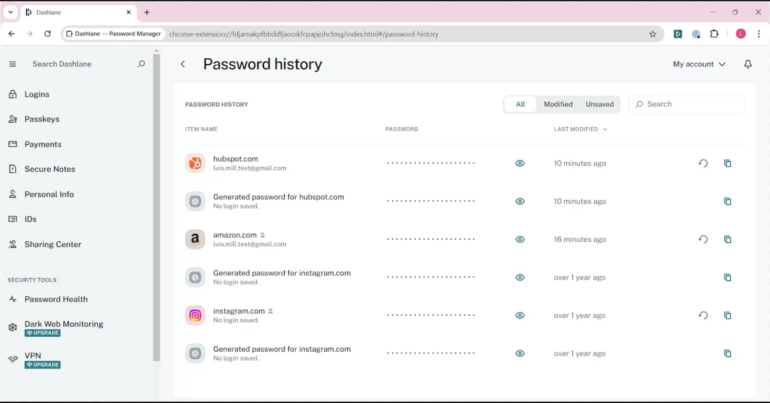
Dashlane fast facts Our rating: 4.4 stars out of 5Pricing: Starts at $4.99 per monthKey features Secure password vault encryption. No recorded data breaches. Well-designed and intuitive user interface. Dashlane has become one of the most popular password managers available — and for good reason. It has top-tier zero-knowledge encryption for its password vault, a ton of convenient usability features, and a very intuitive user-interface. While there are more affordable options available, Dashlane’s feature-packed take on password management makes it one of the best all-around choices in the space. NordPass Employees per Company Size Micro (0-49), Small (50-249), Medium (250-999), Large (1,000-4,999), Enterprise (5,000+) Micro (0-49 Employees), Small (50-249 Employees), Medium (250-999 Employees), Large (1,000-4,999 Employees), Enterprise (5,000+ Employees) Micro, Small, Medium, Large, Enterprise Features Activity Log, Business Admin Panel for user management, Company-wide settings, and more Dashlane Employees per Company Size Micro (0-49), Small (50-249), Medium (250-999), Large (1,000-4,999), Enterprise (5,000+) Micro (0-49 Employees), Small (50-249 Employees), Medium (250-999 Employees), Large (1,000-4,999 Employees), Enterprise (5,000+ Employees) Micro, Small, Medium, Large, Enterprise Features Automated Provisioning ManageEngine ADSelfService Plus Employees per Company Size Micro (0-49), Small (50-249), Medium (250-999), Large (1,000-4,999), Enterprise (5,000+) Any Company Size Any Company Size Features Access Management, Compliance Management, Credential Management, and more Does Dashlane have a free version? Yes, Dashlane has a free plan. However, it is very limited as it only allows for a maximum of 25 passwords stored in user vaults. This makes it an unrealistic option for people looking to use a free password manager long term, especially since I expect the average user to have more than 25 passwords. If you’re looking for a free password manager to use as your main solution, Bitwarden and NordPass are two password managers I recommend, as they both have free plans that offer unlimited password storage. In May 2024, Dashlane also announced that Dashlane Free users who exceeded the 25-password limit would be converted to read-only and would no longer have autofill capabilities unless they upgrade. In my view, this shows that Dashlane is primarily focusing on their paid users and probably have their free plan set up as a test drive tool only. Again, for people looking for a viable, free password manager, there are quality alternatives out there. While this is unfortunate, Dashlane does offer a 30-day trial for its Premium plan. This way, you get a clearer picture of Dashlane’s paid features and user experience, without the limitations that come with the free plan. For more info, we have a Dashlane Free vs Premium feature that dives more extensively into the difference between the two plans. Dashlane Pricing Dashlane has two subscription tiers for individual and business customers, namely Personal and Business. Personal: Personal plans Free plan Premium Friends & Family Price Free $4.99 per month (billed annually) $7.49 per month for up 10 members (billed annually) No. of devices 1 device Unlimited Unlimited Feature differences Maximum of 25 passwords, password sharing Unlimited passwords and passkeys, password sharing, dark web monitor, VPN, real-time phishing alerts All Premium features (VPN only for plan admin) Dashlane’s costs are on the pricier side compared to other password managers. Unfortunately, its Premium plan has raised in price to $4.99 per month compared to its $3.33 monthly price back in 2023. This makes it a fairly pricey option compared to the likes of Bitwarden and Roboform, which have starting plans at $0.83 and $1.66 per month respectively. That’s not to say that Dashlane doesn’t include features to back up its monthly fee. In fact, its starting plan is fully-featured as it includes unlimited device support, unlimited passwords and passkeys, a dark web monitor, and even a built-in VPN. Having a bundled VPN is not something often seen with password managers and a convenient tool that gives Dashlane users additional security. Meanwhile, its Friends and Families plan is also on the expensive end at $7.49 per month. However, it’s important to mention that it’s one of the only password manager family subscriptions that covers 10 people in a single plan. Most other family plans cover 5-6 people, at around $3-6 per user, per month. So in this aspect, I think Dashlane’s Family subscription falls right in the middle compared to other similar offerings. Business: Business plans Standard Business Business Plus Price $20 for 10 users (billed annually) $8 per user, per month (billed annually) $5 per employee, per month (billed annually)Starts at 100 employees No. of devices Unlimited Unlimited Unlimited Feature differences Dark web monitor, password health dashboard, dark web insights All Standard features plus VPN, SSO integration, SCRIM Provisioning, SIEM integration All Business features plus Credential Risk Detection Looking into its business subscriptions, Dashlane’s Standard plan at $20 per month for 10 seats is on trend with other password managers’ similar subscriptions. This plan is ideal for small teams that want a centralized password management solution. If you want a more affordable option, NordPass offers a Teams option of $1.79 per user per month, max 10 users, that’s good for two years. For businesses, Daslane’s Business tier of $8 per seat per month is a good choice, with all Standard plan features plus single-sign on and SIEM integration included. If the higher price tag is out of your budget, Dashlane now offers a Business Plus plan that’s more affordable at $5 per seat, per month, provided your company has a minimum of 100 users. Both plans provide on-demand phone support, real-time phishing alerts, and their built-in VPN. Is Dashlane safe? As it deals with highly sensitive data in passwords, it’s important to know if Dashlane is actually a safe and secure service to use. I’m happy to report that Dashlane checks all of the boxes in terms of security. Dashlane operates on zero-knowledge architecture, which means only the user knows their Master Password and the data stored within their vault. It utilizes AES 256-bit encryption, the industry standard encryption algorithm, to encrypt all passwords and credentials in the vault. It even encrypts all the data

Dashlane Review: Features, Pricing, Security, Pros & Cons Read More »

Turnkey AI option puts organizations in control

No organization can afford complacency while competitors harness artificial intelligence (AI) technologies to innovate and improve. But this enthusiasm is tempered by the realities of implementation and integration, coupled with fear of over-depending on rapidly evolving AI cloud service providers. Business and IT leaders know that speed is crucial to gaining or preserving competitive advantage. The breakthroughs from cloud-based leaders such as OpenAI, Microsoft, Amazon Web Services, Google, and others are impressive, but their focus on outdoing each other and the huge investments needed to do so might be obscuring the more measured approach their customers prefer. Many CIOs and CTOs are assessing the risks of placing too much faith in public cloud AI platforms. Substantial numbers of organizations will always be wary of service providers or unable to fully entrust their fate to them, especially in such a rapidly changing field. Others may fear vendor lock-in and the prospect of escalating licensing fees to fund large-scale AI investments. Controlling your own destiny Addressing concerns related to security, infrastructure, ethics, trust, and financial viability is essential for harnessing the transformative power of AI. Many organizations, especially in regulated industries, are loath to risk compliance violations due to data transfer. Others worry about vendors eager to harvest data to feed the insatiable demands of large language models. That’s why the desire to control their own destiny depends in varying degrees on their own internal capabilities. That desire is tempered by many challenges, including the often huge cost of building custom environments and integrating with existing infrastructure. That may help explain why just under half of the companies that participated in a recent Foundry survey have a dedicated AI budget and even fewer believe they have the right data and technology in place to use AI effectively1. Almost all of the survey participants reported challenges in implementing AI initiatives, including lack of in-house expertise, lack of a compelling business case or investment justification, competing priorities, and the cost of implementing AI in the existing technology stack, among others. Moreover, no AI application has managed to achieve a satisfaction level exceeding 64%. Rather than mortgaging IT budgets and surrendering data to hyperscalers leading the AI revolution, forward-thinking organizations need options that enable them to efficiently build and run LLMs in house. Integrated tech stack for simplifying AI implementation Platforms such as ASUS’s innovative AI POD offer a promising alternative. The ASUS AI POD integrates 72 NVIDIA Blackwell Tensor Core GPUs and 36 NVIDIA Grace CPU Superchips within a unified NVIDIA NVLink domain, which interconnects GPUs and CPUs for the high-speed, low-latency communication essential for efficient parallel processing. The turnkey, optimized stack from ASUS delivers an enterprise-ready, fully integrated platform that simplifies AI deployment, secures sensitive data, and accelerates time to value — all without traditional cloud vendor lock-in. Learn how ASUS AI POD can reduce time-to-value and support diverse teams. 1 Foundry, “AI Priorities Study 2025,” https://foundryco.com/tools-for-marketers/research-ai-priorities/ source

Turnkey AI option puts organizations in control Read More »

Efficient Site Monitoring and Accurate Analytics Is Possible with This Tool

TL;DR: Monitor your site and user analytics to run your site and servers more efficiently with Webilytics, now available for $29. Have you just started your own business? You’ve likely already created and published your website to gather a greater following, whether you’re offering a service or a product. However, there’s one thing missing for your site: a website monitoring tool that offers actionable analytics. Any business owner or solopreneur can benefit from proper analytics, which are made convenient and accessible by Webilytics. This tool can help you track user behavior, monitor site uptimes and downtimes, and offers plenty more to benefit any site for only $29 (reg. $395). What does Webilytics offer? It’s not just any website monitoring tool — Webilytics provides business owners with website, domain, and server monitoring, ensuring your site remains online, responsive, and optimized for performance. Check out some of the insights you can take advantage of by adding this tool to your business: User behavior tracking: See how your site visitors interact with your page through session recordings and heat maps. This could help you enhance their experience and eliminate conversion blockers. Site uptime and downtime monitoring: Sites can often crash or not respond properly, which is why tracking these analytics can help visitors enjoy a more pleasant visit to your page. Server resource monitoring: prevent performance bottlenecks by keeping an eye on server usage and resource consumption. Demographics: Knowing where your users are based, their browsing habits, and device preferences can help you optimize your site and other content. Status pages: Create branded status pages to inform visitors about site availability and any ongoing maintenance that may interrupt their browsing experience. Along with those site-monitoring and optimization features, you’ll be able to get instant notifications about your site through email, Webhook, Slack, Discord, Telegram, and WhatsApp, allowing you to stay on top of your site’s performance. Optimize your business’s site by grabbing lifetime access to Webilytics’ site monitoring and user analytics tools, now $29 while supplies last. Webilytics Site Monitoring & User Analytics: Lifetime Subscription StackSocial prices subject to change. source

Efficient Site Monitoring and Accurate Analytics Is Possible with This Tool Read More »

Republican FCC Aide Named NTIA's Acting Head

By Christopher Cole ( March 19, 2025, 2:23 PM EDT) — The White House has named Adam Cassady, formerly a top Republican aide at the Federal Communications Commission, as acting chief of the U.S. Department of Commerce branch in charge of federal spectrum policy…. Law360 is on it, so you are, too. A Law360 subscription puts you at the center of fast-moving legal issues, trends and developments so you can act with speed and confidence. Over 200 articles are published daily across more than 60 topics, industries, practice areas and jurisdictions. A Law360 subscription includes features such as Daily newsletters Expert analysis Mobile app Advanced search Judge information Real-time alerts 450K+ searchable archived articles And more! Experience Law360 today with a free 7-day trial. source

Republican FCC Aide Named NTIA's Acting Head Read More »

Visa’s AI edge: How RAG-as-a-service and deep learning are strengthening security and speeding up data retrieval

Join our daily and weekly newsletters for the latest updates and exclusive content on industry-leading AI coverage. Learn More Global payments giant Visa operates in 200-plus countries and territories, all with their own unique, complex rules and regulations.  Its client services team must understand those nuances when policy-related questions come up — like ‘are we allowed to process this type of payment in this country?’ — but it’s simply not humanly possible to know all those answers top-of-mind.  This means they’ve typically had to track down relevant information manually — an exhaustive process that can take days depending on how accessible it is.  When generative AI emerged, Visa saw this as a perfect use case, applying retrieval-augmented generation (RAG) to not only pull out information up to 1,000X faster, but cite it back to its sources.  “First of all, it’s better quality results,” Sam Hamilton, Visa’s SVP of data and AI, told VentureBeat. “It’s also latency, right? They can handle a lot more cases than they were able to before.” This is just one way Visa is using gen AI to enhance its operations — supported by a deliberately-built, tiered tech stack — while managing risk and keeping fraud at bay.  Secure ChatGPT: Visa’s protected models November 30, 2022, the day ChatGPT was introduced to the world, will go down in history as a pivotal moment for AI.  Not long thereafter, Hamilton noted, “employees at Visa were all asking, ‘Where is my chatGPT?’ ‘Can I use ChatGPT?’ ‘I don’t have access to ChatGPT.’ ‘I want ChatGPT.’” However, as one of the world’s largest digital payments providers, Visa naturally had concerns about its customers’ sensitive data — specifically, that it remained secure, out of the public domain and wouldn’t be used for future model training.   To meet employee demand while balancing these concerns, Visa introduced what it calls ‘Secure ChatGPT,’ which sits behind a firewall and runs internally on Microsoft Azure. The company can control input and output via data loss prevention (DLP) screening to ensure no sensitive data is leaving Visa’s systems.  “All the hundreds of petabytes of data, everything is encrypted, everything is secure at rest and also in transport,” Hamilton explained. Despite the name, Secure ChatGPT is a multi-model interface offering six different options: GPT (and its various iterations), Mistral, Anthropic’s Claude, Meta’s Llama, Google’s Gemini and IBM’s Granite. Hamilton described this as model-as-a-service or RAG-as-a-service.  “Think of that as a kind of a layer where we can provide an abstraction,” he said. Instead of people building their own vector databases, they can pick and choose the API that best fits their particular use case. For instance, if they just need a little bit of fine-tuning, they’ll typically choose a smaller open-source model like Mistral; by contrast, if they’re looking for more of a sophisticated reasoning model, they can choose something like OpenAI o1 or o3.  This way, people don’t feel constrained or as if they’re missing out on what’s readily available in the public domain (which can lead to ‘shadow AI,’ or the use of unapproved models). Secure GPT is “nothing more than a shell on top of the model,” Hamilton explained. “Now they can pick the model they want on top of that.”  Beyond Secure ChatGPT, all Visa developers are given access to GitHub Copilot to assist in their day to day coding and testing. Developers use Copilot and plugins for various integrated development environments (IDEs) to understand code, enhance code and perform unit testing (determining that code runs as intended), Hamilton noted. “So the code coverage [identifying areas where proper testing is lacking] increases significantly because we have this assistant,” he said.  RAG-as-a-service in action One of the most potent use cases for Secure ChatGPT is the handling of policy-related questions specific to a given region.  “As you can imagine, being in 200 countries with different regulations, documents could be thousands and thousands, hundreds of thousands,” Hamilton noted. “That gets really complicated. You need to nail that, right? And it needs to be an exhaustive search.”  Not to mention, local policy changes over time, so Visa’s experts must be up-to-date.  Now with a robust RAG grounded in reliable, up-to-date data, Visa’s AI not only quickly retrieves answers, but provides citations and source materials. “It tells you what you can do or cannot do, and says, ‘Here is the document that you want, I’m giving an answer based on that,’” Hamilton explained. “We have narrowed answers with the knowledge that we have built into the RAG.”  Normally, the exhaustive process would take “if not hours, days” to draw concrete conclusions. “Now I can get that in five minutes, two minutes,” said Hamilton.  Visa’s four-layer ‘birthday cake’ data infrastructure These capabilities are the result of Visa’s heavy investment in data infrastructure over the last 10 years: The finance giant has spent around $3 billion on its tech stack, according to Hamilton.  He describes that stack as a “birthday cake with 4 layers”: The foundation is a ‘data-platform-as-a-service layer, with ‘data-as-a-service,’ an AI and machine learning (ML) ecosystem and data services and products layers built on top.  Data-platform-as-a-service essentially serves as an operating system built on a data lake that aggregates “hundreds of petabytes of data,” Hamilton explained. The layer above, data-as-a-service, serves as a sort of “data highway” with multiple lanes going at different speeds to power hundreds of applications.  Layer three, the AI/ML ecosystem, is where Visa continuously tests models to ensure they are performing the way they should be, and are not susceptible to bias and drift. Finally, the fourth layer is where Visa builds products for employees and clients.  Blocking $40 billion in fraud Being a trusted payment provider, one of Visa’s top priorities is fraud prevention, and AI is playing an increased role here, as well. Hamilton explained that the company has invested more than $10 billion to help reduce fraud and increase network security. Ultimately, this helped the company block $40 billion in attempted fraud in 2024 alone. For instance, a new

Visa’s AI edge: How RAG-as-a-service and deep learning are strengthening security and speeding up data retrieval Read More »

Microgrids And Data Centers: A Sustainable Power Duo

AI’s Escalating Demands On Data Centers Rapidly progressing AI initiatives coupled with new sustainability regulations have sparked increasing demand for computing power, distribution, and technology capabilities in data centers. Tech leaders are addressing these computing power demands by turning to advancements such as new cooling methods, semiconductors, power sources, digital twins, and internet-of-things (IoT) monitoring capabilities. In light of these advancements and increasing demand from data centers, tech leaders are reassessing their data centers and looking to implement innovative approaches to meet power demands and sustainability goals. The Transformative Potential Of Microgrids One innovation gaining momentum to address increasing data center energy demands is the emergence of microgrids. Microgrids are local power systems that use renewable energy integration to allow for reliable and resilient energy operations. Accordingly, this allows organizations to meet their sustainability goals and can help reduce energy costs. Optimized energy utilization: Microgrids facilitate the integration of various distributed energy resources (DERs) — e.g., solar, wind, and combined heat and power systems — to optimize clean energy supply, distribution, and efficiency, as well as reduce energy waste. Since microgrids are localized, they ensure that generated energy is utilized more efficiently, along with reducing transmission and distribution losses that are inevitable in traditional energy systems. Sustainability and cost-savings: Through the integration of DERs, microgrids lower reliance on fossil fuels and decrease greenhouse gas emissions, ultimately contributing to sustainable energy goals. Additionally, harnessing the use of renewable energy sources can help reduce energy costs by avoiding peak electricity prices and lowering the constant dependency on the traditional power grid. Enhanced reliability: Microgrids can operate both with the main data center power grid and autonomously, which enhances reliability by reducing the risk of outages and ensuring uninterrupted operations. The ability for microgrids to act autonomously allows for maintenance of continuous power to the localized area in the event of an outage, such as natural disasters or cyber attacks. This is critical infrastructure for services that require uninterrupted power supply. Microgrids have already been adopted by numerous organizations, including The Home Depot, JFK Airport, Southern California Gas Company, Kaiser Permanente Richmond Medical Center, and the University of California San Diego, all of which are paving the way toward a more sustainable and resilient energy future. This Is Just The Start The implementation of microgrids is one innovation that organizations are turning toward to meet power demands, improve resiliency, and move closer to a more sustainable future. Alongside microgrids, we have identified and discussed nine additional emerging innovations in the data center in our new report, Top 10 Emerging Innovations In The Data Center, 2025. This report dives deeper into innovations in types of cooling methods, semiconductors, power sources, digital twins, and IoT monitoring to meet changes in power demands, cooling needs, sustainability reporting, technology capabilities, local regulations, and performance requirements. For in-depth insights into AI’s impact, data center trends, and sustainability strategies, Forrester clients can access our exclusive reports and set up guidance sessions to continue to explore current trends and solutions. source

Microgrids And Data Centers: A Sustainable Power Duo Read More »