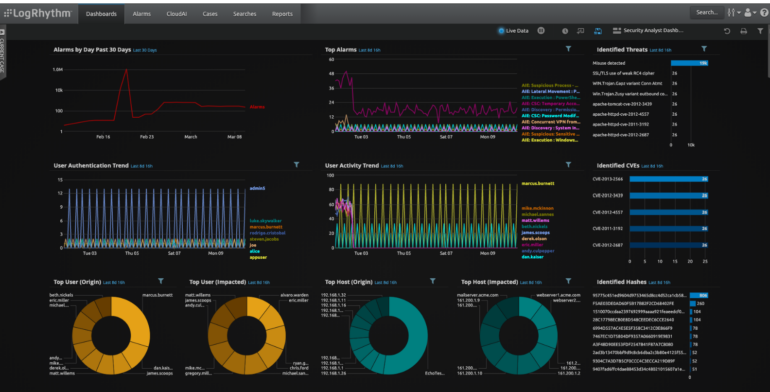
Logs and event data are becoming too labor-intensive to analyze manually due to the growing cyber threat landscape. As a result, organizations now rely on Security Information and Event Management, commonly known as SIEM tools, to collect and analyze these data types to gain actionable security insights. LogRhythm and Splunk are two prominent players in the SIEM market, and many organizations deploy them to monitor and manage security events, detect threats, and ensure a robust security posture. But what distinguishes one from the other? This article comprehensively compares LogRhythm and Splunk, examining their features, pricing, pros, and cons. LogRhythm: Best for an all-in-one SIEM, with User and Entity Behavior Analytics and centralized log management. Splunk: Best for customizability, powerful log analytics capabilities, and advanced threat detection. ManageEngine Log360 Employees per Company Size Micro (0-49), Small (50-249), Medium (250-999), Large (1,000-4,999), Enterprise (5,000+) Micro (0-49 Employees), Small (50-249 Employees), Medium (250-999 Employees), Large (1,000-4,999 Employees), Enterprise (5,000+ Employees) Micro, Small, Medium, Large, Enterprise Features Activity Monitoring, Blacklisting, Dashboard, and more Graylog Employees per Company Size Micro (0-49), Small (50-249), Medium (250-999), Large (1,000-4,999), Enterprise (5,000+) Medium (250-999 Employees), Large (1,000-4,999 Employees), Enterprise (5,000+ Employees) Medium, Large, Enterprise Features Activity Monitoring, Dashboard, Notifications LogRhythm vs Splunk: Comparison table The following table outlines the key features found in LogRhythm and Splunk. LogRhythm Splunk Real-time monitoring Yes Yes Advanced threat detection Yes Yes Centralized management dashboards Yes Yes Easy of deployment Easier to deploy Difficult Customizable dashboard Yes Has more customizable features Threat remediation features Yes Yes User and Entity Behavior Analytics (UEBA) Yes Yes LogRhythm vs Splunk: Pricing LogRhythm pricing LogRhythm operates a flexible pricing and licensing structure that comes with unlimited log resources and users. Prices are also offered on a perpetual, subscription, and unlimited data basis. For more details on LogRhythm’s pricing, contact their sales team for a proper quotation. Splunk pricing Similar to LogRhythm, Splunk operates a flexible pricing model, which is captured below. Workload: Customers are charged based on the types of workload they run with the Splunk Platform. Ingest: Here, customers pay based on the amount of data they bring into the Splunk Platform. Entity: This plan is based on the number of hosts using Splunk. Activity-based: This is based on activities being monitored by Splunk. Apart from the above pricing options, Splunk users also have the option to get an estimate of what they will be charged if they use Splunk. LogRhythm vs Splunk: Feature comparison Below is a head-to-head comparison between LogRhythm and Splunk. Deployment options LogRhythm users have flexible deployment options to match varying needs and goals. The deployment choices available to customers include self-hosting, infrastructure as a service (IaaS), or engagement with a managed security service provider. There is also a cloud deployment option with LogRhythm Cloud, which presents a software-as-a-service (SaaS) choice. On the other hand, Splunk users can deploy the solution in a distributed search or single instance deployment. In addition, the software is available in cloud, on-premise, or multi-cloud formats. Data analysis When it comes to data analysis, LogRhythm’s Machine Data Intelligence (MDI) functionality helps users to make sense of their data. This functionality contextualizes and enriches data at the time of ingestion. It also helps to translate complex data into digestible chunks of information to enhance the accuracy of data analysis. Splunk also has a data analytic engine designed to gather, index, and manage large volumes of data, regardless of its format. Splunk’s data analytics can analyze data in real-time and dynamically generate schemas. This eliminates the need for users to deeply understand the underlying data structure, as they can easily query and explore the data without any prior knowledge. Customizable dashboard LogRhythm allows users to customize their dashboards in ways that suit them. For instance, users can decide to customize the report template, create custom log detail reports, restore the default logo to a report, schedule and manage scheduled reports, rename a custom dashboard, and decide which dashboard to make public or private. LogRhythm dashboard. Image: LogRhythm Splunk also offers a highly customizable dashboard. Users can choose from various charts and other virtualizations to act on their data. For instance, users can integrate reports, charts, and reusable panels to derive more insight from their data. In addition, there is also the option to tailor data for different use cases and users, such as business, security analysts, auditors, developers, and operations teams — to facilitate their operations. Splunk data virtualization dashboard. Image: Splunk More cloud security coverage Centralized log and incident management LogRhythm offers centralized log and incident management that helps users collect, store, and analyze logs/events from various sources for auditing, compliance, and forensic purposes. There are also case management and playbooks, which offer incident management functionalities to facilitate log and incident management processes. Similarly, Splunk also provides a central log management feature that allows users to collect and store logs from various sources in centralized storage. Users can also encrypt the logs collected to prevent unauthorized access. Advanced threat detection Both LogRhythm and Splunk provide users with advanced threat detection capabilities. LogRhythm does this by combining machine analytics and search analytics. These functionalities offer users a risk-based monitoring strategy that automatically identifies and prioritizes attacks and threats. Splunk also rides on the power of machine learning to detect advanced threats and other 1790+ out-of-the-box detections for frameworks such as MITRE ATT&CK, NIST, CIS 20, and Kill Chain. Splunk executed playbook & actions. Image: Splunk SEE: Securing Linux Policy (TechRepublic Premium) LogRhythm pros and cons Below are the key takeaways from the LogRhythm SIEM solution. Pros Users can map their security and IT operations to existing frameworks like MITRE ATT&CK and NIST. Offers real-time visibility across environments for easy identification and prioritization of potential threats. Centralized log management support. Offers User and Entity Behavior Analytics capabilities (UEBA). Offers free training videos. Cons Complicated pricing plans. The customization feature is not broad. No free trial. Splunk pros and cons The pros and cons of Splunk are highlighted below. Pros