What Is a Cash Management Account? All You Need To Know

A cash management account, or CMA, is a personal or business cash account that combines the services of checking, savings, and investment accounts. It’s not held by a bank but rather by a brokerage, investment firm, fintech, robo advisor, or nonbank financial institution (NBFI). It complements an investment account and offers high-interest yields (like a savings account) and deposits, withdrawals, debit card use, and bill pay (like a checking account). The main difference between a cash management account and other accounts is the US federal tax liability. Depending on the source of the funds, withdrawals, interest earned, and dividends may be subject to federal taxes. Benefits of a cash management account Drawbacks of a cash management account Funds can be insured by the FDIC? and the SIPC Securities Investor Protection Corporation . It includes a debit card and has check-writing capabilities. It streamlines financial management. Most accounts earn interest. It can be nested with stocks, bonds, mutual funds, retirement accounts, sweep accounts, and business accounts under one online banking login. Withdrawal limits may apply. Limits may be placed on withdrawals. Customer service is generally not face-to-face. Most accounts have minimum balance requirements and monthly fees. It is difficult to deposit cash with no in-person service locations. How a cash management account works It is designed to be a holding or storage hub for business working capital or personal funds. It allows your money to remain accessible while still having the options of earning interest along with getting the security of FDIC and SIPC coverage. Many account holders and business owners use it to build up savings or emergency funds, while others treat it as a regular deposit account. FDIC and SIPC rules, limits, and security The FDIC provides coverage to protect deposited funds up to $250,000 at participating institutions. This limit can be increased by the following methods: Opening accounts at multiple banks that are members of the FDIC Adding a joint owner to an individual account Creating a payable on death account; maximum coverage is $1,250,000 for up to five beneficiaries Opening an account at a fintech that partners with multiple banks and can make deposits at additional financial institutions on your behalf Partnering with a financial institution with access to the IntraFi network Meanwhile, the SIPC protects investors from failed brokerage firms for amounts up to $250,000 for cash and up to $500,000 for securities. With SIPC, each account type receives separate coverage (instead of combined totals like FDIC coverage). Here are the account types covered: Individual accounts Joint accounts Corporate accounts Trust accounts IRAs Individual Retirement Accounts Roth IRAs Executor held accounts Guardian held accounts Multiple accounts of the same type are insured up to $500,000 at the same brokerage, even if the deposit amount exceeds $500,000. To ensure all funds are covered, some funds would need to be moved to a different brokerage or a different account type. Fees influencing cash management account pricing Some business bank account fees commonly charged for a cash management account influence the account’s pricing. These include the following: Monthly maintenance fees Account management fees Overdraft fees Wire fees ACH fees Bill pay access fees Foreign transaction fees Advisory investing fees ATM fees Transaction limit fees How to open a cash management account Since there are two types of cash management accounts, personal and business, you will need to follow the steps based on the type that best fits your needs. Personal accounts will only need your personal information, whereas business accounts will need to go through the following process: Step 1: Select a fintech, brokerage, or investment firm that offers a cash management account. Step 2: Once you pick a provider, access its website to start the process of opening the account. Step 3: Fill out all the fields with your business information, including Full legal business name Physical address of the business Phone number of the business EIN Employee Identification Number Business type Beneficial ownership of the business Any member with 25% or more ownership Personal information for each beneficial owner. Full legal name SSN Social Security Number Physical address Phone number Step 4: Select the type of account that works best for your business. Step 5: Review the terms and conditions, ensuring you understand minimum balance requirements, withdrawal limits, fees, and interest-earning capabilities. Step 6: Fund your account to activate it. Step 7: Order a debit card. Step 8: Set up online banking; link any other accounts you need to see — like IRAs, retirement accounts, stocks, bonds, mutual funds, and investments. Step 9: Determine if multiple accounts of different types need to be opened to cover all funds following the FDIC and SIPC guidelines. Step 10: Request additional features such as automatic sweeps or investment transfers. Opening a cash management account generally requires the same legal and personal documentation required to open a business bank account at a traditional bank. Popular business cash management account providers If you are looking for a business cash management account, consider the following: Rho Rho is a fintech company, not a bank or an FDIC-insured depository institution. Checking account and card services are provided by Webster Bank N.A., member FDIC. Savings account services are provided by American Deposit Management Co. and its partner banks. International and foreign currency payments services are provided by Wise US Inc. is a business platform built for startups and growth-stage businesses, though it also serves world-class enterprises. It offers expense management, A/P automation, and accounting integrations. Ramp Ramp is a fintech company, not an FDIC-insured depository institution. Banking services are provided by First Internet Bank (FIB), member FDIC. Subject to the terms of the applicable ICS Deposit Placement Agreement, FIB will place deposits at FDIC-insured institutions through IntraFi’s ICS service. serves businesses of all sizes. With the Ramp Treasury account, you have access to the financial operations platform and built-in cash management tools to make automatic investments and optimize cash flow. If a personal cash management account is what you need, look into the following:

What Is a Cash Management Account? All You Need To Know Read More »

Four Tactics To Manage Through Change

An unwritten truth in large organizations is that the only constant is change. But as the US’s largest employer faces widespread transformation, even the most seasoned leaders may find that their usual leadership playbooks no longer apply. As a small resource for those leading teams during this time of big uncertainty, I’ve rounded up Forrester’s top-read resources on change tactics and leadership to help you guide your teams on their change journeys. Implement These Four Tactics Now Define your sphere of control. Successful transformations happen from the middle out, which means that middle managers have a critical role to play. Identify the decisions and actions that are within your control, and coach employees to do the same. Create a continuous cycle of listening and response. Determine who will represent the face of the change within your organization and provide a single source of truth for questions. Then leverage a consistent, continuous cadence of communication to build and reinforce trust through transparency. Embrace uncertainty (with empathy). As your employees navigate their personal change experience, they may find themselves somewhere between shock and uncertainty. Uncertainty often leads to anxiety, so work to minimize the unknown by identifying and resolving points of uncertainty, big or small, wherever possible. Prepare for the future. When changes come fast, it can be hard to break out of reactive mode. Carve out time for proactive planning, including: Near-term prioritization. How will we maintain mission-critical functions if program capacity is reduced? Strategic communication. If a new leader steps in tomorrow, how will we communicate the strategic value of our work? Realignment. As new priorities become clear, how will we align activities and resources to maximize impact? Read Forrester’s Essential Research On Change Leadership Connect With Us The Forrester team is here to help. Schedule time with us to develop a personalized plan of action to meet your unique challenges and context. source

Four Tactics To Manage Through Change Read More »

The AI Experience Era: The Next Decade of Tech Marketing

“Change” has been the theme in tech marketing for the past several years. We recently published the results of our 22nd annual tech marketing spend benchmark, IDC Tech Marketing Investment Guide for 2025 Planning: Benchmarks, Key Performance Indicators, and CMO Priorities. The results reflect the acceleration of digital transformation over the past five years, the rapid adoption of GenAI, and marketing’s response to the permanent shift in consumer and B2B buying behavior. The trendline indicates that marketing has officially entered the next era – the AI experience era. A Look Back at Marketing Since the Dawn of Digital In 2007, social media was introduced to the world, forever altering how consumers obtain information and engage with brands. For the next decade and a half, marketers embarked on a digital transformation of both customer engagement and internal operations. Digital, social and demand centers of excellence were formed. Automation platforms for both marketing and sales were adopted. Use of analytics and database marketing placed the responsibility of creating leads and driving demand, squarely in marketing’s remit.   In 2023, GenAI changed the game.. Creative capabilities were broadly placed into the hands of all marketers and citizen creators. Searching and gathering information was augmented and in some cases, replaced by GenAI applications such as ChatGPT. In the 2024 B2B Tech Buyer Behavior Study, 20% of respondents stated they are using AI Chatbots to search and for discovery of information, brands and vendors. This has lead marketing leaders to take full responsibility for the digital customer experience and the orchestration of the omnichannel experience. The 4 Biggest Things to Happen to Marketing in the Next Decade Marketing’s Remit Has Expanded Starting back in 2021, IDC Research showed that marketing’s #1 remit was driving business growth. In the 2023 Marketing Organizational Models study, at least 80% of senior marketing leaders stated they carry the responsibility of digital customer experience, employee communications, internal brand communications and marketing technology. In 2024, IDC research found that CMOs are now assuming the role of the Chief Market Officer, expanding marketing’s role with the full accountability across the go-to-marketing engine, including sales. As a result, the technology marketing spend benchmark found a 10.8% increase in marketing investment year-over-year. The allocation of investments have evolved, increasing the investment in marketing technology program spend by 26% and allocating 3.4% more to staffing of MarTech roles. Digital experience roles have evolved far beyond email and phone outreach to know include managing chat and mobile/SMS engagement. Web and social media marketing staffing has grown 8% as a result of advertising staff experiencing a shift to enable more social media efforts, mobile advertising, pulling work in-house from agencies. 56% of benchmark participants anticipate a 10% or higher ROI from GenAI in the next 12-18 months. A quarter of marketing leaders believe that GenAI represents a major opportunity and are striving to be leaders, even if it means making mistakes. GenAI is actively being utilized across marketing. 97% of marketers are leveraging GenAI to support content marketing, including dynamic SEO optimization, creating derivatives of content, translating and localizing. 82% of marketers are supporting the evolution of web marketing, beyond digitally delivering analog content (i.e. PDFs) to incorporating more interactive and immersive content, such as personalized digital assistants, hyper-personalized web pages and personalized offers. Marketing operations are also experiencing substantial benefits from GenAI with close to 80% of marketers focused use cases such as micro-segmentation, more real time insights and gathering voice-of-the-customer.  ABM Gives Way to Personalization-at-Scale While the term “Account Based Marketing” or ABM is still floating around, less marketers are focused on continuing to enable personalized marketing for a subset of the customer and prospect base. Instead, marketers are leveraging GenAI to achieve personalization-at-scale. The benchmark study found an increase in industry and audience marketing staff positions as marketers are created horizontal teams focused on connected experiences, moving beyond marketing to one persona and instead focusing on the whole marketing journey.  A key dependency for GenAI and personalization-at-scale is the health of marketing’s data infrastructure. Marketing is only as good as the data it runs on. Recognizing how critical intelligence is to AI experience marketing, marketers rebalanced their intelligence investment across competitive, customer and market intelligence. The investment in the MarTech stack sits at 4.4% of the marketing budget, with a 22.4% surge in data and analytics spending year-over-year. There is a lot of conversation around GenAI evolving the marketing function, even changing marketing roles. Did you consider that soon you may be marketing to GenAI agents of your customers? Even having your own GenAI agent engage, rather than a marketing or sales representative? In the 2024 B2B Tech Buyer Behavior Study, 73% of B2B buyers stated they would use more AI guided selling assistants to act as an intermediary between themselves and vendors, such as doing product comparisons, responding to RFI/RFPs, answering technical questions and providing quotes and configurations.  Shoring up your data, tech stack, digital experience enablement, and LLM optimization is critical. This requires a combination of technology and UX in addition to continued investment in technology and experience platforms. It is also essential to make sure you have the right people to deliver. Marketers must continue to up-skill and hire staff that understands how to train and prompt LLMs, design and implement omnichannel experiences. Over the last five years, we have seen the shift in the priorities and focus of marketers through their marketing investment trends. IDC Research finds that the executive team now has a spotlight on marketing’s technology investment and the maturity of customer intelligence. To deliver to marketing’s strategic responsibility and expectations, leaders need to maintain the investment focus on maturing the core AI experiential capabilities, essential for marketing in the experience era.  source

The AI Experience Era: The Next Decade of Tech Marketing Read More »

Kyndryl: The largest manager of VMware assets is busier than ever in the cloud

With around 80,000 employees and serving most of the Fortune 100 and customers in more than 60 countries, Kyndryl is uniquely qualified to speak to the rapidly evolving infrastructure needs of enterprises. It’s a reality David Simpson, senior vice president of Cloud Practice growth at Kyndryl, knows well. “At Kyndryl, we have a long and extensive track record of designing, building, managing, and modernizing the complex, mission-critical information systems organizations around the world rely on every day,” says Simpson. “Working with a strong and extensive cadre of partners and many thousands of customers – from new innovators to the world’s most established and successful brands – our teams are hard at work addressing the challenges and the opportunities emerging in light of transformative computing trends that are accelerating and growing in importance across the globe.” The depth of the company’s solutions suite and services offerings reflect the scope and breadth of these challenges and opportunities and encompass applications, data and AI, the digital workplace, core enterprise systems, networks, the edge, and cyber resilience and security. All are supported by a deep bench of IT and cloud experts within Kyndryl Consult, a global network of technology strategy and implementation consultants with extensive experience helping customers create a winning digital transformation strategy, an enterprise architecture that ideally addresses their unique needs, and the culture required to realize its full potential. This applies to all of the industries Kyndryl serves. These include the automotive; banking and finance; energy; government; healthcare; insurance; manufacturing; retail; technology, media and telecommunications; travel and transportation; and chemical, oil and gas. Kyndryl’s cloud portfolio consists of a full range of offerings in four focus areas: cloud consult, public cloud, private cloud, and modern operations. Kyndryl’s experts also provide the insights and real-world experience needed to help organizations across the spectrum of cloud maturity, from those who want to start their cloud journey to stalwarts committed to refining their IT infrastructure with an extensive portfolio of managed cloud services. “We pride ourselves on being a trusted partner our customers can turn to when they must navigate an IT environment that is marked by new developments that impact each organization in unique ways,” adds Simpson. “That reality is particularly apparent when you look at the hybrid, multi-cloud approach that is increasingly prominent today.” The need for hybrid, multi-cloud acumen – is greater now than ever Simpson stresses that as many customers have matured in their cloud migration journeys, many have already moved most of their easy “lift-and-shift” workloads to the cloud and are now looking at second- and third-wave workloads that demand a more nuanced and specific approach that takes into account the particular strengths and limitations not only of different cloud approaches – private, public and hybrid or multi-cloud – but also the specific clouds offered by major hyperscalers and niche or industry-specific cloud providers. “As customers have come to look at deeply integrated and expansive workloads, most have come to realize that using one cloud is not an option,” says Simpson. “We recommend they look at the characteristics of the workload, the data requirements, and determine the best platform for each workload across a public, private, and traditional IT landscape. We provide the capabilities to help organizations be productive, secure, technically and financially manage across a hybrid landscape.” Simpson notes that enterprises are rightly being more strategic. More specifically, he stresses that a true multi-cloud program empowers organizations to seek best-of-breed technologies, experiment with new innovations, fill performance gaps – for example, those related to quantum computing – engage with cloud providers in specific geographies to address sovereignty, performance, and latency needs, and importantly to keep certain mission-critical workloads on premises. “On one hand, we are living in a time in which edge computing is driving more than half of data and infrastructure outside of the data center according to IDC,” says Simpson. “On the edge is where workloads and use cases drive revenue and customer sentiment, but they all require local or on-premise resources to perform well. When you also consider efforts to mitigate data privacy laws, embrace new applications of high-performance computing, utilize virtual desktop infrastructure, and continue to get the most out of existing core, on-premises systems – among them customer relationship management, enterprise resource planning, and business intelligence assets, we clearly also live in a time when there is a corresponding drive to keep data within enterprises’ four walls. This, and AI workloads that require self-learning applications and intellectual property not be exposed to the internet, is driving private cloud adoption even as the hybrid cloud approaches proliferate.” Notably, Kyndryl’s work to address the needs of public,  hybrid, and private cloud strategies draws on its experience with customers. It also relies on partnerships, such as the extensive relationship with VMware, and its expertise and use of VMware by Broadcom Technologies. “Over the past two decades we amassed many thousands of VMware certifications and created a corps of VMware experts – all while working closely with VMware’s development teams,” adds Simpson. “Today, we oversee more VMware assets than any other provider and are more excited by their future than ever, particularly as we look at the singular capabilities of VMware Cloud Foundation and its application with Kyndryl Bridge, our AI-powered open-integration platform that lets enterprises observe, integrate and orchestrate their entire technology environment with ease. As a Broadcom Pinnacle Partner, we can further help our customers realize the full benefits of our collaborative efforts and innovations while still using the proven technologies they know and trust.” To learn more, visit us here. source

Kyndryl: The largest manager of VMware assets is busier than ever in the cloud Read More »

FCC Probes iHeart Practices Amid Broadcast Payola Inquiry

By Christopher Cole ( February 25, 2025, 5:14 PM EST) — The Federal Communications Commission’s chief, who says he wants to crack down on payola practices, has launched a probe into whether iHeart is forcing musicians to accept cut-rate pay to entertain crowds at the company’s upcoming Austin, Texas, event in return for more favorable airtime…. Law360 is on it, so you are, too. A Law360 subscription puts you at the center of fast-moving legal issues, trends and developments so you can act with speed and confidence. Over 200 articles are published daily across more than 60 topics, industries, practice areas and jurisdictions. A Law360 subscription includes features such as Daily newsletters Expert analysis Mobile app Advanced search Judge information Real-time alerts 450K+ searchable archived articles And more! Experience Law360 today with a free 7-day trial. source

FCC Probes iHeart Practices Amid Broadcast Payola Inquiry Read More »

How big U.S. bank BNY manages armies of AI agents

Join our daily and weekly newsletters for the latest updates and exclusive content on industry-leading AI coverage. Learn More The financial services industry is one of the most regulated sectors. It also manages huge amounts of data. Conscious of a need for caution, financial companies have slowly added generative AI and AI agents to their stables of services.  The industry is no stranger to automation. But use of the term “agent” has been muted. And understandably, many in the industry took a very cautious stance toward generative AI, especially in the absence of regulatory frameworks. Now, however, banks like JP Morgan and Bank of America have debuted AI-powered assistants. A bank at the forefront of the trend is BNY. The financial services company founded by Alexander Hamilton is updating its AI tool, Eliza (named after Hamilton’s wife), developing it into a multi-agent resource. The bank sees AI agents as providing valuable assistance to its sales representatives while engaging its customers more. A multi-agent approach Sarthak Pattanaik, head of BNY’s Artificial Intelligence Hub told VentureBeat in an interview that the bank began by figuring out how to connect its many units so their information can be easily accessed.  BNY created a lead recommendation agent for its various teams. But it did more. In fact, it uses a multi-agent architecture to help its sales team make suitable recommendations to clients. “We have an agent which has everything [the sales team] know[s] about our client,” Pattanaik said. “We have another agent which talks about products, all the products that the bank has…from liquidity to collateral, to payments, the treasury and so forth. Ultimately…we are trying to solve a client need through the capabilities we have, the product capabilities we have.” Pattanaik added that its agents have reduced the number of people many of its client-facing employees must speak to in order to determine a good recommendation for customers. So, “instead of the salespeople talking to 10 different product managers, 10 different client people, 10 different segment people, all of that is done now through this agent.” The agent lets its sales team answer very specific questions that clients might have. For example, does the bank support foreign currencies like the Malaysian ringgit if a client wants to launch a credit card in the country? How they built it The multi-agent recommendation capabilities debuted in BNY’s Eliza tool.  There are about 13 agents that “negotiate with each other” to figure out a good product recommendation, depending on the marketing segment. Pattanaik explained that the agents range from functional agents like client agents to segment agents that touch on structured and unstructured data. Many of the agents within Eliza have a “sense of reasoning.” The bank understands that its agent ecosystem is not fully agentic. As Pattanaik pointed out, “the fully agentic version would be that it would automatically generate a PowerPoint we can give to the client, but that’s not what we do.” Pattanaik said the bank turned to Microsoft’s Autogen to bring its AI agents to life.  “We started off with Autogen since it is open-source,” he said. “We are generally a builder company; wherever we can use open source, we do it.” Pattanaik said Autogen provided the bank with a set of solid guardrails it can use to ground many of the agents’ responses and make them more deterministic. The bank also looked into LangChain to architect the system.  BNY built a framework around the agentic system that gives the agents a blueprint for responding to requests. To accomplish this, the company’s AI engineers worked closely with other bank departments. Pattanaik underscored that BNY has been building mission-critical platforms for years and has scaled products like its clearance and collateral platforms. This deep bench of knowledge was key to helping the AI engineers in charge of the agent platform give the agents the specialized expertise they needed.  “Having less hallucination is a characteristic that always helps, compared to just having AI engineers driving the engine,” Pattanaik said. “Our AI engineers worked very closely with the full-stack engineers who built the mission-critical systems to help us ground the problem. It’s about componentizing so that it’s reusable.”  Building, for example, a lead-recommendation agent this way allows it to be developed by BNY’s different lines of business. It acts as a microservice “that continues to learn, reason and act.”  Expanding Eliza As its agentic footprint expands, BNY plans to further upgrade its flagship AI tool, Eliza. BNY released the tool in 2024, though it has been in development since 2023. Eliza lets BNY employees access a marketplace of AI apps, get approved datasets and look for insights.  Pattanaik said Eliza is already providing a blueprint for how BNY can move forward with AI agents and offer users more advanced, intelligent service. But the bank doesn’t want to be stagnant, and wants the next iteration of Eliza to be more intelligent. “What we built using Eliza 1.0 is a representation, and the learning aspect of things,” Pattanaik said. “With 2.0, we’re going to improve the process and also ask, how do we build a great agent? If you think about agents, it’s about something that can learn and reason and, at some point in time, provide some actions as to this is a break, this is not a break and so forth. This is the direction we are going towards as we build 2.0, because a lot of things have to be set up in terms of the risk guardrails, the explainability, the transparency, the linkages and so forth, before we become completely autonomous.”  source

How big U.S. bank BNY manages armies of AI agents Read More »

6 Best Credit Unions for Business Accounts in 2025

If you’re a business owner exploring business banking options, credit unions can offer competitive products with lower fees and higher interest rates than traditional banks. However, membership requirements can be more restrictive, which is an important factor to consider when choosing the best credit unions for business accounts. I review the six best credit unions and compare key features, fees, and pros and cons to help you find the best fit for your company’s needs. Best overall credit union for business accounts: Affinity Plus FCU Federally insured by the National Credit Union Administration (NCUA) Best for social entrepreneurs seeking flexible financing: Self-Help FCU Federally insured by the National Credit Union Administration (NCUA) Best for military-affiliated business owners: Navy Federal Credit Union Federally insured by the National Credit Union Administration (NCUA) Best for membership flexibility and scalable checking accounts: Credit Union 1 Federally insured by the National Credit Union Administration (NCUA) Best for business insurance services: First Tech Federal Credit Union Federally insured by the National Credit Union Administration (NCUA) Best for interest-earning business accounts: Bethpage Federal Credit Union Federally insured by the National Credit Union Administration (NCUA) Best credit union for business accounts comparison Below, I summed up the top features I considered for the six credit unions for business accounts. Here is our list of the best credit union business accounts. Image: Affinity Plus FCU Affinity Plus FCU: best overall credit union for business accounts My rating: 4.17 out of 5 Why I chose it Affinity Plus is my overall best credit union for business accounts because of its comprehensive range of services, including competitive savings options and reward-earning debit cards. With access to a broad ATM network and cash and coin services, Affinity Plus is an excellent choice for businesses that value both digital and in-person banking (as long as a branch is located nearby). Membership qualifications Eligibility: To become a member, you must live, work, study, or worship in certain eligible regions or have a family or employer affiliation. You can also join by donating a one-time $25 to the Affinity Plus Foundation. See Affinity Plus FCU’s eligibility criteria. Business Membership: For sole proprietors or LLCs, the business owner must open the membership. Review the business document checklist for your business type, submit the required documents, and send a membership interest form online. Fees Monthly service fees: None Check clearing fees and monthly deposit fees: 20 cents per check after the 50 limit Monthly service fees: $15 Check clearing fees and monthly deposit fees: 20 cents per check after the 250 limit Features Over 60,000 ATMs nationwide via the MoneyPass, Co-op, and SUM networks High-yield money market accounts (MMAs) and certificates of deposit (CDs) No annual fee business credit card Business vehicle loans and equipment loans Business lines of credit and real estate loans Cash and coin services with reduced rates for business members Pros and cons Pros Cons Multiple options to qualify for membership Rewards for debit card purchases Many savings and lending products Limited branch locations Low yields for business checking and savings accounts Image: Self-Help FCU Self-Help FCU: best for social entrepreneurs seeking flexible financing My rating: 4.15 out of 5 Why I chose it I consider Self-Help FCU one of the top credit unions for social entrepreneurs looking for flexible financing. I appreciate how it focuses on supporting underserved communities. With small business loans starting at $15,000 in Illinois and North Carolina, with the option to apply for lower loan amounts and waived collateral requirements, Self-Help FCU is a great provider for businesses that need a little extra flexibility. Additionally, its business accounts have waivable monthly fees, which helps reduce business costs. Membership qualifications Eligibility: Membership is available to individuals living, working, studying, or worshipping in eligible communities in California, Illinois, and Wisconsin. You can also qualify by having a family or employer affiliation or paying a one-time $5 fee to support their community mission. Business Membership: Available for businesses in these states and with the proper documentation. For more info, contact 877-369-2828. Complete the online membership application and submit it by mail or at your nearest branch. Monthly Fees Business Checking: $15; waivable with a combined average daily balance (ADB) of $25,000 across your business accounts under a single member number. Features 100 free monthly transactions Interest-earning checking account Savings, MMAs, and CDs Small Business Administration (SBA) loans, nonprofit business loans, and commercial loans Provides financial services to underserved communities Member of the national Co-op shared branching network Pros and cons Pros Cons Easy membership requirements No minimum opening balance for a business checking account No monthly fee for a business savings account Higher loan amount (over $500,000) requirement outside Illinois and North Carolina No lines of credit Image: Navy Federal Credit Union Navy Federal Credit Union: best for military-affiliated business owners My rating: 3.80 out of 5 Why I chose it In my opinion, the Navy Federal Credit Union is an outstanding choice for military-connected entrepreneurs seeking a reliable credit union for their business checking needs. It offers some of the best credit union business checking accounts with fee-free or waivable fee options. As the largest credit union in terms of assets and membership, with branches in over 30 states, Navy Federal’s strong presence and extensive services set it apart from other credit unions. Membership qualifications Eligibility: Restricted to US military service members, veterans, Department of Defense (DoD) personnel, and their families. See Navy FCU’s membership eligibility page. Business Membership: A $250 deposit is required for sole proprietorships and $255 for other legal entities. All business owners must be Navy FCU members. You can apply for membership online. Monthly Fees Business Checking: None Business Plus Checking: $8; not waivable Business Premium Checking: $20; waivable if ADB is $5,000 or more Features Debit card with zero liability for unauthorized transactions Competitive APY for business checking and savings Business savings, MMAs, and CDs Merchant services, payroll processing, and business insurance Business credit cards Commercial real estate (CRE) loans, lines of credit, and

6 Best Credit Unions for Business Accounts in 2025 Read More »

Lenovo CLO Announces Retirement Plan; Successor Named

By James Boyle ( February 21, 2025, 4:44 PM EST) — Consumer technology company Lenovo will be shaking up its leadership team with retirement plans for its chief legal officer and chief financial officer, announced Friday…. Law360 is on it, so you are, too. A Law360 subscription puts you at the center of fast-moving legal issues, trends and developments so you can act with speed and confidence. Over 200 articles are published daily across more than 60 topics, industries, practice areas and jurisdictions. A Law360 subscription includes features such as Daily newsletters Expert analysis Mobile app Advanced search Judge information Real-time alerts 450K+ searchable archived articles And more! Experience Law360 today with a free 7-day trial. source

Lenovo CLO Announces Retirement Plan; Successor Named Read More »

IT Hiring in 2025: Cloudy With a Chance of High Salaries

A wave of IT job losses doesn’t make bleak reading for 2025 — quite the contrary, as the reality of AI kicks in and accelerates demand for IT pros.  In 2024, the number of unemployed IT workers reached its highest point since the dot-com collapse of the early 2000s.  Layoffs coincided with peak pessimism that generative AI would take developers’ jobs as enthusiasm for LLMs surged and the C-suite bought into automation.   But don’t misread the signs: Many tech layoffs hit business staff rather than frontline tech staff at companies repositioned for AI, cloud, and cybersecurity.  While 2025 promises uncertainty, and businesses should expect the unexpected, two things will remain constant: demand for digital and the tech skills shortage.  As a result, professionals with the right skills will command large and growing salaries. The only question is, which skills?  Foundational Approach  Recruitment specialist Harvey Nash capped a gloomy 2024 with some chilling data, which expects the increase in recruitment will be at its lowest level since 2011. But there’s a silver lining to these findings: recruitment is still happening. Analyst firm IDC predicts hiring will vary by sector, and recruitment in the UK will bounce back, with nearly half of IT and tech hiring managers planning to increase headcounts.  Related:How DOGE May Impact Tech Digitalization is real, and CIOs and CTOs need skills and experience in AI, cloud and cybersecurity to deliver.  After experimenting with AI, the focus for 2025 will be delivery: large-scale, day-to-day production to win and retain customers. And IT pros can expect to experience sharp growing pains as AI has proved difficult to deliver outside pilots or limited deployments. For all the recent AI successes, just as many systems failed to deliver as expected, produced inaccurate and unreliable returns, or introduced risk.  This opens up opportunities for those with the skills and experience to design, build, and train models and for those capable of taking systems from pilot to production.  But AI has broad applications, so what skills should IT pros be homing in on? According to one industry-backed report, “foundational” skills in AI literacy, especially in data analysis and prompt engineering, will be key.    The hiring data and trends from Andela’s talent marketplace align with this report, saying “generalists” are in huge demand. As such, it is important to build a solid grounding before plunging into the AI jobs market. A good example is Python.  Getting ahead in a foundational technology such as Python means technologists can apply the mechanics of the possible to solve problems at a practical level. Python pre-dates AI so it has something akin to universal applicability in the world of programming. But AI and data mining have taken it to a whole new level, with libraries, like PyTorch, TensorFlow and Langchain, building the foundation in AI. Its ease of use and the growing set of libraries have seen the language rated most popular during the past year.  Related:The CEO/CIO Dynamic: Navigating GenAI Implementation Six of the Best  But tech skill demand isn’t limited to AI. Hidden in Andela’s marketplace data were revealing insights on roles being sought by hiring managers — and the salaries on offer. Our survey of more than 150,000 individuals identified the six highest-paid technology posts:  Principal software engineer  Lead software engineer   Senior back-end engineer (Java)   We have seen clients pay $144,000 for a technical architect, making this the highest-paid position going into 2025. Interest in digital will mean salaries for those with foundational skills will remain steady or even increase.  Behind these skills, however, lies a set of deeper capabilities sought by teams hiring global talent.  Related:Apple’s $500 Billion AI Investment to Create 20,000 Tech Jobs Take a principal software engineer. Recruiters are looking for experience with Java, Ruby on Rails, Python or Golang, knowledge of the three main cloud providers’ platforms, a firm grasp of containerization, and expertise in microservices and CI/CD.  Senior back-end engineers should have these skills plus expertise in design patterns, data structures and algorithms, and unit testing.  And technical architect — one of the best-paid jobs this year? Familiarity of cloud computing technologies and providers’ platforms, an understanding of how CRM systems operate in the cloud, and a solid understanding of cybersecurity principles are prerequisites.  AI and business uncertainty are influencing hiring — just not for the worst.  For anyone changing jobs in 2025, the advice is simple: Stay up to speed on new technologies while remaining well-grounded on foundational skills so employers can build the talent needed to get ahead on digital — and you can land the salary you want.  source

IT Hiring in 2025: Cloudy With a Chance of High Salaries Read More »

Putting AI to work in your organization: You’ve got to adapt your processes

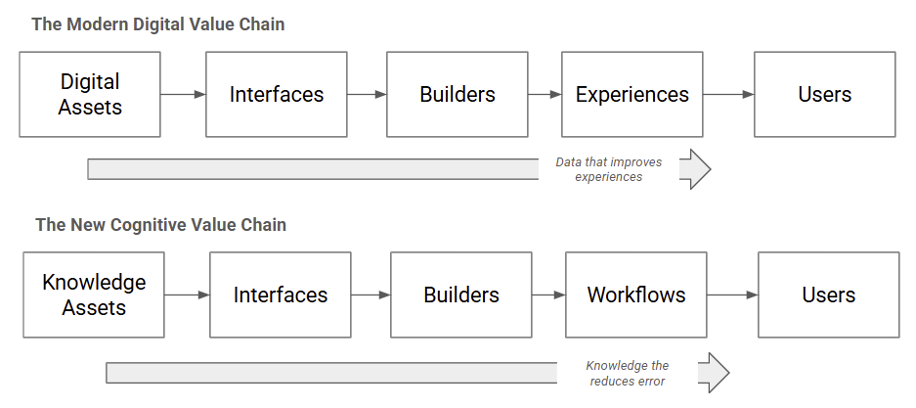
By Bryan Kirschner, Vice President, Strategy at DataStax In a previous article, I advocated for taking a personal growth mindset toward generative AI (genAI). I ended it with a promise to offer a guide to adapting processes, building alignment, and pursuing organizational excellence to those in a position to lead an organization-wide genAI journey. That’s my focus here. It’s an urgent and important job to be done, because while history isn’t exactly repeating itself right now, I see it rhyming. Here’s what the impact of web and mobile can teach us about where the puck is going with genAI. From retention and exposure to connection and consumption After decades of replacing paper-based processes and records, big retailers entered the dawn of digital transformation with a lot of data generated in the course of doing business. Customer purchase histories and store inventories, for example, were reliably retained. Employees could access them as needed to process a return or place the next month’s orders to suppliers, respectively. What incumbent retailers could not count on, however, was a rapid round trip from the creation of that sort of information back into real-time e-commerce experiences. In the new world of Web 2.0 and mobile, customer experiences lacking (for example) personalization or suggested substitutes for out-stock items quickly became unsatisfying and uncompetitive. Processes and tools built for retention and exposure were no longer fit for purpose. New ones needed to drive connection and consumption of what now needed to be managed not simply as business records but also as digital assets that were critical to improving every interaction. Something similar now applies to every company, regardless of industry, now that we’re at the dawn of the age of genAI. Leveraging your organization’s knowledge assets Every company is entering this era with a lot of unstructured data generated in the course of doing business. All the documents, presentations, and analyses (as well as the email chains and Slack threads) used to make business decisions and document subsequent results are reliably retained. Teams know where to find (for example) QBRs, MRDs, and PRDs. And genAI makes it possible to leverage them as knowledge assets that can be connected to and consumed to improve every employee workflow. Here’s why and what to do about it. With e-commerce customer interactions, leveraging digital assets solved for “I wish you’d told me” missed opportunities that lead to lost revenue. (And frustration: It’s tongue-in-cheek, but I often suggest imagining an app today telling you “this item could have shipped free from a different seller” five seconds after you hit the “buy” button.) In employee workflows, leveraging knowledge assets using genAI solves for “I wish we’d known” missed opportunities that lead to disappointment (and frustration). We can get an intuitive handle on this from an insight by organizational learning pioneer Chris Argyris. He defined error in the  business context as a gap between intended and actual outcomes. It’s both brilliant and actionable, because, in business, we rarely do things out of idle curiosity. From preventing regretted attrition to juicing back-to-school sales, we’ve got metrics or other success criteria in mind. And if we reflect on postmortems on occasions when there was indeed a gap between what was intended and what was achieved, it points us toward knowledge as both the prophylaxis and remedy. Those conversations likely included statements like these: “We drew the wrong conclusion from…” “We never even imagined…” “If only we’d known…” GenAI enables conversational access to any codified knowledge, and it makes possible agentic systems that can do work on people’s behalf. These two capabilities make it perfect for incorporating into workflows that would otherwise become unsatisfying and even uncompetitive. An HR example Let’s consider the potential for helping prevent regretted attrition if knowledge assets are accessible to retrieval-augmented generation (RAG) and agentic genAI apps. An HR business partner (HRBP) could get a weekly comparison of trending topics and sentiment comparing internal channels like Slack and email with external sources such as Glassdoor and LinkedIn. Levels and trends in the latter might be benchmarked against top competitors. The HRBP and each of his client people managers could get a weekly diagnosis of internal comms sentiment among high performers, accompanied by an analysis of how they’ve spent their time in the last week (e.g., percent of time in meetings) and positive and negative events (e.g., a feature shipped versus a feature timeline that slipped). Each high performer might have a customized plan taking into account internal and external sources that are updated on an ongoing basis. For example: One employee might write frequently on Substack about work-related topics, while also posting Medium about a hobby. GenAI could note if the tenor of the former turns negative or if the frequency of the latter declines coincident with this employee taking an unusual number of sick days. An “High Performer Risk Synthesizer Analyst” agent could put all these pieces together into briefings for an “HRBP Attention Assistant” agent, a “Manager Attention Assistant,” and an “HR-Manager Coordinator”—the latter providing informed recommendations with rich context that the HRBP and manager could discuss with it about where they might best devote their (finite human) attention to as they wrap up the week or begin the next. For indications of low risk, that action might entail approving a pre-drafted check-in email. For indications of high risk, it might entail agreeing to a 1:1 meeting for which time has already been found on the employee’s calendar. The cognitive value chain This example of “agentic flows” of previously latent or hard-to-assemble knowledge is well within the power of genAI technology as it stands today. Rallying around changing behaviors and putting the right tools in place is the next job to be done. DataStax The result will be a cousin and complement to the modern digital value chain that we call the new cognitive value chain. I’ll cover the components and competencies required for the latter in an upcoming article. Learn more about DataStax. About Bryan Kirschner:Bryan is Vice

Putting AI to work in your organization: You’ve got to adapt your processes Read More »