Rethinking RFPs: Transforming Procurement with AI

In 2011, when Marc Andreessen famously said, “Software is eating the world,” the enterprise software market was valued at $300 billion, making up a respectable 19% of the broader IT market. Today at IDC, we project the market will skyrocket to $1.6 trillion in 2026, capturing 39% of the IT landscape. This explosive growth means that the role of the CIO is evolving, too. Traditionally, the CIO has been responsible for maintaining operational efficiency and minimizing risks. But now, he or she is also expected to drive digital transformation and generate new revenue streams. In fact, our own research shows that 67% of CEOs expect their CIOs to lead digital transformation efforts in the next two years. And that starts with software procurement. Now, just saying the dreaded “p” word might trigger a stress response in any CIO who’s confronted this giant “elephant in the room.” Without the right tools and strategy in place, procurement can feel like an endless cycle of pain points — and every choice can feel like a high-stakes race. One wrong move, and you’re lagging — trampled with overpriced contracts and incompatible tech, or, worse, “supplier ghosting” when you’re desperate for support. The good news? A new wave of AI-powered procurement platforms is stepping up to help CIOs tame the beast. They promise to make procurement faster, smarter, and more strategic, saving your organization time and resources (and, saving your sanity too). Before we dive into why this shift matters — and how AI can transform the procurement process — let’s revisit the pain points that have been wreaking havoc for decades, starting with the all-important RFP. The RFP Challenge: Why It Matters Mastering the Request for Proposal (RFP) process is critical for CIOs. After all, procurement isn’t just about purchasing technology; it’s about aligning tech investments with your organization’s broader business goals, the cornerstone of digital transformation. Traditionally, the RFP process consists of several critical steps: Defining Requirements: Identifying business needs ensures alignment between your organization’s goals and the solutions you’re seeking. Market Research: Thorough research and analysis help identify suitable vendors and solutions. Drafting the RFP: The RFP must clearly communicate the requirements to vendors, soliciting bids. Evaluation: Proposals are assessed to determine the best fit against predefined criteria. Selection and Negotiation: The best solution is selected, and terms are negotiated to establish a successful partnership. The RFP process may seem straightforward — define the problem, invite vendors to bid, evaluate the options, and make the best choice. But if you’ve ever waded through piles of vendor responses, you know it can feel more like a maze of confusion, and losing your way comes with costly consequences. That’s why RFPs remain one of the most valuable yet frustrating aspects of procurement. Their potential to guide informed, strategic software selection is often undermined by: Lengthy Timelines: Traditional RFP processes can extend project implementation timelines by up to three times longer than anticipated. (IDC) Cost Overruns: Our own research found that 44% of CIOs cited the cost of sourcing exercises as their number one pain point in 2024, with external consultants and research adding to the expense. Resource Strain: IT teams, often lacking the business acumen for vendor selection, are burdened with time-intensive manual tasks like contract analysis and supplier evaluation. (CIO) When poorly executed, RFPs can create a domino effect of delays, misaligned vendor relationships, and wasted budgets. Of course, RFPs are just one piece of a larger puzzle. From resource-heavy sourcing exercises to integration challenges, the pain points in procurement can derail even the most promising tech initiatives. Overcoming Procurement Challenges with AI AI-powered procurement platforms can transform the process, helping CIOs overcome common hurdles and make decisions with confidence across the whole procurement lifecycle: 1. Streamlining RFPsWriting, distributing, and evaluating RFPs is like reinventing the wheel every time you need a new tech solution. It’s tedious, time-consuming, and rarely yields the insights you need to make confident decisions. Example: Looking for a new cybersecurity solution? An AI-powered platform drafts a tailored RFP, distributes it to vetted suppliers, and evaluates the responses based on predefined criteria. Fact: AI automates time-intensive tasks like vendor comparison, contract analysis, and data validation, slashing timelines and improving accuracy. (Financial Times) 2. More Confident Decision-MakingAI-powered tools can not only streamline research and reduce redundant trials, but they offer decision-making confidence based on insights from thousands of data points. Example: You’re launching a new office, and your team is stretched thin. AI handles the logistics of sourcing IT hardware, comparing costs, and ensuring timely delivery — freeing your team to focus on relationships and strategy.Fact: AI-driven insights empower CIOs to quickly evaluate vendors with data-backed precision, ensuring alignment with business goals. (McKinsey) 3. Proactive Risk ManagementAI doesn’t just find suppliers — it also screens them. From tracking delivery times to analyzing performance reviews, AI can help ensure you’re partnering with reliable vendors who won’t disappear when you need them most. Example: AI flags a supplier’s declining performance metrics before you renew their contract, saving you from a costly investment. Fact: AI tools quickly assess supplier risks, mitigate compliance issues, and increase transparency in the procurement process. (SAP) 4. Cost Optimization:AI procurement platforms excel at identifying cost-saving opportunities. They’ll flag overpriced contracts, suggest negotiation tactics, and even predict future price trends so you can strike while the iron’s hot. Example: AI notices your organization’s historical spend on IT procurement services and recommends consolidating vendors to unlock bulk discounts. Fact: AI-powered spend analysis highlights savings opportunities and eliminates unnecessary expenses. (McKinsey) 5. Speedy Analysis of Vendor OptionsAI thrives on data. It can analyze your needs, compare thousands of vendors in seconds, and deliver curated recommendations tailored to your specific goals. In short, AI narrows the field, so you’re not wasting time on irrelevant options. Example: You need a new cloud provider. An AI-powered platform evaluates costs, performance metrics, and integration capabilities across dozens of vendors, instantly highlighting the best fits. Fact: 79% of companies report challenges in purchasing B2B software

Rethinking RFPs: Transforming Procurement with AI Read More »
Breaking down Grok 3: The AI model that could redefine the industry

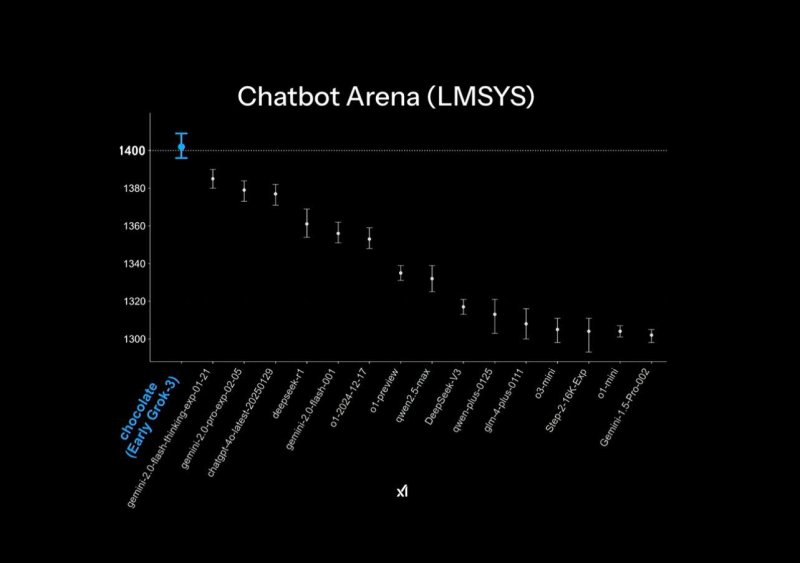
Join our daily and weekly newsletters for the latest updates and exclusive content on industry-leading AI coverage. Learn More Less than two years since its launch, xAI has shipped what could arguably be the most advanced AI model to date. Grok 3 matches or beats the most advanced models on all key benchmarks as well as the user-evaluated Chatbot Arena, and its training has not even been completed yet.  We still don’t have a lot of details about Grok 3, as the team has not yet released a paper or technical report. But from what xAI has shared in a presentation and based on different experiments AI experts have run on the model, we can guess how Grok 3 might affect the AI industry in the coming months. Faster launches With competition increasing between AI labs (just look at the release of DeepSeek-R1), we can expect model release cycles to become shorter. In the Grok 3 presentation, xAI founder Elon Musk said that users may “notice improvements almost every day because we’re continuously improving the model.” “Competitive pressure from DeepSeek and Grok integrated into a shifting political environment for AI — both domestic and international — will make the established leading labs ship sooner,” writes Nathan Lambert, machine learning scientist at Allen Institute for AI. “Increased competition and decreased regulation make it likely that we, the users, will be given far more powerful AI on far faster timelines.” On the one hand, this can be a good thing for users as they constantly get access to the latest and greatest models as opposed to waiting for month-long rollouts. On the other, it can have a destabilizing effect for developers who expect consistent behavior from the model. Previous research and empirical evidence from users has shown that various versions of models can react differently to the same prompt.  Enterprises should develop custom evaluations and regularly run them to make sure new updates do not break their applications. Scaling laws The recent release of DeepSeek-R1 undermined the massive spending that big companies are making to create large compute clusters. But xAI’s sudden rise is a vindication of the massive investments tech companies have been making in AI accelerators. Grok 3 was trained in a record time thanks to xAI’s Collosus supercluster in Memphis. “We don’t have specifics, but it’s reasonably safe to take a datapoint for scaling still helps for performance (but maybe not on costs),” Lambert writes. “xAI’s approach and messaging has been to get the biggest cluster online as soon as possible. The Occam’s Razor explanation until we have more details is that scaling helped, but it is possible that most of Grok’s performance comes from techniques other than naive scaling.” Other analysts have pointed out that xAI’s ability to scale its computer cluster has been the key to the success of Grok 3. However, Musk has alluded that there is more than just scaling at work here. We’ll have to wait for the paper to get the full details. Open source culture There is a growing shift toward open sourcing large language models (LLMs). xAI has already open-sourced Grok 1. According to Musk, the company’s general policy is to open source every model except the latest version. So, when Grok 3 is fully released, Grok 2 will be open-sourced. (Sam Altman has also been entertaining the idea of open sourcing some of OpenAI’s models.) xAI will also refrain from showing the full chain-of-thought (CoT) tokens of Grok 3 reasoning to prevent competitors from copying it. It will instead show a detailed overview of the model’s reasoning trace (as OpenAI has done with o3-mini). The full CoT will only be available once xAI open sources Grok 3, which will probably come after the release of Grok 4. Do your own vibe check Despite the impressive benchmark results, reactions to Grok 3 have been mixed. Former OpenAI and Tesla AI scientist Andrej Karpathy placed its reasoning capabilities at “around state-of-the-art,” along with o1-Pro, but also pointed out that it lags behind other state-of-the-art models on some tasks such as creating compositional scalable vector graphics or navigating ethical issues. Other users have pointed out flaws in Grok 3’s coding abilities in comparison to other models, although there are also many instances of Grok 3 pulling out impressive coding feats. Based on my own experience with leading models, I advise you do your own vibe check and research. I never judge a model based on a one-shot prompt. Have a set of tests that reflect the kind of tasks you accomplish in your organization (see a few examples here). Chances are, with the right approach, you can get the most out of these advanced models. source

Breaking down Grok 3: The AI model that could redefine the industry Read More »

It takes an ecosystem to raise a scaleup

Europe’s startup scene has entered troubled waters. Long overshadowed by Silicon Valley and now being chased down by China, the continent is urgently looking for boosts. Increasingly, the search is leading to ecosystems.  The ecosystem model creates networks of individuals, organisations, and resources. Their shared expertise and resources can produce a multiplier effect, driving innovation and accelerating growth. A core component of European ecosystems is the EU. While its tech strategy often faces criticism, the bloc has also played a key role in driving startup success. Just ask Nicolas Benady, the CEO of Swan, a thriving banking-as-a-service (BaaS) fintech based in France. “Our company wouldn’t exist without the European Union,” he says. TNW Conference FLASH SALE is LIVE Discover the next big thing. This week only, take advantage of our 2 for 1 offer on General Attendee and Corporate Passes. Ends 21 February. Benady points to the impact of the Payment Service Directive, an EU law that established standardised rules for electronic payments. The legislation sparked the success of many global fintech leaders, from Revolut to Adyen. They finally had a chance to compete with banks in payments. Swan has reaped the benefits. Last month, the startup announced it had raised €42mn — the second part of a Series B round that brought Swan’s total funding to an estimated €100mn.  “Without this directive, I don’t think we’d have so many fintechs today in Europe,” Benady says. Fintechs are far from the only beneficiaries of the EU ecosystem — but the network still needs work.  At TNW’s Nurturing Scaleup Success webinar on Tuesday, Benady joined a panel of European tech experts to explain the power and peril of ecosystems. Their message was clear: no startup scales alone. Their success depends on a thriving ecosystem of partners. 4 pillars of a thriving ecosystem Jason Lynch, CEO of quantum computing startup Equal1, has firsthand experience of the power of ecosystems. His company has partnered with Arm on computing breakthroughs, collaborated with Nvidia to blend hardware with software, and teamed up with the Netherlands Organisation for Applied Scientific Research (TNO) on product development.  Equal1 also recently secured investment from TNO. To strengthen the alliance, the startup has set up shop in another component of the Dutch ecosystem: the House of Quantum in Delft, a national campus for quantum startups. Lynch has high hopes for the relocation. “Being in a centre of excellence… is a critical piece of an ecosystem,” he says.  At the TNW webinar — now available to watch on-demand — Lynch broke down four crucial benefits of an ecosystem. 1. Talent As Silicon Valley’s network effects continuously prove, startups benefit immensely from proximity to talent. The House of Quantum provides another promising example. With a steady stream of experts flowing through the site, the centre is giving Equal1 a fresh talent pipeline. 2. Infrastructure Computation costs for startups can be astronomical. With access to shared infrastructure, startups can achieve dramatic savings.  3. Partnerships Tech firms often rely on complex supply chains. Ecosystems offer a route to bring each component together. “What a centre of excellence like Delft offers is an ability to work very closely with companies that are just across the corridor,” says Lynch.  4. Customers End users are drawn to areas with substantial expertise and companies. They help startups to validate and commercialise their products more quickly. “A hub like this really attracts in those end users,” says Lynch.  Yet Lynch also has concerns about EU ecosystems. Chief among them is a failure to commercialise ideas. “It’s well-recognised that European research is leading the world. People would probably say that bringing that research to market is where Europe has more of a challenge. For me, that’s about speed, getting out of the way of startups, and trying to lower the barriers as much as possible.” The money streams EU policymakers are often slated for providing insufficient support to startups. There are growing signs, however, that their attitudes are changing. Clotilde Hocquard, Public Affairs Lead at France Digitale, a European organisation that connects startups and investors, points to several positive developments. One is an expansion of funding streams, such as a new EU initiative to mobilise €200bn for AI investments. Another is France’s Tibi Initiative, which brings institutional investors together with accredited VC firms to encourage tech investing. “It should be replicated at the European level,” Hocquard says. Big ideas like this have been hard to bring to life, but they’re now attracting growing support. Hocquard noticed the momentum shift after last year’s publication of the Draghi Report, which revealed alarming problems for European innovation.  “Policymakers are starting to realise that they need to do something to make sure startups can thrive in Europe,” she says.  Despite the positive signs, Hocquard wants faster progress. She points to another example set in the US. “We have to make sure to mobilise pension funds and insurers, like in the United States. And we have to make sure the money is targeted towards VC funds and to finance innovation.”  But funding isn’t the only challenge for EU ecosystems. The double-edged sword of regulation Swan may only exist thanks to EU rules, but the bloc’s regulation is a double-edged sword. One big problem is the diversity of laws. Despite the single market, the EU’s legislation is fragmented. “We don’t have anything single,” says Hocquard. “We have 27 member states doing what they want with their rules.” This smorgasbord of laws raises barriers to scaling across borders. If the ecosystem could harmonise the rules, startups would face smoother paths to expansion.   Hocquard points to company law as a powerful and straightforward initial target. She also urges member states to stop twisting EU rules in different directions. “If there’s a European law, it should be applied in a uniform way across the continent,” she says. Ecosystems for scale The urge to scale can lead to premature decisions. Benady advises early-stage founders to first focus on the product-market fit. “Once you start to see commercial traction, then you have

It takes an ecosystem to raise a scaleup Read More »

Imagine A World Where Innovation Never Sleeps

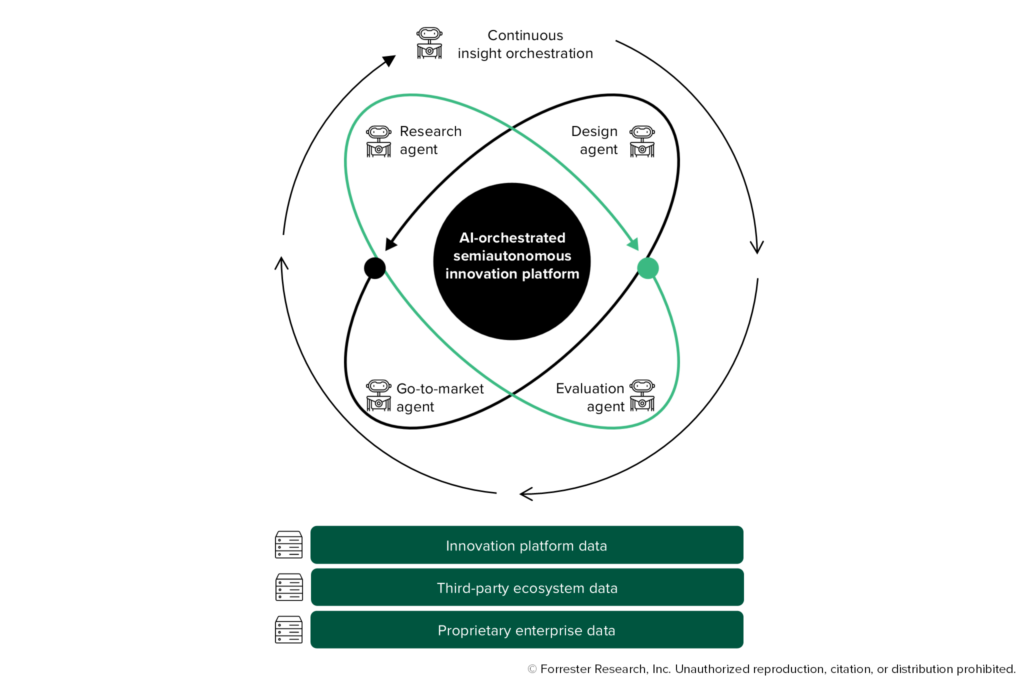
Picture an innovation team that continuously screens market trends, translates them into product designs, and assesses manufacturability and pricing scenarios — all in real time. This is the promise of the AI-orchestrated, semiautonomous innovation lifecycle. GenAI Rehapes Different Stages Of The Innovation Process Generative AI (genAI) is already reshaping the different stages of the innovation process by augmenting creative productivity. From idea generation to commercialization, genAI’s ability to create text, code, audio, images, and videos is transforming how we innovate. Fossil Group, for example, is using retrieval-augmented image generation to create novel watch designs, showcasing how AI can turbocharge the creative process. Importantly, the most common downsides of genAI aren’t an issue in creative use cases; hallucinations are a feature, not a bug, in creative design. Dialing up the model’s temperature results in less conventional output. Damian Fernandez-Lamela, former VP of data science and analytics at Fossil Group, highlighted this point:  GenAI Adoption Moves Beyond Phase-Specific Innovation Tools While such phase-specific tools have driven significant productivity gains, they are not the full story. The real challenge lies in reimagining the entire innovation process. Increasing speed to design is great, but as long as speed to market remains slow, there is little value upside for the enterprise. Simply, more designs, more code, and more content are unlikely to unlock significant value. The more important question lies in determining which designs, which code, and which content are most likely to create value that you can monetize. The Future Of Innovation Lifecycles: AI-Orchestrated And Semiautonomous Picture a system in which new designs can be assessed for manufacturability by analyzing the inventory of parts, supply chains, and distribution networks. The resulting products can be presented to a synthetic client panel while marketing material and product documentation are prepared automatically. Multiagent innovation platforms where AI-powered agents drive continuous market screening, design, evaluation, and commercialization make such a future accessible.   Prepare Now For The GenAI-Infused Future Of Innovation In a world where innovation never sleeps, old ways of working will seize to be effective. The traditional lifecycle stage will amalgamate into a continuous flow of insights, feedback loops, and refinement. To benefit, innovation leaders must break down internal silos, adjust skill strategies, articulate data strategies, and codify organizational context and brand identity. The AI-orchestrated, semiautonomous innovation lifecycle is set to redefine how we innovate. By leveraging genAI and multiagent platforms, organizations can achieve unprecedented speed, quality, and success in their innovation efforts. To uncover more details about this emerging trend and how to prepare your organization, read our report on semiautonomous innovation. Don’t hesitate to get in touch in case you have any questions. Watch this space for more updates on multiagentic innovation platforms and case studies of early adopters. Related Forrester Content Introducing The AI-Orchestrated, Semiautonomous Innovation Lifecycle source

Imagine A World Where Innovation Never Sleeps Read More »

How Neudesic is Harnessing AI for Impact in Australia

Around the globe, business leaders are exploring AI’s potential to help them operate more efficiently and drive better business outcomes. But not all businesses are on a fast path to achieving impactful AI results. According to 2025 IBM research, for example, 77% of executives say they need to adopt gen AI quickly to keep up with competitors — but only 25% strongly agree that their organisation’s IT infrastructure can support scaling AI across the enterprise. AI progress in Australia is advancing, but still limited. In the 2024 World Digital Competitiveness Ranking by the International Institute for Management Development, which measures countries on their digital knowledge, technology, and future readiness, Australia placed 15th of 67 countries — up just one slot from 16th in 2023. One of the challenges holding back Australian businesses is a lack of the functional capability and confidence required to break out of the experimentation phases of AI projects. “When an organisation is working with any unknown technology, the natural position will be to isolate it and put it in a sandbox, because of its perceived riskiness,” says John Hanna, Neudesic Australia.  “This is not solely a reflection of technology, but one of organisational capability. [It takes both] organisational capability and technical talent to work with AI technologies effectively.” Developing the functional capability to manage AI projects, and operationalise them once completed, is an especially tough challenge for Australia’s mid market organisations — which are competing against larger companies, across global markets, for small pools of skilled AI talent. Working with a trusted integrator, with deep AI experience and credentials, can help mid market organisations fill the capability gaps that can keep them from moving beyond the sandbox to leveraging AI for impact. The right integrator partner will ensure the following efforts are central to Australian mid market organisations’ AI journeys, helping drive up their AI confidence and accelerate their success. Define the outcomes AI will deliver Organisations need to determine their AI objectives, and align them to their business priorities, before taking other steps. Having clear AI objectives and use cases, and identifying metrics for assessing improvements in the areas where AI is ultimately applied, makes securing buy-in and approval easier. Common areas where businesses aim to harness AI for impact include increasing productivity, improving quality of work, or pursuing wider business value initiatives — such as improving customer service or bringing new products to market faster. An integrator partner that offers data and AI strategy services, such as longtime Microsoft partner Neudesic, can help Australian mid market organisations pinpoint the applications in which AI can drive meaningful, measurable benefits. Build a data foundation underpinned by expertise Working with AI introduces new challenges and constraints to the ways organisations manage their data, and maintain the quality and security of that data. Organisations need to have clear policies on the classification of data that can be used for AI based projects, for example, as well as policies on the usage of external data (that may have copyright or licensing requirements). Organisations also need clarity on who is responsible for their datasets — especially those created for the sole purpose of AI usage — among many other security, storage, and compliance considerations. With AI skill sets in Australia still highly limited, an integrator partner with experience building data foundations for leading multinational firms can be invaluable to mid market organisations. “Having a trusted partner can help businesses avoid common [data and technology] pitfalls or mistakes, resulting in less investment remorse and creating business confidence in the technology at a faster pace than would otherwise be possible,” says Hanna. Empower data-driven decision making No matter the scale or size of their businesses, all organisations’ AI needs to be enterprise-grade in order to be capable of scaling over time, and providing the insights necessary to help organisations navigate an uncertain future. Applying tried and tested technology solutions to targeted problem and opportunity areas is the fastest path to both driving impactful outcomes, and cultivating valuable insights to support data-informed decisions and strategies. “Ultimately the breadth of data businesses need to deal with is vast, disparate and unstructured, often pushing existing systems, processes and teams that rely on analysing known patterns, beyond their capabilities,” says Hanna. “Adoption of AI provides a solution to analyse this information at scale and speed.” Advance AI with confidence and capability Having the right people, approach, and technology behind their AI initiatives helps organisations move projects forward with confidence. Making progress on AI as an organisational priority — rather than staying in the experimentation phase — takes a level of functional capability that’s challenging for Australian companies to achieve on their own. Neudesic, an IBM Company and award-winning Microsoft pure-play partner, brings enterprise-grade IP and world-class experience and partnerships to the Australian market to help companies realise impact from their AI investments. To find out more about Neudesic, go to https://www.neudesic.com/. source

How Neudesic is Harnessing AI for Impact in Australia Read More »

Judge Won't Bar DOGE Access To Treasury, OPM Data

By Ali Sullivan ( February 21, 2025, 7:19 PM EST) — A Virginia federal judge on Friday rejected a data privacy watchdog’s bid for a preliminary injunction blocking Elon Musk’s Department of Government Efficiency from accessing data systems housed in the U.S. Department of the Treasury and the U.S. Office of Personnel Management…. Law360 is on it, so you are, too. A Law360 subscription puts you at the center of fast-moving legal issues, trends and developments so you can act with speed and confidence. Over 200 articles are published daily across more than 60 topics, industries, practice areas and jurisdictions. A Law360 subscription includes features such as Daily newsletters Expert analysis Mobile app Advanced search Judge information Real-time alerts 450K+ searchable archived articles And more! Experience Law360 today with a free 7-day trial. source

Judge Won't Bar DOGE Access To Treasury, OPM Data Read More »

15 Months of Powerful Cyber Protection and Backup for Only $30

TL;DR: Get the ultimate in cyber protection with a 15-month subscription to 50GB Norton 360 Deluxe PC Cloud Storage Backup for 5 Devices — now 71% off for a best-on-web price of $29.99. If you’ve been worrying about data security because strong cloud storage backup is either too expensive or offers too little space for your files, then worry no more. A 15-month subscription to 50GB Norton 360 Deluxe PC Cloud Storage Backup for 5 Devices is currently 71% off, available for a best-on-web price of $29.99, which is far cheaper than Amazon’s $89.99 offer for the same subscription. This all-in-one solution provides multiple layers of protection for your online privacy and devices. It requires no effort on your part. You download the program instantly, and your devices will be secure in mere minutes. Norton 360 Deluxe has all the features of Norton AntiVirus Plus and adds even more tools to protect you. This backup blocks hackers who could infect your devices with viruses and malware that could completely incapacitate them. It also prevents phishing attacks and allows you to easily use strong passwords to stop takeovers of your accounts. Dark web monitoring is also included, so you’ll receive alerts if your personal data is found on the dark web. You will enjoy secure browsing even on public Wi-Fi with the built-in VPN’s no-log privacy and bank-grade encryption. Manage and oversee your children’s online activities with parental control tools to create a safer digital space for your whole family. Best of all, this deluxe backup does all this while optimizing the performance of your device so that you may remain secure without slowing down your system. This is the ultimate cyber protection for all your online activities, including browsing, shopping, and using AI tools. Give yourself the peace of mind that comes from knowing that powerful security features keep you safe from hackers, viruses, malware, scams, and ransomware that could infiltrate your devices and compromise your data. Get a 15-month Subscription to 50GB Norton 360 PC cloud storage backup for five Devices while it’s on sale for a best-on-web price of $29.99, a 71% discount off the regular $104.99 subscription price, which is far better deal than Amazon’s $89.99 15-month subscription offer. Prices and availability are subject to change. source

15 Months of Powerful Cyber Protection and Backup for Only $30 Read More »

FCC Decision To Nix Complaint Against Fox TV Appealed

By Christopher Cole ( February 19, 2025, 7:23 PM EST) — A media advocacy group appealed a mid-January Federal Communications Commission decision to toss a complaint against Fox TV’s Philadelphia station over misinformation that aired following the 2020 election…. Law360 is on it, so you are, too. A Law360 subscription puts you at the center of fast-moving legal issues, trends and developments so you can act with speed and confidence. Over 200 articles are published daily across more than 60 topics, industries, practice areas and jurisdictions. A Law360 subscription includes features such as Daily newsletters Expert analysis Mobile app Advanced search Judge information Real-time alerts 450K+ searchable archived articles And more! Experience Law360 today with a free 7-day trial. source

FCC Decision To Nix Complaint Against Fox TV Appealed Read More »

Newsletter: 24 Feb 2025

NEWS THIS WEEK A-HKFTA: Bridging Innovation Between Australia and the Greater Bay Area The Australia-Hong Kong Free Trade Agreement (A-HKFTA) is more than just a trade agreement; it is a strategic gateway for technology companies in Australia and the Guangdong-Hong Kong-Macao Greater Bay Area to expand their influence. Australia to the Guangdong-Hong Kong-Macao Greater Bay Area: Hong Kong as a springboard The Australia-Hong Kong Free Trade Agreement simplifies market access for Australian artificial intelligence, fintech and biotech companies, ensuring zero tariffs and seamless data flows. Hong Kong’s strong intellectual property protection, financial infrastructure and proximity to Shenzhen’s tech ecosystem make it an ideal stepping stone for Australian businesses to scale up in the US$2 trillion economy of the Guangdong-Hong Kong-Macao Greater Bay Area. Guangdong-Hong Kong-Macao Greater Bay Area and Australia: Hong Kong as a Gateway Hong Kong’s legal and business environment provides a familiar yet globally connected basis for GBA businesses to comply with Australian regulations. Australia’s strengths in deep technology, clean energy and quantum computing provide valuable collaboration opportunities for innovators in the Guangdong-Hong Kong-Macao Greater Bay Area. Listing Opporutnity on ASX Another funding pillar for startups: listing on the Australian Securities Exchange (ASX) – from a strategic measurement perspective, it can provide faster and cheaper access to capital than other listing markets. Read More Investor Scouting Explore More Startup Scouting Explore More Advisors Scouting Explore More

Newsletter: 24 Feb 2025 Read More »

Americans Continue to View Several Economic Issues as Top National Problems

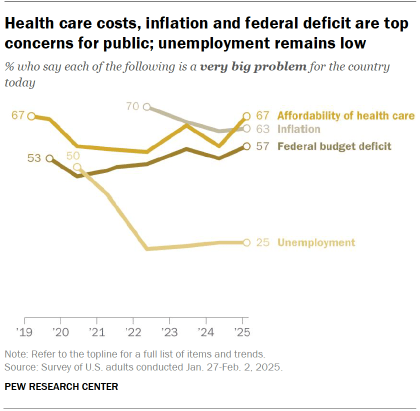
Sharp rise in the share of Democrats who view ‘the state of moral values’ as a very big national problem How we did this Pew Research Center conducted this study to understand Americans’ views of problems facing the country. For this analysis, we surveyed 5,086 adults from Jan. 27 to Feb. 2, 2025. Everyone who took part in this survey is a member of the Center’s American Trends Panel (ATP), a group of people recruited through national, random sampling of residential addresses who have agreed to take surveys regularly. This kind of recruitment gives nearly all U.S. adults a chance of selection. Surveys were conducted either online or by telephone with a live interviewer. The survey is weighted to be representative of the U.S. adult population by gender, race, ethnicity, partisan affiliation, education and other factors. Read more about the ATP’s methodology. Here are the questions used for this report, the topline and the survey methodology. At the start of President Donald Trump’s second term, Americans see a host of economic issues – from inflation to the affordability of health care and the federal budget deficit – as top problems facing the country. With most adults continuing to say the nation’s economy is in only fair (45%) or poor (31%) shape, large shares of the public – including majorities of Republicans and Democrats – see multiple economic considerations as very big national problems. Today, 63% say inflation is a very big problem for the country. This is comparable to last May and down from a high of 70% in 2022. At the same time, the share of adults who say the affordability of health care is a very big national problem has risen 10 percentage points since last year: Today, 67% say this, up from 57% in 2024. There has also been an uptick in the share of Americans who see the federal deficit as a very big problem (53% then, 57% today), driven mostly by rising deficit concern among Democrats. One exception is unemployment. As has been the case for the last three years, only about a quarter say it is a very big problem for the country. How Americans rank national problems Roughly seven-in-ten Americans say “the role of money in politics” is a very big problem in the country today – the highest share of any of the 24 items asked about on the survey. The affordability of health care (67%), inflation (63%), the federal budget deficit (57%) and the number of Americans living in poverty (53%) are also among the public’s top concerns. About half or more see the ability of Republicans and Democrats to work together (56%), drug addiction (51%) and the state of moral values (50%) as very big problems in the country today. Far smaller shares of the public see terrorism, racism or climate change as very big problems for the nation – though Republicans and Democrats disagree about the severity of some of these problems.    Note: Refer to the topline for a full list of the 24 items asked about. The lowest four items are not shown here. Republicans less worried about partisan cooperation, political system There have been notable declines in the shares of Republicans who say “the ability of Democrats and Republicans to work together” and that “the way the U.S. political system operates” are very big national problems. The ability of Republicans and Democrats to work together In May 2024, 57% of Republicans and Republican-leaning independents said the ability of Democrats and Republicans to work together was a very big problem for the country. This has dropped to 48% today. Nearly two-thirds of Democrats and Democratic leaners continue to see partisan relations as a very big national problem (63% a year ago vs. 64% today). The way the U.S. political system operates In 2019, 48% of Republicans said the way the U.S. political system operates was a very big problem; 40% say this today. Democrats’ views are little changed over this period (54% then vs. 56% today).   Democrats increasingly concerned about agreement on basic facts, state of moral values Republicans and Democrats are moving in different directions when it comes to whether Americans’ level of agreement on the basic facts and the state of moral values in the country today are big problems for the nation. Americans’ level of agreement on basic facts 46% of Democrats said in 2018 that “Americans’ level of agreement on the basic facts about issues and events” was a very big problem for the country. Today, 58% say this. By contrast, there has been a 7-point decline in the share of Republicans who view this as a very big problem over this same period (39% then, 32% now). The state of moral values About a year ago, 32% of Democrats said “the state of moral values” was a very big problem. This has jumped to 51% today. There has been a 13-point decline in the share of Republicans saying the state of moral values is a very big problem since last year (61% then, 48% now). Partisans’ views of the nation’s problems Republicans and Democrats generally agree on the severity of several issues facing the country – including the role of money in politics and the affordability of health care. But Republicans and Democrats see other issue areas differently: Among Republicans Illegal immigration (73%) and inflation (73%) remain the top concerns for Republicans and Republican-leaning independents. Among Democrats The role of money in politics is the top concern (78%), followed by the affordability of health care (73%), gun violence (69%) and climate change (67%).   There are particularly wide partisan gaps on the extent to which climate change and illegal immigration are seen as problems. There are also at least 20-point gaps on each of the following issues:  Americans’ level of agreement on the basic facts about issues and events (32% of Republicans vs. 58% of Democrats say this is a very big problem) The number of Americans living in poverty

Americans Continue to View Several Economic Issues as Top National Problems Read More »