
Oppo Find N5: Global Launch Announced for World’s Thinnest Book-Style Foldable Smartphone

Its only limit to being any slimmer than it is now is the charging port, which is separated from the case by a small slither of metal, according to product manager Zhou Yibao. Oppo is careful not to claim the Find N5 as the thinnest foldable smartphone, as Huawei’s Mate XT Ultimate, measuring just 3.6 mm thick when unfolded, pips it to the title. However, as Huawei’s is a tri-fold device, the Find N5 can safely claim to be the thinnest bi-folding, or book-style, smartphone at a rumoured 4.2 mm thick. In pictures shared on Weibo, Yibao compared the device to an iPhone 16 Pro Max and two Chinese yuan coins to demonstrate its thinness. Oppo Find N5 next to an iPhone 16 Pro Max. Image: Oppo/Weibo Oppo Find N5 next to two Chinese yuan coins. Image: Oppo/Weibo What are key features of the Oppo Find N5? Yibao has revealed a number of features we can expect from the device, including its IPX6, IPX8, and IPX9 full-level water resistance certifications, meaning it can withstand high-pressure, high-temperature jets of water as well as submersion. He said it is the “only folding flagship on the market” to offer all three. The Find series head also announced that the Find N5 will come with DeepSeek-R1 integrations, such as with the voice assistant, online search, and the local file system, so chats can be saved to the device. Oppo Find N5 will support ColorOS, the company’s custom Android-based operating system with multitasking features like the split screen. According to Digital Camera World, which was sent a handset ahead of the launch, it also has a triple camera setup from Swedish camera-maker Hasselblad, and the crease down the middle of the display is visible but “almost impossible to feel with your finger.” The device will be powered by Qualcomm’s Snapdragon 8 Elite chip, according to an image shared by Yibao, and can be charged both with a cable and wirelessly, marking an upgrade from its predecessor. There are three colours available: black, white, and purple. All three will be available in China, with the official names Satin Black, Jade White, and Dusk Purple. Only the black and white versions will be sold in Europe, under Cosmic Black and Misty White. The Oppo Find N5 is the successor to Oppo Find N3 released in 2023; the name N4 was not used in the latest version due to the number’s association with death in China. The N3 was sold as OnePlus Open in the U.S., and was also launched in the U.S. later than elsewhere. It is therefore likely that the device will make its way to the States later this time around, too, and be named OnePlus Open 2. source

Oppo Find N5: Global Launch Announced for World’s Thinnest Book-Style Foldable Smartphone Read More »

Too many models, too much confusion: OpenAI pledges to simplify its product line

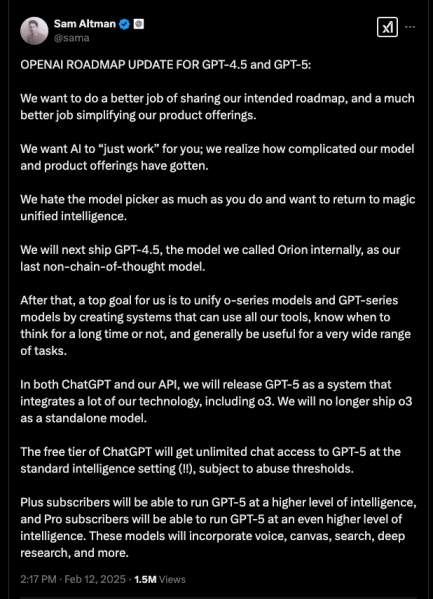
Join our daily and weekly newsletters for the latest updates and exclusive content on industry-leading AI coverage. Learn More OpenAI plans to “simplify” its model offerings, even as it prepares to ship its last non-reasoning model, GPT-4.5. This is a rare admission from a tech company that its product releases haven’t been differentiated enough for customers. OpenAI CEO Sam Altman took to X to give product roadmap updates and acknowledge that some of the company’s recent releases muddled the waters. “We want to do a better job of sharing our intended roadmap, and a much better job simplifying our product offerings,” Altman wrote. “We want AI to ‘just work’ for you; we realize how complicated our model and product offerings have gotten.” Altman took particular umbrage against ChatGPT’s model picker, where users tap a drop-down to choose from released models. The number of models a user can choose depends on their subscription tier.  Altman said his team “hates the model picker as much as you do” and will bring back “magic unified intelligence,” presumably referring to a single model powering a platform. Altman said the company plans to integrate its technology, including the o-series of models, into GPT-5 when it comes out on ChatGPT and its APIs.  Over the past year, OpenAI has released GPT-4o, o1, o3 and o3-mini models. It has also launched new ChatGPT subscription tiers, including the $200/month ChatGPT Pro.  On top of all that, the company has released Operator agent, Deep Research, ChatGPT tasks and a host of other new features that are sometimes only available through specific models or paid levels.  Awaiting the release of OpenAI’s GPT-4.5 and 5 Altman said OpenAI’s next step is releasing GPT-4.5, its last non-chain-of-thought (CoT) model. It’s been internally called Orion, although he did not explain what new capabilities GPT-4.5 will have.  “After that, a top goal for us is to unify o-series models and GPT-series models by creating systems that can use all our tools, know when to think for a long time or not and generally be useful for a very wide range of tasks,” said Altman.  When the company releases GPT-5, it will stop shipping the reasoning o3 as a standalone model.  OpenAI understands that some users may not need the full capabilities of its newest models, Altman conceded, which is why the company created a model picker in the first place. GPT-5’s capabilities will be attuned to the subscription level to replace the dropdown, he said. “The free tier of ChatGPT will get unlimited chat access to GPT-5 at the standard intelligence setting (!!), subject to abuse thresholds,” said Altman. “Plus subscribers will be able to run GPT-5 at a higher level of intelligence, and Pro subscribers will be able to run GPT-5 at an even higher level of intelligence. These models will incorporate voice, canvas, search, deep research and more.” Altman did not say when GPT-4.5 or GPT-5 could be released.  Customer confusion OpenAI’s decision to simplify how it presents models points to a continuing problem: Not everyone understands what each model is supposed to do and what makes it different. OpenAI is not alone in this. If I weren’t reporting on the industry day in and day out, I wouldn’t be able to differentiate between the Gemini models and tell you why Claude’s Sonnet is better than Haiku. While this confusion is more common among consumers, simplifying products makes things much more manageable, even for power users like AI engineers.  Increasingly, you must have a working encyclopedia of which models can do what and which are more updated. Integrating the latest capabilities into one model and only allowing more complex abilities based on usage could make it easier for many developers to experiment faster.  source

Too many models, too much confusion: OpenAI pledges to simplify its product line Read More »

The Big Power of Small AI in 2025

In the world of AI, small is becoming very big. Many software companies, particularly those looking to ramp up their AI solutions quickly, are increasingly turning to small language models (SLMs), which require less computational power and memory — meaning smaller datasets. Designed for specific enterprise tasks, these models are not only faster to train and deploy, but they are already outperforming or matching similarly sized models, which is good for any company that wants to implement AI, and especially those with limited resources, budget, or time constraints. The market for SLMs is expected to grow a steady 15% over the next five years. On the flip side, the more well-known large language models (LLMs) used in many AI applications are trained with massive datasets. This data can take months to train, and it’s just the beginning — it is often followed by human fine-tuning. LLMs involve significant development expenses that may run into several million dollars, according to some estimates, which can be a major financial burden for most software companies and startups. SURVEY: Our sister site DZone is looking for your views on generative AI. Since SLMs are growing in popularity, what’s next? SLMs can be useful to companies looking for targeted quick wins and are the preferable choice for many, as they use far fewer parameters and can be built from scratch or adapted from LLMs. The smaller size of these models allow them to be hosted in an enterprise’s data center instead of the cloud. SLMs are even more powerful when open-source, and by training on carefully curated enterprise datasets, they can be filtered for objectionable content with critical concerns like governance, risk, privacy, and bias mitigation, as this becomes increasingly important in 2025 and beyond. When it comes to AI, timing is everything Among the many use cases, SLMs find a sweet spot when predicting outcomes in time series data. Timing is critical in business, where every organization has a forecast of sales, demand, revenue, and capacity requirements; this is called time series forecasting, and it involves predicting future values based on past observations collected in constant time intervals, whether that is daily, monthly, quarterly, or yearly. AI is expected to accelerate and tighten business planning with a faster foundation model for this kind of multivariable forecasting. For instance, an SLM called Tiny Time Mixers (TTMs) can swiftly generate time-dependent outputs, predicting future trends in diverse domains such as electricity consumption, traffic congestion, retail, and finance. This type of model is being used by a global leader in the field of AI-powered investment solutions, QuantumStreet AI, to help pull ESG data and sentiment signals from news and other data sources to help its platform forecast stock price movement across industries. As innovation continues, models will be trained on even more data and deliver stronger performances while providing greater flexibility with support for external variables and rolling forecasts. Getting AI into your workflow today AI is beginning to change business in ways we are just starting to imagine. However, the breathless hype about AI of the past two years must be leavened with cost, trust, and resource considerations. In fact, companies may soon prefer a blend of LLMs and SLMs, using bigger models first to address some of the most challenging business problems, and once they get the answer, switch to smaller models that replicate the findings at a lower cost and with decreased latency. Looking forward, SLMs will also play a prominent role in the advancement of AI agents that are capable of greater autonomy, sophisticated reasoning, and multi-step problem solving. SLMs feature support for key agentic capabilities, such as advanced reasoning and specific function calling, which are critical to ensure an agent can connect with external APIs, reassess its plan of action, and self-correct. Enterprises implementing AI must strike the right balance between powerful and practical. Think of an SLM as a race car and a LLM as a motorhome — both will get you where you want to go but serve different needs. It is the models that deliver high performance relative to model size while maximizing safety, speed, and cost-efficiency that can more easily be integrated across diverse business environments and workflows. Whether your company is piloting AI projects today or exploring the use of AI agents tomorrow, SLMs will significantly impact the ability to implement AI quickly across your business. IBM VP Raj Datta. Image: IBM Raj Datta is Vice President, Software and AI Partnerships at IBM, where he spearheads strategy, sales, and strategic alliances. Before, he co-founded and was CEO at software company oak9, and was President of Software AG, North America. Prior, he spent 19 years at IBM in global and national leadership. Datta holds an MBA in Marketing and Finance from Northwestern University Kellogg School of Management, and a BA in Economics from the University of Illinois, Urbana. source

The Big Power of Small AI in 2025 Read More »

Unlocking AI’s full potential in procurement with smarter data management

Supply chain operations are often stymied by inefficiencies that result in higher costs, longer lead times, and dissatisfied customers. These inefficiencies stem from manual processes that slow operations down, data silos that worsen decision making and a lack of visibility into supply chain activities, including procurement. By implementing cutting-edge AI solutions into supply chain operations, procurement teams can overcome these challenges. Since data is the fuel for AI, unlocking its full potential is only possible when organizations have mastered data management. “Over the next decade, AI and data management will redefine procurement by automating complex decision-making, enhancing supplier collaboration, and improving risk management,” says Santosh Nair, chief product officer at GEP. However, according to Foundry research conducted for GEP, weak internal data management capabilities were the most common challenge organizations face when preparing data for AI initiatives (45%). Moreover, internal resistance and caution over sharing data (43%) and complexity in managing unstructured data (4o%) were the second and third ranked answers. With a robust data management strategy, organizations can overcome these challenges, avoiding financial pain and outpacing their peers. “AI in procurement thrives on high-quality, structured, well-governed data,” Nair says. “Smarter data management ensures that AI models can generate accurate insights, automate decision-making, and drive efficiency.” Procurement challenges & how AI can help Entering the age of AI, procurement teams face several profound challenges. A lack of visibility into supply chain operations makes it difficult to anticipate disruptions, optimize inventory, or identify reliable suppliers. Manual tasks — like processing purchase orders and managing invoices — limit scalability and waste valuable time that could be spent on strategic initiatives. On top of this, data silos hold teams back. “Despite AI’s potential, many procurement teams struggle with data-related obstacles that hinder adoption,” Nair explains. “For example, procurement data is often scattered across ERP systems, suppliers’ portals, and spreadsheets — making it difficult for AI models to access comprehensive insights.” AI solves these challenges by offering real-time visibility, automating manual tasks, and eliminating data silos through integration. This enables teams to better predict risks, streamline workflows, and otherwise operate more efficiently. Data management: The key to AI success AI success starts with strong data management — a capability most organizations aspire to possess. “To maximize AI’s impact in procurement, organizations must adopt proactive data management strategies,” Nair says. To do this, Nair believes companies should implement centralized procurement data strategies, standardize and cleanse data regularly, strengthen data governance and security, and leverage AI for data enrichment. Almost all businesses in the study are thinking about or enacting training programs to address data management challenges. The study found that 34% of organizations are investing in data management training already, with 65% planning to follow suit. Meanwhile, 56% are conducting regular data audits while 39% plan to do so. Another way to accelerate time to value is by partnering with third-party experts; 55% intend to collaborate with AI vendors to maximize their investments in the technology. Learn more about how AI can optimize your supply chain, end to end. source

Unlocking AI’s full potential in procurement with smarter data management Read More »

BREAKING: Judge Won't Bar DOGE Access To Treasury, OPM Data

By Ali Sullivan ( February 21, 2025, 7:19 PM EST) — A Virginia federal judge on Friday rejected a data privacy watchdog’s bid for a preliminary injunction blocking Elon Musk’s Department of Government Efficiency from accessing data systems housed in the U.S. Department of the Treasury and the U.S. Office of Personnel Management…. Law360 is on it, so you are, too. A Law360 subscription puts you at the center of fast-moving legal issues, trends and developments so you can act with speed and confidence. Over 200 articles are published daily across more than 60 topics, industries, practice areas and jurisdictions. A Law360 subscription includes features such as Daily newsletters Expert analysis Mobile app Advanced search Judge information Real-time alerts 450K+ searchable archived articles And more! Experience Law360 today with a free 7-day trial. source

BREAKING: Judge Won't Bar DOGE Access To Treasury, OPM Data Read More »

What is Web Hosting? How Web Hosting Service Works?

If you’ve ever wondered how websites appear on the internet, the answer lies in web hosting. Web hosting is a service that stores website files on a server and makes them accessible to visitors worldwide. Every website—whether a simple blog or a large e-commerce store—needs hosting to function. Think of web hosting like renting space online. Just as a physical store needs a location to operate, a website needs a server to store its data and serve it to users when they type in a web address. The type of hosting you choose affects website performance, security, and scalability, making it a crucial decision for anyone building an online presence. Read more: Need a Website Fast? Here’s How to Go Live in Hours, Not Weeks How does web hosting work? Web hosting works by storing website files—such as text, images, and code—on a specialized computer called a web server. When someone enters your website’s domain name (e.g., www.example.com) in their browser, the browser sends a request to the server, which then delivers the necessary files to display the website on the visitor’s device. Web servers are always connected to the internet, ensuring your website is accessible 24/7. Hosting providers manage these servers, handling maintenance, security, and performance optimization, so websites load quickly and reliably. There are different types of web hosting, each offering varying levels of performance, security, and control. Shared hosting is like renting an apartment in a building, where multiple websites share the same server resources. VPS (Virtual Private Server) hosting provides a more isolated environment, while dedicated hosting gives a website full control over an entire server. Cloud hosting uses multiple servers to balance traffic and improve uptime. Without web hosting, a website has nowhere to “live” on the internet, making hosting a fundamental requirement for any online presence. Read more: How to Use the Apache Web Server to Install and Configure a Website Why web hosting is important Web hosting is essential because it ensures that websites are accessible, perform well, and remain secure. Without hosting, a website’s files wouldn’t have a place to be stored and served to visitors. Enabling website accessibility A website is only useful if people can access it. Web hosting providers keep websites online by storing data on servers connected to the internet 24/7. Without hosting, a website would exist only on a personal computer and wouldn’t be reachable by users worldwide. Storage and performance considerations The type of hosting you choose affects website speed and reliability. A slow website can frustrate visitors and hurt search rankings. Hosting plans determine how much storage, bandwidth, and processing power a website has, which impacts loading speed and the ability to handle traffic spikes. Security and reliability factors Good hosting providers offer security features like SSL certificates, firewalls, and regular backups to protect websites from cyber threats. They also provide uptime guarantees, ensuring that websites remain accessible without frequent outages. Choosing a reliable web host prevents data loss, improves trust with visitors, and helps businesses maintain a strong online presence. Must-read developer coverage Types of web hosting Choosing the right web hosting depends on your website’s needs, traffic, and budget. Below are the most common hosting types, along with their pros, cons, and ideal use cases. Shared hosting Definition: Multiple websites share the same server and resources, making it the most affordable hosting option. Pros Cons Low cost and beginner-friendly Easy setup with minimal technical knowledge required Hosting provider handles server maintenance Slower performance due to shared resources Limited customization and scalability Higher security risks if other websites on the server are compromised Best for: Small blogs, personal websites, and startups with low traffic.Bad for: E-commerce stores, high-traffic sites, and businesses needing strong security. VPS (Virtual Private Server) hosting Definition: A virtualized server environment where resources are allocated to individual websites, offering more control than shared hosting. Pros Cons Dedicated resources improve performance Greater control over server settings More scalable than shared hosting More expensive than shared hosting Requires some technical knowledge for management Not as powerful as a dedicated server Best for: Growing websites, mid-sized businesses, and developers needing flexibility.Bad for: Beginners or businesses needing hands-off server management. Dedicated hosting Definition: A website has an entire physical server to itself, providing maximum performance and customization. Pros Cons Full control over server settings and resources Best performance and highest security Can handle large traffic volumes Expensive, with costs starting at $80+/month Requires advanced technical expertise Maintenance and security are the website owner’s responsibility (unless managed) Best for: Large businesses, enterprise websites, and high-traffic platforms.Bad for: Small businesses, personal websites, and those on a tight budget. Cloud hosting Definition: Websites are hosted across multiple connected servers, improving uptime and scalability. Pros Cons Highly scalable—can handle traffic surges Better uptime and reliability than traditional hosting Pay-as-you-go pricing structure Can be more expensive than shared or VPS hosting Pricing may be unpredictable due to variable usage costs Less direct control over physical server management Best for: Businesses expecting fluctuating traffic, e-commerce, and SaaS platforms.Bad for: Small websites with minimal traffic and tight budgets. Managed hosting Definition: The hosting provider handles server management, updates, security, and backups, allowing website owners to focus on content and business. Pros Cons Hands-off maintenance with expert support Enhanced security and automatic updates Optimized performance for specific platforms (e.g., WordPress, WooCommerce) More expensive than standard hosting Less control over server configurations May have limitations on software installations Best for: WordPress sites, enterprise businesses, and those wanting a hassle-free hosting experience.Bad for: Developers or businesses needing full control over their hosting environment. Key features to look for in a web hosting provider With dozens of players in the website hosting space, choosing the right web hosting provider is crucial. It can impact your website performance, security, and your reliability. Here are some key features to consider when selecting a hosting service. Performance and uptime Website speed and availability directly impact user experience and SEO rankings. Look for a provider that guarantees at least

What is Web Hosting? How Web Hosting Service Works? Read More »

Lenovo CLO Announces Retirement, Successor Named

By James Boyle ( February 21, 2025, 4:44 PM EST) — Consumer technology company Lenovo will be shaking up its leadership team with retirement plans for its chief legal officer and chief financial officer, announced Friday…. Law360 is on it, so you are, too. A Law360 subscription puts you at the center of fast-moving legal issues, trends and developments so you can act with speed and confidence. Over 200 articles are published daily across more than 60 topics, industries, practice areas and jurisdictions. A Law360 subscription includes features such as Daily newsletters Expert analysis Mobile app Advanced search Judge information Real-time alerts 450K+ searchable archived articles And more! Experience Law360 today with a free 7-day trial. source

Lenovo CLO Announces Retirement, Successor Named Read More »

Warby Parker Hit With $1.5M Fine After HHS Breach Probe

By Lauren Berg ( February 20, 2025, 10:19 PM EST) — The U.S. Department of Health and Human Services announced Thursday that it has imposed a $1.5 million fine on Warby Parker Inc. following a cyberattack on the eyewear manufacturer’s website that exposed the protected health information of nearly 200,000 customers…. Law360 is on it, so you are, too. A Law360 subscription puts you at the center of fast-moving legal issues, trends and developments so you can act with speed and confidence. Over 200 articles are published daily across more than 60 topics, industries, practice areas and jurisdictions. A Law360 subscription includes features such as Daily newsletters Expert analysis Mobile app Advanced search Judge information Real-time alerts 450K+ searchable archived articles And more! Experience Law360 today with a free 7-day trial. source

Warby Parker Hit With $1.5M Fine After HHS Breach Probe Read More »

Balanced Benefits Give Loyalty Programs A Competitive Advantage

Loyalty programs are struggling to deliver an engaging member experience. In Forrester’s Consumer Benchmark Survey, 2024, 34% of US online adults who belong to a customer loyalty program agreed that they frequently forget to use loyalty programs to which they belong. To maximize program effectiveness, loyalty programs need a balanced mix of transactional benefits that offer monetary value and nontransactional benefits that spark more emotional connections. Financially tied benefits such as points and discounts are table stakes for modern loyalty. They motivate program members to share more information about themselves and drive desired purchase behaviors. But they are also easy for other brands to copy and for consumers to forget. Lower prices often drive switching behavior. To create meaningful and durable customer connections, loyalty marketers need to include benefits that drive more emotional connections with the brand. In Forrester’s Customer Experience Benchmark Survey, 2024, 82% of consumers indicated that they will spend more with brands that make them feel appreciated. To strike the right balance of benefits and drive engagement, check out our recently published report, How To Balance Your Loyalty Program Benefits, in which we delve into the following topics: How to assess your program benefit mix. Use our calculation to quickly assess how balanced your program benefits are by using existing member data. Inspiration for rewarding beyond the transaction. Even a well-balanced loyalty program can discover new opportunities to wow members and increase engagement. For example, programs can offer members exclusive behind-the-scenes experiences, invitations to attend partner events, or access to members-only merchandise. A five-step framework for balancing benefits. Follow our five-step framework to develop a focused plan to evaluate and incorporate a balanced mix of member benefits. This approach starts with an audit to define gaps and opportunities followed by company effort to uncover new and unique engagement elements. Winnow the list to the most impactful items by validating each benefit through research and feasibility. The goal is to develop a process that promotes continuous improvement of benefits that align with the brand and resonate emotionally with members. Check out the full report for top strategies to make members feel valued and appreciated. Questions? We’d love to help you with your loyalty initiatives. Connect with us by scheduling a guidance session. source

Balanced Benefits Give Loyalty Programs A Competitive Advantage Read More »

Sundar Pichai: Google's AI Vision takes center stage in Dubai

At the 2025 World Government Summit in Dubai, Google & Alphabet CEO Sundar Pichai joined H.E. Omar Al Olama, UAE Minister of State for Artificial Intelligence, Digital Economy, and Remote Work Applications, for a virtual fireside chat. The discussion centered on Google’s AI-first strategy, its dedication to long-term investments in foundational technologies, and the cultural elements driving Google’s innovation. Pichai emphasized Google’s commitment to making AI broadly accessible, stating, “Intelligence is going to be widely available. This technology is going to be at everyone’s fingertips, and it’s going to impact the world profoundly.” He highlighted Google’s AI-powered products, reaching over 2 billion users, from Maps and Search to Android, and its recent advancements with the Gemini models. The conversation touched upon Google’s progress in Quantum computing, with Pichai expressing excitement about its potential: “The progress in Quantum is palpably exciting…In a 5 to 10 year time frame, I think you will see start practically useful quantum computers.” He noted Google’s ability to perform a computation in 5 minutes that would have taken the world’s fastest supercomputers over 10 septillion years, signifying a major breakthrough in error correction for large-scale quantum computers. source

Sundar Pichai: Google's AI Vision takes center stage in Dubai Read More »