The UK Government Is Ready To Embrace AI, But Without Trust It Risks Disaster

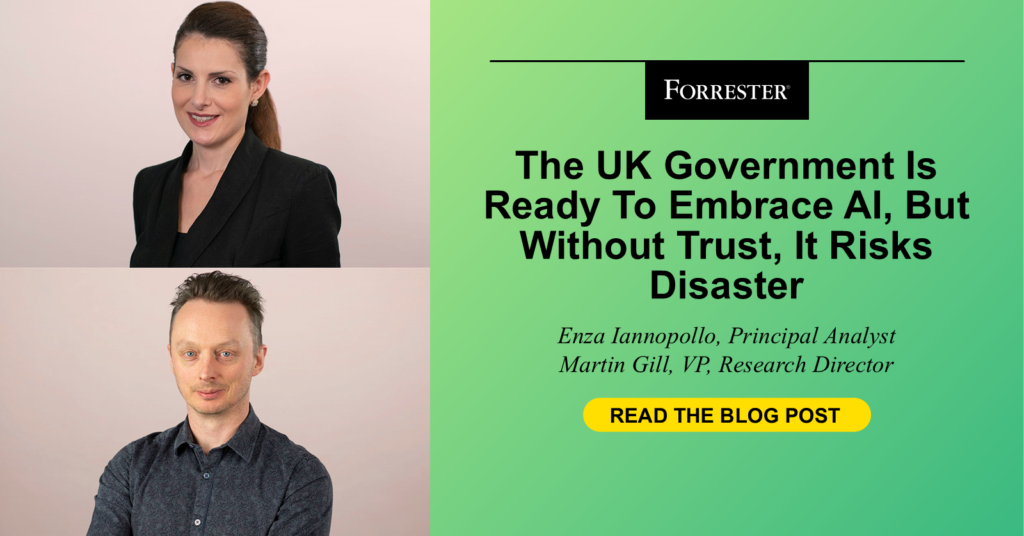
Internationally, The UK Is Prioritizing AI Security Over Safety Last week, together with the US, the UK refused to sign an international agreement on artificial intelligence at a global AI summit in Paris. The agreement aims to align 60 countries on a commitment to develop AI in an open, inclusive, and ethical way. According to the UK government, however, it fails to address global AI governance issues and leaves questions on national security unanswered. Yes, these types of agreements rarely produce any immediate changes to policy or practices (in fact, this is not what they are for!), but it’s an odd justification, and it’s puzzling that the UK, which championed “AI safety” globally and promoted the adoption of a range of agreements in the past, is walking away from it now. Meanwhile, the UK Department for Science, Innovation, and Technology announced that the global “AI Safety Institute” changed its name to become the “AI Security Institute.” Make no mistake: This is more than a name change. The new focus of the AI Security Institute is primarily on cybersecurity, and previous goals — such as understanding societal impacts of AI and mitigating risks such as unequal outcomes and harming individual welfare — are no longer explicit parts of its mission. Domestically, The UK Wants To Drive Public-Sector AI Innovation Not only was the UK government busy building new tech/geopolitical relationships, it also made some domestic decisions that UK citizens and consumers should be watching. These include: An agreement with Anthropic to start building AI-powered services. Last week, the UK government and AI provider Anthropic signed a memorandum of understanding, marking the beginning of a collaboration that will enable the UK public sector to harness the power of AI for a range of services and experiences. The immediate goal is to use Claude, Anthropic’s family of large language models (LLMs), to launch a chatbot that will improve the way citizens in the UK access public-sector information and services. Bold future plans. This is just the beginning. Future plans include the use of Anthropic’s LLMs across a range of public-sector activities, from scientific research to policy-making, supply chain management, and much more. As the UK government embraces over 50 different initiatives that bring AI to the core of its public sector and government activities, according to the latest “AI opportunities action plan,” future collaboration with other AI providers beyond Anthropic is the obvious next step. New AI guidelines for government departments. To complete the fray of AI-related activity, new guidelines for the use of AI and generative AI in the public sector also saw the light of day last week. The Artificial Intelligence Playbook for the UK Government expands the 2024 Generative AI Framework for His Majesty’s Government, but it substantially remains a set of basic, common-sense principles that public servants should apply when using AI and genAI. It seems to be too little, though, especially if compared with the volume and magnitude of the UK’s AI ambitions and projects. Innovation Without Citizen Trust Will Be Meaningless AI is an incredible opportunity for virtually every organization, including the public sector. The enthusiasm that the UK government is putting into its current and future AI projects is refreshing to see, but a commitment to trustworthy AI is paramount to keep the enthusiasm going and avoid backlash — especially in a country where there currently aren’t, and in the future probably won’t be, any rules and governance for trustworthy AI. As Forrester’s government trust research shows, when trust in institutions is strong, governments reap social, economic, and reputational benefits that enable them to expand and extend their relationship with the people they serve. When trust is weak, they lose those benefits and must work harder to create and maintain economic well-being and social cohesion in order for people to prosper. According to the latest Forrester data, overall trust in UK government organizations is weak, with a score of 42.3 on our 100-point scale. There are two main priorities for the UK public sector and its partners as they embrace AI: Establish and follow a trustworthy framework for every AI project. The new AI playbook is a good starting point. Other AI risk frameworks can further increase the effectiveness of the playbook to deliver responsible and trustworthy AI. The EU AI Act, which is not binding for the UK public sector and its partners, for example, can still provide a set of valid principles to assess AI risks and select risk mitigation strategies. Design and build AI applications that engender citizen trust. It’s vital that you understand and act on the drivers that impact how UK citizens trust the UK government the most as well as the effects that trust has on specific governmental mission-critical activities. Once the dynamics that govern trust are clear, public servants can more effectively develop strategies that specifically address the “trust gap” and help grow and safeguard citizens’ trust. If you want to know more about Forrester’s government trust research or AI trustworthy frameworks, please schedule a guidance session with us. source

The UK Government Is Ready To Embrace AI, But Without Trust It Risks Disaster Read More »

Tesla sales are tanking in Europe. Is Musk to blame?

Elon Musk’s MAGA politics are fast becoming a mega problem for Tesla. New registrations of Tesla vehicles plummeted across Europe last month amid widespread boycotts against the EV brand. While broader economic forces are at play, Musk’s role in the Trump administration and his open support of far-right politicians appears to be fuelling his company’s precipitous fall from grace — and gifting rival brands a golden opportunity. Germany’s transport authority reported that new Tesla registrations in January fell by nearly 60% year-on-year. That’s despite the country’s battery-electric vehicles sector seeing a combined 53.5% growth in sales last month. Dramatic declines in registrations were also reported in Spain (75.4%), France (63.4%), Sweden (46%), and the Netherlands (42.5%). The dip has been linked to the behaviour of Tesla’s CEO. The 💜 of EU tech The latest rumblings from the EU tech scene, a story from our wise ol’ founder Boris, and some questionable AI art. It’s free, every week, in your inbox. Sign up now! “There is no doubt that ‘the Musk factor’ has influenced Tesla’s sales in the same way as his reputation impacted Twitter when he bought it and rebranded it as X,” Andrew Fellows, an automotive industry expert at Star, a market intelligence firm, tells TNW. Musk, an already divisive figure, has gone on a MAGA rampage in recent months, with the world’s richest man — and the social media platform X, which he owns — fast becoming a mouthpiece for Trump-era conservatism.    In Europe, Musk has openly endorsed Germany’s populist AfD, even hosting an interview on X where he heaped praise on the party’s leader Alice Weidel. At the Trump inauguration on January 20, Musk made a controversial hand gesture, which many interpreted as a Nazi-style salute.  Musk’s actions are either despicable or courageous, depending on whom you ask. But for those who deplore his actions, Tesla — a brand hard to set apart from its leader — is an obvious target.  The backlash against Tesla On January 23, political campaigners beamed an image of Musk making the Nazi-like salute along with the word “Heil” onto Tesla’s gigafactory in Berlin. After Musk joined an AfD rally by video call in late January, Poland’s Tourism Minister Slawomir Nitras called for a boycott of the EV brand. In early February, a Tesla showroom in the Netherlands was defaced with swastikas and anti-fascist slogans.  Tesla Gigafactory, Berlin (In collaboration with @politicalbeauty) pic.twitter.com/xwRUiYX03p — Led By Donkeys (@ByDonkeys) January 22, 2025 It’s not hard to argue that public sentiment against Musk is souring. However, whether the entrepreneur’s actions are hurting Tesla’s bottom line is harder to measure.  One of the best ways to gauge that is to ask Tesla owners.  In the Netherlands, one in three Tesla drivers want to get rid of their car because of Musk, according to a recent survey. One such individual is Tim Kraaijvanger, the founder of Tesla360.nl, a Dutch site dedicated entirely to Tesla products. In an ironic twist, Kraaijvanger recently sold his Tesla and bought a Polestar instead.  “I do not wish to be associated with [Musk’s] ideology,” he told Wired. “While Musk might get away with a [Nazi-like] salute in some parts of the world, European markets reject such behaviour.” Musk’s antics could be good news for other EV-makers, as more people like Kraaijvanger jump ship. “It’s a fantastic opportunity for rival manufacturers,” says Fellows.  Among those poised to take advantage is Polestar, the Swedish EV brand. Polestar’s CEO Michael Lohscheller said that the company has seen a spike in enquiries from disgruntled Tesla owners in recent months — and he’s encouraging his salespeople to target them. “We get a lot of people writing that they don’t like all this,” Lohscheller told Bloomberg News. “It’s important to listen closely to what they say. And I can tell you, a lot of people have very, very negative sentiment.” Some drivers, not yet ready to part with their Tesla, have begun attaching stickers to their cars bearing messages such as, “I bought this car before Elon went crazy.” Even some of Tesla’s employees want to distance themselves from their boss, according to the Washington Post.  As of today, Tesla stock has fallen 15% in the last month.  “Tesla is developing a serious reputational problem,” says Fellows. The automotive industry expert believes Musk and Trump share around 30% of the blame for the EV maker’s sales decline. He attributes the remaining 70% to “industry factors.” The blame game Tesla’s Model Y was Europe’s best-selling car in 2023, but intense competition has challenged the brand’s market share. In 2024, Tesla’s sales declined by 1.1%, its first drop in over 10 years. In September, Chinese automaker BYD became the world’s leading EV brand, thanks to its aggressive pricing strategy.   While Tesla has made modest changes to its lineup in the past few years, rival brands like VW, Renault, and BMW have been rolling out new models, sometimes with lower prices.     Tesla has also been subject to many of the same challenges as other EV makers — slowing demand, supply chain shocks, and decreased subsidies for first-time buyers. But the company also has some unique issues of its own.   “Tesla was already facing several headwinds in 2025 before CEO Elon Musk found himself at the centre of several controversies with the potential to impact the company’s sales volume and profitability,” Peter McNally, senior analyst at London-headquartered research firm Third Bridge, tells TNW.   Musk’s firm has also been busy updating its Model Y, which McNally believes contributed to the sales drop as customers wait for the latest model before upgrading. The refreshed Model Y is set to go on sale in the US next month. Musk’s antics couldn’t have come at a worse time for Tesla, as it grapples with intense competition, an ageing model lineup, and a wider slump in demand for electric vehicles.  Tesla’s reputation in Europe now largely hinges on its CEO — unless the company decides to oust him.  source

Tesla sales are tanking in Europe. Is Musk to blame? Read More »

Six Sigma certification: The six-level path to Master Black Belt

Six Sigma certification overview Six Sigma follows a certification path using belts, starting with White Belt and going up to Master Black Belt. These certifications are designed to validate you have the knowledge and understanding to undertake Six Sigma projects in your organization, with different levels of responsibility as you move up the levels. Earning Six Sigma certification demonstrates you have the ability to address and solve complex process problems. Given its applicability across many industries, it is a versatile credential to earn, and because professionals with Six Sigma certification are skilled at improving process quality and efficiency, they are considered valuable employees for impacting but also affect the bottom line. Six Sigma White Belt White Belt is the first step on the Six Sigma certification path for those just starting to develop and hone Six Sigma related skills. To earn this level certification, you’ll need to demonstrate you have a basic understanding of the Six Sigma methodology. The exam tests your knowledge of definitions, history, and structure of the framework, as well as your awareness of who should be involved in Six Sigma implementation within the organization. There are no prerequisites to take the free online, open-book, 30-question multiple-choice exam, which you’ll need to score 70% or higher to pass. This certification never expires and there’s a free self-study guide available to prepare for the test. source

Six Sigma certification: The six-level path to Master Black Belt Read More »

Public Anticipates Changes With Trump but Is Split Over Whether They Will Be Good or Bad

55% of Republicans say GOP congressional leaders do not have an obligation to support Trump’s policies and programs if they disagree with him President Donald Trump talks to reporters in the Oval Office on Jan. 30, 2025. (Chip Somodevilla/Getty Images) How we did this Pew Research Center conducted this study to understand Americans’ views of Donald Trump, his presidency and his administration. For this analysis, we surveyed 5,086 adults from Jan. 27 to Feb. 2, 2025. Everyone who took part in this survey is a member of the Center’s American Trends Panel (ATP), a group of people recruited through national, random sampling of residential addresses who have agreed to take surveys regularly. This kind of recruitment gives nearly all U.S. adults a chance of selection. Surveys were conducted either online or by telephone with a live interviewer. The survey is weighted to be representative of the U.S. adult population by gender, race, ethnicity, partisan affiliation, education and other factors. Read more about the ATP’s methodology. Here are the questions used for this report, the topline and the survey methodology. Less than a month into Donald Trump’s return to the White House, the American public is evenly divided over the impact his new administration will have on the federal government: 41% say Trump’s administration will improve the way the federal government works, and 42% say it will make things worse.  And while Trump is a familiar figure in political life, the number and scope of his executive actions in these first few weeks have still defied many Americans’ expectations: For nearly three-in-ten adults (28%), his actions so far have been better than expected. But for a larger share (35%), his actions have been worse than expected. Another 36% say his early actions have been what they expected. Related: What Americans think about Trump’s immigration actions early in his second term Echoing partisan divisions during much of Trump’s first term in office, Republicans are upbeat about Trump’s actions and agenda, but Democrats find little to like: 67% of Republicans – including those who lean to the GOP – support all or most of Trump’s plans and policies. In contrast, 84% of Democrats and Democratic leaners support few or none. About three-quarters of Republicans (76%) say Trump will improve the way the federal government works. A nearly identical share of Democrats (78%) say he’ll make it worse.  Just over half of Republicans (53%) say Trump’s recent actions have been better than they expected, while six-in-ten Democrats (60%) say they’ve been worse than expected. The latest national survey by Pew Research Center – conducted Jan. 27-Feb. 2 among 5,086 adults – finds that 47% of Americans currently approve of Trump’s job performance. This is a higher approval rating for Trump than at any point during his first term. Still, his post-inauguration approval rating is lower than that of most other presidents dating back to Ronald Reagan. (The exception is George W. Bush’s early second-term rating, which was on par with Trump’s current rating.) Visit Chapter 1 for more on Trump’s approval rating. Views of Trump’s traits, qualities Overall, the public expresses mixed to low confidence in Trump on several characteristics. More are confident in Trump’s leadership skills and mental fitness than in him to act ethically in office, respect the country’s democratic values or pick good advisers. As in the past, most Republicans express high levels of confidence in Trump on all six dimensions, while Democrats have little to no confidence in him on any of them. Republicans are particularly confident in Trump’s leadership skills and in his mental fitness to do the job. They are somewhat less confident in Trump on the other dimensions, but the shares expressing confidence in his ethics and staffing choices are higher than they were a year ago.   For example, in April 2024, 46% of Republicans and GOP leaners said they were confident in Trump to act ethically in office. Today, 55% of Republicans say this. The share who say he picks good advisers is also up (50% then vs. 60% today). Little appetite among either Republicans or Democrats for cross-party compromise With the Republican Party in control of the presidency, Senate and House, 61% of Republicans want to see Trump stand up to Democratic congressional leaders on issues – even if it makes it harder to address critical problems facing the country.  A smaller share (38%) say he should try his best to work with them. Seven-in-ten Democrats place a higher priority on their congressional leadership standing up to Trump on issues rather than on working with him to accomplish things. Historically, those affiliated with the president’s party tend to be more open to compromise than those who support the opposing party. There is less appetite for compromise among Republicans today than there was among Democrats during Biden’s presidency. Other findings: GOP loyalty, views of Trump’s long-term success, agenda and Jan. 6 pardons A majority of Republicans say their own congressional representatives are not obligated to support Trump’s policies if they disagree with him. While Republicans largely back Trump’s plans and policies, 55% say GOP representatives in Congress do not have to support the president when they disagree. Nearly half of Democrats (46%) say they support none of Trump’s plans and policies. Another 38% of Democrats say they support “only a few” of them. Among Republicans, 67% say they support all (18%) or most (49%) of Trump’s agenda. The public is split on whether Trump will be a successful president. Roughly a third of the public (35%) says Trump will be a successful president in the long run. A third of Americans say he will be unsuccessful. Today, 31% say it is too early to tell – far smaller than the share who said this at the start of Trump’s first term in 2017. Jump to read more about expectations and reactions to Trump’s presidency in Chapter 1. Republican satisfaction with the state of the country surges, while Democratic satisfaction drops. Nearly two-thirds of Republicans

Public Anticipates Changes With Trump but Is Split Over Whether They Will Be Good or Bad Read More »

What Are Biometric Payments & How Do They Work?

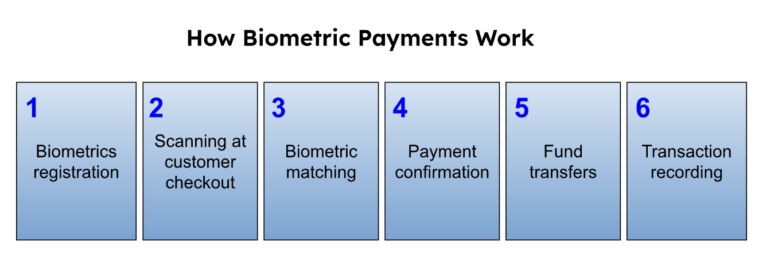
Key takeaways: Biometric payments make use of a customer’s unique physical attributes to authenticate a transaction. Touch ID on smartphones — using fingerprints to confirm digital wallet payments — is the most widely used form of biometric payment. Other forms of biometric payments include palm vein scanning, facial mapping, iris scanning, and voice recognition. Businesses looking to set up in-store biometric payment methods will need a biometric scanner to register, store, capture, and match customers’ biometric data. What are biometric payments? Biometric payments are transactions that use human physical attributes, such as fingerprint, palm, facial features, iris, and voice, to authenticate and confirm a customer’s intent to purchase. Like a person’s signature, these biometric characteristics are unique for each individual and are hard to replicate. This makes biometric payment one of the most secure contactless payment methods today. Modern biometric payment began in the early 2000s when John Rogers founded the Pay By Touch service, which allows customers to pay by scanning their fingerprints. Apple followed soon after, launching Touch ID technology in 2013 as a key feature of the iPhone 5S. Today, fingerprint scanners are in almost every smartphone, tablet, and laptop, used to secure personal information and confirm mobile payments. Who should use biometric payments? Customers can set up fingerprint authentication on their smartphones and use it to authenticate their payments. So any ecommerce or brick-and-mortar store regardless of business type can accept biometric payments if it already supports digital wallet payments such as Apple Pay, Google Pay, PayPal, and the like. A merchant-based biometric payment setup, such as those often used in government, private offices, and even schools, requires considerable hardware and software investment. In general, you should invest in a biometric scanner if your business: Serves customers in person: Customers will have to be physically present to register and scan their fingerprint or palm to confirm their payment. A great example would be retailers with self-service kiosks like grocery stores or fast food restaurants. Caters to a younger demographic: Younger costumes are more open to setting and signing up for new payment methods Enables better customer experience: Adding biometric payments to a POS system that’s already integrated with CRM and loyalty management systems can significantly boost customer experience, from the first purchase to repeat transactions. Offers subscriptions: Biometric registration integrated within the sign-up process gives customers an increased sense of security, which can build loyalty and attract new customers. Healthcare services are a good example. How do biometric payments work? Image: Biometric payments process flow The customer registers their biometrics information with a store. This is then added to the customer’s profile and encrypted. When the customer next shops in the store, the merchant’s system will prompt for biometric authentication to complete the purchase via the biometric scanner. The system searches its stored biometric data based on the customer name and matches it against the features captured by the biometric scanner. If the biometric data matches, the transaction is confirmed and a receipt is generated. Otherwise, the system alerts the cashier and prompts for a rescan. The customer’s chosen payment method is debited with the purchase amount while the merchant receives the proceeds of the transaction less the processing fees. The customer’s source of funds and the merchant’s POS and payment processor records the transaction. For online businesses, biometric payment authentication is connected to mobile wallet apps. The transaction process follows any other NFC payment method used on online payment gateways with the added biometric security prompted by the customer’s smartphone. SEE: 5 Online Payment Methods for Small Businesses To Try What is a biometric scanner? The biometric scanner is the technology at the core of biometric payments. It is a combination of: Hardware that captures the biometric attribute via a near-infrared (NIR) sensor, smart camera, or microphone, and Software that stores the biometric data. The scanner also replaces the role of a password or PIN so that only individuals whose biometrics are stored in the system can gain access to the asset the security is protecting. This includes allowing a person to use a source of funds to complete a transaction. Types of biometric authentication There are several means of processing biometric authentication: Fingerprint scanning: The scanner records multiple point-to-point measurements of an individual’s fingerprint (usually the index or thumb). Palm vein scanning: The scanner captures the vein patterns from the individual’s palm. ‘ Facial mapping: The scanner captures “facial landmarks” and measures features such as the distance between points, slopes, ridges, and angles of the face. Iris scanning: The scanner identifies and records the unique characteristics of an individual’s iris. Voice recognition: Records an individual’s voice sample and identifies accents, inflection points, and tone. In principle, biometric authentication is applied to provide security and monitor events by confirming identity. You will likely be more familiar with it being used to access a secure location, register identity with a bank, school, or government body, unlock phones or laptops, and confirm attendance than as a means to protect your source of funds during payments. That said, consumers are becoming more open to biometrics payments thanks to smartphones. What are the different biometric payment methods available today? The most widely adopted biometric payment methods available today are fingerprint and palm scanning. And, though still rare, there are also recent developments in the use of iris scans, voice recognition, and facial mapping to authenticate payments. Biometric payments examples The primary example of biometric payments are fingerprint-scanning-enabled smartphones, such as iPhones, that prompt a customer to scan their finger via the screen to proceed with a payment. (Image: Apple) Mastercard launched its global Biometric Checkout Program in 2022, which used facial recognition technology to authenticate transactions. The customer just needs to hold out their hand and smile at the smart camera to complete their purchase. (Image: Mastercard) Just last year, Mastercard partnered with Poland retail store Empike and fintech PayEye to launch its pilot biometric Checkout Program in Europe. Empik customers can pay for their purchases with a

What Are Biometric Payments & How Do They Work? Read More »

EuroStack: Europe’s path to digital independence?

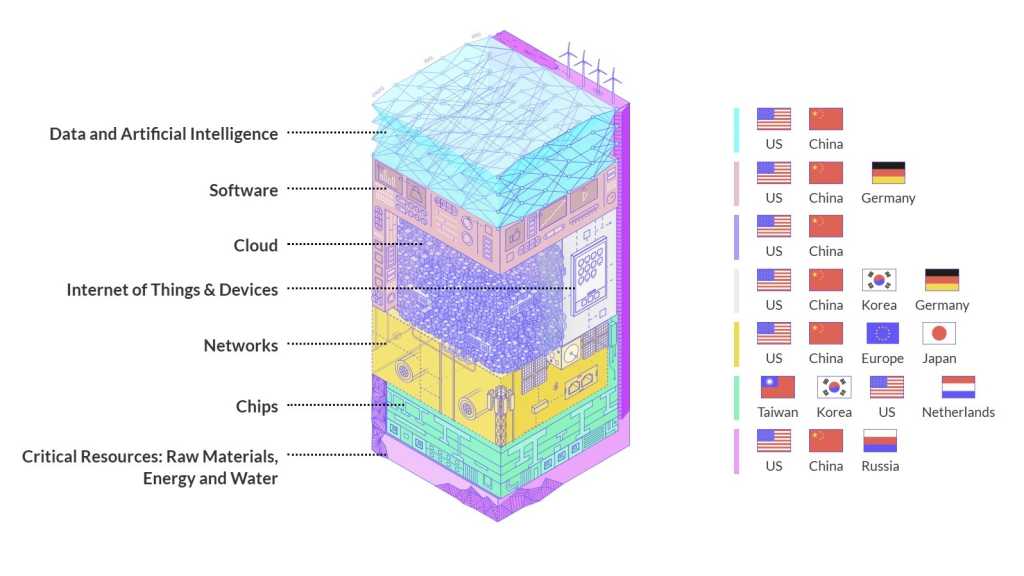
Resources: critical materials, energy and skilled labor; Chips: processors, memory technologies and quantum communication systems; Networks: Digital and physical connections, including cell towers and fiber optic networks; Connected devices and IoT: devices that enable real-time information processing and data collection Cloud infrastructure: Secure data storage and computing power; Software platforms, applications and algorithms: Operating systems, applications and cybersecurity frameworks; Data and AI: processing data to gain insights. EuroStack has already identified the leading European companies and existing alliances and networks for each level. These include companies such as Aleph Alpha, Bosch, Deutsche Telekom, NextCloud, SAP and Siemens. In order to close the gaps, the first step is to set up a European sovereign technology fund, which will initially provide ten billion euros to develop digital EuroStack demonstrators. These demonstrators, which will be selected as part of an open competition known as the EuroStack Challenge, will serve as minimum viable products (MVPs) to demonstrate Europe’s ability to innovate and scale in the field of digital enabling technologies. The status quo: Europe is dependent on foreign providers in almost all areas of technology. EuroStack Overall, the initiative envisages a total investment of €300 billion over a period of 10 years, with various sources of funding to be tapped into. These include existing EU programs such as Horizon Europe, Digital Europe and the European Innovation Council (EIC) as well as national contributions, private investment and venture capital. source

EuroStack: Europe’s path to digital independence? Read More »

Compliance Pointers For DOJ's Sweeping Data Security Rule

By Sam Castic ( February 21, 2025, 12:38 PM EST) — A new final rule from the U.S. Department of Justice aims to prevent countries of concern from accessing U.S. sensitive personal data and government-related data[1]. The rule, which was issued on Dec. 27 and takes effect on April 8, implements former President Joe Biden’s 2024 Executive Order No. 14117 on U.S. data security. … Law360 is on it, so you are, too. A Law360 subscription puts you at the center of fast-moving legal issues, trends and developments so you can act with speed and confidence. Over 200 articles are published daily across more than 60 topics, industries, practice areas and jurisdictions. A Law360 subscription includes features such as Daily newsletters Expert analysis Mobile app Advanced search Judge information Real-time alerts 450K+ searchable archived articles And more! Experience Law360 today with a free 7-day trial. source

Compliance Pointers For DOJ's Sweeping Data Security Rule Read More »

「Zetrix」香港區「環球小姐」(Miss Universe) 2025 選美大賽正接受報名

由「Zetrix」冠名贊助第 73 屆香港區「環球小姐」(Miss Universe)選美大賽於上年再度盛大啟動,招募來自香港的女性參加,吸引逾百位後選人參加,美女雲集,當中不少候選人擁有選美經驗,她們於個人面試中的發揮相當出色。隨著上 一屆全球矚目的選美盛事「環球小姐」(Miss Universe) 2024 選美大賽取得空前成功,全球超過 150 個國家及地區參與。 香港區選美大賽主辦方正式宣布,2025 年「Zetrix」香港區「環球小姐」選美大賽已正式啟動並公開招募來自香港的女性參加,支持香港的傑出女性,期待能夠看見新一屆的環球小姐代表香港 走向國際舞台,為香港爭光,飛躍至更高的成就。選拔賽報名現已正式開始,截止日期為 5 月 23 日,期盼更多香港女性踴躍參與,共同創造屬於香港的美麗傳奇!香港區「環球小姐」(Miss Universe)2025 選美大賽之冠軍將代表香港參加 2025 環球小姐全球總決賽爭奪冠軍寶座。 回顧上屆「Zetrix」香港區「環球小姐」(Miss Universe)選美大賽,姚祖恩(Jojo)以大熱姿態 贏得 2024 年度香港區「環球小姐」(Miss Universe)冠軍寶座;姚祖恩同時奪得「環球小姐香 港區 2024 最上鏡佳麗獎」及「環球小姐香港區 2024 Zetrix 最受歡迎佳麗獎」,大熱膺三料冠軍; 亞軍由甄蕎(Yankiu)奪得;雷莊兒(Juliette)則是雙料季軍,同時獲得「環球小姐香港區 2024 最具台型佳麗獎」。姚祖恩(Jojo)代表香港前往墨西哥參加 2024 環球小姐全球總決賽, 與來自世界各地的佳麗爭妍鬥麗,發揮超高水準,成功將香港的獨特魅力展現於世界舞台。 「Zetrix」香港區「環球小姐」(Miss Universe)選美大賽 2025 選拔賽現已正式接受報名,香港區「環球小姐」(Miss Universe)冠軍將代表香港參加 2025 環球小姐全球總決賽,並可獲得總 值一百萬港元現金獎,亞軍及季軍可分別獲得總值二十萬及十萬港元現金獎。香港區「環球小 姐」(Miss Universe)選美大賽主辦機構宣布由 2024 年起,取消參賽選者之年齡上限,以往年齡限制為 18-28 歲。同時,亦不設身高及體重限制,讓更多有才華的女性有機會參與這個國際性的選美比賽,彰顯個人魅力與自信,相信將會為香港乃至全球的參賽者創造更多公平和充滿包容的競爭環境,讓真正有實力的佳麗脫穎而出。 「環球小姐」(Miss Universe)選美大賽不單是一個選美活動,更是展現女性魅力、讓女性發光發亮回饋社會的舞台。「環球小姐」旨於培養女性自信心,展現她們最優秀的一面,使其擁有為社會甚至世界作出實質改變的力量。 2025 香港區「環球小姐」(Miss Universe)為具抱負、才華、 美麗自信的年輕女性提供一個榮耀與挑戰並存的成長舞台,讓她們有機會以環球小姐的身份代表香港參賽,推動香港女性的美麗與才華在國際舞台上綻放光芒。 香港區「環球小姐」(Miss Universe)選美大賽 2025 選拔賽現已接受報名 參加資格: (A) 參選者必須為女性; (B) 參選者必須年滿 18 歲; (C) 參選者必須持有有效之香港身份證 報名方法: 參選者必須於 2025 年 5 月 23 日(星期五)或以之前將個人資料、聯絡電話及近照,電郵至大會電子郵箱: [email protected] 有關香港區「環球小姐」(Miss Universe)選美大賽 粉絲們請密切關注官方 Instagram 帳號 @miss.universe.hk 了解比賽的最新動態、幕後花絮及其他精彩內容。 LinkedIn Email Facebook Twitter WhatsApp source

「Zetrix」香港區「環球小姐」(Miss Universe) 2025 選美大賽正接受報名 Read More »

CIOs in Dubai discuss the AI-Ready IT team of tomorrow

As organizations across the Middle East accelerate their adoption of artificial intelligence, a critical question arises: how do you build an IT team equipped to handle this transformation? This was the central theme of a panel discussion at the 18th edition of the IDC Middle East CIO Summit, held in Dubai, which brought together IT leaders to explore talent development strategies for the AI-infused enterprise. The panel recognized that IT organizations are undergoing a fundamental shift, requiring CIOs, data heads, and AI leaders to rethink their approach to talent management. The discussion revolved around key areas such as skill assessment, gap analysis, data architecture, security, governance, and the non-technical skills necessary for cross-functional collaboration and change management. “The biggest challenge is that people are not used to operating at a very fast speed and making decisions quicker than they currently do. This will cause some challenges when we start to see good use cases of AI implementation. How do we work with that speed? On the tech side, there is a big skills gap. Part of the problem is that when we start a course, the technology has already changed; it’s also changing so fast,” said Adam Lalani, CTO at Alliad (UAE). source

CIOs in Dubai discuss the AI-Ready IT team of tomorrow Read More »

What Financial Intermediaries Can Expect From New Admin

By A.J. Dhaliwal and Moorari Shah ( February 14, 2025, 11:13 AM EST) — Brokers, lead generators and digital platforms — key intermediaries in consumer financial services — are closely monitoring how the change in administration might affect ongoing regulatory initiatives. These intermediaries operate at the nexus of consumer access and financial innovation, making them integral yet vulnerable to evolving rules aimed at balancing consumer protection with market competition…. Law360 is on it, so you are, too. A Law360 subscription puts you at the center of fast-moving legal issues, trends and developments so you can act with speed and confidence. Over 200 articles are published daily across more than 60 topics, industries, practice areas and jurisdictions. A Law360 subscription includes features such as Daily newsletters Expert analysis Mobile app Advanced search Judge information Real-time alerts 450K+ searchable archived articles And more! Experience Law360 today with a free 7-day trial. source

What Financial Intermediaries Can Expect From New Admin Read More »