Decoding OpenAI’s Super Bowl ad and Sam Altman’s grandiose blog post

Join our daily and weekly newsletters for the latest updates and exclusive content on industry-leading AI coverage. Learn More If you were in one of the nearly 40 million U.S. households that tuned into the NFL Super Bowl LIX this year, in addition to watching the Philadelphia Eagles trounce the Kansas City Chiefs, you may have caught an advertisement for OpenAI. This is the company’s first Super Bowl ad, and it cost a reported $14 million — in keeping with the astronomical sums commanded by ads during the big game, which some come to see instead of the football. As you’ll see in a copy embedded below, the OpenAI ad depicts various advancements throughout human history, leading up to ChatGPT today, what OpenAI calls the “Intelligence Age.“ While reaction to the ad was mixed — I’ve seen more praise and defense for it than criticism in my feeds — it clearly indicates that OpenAI has arrived as a major force in American culture, and quite obviously seeks to connect to a long lineage of invention, discovery and technological progress that’s taken place here. Innofensive and simple, or dramatic and stark? On its own, the OpenAI Super Bowl ad seems to me to be a totally inoffensive and simple message designed to appeal to the widest possible audience — perfect for the Super Bowl and its large audience across demographics. In a way, it’s even so smooth and uncontroversial that it is forgettable. But coupled with a blog post OpenAI CEO Sam Altman published on his personal website earlier on Sunday entitled “Three Observations,” suddenly OpenAI’s assessment of the current moment and the future becomes much more dramatic and stark. Altman begins the blog post with a pronouncement about artificial general intelligence (AGI), the raison d’etre of OpenAI’s founding and its ongoing efforts to release more and more powerful AI models such as the latest o3 series. This pronouncement, like OpenAI’s Super Bowl ad, also seeks to connect OpenAI’s work building these models and approaching this goal of AGI with the history of human innovation more broadly. “Systems that start to point to AGI* are coming into view, and so we think it’s important to understand the moment we are in. AGI is a weakly defined term, but generally speaking we mean it to be a system that can tackle increasingly complex problems, at human level, in many fields. People are tool-builders with an inherent drive to understand and create, which leads to the world getting better for all of us. Each new generation builds upon the discoveries of the generations before to create even more capable tools — electricity, the transistor, the computer, the internet and soon AGI.“ A few paragraphs later, he even seems to concede that AI — as many developers and users of the tech agree — is simply another new tool. Yet he immediately flips to suggest this may be a much different tool than anyone in the world has ever experienced to date. As he writes: “In some sense, AGI is just another tool in this ever-taller scaffolding of human progress we are building together. In another sense, it is the beginning of something for which it’s hard not to say ‘this time it’s different’; the economic growth in front of us looks astonishing, and we can now imagine a world where we cure all diseases, have much more time to enjoy with our families and can fully realize our creative potential.“ OpenAI’s (and others’) quest for longevity The idea of “curing all diseases” is certainly appealing — it mirrors something rival tech boss Mark Zuckerberg of Meta also sought out to do with his Chan-Zuckerberg Initiative, a medical research nonprofit co-founded with his wife, Prisicilla Chan. As of two years ago, the timeline proposed to reach this goal was 2100. Yet now, thanks to the progress of AI, Altman seems to believe it’s attainable even sooner, writing: “In a decade, perhaps everyone on earth will be capable of accomplishing more than the most impactful person can today.” Altman and Zuck are hardly the only two high-profile tech billionaires interested in medicine, and longevity science in particular. Google’s co-founders, especially Sergey Brin, have put money towards analogous efforts, and in fact, there were (or are) at one point so many leaders in the tech industry interested in prolonging human life and ending disease that back in 2017, The New Yorker magazine did an extensive feature: “Silicon Valley’s Quest to Live Forever.” This utopian notion of ending disease and ultimately death seems patently hubristic to me on the face of it — how many folklore stories and fairy tales are there about the perils of trying to cheat death? — but it aligns neatly with the larger techno-utopian beliefs of some in the industry, which have been helpfully grouped by AGI critics and researchers Timnit Gebru and Émile P. Torres under the umbrella term TESCREAL, an acronym for “transhumanism, extropianism, singularitarianism, (modern) cosmism, rationalism, effective altruism and longtermism.” As these authors elucidate, the veneer of progress sometimes masks uglier beliefs, such as the inherent racial superiority or humanity of those with higher IQs or specific demographics, ultimately evoking racial science and phrenology of more openly discriminatory and oppressive ages past. There’s nothing to suggest in Altman’s note that he shares such beliefs, mind you…in fact, rather the opposite. He writes: “Ensuring that the benefits of AGI are broadly distributed is critical. The historical impact of technological progress suggests that most of the metrics we care about (health outcomes, economic prosperity) get better on average and over the long-term, but increasing equality does not seem technologically determined and getting this right may require new ideas.” In other words: He wants to ensure everyone’s life gets better with AGI, but is uncertain how to achieve that. It’s a laudable notion, and one that maybe AGI itself could help answer. But, for one thing, OpenAI’s latest and greatest models remain closed and proprietary as opposed to competitors such

Decoding OpenAI’s Super Bowl ad and Sam Altman’s grandiose blog post Read More »

How to Fix the Four Biggest Problems with Failed VPN Connections

Virtual private networks have risen from obscurity to become the frequently preferred method of linking private networks. Although VPNs became popular because they enabled using the Internet to secure network connections, thereby eliminating the need for expensive dedicated circuits, VPN adoption skyrocketed because the technology also proved relatively simple, reliable, and secure. Considering VPNs foolproof, however, leads to a false sense of security. Following state-sponsored attacks that used compromised VPNs to enable exploitative attacks, organizations received a wake-up call that VPN accounts require close monitoring and safeguarding, too. With proper security practices, VPNs continue to effectively fulfill an essential need to reliably and securely connect remote employees, branch offices, authorized partners, and other systems. Yet VPN connection errors continue to inevitably arise. Often, Windows server-powered VPN connection issues that arise often fall into one of four categories: The VPN connection is rejected. An unauthorized connection is accepted. Locations beyond the VPN server prove unreachable. A tunnel cannot be established. Here’s how to resolve these common Windows Server-powered VPN connection errors. Semperis Employees per Company Size Micro (0-49), Small (50-249), Medium (250-999), Large (1,000-4,999), Enterprise (5,000+) Small (50-249 Employees), Medium (250-999 Employees), Large (1,000-4,999 Employees), Enterprise (5,000+ Employees) Small, Medium, Large, Enterprise Features Advanced Attacks Detection, Advanced Automation, Anywhere Recovery, and more ESET PROTECT Advanced Employees per Company Size Micro (0-49), Small (50-249), Medium (250-999), Large (1,000-4,999), Enterprise (5,000+) Any Company Size Any Company Size Features Advanced Threat Defense, Full Disk Encryption , Modern Endpoint Protection, and more ManageEngine Log360 Employees per Company Size Micro (0-49), Small (50-249), Medium (250-999), Large (1,000-4,999), Enterprise (5,000+) Micro (0-49 Employees), Small (50-249 Employees), Medium (250-999 Employees), Large (1,000-4,999 Employees), Enterprise (5,000+ Employees) Micro, Small, Medium, Large, Enterprise Features Activity Monitoring, Blacklisting, Dashboard, and more Working with the Windows Server Routing and Remote Access console Once a VPN is set up using a Windows Server, connection issues occasionally occur, even when a connection previously worked properly. Troubleshooting often involves working with Windows servers’ Routing and Remote Access console snap-in tool, which is where Microsoft concentrates many VPN configuration settings. The Routing and Remote Access snap-in lives within the Microsoft Management Console, known as the MMC. There are multiple ways to access the MMC. You can select the console from the Start menu’s Programs options, within the Administrative Tools folder within Windows server’s Control Panel or by typing mmc at a command prompt. You can also reach the MMC by pressing the Windows key and the letter R simultaneously and entering mmc and pressing the Enter key. While the actual user interface and menu options occasionally change subtly between specific server versions, administrators should be able to navigate the various consoles — whether working with an older version or the current Windows Server 2022 iteration — using the same approach. How to fix the four biggest problems with failed VPN connections 1: The VPN connection is rejected. Having a VPN client’s connection rejected is perhaps the most common VPN problem. Part of the reason this problem is so common is that many issues can cause a connection to be rejected. If the Windows server-powered VPN rejects client connections, you first need to confirm that the Routing and Remote Access Service is actually running on the Windows server. You can check by opening the Windows server’s Services console, which you can access by clicking Start | Control Panel | Administrative Tools | Services. With the Services console open, navigate within the list of services to the Routing and Remote Access entry to ensure its service is running. The Services console displays the status of the Routing and Remote Access entry. With the Routing and Remote Access entry highlighted within the Services console, you can click Start the Service or right-click the entry and select Restart. If the RRAS service was set to Manual or Disabled, you can open the entry, change the Startup Type to Automatic, and then click Start and OK. More about Cloud Security After confirming the RRAS service is running, it’s a good idea to test the connection by pinging the VPN server first by IP address and then by its fully qualified domain name. If you encounter errors, a DNS problem is likely occurring, and you can turn your attention to resolving that issue. If the VPN server pings work, though, and you still have connection issues, address a potential authentication mismatch. Sometimes, the VPN client and VPN server are set to use different authentication methods. Confirm whether an authentication error is the problem by opening the server console. Yet another method of accessing the MMC is to type Control+R to open a command prompt in which you can type mmc and hit Enter or click OK. With the console open, navigate to the Routing and Remote Access entry. If the entry isn’t present, click File, select Add/Remove Snap-in, choose the Routing and Remote Access option from the choices, and click Add, then OK. With the Routing and Remote Access snap-in added, right-click on the VPN server and click Properties. Then, review the Security tab to confirm the authentication method. Windows Authentication is the most common, although a different option, such as RADIUS may be in place. Ensure the VPN client is set to the authentication method specified within the Security tab. More things to check Typically, the items just reviewed are responsible for most VPN connection refusal errors. But other fundamentals must be correct, too. For example, if the Windows Server hosting the VPN hasn’t joined the Windows domain, the server cannot authenticate logins. You’ll first have to connect the server to the domain. IP addresses are another fundamental element for which administration must be properly set. Each Web-based VPN connection usually uses two different IP addresses for the VPN client computer. The first IP address is the one that the client’s ISP assigned. This is the IP address that’s used to establish the initial TCP/IP connection to the VPN server over the Internet. However, once the client attaches to the VPN

How to Fix the Four Biggest Problems with Failed VPN Connections Read More »

Europe has twice as many climate tech startups as the US

Europe is home to twice as many climate tech startups as the US (30,000 vs. 14,300). However, limited access to VC funding is forcing these early-stage companies to seek capital from outside the continent, according to a new report released at the Munich Security Conference today. Venture financing in Europe averaged just 0.2% of GDP between 2013 and 2023, a fraction of the US average of 0.7%. While the continent is great at creating clean tech companies, it’s not so good at funding them.  The authors of The Importance of Climate Tech for European Resilience report — the World Fund, Kaya Partners, and Worthwhile Capital Partners — fear this trend isn’t just bad for business, but also leaves Europe exposed to geopolitical and economic shocks. Dependency on foreign powers for everything from solar panels to EVs is eroding Europe’s resilience, they said.  They warn that Europe has lost the early advantage in climate tech R&D that it established during the 2010s. Germany provides a good example. Despite being a frontrunner in solar and wind capacity in the early 2000s, the country saw its progress stall after 2012 due to tariff and subsidy policies. As a result, annual installed renewable capacity peaked at 9.7GW in 2012 and remained below that level until 2022. “Thanks to its leadership in climate tech innovation, Europe has a second chance to build leading industries and strengthen its resilience,” said Danijel Višević, World Fund general partner and co-author of the white paper. “We shouldn’t repeat the mistakes made in 2012, but capitalise on our opportunities.” The 💜 of EU tech The latest rumblings from the EU tech scene, a story from our wise ol’ founder Boris, and some questionable AI art. It’s free, every week, in your inbox. Sign up now! The authors call for bold, long-term policy and investment shifts across four key areas: energy, food security, frontier technologies, and raw materials. They view defence as a unifying thread across these sectors.  The paper’s key recommendations include upgrading the energy grid, boosting long-term energy storage, and backing frontier tech like AI, fusion, and quantum computing. It also calls for an increase in EU defence spending to at least 3% of GDP.   Additionally, the report reiterates Mario Draghi’s call for €800bn in annual spending via public-private partnerships, regulatory streamlining, and expanded roles for institutions like the European Investment Bank.   Combined, these actions could provide a clear and solid basis for policies that actively strengthen resilience by 2029, the report argues.  The paper comes as world leaders gather at tense times in global politics, which are strengthening the case for European independence in venture financing.    “Disruption is upon us,” said Bo Lidegaard, a partner at Kaya Partners and co-author of the white paper. “Europe must embrace it and reignite the creativity, innovation, and entrepreneurship so deeply rooted with us.” source

Europe has twice as many climate tech startups as the US Read More »

The people and AI that fuel Repsol’s digitalization

Finally, there’s the responsible AI group, and since the first stage of the digital program, mechanisms have been established to ensure responsible and safe AI models. “In the second digital wave, we’ve collaborated with other organizations by forming working groups to promote joint reports that ensure responsible AI,” Arroyo adds. “In addition, we set guiding principles in line with the European AI Act, and defined the governance model so AI is used legally, responsibly, and in an agile manner.”   Adding layers for better performance After a year of work, in addition to the lines already launched, the company created additional ones including systemized gen AI plans for each business unit; the Business and Productivity Impact Office to identify, measure, and monitor the impact generated by gen AI; structured training to facilitate the successful adoption of gen AI; and human-centered AI to define the interaction between users and applications.  The Generative AI Competence Center has also had a major impact on professionals and the corporate culture. Within the framework of new ways of working, the Copilot M365 pilot project has been carried out to help evaluate the impact of the gen AI tool, alongside active change management. The experiment lasted four months and resulted in an average time saving of 121 minutes per week, per person on routine tasks, which represents over 96 hours per year per employee. source

The people and AI that fuel Repsol’s digitalization Read More »

IPhone Buyers Can't Get Apple DOJ Docs Before Discovery

By Nadia Dreid ( February 18, 2025, 9:25 PM EST) — Apple doesn’t have to turn over the millions of documents it gave the U.S. Department of Justice as part of a private monopolization suit brought by iPhone and Apple Watch buyers, at least not until discovery, a judge overseeing the recently created multidistrict litigation has said…. Law360 is on it, so you are, too. A Law360 subscription puts you at the center of fast-moving legal issues, trends and developments so you can act with speed and confidence. Over 200 articles are published daily across more than 60 topics, industries, practice areas and jurisdictions. A Law360 subscription includes features such as Daily newsletters Expert analysis Mobile app Advanced search Judge information Real-time alerts 450K+ searchable archived articles And more! Experience Law360 today with a free 7-day trial. source

IPhone Buyers Can't Get Apple DOJ Docs Before Discovery Read More »

8 Best Bank Accounts for Shopify Stores in 2025

As a Shopify store owner, choosing the right financial provider is crucial for the smooth operation and growth of your business. It’s important to select a bank that not only integrates seamlessly with Shopify but also offers minimal transaction fees and robust support for payment processing. As your business expands, opting for a bank with additional features, such as financing options and the ability to handle international transfers, becomes essential. Our list highlights both traditional banks and fintech companies, each offering key features and tools to help your Shopify store thrive. Here is the list of the eight best bank accounts for Shopify stores. Best bank accounts for Shopify stores quick comparison Below is a summary of the top features I considered for the eight best bank accounts for Shopify stores. U.S. Bank Platinum Business Checking: Best overall bank account for Shopify Stores My rating: 4.23 out of 5 Image: U.S. Bank U.S. Bank Member FDIC.  is a traditional bank offering business accounts online with three checking tiers. The Silver Business Checking has no monthly fees, 125 free transactions, and a $2,500 cash deposit allowance monthly. The Gold and Platinum accounts offer more transactions and higher deposit limits. U.S. Bank also provides savings products and lending solutions, including lines of credit, quick loans, and term loans, making it a flexible choice for businesses of all sizes. Read our U.S. Bank business checking review to learn more about its fees and features. Why I chose it U.S. Bank Platinum Business Checking is my top recommendation for the best business bank account for Shopify stores. With high fee-free transactions and cash deposit limits, it offers significant savings. The bank provides robust mobile and online banking tools to help you track transactions and manage bill payments. Additionally, you can use the free cash flow forecast tool to keep your finances in check and integrate with QuickBooks to easily manage bills and invoices. Earn a $500 bonus when you open a Silver Business Checking account or $900 when you open a Platinum Business Checking account online (promo code: Q1AFL25) and meet qualifying activities, subject to certain terms and limitations. The offer is valid through March 31, 2025. Member FDIC. Monthly fees Silver Business Checking: $0 Gold Business Checking: $20; waivable by having any of these: A U.S. Bank Payment Solutions Merchant Banking account $10,000 average collected balance $20,000 combined average collected business deposit balances $50,000 combined average collected business deposits and outstanding credit balances Platinum Business Checking: $30; waivable by having any of these: A U.S. Bank Payment Solutions Merchant Banking account $25,000 average collected checking balance $75,000 combined average collected business deposits and outstanding credit balances Features Cashflow tools QuickBooks and ADP integrations Overdraft protection In-person and online banking options High-yield money market accounts Check fraud prevention services Fee-free withdrawals at the MoneyPass network Small Business Administration (SBA) loans, lines of credit, and term loans Pros and cons Pros Cons Up to $900 welcome offer No monthly fee for basic tier checking Free cash flow forecast tool Low interest for interest-bearing checking products Steep balance requirement to waive the monthly fees of high-tier accounts $100 initial deposit Mercury Business Checking: Best for fee-free wire transfers and subaccounts My rating: 4.20 out of 5 Image: Mercury Mercury Mercury is a fintech company, not an FDIC-insured bank. Banking services provided by Choice Financial Group and Evolve Bank & Trust®️; Members FDIC. Deposit insurance covers the failure of an insured bank. is an ideal fintech choice for Shopify entrepreneurs, offering a business checking account with no monthly fees, unlimited transactions, and seamless integrations with Shopify and QuickBooks. With FDIC coverage Mercury is a fintech company, not an FDIC-insured bank. Deposits in checking and savings accounts are held by our banking services partners, Choice Financial Group and Evolve Bank & Trust®️; Members FDIC. Deposit insurance covers the failure of an insured bank. Certain conditions must be satisfied for pass-through insurance to apply.  of up to $5 million through partner banks, your funds are well-protected. As your business grows, you can upgrade to Mercury Plus or Pro for advanced automated accounting features. Check out our comprehensive Mercury business checking review to learn if it suits your business needs. Why I chose it Mercury business checking is one of my best Shopify bank accounts, particularly those running global operations or frequently working with international suppliers. Its fee-free domestic and international wire transfers help you save on cross-border payments. Additionally, Mercury’s 14 subaccounts make it easy to track customer payments and allocate funds for specific expenses like marketing and shipping. This level of organization and flexibility makes Mercury a top choice for eCommerce businesses. Monthly fee Mercury Business Checking: $0 Features Physical and virtual debit cards QuickBooks, NetSuite, and Xero accounting software integration Compatible with Shopify, Stripe, Square, Zapier, Amazon, and PayPal payment processors IO corporate card has auto cash back rewards Savings account available Customized account access Advanced accounting automation is available under a subscription plan Mercury investor database Pros and cons Pros Cons No opening deposit, minimum balance requirement, or monthly fee Fee-free wire transfers 14 subaccounts No cash deposit support Sole proprietorship and trust accounts cannot be opened Non-interest earning checking account Novo Business Checking: Best for fee-free ACH transfers and express payments My rating: 4.13 out of 5 Image: Novo Novo Provider is a fintech platform, not a bank. It provides FDIC insurance and deposit services through a partnership with Middlesex Federal Savings. , a fintech supporting Shopify stores, offers a business checking account with no monthly fees, unlimited transactions, and fee-free standard ACH transfers. Through its partnership with Wise, Novo allows you to send international payments at a low cost. You also enjoy up to $7 in monthly ATM fee refunds, applicable to both local and international debit card transactions. Additionally, Novo lets you access your Stripe payouts early, providing quicker access to your funds for better cash flow management. Read our Novo business checking review to discover its key features and pricing. Why

8 Best Bank Accounts for Shopify Stores in 2025 Read More »

Sonar analyzes code for quality, security metrics for developer teams

00:00 Hi, everybody. Welcome to DEMO, the show where companies come in and showcase their latest products and services. I’m joined today by Harry Wang. He is the Vice President of Growth and New Ventures at Sonar. Welcome to the show, Harry. 00:11Thank you for having me, Keith. 00:12So, tell us a little bit about Sonar and what you’re going to show us today. 00:15Yeah, absolutely. Sonar is the company behind a very well-known product, SonarQube, widely used in the developer and DevOps community. We serve over 7 million developers, 400,000 organizations, and more than 20,000 commercial customers. 00:34So, is this product designed for individual developers, teams, or entire IT departments? 00:42Both, actually. Our company was started by developers for developers, so we are very much a developer-first organization. Our goal is to help developers write better code, stay productive, and ultimately build better applications. For organizations and IT departments, it’s about coordination — ensuring software quality and code integrity. 1:06And if you had to narrow it down, what is the key problem you’re solving for developers? What challenges are they facing that Sonar can help with? 1:17In two words: code quality. As companies undergo digital transformations, software has become one of their most valuable assets. And behind every software product is its code. Code is, I would argue, the largest asset a company has as it moves into the digital future — especially with the rise of AI.Nowadays, it’s not just humans writing code; AI is generating code as well. So, maintaining high-quality code is critical because it underpins the entire application development process. 1:49Are companies typically checking their code quality after development, or are you seeing more teams integrate it into the development process? 2:03Excellent question. For our audience — many of whom are in leadership roles within organizations — the concept of “shift left” should be familiar. As a developer-first company, we’ve always focused on the left side of the development process. So for us, it’s about getting the code right from the beginning — solving and preventing problems early. The cost of fixing issues is much lower when caught early in development, and it’s even better if those issues never occur in the first place. 2:37So, if a company doesn’t have a platform like Sonar, how would they typically handle code quality? Would they be manually reviewing everything post-development, or would they be using other tools? 2:49Often, the traditional process involves defining requirements, writing code, and then passing it through various testing phases — unit tests, integration tests, usability tests. If everything goes well, it goes into production. But the feedback cycle for detecting issues — whether during testing or in production — can be very long, sometimes stretching for months. Developers in the field often experience delays due to these extended feedback loops. Our goal is to shorten that feedback cycle significantly. 3:25All right, so the idea is to speed up the entire process. 3:27Exactly. 3:28Let’s take a look at what you’ve got. Show us some cool stuff. 3:31Yeah, sure. I’m going to jump into the SonarQube UI. This is a self-hosted version, but we also offer a SaaS solution. This is the home view, where you can see multiple projects. For roles like Head of Engineering, Platform Engineering, or Developer Experience, managing many applications and projects is a daily task. We have a concept called portfolios, which helps different stakeholders organize projects they care about. These are self-defined — so, for example, a CIO might want visibility into all projects across the organization. Here, you can see different metrics that leadership cares about, organized by product. You get a high-level overview, but you can also drill down into individual projects. If you’re concerned about releasability, for example, this tells you if a project has issues preventing it from being built or deployed. Or, if you’re the CISO, security is your priority. You can see security metrics across different projects. Reliability is another key factor — things like race conditions between threads or memory leaks. So, we measure various aspects of the code depending on its state. Whether you’re a team lead or a senior leader, you can generate customized reports. 5:15And I see you’re giving letter grades. That reminds me of school. 5:20Exactly, same concept! 5:22If you go back to your projects or portfolio… you had a lot of Ds on one of them. 05:29Yes, if a project has a D (or worse, an E), that’s a major red flag. Let’s take an example. My favorite language is Java, so let’s pick one of those projects. You can see this project has an E rating — definitely something that requires attention. We also have something called a quality gate. This is a concept we introduced to help organizations define stopping criteria. Essentially, if a project doesn’t meet certain standards — whether due to security issues, maintainability concerns, or lack of unit test coverage — it fails the quality gate. That means it cannot move forward until the team resolves the issues. Let’s drill into that. You can see the product failed, but you also get insights into what’s happening with new code and the overall codebase. Development teams typically work on small portions of a codebase at a time. It might contain millions or even tens of millions of lines of code, but during a sprint, they may only be touching a few files. They can choose to focus on just the new code or take a broader view — paying off technical debt and refactoring where needed. If I know there are 18 issues, I can drill down into them and see what’s causing the failure. As a developer or technical lead, I can investigate each issue, assign tasks, and ensure they’re addressed early in the sprint. You can also categorize issues — whether they’re security vulnerabilities, readability concerns, or maintainability challenges. And of course, security is always a major concern. Here’s an example — this is a user-controlled code vulnerability, which could

Sonar analyzes code for quality, security metrics for developer teams Read More »

Why We're Moving from ZTE to SASE Terminology

As software-defined wide-area networks (SD-WANs) hit the peak of excitement, Forrester analysts noticed that the hype wasn’t turning into deployments. Many of the SD-WAN investigations were being held up by security teams that put a pause on the projects as the teams tried to wrap their heads around the shift in security architecture and controls from data center to cloud. At the time, networking and security were becoming interdependent, yet organizations and solutions were not quite there. Forrester put together a model that would help clients build a single, integrated networking and security model, coining a term that we thought was fitting — Zero Trust edge (ZTE) — as these changes made way for providing Zero Trust security via networking at the edge. But we weren’t the only ones naming this same new phenomenon; the term secure access service edge (SASE) rose around the same time. It didn’t set the bar quite at the same threshold as ZTE, but it described the same change. At the time, the market was full of partnerships between networking and security vendors, and only a few vendors had started to create a single solution with management and monitoring delivered from the cloud. Why Now? Five years later, the market is full of integrated solutions. It is also clear at this time that SASE (pronounced “sassy”) is the preferred market term. As such, we are going to switch over to this market-preferred term while pushing that term to meet the same bar we set for ZTE. For me, this is an easy decision, as customer-first has always been my one key truth to live by. Why? Please indulge me as I take a trip down memory lane, as my career is shaped by two prior experiences: Engineering aircraft components. Straight out of college, I spent time at a small aircraft company engineering new capabilities and improving the manufacturing, safety, or quality of existing parts. In that world, a slight change in dimension of component, such as landing-gear tube thickness, could cause a crash. I spent a lot of time talking to the pilots to see what improvements would drive them to buy the next model or lure new buyers. My greatest contribution: a curved dashboard. The costs of manufacturing the dashboard increased, but current and potential clients loved it. It made the aircraft feel personalized, and the instruments were easier to read. Launching ProVision ASIC and 5400. While I was at HP ProCurve (before the HP split into HPE and HP Inc.), account managers heavily pushed client visits to promote the previous launch (5400 and ProVision ASIC). Not only did I get a lot of direct feedback from customers about the new products (and launch) that helped shape the next cycle, but they also weren’t shy about sharing their thoughts about other products. Many of these thoughts were about real barriers they faced that made their day-to-day or real-world scenarios challenging. Hence, I try to create and release information as if I’m walking in the customer’s shoes, removing any hurdles to getting the best information to make the right decision for their organizations. If clients search “SASE” looking for best practices, design guides, and vendor comparisons, then that is the term we must use to get them what they need. Rather than waste cycles drawing comparisons between the two, we will simply push SASE to be better and achieve a higher standard to meet clients’ needs. We will be pivoting our original definition to now define SASE this way: A solution that combines security and networking functionalities — such as software-defined wide-area networks (SD-WANs), cloud access security brokers (CASBs), Zero Trust network access (ZTNA), and secure web gateways (SWGs) — delivered and supported by a single vendor with any combination of cloud, software, or hardware components. Tactically, this means that over the next few weeks, our current research with ZTE will be relabeled with SASE, along with any future research listed. A big thank you to my friend and former colleague, David Holmes, for his collaboration on this research. It was truly a pleasure. source

Why We're Moving from ZTE to SASE Terminology Read More »

The 7 Best Cash Management Accounts Reviewed for 2025

Cash management accounts are held at non-bank financial institutions (NBFIs), investment firms, fintechs, payment processors, or brokerages. Generally, those needing cash management accounts have other investments housed at these depositories, such as stocks, bonds, mutual funds, certificates of deposit (CDs), or Individual Retirement Accounts (IRAs). Cash management accounts can be set up for personal or business use, depending on your needs. This product is used as an all-in-one general account that simultaneously acts as a checking account and a savings account. Most cash management accounts allow for deposits, withdrawals, debit card transactions, and the use of bill pay. Each institution has its own perks and benefits. It’s also a good way to monitor larger investments by linking cash management and investment accounts together through online portals. Here is a list of the best seven cash management accounts for 2025: Best overall for businesses of all sizes, from startups to large corporations: Ramp Ramp Business Corporation is a financial technology company and is not a bank. Bank deposit services provided by First Internet Bank of Indiana, Member FDIC. Securities products and brokerage services are provided by Apex Clearing Corporation. Apex Clearing Corporation is an SEC-registered broker-dealer, a member of FINRA and SIPC. Best for high-growth startups with substantial cash reserves: Mercury Mercury is a fintech company, not an FDIC-insured bank. Banking services provided by Choice Financial Group, Column N.A., and Evolve Bank & Trust, Members FDIC. Treasury accounts are advised by Mercury Advisory LLC, an SEC-registered investment adviser (“Mercury Advisory”), and are custodied by Apex Clearing Corporation, a registered broker dealer and Member FINRA/SIPC. Treasury accounts are not FDIC insured. High-liquidity, lower-risk portfolios are powered by J.P. Morgan and Morgan Stanley. Exclusively for Mercury account holders. Best for startups, growth-stage businesses, and world-class enterprises: Rho Rho is a financial technology company, not a bank. Checking account and card services are provided by Webster Bank, N.A., member FDIC. Savings account services are provided by American Deposit Management Co. and its partner banks. Securities based portfolios do not have FDIC insurance. Best for businesses operating online, eCommerce marketplaces, or those collecting peer-to-peer payments: Stripe Stripe Treasury Accounts are eligible for FDIC pass-through deposit insurance if they meet certain requirements. The accounts are eligible only to the extent pass-through insurance is permitted by the rules and regulations of the FDIC, and if the requirements for pass-through insurance are satisfied. The FDIC insurance applies up to 250,000 USD per depositor, per financial institution, for deposits held in the same ownership capacity. Stripe is not a federally insured deposit institution. FDIC insurance applies only in the event of the failure of an FDIC-insured bank. Best for business and personal investors looking for a cash management account to keep investment funds and spendable funds separated: Fidelity Your tooltip content goes here. Best for individuals searching for a high-yield cash management account for short-term investments: Vanguard The Vanguard Cash Plus Account is a brokerage account offered by Vanguard Brokerage Services, a division of Vanguard Marketing Corporation, member FINRA and SIPC. Under the Sweep Program, Eligible Balances swept to Program Banks are not securities: they are not covered by SIPC, but are eligible for FDIC insurance, subject to applicable limits. Money market funds held in the account are not guaranteed or insured by the FDIC, but are securities eligible for SIPC coverage. Best for individuals looking for an account with a high FDIC deposit limit across partner relationships and high APY: Wealthfront Cash Account is offered by Wealthfront Brokerage LLC (“Wealthfront Brokerage”), a Member of FINRA/SIPC. Neither Wealthfront Brokerage nor any of its affiliates are a bank, and Cash Account is not a checking or savings account. Funds are conveyed to partner banks that accept and maintain deposits, provide the interest rate, and provide FDIC insurance. Investment management and advisory services — which are not FDIC insured — are provided by Wealthfront Advisers LLC (“Wealthfront Advisers”), an SEC-registered investment adviser. Financial planning tools are provided by Wealthfront Software LLC (“Wealthfront”). The Stock Investing Account is a limited-discretion investment product offered by Wealthfront Advisers LLC. Best seven cash management accounts quick comparison If you’re searching for a fintech for general business banking needs and also looking for interest-earning options, you may want to consider Bluevine. For a full roundup of its features, you can read our Bluevine Business Checking Review. Ramp: best overall for businesses of all sizes, from startups to large corporations Image: Ramp Ramp Treasury is my top overall pick for a business cash management account with all the bells and whistles. It’s a unique account that allows investors to cut the wait time down significantly without the high fees. Many cash management accounts offer speed or no fees. With Ramp, you don’t have to choose. Compromise is not an option. It also has fully integrated workflows every step of the way and plenty of software integrations to make financial management a breeze. Why I chose it Ramp pays one of the highest APYs with the lowest risk on its cash management account. Currently, this rate is at 2.5% and is FDIC-backed by First Internet Bank of Indiana. It also has no fees, no minimum deposits, no transfer caps, unlimited ACH, and it can be linked to your investment accounts so you can see and manage all your finances from one login. Due to its relationship with partner banks and the Insured Cash Sweep (ICS) service provided by IntraFi, FDIC coverage can be extended up to tens of millions of dollars per depositor, as stated on its website. Features Free unlimited ACH High FDIC coverage through the ICS/IntraFi program High APY without risky investments Easy funds transfer through online portal Automatic alerts when funds are low or if the current balance will not cover bills Integrates with Ramp corporate cards Pros and cons Pros Cons No fees No minimum balance requirement Same-day ACH is free Automatic alerts No transfer caps Cash deposits not accepted Fewer banking products compared to traditional banks No physical locations Mercury: best for

The 7 Best Cash Management Accounts Reviewed for 2025 Read More »

Perplexity just made AI research crazy cheap—what that means for the industry

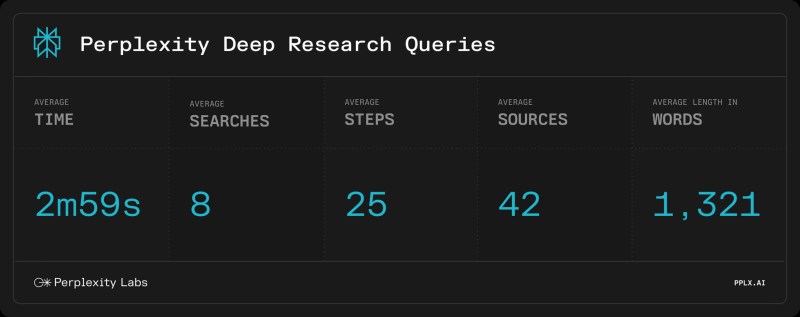
Join our daily and weekly newsletters for the latest updates and exclusive content on industry-leading AI coverage. Learn More Perplexity has shattered the AI market’s status quo today by launching Deep Research, a tool that generates comprehensive research reports in minutes and opens advanced AI capabilities to users at a fraction of typical enterprise costs. “Thankful for open source! We’re going to keep making this faster and cheaper,” Perplexity CEO Aravind Srinivas wrote in a post on X. “Knowledge should be universally accessible and useful. Not kept behind obscenely expensive subscription plans that benefit the corporates, not in the interests of humanity!” Thankful for open source! We’re going to keep making this faster and cheaper. Knowledge should be universally accessible and useful. Not kept behind obscenely expensive subscription plans that benefit the corporates, but not in the interests of humanity! https://t.co/mtG4oZhl4z pic.twitter.com/M1yHtXJKUe — Aravind Srinivas (@AravSrinivas) February 14, 2025 Perplexity Deep Research is redefining AI pricing — can enterprise AI survive? The launch exposes a painful truth in AI pricing: Expensive enterprise subscriptions may be unnecessary. While Anthropic and OpenAI charge thousands monthly for their services, Perplexity offers five free queries daily to all users. Pro subscribers pay $20 monthly for 500 daily queries and faster processing — a price point that could force larger AI companies to explain why their services cost up to 100 times more. Companies have been significantly increasing their AI investments, with enterprise AI spending expected to rise by 5.7% in 2025, despite overall IT budget increases of less than 2%. Some businesses are planning to increase their AI spending by 10% or more, with an average increase of $3.4 million dedicated to AI initiatives. These investments now look questionable as Perplexity delivers similar capabilities at consumer prices. In a typical query, Perplexity’s Deep Research tool performs 8 searches and consults 42 sources to generate a 1,300-word report in under 3 minutes. (Credit: Perplexity) How Perplexity Deep Research is outperforming Google and OpenAI Deep Research’s technical achievements suggest expensive AI services may be overpriced rather than superior. The system scored 93.9% accuracy on the SimpleQA benchmark and reached 20.5% on Humanity’s Last Exam, outperforming Google’s Gemini Thinking and other leading models. OpenAI’s Deep Research still leads with 26.6% on the same exam, but OpenAI charges $200 percent for that service. Perplexity’s ability to deliver near-enterprise level performance at consumer prices raises important questions about the AI industry’s pricing structure. “Deep Research on Perplexity completes most tasks in under 3 minutes,” the company announced, highlighting its ability to perform dozens of searches and analyze hundreds of sources simultaneously. The tool combines web search, coding capabilities and reasoning functions to refine research iteratively — mimicking expert human researchers but at machine speed. Perplexity Deep Research achieved a 93.9% accuracy score on the SimpleQA benchmark, substantially higher than competing models from OpenAI, Google and Anthropic. (Credit: Perplexity) Why Perplexity’s affordable AI is breaking down barriers to advanced technology The implications stretch beyond pricing. Enterprise AI has created a digital divide between well-funded companies and everyone else. Small businesses, researchers and professionals who couldn’t afford thousand-dollar subscriptions were effectively locked out of advanced AI capabilities. Perplexity’s approach changes this calculation. The tool handles complex tasks, from financial analysis and market research to technical documentation and healthcare insights. Users can export findings as PDFs or share them through Perplexity’s platform, potentially replacing expensive research subscriptions and specialized tools. Deep Research is now a commodity thanks to Perplexity pic.twitter.com/Fk8yvPTLzV — Aravind Srinivas (@AravSrinivas) February 14, 2025 The company plans to expand Deep Research to iOS, Android, and Mac platforms, which could accelerate adoption among users who previously viewed AI tools as out of reach. This broad access may prove more valuable than any technical breakthrough — finally putting advanced AI capabilities in the hands of users who need them most. For technical decision makers, this shift demands attention. Companies paying premium prices for AI services should examine whether those investments deliver value beyond what Perplexity now offers at a fraction of the cost. The answer may reshape how organizations approach AI spending in 2025 and beyond. While Perplexity’s competitors scramble to justify their premium pricing, thousands of users are already testing Deep Research’s capabilities. Their verdict might matter more than any benchmark: In AI’s new reality, the best technology isn’t the one that costs the most — it’s the one people can actually use. source

Perplexity just made AI research crazy cheap—what that means for the industry Read More »