Rethinking the enterprise network backbone

Multiple business imperatives are driving CIOs to re-examine and re-invent their approach to network infrastructure, including the mission critical backbone that supports highly complex, bandwidth-intensive, multi-cloud environments. One emerging alternative: backbone-as-a-service (BBaaS) offerings. As with other “as-a-service” offerings, the idea behind BBaaS is to simplify the process of providing secure, high-performance connectivity across geographic regions. It’s especially attractive as an alternative to MPLS, promising to do for wide-area backbones what the cloud did for compute, storage, and application development. The business pressures prompting the need for such a service are many, including: M&A/Business Expansion: Enterprises are constantly changing, whether through sudden mergers and acquisition, digital transformation efforts, or growth into new markets. Networks need to be designed to help organizations accelerate the pace of change, rather than slow things down. Edge: The proliferation of IoT devices in industries such as manufacturing, retail, energy, utilities and oil and gas is generating new demands for high-bandwidth, low-latency edge-to-data center and edge-to-cloud connectivity. Hybrid multi-cloud: The debate over cloud vs. on-prem has been pretty much settled; and the answer is both. Organizations are living in a hybrid, multi-cloud world where some applications are moving to the cloud, others are remaining on-premises, and many are using multiple hyperscalers and SaaS providers. Connectivity across this complex ecosystem needs to be resilient, secure and seamless. AI: The emergence of AI as a C-level priority creates new requirements for network capacity to move large data sets between on-prem and cloud locations, and to deliver high-bandwidth, low-latency connectivity for traditional apps that now have an AI component embedded in them, such as Microsoft 365 Copilot. Out with the old, in with the new Historically, enterprises relied on a MPLS for much of their wide-area connectivity requirements. Provided by traditional telecom vendors, MPLS is a reliable, secure technology, but it is also expensive and inflexible — it can take months to get a new circuit provisioned. The scattering of employees to remote work sites, the migration of applications to the cloud and the requirements for networks to provide agile, flexible, cost-effective, any-to-any connectivity have rendered MPLS obsolete. In its place, enterprises are looking for a cloud-based service that features one-click provisioning, on-demand scalability, consumption-based pricing, a self-service portal, and, best of all, no hardware to own or manage. Alkira CBaaS delivers connectivity and more for today’s AI-driven networks One such offering is Alkira Global Backbone-as-a-Service. It provides high-capacity, low-latency, site-to-site, elastic connectivity between core data centers, edge locations, remote sites and any multi-cloud site – with no equipment to manage or software to download. Customers connect their sites to Alkira Cloud Exchange Points (CXPs) located in different regions around the globe and get encrypted IP connectivity on hyper-scale cloud infrastructure, providing high performance. The service also enables enterprises to migrate their SD-WAN fabrics to the cloud. Through the Alkira portal, enterprises can build, deploy, manage and monitor their entire network from a single interface. Alkira also offers integrated security services and provides visibility and governance. The benefits are increased speed and agility, a shift from Capex to Opex for funding, and the ability to scale up or down with a single click. Offerings such as the Alkira Global Backbone-as-a-Service support digital transformation efforts, help drive innovation, and enable organizations to reap the full benefits of the AI revolution. To learn more about Alkira Global Backbone-as-a-Service, visit: https://www.alkira.com/global-backbone-as-a-service/ source

Rethinking the enterprise network backbone Read More »

AI Product Managers: The Role Of The Future Or Another Tool In Your toolkit?

In the early days of the internet, job opportunities for “internet product managers” began to appear as companies recognized their need for this new technology. As the internet evolved, other roles such as “web product manager” or “digital product manager” became common. While these roles to some extent still exist, having internet experience is now an expected prerequisite for most product management roles. Today, you are probably seeing more “AI product manager” or “AI product owner” job titles. A Google search on “AI product managers” today reveals anywhere from a thousand of these roles to over twenty thousand jobs with these title or skills requirements. While “AI PMs” might go the way of internet product manager in the future, today it is clear that there is a demand for individuals with traditional product management skills and AI-specific expertise. Key Areas Of Proficiency Are Required For The AI Product Manager AI-specific technical competence: AI product managers will need to demonstrate an understanding of AI and machine learning technologies and how AI models are trained, tested, and implemented. Data science skills: As AI models are dependent on their underlying data, AI product managers will need to deeply understand data requirements, quality, and potential biases that will impact a model’s performance. AI model performance: An AI product manager will need to understand how AI models are developed and iterated with the goal of improving usability, accuracy, reliability, and scalability along with the time and costs involved in that process. Regulatory, ethics, and bias understanding: AI models sometimes replicate biases in the source data for the models. An AI product manager will need to understand the sources and effects of these biases and how to test for them, as well as an understanding of how privacy, regulatory, and ethical issues should be managed. Education, evangelization, and influence management: Given that generative AI is a quickly evolving technology, AI product managers will be called on to evangelize the business benefits and bring stakeholders up to speed. Many of the challenges today for the AI product manager will differ slightly from those of their traditional colleagues. More than working on product features, AI product managers are focused on model performance, acceptable error rates, understanding new types of user interaction, and management of risk and cost trade-offs. Of course, core similarities remain: the focus on solving real customer problems, setting vision and strategy, roadmap prioritization and trade-offs, stakeholder management, and working with marketing, sales, and customer success. Every Product Manager Will Be An AI Product Manager, So Start Learning Today Just as the “internet product manager” evolved to become a component of today’s standard product management practice, Forrester predicts that AI will also become part of the standard product manager’s role in the future. Generalist PMs will need a baseline understanding of AI so they can thoughtfully integrate AI capabilities into existing products and continually improve those capabilities based on technology changes and customer feedback. They will also need to understand the basics of model behavior, data privacy, and ethical considerations. Product Leaders Must Support Their Teams’ AI/ML Learning Product management leaders must take a strategic approach to upskilling their teams about AI and ML by fostering a culture of learning and providing hands-on experiences. A good start is providing AI literacy courses (such as those from Coursera or LinkedIn Learning), hands-on learning opportunities like AI hackathons or instructor-led AI bootcamps, and online interactive options such as Google’s ML crash course. Finally, product leaders must encourage team members to experiment with today’s popular tools in their everyday lives. A suggestion: Make one day a week a “no search engine” day, encouraging use of AI tools instead. Please join Forrester Vice President and Principal Analyst Lisa Singer and her panel of experts to discuss AI product strategy in a fast-changing world at Forrester’s B2B Summit North America 2025. source

AI Product Managers: The Role Of The Future Or Another Tool In Your toolkit? Read More »

Lili Review: Business Checking Features, Pros, Cons & More

Lili is a digital-first banking platform tailored for small business owners, and entrepreneurs looking for an accessible, modern approach to financial management. Known for its user-friendly mobile app, automated expense tracking, and fee-free business checking accounts, Lili aims to empower business owners with a streamlined, hassle-free banking experience. Wondering if Lili is the right fit for your business needs? Below, I dive into Lili’s key features, pricing structure, and how it compares with other digital banking services. Lili’s fast facts My rating: 4.7 out of 5Starting price: Free business checking with no monthly maintenance fees or minimum balance requirementsKey features: No monthly fees Automatic tax and expense categorization Seamless integration with bookkeeping tools like QuickBooks Instant invoice creation for easy billing Image: Lili Lili has gained popularity among self-employed individuals and small business owners who want simplicity in their business banking. With comprehensive expense tracking, tax categorization, and no-cost banking options, Lili helps entrepreneurs achieve financial clarity without the need for a physical bank branch. Let’s take a closer look at what Lili offers and how it stands out among digital banking competitors. Lili Business Checking review: User ratings and feedback 4.7/5 Lili has received positive feedback for its automated features, user-friendly interface, and fee-free structure, making it especially popular among solo business owners. Most users appreciate Lili’s expense and tax categorization tools, which are perfect for keeping track of finances without hassle. On the downside, some users note that Lili doesn’t offer options for cash deposits, which may be limiting for businesses that handle cash frequently. Despite this limitation, Lili remains an excellent choice for digital-focused businesses that operate primarily online (i.e., ecommerce, digital stores, etc.). Trustpilot: 4.7 out of 5 stars G2: 4.6 out of 5 stars Business owners consistently commend Lili for its straightforward account setup and digital banking tools, which streamline expense tracking and simplify financial organization. A common drawback is the lack of cash deposit options. However, this won’t impact businesses that are comfortable operating online. Lili’s pricing structure Lili’s pricing model centers around accessibility and simplicity. It offers business checking accounts with no monthly maintenance fees and no balance requirements, which makes Lili especially appealing to business owners, and startups wanting to reduce banking expenses while gaining access to effective financial tools. No monthly fees: Lili’s business checking account is completely free with no hidden fees. Unlimited ACH transfers: ACH transfers between accounts are unlimited and free of charge. Debit card access: Both digital and physical debit cards are available for free. Automatic tax and expense tracking: Built-in features categorize transactions and track expenses, helping users simplify bookkeeping and tax preparation. Lili’s low-cost, feature-rich approach is ideal for small businesses aiming to keep expenses low while gaining access to essential banking functions. Visit Lili Key features of Lili Business Checking 4.7/5 Lili provides features designed to meet the needs of small business owners, and entrepreneurs. Here’s a closer look at what you can expect from Lili Business Checking. 1. No monthly fees Lili’s business checking account is completely free, with no monthly maintenance fees or minimum balance requirements. This makes Lili a cost-effective option for small business owners who want to save on banking fees. 2. Automated tax and expense tracking One of Lili’s standout features is its automated tax and expense categorization. Every transaction is automatically sorted and categorized, making it easier for business owners to monitor their spending and prepare for tax season. This feature is especially helpful for business owners who often handle both personal and business expenses. 3. Integration with accounting software Lili integrates seamlessly with popular accounting tools like QuickBooks, allowing users to sync their transactions and streamline bookkeeping. This integration reduces the time spent on manual entry, giving users a clear view of their cash flow and simplifying financial management. 4. Digital and physical debit cards Lili offers both virtual and physical debit cards that can be used for business expenses. The ability to issue multiple cards and set spending limits makes it easier for small teams to manage expenses while keeping finances secure and organized. Would our expert use Lili Business Checking? 5.0/5 Lili Business Checking is an excellent choice for solo business owners, and small teams who prefer a digital-first approach to banking. The fee-free structure and automated expense tracking make it ideal for entrepreneurs looking to minimize costs while gaining access to essential financial tools. Expert opinion: Lili is perfect for businesses prioritizing affordability, tech-driven solutions, and easy integration with accounting software. However, a more traditional bank may be a better fit if your business frequently requires cash deposits or in-person banking services. Lili pros No monthly fees or minimum balance requirements: Great for startups and business owners focused on reducing costs Automated tax categorization and expense tracking: Helps users stay organized and prepared for tax season Integration with QuickBooks: Syncs transactions automatically, reducing manual data entry Digital and physical debit cards: Easy to issue and manage, especially useful for small teams Lili cons No option for cash deposits: May limit businesses that handle cash Limited to online-only services: No physical branches or in-person banking options No business credit or lending products: Focuses exclusively on checking accounts and debit cards, so businesses needing credit may need an alternative provider Business types supported by Lili Lili is designed to cater to a variety of small business structures, making it a versatile banking solution for entrepreneurs. The types of businesses that can benefit from Lili include: Sole proprietors: Lili is ideal for individuals running their own small, unincorporated businesses. Single-member LLCs: Lili supports single-member LLCs, offering tools to help business owners manage expenses, categorize transactions, and prepare for tax season. Independent contractors: Lili’s automated expense tracking and tax features are especially useful for those working in gig- or project-based roles. Side hustlers: Lili’s no-fee checking is an excellent option for side hustlers who may not need a traditional business account but want to keep their business and personal finances separate. With these business structures in mind,

Lili Review: Business Checking Features, Pros, Cons & More Read More »

3. How the COVID-19 pandemic affected U.S. religious life

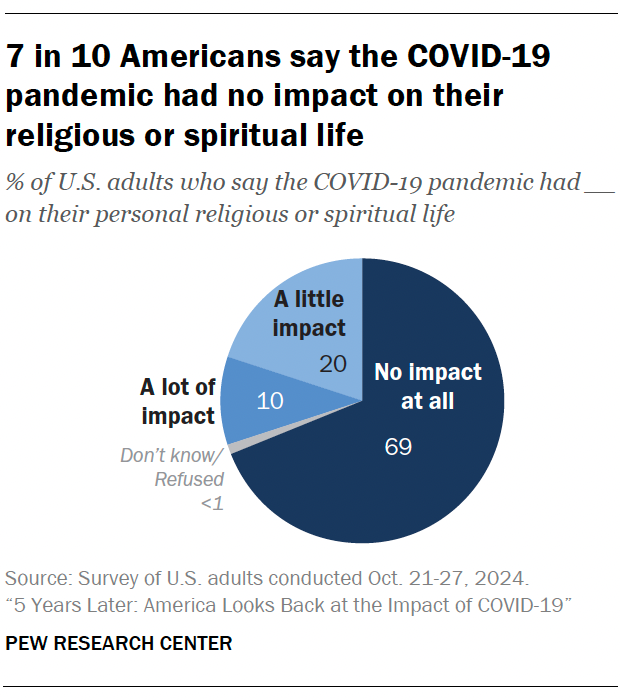
Michael Rotolo contributed to this chapter. The COVID-19 pandemic had an enormous impact on how religious communities gather for worship. In a Pew Research Center survey in July 2020, a few months after the coronavirus struck the United States, just 6% of Americans who regularly attend religious services said their house of worship was open to the public and holding services in the same way as before the COVID-19 outbreak. The vast majority reported either that their house of worship was not open for in-person services (31%) or that it was open but with changes to limit the spread of disease (55%). More than a year and a half later, in March 2022, fewer than half of regular worshippers (43%) reported that their church, synagogue, mosque or other house of worship had completely returned to normal, pre-pandemic operations. Yet, despite COVID-19’s widespread effects on how houses of worship operate, most Americans say their religious and spiritual lives have not been changed by the pandemic, according to a Center survey conducted in October 2024. Just 10% of U.S. adults report that the COVID-19 pandemic had a lot of impact on their religious or spiritual lives, while 20% say the pandemic had a little impact. About seven-in-ten Americans (69%) say the pandemic had no impact at all on their religious or spiritual lives. Among those who say their religious or spiritual lives were impacted, the pandemic’s effects appear to be a mixed bag: Roughly equal shares of U.S. adults say the pandemic’s effect on their religious or spiritual lives was mostly positive (10%), mostly negative (9%) and neither positive nor negative (11%). Trends in religious service participation Throughout the pandemic, we periodically asked U.S. adults whether they had attended religious services in person in the prior month and, separately, whether they had participated virtually (either by streaming religious services online or by watching them on TV). Since the early days of the coronavirus outbreak, the ways in which Americans participate in religious services have changed dramatically, with steadily rising numbers attending in person (and an overall drop in virtual participation) as the pandemic gradually receded. Yet the percentage of U.S. adults taking part in religious services in some way – in person, virtually or both – has remained quite steady. In each of six surveys between 2020 and 2024, about 40% (or slightly more) of respondents reported that they had participated, one way or another, in services during the past month. In the October 2024 survey, 32% of Americans say they attended religious services in person in the month prior to the survey, and 27% say they watched services online or on TV during the same period – both up slightly from the last time we asked these questions in November 2022. The new survey also asked respondents whether they currently attend religious services in person more often, less often or about as often as they did before the pandemic. A second question asked the same thing about how often they watch services virtually. The vast majority of U.S. adults say their religious participation habits have not changed: About eight-in-ten say either that they attend services in person about as often as they did before the pandemic (31%) or that they did not attend before the pandemic and still don’t (48%). Roughly eight-in-ten say either that they watch services virtually about as often as they did before the pandemic (18%) or that they didn’t watch services before the pandemic and still don’t (62%). There may be a small net decrease in in-person attendance: 13% of Americans say they attend in person less often than they did before the pandemic, while just 7% say they now attend more often. But that difference is almost exactly offset by an increase in virtual participation: 13% of Americans say they watch services online more often than they did before the pandemic, while 6% say they now watch less often. Together, these survey findings paint a picture of remarkable stability in U.S. religious life during a time of widespread upheaval in how houses of worship operate and despite a decades-long decline in religious affiliation and participation. The spiritual impact of the pandemic among religious groups and by race/ethnicity Black Protestants and Hispanic Catholics are more likely than some other large U.S. religious groups to say the pandemic affected their religious or spiritual lives. Nearly half of Black Protestants (46%) and Hispanic Catholics (47%) say the pandemic had at least a little impact on their religious or spiritual lives, compared with 30% of U.S. adults overall. This appears to reflect a broader racial and ethnic pattern. Black Americans (44%), Hispanic Americans (40%) and Asian Americans (44%) are far more likely than White Americans (24%) to say the pandemic affected their religious or spiritual lives. These differences hold up even in statistical analyses that control for the effects of age, gender, education, political party, ideology, religious affiliation, income and region. Among those who say their religious or spiritual lives were impacted by the pandemic: Black Protestants are more likely to say the pandemic had a mostly positive impact on them than a mostly negative impact (17% vs. 11%). White Catholics are more likely to say the pandemic had a mostly negative impact than a mostly positive impact on them (11% vs. 6%). When looking at race and ethnicity more broadly, Black, Hispanic and Asian Americans are somewhat more likely to say the pandemic had a mostly positive than a mostly negative impact on their religious or spiritual lives. Roughly equal shares of White Americans say the pandemic’s effect on their religious or spiritual lives was mostly positive (7%) and mostly negative (8%). Trends in religious service participation among religious and demographic subgroups Throughout the pandemic, overall participation in religious services remained quite stable among most religious subgroups, most age groups and supporters of both major U.S. political parties. There are two notable exceptions: Religious service participation estimates for Jews are higher in the November 2022 and October 2024

3. How the COVID-19 pandemic affected U.S. religious life Read More »

Global Technology Spending In 2025 Will Reach $4.9 Trillion With Robust 5.6% Growth

The growing digital economy will capture 17% of global GDP by 2028 and see a 7% compound annual growth rate (CAGR) through 2028, which will in turn drive robust technology spending growth across the globe. In 2025, two-thirds of global tech spending will come from software and IT services, and in Europe and North America, this share of tech spending will be even higher. While the finance and insurance, government, and media and information sectors combined currently account for 46% of global tech spend, other factors driving global tech spending include: Software. Fueled by cybersecurity, cloud computing, generative AI (genAI), and the modernization of legacy systems, software will capture nearly 60% of global tech spend growth through 2029. The forecast shows that software spending by enterprises and governments will reach 1.7% of global GDP by 2029, nearly doubling its worth since 2016. GenAI will revolutionize sectors such as financial services, media, and retail, enhancing customer experiences with more personalized and humanlike virtual assistants and customer service solutions. IT services. Nineteen percent of global tech spend comes from tech consulting and system integration services, and 15% comes from tech outsourcing and hardware maintenance. Driven by infrastructure as a service, outsourcing services growth outpaces that of consulting services. The United States. With the advantages of lower inflation, reduced interest rates, and a dynamic technology sector, the US will see a 6% increase in technology spending (excluding staff costs) in 2025. Remarkably, the US accounted for 41% of global tech spend and 46% of AI software spend in 2024. Almost 70% of the top 24 companies by market cap that saw the fastest growth from 2015 to 2023 come from the US, and more than half of these are media and information companies. The Asia Pacific region. This region is witnessing a surge in real GDP growth that far exceeds the global average, led by countries such as India, the Philippines, Vietnam, and Indonesia. This rapid economic expansion drives tech spending growth, with emerging countries known for innovation like China, India, Japan, and Malaysia showcasing the region’s potent tech investment potential. Managing tech inhibitors. Enterprises need to balance tech talent availability (including AI capabilities acquired through partnerships and acquisitions) with the minimization of technical debt, as well as tangible tech investment returns. Legacy systems still capture two-thirds of global tech spending. With the half-life of tech skills at less than five years, skills renewal of the tech workforce is vital. To accelerate technology spending growth in 2025, enterprises will grow their AI infrastructure capacity (with strong growth expected for data centers) as well as find growth through partnerships and acquisitions. The Forrester report, Global Tech Market Forecast, 2024 To 2029, shows robust 5.6% growth in 2025 to reach $4.9 trillion that is then set to surpass $5 trillion by 2026 and soar beyond $6 trillion by 2029. For more in-depth analysis by region or country, also keep an eye out for Forrester’s European and US tech market forecasts from 2024 to 2029. source

Global Technology Spending In 2025 Will Reach $4.9 Trillion With Robust 5.6% Growth Read More »

Less supervision, better results: Study shows AI models generalize more effectively on their own

Join our daily and weekly newsletters for the latest updates and exclusive content on industry-leading AI coverage. Learn More Language models can generalize better when left to create their own solutions, a new study by Hong Kong University and University of California, Berkeley, shows. The findings, which apply to both large language models (LLMs) and vision language models (VLMs), challenge one of the main beliefs of the LLM community — that models require hand-labeled training examples. In fact, the researchers show that training models on too many hand-crafted examples can have adverse effects on the model’s ability to generalize to unseen data. SFT vs RL in model training For a long time, supervised fine-tuning (SFT) has been the gold standard for training LLMs and VLMs. Once a model is pre-trained on raw text and image data, companies and AI labs usually post-train it on a large dataset of hand-crafted examples in question/answer or request/response format. After SFT, the model can undergo additional training stages, such as reinforcement learning from human feedback (RLHF), where the model tries to learn implicit human preferences based on signals such as answer rankings or liking/disliking the model’s responses. SFT is useful for steering a model’s behavior toward the kind of tasks the model creators have designed it for. However, gathering the data is a slow and costly process, which is a bottleneck for many companies and labs. Recent developments in LLMs have created interest in pure reinforcement learning (RL) approaches, where the model is given a task and left to learn it on its own without hand-crafted examples. The most important instance is DeepSeek-R1, the OpenAI o1 competitor that mostly used reinforcement learning to learn complex reasoning tasks. Generalization vs memorization One of the key problems of machine learning (ML) systems is overfitting, where the model performs well on its training data but fails to generalize to unseen examples. During training, the model gives the false impression of having learned the task, while in practice it has just memorized its training examples. In large and complex AI models, separating generalization from memorization can be difficult. The new study focuses on the generalization abilities of RL and SFT training in textual and visual reasoning tasks. For textual reasoning, an LLM trained on a set of rules should be able to generalize to variants of those rules. In visual reasoning, a VLM should remain consistent in task performance against changes to different aspects of visual input, such as color and spatial layout. In their experiments, the researchers used two representative tasks. First was GeneralPoints, a benchmark that evaluates a model’s arithmetic reasoning capabilities. The model is given four cards, as textual descriptions or images, and is asked to combine them to reach a target number. For studying ruled-based generalization, the researchers trained the model using one set of rules, then evaluated it using a different rule. For visual generalization, they trained the model using cards of one color and tested its performance on cards of other colors and numbering schemes. The second task is V-IRL, which tests the model’s spatial reasoning capabilities in an open-world navigation domain that uses realistic visual input. This task also comes in pure-language and vision-language versions. The researchers evaluated generalization by changing the kind of instructions and visual representations the model was trained and tested on. They ran their tests on Llama-3.2-Vision-11B, warming the model up by training it on a small SFT dataset, then creating separate versions for each task and training paradigm. For each task, they separately scaled the training on RL and SFT. The SFT process trains the model on additional hand-crafted solutions, while RL lets the model generate many solutions for each problem, evaluate the results and train itself on the correct answers. The findings show that reinforcement learning consistently improves performance on examples that are drastically different from training data. On the other hand, SFT seems to memorize the training rules and doesn’t generalize to out-of-distribution (OOD) examples. These observations apply to both text-only and multimodal settings. SFT-trained models perform well on training examples (in-distribution) while showing poor performance on unseen examples (out-of-distribution) (source: arXiv) Implications for real-world applications While their experiments show that RL is better at generalizing than SFT, the researchers also found that SFT is helpful for stabilizing the model’s output format, and is crucial to enabling RL to achieve its performance gains. The researchers found that, without the initial SFT stage, RL training did not achieve desirable results. This is a bit different from the results obtained by DeepSeek-R1-Zero, which was post-trained on pure RL. The researchers suggest that this can be due to the different backbone model they used in their experiments. It is clear that there is a lot of untapped potential in RL-heavy approaches. For use cases that have verifiable results, letting the models learn on their own can often lead to unanticipated results that humans could not have crafted themselves. This could come in very handy in settings where creating hand-crafed examples can be tedious and expensive. source

Less supervision, better results: Study shows AI models generalize more effectively on their own Read More »

Money Market Account vs Savings Account: Which Is Better?

Money market accounts (MMAs) and savings accounts are common banking products offered by financial institutions. Both are classified as savings products and may seem similar since they earn interest. However, money market accounts tend to have higher interest rates and require larger minimum balances than savings accounts. Additionally, some MMAs let you write checks and often come with a debit card. What is a money market account? A money market account is a deposit account that blends the features of a traditional savings account and a checking account. In general, it offers higher interest but often has a higher minimum balance requirement and initial deposit than a traditional savings account. Money market accounts can include check-writing privileges and a debit card. What is a savings account? A savings account is a basic bank account where customers deposit their funds and earn interest. These accounts are considered low-risk and usually offer lower yields than money market accounts. Savings accounts also have lower initial deposits and balance minimums and often feature low or no monthly service fees. To encourage saving and limit access to funds, savings accounts typically are not issued a debit card. Key differences: savings account vs money market account Below is a table highlighting the differences between a savings account vs money market account. Savings Account Money Market Account Initial deposit amount Lower Higher Minimum balance requirement Lower Higher Monthly service fee Lower; waivable Higher; waivable Earns interest Yes Yes Monthly withdrawal limits Six but varies per provider Six but varies per provider Debit card availability No Yes; some Check-writing No Yes; some Federally insured Yes Yes Risk level Very low-risk Low-risk Suitability Short-term goals Medium to long-term goals Interest rates of money market vs savings accounts Before choosing a business bank, it is essential to review the interest rate offered for a money market vs a savings account. Money market account: It typically offers higher interest rates than savings accounts, ranging from 0.5% to over 3%, depending on the bank and the minimum balance required. Some financial institutions provide tiered MMAs, which yield higher returns for larger accounts. Savings account: In contrast, a savings account draws lower interest, typically between 0.01% and 0.5% at many banks. Online banks and credit unions may provide more competitive rates. The minimum balance requirements for savings accounts tend to be lower than MMAs. If your goal is to earn higher interest while meeting minimum balance requirements, I recommend choosing a money market account. However, if you want a simpler account without the pressure of maintaining a high balance, a regular savings account may be a better choice. Access to funds of money market vs savings accounts Compared to other types of savings products, such as certificates of deposit (CDs), both money market and savings accounts offer more liquidity. Money market account: Highly liquid, it enables easy access to funds and transfers to linked checking accounts. Unlike regular savings accounts, some MMAs also allow check writing and debit card access. However, check with your bank for withdrawal limits, as transfers and withdrawals are typically restricted to six per month under Federal Reserve regulations. Savings account: This account type allows easy access to funds through online banking and transfers between linked accounts, though it may have the same monthly withdrawal limits as MMAs. Some banks may not limit inter-account transfers. Generally, there are no minimum balance requirements, and you won’t face penalties for accessing your money. If you’re looking for more flexibility, such as the ability to write checks or use a debit card, I strongly recommend a money market account that offers these features over a traditional savings account. However, if you prefer higher liquidity without the need to maintain a large balance, a savings account might be more suitable for you. Minimum balances and fees of money market vs savings accounts Fees and balance requirements can vary a lot between money market accounts and savings accounts, depending on the financial institution. Here are some general differences: Money market account: Typically requires a higher minimum balance, often ranging from $1,000 to $5,000, but it can sometimes reach $10,000 or more. Monthly service fees usually range from $5 to $30. Additionally, if you exceed the monthly limit of six transactions, you may incur transaction costs. Savings account: Generally has lower minimum balance requirements, starting as low as $25 to $100. Many providers, particularly online-only banks, may not require a minimum balance or charge a monthly service fee at all. However, if you exceed the monthly withdrawal limit, a transaction fee of $3 to $10 may apply. If you have a smaller balance and prefer an account with little to no fees, a savings account is likely your best option. Between a money market and a savings account, I believe the latter can be a more cost-effective option if you don’t plan to maintain a large balance or earn high returns. Risk and insurance of money market vs savings accounts When discussing risk and insurance, both MMAs and savings accounts are generally considered low-risk options. They are typically insured by the Federal Deposit Insurance Corporation (FDIC) for banks and the National Credit Union Administration (NCUA) for credit unions. Money market account: It is designated as low-risk because it is backed by the FDIC or NCUA. If the financial institution fails, your account is protected up to $250,000 per depositor and per institution. Generally, the risk associated with MMAs is slightly higher since they may be invested in short-term securities, such as treasury bills and CDs. Savings account: Classified as very low risk, it is also insured by the FDIC or NCUA up to a coverage limit of $250,000 per depositor and per institution, in case of a bank or credit union failure. Regular savings accounts are considered the safest savings vehicles since they are not exposed to market fluctuations. Overall, I view both MMAs and savings accounts as low-risk options due to the FDIC or NCUA insurance coverage. While some minimal risk may exist,

Money Market Account vs Savings Account: Which Is Better? Read More »

5 Years Later: America Looks Back at the Impact of COVID-19

Most Americans say the pandemic drove the country apart Clockwise from top left: A second-grader does remote schoolwork at the Reading, Pennsylvania, Boys and Girls Club in January 2021. Protesting against COVID-19 vaccine mandates in Buffalo, New York, in February 2022. An Easter Mass in Washington, D.C., on April 4, 2021. White flags honoring lives lost to COVID-19 on Washington’s National Mall in October 2021. (Ben Hasty/MediaNews Group/Reading Eagle, Dustin Franz/AFP, Saul Loeb/AFP, Liu Jie/Xinhua, all via Getty Images) How we did this Pew Research Center conducted this study to better understand how Americans were impacted by the COVID-19 pandemic. Most data on Americans’ current views and experiences is from a survey of 9,593 U.S. adults conducted Oct. 21-27, 2024. Data on experiences in the workplace is from a separate survey of 5,273 U.S. workers conducted Oct. 7-13, 2024. Everyone who completed these surveys is a member of the Center’s American Trends Panel (ATP), a group of people recruited through national, random sampling of residential addresses who have agreed to take surveys regularly. This kind of recruitment gives nearly all U.S. adults a chance of selection. Surveys were conducted either online or by telephone with a live interviewer. The surveys are weighted to be representative of the U.S. adult population by gender, race, ethnicity, partisan affiliation, education and other factors. Read more about the ATP’s methodology. Here are the questions from the late October survey used for this report, the topline and the survey methodology. Here are the topline and survey methodology for questions from the Oct 7-13 workers survey. We supplemented our recent ATP survey data with previous Pew Research Center findings to explore how views and experiences changed during and after the pandemic. Links to these earlier surveys – including their toplines and methodologies – can be found throughout this report. The most significant pandemic of our lifetime arrived as the United States was experiencing three major societal trends: a growing divide between partisans of the left and right, decreasing trust in many institutions, and a massive splintering of the information environment. COVID-19 did not cause any of this, but these forces fueled the country’s divided response. Looking back, nearly three-quarters of U.S. adults (72%) say the pandemic did more to drive the country apart than to bring it together. Fundamental differences arose between Americans over what we expect from our government, how much tolerance we have for health risks, and which groups and sectors to prioritize in a pandemic. Many of these divides continue to play out in the nation’s politics today. The pandemic left few aspects of daily life in America untouched. Looking back on it nearly five years later, three-quarters of Americans say the COVID-19 pandemic took some sort of toll on their own lives. This includes 27% who say it had a major toll on them and 47% who say it took a minor toll. The virus itself also had a staggering impact. A large majority of U.S. adults have had COVID-19 at some point, and more than 1 million Americans died from it. Millions continue to struggle with long COVID. And most say they know someone who was hospitalized or died from the virus. But most Americans have moved on. The vast majority of those who say their lives were impacted report having recovered at least somewhat. Among U.S. adults overall, about one-in-five (21%) now say the coronavirus is a major threat to the health of the U.S. population as a whole. And a majority (56%) think it’s no longer something we really need to worry about much. This is reflected in Americans’ behavior: Just 4% regularly wear a mask, while most never do. And fewer than half of U.S. adults said they planned to get an updated COVID-19 vaccine last fall, a stark contrast to the long lines and widespread demand that met the initial rollout of vaccines. At the five-year anniversary of the coronavirus outbreak, a major Pew Research Center survey conducted in late October 2024 provides insight into how Americans assess the nation’s pandemic response. These findings are paired with an analysis of trends dating to early 2020. The report sections take a closer look at COVID-19’s impact in four specific areas of American life: health, work, religion and technology. Massive gaps remain between Republicans and Democrats in views toward COVID-19, including vaccines Majorities of both Democrats and Republicans were personally impacted by the pandemic: Eight-in-ten Democrats (including independents who lean to the Democratic Party) say COVID-19 took at least a minor toll on them, while 69% of Republicans and GOP leaners say the same. And virtually identical shares of Republicans and Democrats say they have tested positive for COVID-19 or been pretty sure they had it. But the pandemic highlighted the different values and priorities of America’s two major political parties. Two years after the pandemic started, Republicans were more likely than Democrats to say the country had given too little priority to individual choice and supporting businesses and economic activity in the response to the coronavirus outbreak. And a larger majority of Republicans than Democrats said the country hadn’t given enough priority to the needs of K-12 students. Democrats, meanwhile, were more likely to say the country came up short on limiting risks for vulnerable populations and protecting public health. These differing outlooks are part of what shaped the sharply partisan responses to COVID-19 that persist today. In the new survey: Republicans are much more likely to say COVID-19 is now no worse than a cold or flu. About six-in-ten Republicans say this. By contrast, 76% of Democrats take the opposite view and describe COVID-19 today as worse than a cold or flu. Meanwhile, Democrats are much more inclined to worry that we’re not taking COVID-19 seriously enough today. Fully 60% of Democrats worry we’re not taking COVID-19 seriously enough now, compared with 20% of Republicans. There also are differing views on the steps people should take when they are feeling sick. While majorities of both parties say

5 Years Later: America Looks Back at the Impact of COVID-19 Read More »

SAP aims to unify data for AI, analytics with new Business Data Cloud

Getting ready for agentic wars? Analysts also said that SAP’s strategy to champion BDC as the foundational data layer is another step towards getting ready for the agentic wars — a phase where rival vendors such as Salesforce, Oracle, Microsoft, Workday, and ServiceNow, among others will try to get a majority share of enterprises’ expenditure. “Enterprises are already using multiple products across their businesses. If an enterprise uses both Salesforce and SAP across different departments, the real question is which agentic offering are they going to choose: Agentforce or Joule? That’s what vendors are preparing for,” IDC’s Parker explained. As for competition in other domains, SAP executives said the company is not planning to compete with other data platform providers such as Snowflake or any of the hyperscalers. Rather, they said that they want to help enterprises unlock the value of their data by providing a unified data layer and tooling on top to unearth insights. source

SAP aims to unify data for AI, analytics with new Business Data Cloud Read More »

Appendix

ABOUT PEW RESEARCH CENTER Pew Research Center is a nonpartisan, nonadvocacy fact tank that informs the public about the issues, attitudes and trends shaping the world. It does not take policy positions. The Center conducts public opinion polling, demographic research, computational social science research and other data-driven research. Pew Research Center is a subsidiary of The Pew Charitable Trusts, its primary funder. source

Appendix Read More »