Research shows AI datasets have human values blind spots

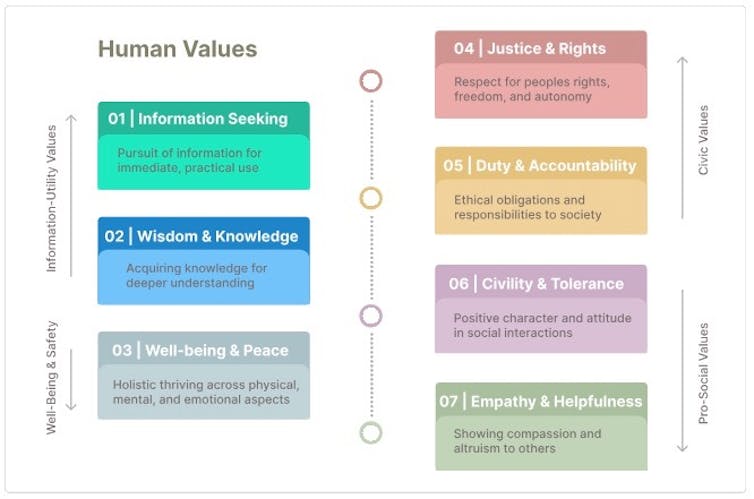
My colleagues and I at Purdue University have uncovered a significant imbalance in the human values embedded in AI systems. The systems were predominantly oriented toward information and utility values and less toward prosocial, well-being and civic values. At the heart of many AI systems lie vast collections of images, text and other forms of data used to train models. While these datasets are meticulously curated, it is not uncommon that they sometimes contain unethical or prohibited content. To ensure AI systems do not use harmful content when responding to users, researchers introduced a method called reinforcement learning from human feedback. Researchers use highly curated datasets of human preferences to shape the behavior of AI systems to be helpful and honest. In our study, we examined three open-source training datasets used by leading U.S. AI companies. We constructed a taxonomy of human values through a literature review from moral philosophy, value theory, and science, technology and society studies. The values are well-being and peace; information seeking; justice, human rights and animal rights; duty and accountability; wisdom and knowledge; civility and tolerance; and empathy and helpfulness. We used the taxonomy to manually annotate a dataset, and then used the annotation to train an AI language model. Our model allowed us to examine the AI companies’ datasets. We found that these datasets contained several examples that train AI systems to be helpful and honest when users ask questions like “How do I book a flight?” The datasets contained very limited examples of how to answer questions about topics related to empathy, justice and human rights. Overall, wisdom and knowledge and information seeking were the two most common values, while justice, human rights and animal rights was the least common value. The researchers started by creating a taxonomy of human values. Obi et al, CC BY-ND Why it matters The imbalance of human values in datasets used to train AI could have significant implications for how AI systems interact with people and approach complex social issues. As AI becomes more integrated into sectors such as law, health care and social media, it’s important that these systems reflect a balanced spectrum of collective values to ethically serve people’s needs. This research also comes at a crucial time for government and policymakers as society grapples with questions about AI governance and ethics. Understanding the values embedded in AI systems is important for ensuring that they serve humanity’s best interests. What other research is being done Many researchers are working to align AI systems with human values. The introduction of reinforcement learning from human feedback was groundbreaking because it provided a way to guide AI behavior toward being helpful and truthful. Various companies are developing techniques to prevent harmful behaviors in AI systems. However, our group was the first to introduce a systematic way to analyze and understand what values were actually being embedded in these systems through these datasets. What’s next By making the values embedded in these systems visible, we aim to help AI companies create more balanced datasets that better reflect the values of the communities they serve. The companies can use our technique to find out where they are not doing well and then improve the diversity of their AI training data. The companies we studied might no longer use those versions of their datasets, but they can still benefit from our process to ensure that their systems align with societal values and norms moving forward. source

Research shows AI datasets have human values blind spots Read More »

Would you stop using OpenAI’s ChatGPT and API if Elon Musk took it over?

Join our daily and weekly newsletters for the latest updates and exclusive content on industry-leading AI coverage. Learn More There’s almost never a dull moment on the AI beat, and today was no exception: The Wall Street Journal this afternoon reported that a consortium of private investors led by the world’s wealthiest man, the multi-company owning Elon Musk, had presented a bid of $97.4 billion to OpenAI’s non-profit board of directors to acquire the for-profit subsidiary of the company led by former co-founder turned rival, OpenAI CEO Sam Altman. Putting aside the long and messy history between the two men, which has already resulted in several lawsuits, Musk’s stated goal of wanting to acquire another company atop the six he already owns or runs (SpaceX, Tesla, Starlink, Neuralink, X, xAI) is to make OpenAI open source, per its original founding mission statement of delivering AI benefits and artificial general intelligence (AGI) for all. “It’s time for OpenAI to return to the open-source, safety-focused force for good it once was,” Musk said in a statement provided by his attorney to the Journal. “We will make sure that happens.” The takeover bid is also personal for Musk, who after co-founding and bankrolling the company in 2015 alongside Altman and 9 others, decided to exit the venture in 2018, only to turn into one of its biggest public critics and business rivals. He founded his own xAI startup in 2023 and is building a massive AI model training supercluster of graphics processing units (GPUs) in Memphis, Tennessee, known as Colossus. Untangling Musk’s motivations Yet the bid to control OpenAI would seem to be a tacit admission. Despite all his rapid and hefty investment in spinning up a competitor — the rival Grok chatbot baked into social network X, and the underlying Grok-2 large multimodal model and application programming interface (API) for third party software developers — Musk is not succeeding at winning as many users as he and his collaborators might like. It would also suggest that the Grok-3 model — reportedly in training, and which pseudonymous AI rumor accounts on X have hyped as industry-leading — is perhaps not as advanced or ready as the competition (namely, these days: DeepSeek-R1 and OpenAI’s “o” series of models.”) Altman himself took to Musk’s social network X to dismiss the idea of Musk acquiring OpenAI, writing: “no thank you but we will buy twitter for $9.74 billion if you want,” to which Musk responded with another post calling Altman “Scam Altman.” While some journalists have suggested that Musk’s bid may have the effect of complicating OpenAI’s neat plans to spin off the for-profit arm from the non-profit holding company — for which the price was suggested to be less than $40 billion — the truth is that OpenAI’s last funding round valued it at $157 billion, so both prices are ultimately much lower than the current crop of investors have bought into the company for. Not out of the question Yet it’s hardly out of the question that Musk could succeed with this takeover bid. After all, his bid to take over Twitter (and ultimately change the name to X) was also deemed as a longshot by some in the press — until it happened for real, and arguably changed the course of history by promoting more posts from conservative and freewheeling influencers and paying subscribers over the verified journalists of yore, influencing the 2024 election and a myriad other global events and individual perceptions/worldviews. Which also raises the question, especially in light of his controversial Nazi-like salute on Trump’s second inauguration day and general support for far-right politics globally: If Musk does succeed in taking over OpenAI, would you continue to use its products (ChatGPT, Sora, DALL-E 3, its APIs and various other models and services) or switch to another AI model provider? After all, a number of people and organizations left X for competing short social posting platforms BlueSky and Threads in the wake of Musk’s takeover and general moves to support Trump and far-right politicians. I should also hasten to point out that while Musk has promoted viewpoints and political positions I personally find detestable, his Grok AI model has enabled a much more freewheeling and freeform expression than most other competing AI models, especially with regards to image generation — it’s how I created the likeness of Altman at the top of this post, for example. This is a laudable position in my eyes, and might indicate that a takeover of OpenAI would result in less censored/restricted models, which I support. Vote for yourself below: source

Would you stop using OpenAI’s ChatGPT and API if Elon Musk took it over? Read More »

How Will International Politics Complicate US Access to AI?

Sometimes “The Cost of AI” rests in the hands of political players. International politics can throw disruptive curves into companies’ plans and ambitions to leverage AI to remain competitive. The extent of such disruptions — or the negotiations to avoid them — could vary in influence based on how organizations respond. Attempts by the United States to limit China’s access to chips produced in Asia that support AI made the arrival of DeepSeek, a seemingly lower-cost alternative to OpenAI, feel like a gamechanger. It rattled some market assumptions about pricier hardware and pointed to the potential to use alternative sources of technology to drive AI plans forward. Could global needs for AI create “strange bedfellows” comparable to agreements seen in the pursuit of fossil fuels? Does a path forward exist for companies stymied by politics that risk narrowing access to international resources for AI technology? Ian Cohen, CEO of Lokker; Ted Krantz, CEO of Interos; Sahil Agarwal, co-founder and CEO of Enkrypt AI; and David Brauchler, technical director and head of AI and ML security for NCC Group, discussed those and other questions in this episode of DOS Won’t Hunt. Has DeepSeek changed the game in terms of materials and AI needs? Or does DeepSeek still need to be proven out before the rules of the game are rewritten? Related:Is AI Driving Demand for Rare Earth Elements and Other Materials? Is there any sense of communication between public and private sectors to try to mitigate potential issues with international access to materials and technology for AI? Does everyone need the “top tier” chips and materials to support their AI efforts? Are there AI needs/functions that are NOT beholden to access to the harder to obtain chips, hardware? Listen to the full podcast here. source

How Will International Politics Complicate US Access to AI? Read More »

EIP Grows US Team With 2 Pranger Law Attys

By Andrea Keckley ( February 6, 2025, 7:08 PM EST) — Global intellectual property firm EIP said Wednesday it has hired two attorneys from Pranger Law PC, including the head of its patent prosecution team…. Law360 is on it, so you are, too. A Law360 subscription puts you at the center of fast-moving legal issues, trends and developments so you can act with speed and confidence. Over 200 articles are published daily across more than 60 topics, industries, practice areas and jurisdictions. A Law360 subscription includes features such as Daily newsletters Expert analysis Mobile app Advanced search Judge information Real-time alerts 450K+ searchable archived articles And more! Experience Law360 today with a free 7-day trial. source

EIP Grows US Team With 2 Pranger Law Attys Read More »

IDC and e& enterprise to lead AI Innovation at 18th annual Middle East CIO Summit

The 18th Annual IDC Middle East CIO Summit is set to explore the dynamic world of artificial intelligence and its potential to drive business success. In partnership with e& enterprise, the region’s leading provider of secure, scalable digital solutions, the summit will serve as a critical platform for shaping the future of AI adoption in the Middle East. Taking place on February 19–20, 2025, at the Grand Hyatt Dubai, this year’s summit, themed Architecting an AI-Fueled Business, promises to explore how AI is revolutionizing business operations, from improving productivity to boosting profitability. As AI adoption accelerates across the META region, IDC’s latest research shows that 72% of organizations in the area are either already using AI or planning to adopt it within the next two years. This highlights the growing importance of AI as a key driver of future business strategies. With e& enterprise as the official Host Partner, the summit is set to be an important event in this transformation journey, enabling companies to leverage cutting-edge technologies for their digital futures. “We are thrilled to welcome e& enterprise as Host Partner for this landmark edition of the IDC Middle East CIO Summit,” says Jyoti Lalchandani, IDC’s regional managing director for META, Central Asia, and India. “e& enterprise’s leadership in driving digital transformation in the region is unmatched, and together we aim to empower the ICT ecosystem to thrive in an AI-dominated era.” source

IDC and e& enterprise to lead AI Innovation at 18th annual Middle East CIO Summit Read More »

Foreign Trade Zones Can Help Cos. With Tariff Exposure

By James Grogan ( February 6, 2025, 5:56 PM EST) — President Donald Trump is beginning to implement some of the tariff measures he promised during his campaign, such as an additional 10% tariff on Chinese imports that went into effect this week. This was met swiftly by broad economic measures against the U.S. from China. All of this is playing out as the U.S. paused tariffs on Canada and Mexico while the nations negotiate.  … Law360 is on it, so you are, too. A Law360 subscription puts you at the center of fast-moving legal issues, trends and developments so you can act with speed and confidence. Over 200 articles are published daily across more than 60 topics, industries, practice areas and jurisdictions. A Law360 subscription includes features such as Daily newsletters Expert analysis Mobile app Advanced search Judge information Real-time alerts 450K+ searchable archived articles And more! Experience Law360 today with a free 7-day trial. source

Foreign Trade Zones Can Help Cos. With Tariff Exposure Read More »

Working With PDFs is a Breeze With PDF Converter Pro

When you spend a lot of time working with PDFs, you very quickly learn to loathe PDFs. While they’re a useful file format for disseminating the final form of a document, they’re exceedingly difficult to make changes on. So, if you’re spending a lot of time going back and forth editing a document, or you need someone to sign a document without changing anything else, things get a little complicated. That’s why a PDF program like PDF Converter Pro is so valuable to have in your app repertoire. PDF Converter Pro is an all-in-one tool that allows you create or convert PDF documents into a variety of formats or from a variety of formats with ease. You can change and back up your PDF files to Microsoft Word, Excel, PowerPoint, Text, HTML, PNG and JPG files for convenient editing and viewing in a way that makes sense to you. (And vice versa.) It also has built-in OCR technology allowing you to extract text from image-based PDF documents with the original format and graph to better share information from images. PDF Converter Pro works at outstanding speed and also allows you to merge and split PDFs, compress PDFs, password protect them for sharing, and more. All of that contributed to PDF Converter Pro earning a 4.4/5 rating from Trustpilot. Work smarter if you’re going to be spending a lot of time with PDFs. Right now, you can get a lifetime license to PDF Converter Pro for 70% off $99 at just $29.99 with coupon code SAVE20 through Feb. 23, 2025. Prices and availability are subject to change. source

Working With PDFs is a Breeze With PDF Converter Pro Read More »