The Product Model Solves For Tech Debt

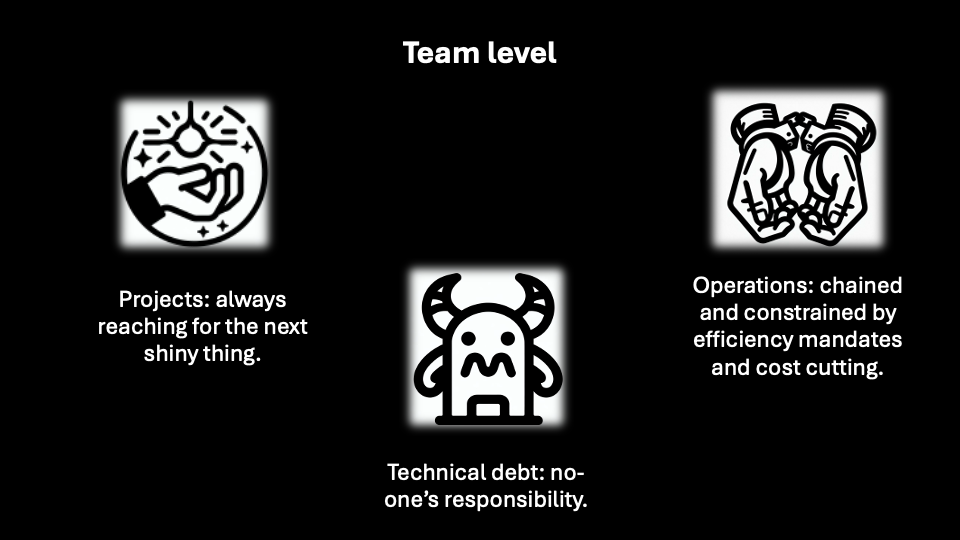
Author’s note: on rereading this, it seems like I’m calling for dev/ops integration via the product model which is hardly revolutionary. Old news, right? And yet … why is there still SO MUCH TECHNICAL DEBT?  ======================= Product management and technical debt are top of mind for many digital and IT organizations, but people are unclear on the relationship between them. Did you know that one is a solution for the other? Let me explain. How Does Tech Debt Arise? The economic cause I see over and over again: It emerges “in the cracks,” between projects funded to achieve new, innovative things and technical operations constantly pressured for efficiency. Neither side has clear accountability for the problem, and so mitigating technical debt becomes highly politicized, with much kicking the can down the road — which only makes matters worse:   The above illustration is how traditional “dev” vs. “ops” teams might perceive it. But both are essentially powerless, because funding doesn’t happen there. At the org level, it looks like this:   The leaders fight over who has to pay for technical debt in the aggregate. The development leader may be “closer to the business,” which controls the money overall, but “the business” is historically uninterested in paying down the debt. In theory, “the business” owns both sides of the problem but in reality tends to focus on new functionality and be much less interested when, for example, a required update to end-of-life (EoL) technology requires millions of dollars of migration costs — essentially to maintain the status quo. So the infrastructure group is told to take it out of constrained operational budgets. Notice also that many of the projects on the left are now handcuffed because the technical debt has started to also slow down project delivery and operations is increasingly fighting fires. In the past, leaders might advocate large-scale “IT transformations” and try to direct some of that funding to paying off technical debt, but such transformations are notorious for failing. Forrester also has heard that such transformations have difficulty making an ROI case for large-scale technical debt paydowns. Forrester does not recommend ROI as a criteria for deciding to rectify technical debt, which should be seen more as essential maintenance spend. Many of us are familiar with these dynamics in traditional plan/build/run IT organizations. Many are also pursuing product model IT transformations, but I haven’t seen much discussion of the impact of the product model on technical debt. What’s becoming clear is that product is potentially a game-changer. Marty Cagan of the Silicon Valley Product Group (one of the leading product thinkers I follow) states that “most companies with a good handle on tech debt will tell you that they work on tech debt every day, with about 10–30% of the engineering capacity.” But how? How can this level of investment be sustained when spending is so politicized and fragmented? Exactly How Does The Product Model Solve For Tech Debt? In the product model, the product team owns both new features and ongoing delivery of value. As my recent blog from the TBM Council conference pointed out, increasingly, product management is a “business within the business,” which means that it owns both development and operational concerns. If the product team is dependent on a major piece of software approaching EoL, it needs to budget for the software’s replacement (and associated migration costs) if the product wants to remain “in business.” In a simple “two in a box” model, we have, for example, a close partnership between a product lead and an engineering lead. Here’s the interesting aspect: A fixed percentage of funding is protected and dedicated to technical debt. Note that the tech debt paydown is controlled by the engineering lead. This is based on a number of conversations I’ve had: Product leads may still have a tendency to focus on the shiny and new, so the engineering lead takes point on prioritizing the tech debt paydown. Devolution of the authority means that decisions are taken closer to the information, a key agile/DevOps value. Ideally there’s a unified funnel ala Mik Kersten’s Flow Framework: all work is either features, defects, debts, or risks.   Higher in the org, note that the protected capacity for tech debt is established and sponsored at the executive level. This of course takes the product lead and CTO presenting a united front that the budget *must* work that way. Ideally, the product model means no more idea of “IT” versus “the business” but many organizations are still working through those nuances. Topic for another day.   Another supportive, product-related development is platform engineering, which reduces the occurrence of technical debt (in part) by streamlining the infrastructure portfolio and reducing variation. Yes, this comes at the cost of some developer independence, but the days when that was a dominant priority are done. There’s growing consensus that too much developer autonomy to choose “flavor of the month” tech results in fragmented and decaying tech stacks that are toxic to innovation and agility. Organizations can’t get a handle on tech debt with so-called “full-stack” teams selecting whatever tech strikes their fancy in a given week. This is why platform engineering has become a major trend, as it replaces bureaucratic architecture processes and drives infrastructure teams toward empathy with their internal customers. Summary Recommendations Integrating dev and ops at the product team level Protecting a “tech debt paydown” stream as an ongoing budgetary priority Investing in platform engineering to reduce sprawl Are you working on a product operating model, tech debt, platform engineering, or the intersections between them? If so, drop me a line. source

The Product Model Solves For Tech Debt Read More »

IT Leaders Fear AI-Driven Cybersecurity Costs Will Soar

IT leaders are concerned about the rocketing costs of cyber security tools, which are being inundated with AI features. Meanwhile, hackers are largely eschewing AI, as there are relatively few discussions about how they could use it posted on cyber crime forums. 1 New Relic Employees per Company Size Micro (0-49), Small (50-249), Medium (250-999), Large (1,000-4,999), Enterprise (5,000+) Any Company Size Any Company Size Features Analytics / Reports, API, Compliance Management, and more 2 Wrike Employees per Company Size Micro (0-49), Small (50-249), Medium (250-999), Large (1,000-4,999), Enterprise (5,000+) Medium (250-999 Employees), Large (1,000-4,999 Employees), Enterprise (5,000+ Employees) Medium, Large, Enterprise Features 24/7 Customer Support, 360 Degree Feedback, Accounting, and more In a survey of 400 IT security decision makers by security firm Sophos, 80% believe that generative AI will significantly increase the cost of security tools. This tracks with separate Gartner research that predicts global tech spend to rise by almost 10% this year, largely due to AI infrastructure upgrades. The Sophos research found that 99% of organisations include AI capabilities on the requirements list for cyber security platforms, with the most common reason being to improve protection. However, only 20% of respondents cited this as their primary reason, indicating a lack of consensus on the necessity of AI tools in security. Three-quarters of the leaders said that measuring the additional cost of AI features in their security tools is challenging. For instance, Microsoft controversially increased the price of Office 365 by 45% this month due to the inclusion of Copilot. On the other hand, 87% of respondents believe that AI-related efficiency savings will outweigh the added cost, which may explain why 65% have already adopted security solutions featuring AI. The release of low-cost AI model DeepSeek R1 has generated hopes that the price of AI tools will soon decrease across the board. SEE: HackerOne: 48% of Security Professionals Believe AI Is Risky But cost isn’t the only concern highlighted by Sophos’ researchers. A significant 84% of security leaders worry that high expectations for AI tools’ capabilities will pressure them to reduce their team’s headcount. An even larger proportion — 89% — are concerned that flaws in the tools’ AI capabilities could work against them and introduce security threats. “Poor quality and poorly implemented AI models can inadvertently introduce considerable cybersecurity risk of their own, and the adage ‘garbage in, garbage out’ is particularly relevant to AI,” the Sophos researchers cautioned. Must-read security coverage Cyber criminals are not using AI as much as you may think Security concerns may be deterring cyber criminals from adopting AI as much as expected, according to separate research from Sophos. Despite analyst predictions, the researchers found that AI is not yet widely used in cyberattacks. To assess the prevalence of AI usage within the hacking community, Sophos examined posts on underground forums. The researchers identified fewer than 150 posts about GPTs or large language models in the past year. For scale, they found more than 1,000 posts on cryptocurrency and more than 600 threads related to the buying and selling of network accesses. “Most threat actors on the cybercrime forums we investigated still don’t appear to be notably enthused or excited about generative AI, and we found no evidence of cybercriminals using it to develop new exploits or malware,” Sophos researchers wrote. One Russian-language crime site has had a dedicated AI area since 2019, but it only has 300 threads compared to more than 700 and 1,700 threads in the malware and network access sections, respectively. However, the researchers noted this could be considered “relatively fast growth for a topic that has only become widely known in the last two years.” Nevertheless, in one post, a user admitted to talking to a GPT for social reasons to combat loneliness rather than to stage a cyber attack. Another user replied it is “bad for your opsec [operational security],” further highlighting the community’s lack of trust in the technology. Hackers are using AI for spamming, gathering intelligence, and social engineering Posts and threads that mention AI apply it to techniques such as spamming, open-source intelligence gathering, and social engineering; the latter includes the use of GPTs to generate phishing emails and spam texts. Security firm Vipre detected a 20% increase in business email compromise attacks in the second quarter of 2024 compared to the same period in 2023; AI was responsible for two-fifths of those BEC attacks. Other posts focus on “jailbreaking,” where models are instructed to bypass safeguards with a carefully constructed prompt. Malicious chatbots, designed specifically for cybercrime have been prevalent since 2023. While models like WormGPT have been in use, newer ones such as GhostGPT are still emerging. Only a few “primitive and low-quality” attempts to generate malware, attack tools, and exploits using AI were spotted by Sophos research on the forums. Such a thing is not unheard of; in June, HP intercepted an email campaign spreading malware in the wild with a script that “was highly likely to have been written with the help of GenAI.” Chatter about AI-generated code tended to be accompanied with sarcasm or criticism. For example, on a post containing allegedly hand-written code, one user responded, “Is this written with ChatGPT or something…this code plainly won’t work.” Sophos researchers said the general consensus is that using AI to create malware was for “lazy and/or low-skilled individuals looking for shortcuts.” Interestingly, some posts mentioned creating AI-enabled malware in an aspirational way, indicating that, once the technology becomes available, they would like to use it in attacks. A post titled “The world’s first AI-powered autonomous C2” included the admission that “this is still just a product of my imagination for now.” “Some users are also using AI to automate routine tasks,” the researchers wrote. “But the consensus seems to be that most don’t rely on it for anything more complex.” source

IT Leaders Fear AI-Driven Cybersecurity Costs Will Soar Read More »

It Takes a Village: New Infrastructure Costs for AI — Utility Bills

Demand for artificial intelligence, from generative AI to the development of artificial general intelligence, puts greater burdens on power plants and water resources, which might also put the pinch on surrounding communities. The need to feed power to the digital beast to support trends, such as the rise of cryptocurrency, is not new but the persistent demand to build and grow AI calls new attention to the limits of such resources and inevitable rises in price. “The growth in power utilized by data centers is unprecedented,” says David Driggers, CTO for cloud services provider Cirrascale. “With the AI boom that’s occurred in the last 18 to 24 months, it is literally unprecedented on the amount of power that’s going to data centers and the projected amount of power going into data centers. Dot-com didn’t do this. Linux clustering did not this.” The hunger for AI led to a new race for energy and water that can be very precious in some regions. The goal might be to find a wary balance, but for now stakeholders are just looking for ways to keep up. “Data centers used to take up 1% of the world’s power, and that’s now tripled, and it’s still going up,” Driggers says. “That’s just insane growth.” In recent years, chipmakers such as Nvidia and AMD saw their sales to data centers ramp up in response to demand and expectations for AI, he says, as more users and companies dove into the technology. “A big part of it is just the power density of these platforms is significantly higher than anything that’s been seen before,” Driggers says. Related:The Real Cost of AI: An InformationWeek Special Report Feeding the Machines There was a time when an entire data center might need one megawatt of power, he says. Then that became the power scale to support just a suite — now it can take five megawatts to do the job. “We’re not a hyperscaler but even within our requirements, we’re seeing over six months, our minimum capacity requirements are doubling,” Driggers says. “That’s hard to keep up with.” The runaway demand might not be simple to respond to given the complexities of regulations, supply, and the costs this all brings. Evan Caron, co-founder and chief investment officer, Montauk Climate, says a very complicated interdependency exists between public and private infrastructure. “Who bears the cost of infrastructure buildout? What markets are you in? There’s a lot of nuance associated with where, what, when, how, et cetera.” There is no catchall answer to this demand, he says, given local and regional differences in resources and regulations. “It’s very hard to assume the same story works for every part, every region in the US, every region globally,” Caron says, “who ultimately bears the cost, whether it’s inflationary, whether it’s ultimately deflationary.” Related:What Is the Cost of AI: Examining the Cost of AI-Enabled Apps Even before the heightened demand for AI, data centers already came with significant utility price tags. “Generally speaking, a data center uses a lot of land, a lot of water — fresh water — a lot of power,” Caron says. “And you need to be able to build infrastructure to support the needs of that customer.” Depending on where in the US the data center is located, he says there can be requirements for data centers to build substations, transmission infrastructure, pipeline infrastructure, and roads, which all add to the final bill. “Some of it will be borne by the consumers in the market,” Caron says. “The residential customers, the commercial customers that aren’t the data center are going to get charged a share of the cost to interconnect that data center.” Still, it is not as simple as hiking up prices any time demand increases. Utility companies typically must present before their respective utility commissions the plans to provide those services, their need to build transmission lines, and more to determine whether it is worth making such upgrades, Caron says. Related:AI’s Hidden Cost: Will Data Preparation Break Your Budget? “That’s why you’re seeing a lot of pushback,” he says, “because the assets that are going behind the meter get unfair subsidies from a utility, from a transmission company, from a generation company.” This can increase costs passed on to other consumers. It does not have to be that way though. If hyperscalers were required to front the entire bill for such new infrastructure, Caron says, it could be argued that it would be a benefit to the rest of the customers and community. However, that is not the current state of affairs. “They’re not interested in bearing the cost across the board” he says, “so they’re pushing a lot of those costs back to consumers.” The first several years of such buildouts could be very inflationary, Caron says. The promise of AI — to deliver smarter systems that are more efficient with lower costs of living — would ultimately be deflationary. In the near term, however, there is a supply and demand imbalance, he says. “You have more demand than supply; prices have to rise to meet that.” That could lead to increased costs across technology-driven regions with elevated competition for resources. “It’s going to be very inflationary for a long time,” Caron says. He foresees the Trump administration moving to rip out regulation based on a narrative that these processes can be easier, but state governments and the federal governments have distinct powers that can make this more complex than solving the problem with the stroke of one pen “Utilities are regulated monopolies in the state,” Caron says. “There’s almost 3,000 separate utilities in North America.” Multiple stakeholders, incumbent energy companies, independent power producers, and the fairness doctrine around antitrust are all elements that come into play in this energy race. “You’re not going to get everyone to be aligned around the same set of expectations,” Caron says. Consumers want prices to go down, he says, while energy generators can want prices to go up, transmission companies

It Takes a Village: New Infrastructure Costs for AI — Utility Bills Read More »

Activist Elliott Takes Aim At $7.2B AspenTech-Emerson Deal

By Al Barbarino ( February 7, 2025, 4:31 PM EST) — Activist investment firm Elliott Investment Management said Friday it has amassed a more than $1.5 billion stake in Aspen Technology, stating that AspenTech’s plan to sell off its remaining shares for $7.2 billion to global technology company Emerson undervalues the business…. Law360 is on it, so you are, too. A Law360 subscription puts you at the center of fast-moving legal issues, trends and developments so you can act with speed and confidence. Over 200 articles are published daily across more than 60 topics, industries, practice areas and jurisdictions. A Law360 subscription includes features such as Daily newsletters Expert analysis Mobile app Advanced search Judge information Real-time alerts 450K+ searchable archived articles And more! Experience Law360 today with a free 7-day trial. source

Activist Elliott Takes Aim At $7.2B AspenTech-Emerson Deal Read More »

When digital literacy fails, IT gets the blame

Eventually, most of the technical glitches were resolved, and doctors, patients, and support medical personnel learned how to integrate virtual visits with regular physical visits and with the medical record system. By the time the pandemic hit in 2019, telehealth visits were already well under way. These visits worked because the IT was there, the pandemic created an emergency scenario, and, most importantly, doctors, patients, and medical support personnel were already trained on using these systems to best advantage. The human elements — training and skills development — are the critical and essential components of digital projects. That’s precisely why CIOs should insist that education and skills development be requisite milestones that must be met in every digital project.  source

When digital literacy fails, IT gets the blame Read More »

FCC Says No To Ohio Group's Bid For Low Power FM Station

By Nadia Dreid ( February 6, 2025, 7:35 PM EST) — An Ohio church has come out on top in its battle to be awarded the rights to launch a low power FM station in its neck of the woods after the group it was up against was accused of knowingly listing a manager’s dead grandmother on a license renewal application…. Law360 is on it, so you are, too. A Law360 subscription puts you at the center of fast-moving legal issues, trends and developments so you can act with speed and confidence. Over 200 articles are published daily across more than 60 topics, industries, practice areas and jurisdictions. A Law360 subscription includes features such as Daily newsletters Expert analysis Mobile app Advanced search Judge information Real-time alerts 450K+ searchable archived articles And more! Experience Law360 today with a free 7-day trial. source

FCC Says No To Ohio Group's Bid For Low Power FM Station Read More »

Securing a Better Salary: Tips for IT Pros

Negotiating a higher salary or better benefits can be daunting, but IT professionals can strengthen their case by aligning their contributions with organizational goals and adopting strategic approaches.  The key to securing a raise lies in preparation, communication, and demonstrating measurable value to higher-ups. Quantifiable metrics are crucial during salary discussions, as they provide clear evidence of your impact. Key performance indicators (KPIs) to highlight include revenue generation, cost savings, productivity improvements, customer satisfaction, and security or risk mitigation.   Demonstrating how your contributions align with these metrics makes a compelling case for your value to the organization.  Scott Wheeler, cloud practice lead at Asperitas, says it’s important to start raise negotiation preparations by understanding the organization’s strategic and tactical goals.  Taking on projects that are both impactful and achievable shows alignment with the company’s priorities. “Identify work that aligns with those goals and has reasonable delivery timelines, preferably under a year,” Wheeler says.  He adds that building a productive rapport with managers is another cornerstone of effective salary negotiations. “Understand what your manager values and what they will be evaluated on,” Wheeler says. “Align your work with their goals and share progress on your projects regularly.”  Related:The Cost of AI Talent: Who’s Hurting in the Search for AI Stars? He says establishing a personal connection with higher-ups can also help. “Knowing what your manager values, both in and outside of work, creates a better partnership and makes communication easier,” Wheeler explains.  Megan Smith, head of HR at SAP North America, says she agrees the more an employee can master the art of communicating proactively with their manager, the greater the trust they can build.  “This includes things like sharing the right level of information at the right time,” she explains via email.  For example, providing a heads up around possible risks in a project, and sharing summary updates regularly of what is being accomplished, helps the manager trust they have the right degree of visibility necessary for the overall success of the team.   Salary as Reflection of Performance   Smith says having a conversation with your manager about your salary is really a conversation about how you are achieving your goals, because a salary increase reflects your performance.  “Discuss your performance with your manager early and often, so that when you want to connect it to salary, which can be done at any time but recommend at least a couple months prior to the salary review timeline of your company, this is a natural connection,” she says.  Related:Tech Company Layoffs: The COVID Tech Bubble Bursts She recommends approaching salary conversations with curiosity, for example by asking your manager how they perceive your salary aligning to your contributions and impact.  “Get educated on your own point of view,” she adds. “Do you have any data from internal salary ranges to suggest if you are positioned low?”  Smith says it’s important that you don’t make it about “asking for a raise” but rather, make the conversation about an informed discussion about how your salary reflects your contributions, and if that presents opportunity for an increase in the next salary review cycle.   IT as a Leadership Profession  From the perspective of Mark Ralls, president at Auvik, the nature of IT work provides ample opportunities for IT pros to show leadership even if they are not in a formal managerial role.   “Cross-functional or team-based project work allows IT pros to demonstrate the ability to manage through influence, where they help coordinate the efforts of others through relationship building and persuasion rather than formal authority,” he says.   Wheeler also emphasizes the importance of teamwork and collaboration in achieving goals.   Related:Shopping for an LLM? Here’s What to Know About Pricing “Form partnerships, either internally or externally, that can help you deliver results,” Wheeler says. “Most work requires a team effort, and sometimes moving to a different internal team may be necessary to produce the desired outcome.”  Documenting and showcasing these successes are critical to building a strong case during salary discussions.  Success in salary negotiations also depends on effective communication and the ability to understand and address the motivations of various stakeholders to align everyone with a common objective.  “Gaining buy-in and achieving desired outcomes by establishing credibility and trust is a key indicator that someone is ready for that next step to management, earning a raise and potentially a promotion in the process,” Ralls says.   A recent engineering career mobility report by SignalFire indicates specialization is a key way to turbocharge upward mobility — and with it, salary bumps.   Jarod Reyes, head of developer community at SignalFire, says instead of focusing on a general KPI around developer productivity, he would focus on finding a project, or place in the engineering organization where one can become the specialist.  “We can see in the data that specialization is the key to rapid upward mobility for engineers happy in their current role,” he says. “We could see engineers who wanted to move into management roles would take paths that developed more broad skill sets, expanding their surface area and sphere of influence.”  This includes finding ways to lead a project and looking for opportunities to improve the business or reduce costs — what Reyes calls “sure fire bets”.  He notes that engineers who wanted to move up a non-management path (down a specialist path, like principal or staff engineer) focused on narrowing their skill sets, taking roles where they were expected to be the directly responsible individual like a site-reliability engineer or data architect.  Reyes says from personal experience managing engineering teams and building engineering teams for the last 13 years he could say communicating often with the team about the values that are rewarded is very important.  “Having direct conversations not just annually, but monthly with your engineers is an important way of building trust and earning loyalty,” he says. “I think more important than upward mobility I have found that engineers really enjoy working on a team that is crucial, efficient and impact oriented.”  source

Securing a Better Salary: Tips for IT Pros Read More »

Workday to cut 1,750 jobs, shift focus to AI and global expansion

International expansion is another priority for Workday, which plans to seize the growing demand for cloud-based HR solutions outside the United States. DeStefano noted that the company is taking a three-pronged approach to ensure financial stability: “cost reductions, market expansion overseas, and investing in tools designed to enhance decision-making and improve efficiency. This is particularly relevant given the increasing competition within the market, increased consolidation through firm acquisitions, and the potential for slower demand due to higher interest rates.” While specific regional targets weren’t disclosed, DeStefano observed that the company’s strategy suggests a careful realignment of resources. “Based on their statements, they have decided to close certain locations while opening new ones. This suggests that the geographical reorganization is designed to restructure their regional footprint to keep pace with evolving consumer demand across their markets,” he said. “Additionally, while the company is laying off employees, they are not enacting a hiring freeze. Instead, they have stated that they will add workers to critical locations and roles within the company, along with making AI investments, to maintain and enhance its applications for consumers throughout the transition and in the long run.” Workday faces intense competition in HR software from both established firms and startups, according to Janice Quek, an analyst at investment research firm CFRA. source

Workday to cut 1,750 jobs, shift focus to AI and global expansion Read More »

Judge Won't Transfer Apple IP Fight, Warns Of Circuit Split

By Andrea Keckley ( February 7, 2025, 7:15 PM EST) — A Texas federal judge has denied Apple’s request to relocate Oregon startup Proxense LLC’s patent suit against it, saying the case “would not be clearly more convenient to try in the Northern District of California.”… Law360 is on it, so you are, too. A Law360 subscription puts you at the center of fast-moving legal issues, trends and developments so you can act with speed and confidence. Over 200 articles are published daily across more than 60 topics, industries, practice areas and jurisdictions. A Law360 subscription includes features such as Daily newsletters Expert analysis Mobile app Advanced search Judge information Real-time alerts 450K+ searchable archived articles And more! Experience Law360 today with a free 7-day trial. source

Judge Won't Transfer Apple IP Fight, Warns Of Circuit Split Read More »

Live Oak Bank Review: Services, Rates, and More

Live Oak Bank is a digital-first bank that provides tailored financial services for small businesses and entrepreneurs across various industries. Offering a range of products from high-yield business savings accounts to specialized small business loans, Live Oak Bank aims to help business owners access competitive rates, simplified banking, and a highly responsive customer service experience. Wondering if Live Oak Bank is right for your business needs? Below, I dive into Live Oak Bank’s key services, rates, customer reviews, and competitive comparisons to see how it stands up in the business banking landscape. Live Oak Bank fast facts My rating: 4.7 out of 5Starting price: No monthly maintenance fees for accountsKey features: High-Yield business savings: Competitive APY for small business savings accounts Specialized loans: Customizable loan solutions for small business growth Digital-first model: Full online banking services with a dedicated customer support team FDIC-insured: Account balances insured up to $250,000 Overview of Live Oak Bank Live Oak Bank caters specifically to business clients, providing industry-focused loan products and high-interest savings options. With a digital-only banking approach, Live Oak makes it easy for entrepreneurs to manage funds and apply for loans without the need to visit a physical branch. The bank supports a range of industries, from veterinary practices and healthcare providers to breweries and self-storage businesses, by offering unique financial tools and knowledgeable customer support. In addition, Live Oak Bank’s user-friendly mobile platform and web app streamline the process for busy business owners. Let’s take a closer look at what Live Oak Bank offers and how it stands out among other digital banking competitors. Live Oak Bank Reviews: User opinions and ratings 4.65/5 Live Oak Bank users frequently praise its high-yield savings rates, loan options, and customer service tailored for business owners. The platform’s industry-specific loan products are particularly valued by niche businesses that often struggle to find financing through traditional banks. However, some users report that the digital-only setup can be limiting, especially if they prefer in-person support or need access to cash transactions. Overall, Live Oak Bank is highly rated for its specialized offerings and strong online experience. Trustpilot: 4.6 out of 5 stars G2: 4.7 out of 5 stars While many customers appreciate Live Oak Bank’s digital tools and high-yield savings accounts, others find the lack of physical branches and cash deposit options to be a drawback. Despite this, Live Oak’s industry expertise, loan offerings, and competitive APYs make it a top choice for digital-forward businesses. Live Oak Bank’s pricing structure Live Oak Bank’s fee structure is simple and business-friendly. They offer accounts with no monthly maintenance fees, which can help small businesses minimize their expenses. Here’s a breakdown of the key pricing points for Live Oak Bank’s offerings: No monthly fees: Account maintenance is free, with no hidden charges for standard transactions. High-yield savings APY: Live Oak offers a competitive APY on its business savings accounts, though rates may vary. Customized loan terms: Business loan fees and rates are determined by the borrower’s needs and industry type. No minimum balance: Live Oak Bank’s accounts do not have a minimum balance requirement, making it accessible for businesses of any size. Key features of Live Oak Bank 4.7/5 Live Oak Bank provides several unique features that can appeal to small business owners and entrepreneurs looking to open a business bank account that has services tailored to their digital infrastructure needs. Below are some of the standout offerings: Industry-specific loan options: Live Oak Bank specializes in providing loans for specific industries such as healthcare, agriculture, veterinary services, and more. This targeted approach allows business owners to access loan products with terms and conditions suited to their industry’s unique requirements. Whether for expansions, equipment financing, or startup funding, Live Oak Bank offers personalized loan options that can be a valuable asset for growing businesses. High-yield savings accounts: Live Oak Bank’s high-yield savings accounts provide competitive APYs, allowing businesses to grow their reserves. Unlike traditional business accounts, Live Oak offers rates that rival other digital banks, making it an attractive option for business owners looking to maximize their savings. Comprehensive digital banking tools: As a digital-only bank, Live Oak provides an intuitive online platform and mobile app where customers can easily manage accounts, check balances, and apply for loans. The bank also offers customer service representatives who are highly knowledgeable in specific industries, giving users access to specialized support without needing a physical branch. FDIC-insured security: Partnering with FDIC-insured institutions, Live Oak Bank ensures that customer deposits are protected up to $250,000, giving business owners peace of mind when managing larger sums through a digital-only bank. More Banking Coverage What business types are supported by Live Oak Bank? Live Oak Bank works with a wide range of industries and business types, offering loans and banking services specifically tailored to various sectors. The primary industries served include: Healthcare: Including veterinary practices and dental clinics Agriculture: Loans for farmers and agricultural businesses Self-storage and warehousing Franchises: Financial solutions for franchise operators Breweries: Specialized loans and financing for breweries Live Oak’s support for these sectors makes it a valuable partner for business owners operating within these industries, as they can access products specifically designed to meet industry standards and requirements. Would our expert recommend Live Oak Bank? 5.00/5 Live Oak Bank is a highly recommended option for small business owners, especially those in specialized industries looking for accessible loans and high-yield savings options. With its no-fee checking, competitive APYs, and industry-specific loan products, Live Oak Bank provides valuable tools for business owners who prefer a tech-forward banking experience. Expert’s opinion: Live Oak Bank is a strong choice for digital-first entrepreneurs seeking flexible, specialized financial solutions. However, businesses that require cash-handling services or prefer in-person banking may want to explore alternative options. Live Oak Bank pros Competitive interest rates for business savings No monthly fees or hidden charges Industry-specific loan products for unique financing needs Simple online and mobile account management Live Oak Bank cons No cash deposit options Limited to digital services with no

Live Oak Bank Review: Services, Rates, and More Read More »