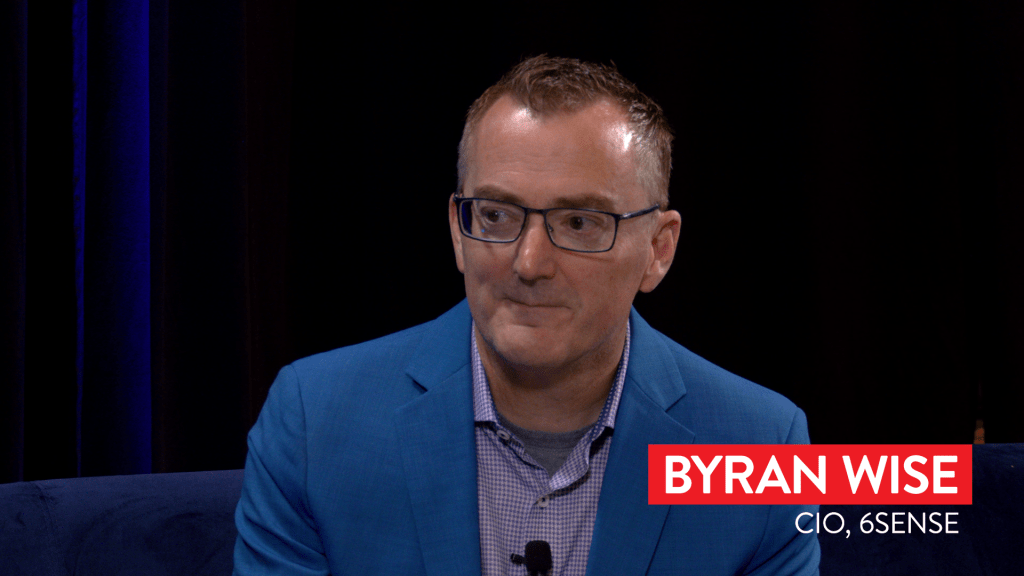
CIO Leadership Live from the CIO100 with Bryan Wise, CIO, 6Sense and Lee Rennick, Executive Director, CIO Communities, cio.com
00:00 I’m Lee Rennick, Executive Director of CIO Communities for CIO. And I’m thrilled to be here at the CIO Symposium and 100 with Bryan Wise, CIO of 6sense.00;00;20;02 – 00;00;38;51UnknownBryan, thanks so much for joining us today. And congratulations on your CIO 100 award winning project. Thank you so much for having me. Yeah, happy to be honored. Let’s see I 100. It’s a great honor. Well, it’s great to have you here today. So 6sense has put together a really great project. I read through, actually, I was one of the judges.00;00;38;51 – 00;00;59;12UnknownI happened to read through some of those applications. And it’s an award winning project called Automation Domination. So could you tell me a little bit about it? Yeah. One of the things that, I usually come in as a CIO for sometimes pre-IPO companies, okay. All the time when you come in to an environment like that. Yeah, there’s a lot of fast growth, right?00;00;59;12 – 00;01;31;22UnknownAnd there’s a lot of situations where, sort of your business processes are not really as mature as it should be. And because of speed, maybe you’re doing things that are maybe manual and in sort of nature and you got to start maturing, right. Because end to end process is to be as efficient as possible. So automation domination is a program we put in place to really change the way that the company is thinking about, you know, how efficient automation of their processes and sort of not accepting the status quo, right.00;01;31;35 – 00;01;53;49UnknownAnd so the idea behind it was, we made it a top level company objective. And the key result was to save 67,000 manual people hours. Incredible way we came up with that was we took our employee base, about 1200 toys, and we said, what if we could save one hour per week per employee for the entire year?00;01;53;50 – 00;02;19;31UnknownSo that’s the rough math of why 67,000 hours hours became the goal. Yeah. And, the real meta deliverable, though, that was the key result of track. But the real meta deliverable was to change the culture and the way people think about what they’re doing. It was also to create an environment where people also thought about what they do and how it affects other groups.00;02;19;32 – 00;02;43;13UnknownSo in turn breaks down silos. Yeah. And, really just make it so that it becomes ingrained into our environment. And then for me as a CIO, I know there’s going to be process improvement, efficiencies, ultimately speed that helps our customers in the end. So we really did focus a lot on the, on the sales and marketing as a sort of, because that’s what we do.00;02;43;16 – 00;03;06;17UnknownYeah. And, it was just a great experience and it was so successful that, we are doing it again. And so our goal, our next goal is to say 100,000 hours. I should have said we actually save over 91,000 hours. My original goal, our next goal is 100,000. And and I already told the team I think it’s sandbagged and we need to actually increase that.00;03;06;18 – 00;03;28;45UnknownSo it’s a pretty awesome, experience. And now it’s sort of changed the entire culture. And I don’t have to really cheerleader anymore. You just hear. Right. Our team members are employees talking about it all the time. Yeah, because I’m sure they’re able to report back on productivity they’ve achieved through their business through through this great opportunity of really automation, domination and all that stuff.00;03;28;45 – 00;03;52;48UnknownSo that’s really cool and that’s really important. Right. And that idea of internal productivity, which is really enhancing your customer experiences too, is great. So I want to talk to you about that a little bit. I speak to a lot of CIOs about data and cloud. And some have moved out, like during Covid a lot when a lot of people put their data in the cloud and then, you know, they were looking at costs around that of processing data.00;03;52;52 – 00;04;11;26UnknownAnd, you know, some are now saying, well, I’m now thinking of bringing it back down on Prem, because I want to keep my most important, important data, right, right on prem or maybe on the edge of the cloud. Yeah. So I’ve talked to a lot of people about this. I would love to learn more about your approach to that around data and cloud.00;04;11;31 – 00;04;35;54UnknownIt’s really interesting to to think about what is the cloud going forward. So when you think about truly like on prem physically. Yeah, yeah, those would be data centers. And the world has changed a little bit that your data center is your cloud provider going forward. Right. You can control that. So it is really interesting sort of change in landscape.00;04;35;59 – 00;05;03;52UnknownAnd then like sixth sense where digitally native computing. Right. So our company never had anything on. Right. Right. Exactly. Always been in the cloud. Yeah I do think it’s some it is makes it faster because you can deploy products much faster. You have all capital intensive infrastructure. You need to buy, but it does require, a certain mindset of like controlling costs, right.00;05;03;57 – 00;05;28;38UnknownBecause of that ease of use into that computational sort of resources, you can get carried away. It also brings up interesting questions around, well, where is my data exactly? Yes. So there’s like data sovereignty. Yes. Where is it going? And so while it is simple to go to the cloud, it adds other complexity you have to consider.00;05;28;43 – 00;05;50;06UnknownYeah. Going forward, I do think that, most of the world will now be just digitally native. We have already seen that in tech companies. There are some exceptions depending on the industry you’re in. Yeah, but then there’s going to be situations in the future where if you get large enough, you know, you will start saying, what’s the cost benefit analysis on that?00;05;50;18 –