FCC Floats $4.4M Robocall Fine Against Telecom Network

By Christopher Cole ( February 4, 2025, 10:02 PM EST) — The Federal Communications Commission on Tuesday proposed a fine of more than $4.4 million against a Chicago-based telecom that the agency accused of allowing government impostor calls on its network…. Law360 is on it, so you are, too. A Law360 subscription puts you at the center of fast-moving legal issues, trends and developments so you can act with speed and confidence. Over 200 articles are published daily across more than 60 topics, industries, practice areas and jurisdictions. A Law360 subscription includes features such as Daily newsletters Expert analysis Mobile app Advanced search Judge information Real-time alerts 450K+ searchable archived articles And more! Experience Law360 today with a free 7-day trial. source

FCC Floats $4.4M Robocall Fine Against Telecom Network Read More »

Forget expensive leadership training—CodeSignal’s AI tool brings coaching to everyone

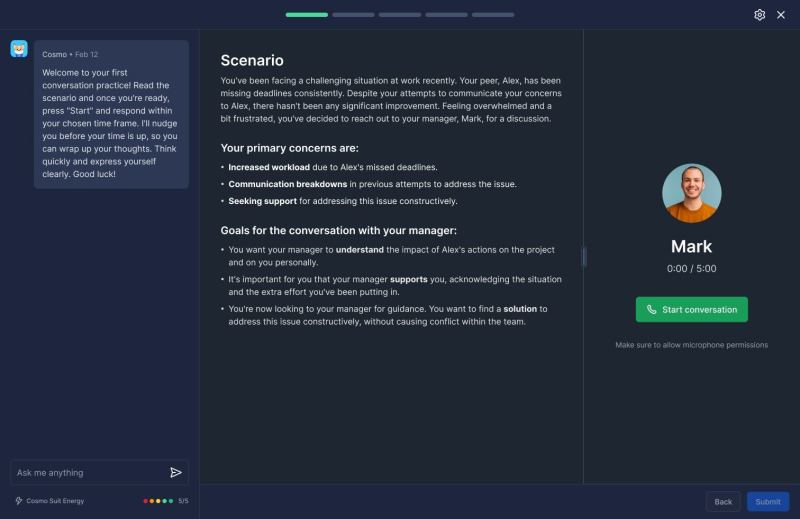
Join our daily and weekly newsletters for the latest updates and exclusive content on industry-leading AI coverage. Learn More CodeSignal, which is known for its technical skills assessment platform, is making a significant pivot into leadership and communication training with a new AI-powered conversation simulation tool. The move represents a strategic expansion beyond the company’s core technical assessment business, which has attracted clients like Netflix, Capital One, Meta and Dropbox. The San Francisco-based company’s new offering uses voice-enabled AI to simulate workplace scenarios, allowing users to practice difficult conversations like delivering feedback or resolving conflicts. The system provides real-time coaching through an AI mentor named Cosmo. “Leadership training often costs $20,000 to $40,000 per person for a one-month program,” Tigran Sloyan, CEO of CodeSignal, said in an exclusive interview with VentureBeat. “For a 10-person executive team, you’re looking at a multi-million dollar price tag, which means it’s never been accessible to anyone below the executive level.” The platform’s rapid growth suggests strong market demand for accessible skills development tools. CodeSignal’s learning platform has attracted one million users in less than a year since launch, with user base and usage doubling every two months, according to Sloyan. The technology leverages recent advances in generative AI and voice models to create realistic conversational partners. Early feedback suggests the AI-powered approach may have advantages over traditional role-playing with human actors. CodeSignal’s new AI conversation simulator presents users with workplace scenarios and a 5-minute window to practice difficult management conversations, guided by Cosmo, an AI mentor. (Credit: CodeSignal) How AI simulation outperforms human role-playing for leadership training “The feedback has been higher on average than with human role-playing,” said Sloyan. “When you’re doing real actors, usually it’s a workshop with other people watching. The fact that you have no judgment with AI and can practice as many times as needed takes the pressure off.” The company is targeting the underserved middle management segment, where traditional leadership development programs have been cost-prohibitive. The solution is priced at $25 monthly for individuals and $39 per user monthly for enterprise licenses. Beta customers have deployed the platform for management training, sales training and interviewer preparation. “We don’t want sales people practicing on actual customers,” Sloyan explained. “Now they can practice customer scenarios with AI first.” Market expansion and mobile learning: What’s next for CodeSignal The expansion comes as businesses increasingly focus on developing leadership capabilities across organizational levels. CodeSignal appears well-positioned to capitalize on this trend, with plans to launch a mobile version later this year to enable on-the-go learning. “Skills are changing faster than ever, driven by transformative technologies like AI,” said Sloyan. “This idea of lifelong, constant learning is more important than it has ever been before.” The move into leadership development could help CodeSignal capture a larger share of corporate training budgets while diversifying beyond technical assessments. The company faces competition from established leadership development firms and new AI-powered learning platforms, but its combination of technical expertise and AI capabilities may provide competitive advantages in the rapidly evolving market for workplace skills development. source

Forget expensive leadership training—CodeSignal’s AI tool brings coaching to everyone Read More »

Trump's Energy Plans: Climate, Data Centers, LNG And More

By Tory Lauterbach, Janine Durand and Jess Rollinson ( February 6, 2025, 3:18 PM EST) — The U.S. energy industry continues to untangle what President Donald Trump’s second administration will mean for it. … Law360 is on it, so you are, too. A Law360 subscription puts you at the center of fast-moving legal issues, trends and developments so you can act with speed and confidence. Over 200 articles are published daily across more than 60 topics, industries, practice areas and jurisdictions. A Law360 subscription includes features such as Daily newsletters Expert analysis Mobile app Advanced search Judge information Real-time alerts 450K+ searchable archived articles And more! Experience Law360 today with a free 7-day trial. source

Trump's Energy Plans: Climate, Data Centers, LNG And More Read More »

Ethical AI is turning the Netherlands into an innovation leader

Long admired for its progressive policies and open economy, the Netherlands is making an aggressive play to become Europe’s next tech powerhouse. By blending AI with sustainability and a strong ethical framework, the country attracted $2.5bn in tech investments in 2024 alone — a 39% surge from the previous year. With a government-backed push for responsible innovation, the Netherlands is positioning itself as the epicentre of Europe’s next tech renaissance.  According to VC firm Atomico, the country has become one of Europe’s fastest-growing tech ecosystems. Europe’s leading stock exchange by market cap, Euronext Amsterdam, has become a cornerstone of the country’s digital ecosystem. Tech now accounts for 23% of Euronext Amsterdam’s total market — exceeding the New York Stock Exchange’s 14%.  Ethical AI is a pivotal aspect of the Netherlands’ tech ambitions. Dutch leaders in the space include Kickstart AI, a collaboration among five major Dutch companies — Ahold Delhaize, ING, KLM, NS, and Philips — that focuses on driving ethical AI innovations that align with societal values and can tackle real-world challenges. Another key initiative, GPT-NL, spearheaded by non-profits TNO, NFI, and SURF, aims to ensure transparent and fair AI usage, adhering to Dutch and European principles of data ownership and ethical standards.  The Dutch government has been a key player in these developments. It’s implemented policies that nurture tech growth at every stage — from grants for early-stage startups to tax incentives for R&D activities. Meanwhile, programs like the Dutch Good Growth Fund and the Innovation Box tax scheme encourage businesses to invest in sustainable, high-tech solutions.Last year, the Dutch government unveiled its vision for generative AI, outlining a framework to develop and use this technology responsibly while maintaining control over its societal impacts. The vision is structured around six key action lines: fostering collaboration among stakeholders; closely monitoring AI advancements; developing appropriate legislation and regulations; expanding AI knowledge and skills (particularly through education); experimenting with generative AI within government in a safe and controlled manner; and ensuring strict supervision with enforcement measures when necessary. “It is essential that the Netherlands does not remain stuck on the sidelines when it comes to artificial intelligence,” said Micky Adriaansens, Netherlands’ Minister of Economic Affairs and Climate Policy, during a briefing last year. “In particular, generative AI is increasingly developing into one of the most defining technologies of our time, both in everyday life, and for example for application in machines and in more efficient industrial systems. Asia and the US have taken the lead and Europe will have to catch up.” The plans aligns with significant investments — amounting to millions of euros — already made by research institutions, private enterprises, and the government, all focused on keeping pace with the rapid evolution of AI. “The Dutch approach to ethical AI development embodies a distinctly European balance between innovation and privacy rights,” said Krik Gunning, co-founder and CEO of Amsterdam-based digital identity startup Fourthline. “By establishing clear guidelines for data protection and algorithmic transparency through frameworks like the GDPR, Europe has built a foundation of trust crucial for the adoption of AI-driven solutions in the digital identity space.” A sustainable technology plan The government has provided further support by investing heavily in smart cities. Amsterdam and Eindhoven lead the way in deploying IoT technologies, 5G networks, and AI-driven solutions to improve urban living. Another pillar is emerging in the Hague, where a spin-off from the Netherlands Organisation for Applied Scientific Research (TNO) recently unveiled plans to build digital twins of smart cities. Gunning added that the partnership between the Dutch government and leading universities in Delft and Eindhoven has also been instrumental in fostering innovation. TU Delft works with the Dutch government, industry partners, and other technical universities to develop materials for sustainable energy sources. TU Eindhoven, meanwhile, is at the heart of the Brainport Eindhoven innovation ecosystem, one of Europe’s leading high-tech regions. “What makes this model particularly effective is its focus on practical innovation — ensuring research translates into real solutions,” Gunning said. “One cool success story of a Dutch university working in partnership with the private sector and the government is ASML.” Moreover, ethical AI development Initiatives like the Dutch AI Coalition aim to create a collaborative environment where industry, academia, and government work together to harness AI responsibly. Another promising sector is sustainability. Collectively, Dutch green tech startups attracted a record $700mn in funding in 2024. Companies such as Voltfang, which focuses on renewable energy storage, and Vind, a pioneer in wind energy optimisation, are emerging leaders in the sector. The country is also experimenting with circular economy models, where waste is minimised and resources are reused.  Anders Indset, chairman of Njordis Group, a VC firm investing in technology companies, says the sustainability advances can boost AI progress.  “The Netherlands has a strong focus on renewable energy, which ensures a sustainable energy supply for the development and training of AI models,” Indset told me. “The availability of eco-friendly energy reduces both costs and environmental impact when training energy-intensive AI systems.”  Retaining AI talent is the Netherlands’ biggest tech hurdle The Netherlands’ pursuit of becoming an innovation leader in Europe is not without its challenges. While the country has become a magnet for investment — with VC funds like Peak Capital and Speedinvest funding high-impact startups, and institutional investors including pension funds increasingly investing in Dutch tech — its ability to retain skilled talent could impede its growth.  Global tech hubs like Silicon Valley and Shenzhen offer highly lucrative opportunities. To compete with them, the Dutch ecosystem must keep innovating and provide compelling incentives to retain top talent. “One of our key competitive advantages in attracting global tech talent has been the tax benefits, which enable us to compete effectively with tech hubs like London, Berlin, and Singapore for top specialists in AI, cybersecurity, and fintech,” Gunning explained. “Most international tech professionals tend to only stay in the Netherlands during their peak working years, typically from their late twenties to early forties.” While Atomico reported that the


Ethical AI is turning the Netherlands into an innovation leader Read More »

Judge Questions Firm's Candor In Apple, Amazon Docs Row

By Greg Lamm ( February 6, 2025, 8:45 PM EST) — A Washington federal judge said on Thursday there was “troubling shifting” around Hagens Berman Sobol Shapiro LLP’s explanation of texts and emails with a client who disappeared from a proposed class action targeting Amazon and Apple, while also saying it might not matter because the firm found substitute plaintiffs…. Law360 is on it, so you are, too. A Law360 subscription puts you at the center of fast-moving legal issues, trends and developments so you can act with speed and confidence. Over 200 articles are published daily across more than 60 topics, industries, practice areas and jurisdictions. A Law360 subscription includes features such as Daily newsletters Expert analysis Mobile app Advanced search Judge information Real-time alerts 450K+ searchable archived articles And more! Experience Law360 today with a free 7-day trial. source

Judge Questions Firm's Candor In Apple, Amazon Docs Row Read More »

Stop navigating the cloud, and start shaping it

Centralized FinOps. In a centralized model, a single team or department is responsible for managing cloud costs across the entire organization. This approach provides consistency and centralized control, making it easier to enforce policies and standards. However, it may lack the flexibility to address the specific needs of individual business units.  Federated FinOps. A federated model, also known as autonomous FinOps, allows individual business units or departments to manage their own cloud costs. This approach provides greater agility and customization, enabling teams to develop cost optimization strategies tailored to their unique requirements. While federated FinOps offers flexibility, it requires strong governance to ensure alignment with overall organizational goals.   Transitioning to a federated FinOps model can offer significant benefits in terms of agility and customization, but it also comes with its own set of challenges. Here are some of the key challenges organizations might face:  Governance and compliance. In a federated model, different business units or departments manage their own cloud costs. This decentralization can lead to inconsistencies in governance and compliance. Ensuring that all units adhere to organizational policies and regulatory requirements can be challenging.  Visibility and transparency. Achieving a unified view of cloud spending across the organization can be difficult in a federated model. Each unit may use different tools and processes for cost management, making it hard to consolidate data and gain comprehensive insights into overall cloud expenditures.  Resource allocation and optimization. Without centralized control, it can be challenging to ensure optimal resource allocation and cost optimization. Different units may have varying levels of expertise and may not always follow best practices for cost management, leading to inefficiencies and higher costs.  Collaboration and communication. Effective collaboration and communication between different units are crucial for the success of a federated FinOps model. However, silos can develop, and units may not share information or collaborate effectively, hindering the overall efficiency of the FinOps strategy.  Skill gaps and training. Ensuring that all units have the necessary skills and knowledge to manage their own cloud costs can be challenging. Continuous training and upskilling are required to keep pace with the evolving cloud landscape and FinOps best practices.  Tooling and integration. Different units may use different tools for cost management, leading to integration challenges. Ensuring that these tools work seamlessly together and provide accurate and consistent data can be a significant hurdle.   Addressing these challenges requires a well-defined strategy that includes strong governance frameworks, effective communication channels, continuous training programs and robust tooling and integration solutions. By tackling these challenges head-on, organizations can successfully transition to a federated FinOps model and reap its benefits.   3 popular cloud strategies: Cloud First, Cloud Smart and Cloud Power Play   Navigating the digital transformation journey can be complex, but understanding different cloud strategies can help organizations make informed decisions. Let’s dive into three popular strategies: Cloud First, Cloud Smart and Cloud Power Play, along with their pros, cons and real-world examples.   source

Stop navigating the cloud, and start shaping it Read More »

Ga. Judge Balks At Zurich's Claim Of Surprise Testimony

By Chart Riggall ( February 5, 2025, 7:00 PM EST) — A Georgia federal judge has rejected Zurich American Insurance’s bid to strike supposed surprise testimony from a recent trial where it lost $12.2 million over a disputed rain damage claim from a solar farm, ruling Wednesday that the real surprise was Zurich’s belated and meritless objections…. Law360 is on it, so you are, too. A Law360 subscription puts you at the center of fast-moving legal issues, trends and developments so you can act with speed and confidence. Over 200 articles are published daily across more than 60 topics, industries, practice areas and jurisdictions. A Law360 subscription includes features such as Daily newsletters Expert analysis Mobile app Advanced search Judge information Real-time alerts 450K+ searchable archived articles And more! Experience Law360 today with a free 7-day trial. source

Ga. Judge Balks At Zurich's Claim Of Surprise Testimony Read More »

DeepSeek Locked Down Public Database Access That Exposed Chat History

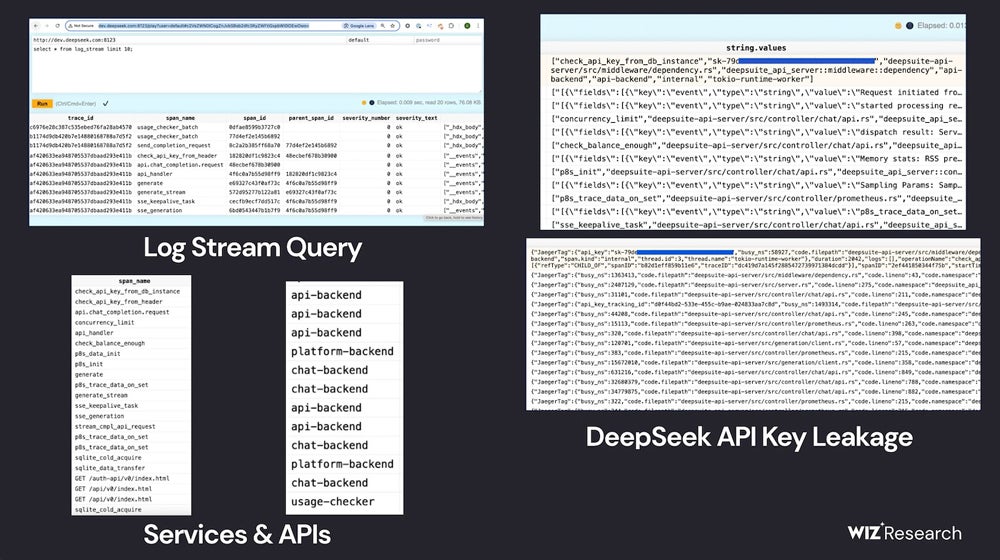
On Jan. 29, U.S.-based Wiz Research announced it responsibly disclosed a DeepSeek database previously open to the public, exposing chat logs and other sensitive information. DeepSeek locked down the database, but the discovery highlights possible risks with generative AI models, particularly international projects. DeepSeek shook up the tech industry over the last week as the Chinese company’s AI models rivaled American generative AI leaders. In particular, DeepSeek’s R1 competes with OpenAI o1 on some benchmarks. How did Wiz Research discover DeepSeek’s public database? In a blog post disclosing Wiz Research’s work, cloud security researcher Gal Nagli detailed how the team found a publicly accessible ClickHouse database belonging to DeepSeek. The database opened up potential paths for control of the database and privilege escalation attacks. Inside the database, Wiz Research could read chat history, backend data, log streams, API Secrets, and operational details. The team found the ClickHouse database “within minutes” as they assessed DeepSeek’s potential vulnerabilities. “We were shocked, and also felt a great sense of urgency to act fast, given the magnitude of the discovery,” Nagli said in an email to TechRepublic. They first assessed DeepSeek’s internet-facing subdomains, and two open ports struck them as unusual; those ports lead to DeepSeek’s database hosted on ClickHouse, the open-source database management system. By browsing the tables in ClickHouse, Wiz Research found chat history, API keys, operational metadata, and more. Wiz Research identified key DeepSeek information in the database. Image: Wiz Research The Wiz Research team noted they did not “execute intrusive queries” during the exploration process, per ethical research practices. More must-read AI coverage What does the publicly available database mean for DeepSeek’s AI? Wiz Research informed DeepSeek of the breach and the AI company locked down the database; therefore, DeepSeek AI products should not be affected. However, the possibility that the database could have remained open to attackers highlights the complexity of securing generative AI products. “While much of the attention around AI security is focused on futuristic threats, the real dangers often come from basic risks—like accidental external exposure of databases,” Nagli wrote in a blog post. IT professionals should be aware of the dangers of adopting new and untested products, especially generative AI, too quickly — give researchers time to find bugs and flaws in the systems. If possible, include cautious timelines in company generative AI use policies. SEE: Protecting and securing data has become more complicated in the days of generative AI. “As organizations rush to adopt AI tools and services from a growing number of startups and providers, it’s essential to remember that by doing so, we’re entrusting these companies with sensitive data,” Nagli said. Depending on your location, IT team members might need to be aware of regulations or security concerns that may apply to generative AI models originating in China. “For example, certain facts in China’s history or past are not presented by the models transparently or fully,” noted Unmesh Kulkarni, head of gen AI at data science firm Tredence, in an email to TechRepublic. “The data privacy implications of calling the hosted model are also unclear and most global companies would not be willing to do that. However, one should remember that DeepSeek models are open-source and can be deployed locally within a company’s private cloud or network environment. This would address the data privacy issues or leakage concerns.” Nagli also recommended self-hosted models when TechRepublic reached him by email. “Implementing strict access controls, data encryption, and network segmentation can further mitigate risks,” he wrote. “Organizations should ensure they have visibility and governance of the entire AI stack so they can analyze all risks, including usage of malicious models, exposure of training data, sensitive data in training, vulnerabilities in AI SDKs, exposure of AI services, and other toxic risk combinations that may exploited by attackers.” source

DeepSeek Locked Down Public Database Access That Exposed Chat History Read More »

Adobe Acrobat AI now reads and explains your contracts in minutes — here’s how it works

Join our daily and weekly newsletters for the latest updates and exclusive content on industry-leading AI coverage. Learn More Adobe is expanding its push into AI with new features that aim to demystify complex contracts and legal documents for both businesses and consumers, as the company seeks to maintain its dominant position in the document management market. The software giant announced today that its Acrobat AI Assistant can now automatically detect contracts, summarize key terms and compare differences across multiple versions — capabilities that Adobe says could help address a widespread problem: Most people don’t fully read agreements before signing them. According to Adobe’s research, nearly 70% of consumers have signed contracts without understanding all the terms. The problem extends into the business world, too, where 64% of small business owners have avoided signing contracts due to uncertainty about the content. “Control F is dead,” said Lori DeFurio, a product executive at Adobe, referring to the traditional way people search documents. “Why would I ever search again when I can just ask?” The shift from keyword searching to conversational AI reflects Adobe’s broader vision for making complex documents more accessible to everyone. Credit: Adobe How Adobe’s AI actually reads your contracts The new features represent a significant enhancement to Adobe’s AI capabilities — but notably stop short of providing legal advice. Instead, the system acts more like an intelligent research assistant, helping users locate and understand important contract terms while providing clear citations back to source material. “This is not a replacement for legal advice,” Michi Alexander, VP of product marketing at Adobe, emphasized in an exclusive interview with VentureBeat. “This is just to help you understand as a starting point your contracts, and where you potentially might want to ask questions.” The technology works by analyzing contract text and presenting information in more digestible formats. For example, users can compare up to 10 different contract versions in a table that highlights specific changes. The system can also process scanned documents, even if they’re wrinkled or imperfectly captured. A key differentiator, according to Adobe executives, is the system’s ability to provide specific citations for its analyses. “The answer AI assistant gives you is your guide on where in the document you should find the answer,” said Alexander. Your documents are safe, Adobe says: Inside the security architecture As AI features become more prevalent in enterprise software, questions about data security take center stage. Adobe emphasizes that all contract analysis happens in a transient fashion — documents are processed in the cloud but aren’t stored or used to train AI models. “Your data is always your data,” Lori DeFurio, a product executive at Adobe, explained during a product demonstration for VentureBeat. “We do not look at any of the documents that you don’t tell it to…your content is never used to train AI models.” The feature integrates into Adobe’s existing Acrobat ecosystem, which the company says serves more than 650 million monthly active users. It’s available for an additional $4.99 monthly fee for individual users, with enterprise pricing available for larger organizations. The real-world impact: How businesses are already using contract AI The release comes at a time when companies are increasingly looking to AI to streamline operations. According to Adobe’s survey, 96% of technology leaders believe AI would make them more confident in employees’ ability to handle contracts responsibly. In interviews the company performed with three dozen early users, most reported cutting their contract review time by 70 to 80%. “I used to spend 45 minutes on initial contract reviews,” said Austin Bailey, a real estate development executive who has been testing the feature since January. “Now I typically finish in under 10 minutes.” While Adobe isn’t the first company to apply AI to contract analysis, its massive user base and deep integration with existing document workflows could give it an advantage in the growing market for AI-powered business tools. The move also reflects a broader trend of traditional software companies embedding AI capabilities into their core products, rather than treating them as standalone features. For Adobe, which has invested in AI development for more than five years, the strategy appears to be paying off — the company reports that customer conversations with its AI assistant doubled quarter-over-quarter in late 2024. The future of contract analysis may increasingly rely on AI assistance, but human judgment remains crucial. As Alexander puts it, the tool is meant to “guide you to the parts of the document” rather than replace careful review entirely. source

Adobe Acrobat AI now reads and explains your contracts in minutes — here’s how it works Read More »