AI startup Sereact lands €25M to give dumb robots better brains

Stuttgart, Germany-based Sereact has secured €25mn to advance its embodied AI software that enables robots to carry out tasks they were never trained to do.  “With our technology, robots act situationally rather than following rigidly programmed sequences. They adapt to dynamic tasks in real-time, enabling an unprecedented level of autonomy,” said Ralf Gulde, CEO and co-founder of Sereact (short for “sense, reason, act”). Early Spotify and Klarna-backer Creandum led the Series A round. Existing investors Point Nine and Air Street Capital also chipped in as did several prominent angel investors. These include former Formula 1 World Champion Nico Rosberg, ex-DeepMind product lead Mehdi Ghissassi, and past Skype exec Ott Kaukver. Typically, robots — like those Roomba vacuum cleaners — are hard-coded. This means they follow exact instructions that enable them to repeat specific tasks.  The 💜 of EU tech The latest rumblings from the EU tech scene, a story from our wise ol’ founder Boris, and some questionable AI art. It’s free, every week, in your inbox. Sign up now! Sereact’s eembodied AI, however, acts like a robot’s brain, allowing them to analyse and even learn new jobs on the go. This is thanks to a machine learning technique called zero-shot visual reasoning, which allows AI to understand and interpret images without prior specific training on those types of images.  The model, dubbed PickGPT, makes robots smarter. It also means humans don’t have to pre-program them for each task, saving time for the companies that use them.  “The opportunities here are endless and it’s great to see this kind of innovation coming from Europe,” said Johan Brenner, general partner at Creandum. Sereact’s approach is similar to that of UK startup Wayve, which raised $1bn in Europe’s largest-ever AI funding round last year. However, while Wayve’s tech targets autonomous vehicles, Sereact focuses on logistics and warehouse robots that do things like pick and pack, sort goods, and run quality control checks. Firms like BMW, Daimler Truck, Bol and Active Ants have already adopted Sereact’s software at their factories. However, the startup is now looking to venture beyond the warehouse.  Sereact said it will use the fresh funding to develop new “robot hardware platforms,” such as mobile robots and humanoids. The company also plans to expand its US presence.  “We’re on an exciting journey to become the leading platform for robotics applications that forever change the daily lives of people and businesses,” said Gulde.  source

AI startup Sereact lands €25M to give dumb robots better brains Read More »

Deloitte: 74% of enterprises have already met or exceeded gen AI initiatives (but challenges remain)

Join our daily and weekly newsletters for the latest updates and exclusive content on industry-leading AI coverage. Learn More Enterprises of all sizes around the world are trying to make sense of generative AI and determine where it might add value. The good news: The majority of organizations are actually making it work. According to a new report today from Deloitte, the majority of enterprises are actually meeting or exceeding their own expectations for return on investment (ROI) from gen AI. The “State of Generative AI Q4” report, based on a survey of 2,773 leaders across 14 countries, highlights both the progress and challenges organizations face in their gen AI journeys. The report shows considerable progress from the first version released a year ago, in which business leaders expressed multiple concerns. There is also positive progress over the third quarter report, which showed that the majority of organizations had avoided some gen AI use cases due to data issues. Despite longer-than-expected time to value, nearly three-quarters (74%) of respondents reported that their most advanced gen AI initiatives are meeting or exceeding ROI expectations. Cybersecurity and IT functions are leading the way in terms of ROI and successful scaling. Key findings include: Organizations require at least 12 months to resolve major adoption challenges IT, cybersecurity, operations, marketing and customer service show strongest adoption and results Regulatory compliance has emerged as the top barrier to gen AI deployment 78% of respondents expect to increase their overall AI spending in the next fiscal year Jim Rowan, head of AI at Deloitte, told VentureBeat that the biggest gains enterprises are reporting from AI usage are efficiency and cost savings. “We’re taking time out of day-to-day tasks and activities and making individuals more efficient,” said Rowan. The challenge of gen AI moving at enterprise speed Enterprise technology by definition is about stability and resilience. It is supposed to be the stuff businesses run on. For many types of technology, enterprise adoption can take multiple years as organizations first need to validate use cases and ROI potential. While the rapid advancements in gen AI capabilities have captured the public’s imagination, enterprises are often moving at a much slower pace when it comes to adoption. This disconnect between the breakneck speed of AI innovation and the more deliberate nature of enterprise technology rollouts presents a significant challenge. “Enterprises are moving at enterprise speed,” said Rowan. “That plays out in a couple different areas within the report, in terms of scaling questions, risk and regulatory challenges that organizations are facing across the board.” This disparity in speed is further complicated by the fact that many enterprises are still grappling with foundational technology challenges, such as data governance and platform modernization. Rowan noted that those underlying issues must be addressed before enterprises can fully capitalize on the potential of generative AI. Rather than rushing to deploy the latest gen AI tools, Rowan emphasized the importance of a more measured, strategic approach that focuses on building the necessary infrastructure and cultural readiness. By taking the time to properly integrate gen AI into existing operations and workflows, enterprises can ensure that the technology delivers tangible, long-term value, rather than just serving as a fleeting novelty. This patient, deliberate approach, while potentially slower in the short term, may ultimately prove more effective in driving lasting transformation. Where enterprise AI is delivering the most ROI today One of the key areas where enterprises are seeing tangible value from AI is in the software development lifecycle.  According to the report, AI is helping to drive efficiency gains across the entire process — from requirements gathering to testing and deployment.  “We’re seeing it a ton in the software development life cycle,” Rowan said. “This is why IT has been a big, big proponent of this.” Beyond software development, enterprises are tapping into AI to enhance their customer service and contact center operations. By automating certain tasks and interactions, companies are able to improve efficiency and responsiveness. “The other big use case is around contact centers, customer service, sort of engagement from those two,” said Rowan. “So those tend to be the largest areas where we’re seeing the most amount of efficiency being taken out.” How enterprises can measure the impact of gen AI As enterprises seek to quantify the impact of their AI investments, Rowan emphasized the importance of looking at both quantitative and qualitative metrics.  While cost savings and efficiency gains are important, companies should also track the number of new ideas and use cases generated, as well as the impact on employee skills and culture.  In the quantitative categories Rowan cited a few key metrics: Efficiency measurement through cost savings Increased revenue generation Increased efficiency per full-time equivalent employee (FTE) on some activities. On the qualitative side, Rowan pointed to metrics around employee development, continuous learning and the overall transformation of business processes.  “How are your employees’ skills improving? How are you using this moment to really change the culture around learning and development?” he said. Benefitting from the promise of agentic AI Perhaps the biggest area of innovation for enterprises to consider in 2025 is agentic AI. The report indicates that 52% of organizations are pursuing AI agents, with 45% specifically exploring multi-agent systems. Rowan expressed optimism about the potential of agentic AI, but noted that it will take time for enterprises to fully adopt and integrate this technology. He explained that enterprises will likely start with simpler, more focused agent applications before expanding their use. Rowan said that agentic AI has the potential to fundamentally transform enterprise processes and drive significant ROI, but only if approached strategically. With the initial rollouts of gen AI, enterprises often focussed on proof of concept (PoC) deployments. A different approach will be required for agentic AI. Instead of looking at individual use cases, enterprises will be well served looking at the broader process chain. He explained that the true value of agentic AI will come from rethinking entire business processes to be AI-driven, rather

Deloitte: 74% of enterprises have already met or exceeded gen AI initiatives (but challenges remain) Read More »

Users' Google Suit Can Advance With Pared Search Claims

By Bryan Koenig ( January 17, 2025, 4:38 PM EST) — Winnowed consumer antitrust claims against Google can move forward after a California federal judge said Thursday that while users failed to resurrect claims of an agreement keeping Apple out of online search, they’ve now adequately accused Google of stifling would-be rivals with fewer ads or more privacy…. Law360 is on it, so you are, too. A Law360 subscription puts you at the center of fast-moving legal issues, trends and developments so you can act with speed and confidence. Over 200 articles are published daily across more than 60 topics, industries, practice areas and jurisdictions. A Law360 subscription includes features such as Daily newsletters Expert analysis Mobile app Advanced search Judge information Real-time alerts 450K+ searchable archived articles And more! Experience Law360 today with a free 7-day trial. source

Users' Google Suit Can Advance With Pared Search Claims Read More »

5 practical tips for emerging IT leaders

Having clarity of vision and the ability to execute while staying true to your and your organization’s value systems will help you establish credibility and reliability within your workplace and the industry. Cal Newport’s book, Deep Work: Rules for Focused Success in a Distracted World, changed the way I operate and made room for deep work, focus and clarity of thought as I do what I need to do. My practices in creating a distraction-free space for myself where I can find the clarity of my thoughts and visions have helped me work through some mission-critical projects including the one that got me nominated for the Emerging ICT Leaders Award.  I often work through the parting message I want to leave my audience with on any platform in those deep work sessions. My intent for the message and the keywords that I used to impart that message are often the product of the distraction-free spaces I have created for myself at work and home. Every piece of work product – whether it’s a piece of software or an article – I aim to achieve in a distraction-free space so I can give it the meaningful impact I want it to have on the world.  As a leader, your clarity of thought, purpose and clear understanding of your organization’s strategic priorities will form the foundation of what your team can deliver to make the company’s mission a reality. In the tech industry, there is always new shiny fish to distract you. Today, it’s artificial intelligence (AI). Yesterday it was blockchain. I’m not saying those technologies don’t add value, but they only add value for the right use cases with the right setup.  source

5 practical tips for emerging IT leaders Read More »

Microsoft launches Copilot Chat with AI agents; take that, Gemini!

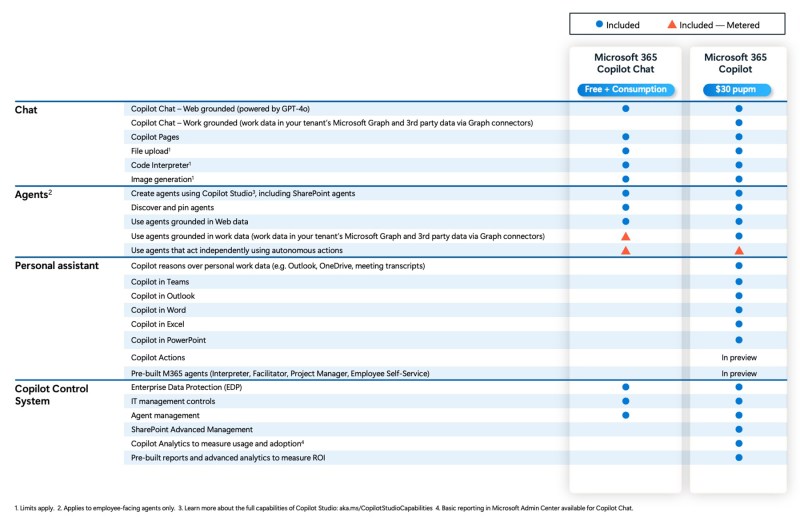
Join our daily and weekly newsletters for the latest updates and exclusive content on industry-leading AI coverage. Learn More Microsoft has been positioning Copilot as the “UI for AI.” The company has already launched several variants of the GPT-4o-powered assistant for business and personal users. Now, as the next step in this work, it is launching Microsoft 365 Copilot Chat — a rebranded version of its free AI chat experience for businesses, enhanced with agentic capabilities. Available starting today, the offering is designed to give businesses an easy way to explore most, if not all, of the capabilities of the more full-featured Microsoft 365 Copilot, which is priced at $30 per user per month. Although the experience is free, there is a notable caveat: The agentic capabilities promising task automation will work only on a consumption-based model. The goal here is pretty obvious: Microsoft wants to give its commercial customers a taste of what it has on offer in the paid version of Copilot. If, with powerful features like agents, the company can make using Copilot a daily habit of Microsoft 365 users — from customer service representatives to marketing leads to frontline technicians — those users might eventually turn to the paid plan. This development is not a surprise given that the rollout of Microsoft 365 Copilot has been reported to be far from perfect, with some enterprises describing it as expensive and complex to implement due to security concerns. For its part, Google continues to move ahead with Gemini for Workspace, positioning it as an affordable, easily accessible AI for work. What to expect from Microsoft 365 Copilot Chat Just like the original version, Microsoft 365 Copilot Chat will continue to have a chat interface, where users will be able to input their queries and get answers from AI.  The model under the hood, GPT-4o from OpenAI, will provide information grounded in the web, allowing users to do market research or prepare strategy documents. It even supports file uploads, enabling users to seek summaries, analyses or suggestions from documents, and image generation for use cases like social media marketing.  But the real deal is support for AI agents. IT admins can now use Copilot Studio to build domain-specific agents and make them available to employees via Microsoft 365 Copilot Chat.  These agents can serve as virtual teammates for employees, helping them automate repetitive tasks, from providing customer information before meetings to monitoring relevant events. They can be grounded using data from the web as well as work data either via Microsoft Graph or third-party graph connectors. “A customer service representative can ask a customer relationship management (CRM) agent for account details before a customer meeting, while field service agents can access step-by-step instructions and real-time product knowledge stored in SharePoint,” Microsoft notes in a blog post.  By providing access to agents within Microsoft 365 Copilot Chat, Microsoft wants to show businesses the value its AI offerings can bring. However, this experience will not be entirely free. The agents will be accessible on a consumption-based model, with the total usage being determined according to the number of messages used by an organization. “You can purchase messages though the Copilot Studio meter in Microsoft Azure, a pay-as-you-go option, for $0.01/message, or via pre-paid message packs priced at $200 for 25,000 messages/month,” the company notes in a separate post. It’s worth noting here that different kinds of interactions will use up messages differently, with Microsoft Graph-based answers taking up as many as 30 messages or 30 cents.  Microsoft 365 Copilot Chat vs Microsoft 365 Copilot Taking on Gemini dominance With this move, Microsoft hopes to squeeze some money out of Microsoft 365 users with basic AI needs while creating an opportunity to convert them into paying customers. It also comes as a counter to Google’s push with the Gemini assistant The Sundar Pichai-led company has just announced that Gemini will be available for free within its Workspace apps, including Gmail, Docs, Sheets, Meet, Chat and Vids. This integration is offered to Workspace Business and Enterprise customers, meaning companies paying a base price of $14 per user per month will gain access to AI features inside their core applications. In contrast, Microsoft 365 users must subscribe to the full Copilot version, priced at $30 per user per month, to access AI features within apps like Teams, Outlook, Word, Excel and PowerPoint. But Microsoft differentiates itself by offering usage-based agentic AI capabilities. This allows businesses to create custom agents for task automation — a feature currently absent in Gemini. Ultimately, the choice comes down to the ecosystem you’re aligned with and your specific needs. Google’s approach enables easy access to Gemini within essential business apps but lacks agentic capabilities for now. Meanwhile, Microsoft 365 provides web-based chat and agentic features (on a pay-as-you-go model) but requires a higher investment to unlock AI functionality within its work apps. source

Microsoft launches Copilot Chat with AI agents; take that, Gemini! Read More »

Brendan Carr Officially Takes Over As FCC Chair

By Christopher Cole ( January 21, 2025, 8:40 PM EST) — Brendan Carr took over as chair of the Federal Communications Commission on Monday, restoring Republican control of the agency as President Donald Trump kicked off his second term…. Law360 is on it, so you are, too. A Law360 subscription puts you at the center of fast-moving legal issues, trends and developments so you can act with speed and confidence. Over 200 articles are published daily across more than 60 topics, industries, practice areas and jurisdictions. A Law360 subscription includes features such as Daily newsletters Expert analysis Mobile app Advanced search Judge information Real-time alerts 450K+ searchable archived articles And more! Experience Law360 today with a free 7-day trial. source

Brendan Carr Officially Takes Over As FCC Chair Read More »

Get Ready for the New Tax Year With H&R Block Tax Software

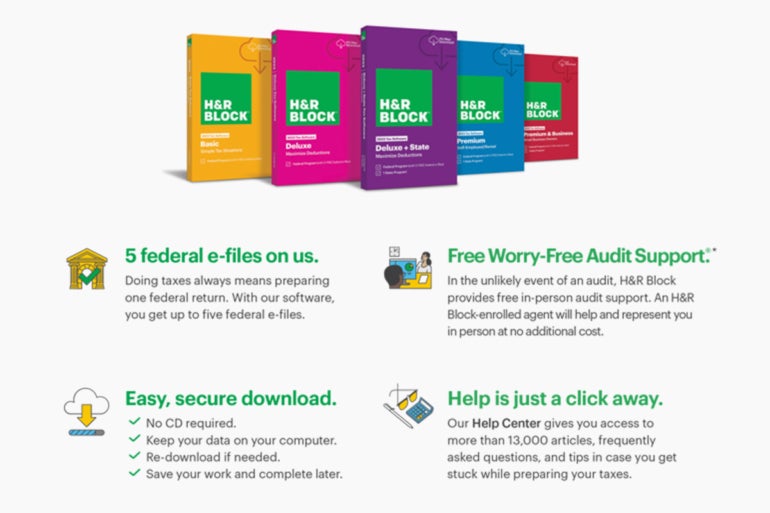
TL;DR: H&R Block Tax Software Deluxe + State 2024 for Windows/Mac helps you file your taxes and maximize deductions, and it’s just $39.99 on PC/Mac. There’s plenty to be excited about when building a business. Filing your taxes is more of a chore. If you want to make the process less stressful and max out your deductions, H&R Block Deluxe can help. This powerful tax software lets you file both federal and state taxes online with ease. It also comes with free audit support and a massive library of 13,000 tax articles. Through February 11, you can get it for just $39.99 over at TechRepublic Academy. Image: StackCommerce April might feel a long way off, but April 15 will come around sooner than you think. That’s the last day to file your taxes unless you fancy a big bill. According to the IRS, the process requires 13 hours of work in total — the best part of two whole working days. H&R Block Deluxe allows you to spend your time on something more productive. Available on PC and Mac, the software shows you how to claim 350 credits and deductions through step-by-step tutorials. That means fewer hours spent reading PDF documents written in legalese. You also have that huge library of articles for reference, along with FAQs and tips from expert accountants. If you need to pause while preparing your filings, you can easily save your work and start where you left off. Once you have run the numbers, H&R Block Deluxe gives you five federal e-files and unlimited federal prep. Previously used TurboTax? No problem. You can import all your data to H&R Block Deluxe with a couple of clicks. It’s easy to see how the software has earned glowing reviews. Earning 5 out of 5 stars on BestBuy and 4.5 on Amazon’s Choice, it shows it’s one of the best tax filing software on the market right now. Order today to get this H&R Block Tax Software Deluxe + State 2024 for Windows/Mac for just $39.99, saving $20 on the regular price. Prices and availability are subject to change. source

Get Ready for the New Tax Year With H&R Block Tax Software Read More »

Key Justices Stay Quiet As High Court Weighs FCC Deference

By Allison Grande ( January 21, 2025, 11:26 PM EST) — Several U.S. Supreme Court justices on Tuesday appeared open to giving district courts more leeway to review the Federal Communciations Commission’s tome of regulations under the Telephone Consumer Protection Act, although the two justices expected to cast pivotal votes refrained from posing questions. … Law360 is on it, so you are, too. A Law360 subscription puts you at the center of fast-moving legal issues, trends and developments so you can act with speed and confidence. Over 200 articles are published daily across more than 60 topics, industries, practice areas and jurisdictions. A Law360 subscription includes features such as Daily newsletters Expert analysis Mobile app Advanced search Judge information Real-time alerts 450K+ searchable archived articles And more! Experience Law360 today with a free 7-day trial. source

Key Justices Stay Quiet As High Court Weighs FCC Deference Read More »

Announcing The Forrester Wave™: Modern Application Development Services, Q1 2025

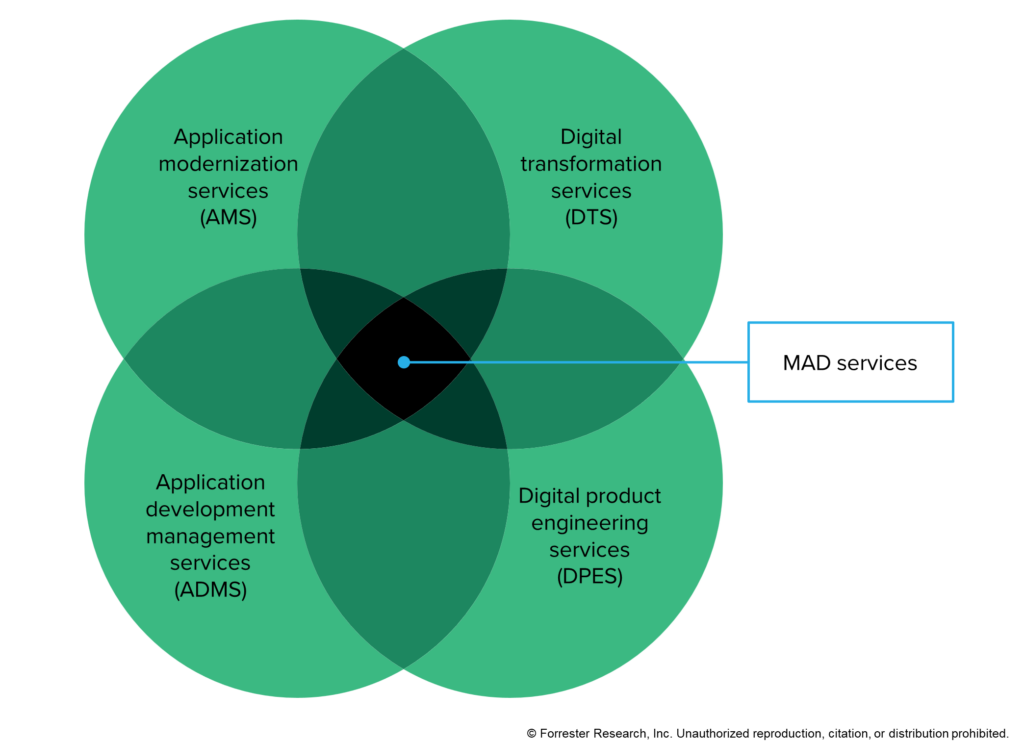
MAD Services Deliver Cool New Products While Transforming Your Development Capabilities Modern application development (MAD) services represent the next wave in custom application development services. Emerging from the convergence of current and past services such as application development management services (ADMS), digital transformation services (DTS), digital product engineering services (DPES), and broader application modernization services (AMS), MAD services are now utilized by leading organizations, with an increasing number of CIOs showing strong interest in these offerings (see figure below).   What sets MAD services apart? It’s their unique ability to not only support clients in delivering modern apps using the latest technologies and development practices but also their role in transforming and modernizing their custom development capabilities. The Venn diagram illustrates the context for MAD services and their foundational services, though it doesn’t capture the market’s multibillion-dollar scale, which is expected to grow. We just published The Forrester Wave™: Modern Application Development Services, Q1 2025, which analyzes and compares 13 medium and large market players out of more than 50 providers that offer MAD services: Accenture, Capgemini, CI&T, Cognizant, EPAM, Globant, HCLTech, Infosys, LTIMindtree, NTT DATA, Softtek, Tata Consultancy Services, and Thoughtworks. Why These Players And Not Others? The MAD services market is highly competitive, and Forrester clients can learn more about the broader landscape and discover a wider group of vendors in The Modern Application Development Services Landscape, Q3 2024. This most recent MAD services Wave’s analysis focuses on medium and large vendors compared to our previous Wave evaluation on the same market, in which the emphasis was on smaller ones. But not every company from the landscape report met the stringent criteria for inclusion in the Wave, which were: Significant peer recognition. These were providers most frequently cited in client bids. Forrester mindshare. This entails the service providers that were referenced more during briefings, inquiries, or research projects over the last year. MAD capabilities. The Wave’s vendors offer comprehensive and differentiating sets of MAD capabilities or, in Forrester’s view, unique capabilities that warrant inclusion. Global MAD services revenue of at least US$450 million. The included vendors have global MAD services revenue of US$450 million in at least two of the North America, LATAM, EMEA, or APAC regions combined. What Distinguishes The Leaders, Strong Performers, And Contenders? Our Wave methodology categorizes vendors into three groups, Leaders, Strong Performers, and Contenders, based on a range of services that we evaluated: agile, DevOps, microservices architecture, cloud services, and more advanced services such as site reliability engineering, project-to-product capabilities, AI and generative AI architecture services, and the testing and development of AI-infused applications. Showing differentiation in all these services was key to our evaluation. Reference clients, case studies, and other evidence also played a critical role in our analysis. After all, it’s the provider’s ability to enhance your team’s skills in new technologies and practices that truly differentiates MAD services from traditional ADMS or AMS services. We encourage readers not to dismiss any provider without first examining the detailed descriptions of strategy, capabilities, and client feedback in our Wave report. Download the accompanying Excel file for a breakdown of the questions, scoring, and criteria grading. For more information, feedback, or questions, email me at [email protected], or if you’re a Forrester client, schedule a guidance session or inquiry. I’m here to assist! source

Announcing The Forrester Wave™: Modern Application Development Services, Q1 2025 Read More »

What is Grok AI? Is It Worth the Hype?

Amid a sea of generative AI products, Grok AI sets itself apart with a bold and irreverent personality. Developed by Elon Musk’s xAI, Grok’s unconventional tone may make it less suitable for business use compared with its competitors. However, Grok still holds its own among the leading foundation models of today, boasting strong test performance and competitive speed. 1 New Relic Employees per Company Size Micro (0-49), Small (50-249), Medium (250-999), Large (1,000-4,999), Enterprise (5,000+) Any Company Size Any Company Size Features Analytics / Reports, API, Compliance Management, and more 2 Wrike Employees per Company Size Micro (0-49), Small (50-249), Medium (250-999), Large (1,000-4,999), Enterprise (5,000+) Medium (250-999 Employees), Large (1,000-4,999 Employees), Enterprise (5,000+ Employees) Medium, Large, Enterprise Features 24/7 Customer Support, 360 Degree Feedback, Accounting, and more What is Grok AI? Grok AI is a large language model designed for generating, changing, or analyzing text. It also offers advanced generative AI capabilities, including internet search functionality and image creation, making it a versatile tool for various tasks. Unlike standalone AI tools, Grok resides within X (formerly Twitter). To access it, users must log into X and purchase a subscription to Grok. This integration aligns Musk’s vision of transforming the social media platform into an “everything app,” where tools like Grok complement the platform’s ecosystem of services. Additionally, Grok’s development is part of xAI’s larger mission to build AI systems with a distinct personality and edge, reflecting Musk’s intent to differentiate Grok from its more conventional competitors. What are the key features of Grok AI? “Grok is designed to answer questions with a bit of wit and has a rebellious streak,” the Grok team wrote in a blog post in November 2023. “A unique and fundamental advantage of Grok is that it has real-time knowledge of the world via the 𝕏 platform. It will also answer spicy questions that are rejected by most other AI systems.” Web search and citations Grok leverages X to deliver real-time answers about current events. Answers to questions related to the news or current events will show links to the source post or website next to the chat window. Images Grok generates images by using xAI’s Aurora, a separate video model. Aurora is an autoregressive image generation model. Autoregressive refers to the statistical technique the model uses to predict what content is most likely to come next in a sequence. Unlike other AI models, Grok will create photorealistic images — a controversial capability, since it can be used to create deepfakes. Grok accepts prompts including copyrighted characters or politically inflammatory material. X users might see the “draw me” feature, in which Grok will generate images based on information in that user’s profile. Facebook similarly introduced AI-generated images into the feed recently. This included images putting the user’s likeness in fantastical situations. API The API for Grok allows for function calling, a 128k context length, and system prompt support. It interoperates with OpenAI and Anthropic software development kits. More must-read AI coverage Who developed Grok AI? xAI developed Grok. Musk founded and leads xAI, which was publicly announced in November 2023. How does Grok AI compare to other AI chatbots like ChatGPT? A major difference between Grok and other generative AI products, like ChatGPT or Llama, is that Grok operates entirely within the X social media platform. Grok will answer questions related to productivity, analyze text,and solve math and coding problems. It can also perform many of the other tasks generative AI can do for business. However, its data remains within the X platform. xAI said the latest version of Grok, Grok 2, scored 87.5% on the MMLU benchmark. MMLU measures the ability to correctly answer natural language questions in academic disciplines including philosophy and mathematics. OpenAI said its o1 scores 92.3%. Meta said its Claude 3.5 Opus scored 86.8%. SEE: Google Workspace subscriptions increased slightly as the Gemini AI became a default part of the package. Is Grok AI free to use? Grok AI is not free to use. It requires a subscription to X Premium or Premium+. Premium costs $8/month or $84/year on the web. Premium+ costs $22/month or $229/year on the web. The Grok enterprise API costs $2 per 1 million input tokens and $10 per 1 million output tokens. What are the privacy concerns associated with Grok AI? Grok’s close association with X has raised concerns about the privacy of personal data on the platform, which may be fed into the AI. X posts are used to train Grok by default. What is the controversy around Grok AI? Musk’s control of Grok and X’s trend toward unlimited — including potentially offensive — content has led some to be weary of using Grok. xAI describes Grok as providing “unfiltered answers.” During the November 2023 announcement of the model, xAI said: “Grok is designed to answer questions with a bit of wit and has a rebellious streak, so please don’t use it if you hate humor!” In September 2024, the National Association of Secretaries of State alleged Grok contributed to election misinformation regarding the US presidential race. In response, X changed Grok’s responses such that questions about voting were redirected to a nonpartisan site, CanIVote.org. Is Grok worth the hype? We find it difficult to recommend Grok for business use cases. Its irreverent tone may make the content it produces inappropriate for general audiences, while heavy reliance on social media for information may make its answers potentially unreliable. Additionally, Grok is not accessible to people without an X account. However, Grok’s irreverent tone may work for some content and audiences, and its placement on X may meet users where they already are. As noted above, Grok scores higher than Meta’s Claude and some versions of OpenAI’s GPT-4 on certain benchmarks. In particular, it holds its own when offering general knowledge and mathematics answers. source

What is Grok AI? Is It Worth the Hype? Read More »