Veeam CIO Nate Kurtz: When data resilience meets AI strategy
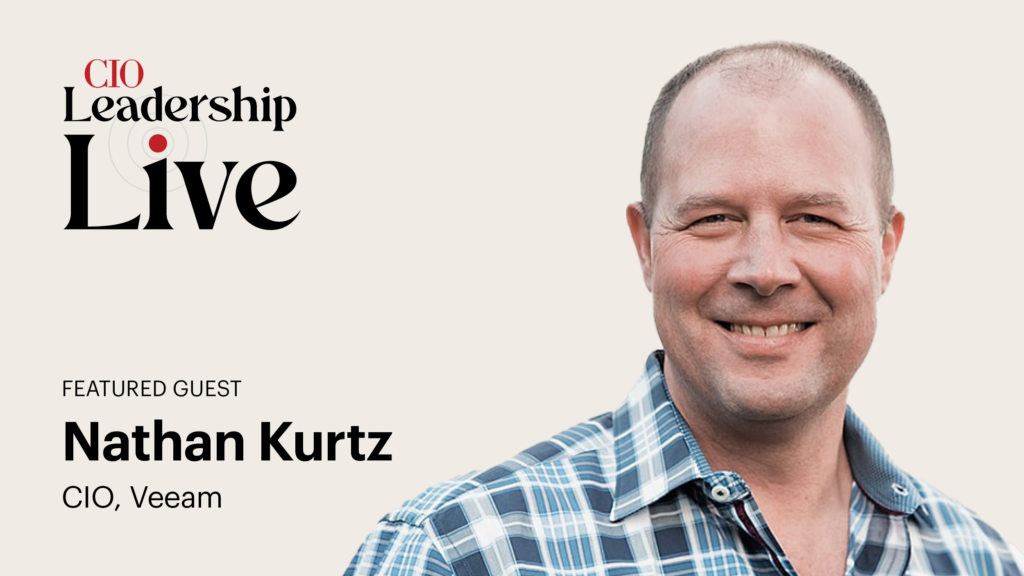
00:00 Hello. Good afternoon, and welcome to CIO Leadership Live. I’m your host, Maryfran Johnson, CEO of Maryfran Johnson Media and the former editor in chief of CIO magazine. Since November 2017 this video show and audio podcast has been produced by the editors of CIO.com and the digital media division of foundry, which is an IDG company. Our sponsor for this episode is Veeam Software, a global market leader in data resilience. Veeam delivers a wide range of solutions for data backup and recovery, data portability and security and data intelligence. Veeam leaders believe that every business should be able to bounce forward after a data disruption with confidence and control wherever and whenever they need it, headquartered outside Seattle, Washington with offices in more than 30 countries. Veeam protects more than 550,000 customers worldwide, including 74% of the global 2000 to learn more, visit veeam.com website. Now onward to today’s guest, I’m joined today by Veeam Software, CIO Nathan Kurtz Nate joined Veeam in June of 2022 he leads the corporate technology team and is responsible for the company’s global business systems and all of its internal technologies. Prior to Veeam, he led the Technology Services team at F5 networks, where he spent more than 10 years leading it through periods of significant growth and helping to transform overall customer and employee experience at this rapidly growing tech provider before F5 networks, Nate spent 11 plus years at Arthur Andersen and KPMG serving as part of the global technology and telecommunication practices, where he led both sales and delivery teams for many of their high tech customers, including Microsoft and Amazon. Nate, welcome. It’s wonderful to have you here today. Thanks,Maryfran, really nice to be here as well. Thanks for for inviting me.Okay, well, I’m going to take full advantage of your expertise with my first question here about data resiliency. Now, what does that term mean to your seat CIO customers today, versus the data backup and data storage needs a kind of data housekeeping that we’ve all heard about for many, many years in the industry. When you talk about data resiliency, what exactly are we talking about?Yeah, so I think, you know, in my my career in tech, I think if you were to go back 1015, years, people tended to talk about, like you said, data backup and recovery. It was pretty basic kind of cut and dry. I think, though, as as this space has evolved and we start talking about data resiliency, it’s become more and more important as time has has gone on, as a CIO, we can recover applications and systems pretty quick. What we can never recover or recreate is our data. And so this is the one area. This is truly the keys to what we are responsible for is is recovering that data in a very complex environment, too. And so it’s the world is becoming more complex. The amount of data that we have as a world is growing. It’s doubling every year. I think the last term I heard was 150 zettabytes. And it’s, continuing to expand. And so not only do we have this rapid growth of data, but we also have growth and complexity in terms of the number of of systems, cloud providers, and where it’s all residing. And so with all this, I would say that macro level environment, in terms of our data, it’s just become more and more critical to be resilient when it comes to it. And for Veeam, we we use this bounce forward slogan because we want, we want our products, but we also want the industry as a whole to be able to very quickly be resilient and recover if there is an incident with their data.Well, you mentioned that in years past, once you could recover applications, but data would be lost. Talk a little bit about the kind of protections that are in place today. I take it that as technologies have evolved, the problem of losing that data forever. I mean, we’re not talking about ransomware here. We’re talking about data that is harmed in a disruption. What is it about technologies and the advances of them that are protecting that data better today? Yeah,yeah. So we tend to, we tend to think of it in a framework, type approach. Sure And so, and I think, I think we’ve kind of talked about this a little bit already, but we tend to think of it in kind of five pillars. When you have just your your basic data backup, are you? Are you on a at the frequency that you want? Are you storing your your data within your systems? But then are you able? The next kind of pillar would be recovery. Are you able to bring it back? Then we get into the areas that I think you’re you’re really asking about, which is on that data portability. Can you recover data from any anywhere to anywhere? Because we’re in a very like I mentioned, a complex environment where we have information being stored both in systems. They could be local, in your own data center. They could be at a Co Location facility where you have a hosted data center. They could be in the cloud, you know, the major cloud providers being AWS, Google Cloud, Azure and so forth. Can you recover between those then we get into data security, and that’s kind of that fourth pillar that we tend to think about, which is, when you have your information stored somewhere, does it have integrity? Is it? Is it free from I guess the common term would be, you know you could, we’ve talked about like viruses or ransomware. Do you know that it has you have assurances and trust in that data, and that’s what these products today are allowing CIOs to have, is we know that these where our data sits, there’s a high degree
Veeam CIO Nate Kurtz: When data resilience meets AI strategy Read More »