What Happens if AI No Longer Has Access to Good Data to Train On?

In a world dominated increasingly by AI, access to relevant data becomes paramount — but what if such streams of information dry up? Regulators at state, national, and international levels continue to watch how businesses capture and use data that could be used to train AI. If restrictions emerge that cut off access to data that AI needs, would the technology stall out despite its promises of innovation? Alternatives such as synthetic data exist, but are they sufficient to properly train AI and deliver results that actually matter to operations? This episode features Shobha Phansalkar, vice president of client solutions and innovation for Wolters Kluwer; Olga Megorskaya, founder and CEO of Toloka; Pete DeJoy, co-founder and senior vice president of product for Astronomer; Melissa Bischoping, senior director of security and product design research at Tanium; and Omar Khawaja, Field CISO, Databricks. They discussed types of data that is necessary and relevant for training AI, how organizations might determine if data is useful or simply junk, what happens if policy stonewalls data access, and whether or not AI simply dies without data. Listen to the full podcast here. source

What Happens if AI No Longer Has Access to Good Data to Train On? Read More »

Introducing the Forrester IT Management Systems Architecture

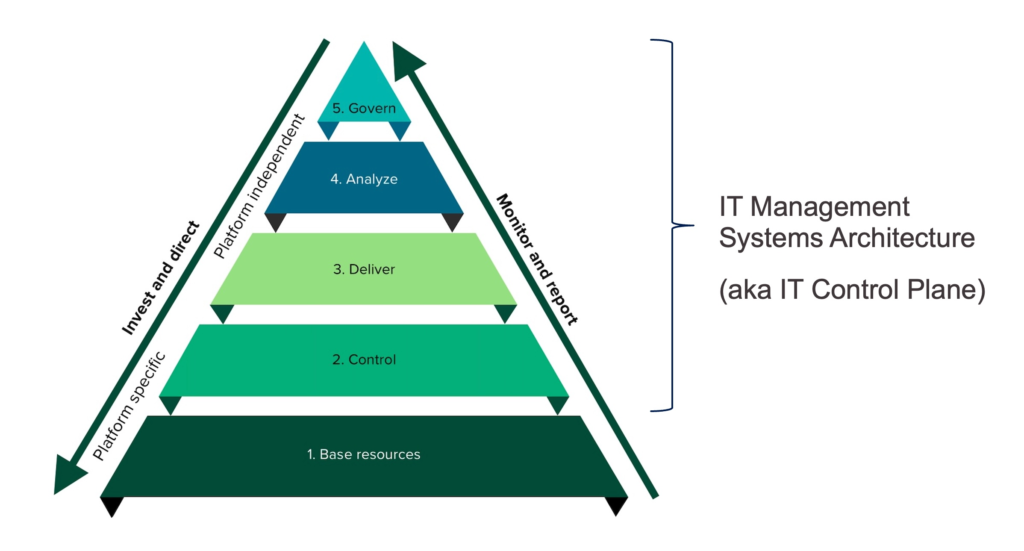
I’m pleased to announce the recent publication of the Forrester IT Management Systems Architecture. IT (information technology) uses a wide variety of systems to effectively run itself. Unlike other business areas, the discipline of IT management still relies on point, best-of-breed solutions, which require extensive integration to make them all work together. This foundational report presents a new layered architecture for understanding the systems used for secure IT delivery and discusses how this architecture will evolve in the future. This new report is a companion architecture to the Forrester Reference IT Capability Map. We maintain these two different views, in keeping with architecture best practices: The capability map shows your IT management concerns from an operating model perspective. In general, you own the development and evolution of these capabilities — they are not simply a matter of sourcing. The systems architecture classifies what you can source in the market to support your IT management capabilities, assisting you with managing this complex portfolio and identifying key integration areas and systems redundancy.   A key scoping boundary is between layer 1 and 2. Most of the multi-trillion global IT budget is spent at layer 1, representing the actual computing resources under management. Layer 1 is not in scope for the IT management systems architecture, per se. The systems in layers 2–5, while numerous and representing billions of dollars economically, are orders of magnitude less in terms of the overall share of the global IT market. The layers are defined as follows, with example systems (see the report for complete system classifications): Layer Description 5. ​Govern This is the layer at which IT investments are directed, monitored, and evaluated at the highest enterprise level and risks are tracked and controlled. It includes strategic portfolio management, enterprise architecture, risk management, and IT financial management.​ 4. ​Execute Work is defined, planned, and tracked here at a higher level, roughly aligned to a “team of teams.” This is where finances are tracked as well as higher-order concerns such as engineering performance, architecture, and technical debt. ​It includes value stream management (aka engineering performance), AIOps, and the recent trend toward security data pipeline management, among other categories. 3. ​Deliver This is the level of work management, the primary team layer. Work is coordinated and executed here, including preplanned as well as interrupt-driven work (which still must be resourced). ​It includes enterprise service management, security analytics, collaborative work management, and other products supporting team-level collaboration, among other categories. 2. ​Control This is the “closest to the metal” layer of the overall control plane. It is the layer of the individual contributor. It represents element management tooling that directly interacts with the resources under management, discovering, instantiating, and configuring them, facilitating the construction and deployment of new software, and monitoring and correcting exceptions.​ It includes products such as integrated software delivery platforms (DevOps platforms), testing automation (including security testing such as software composition analysis), endpoint management, and infrastructure automation, among other categories. 1. ​IT resources These are the core IT “things”: physical and virtual machines, clusters, serverless resources, software installed on them, networking, storage/data, and security infrastructure, along with the myriad configuration settings controlling all of this. This may be on-premises, in the cloud, or hybrid.​ This layer is out of scope for the architecture per se. What’s next in this research stream? Patterns of integration, which may ultimately drive market behavior. Recently, we’ve identified five major integration focal points in the overall architecture:   Core portfolio (configuration management database [CMDB] + enterprise architecture) AIOps Engineering performance/value stream management FinOps Risk and security operations These focus areas bring together data from most of the rest of the IT management systems. From an architecture perspective, the core portfolio is leveraged heavily by the other four (hence the durability of the often-maligned CMDB), and there is growing concern among enterprise architects I talk to about redundancy across the data marts that these product categories represent — integrations add complexity and maintenance costs. If you are an end user figuring out the big picture of your IT management systems or a vendor with a value proposition here (especially an integrative value proposition), I’d love to talk to you. source

Introducing the Forrester IT Management Systems Architecture Read More »

Trump Names Senate Commerce Aide As FCC Commissioner

By Christopher Cole ( January 16, 2025, 4:24 PM EST) — President-elect Donald Trump on Thursday named Olivia Trusty, a top Republican aide on the U.S. Senate Commerce Committee, as his pick for the next GOP commissioner on the Federal Communications Commission…. Law360 is on it, so you are, too. A Law360 subscription puts you at the center of fast-moving legal issues, trends and developments so you can act with speed and confidence. Over 200 articles are published daily across more than 60 topics, industries, practice areas and jurisdictions. A Law360 subscription includes features such as Daily newsletters Expert analysis Mobile app Advanced search Judge information Real-time alerts 450K+ searchable archived articles And more! Experience Law360 today with a free 7-day trial. source

Trump Names Senate Commerce Aide As FCC Commissioner Read More »

Order Management Systems And A Story Of Augmented Evolution

Findings From The Forrester Wave™: Order Management Systems, Q1 2025 Digital leaders know that order management systems (OMSes) are true workhorses at the heart of the commerce tech ecosystem, providing inventory, order, logistic, and operational tools. But the current OMS market shakes off all the basics. It is a story of evolution — on the part of both the vendors and the users of these systems. Our latest Forrester Wave™ evaluation of the market uncovered this new evolutionary tale. The majority of digital leaders with an OMS are happy enough to keep it (though not nearly as many as those sticking with their B2C commerce solution). But many also aren’t just blindly relying on their vendor to keep them ahead of the innovation curve. The state of the enterprise OMS market in 2025 is about: More businesses augmenting their current solution with individual modules of another — usually more modern — solution. We saw certain vendors used this way in the previous evaluation. In 2025, the rip-and-replace is less common than ever as businesses avoid (or at least delay) a replacement in favor of an incremental evolution. (Stay tuned for our fascinating Forrester Total Economic Impact™ [TEI]-based report on exactly this topic!) Broader business impacts from OMSes. Beyond expected — though matured — functionality such as AI-driven routing logic to the less expected, these solutions are going further than their traditional remit. Vendors find competitive differentiation in their solutions’ support for in-store processes (like servicing pickup orders), how they enable end customers to self-serve, and even how they deploy their solutions, creating easier on-ramps for digital businesses. Servicing different users in different ways. Although we know that unified commerce is not a thing, unification matters. Specifically, it matters that any given user has a consistent, unified, nonfrustrating experience. The market is out of patience with juggling multiple, disparate, integrated (but not unified) experiences from a single vendor. But when users are truly unique (e.g., technical users, nontechnical practitioners, and in-store associates), some OMS vendors serve uniquely appropriate experiences for each. Digital businesses selecting replacement OMS solutions — or adding pieces on top of their existing one — have a new set of decisions to make. The functionality is broader, the tooling more specialized, and the delivery more modular. Forrester clients, get in touch so I can walk you through the results of our brand-new evaluation, The Forrester Wave™: Order Management Systems, Q1 2025, the new Wave model, and Forrester’s interactive digital experience for the Wave. source

Order Management Systems And A Story Of Augmented Evolution Read More »

Demand and Supply Issues May Impact AI in 2025

This may well be a sobering year when it comes to AI adoption, use and scaling. On the demand side, organizations will be pulling investments back prematurely because they’re not seeing the value they expected. On the supply side, supply shortages, unmet expectations and investor pressure have caused one big tech company to reduce AI infrastructure investments and others will follow, according to Forrester.  To date, organizations have been investing heavily in AI and GenAI, not necessarily with a view toward ROI, though ROI can be difficult to quantify from a hard dollar perspective, which senior executives and boards now want. The anticipated shortage of infrastructure will also likely have an impact.  What’s Happening on the Demand Side  Organizations will not continue to increase investments in AI if they’re not seeing the value they expect.  “[C]ompanies are scaling back on their AI investments or too impatient in terms of ROI. They will [likely] scale back on their AI investment prematurely, which is not a good strategy,” says Jayesh Chaurasia, analyst at Forrester. “The other factor that might be fueling this is the current economic climate. In the last three months, almost everyone is trying to cut back on any type of investment that is not generating a clear ROI, and not only the AI-related stuff.”  Related:What Happens if AI No Longer Has Access to Good Data to Train On? Executives are asking for ROI numbers on analytics, data governance, and data quality programs, and they are demanding dollar values as opposed to “improving customer experience” or “increasing operational efficiency.”  “In 2023 and this year too, we are seeing more focus on ROI related to generative AI,” says Chaurasia. “Almost every executive was talking about how generative AI is going to just change the world, but it’s not as easy as just deploying a model or a generated AI function and then say your job is done because there is a foundational data analytics requirement that will eventually enable it, and which means you need to have proper privacy and security protocols, [such as] access management and data governance. You also must supply better data quality [because] these models are trained on the entire data set from the internet.”  The fact that people know the models are trained on internet data has inspired internet postings that are intentionally inaccurate or misleading, so the models won’t work right.  “The better answer is, of course, to use your own industry enterprise data, which gives the AI model more information about your company,” says Chaurasia. “You can very easily set up a connection with your data warehouse and get all the data into the model, but it’s not that easy because privacy, security, and governance are not in place. So, you’re not 100% sure whether you’re sharing your data with the model or the entire world.”  Related:AI Risk Management: Is There an Easy Way? Organizations have expected quick returns but not realized them because the initial expectations were unrealistic. Later comes the realization that the proper foundation has not been put in place.  “Folks are saying they expect ROI in at least three years and more than 30% or so are saying that it would take three to five years when we’ve got two years of generative AI. [H]ow can you expect it to perform so quickly when you think it will take at least three years to realize the ROI? Some companies, some leadership, might be freaking out at this moment,” says Chaurasia. “I think the majority of them have spent half a million on generative AI in the last two years and haven’t gotten anything in return. That’s where the panic is setting in.”  Explaining ROI in terms of dollars is difficult, because it’s not as easy as multiplying time savings by individual salaries. Some companies are working to develop frameworks, however.  “Some managers are reaching out to every business unit to ask the benefits that they have received with proper understanding of ownership, where the data exists [and] lineage of particular data set. They are using some custom surveys to reach out to all the employees in the organization to for their suggestions as well as their metrics,” says Chaurasia. “Unfortunately, there is no single framework that I would suggest works for every company.”  Related:Are We Ready for Artificial General Intelligence? Jayesh Chaurasia, Forrester Chaurasia is working on KPIs for the various domains, in terms of quality, governance, MDM, data management, data storage and everything that companies can track over the time to see the improvement, but they’re not connected to dollar value.   “What I’m recommending is find at the tactical, managerial, and executive levels what matters to them [and have] KPIs for each of those different layer levels to maintain and calculate that ROI regularly, so that they can use that KPI those metrics to show the benefit of whether they have improved over time or not.”  View From the Supply Side  If enterprises are reducing AI investments because the anticipated benefits aren’t being realized, vendors will pull back. Meanwhile, China has banned the export of critical materials required for semiconductors and other tech-related technologies in response to President-elect Donald Trump’s planned tariffs, not to mention the downstream impacts of tariffs — higher production costs and therefore higher tech prices IT departments will have to bear when budgets are already tight and may become tighter.  Bottom Line  Infrastructure shortages due to reduced AI investments on the demand side combined with higher prices and a potential US chip shortage due to lack of materials on the supply side would in turn impact the calculus of AI ROI. There are also broader impacts of the incoming administration’s policies such as mass deportation, which could impact tech workers, including AI talent, and their employers.    source

Demand and Supply Issues May Impact AI in 2025 Read More »

Australian IT Sector Maintains Strong Employment Outlook for 2025

The IT sector remains a bright spot in the Australian job market heading into 2025, boasting the most positive employment outlook of any economic sector. Recruitment firm ManpowerGroup’s Employment Outlook Survey for Q1 2025 revealed that the Australian IT sector has a net employment outlook of +27%, leading all other sectors. IT outshines other industries The IT hiring outlook outpaced other Australian sectors, including health care and life sciences (+21%), financials and real estate (17%), and transport, logistics, and automotive (17%). The IT sector exceeded the national net employment outlook of +11% for the quarter. The outlook score is calculated by subtracting the percentage of employers expecting to reduce staff from the percentage expecting to increase hiring. A positive figure indicates more employers plan to hire than cut jobs. SEE: How To Prepare for the Future of IT Jobs in Australia However, the IT sector’s net employment outlook has slightly declined — dropping 1% since Q4 2024 and 2% compared to last year. A global phenomenon: IT leads in hiring outlook Globally, IT continues to dominate hiring trends. ManpowerGroup reported that the worldwide IT net employment outlook across 42 countries stands at +37%, a 2% increase since the previous year. Australia’s IT sector trails behind some Asia-Pacific peers, ranking 36th globally with its +11% overall employment outlook. Within APAC, Australia placed fifth, behind India (+40%), China (+29%), Singapore (+25%), and Japan (+15%). The Asia-Pacific region as a whole recorded a stronger hiring outlook (+27%) than Australia, though this represents a 3% decline compared with the same period last year. More Australia coverage Challenges persist despite positive outlook Despite the promising numbers, securing an IT role in Australia may not be straightforward. A reasonably tight labour market means strong competition for roles, with reports showing a growing number of job seekers relative to the number of advertised positions. SEE: Why Now Could Be a Great Time To Upskill For Tech Jobs A survey from the online jobs website SEEK found that job applications per ad in the information and communications sector have more than doubled since 2022. This means there are still jobs for those searching, but they are not as easy to snare as they once were. A Gartner HR survey released in December 2024 found that 39% of Australian job seekers reported difficulties finding a job, while only 25% felt ample jobs matched their skills. Opportunities with mid-sized employers For IT professionals seeking opportunities, mid-sized companies may offer the best prospects. ManpowerGroup noted that employers with 250-999 employees reported the highest hiring intentions, with a net employment outlook of +17% for 2025. In comparison, larger employers with 1000-4,999 employees reported a more modest outlook of +7%. Salaries are expected to remain relatively stable in 2025 IT recruitment firms say Australian IT employees are expected to continue earning some of the highest salaries available in the country, though salary increases may remain modest. According to recruiter Blue Wave Digital: Front-end software developers: $100,000-$140,000 for mid-level roles; $150,000+ for senior positions AI/ML engineers: $130,000-$180,000 for mid-level experience; $200,000+ for senior positions. Data scientists: $120,000-$160,000 for mid-level roles; $170,000+ for senior positions. Cybersecurity analysts: $100,000-$140,000 for mid-level roles; $150,000+ for senior positions. Cloud engineers: $120,000-$150,000 for mid-level roles. Mercer’s Australian Salary Outlook 2025 predicts that salary increases across the Australian economy — not specifically IT — will remain at 4% in 2025. source

Australian IT Sector Maintains Strong Employment Outlook for 2025 Read More »

Balancing the costs and opportunities of GenAI adoption

Generative AI (GenAI) is reshaping how businesses operate, offering unprecedented opportunities for greater efficiency, streamlined operations, revolutionized customer service, and enhanced decision-making. But alongside its promise of significant rewards also comes significant costs and often unclear ROI. For CIOs tasked with managing IT budgets while driving technological innovation, balancing these costs against the benefits of GenAI is essential. In this article, we will explore the cost-related barriers to GenAI adoption, including high implementation expenses, ineffective cost management, and infrastructure demands. We’ll also examine strategies CIOs can use to address these challenges, ensuring their organizations can recognize the rewards of GenAI without compromising financial stability. While the article’s focus is on GenAI, many of the strategies discussed here are broadly applicable to other innovations in IT, as they provide CIOs with a flexible framework for balancing costs and opportunities presented by emerging technologies. Let’s begin by examining the specific cost-related concerns CIOs face when adopting GenAI technologies. source

Balancing the costs and opportunities of GenAI adoption Read More »

How to Clean the DNF and APT Caches in Linux

Both DNF and APT — the package managers for Red Hat and Ubuntu-based Linux distributions — store cached information to ensure the software installation process is much faster and more reliable. With these caches in place, neither package manager has to download the information whenever you attempt to update, upgrade, or install software. But sometimes, that cache information can become outdated or corrupted. When that happens, you might find that the DNF of APT doesn’t function properly. What do you do? You clean the cache, which will delete all of that information, so you have a clean slate. How do you clean those caches? Let me show you. SEE: Debian vs Ubuntu: Which Linux Distro Fits Your Needs Best? (TechRepublic) How to clean the cache for the DNF package manager The best way to clean the DNF cache is by running the command: sudo dnf clean dbcache This will remove all cache files generated from the repository metadata. If that doesn’t solve your problems, you can run a complete clean with the command: sudo dnf clean all SEE: Top Commands Linux Admins Need to Know (TechRepublic Premium) How to clean the cache for the APT package manager With the APT package manager, you can issue the command: sudo apt-get clean This will remove the content from /var/cache/apt/archives (except for the lock file). Another APT option is to run: sudo apt-get autoclean This only removes the packages that cannot be downloaded from repositories. In other words, if you downloaded a .deb package and installed it (as opposed to installing it from a remote repository), any file associated with that package will remain. And that’s all there is to cleaning the package manager caches for both Red Hat and Ubuntu-based distributions. You probably won’t have to use these tools, but if you do, you know how. This article was originally published in June 2021. It was updated by Antony Peyton in January 2025. source

How to Clean the DNF and APT Caches in Linux Read More »

Open-source DeepSeek-R1 uses pure reinforcement learning to match OpenAI o1 — at 95% less cost

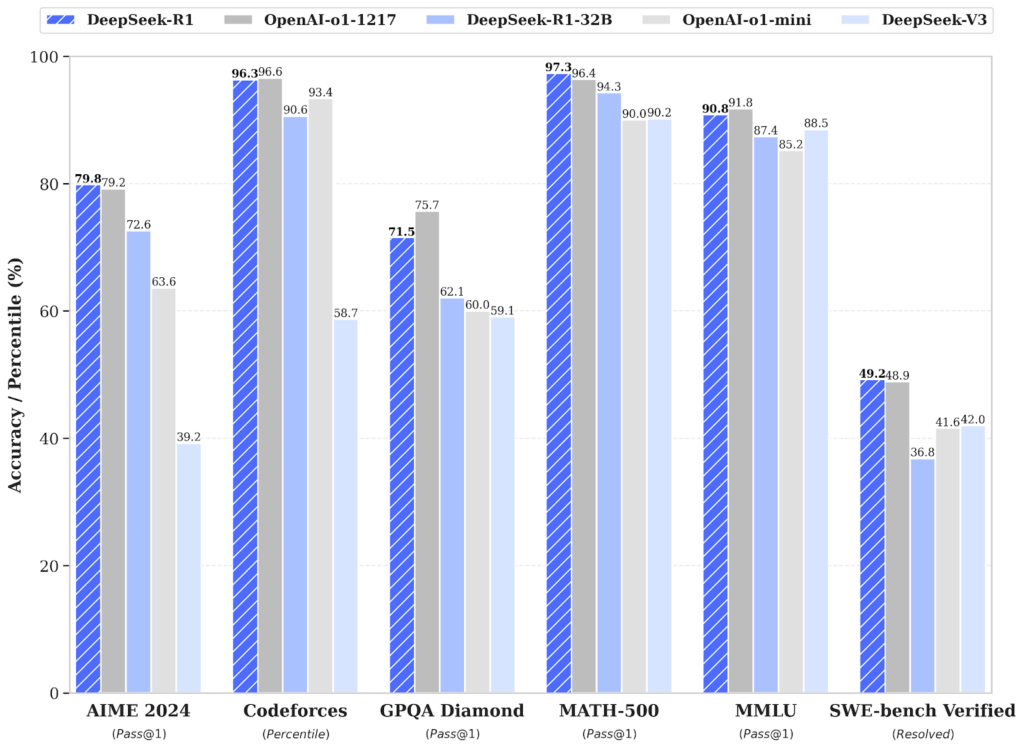
Join our daily and weekly newsletters for the latest updates and exclusive content on industry-leading AI coverage. Learn More Chinese AI startup DeepSeek, known for challenging leading AI vendors with open-source technologies, just dropped another bombshell: a new open reasoning LLM called DeepSeek-R1. Based on the recently introduced DeepSeek V3 mixture-of-experts model, DeepSeek-R1 matches the performance of o1, OpenAI’s frontier reasoning LLM, across math, coding and reasoning tasks. The best part? It does this at a much more tempting cost, proving to be 90-95% more affordable than the latter. The release marks a major leap forward in the open-source arena. It showcases that open models are further closing the gap with closed commercial models in the race to artificial general intelligence (AGI). To show the prowess of its work, DeepSeek also used R1 to distill six Llama and Qwen models, taking their performance to new levels. In one case, the distilled version of Qwen-1.5B outperformed much bigger models, GPT-4o and Claude 3.5 Sonnet, in select math benchmarks. These distilled models, along with the main R1, have been open-sourced and are available on Hugging Face under an MIT license. What does DeepSeek-R1 bring to the table? The focus is sharpening on artificial general intelligence (AGI), a level of AI that can perform intellectual tasks like humans. A lot of teams are doubling down on enhancing models’ reasoning capabilities. OpenAI made the first notable move in the domain with its o1 model, which uses a chain-of-thought reasoning process to tackle a problem. Through RL (reinforcement learning, or reward-driven optimization), o1 learns to hone its chain of thought and refine the strategies it uses — ultimately learning to recognize and correct its mistakes, or try new approaches when the current ones aren’t working.  Now, continuing the work in this direction, DeepSeek has released DeepSeek-R1, which uses a combination of RL and supervised fine-tuning to handle complex reasoning tasks and match the performance of o1.  When tested, DeepSeek-R1 scored 79.8% on AIME 2024 mathematics tests and 97.3% on MATH-500. It also achieved a 2,029 rating on Codeforces — better than 96.3% of human programmers. In contrast, o1-1217 scored 79.2%, 96.4% and 96.6% respectively on these benchmarks.  It also demonstrated strong general knowledge, with 90.8% accuracy on MMLU, just behind o1’s 91.8%.  Performance of DeepSeek-R1 vs OpenAI o1 and o1-mini The training pipeline DeepSeek-R1’s reasoning performance marks a big win for the Chinese startup in the US-dominated AI space, especially as the entire work is open-source, including how the company trained the whole thing.  However, the work isn’t as straightforward as it sounds. According to the paper describing the research, DeepSeek-R1 was developed as an enhanced version of DeepSeek-R1-Zero — a breakthrough model trained solely from reinforcement learning.  We are living in a timeline where a non-US company is keeping the original mission of OpenAI alive – truly open, frontier research that empowers all. It makes no sense. The most entertaining outcome is the most likely. DeepSeek-R1 not only open-sources a barrage of models but… pic.twitter.com/M7eZnEmCOY — Jim Fan (@DrJimFan) January 20, 2025 The company first used DeepSeek-V3-base as the base model, developing its reasoning capabilities without employing supervised data, essentially focusing only on its self-evolution through a pure RL-based trial-and-error process. Developed intrinsically from the work, this ability ensures the model can solve increasingly complex reasoning tasks by leveraging extended test-time computation to explore and refine its thought processes in greater depth. “During training, DeepSeek-R1-Zero naturally emerged with numerous powerful and interesting reasoning behaviors,” the researchers note in the paper. “After thousands of RL steps, DeepSeek-R1-Zero exhibits super performance on reasoning benchmarks. For instance, the pass@1 score on AIME 2024 increases from 15.6% to 71.0%, and with majority voting, the score further improves to 86.7%, matching the performance of OpenAI-o1-0912.” However, despite showing improved performance, including behaviors like reflection and exploration of alternatives, the initial model did show some problems, including poor readability and language mixing. To fix this, the company built on the work done for R1-Zero, using a multi-stage approach combining both supervised learning and reinforcement learning, and thus came up with the enhanced R1 model. “Specifically, we begin by collecting thousands of cold-start data to fine-tune the DeepSeek-V3-Base model,” the researchers explained. “Following this, we perform reasoning-oriented RL like DeepSeek-R1- Zero. Upon nearing convergence in the RL process, we create new SFT data through rejection sampling on the RL checkpoint, combined with supervised data from DeepSeek-V3 in domains such as writing, factual QA, and self-cognition, and then retrain the DeepSeek-V3-Base model. After fine-tuning with the new data, the checkpoint undergoes an additional RL process, taking into account prompts from all scenarios. After these steps, we obtained a checkpoint referred to as DeepSeek-R1, which achieves performance on par with OpenAI-o1-1217.” Far more affordable than o1 In addition to enhanced performance that nearly matches OpenAI’s o1 across benchmarks, the new DeepSeek-R1 is also very affordable. Specifically, where OpenAI o1 costs $15 per million input tokens and $60 per million output tokens, DeepSeek Reasoner, which is based on the R1 model, costs $0.55 per million input and $2.19 per million output tokens.  Sooo @deepseek_ai's reasoner model, which sits somewhere between o1-mini & o1 is about 90-95% cheaper 👀 https://t.co/ohnI6dtPRC pic.twitter.com/Qn78yIGUtt — Emad (@EMostaque) January 20, 2025 The model can be tested as “DeepThink” on the DeepSeek chat platform, which is similar to ChatGPT. Interested users can access the model weights and code repository via Hugging Face, under an MIT license, or can go with the API for direct integration. source


Open-source DeepSeek-R1 uses pure reinforcement learning to match OpenAI o1 — at 95% less cost Read More »

UAE to take center stage in AI Innovation with the launch of Dubai AI Week

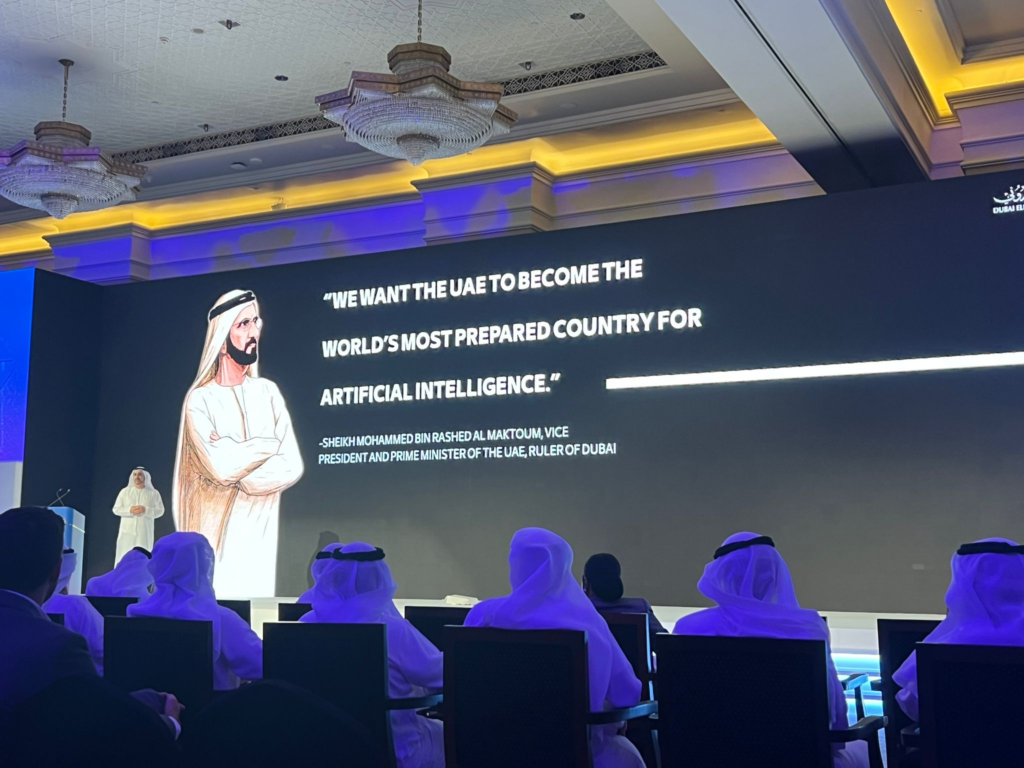
The UAE’s vision for AI is encapsulated in its National AI Strategy 2031, which aims to position the country as a global leader in AI by integrating it across various sectors. This strategy is not just a roadmap but a testament to the UAE’s forward-thinking approach to harnessing the power of AI for socio-economic growth. The country is ranked among the top five in the world for artificial intelligence competitiveness, is poised to further solidify its leadership in the sector with the launch of Dubai AI Week. Set to take place from April 21 to 25, the event has been announced by Sheikh Hamdan bin Mohammed, Crown Prince of Dubai, who described it as a “platform to unlock the transformative potential of artificial intelligence.” With more than 10,000 attendees expected, Dubai AI Week will unite public and private sector leaders, innovators, and experts to explore AI’s potential across industries. A key event within the week will be the AI Retreat, designed to bring together decision-makers and tech leaders to discuss integration strategies for AI. The Dubai Assembly for Generative AI will provide a platform for high-level discussions on generative AI, with particular focus on its application in healthcare, education, and entertainment. source

UAE to take center stage in AI Innovation with the launch of Dubai AI Week Read More »