L3Harris CEO Urges Musk, Ramaswamy To Limit Bid Protests

By Dorothy Atkins ( January 16, 2025, 9:54 PM EST) — L3Harris Technologies’ CEO published an open letter Wednesday to leaders of the new U.S. Department of Government Efficiency — billionaire Elon Musk and ex-presidential candidate Vivek Ramaswamy — calling on them to overhaul the defense contracting process and limit bid protests to three per year, per contractor, among other changes…. Law360 is on it, so you are, too. A Law360 subscription puts you at the center of fast-moving legal issues, trends and developments so you can act with speed and confidence. Over 200 articles are published daily across more than 60 topics, industries, practice areas and jurisdictions. A Law360 subscription includes features such as Daily newsletters Expert analysis Mobile app Advanced search Judge information Real-time alerts 450K+ searchable archived articles And more! Experience Law360 today with a free 7-day trial. source

L3Harris CEO Urges Musk, Ramaswamy To Limit Bid Protests Read More »

機管局向商界介紹機場城市發展藍圖新品牌 「SKYTOPIA」

香港機場管理局昨天舉辦大型活動向商界介紹機場城市發展藍圖新品牌「SKYTOPIA」。活動設有不同主題展覽區域,介紹多個重點項目,展現「SKYTOPIA」 的發展潛力及投資機遇,吸引了逾 300 位來自香港、內地及國際商貿代表出席。「SKYTOPIA」將匯聚商業活動、流行文化、藝術交易及娛樂消閑於一 身。轄下多個項目既能充分發揮香港獨有優勢、更可善用鄰近香港國際 機場的土地與海灣資源,重點包括:• 香港首個融合藝術創作、鑑賞及貿易於一身的一站式藝術廊總匯;• 全港首個專門為藝術品而設的藝術倉儲設施;• 全港最大型、提供逾 500 個遊艇泊位的機場海灣碼頭;• 全港最大規模的水上康樂消閑區;• 匯聚來自全球新鮮食品的空運鮮活市集;• 亞洲國際博覽館第二期發展,當中包括全港最大型、提供二萬個座位的室內多用途表演場地;• 糅合室內、外運動遊戲概念,並將冒險、探索、運動與娛樂融為一體的運動主題遊樂區;• 海岸度假村及豪華酒店;• 1.5 公里長的海灣長廊及露天廣場;• 環保及智能運輸系統,包括自動化停車場和無人駕駛車輛等。機管局主席林天福在活動上指出:「我們展望香港國際機場將不只是旅 客登機或進入香港的門戶。我們的願景是把『SKYTOPIA』建設成世界 頂級地標,吸引來自香港、繁盛的大灣區,以至亞洲主要市場和世界各 地的訪客。機管局的角色是興建主要基建,為一眾專家及投資者提供平 台,讓他們能悉心提供服務與產品。我們衷心感謝香港特區政府在政策 上給予大力支持,並樂見商界的正面反應。我們冀盼與投資者合作,促使『SKYTOPIA』成為驅動香港以至其他地方經濟增長的重要引擎。」「SKYTOPIA」蘊含是項發展的重要特性與願景,顧名思義,英文字 「SKY」(即天空)及「IA」 (即國際機場)體現天空與機場密不可 分的關係,通達世界,無遠弗屆;而「TOP」則承諾為訪客帶來頂級體 驗,凸顯領先世界的地標特色,是旅客夢寐以求的天空之城。 LinkedIn Email Facebook Twitter WhatsApp 非常媒體 Veri-Media 轉載請務必保留本文鏈接 source

機管局向商界介紹機場城市發展藍圖新品牌 「SKYTOPIA」 Read More »

Lenovo to acquire Infinidat to expand its storage folio

The company, which CEO Phil Bullinger currently leads, was founded by Moshe Yanai in 2011. It also has an office in Waltham, Massachusetts. Lenovo eyes high-end enterprise storage market The acquisition is part of Lenovo’s growth strategy to meet the evolving needs of modern data centers that are expected to handle AI and generative AI workloads, the company said, adding that Infinidat’s offering will find synergy with its Infrastructure Solutions Group and jointly will target the high-end enterprise storage market. Currently, Lenovo’s Infrastructure Solutions business operates in the entry and mid-range enterprise storage market offering a portfolio of options, such as flash and hybrid arrays, hyperconverged infrastructure (HCI), software-defined storage (SDS), and data management suites such as Lenovo TruScale. “This is a win-win for both companies. Lenovo fills a big void in its storage portfolio, while Infinidat is able to leverage a hardware design and manufacturing machine,” Matt Kimball, principal analyst at Moor Strategy and Insights, wrote on LinkedIn. Lenovo is expected to quickly train its sites on Infinidat’s storage software IP and look to where it can leverage this more broadly, Kimball explained, adding that “if Lenovo’s channels are properly leveraged, we can see real disruption in the enterprise storage market.” Early focus on the enterprise storage market According to analysts, Lenovo has been hyper-focused on the enterprise storage market since it acquired IBM’s x86 server business for about $2.3 billion in 2014. Another landmark deal for the company, targeted at competing more aggressively with Dell and HPE — the dominant players in the enterprise storage market, came in 2018 in the form of a partnership with NetApp, under which it also developed a joint venture in China to co-develop a new range of ThinkSystem Infrastructure that imbibes NetApp’s data management expertise. source

Lenovo to acquire Infinidat to expand its storage folio Read More »

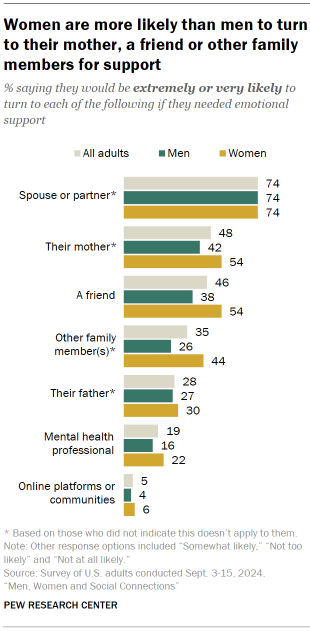
2. Where men and women turn for emotional support and social connection

About three-quarters of U.S. adults (74%) say they would be extremely or very likely to turn to their spouse or partner if they needed emotional support. Men and women are equally likely to say they’d lean on their spouse or partner in this way. Mothers and friends are also frequent sources of support: 48% of adults point to their mother and 46% point to a friend as someone they’d be extremely or very likely to go to. Smaller shares would go to their father (28%) or to another family member (35%). There are significant gender differences when it comes to certain sources of support. By margins ranging from 12 to 18 percentage points, greater shares of women than men say they’d be extremely or very likely to turn to: Their mother (54% of women vs. 42% of men) A friend (54% vs. 38%) Another family member who is not their parent, spouse or partner (44% vs. 26%) Turning to mental health professionals and online communities Americans are less likely to say they’d turn to a mental health professional for emotional support than to say they’d turn to family or friends. About one-in-five adults (19%) say they’d be extremely or very likely to turn to a mental health professional for this type of support. Some demographic groups are more likely than others to say they’d be extremely or very likely to seek out a mental health professional: Women are more likely to say this than men (22% vs. 16%). Black (26%) and Hispanic (25%) adults are more likely to say this than White (16%) and Asian (17%) adults. Adults younger than 50 are more likely to say this than those ages 50 and older (24% vs. 14%). When it comes to seeking emotional support from online platforms or communities, relatively small shares of adults say they would be extremely or very likely to do this (5% overall). Getting emotional support today versus 20 years ago We also asked Americans how they think men and women are doing compared with 20 years ago in terms of having someone to turn to for emotional support. On balance, the public thinks men and women are doing better in this area than they were two decades ago. Some 47% of adults say men are doing a lot or somewhat better, 20% say they’re doing a lot or somewhat worse, and 32% say they’re doing neither better nor worse. There’s a similar pattern for women: 51% say they’re doing better, 14% say they’re doing worse, and 34% say neither better nor worse. Women are more likely than men to say that men are doing better these days when it comes to having someone to turn to for emotional support (51% vs. 42%). Similar shares of men (50%) and women (52%) say women are doing better compared with 20 years ago. Communicating with friends We also asked Americans about their friends and how they stay in touch with them. About eight-in-ten adults (81%) say they have at least one close friend – not counting their family members – and most (64%) have more than one close friend. About one-in-five (18%) say they don’t have any close friends. Among adults who have close friends, 74% say they connect with one at least a few times a week, whether by texting, interacting on social media, talking on the phone or video chatting, or seeing them in person.  Texting is the most common form of communication between friends. Most adults with close friends (61%) say they text one either a few times a week or daily. Sizable shares also interact with friends on social media (39%) or talk to them via phone or video chat (35%). About three-in-ten (29%) say they see a close friend in person at least a few times a week. Differences by gender and age There are large differences in how often men and women text or interact on social media with close friends. Women are more likely than men to say they communicate frequently in these ways by margins of 10 points or more. Women are also somewhat more likely than men to talk on the phone or video chat with a close friend at least a few times a week (38% vs. 32%). But men (31%) are somewhat more likely than women (28%) to say they frequently see friends in person. This gender gap is fairly consistent across adults ages 30 to 49, 50 to 64, and 65 and older. However, among those younger than 30, men and women are about equally likely to communicate with close friends in these ways. Looking just at age, adults younger than 30 are the most likely to say they text (72%) or interact on social media (60%) with a close friend at least a few times a week. Those ages 65 and older are the least likely to say they regularly use these forms of communication. source

2. Where men and women turn for emotional support and social connection Read More »

EU joins industry backlash against Biden’s AI Chip export restrictions

What the framework says The new Framework creates a three-tier licensing hierarchy. Favored countries such as the 10 EU nations will be able to purchase AI chips, including the most powerful, without restriction. Most countries fall into the middle tier, subject to export licensing restrictions on how much computing power they can get hold of. And then there are coutnries that already can’t buy AI chips from the US, including obvious candidates such as China and Russia. For countries in the middle tier, if an individual order doesn’t exceed a “collective computation power up to roughly 1,700 advanced GPUs,” — the sort of GPU power used by a university or medical institute — no export license will be required. These sales won’t count against national chip quotas. As for LLMs, sales of the most powerful proprietary models will also be restricted outside of the favored countries. The US Department of Commerce’s Bureau of Industry and Security (BIS), which drafted the framework, defines the restricted models as those built using closed (as opposed to open-source) weights using more than 10^26 computational operations. source

EU joins industry backlash against Biden’s AI Chip export restrictions Read More »

Nixing NRC Oversight Of Small Reactors Could Cut Both Ways

By Jill McWhirter, Michael Malone and Dan Feldman ( January 17, 2025, 3:19 PM EST) — On Dec. 30, the state of Texas, the state of Utah and small modular reactor developer Last Energy Inc. filed suit in the U.S. District Court for the Eastern District of Texas, Tyler Division…. Law360 is on it, so you are, too. A Law360 subscription puts you at the center of fast-moving legal issues, trends and developments so you can act with speed and confidence. Over 200 articles are published daily across more than 60 topics, industries, practice areas and jurisdictions. A Law360 subscription includes features such as Daily newsletters Expert analysis Mobile app Advanced search Judge information Real-time alerts 450K+ searchable archived articles And more! Experience Law360 today with a free 7-day trial. source

Nixing NRC Oversight Of Small Reactors Could Cut Both Ways Read More »

GenAI deals with news giants increase as Mistral partners with AFP

Yet another deal has been signed between a publisher and a GenAI leader. Paris startup Mistral and news outlet Agence France-Presse (AFP) announced today that they are combining their services to improve AI responses. The deal provides Mistral’s chatbot — imaginatively named Le Chat — with access to all of AFP’s text stories.  According to Mistral, the integration will bring “enhanced factuality” to the AI assistant. The next big thing? It might be you… TNW Conference is here to support startups & scaleups to become the next big thing. Be part of the journey. Price increase on Friday. “Partnering with a globally trusted news agency like AFP allows Le Chat to offer reliable, factual, and up-to-date responses, verified by professional journalists,” said Arthur Mensch, the startup’s CEO and co-founder. Mistral also highlighted the linguistic capabilities. AFP’s daily production of 2,300 text stories spans six languages — French, English, Spanish, Portuguese, German, and Arabic — all of which will be available to LeChat. “Through this partnership, we are providing our clients with a unique multicultural and multilingual alternative,” Mensch said. For AFP, the deal adds an extra income source and a new outlet for the agency’s 1,700 journalists. “Through this partnership, AFP is further diversifying its revenue sources, reaching a clientele beyond the media sector and exploring new uses for its content in the daily operations of businesses,” said Fabrice Fries, the company’s CEO and chairman. Deals and disputes between GenAI firms and news outlets The content deal expands a growing range of agreements between publishers and GenAI companies. Just a day earlier, two other eye-catching collaborations were announced. One brings news from the Associated Press (AP) to Google’s Geminis chatbot. The other merges Axios journalism with OpenAI products. As part of the deal, the ChatGPT-maker will fund the media brand’s expansion to four new US cities.  Axios joins a lengthy list of publishers collaborating with OpenAI. The GenAI giant has now partnered with nearly 20 media organisations, including the Financial Times, Le Monde, and AP. Yet not every news outlet has been a willing collaborator. A group of them — led by The New York Times — took OpenAI to court this week over alleged copyright infringements.  They argue that OpenAI used their content to build systems without consent or payment. OpenAI contends that the “fair use” law protects the practice. By signing agreements with publishers, GenAI firms could avoid such legal disputes. For Mistral, the partnership with AP is the first content deal of this kind. The integration is slated to roll out to all Le Chat users in the coming weeks. Neither Mistral nor AFP have revealed the value of the multi-year contract. source

GenAI deals with news giants increase as Mistral partners with AFP Read More »

The AI gold rush: Why risks and rewards remain a balancing act

Presented by Stibo Systems In the race to capitalize on the transformative potential of AI, enterprises may be taking major risks with their organization’s future by deploying AI solutions without fully considering the ethical, governance and security implications. A recent study from global SaaS solutions provider Stibo Systems, “AI: The High-Stakes Gamble for Enterprises,” found that a full 49% of business leaders admit they are not prepared to use AI responsibly, 79% of organizations do not have bias mitigation policies and practices in place, and 54% of organizations have not implemented new security measures to keep up with AI integration — but only 32% of business leaders admit they’ve rushed AI adoption. Gaps in literacy, ethical usage and organizational preparedness are critical concerns, says Gustavo Amorim, CMO at Stibo Systems, but it’s a balancing act. “Companies need to adopt AI to stay competitive — to realize the major benefits like efficiency, higher productivity, lower costs and greater innovation,” Amorim says. “But in the need to move forward, they’re often leaving business and organizational readiness behind.” Part of the wave of adoption comes from a shift in how business leaders are viewing AI — today it’s overwhelmingly considered to be an overall enabler: nearly 90% of business leaders surveyed said they are eager to use the technology as their partner in critical decision-making. “It’s not that leaders don’t see the risks or don’t realize and acknowledge that there are some risks involved,” he explains. “It’s that we’ve seen the short-term business benefits at this point, and long-term risks and implications have not come home to roost for many organizations yet. But the price tag is steep, including reputational damage, regulatory penalties and the erosion of trust among customers and stakeholders.” Where change management fails technology adoption The three pillars of business readiness and change management are technology, people and process. From an AI perspective, it has become far easier, and far faster, to implement an AI tool, flip the switch — and then consider potential consequences. Digging into the data to ensure it’s fair and free from bias, and fully secure throughout the AI pipeline, takes a great deal of change management effort and time. Unfortunately, that data, and how it’s used, is also foundational to the actual results that an AI initiative produces. “Companies are not necessarily taking the steps and the time to ensure that those things are done in parallel with adoption,” Amorim says. “Changing an internal process, or training the people who are going to be using the technology, giving them the skills required to eliminate bias and write fair treatment and data privacy into the DNA of a strategy, is a major hurdle.” Governance, too, is a challenge and often overlooked. Without putting standards and processes in place around managing the inputs and the outputs, instead of running in parallel with other business processes and becoming a regular part of how business is done, outputs become a problem to be managed. All these issues impact things like how customer data is used in AI, for instance — sharply increasing the potential for problems like non-compliant data use, or data breaches. However, the Stibo Systems study shows that these aren’t currently major concerns for most business leaders, and they haven’t taken those preliminary steps. AI adoption is simply outpacing the development of ethical guidelines, 61% of leaders report, while 49% say they’re not prepared to use AI responsibly, even though 65% feel confident in their AI literacy skill. Unfortunately, that confidence in their preparedness is not reflected in their organization’s AI policies and procedures. For instance, a full 69% of organizations have not implemented any data governance training as part of their AI strategy. AI literacy: the foundation of an ethical framework Data is the foundation of AI, but humans remain the single most important element of an AI strategy right from the jump. Models are created by humans, and humans are in charge of choosing and preparing the data that’s required to train those models, the data that leads to conclusions and outcomes. But AI literacy also includes the business implications of the technology, and understanding what kinds of business processes can be run, and how they can be run fairly and accurately, and that they comply with a company’s internal policies. And because it’s a technology that’s evolving at a breakneck speed, and one that self-learns, adapts and becomes more intelligent, based on the data inputs it receives, you’re never done. Part of data literacy includes continuously analyzing the outputs against certain criteria, which will evolve just as rapidly. AI literacy and organizational preparedness, like most technology initiatives, starts at the top. It’s not just sponsorship of AI initiatives, but the top executive level actively engaging with the subject, offering education around how AI is incorporated into the day-to-day of an organization’s business processes, and setting an example around the importance of responsible AI. “This is usually not a conversation that most senior executives will engage with,” Amorim says. “Imagine a CMO, a CFO or a CEO talking about data bias and how that might become a corporate risk for the organization,” he says. “It’s not a common agenda, which is why it’s ideal to start there.” From there, it’s a matter of turning that into action, by establishing cross-functional teams that can develop policies, standards and guidelines. “Most every company has guidelines and standards around using social media in the workplace, but not every company has guidelines on how you should use AI — and this is essential,” Amorim says.  Sponsored articles are content produced by a company that is either paying for the post or has a business relationship with VentureBeat, and they’re always clearly marked. For more information, contact [email protected]. source

The AI gold rush: Why risks and rewards remain a balancing act Read More »

Baffle protects, controls cloud-native data through record-level encryption

00:00 Hi everybody, welcome to DEMO, the show where companies come in and they show us their products and services. Today I’m joined by Ameesh Divatia, he is the co-founder and CEO at Baffle. Welcome to the show, Amesh. 00:10Thank you, Keith. Happy to be here. 00:12So tell me a little bit about Baffle, and then tell me about what you’re going to show here today. 00:016Absolutely. So Baffle is what we call the easiest way to protect data. What we do is protect data all the way at the field level, so that the cloud service provider or somebody that’s managing the infrastructure never sees sensitive data. So that’s the crux of what we do. We do it with a with a no-code model, we make sure that there are no application changes needed for masking, tokenization, encryption of data. 00:39Who within the company is going to benefit most from using Baffle, is it the CIO level? Is it someone who’s trying to access data, or are you preventing certain people from not seeing data? 00:51Well, the main benefit is for data scientists, they want to analyze data, and they’re prevented from doing so if that data is sensitive. So there’s lots of rules and regulations around it, compliance requirements that security typically sets. So security is usually the one that finds us, but it’s a data scientist that we benefit the most. 01:10So in the problem you’re solving, as far as I can tell, and you can tell me if I’m right or wrong on this is that it allows certain people to see data that’s encrypted, and you’re not unencrypting it or decrypting it, right? So you can still see it, and that just that blows my mind. That’s just like magic wand to me at this point. So again, why should people care about this? Like, what problems are people having when you’ve got people trying to look at encrypted data? 01:34The two main problems, the first one is data breaches, right? Everybody is inundated with, we all get these requests all the time from companies that have shared our data inadvertently, and they’re trying to make make up for it. So data breaches continue to happen. They’re proliferating, which means that the existing data protection solutions don’t necessarily work. What is very interesting, though, is in the past five plus years since GDPR went into effect, there’s a plethora of regulations that are coming into effect for preventing exactly this problem, which is that individuals, just you and I, should not be losing their data just because we share it with somebody that we trust. 02:12So if a company didn’t have something like Baffle on their system in order for someone to look at the data, you would have to decrypt it, and then keep your fingers crossed that that data doesn’t then get breached or stolen or somewhere sitting on a server somewhere unencrypted. 02:26Actually, the problem is worse, because when the data is still on their systems as it’s being processed, it can be exfiltrated. It can be breached. Especially if the database admins credentials are compromised. So you know, at the highest level, we have our phones and we have our messages, iMessages or WhatsApp messages are end to end encrypted. Enterprise applications are not. 02:51So there’s data out there that could be unprotected at this point. 02:55Exactly. So we have protected data at rest. We’ve protected data in transit, but we don’t protect data in use. 03:00So you’ve got some cool things to show me on the demo here. Let’s jump right into it and show me the cool features. 03:07All right, so the animation, the right sort of captures exactly what we do. If you look at the flow of data, it’s coming in from, usually from clear text from an on-prem database, or even if it’s in cloud, it’s the one where the data is clear text, then it goes into this particular protected data, usually in the cloud. So we transform the data all the way down at the field level. So you’re seeing these credit cards. These credit cards are now being transformed into something that’s still readable. It still looks at the credit card, but it’s not the original credit card, and then depending on the persona and the credentials that anybody who has access to the data can get, they can get views of that data. So that’s what you’re seeing in the second half of the animation. Okay, that sort of captures what we do in 30 seconds. So now let’s dive into this. This is our console. This is Baffle Manager. And there’s a few things that are going on, on the left. First of all, what we do, as you could see, there is the application, there is the database, and there is something in the middle, which is what Baffle is. So first things first, what we do is we enroll a database. So this is the database itself that’s been enrolled. It’s a Postgres database that has sensitive data. So step one is actually to figure out exactly what kind of data protection policy that you’re going to have, because, again, we’re going all the way down to the field level. So let’s first start with the data source, which means that you have different sources of information that’s coming in. I’m going to create one just for kicks, because it makes it fun to see. I’m going to see what we can do with this particular database, and what you’re able to do with this is to go all the way down to this particular table and see what is in there and be able to pick which column to encrypt. So now what we’re going to do is we’re going to go into the Postgres database. We’re going to go into the specific table that we’re going to protect. It’s called transactions, and you see all of these things in there. I’m going to make it very simple, just protect one particular field.


Baffle protects, controls cloud-native data through record-level encryption Read More »