AI tools to elevate your job search in 2025

More than half of knowledge workers now use generative AI weekly, according to a recent piece of research from Asana’s Work Innovation Lab, in partnership with Anthropic. The study also found that takeup ramped up by 44% over nine months in 2024. And those who use AI daily benefit most. Eighty-nine percent reported a productivity boost, whereas casual monthly users only saw a 39% increase in productivity. The report also found that knowledge workers believe generative AI has the potential to automate 31% of their job responsibilities. And the more ways they use AI tools at work, the more possibilities they see. 8 jobs to discover this week Full stack AI developer, Witteveen+Bos, Overijssel Data Analyst AI Team, Lely, Zuid-Holland AI Consultant, Refreshworks, Den Haag Software Engineer C#, Profield, Gelderland Java Software Engineer, BKWI, Provincie Utrecht Python Developer, H2B IT Solutions, Noord-Holland Senior DevOps Engineer – Microsoft 365 Specialist, Cognizant, Noord-Holland Platform Engineer MSI, Schiphol Group, Haarlemmermeer “Already, knowledge workers are deploying AI across an average of five different use cases at work, from technical writing to idea generation and brainstorming, demonstrating AI’s versatility across various workflows,” the study’s authors say. “As workers apply AI to a broader range of tasks, they discover innovative ways to enhance their work that they might not have initially considered. This leads them to find new applications for AI, creating a virtuous cycle of AI-powered productivity: the more you use it, the more you find new ways to use it, and the more productive you become.” Of course, these use cases differ across industries, with those working in technology most likely to use generative AI for technical writing, for example. Those working in financial services are more likely to use it for process automation and it won’t be a surprise to find that workers in the media and entertainment sectors gravitate towards tools for image generation. To date, only about 31% of companies have a formal AI strategy in place, which means that in many cases, workers’ usage of genAI tools is unregulated and has led to the rise of the ‘BYOAI’ trend, AKA bring your own AI to work. One way all workers can leverage the use of generative AI tools (regardless of their employers’ stance), is in looking for a new role. Within recruitment, automation is taking over, and software is now doing much of what humans once managed, like sourcing, outreach, and application filtering. Some companies are even using AI to conduct job interviews, with mixed results. In the US, a case was filed last year concerning pharmacy chain CVS. As part of its application process, the company utilises video-interview technology which uses artificial intelligence for analysis. The plaintiff alleged that CVS broke Massachusetts law because it did not provide an opt-out. Amplifying your job search While there may be downsides, the use of generative AI when it comes to job seeking is a net positive. Consider the Reddit user, for example, who recently created an AI bot that was used to automatically apply to 1,000 jobs, with the result being 50 interviews in one month. That’s far more than what many job hunters can expect using traditional career search methods. The user, who subsequently deleted their Reddit account, said at the time that: “The tailored CVs and cover letters, customized based on each job description, made a significant difference.” Speed and accuracy matter, and on the House of Talent Job Board, a new conversational AI job search agent can help you locate your next tech position quickly and accurately. Find the agent on the bottom right-hand side of your screen where it will allow you to search for best-matched jobs using your CV. Or, you can tell it a bit about yourself, your skills, your current location—or where you’d like to work. Once you’ve isolated the best roles to apply for, generational AI can be tasked with optimising your application materials thanks to its time-saving capabilities. AI tools can help you to make fewer grammatical mistakes, align your experience effectively against the actual job description, and essentially speed up the whole process. Perplexity or ChatGPT can be used to quickly compare your CV against a job ad, outputting areas you need to finesse or skills you should highlight, helping you to optimize application materials for each role you apply for. If you’ve ever considered sliding into a recruiter’s DMs on LinkedIn, for example, or sending an email to a hiring manager on spec, then this is another area in which genAI can help. Claude, for example, can help you compose succinct, effective messages or emails you can then edit to make sure they’re completely on point. Cover letters are another time-consuming element of a job hunt that many find daunting. Many job applicants simply don’t bother unless it’s a specific requirement. However, hiring managers like cover letters because they add additional context to your CV. You can showcase your motivation and desire for the role, along with more intangible talents such as your soft skills. The good news is that this process can also be simplified by prompting a Gen AI tool to create a cover letter based on your CV. This framework can then be padded out as you see fit — add in additional experience or KPIs you succeeded with, along with an explanation of why you’d really love the job. And that’s not all. AI can help you research companies, positions, and terminology ahead of job interviews, helping you prepare. You can also use an AI tool as a sounding board for interview preparation, by asking it to generate sample questions for a software engineering role, for example. But no matter what tools or platforms you use, it’s incumbent on you to check the outputs. Generative AI tools are great assistants, but you’re in the driving seat. Ready to look for a new tech role? Check out The Next Web Job Board now source

AI tools to elevate your job search in 2025 Read More »

Outgoing FCC Chair Touts 'Wins On The Board'

With less than a week left in office, the chief of the Biden-era Federal Communications Commission on Wednesday highlighted the accomplishments of her tenure, including efforts to connect more Americans and advance space-based communications, but warned that a number of problems ranging from cybersecurity threats to the digital divide persist. source

Outgoing FCC Chair Touts 'Wins On The Board' Read More »

Do new AI reasoning models require new approaches to prompting?

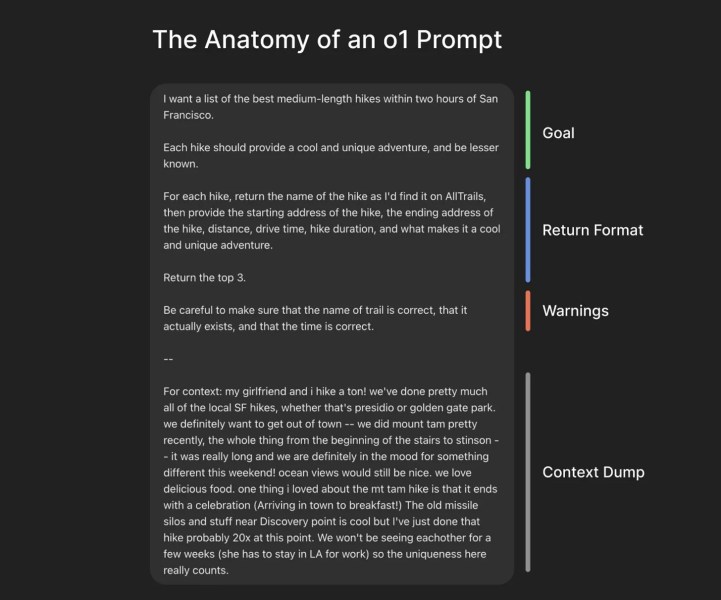
Join our daily and weekly newsletters for the latest updates and exclusive content on industry-leading AI coverage. Learn More The era of reasoning AI is well underway. After OpenAI once again kickstarted an AI revolution with its o1 reasoning model introduced back in September 2024 — which takes longer to answer questions but with the payoff of higher performance, especially on complex, multi-step problems in math and science — the commercial AI field has been flooded with copycats and competitors. There’s DeepSeek’s R1, Google Gemini 2 Flash Thinking, and just today, LlamaV-o1, all of which seek to offer similar built-in “reasoning” to OpenAI’s new o1 and upcoming o3 model families. These models engage in “chain-of-thought” (CoT) prompting — or “self-prompting” — forcing them to reflect on their analysis midstream, double back, check over their own work and ultimately arrive at a better answer than just shooting it out of their embeddings as fast as possible, as other large language models (LLMs) do. Yet the high cost of o1 and o1-mini ($15.00/1M input tokens vs. $1.25/1M input tokens for GPT-4o on OpenAI’s API) has caused some to balk at the supposed performance gains. Is it really worth paying 12X as much as the typical, state-of-the-art LLM? As it turns out, there are a growing number of converts — but the key to unlocking reasoning models’ true value may lie in the user prompting them differently. Shawn Wang (founder of AI news service Smol) featured on his Substack over the weekend a guest post from Ben Hylak, the former Apple Inc., interface designer for visionOS (which powers the Vision Pro spatial computing headset) and co-founder of Dawn, an analytics and diagnostics platform for AI products. The post has gone viral, as it convincingly explains how Hylak prompts OpenAI’s o1 model to receive incredibly valuable outputs (for him). In short, instead of the human user writing prompts for the o1 model, they should think about writing “briefs,” or more detailed explanations that include lots of context up-front about what the user wants the model to output, who the user is and what format in which they want the model to output information for them. As Hylak writes on Substack: With most models, we’ve been trained to tell the model how we want it to answer us. e.g. ‘You are an expert software engineer. Think slowly and carefully“ This is the opposite of how I’ve found success with o1. I don’t instruct it on the how — only the what. Then let o1 take over and plan and resolve its own steps. This is what the autonomous reasoning is for, and can actually be much faster than if you were to manually review and chat as the “human in the loop”. Hylak also includes a great annotated screenshot of an example prompt for o1 that produced a useful results for a list of hikes: This blog post was so helpful, OpenAI’s own president and co-founder Greg Brockman re-shared it on his X account with the message: “o1 is a different kind of model. Great performance requires using it in a new way relative to standard chat models.” I tried it myself on my recurring quest to learn to speak fluent Spanish and here was the result, for those curious. Perhaps not as impressive as Hylak’s well-constructed prompt and response, but definitely showing strong potential. Separately, even when it comes to non-reasoning LLMs such as Claude 3.5 Sonnet, there may be room for regular users to improve their prompting to get better, less constrained results. As Louis Arge, former Teton.ai engineer and current creator of neuromodulation device openFUS, wrote on X, “one trick i’ve discovered is that LLMs trust their own prompts more than my prompts,” and provided an example of how he convinced Claude to be “less of a coward” by first “trigger[ing] a fight” with him over its outputs. All of which goes to show that prompt engineering remains a valuable skill as the AI era wears on. source

Do new AI reasoning models require new approaches to prompting? Read More »

Improving CX Can Drive More Than One Billion Dollars In Revenue (2024)

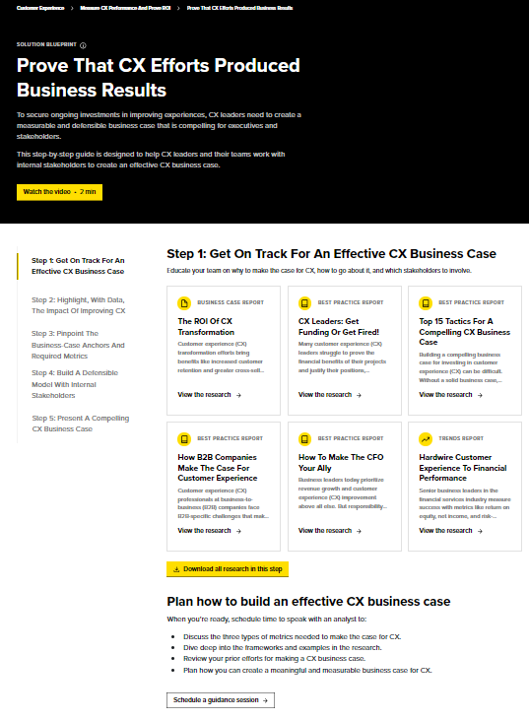
Each year, we calculate how much business growth improving Forrester’s Customer Experience Index (CX Index™) by one point drives. For 2024, we published the results in the report, How Customer Experience Drives Business Growth, 2024. The report includes the dollar upside of improving CX Index by one point for 12 industries: airlines, luxury auto manufacturers, mass-market auto manufacturers, auto/home insurers, multichannel banks, direct banks, credit card issuers, health insurers, midscale hotels, upscale hotels, investment firms, and retailers. A Sneak Peek Into The Business Growth From CX In 2024 The benefits of improving CX can be massive. For example, for a mass-market auto manufacturer, improving CX by one point can lead to more than $1 billion in additional revenue — this is because improving CX increases the chance that customers will buy their next car from the same brand and take the car to the brand’s dealership for service needs. For an auto/home insurer, it’s close to $370 million. In many industries, the upside of making a happy customer even happier is higher than that of placating an unhappy customer. This is because the growth benefits of improving CX increase exponentially when going from “good” to “excellent” for those industries, which include some financial services industries. CX pros in firms where this relationship holds true must focus on identifying CX drivers that move customers from “OK” and “good” CX scores to “excellent” scores. The effect of recommendations on the business upside of CX is small. For each of the industries in our analysis, acquiring new customers via recommendations accounts for less than 7% of the overall business benefit from improved CX. Calculate These Numbers For Your Own Firm Should you use our numbers to communicate the value of CX in your firm? Yes and no. Use them to get initial buy-in that CX drives business results. But don’t just assume that your numbers will look the same. Instead, calculate the business upside of CX for your own firm. Here is how we calculated it — hopefully, you will find this useful: 1. Calculate what each customer is worth, depending on how loyal they plan to be. Forrester’s Customer Experience Benchmark Survey measures the quality of customers’ experiences and their loyalty intentions. Together with other data, we calculate a revenue potential for each customer. How we calculate it depends on how companies in each industry make money. 2. Create models that link CX Index and revenue potential. Our analysis shows, for each industry, the effect of CX changes on business outcomes. We also found out whether that effect changes based on whether we go from a low CX Index score to a medium one or from a medium one to a high one. 3. Calculate the upside of improving CX by one point. Our model shows the impact on a customer’s revenue potential when the CX Index score of the industry rises by one point. We then multiplied that per-customer upside by the number of customers of a big brand in the industry (we focused on the largest brands in the CX Index in each industry, as a few big brands dominate each industry that we investigate). Forrester Clients: Use Our Five-Step Solution Blueprint To Calculate The Business Impact Of CX The image below shows step one. Click Prove That CX Efforts Produced Business Results for all details.   Thank you for your major contribution to this research, James Williams! source

Improving CX Can Drive More Than One Billion Dollars In Revenue (2024) Read More »

越捷航空再度獲AirlineRatings認可 榮獲2025年全球最安全航空公司之一

  越捷航空再度由著名航空安全和產品評級網站AirlineRatings認可,榮獲2025年低成本航空公司中「全球最安全航空公司」名銜。 越捷與其他全球領導低成本航空公司,如瑞安航空 (Ryanair)、易捷航空(easyJet)和邊疆航空(Frontier Airlines)一同躋身前十名。越捷多年來致力提供舒適安全服務,是次認可反映航空公司對飛行安全的承諾,為乘客和機組人員提供安心保障。 在2025年AirlineRatings評估中共有385家全球航空公司,當中考慮過去兩年的事故記錄、機隊年齡、國際民航組織(ICAO)審核結果以及其他安全措施等因素。 AirlineRatings.com首席執行官Sharon Petersen表示:「越捷機隊不但是越南最年輕,更擁有亞太地區最新飛機,多年來安全記反映了其卓越成就。」AirlineRatings還為越捷頒發了七星安全評級,是當中最高的評級,此評級自2018年以來頒發至今。 目前,越捷航空擁有現代和高燃油效率的空中巴士機隊,技術可靠性達到99.7%,與全球名列前茅。同時,越捷繼續在培訓、維護和工程方面進行大量充足投資,以維持最高的安全標準。越捷航空學院(VJAA)作為國際航空運輸協會(IATA)的培訓夥伴,確保持續供應高技能的航空專業人才。 越捷現時營運3條航線飛往富國島、峴港及胡志明市。為滿足2025年的旅遊高峰期,來往香港至峴港及富國島航線已提升為每日運營。越捷是首家從香港直飛富國的航空公司,香港市民可享有 30 天免簽證待遇。 香港至越南的航班 往返香港至富國島   香港→富國島 VJ985 16:40 – 18:25  (2小時45分鐘) 每日一班 富國島→香港 VJ986 11:55 – 15:40  (2小時45分鐘) 往返香港至峴港 香港→峴港 VJ967 21:20 – 22:10  (1小時50分鐘) 每日一班 峴港→香港 VJ966 17:35 –20:20  (1小時45分鐘) 往返香港至胡志明市 香港→胡志明市 VJ877 19:50 – 21:30 (2小時40分鐘) 逢星期一、三、五、日 胡志明市→香港 VJ876 15:10 – 18:50 (2小時40分鐘)   LinkedIn Email Facebook Twitter WhatsApp The post 越捷航空再度獲AirlineRatings認可 榮獲2025年全球最安全航空公司之一 appeared first on VeriMedia. source

越捷航空再度獲AirlineRatings認可 榮獲2025年全球最安全航空公司之一 Read More »

CyberGhost VPN Review (2025): Features, Pricing, and Security

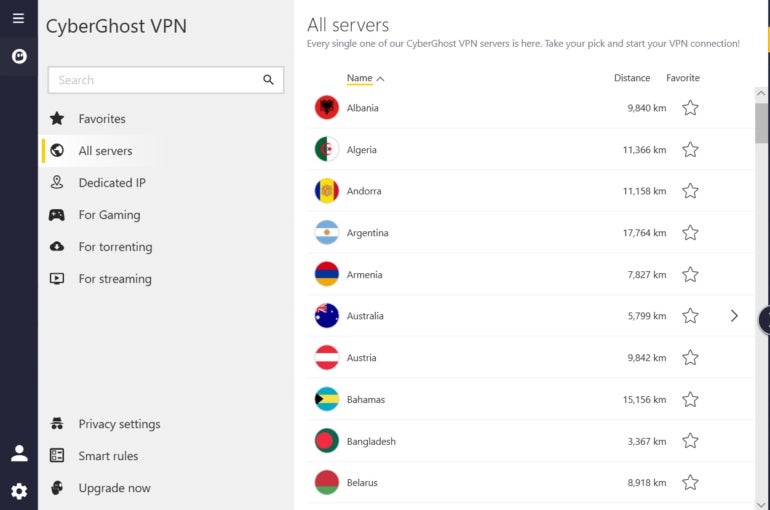
CyberGhost VPN fast facts Our rating: 4.3 stars out of 5Pricing: Starts at $6.99 per month (6-month plan)Key features: Offers servers in 100 countries and 125 locations. Includes streaming, torrenting, and gaming servers. Has generous free trial options. CyberGhost VPN has an impressive server fleet spaning 100 countries and 125 locations, an affordable starting price, and specialized servers for streaming, torrenting, and gaming. It also supports Windows, macOS, Linux, iOS, Android, Android and Apple TV, and even gaming consoles. While its complicated company history may cause some concern, the overall VPN package you get with CyberGhost makes it a worthy VPN choice of the year. Semperis Employees per Company Size Micro (0-49), Small (50-249), Medium (250-999), Large (1,000-4,999), Enterprise (5,000+) Large (1,000-4,999 Employees), Enterprise (5,000+ Employees) Large, Enterprise Features Advanced Attacks Detection, Advanced Automation, Anywhere Recovery, and more ESET PROTECT Advanced Employees per Company Size Micro (0-49), Small (50-249), Medium (250-999), Large (1,000-4,999), Enterprise (5,000+) Any Company Size Any Company Size Features Advanced Threat Defense, Full Disk Encryption , Modern Endpoint Protection, and more ManageEngine Log360 Employees per Company Size Micro (0-49), Small (50-249), Medium (250-999), Large (1,000-4,999), Enterprise (5,000+) Micro (0-49 Employees), Small (50-249 Employees), Medium (250-999 Employees), Large (1,000-4,999 Employees), Enterprise (5,000+ Employees) Micro, Small, Medium, Large, Enterprise Features Activity Monitoring, Blacklisting, Dashboard, and more CyberGhost VPN pricing Plans Price One month $12.99 per month (14-day money-back guarantee) Six months $6.99 per month (45-day money-back guarantee) Two years $2.03 per month (45-day money-back guarantee) While some VPNs offer different features at varied price points, CyberGhost’s pricing is straightforward. It provides three prices depending on your preferred service length — either one month, six months, or two years. The monthly option is billed every month, while the six-month option is billed every six months at $41.94 and the two-year option is billed for the first two years at $56.94 then annually thereafter. In terms of affordability, you will get the most out of your money with their two-year plan. At $2.03 per month, CyberGhost is one of the most affordable VPN options out right now. This is especially true once we take into account the number of servers you get at this price. Keep in mind, however, that this contract locks you in for two years so you won’t have the flexibility of being able to switch providers quickly. If you’re looking to test out the VPN for a month, CyberGhost VPN’s $12.99 is on the pricier end compared to its competitors like Proton VPN, with its one-month Plus plan currently priced at $9.99 per month. You also don’t get CyberGhost VPN’s in-house NoSpy servers for free with the one-month plan. With that, I do wish that CyberGhost offered at least a one-year option for its paid plans instead of its six-month subscription. This would give consumers more leeway with cost and less of the time commitment. Annual plans are also standard offerings for most VPN providers. In my view, having a one-year option would help CyberGhost provide a better one-to-one pitch against its competition. Comparing it to other VPNs, Surfshark’s mid-tier One subscription for one year is priced at $3.39 per month, while NordVPN’s Plus plan is $5.49 per month. At $6.99 per month for only six months, I feel like CyberGhost may seem like less of a bargain when looking at what other VPNs have to offer. CyberGhost VPN does have a fairly generous free trial program. For Windows and macOS users, you can get a 24-hour free trial without providing any payment or credit card information. Android users also have access to a three-day trial, while iOS users get free seven-day access. While the 24-hour Windows and Mac trial is short, accessing all the premium features without handing off any financial information is a worthwhile trade-off. Is CyberGhost VPN safe? CyberGhost VPN offers all the industry-standard security protocols we expect from a decent VPN in 2023. It has the OpenVPN, IKEv2, and WireGuard protocols, as well as AES-256 encryption. It also has a kill switch, DNS leak protection, and split tunneling capability. On its website, CyberGhost boasts that its headquarters are based in Romania — a country with strong privacy laws. This is a big plus for users who are wary of government interference. However, it is worth noting that CyberGhost is owned by Kape Technologies, formerly Crossrider. Crossrider had formerly been associated with malware and adware controversies before it purchased CyberGhost back in 2017. While CyberGhost has maintained that it acts as an independent entity of Kape, the company history is important to mention when it comes to security and privacy. CyberGhost does have a no-logs policy, which states that they don’t log user data such as browsing history, IP addresses, session durations, and the like. This no-logs policy has been confirmed by an independent audit conducted by Deloitte in 2022. In April 2024, CyberGhost completed a second independent audit of its server network and management systems. The assessment was conducted by Deloitte Audit Romania, which said that it found no evidence to conclude that CyberGhost’s “configuration of IT systems and management of the supporting IT operations” were not in accordance with its No-logs Policy No-Logging Safeguards. I commend CyberGhost for continuing its commitment to undergoing third-party audits. I especially appreciate how recent their latest audit was, providing an additional layer of confidence to users interested in purchasing a CyberGhost subscription today. The VPN service also regularly publishes quarterly Transparency Reports that cover police requests and malicious activity reports they receive. This is an admirable level of transparency that definitely adds to CyberGhost VPN’s overall credibility. With its complicated history, prospective users may be hesitant to consider CyberGhost VPN at first. However, I do feel that the company is doing enough to alleviate security concerns customers may have. Key features of CyberGhost VPN CyberGhost VPN provides an alluring package of features for its price, making it a solid choice. Let’s take a look at some key features one by one. Extensive server network CyberGhost

CyberGhost VPN Review (2025): Features, Pricing, and Security Read More »

CIO Leadership Live with Christine Bongard, CEO, Co-Founder, The WIT Network and Lee Rennick

00:00 100:00:03,966 –> 00:00:06,000Welcome to CIO Leadership Live.200:00:06,000 –> 00:00:10,133I’m Lee Rennick, executive directorof CIO communities for cio.com,300:00:10,366 –> 00:00:13,233and I’m very excited and honored todayto welcome Christine400:00:13,233 –> 00:00:16,500Bongard,CEO, co-founder of the WIT Network.500:00:16,800 –> 00:00:17,800Christine.600:00:17,800 –> 00:00:20,500Please introduce yourselfand welcome to the show.700:00:20,500 –> 00:00:20,933Hi there.800:00:20,933 –> 00:00:22,833Lee, thank you so much for having me ontoday.900:00:22,833 –> 00:00:26,500Yes. Christine Bongard,CEO and co-founder of the WIT network.1000:00:27,266 –> 00:00:30,000I have been a woman in technologymy whole career.1100:00:30,000 –> 00:00:33,933I had the fortunate, fortunate experienceof being part of a Techstars1200:00:34,033 –> 00:00:38,866up in the New York metro areaand, had the opportunity to grow business1300:00:38,866 –> 00:00:42,300from start and learn all about everything1400:00:42,333 –> 00:00:45,600technology, how to manage teams,how to run a business.1500:00:45,600 –> 00:00:49,100It was just such an incredible opportunityfor me1600:00:49,400 –> 00:00:52,500and, thatthat led me to being a woman in tech.1700:00:52,833 –> 00:00:57,733And I got to build a great network,over all of that time and,1800:00:58,933 –> 00:00:59,733have the fortunate1900:00:59,733 –> 00:01:03,600experience to then take my, careeras an entrepreneur2000:01:03,600 –> 00:01:08,100and in the tech industry and builda global network for women in tech.2100:01:08,466 –> 00:01:10,366as my my second part of my career.2200:01:10,366 –> 00:01:11,700So loving it.2300:01:11,700 –> 00:01:14,366Wow. Wow, that sounds really amazing.2400:01:14,366 –> 00:01:16,000And we’ll dive into thata little bit more.2500:01:16,000 –> 00:01:18,000And, you know, I’ma member of the Witt network.2600:01:18,000 –> 00:01:21,166Our organization is, I’m so proud that2700:01:21,166 –> 00:01:24,166we have that connectionwith this organization.2800:01:24,166 –> 00:01:26,433and all thatyou do to ensure that women have a safe2900:01:26,433 –> 00:01:29,433place,a place to network and learn and share.3000:01:29,433 –> 00:01:32,133And, so I’m looking forwardto having this interview today.3100:01:32,133 –> 00:01:35,200So I really do appreciate youjoining us today.3200:01:35,200 –> 00:01:36,266Christine, thanks so much.3300:01:36,266 –> 00:01:39,800We have created this seriesto support diversity in technology3400:01:40,000 –> 00:01:43,000and really listen to womenworking in this space.3500:01:43,066 –> 00:01:45,900and how, you know, they’re buildingand supporting out,3600:01:45,900 –> 00:01:48,833other women in, in, in our industry.3700:01:48,833 –> 00:01:51,833And so the first questionand I ask everyone this question,3800:01:52,233 –> 00:01:55,566could you please tell us a little bitabout your own career path and maybe3900:01:55,566 –> 00:01:59,166provide some insights or tips on that rolepath, especially as a women woman?4000:01:59,166 –> 00:02:02,133Excuse me, are there any lessons sharedthat you could, you know,4100:02:02,133 –> 00:02:03,900any lessons learned that you could share?4200:02:03,900 –> 00:02:05,500So a couple of things.4300:02:05,500 –> 00:02:05,966You know, as4400:02:05,966 –> 00:02:10,466I mentioned, just a great opportunityto come up in tech throughout my career.4500:02:10,466 –> 00:02:13,866And I will say thatjust about the whole way through,4600:02:14,300 –> 00:02:18,500I was, consistently one of the only womenin the room, whether we were4700:02:18,500 –> 00:02:23,000with a customer, a partner,at a conference, at networking events,4800:02:23,933 –> 00:02:26,933you know, leads to feeling isolated.4900:02:27,066 –> 00:02:31,733and, you know, some of those eventswere golf events and whiskey tastings5000:02:31,733 –> 00:02:36,666and cigar, events, and those were thingsI really couldn’t relate to.5100:02:36,666 –> 00:02:39,300And, you know,it was hard to break into conversations5200:02:39,300 –> 00:02:42,166with people and I thought,where were the women?5300:02:42,166 –> 00:02:43,200You know, we have to5400:02:43,200 –> 00:02:46,766the technology industry is suchan incredible place to be.5500:02:47,166 –> 00:02:51,066And, you know, just felt like,how do we bring more women into this5600:02:51,066 –> 00:02:54,766and, and make, you know,bring gender parity to these events?5700:02:55,066 –> 00:02:59,000so that you mentioned the word safe,you know, so that that women feel5800:02:59,000 –> 00:03:03,500more comfortable, you know, being in,being in the room and being present.5900:03:03,500 –> 00:03:07,666So, you know,I really took those experiences that6000:03:07,666 –> 00:03:11,566that fueled, my need to, to want to bea part of starting this network.6100:03:11,966 –> 00:03:14,533But you asked about, you know,what are some lessons learned?6200:03:14,533 –> 00:03:16,366And I would say, you know, given6300:03:16,366 –> 00:03:20,166that we haven’t seen a ton of changein the numbers for gender parity,6400:03:20,433 –> 00:03:24,566in this industry,you have to really be bold and go for it.6500:03:24,566 –> 00:03:29,133And, you know, I think, you know,sitting back and kind of waiting for6600:03:29,366 –> 00:03:33,266career paths to materializein front of you or for your manager6700:03:33,533 –> 00:03:38,666to take the time to help you build it out,or for even HR teams to, to do that.6800:03:38,666 –> 00:03:39,966We’re we’re in a,6900:03:39,966 –> 00:03:43,133we’re in a place now in the worldwhere they just don’t have the time7000:03:43,133 –> 00:03:44,233to do that stuff. Right.7100:03:44,233 –> 00:03:49,233So I think we have to really inspire womento get clear on their vision.7200:03:49,300 –> 00:03:50,300Where do they want to go?7300:03:50,300 –> 00:03:54,333What skills do they want to build,and then look at the networks around them,7400:03:54,333 –> 00:03:58,800look at, you know, look at wherethey can take advantage of learning.7500:03:59,133 –> 00:04:02,433You know, we’ve got lots of stuffon LinkedIn learning, and there’s lots of,7600:04:02,633 –> 00:04:07,300technology companies and organizationslike the Witt network that provide7700:04:07,500 –> 00:04:11,466skills training and different,you know, educational opportunities.7800:04:11,466 –> 00:04:14,566And so I just really encourage womento be bold.7900:04:14,566 –> 00:04:15,400Go for it.8000:04:15,400 –> 00:04:18,400You know, get out there and and capture,8100:04:18,533 –> 00:04:21,733you know, the skills that they needto help accelerate their careers.8200:04:22,500 –> 00:04:24,066Yeah, I think that’s great advice.8300:04:24,066 –> 00:04:27,600I was just speaking to a friendand colleague about just this very thing.8400:04:27,866 –> 00:04:31,666I have my own personal like networkingbank book that I have on It’s8500:04:31,700 –> 00:04:35,100a rainbow and it’s on my desk,and it’s like I look at it and when I8600:04:35,100 –> 00:04:39,266need those moments to kind of plan and,you know, speak to others.8700:04:39,266 –> 00:04:42,833And I have a business coach I work with,you know, that’s super important.8800:04:42,833 –> 00:04:46,800And I didn’t really learn this until, likenow in life or like, you know, when I,8900:04:47,066 –> 00:04:50,666when I, started working with organizationslike the IT network.9000:04:50,666 –> 00:04:52,933So, it’s really impactful to me.9100:04:52,933 –> 00:04:56,400So maybe we could, we couldthe segue as well into the next question.9200:04:56,700 –> 00:04:59,933could you please tell our audiencea little bit about the Witt network,9300:05:00,333 –> 00:05:01,566you know, what is it?9400:05:01,566 –> 00:05:02,700How is it formed?9500:05:02,700 –> 00:05:06,300And, you know, we talked about thisa little bit, but why it’s important right9600:05:06,300 –> 00:05:09,300now, especially for women in tech,to have organizations like.9700:05:09,600 –> 00:05:12,700Oh, gosh, I could talk about this for,for


CIO Leadership Live with Christine Bongard, CEO, Co-Founder, The WIT Network and Lee Rennick Read More »

Hallucinations in AI: How GSK is addressing a critical problem in drug development

Join our daily and weekly newsletters for the latest updates and exclusive content on industry-leading AI coverage. Learn More Pharmaceutical giant GSK is pushing the boundaries of what generative AI can achieve in healthcare areas like scientific literature review, genomic analysis and drug discovery. But it faces a persistent problem with hallucinations, or when AI models generate incorrect or fabricated information. Errors in healthcare are not merely inconvenient; they can have life-altering consequences. Here’s how GSK is tackling it. The hallucination problem in generative health care A lot of focus around reducing hallucinations has been applied during the training of a large language model (LLM), or when it is learning from data. But to mitigate hallucinations, GSK instead employs strategies at inference-time, or at the time when a model is actually being used in a real application. Strategies here include things like self-reflection mechanisms, multi-model sampling and iterative output evaluation. According to Kim Branson, SVP of AI and machine learning (ML) at GSK, these techniques help ensure that agents are “robust and reliable,” while enabling scientists to generate actionable insights more quickly. “We’re all about increasing the iteration cycles at GSK — how we think faster,” he said. Leveraging test-time compute scaling Improving an generative AI application’s performance at inference-time, also referred to as test-time, is mostly done by increasing computational resources when a model trying to figure out the answer to a problem. This includes more complex operations such as iterative output refinement or multi-model aggregation, which are critical for reducing hallucinations and improving model performance. Branson emphasized the transformative role of scaling this phase of test-time compute in GSK’s AI efforts, noting that by using strategies like self-reflection and ensemble modeling, GSK can leverage these additional compute cycles to produce results that are not only quicker, but more accurate and reliable. In fact, this is a broader industry trend, not only across healthcare, but other verticals too. “You’re seeing this war happening with how much I can serve, my cost per token and time per token,” said Branson. “That allows people to bring these different algorithmic strategies which were before not technically feasible, and that also will drive the kind of deployment and adoption of agents.” Strategies for reducing hallucinations To tackle hallucinations in healthcare gen AI apps, GSK employs two main strategies that require additional computational resources during inference. Self-reflection and iterative output review One core technique is self-reflection, where LLMs critique or edit their own responses to improve quality. The model “thinks step by step,” analyzing its initial output, pinpointing weaknesses and revising answers as needed. GSK’s literature search tool exemplifies this: It collects data from internal repositories and an LLM’s memory, then re-evaluates its findings through self-criticism to uncover inconsistencies.  This iterative process results in clearer, more detailed final answers. Branson underscored the value of self-criticism, saying: “If you can only afford to do one thing, do that.” Refining its own logic before delivering results allows the system to produce insights that align with healthcare’s strict standards. Multi-model sampling GSK’s second strategy relies on multiple LLMs or different configurations of a single model to cross-verify outputs. In practice, the system might run the same query at various temperature settings to generate diverse answers, employ fine-tuned versions of the same model specializing in particular domains or call on entirely separate models trained on distinct datasets. Comparing and contrasting these outputs helps confirm the most consistent or convergent conclusions. “You can get that effect of having different orthogonal ways to come to the same conclusion,” said Branson. Although this approach requires more computational power, it reduces hallucinations and boosts confidence in the final answer — an essential benefit in high-stakes healthcare environments. The inference wars GSK’s strategies depend on infrastructure that can handle significantly heavier computational loads. In what Branson calls “inference wars,” AI infrastructure companies — such as Cerebras, Groq and SambaNova — compete to deliver hardware breakthroughs that enhance token throughput, lower latency and reduce costs per token.  Specialized chips and architectures enable complex inferencing routines, including multi-model sampling and iterative self-reflection, at scale. Cerebras’ technology, for example, processes thousands of tokens per second, allowing advanced techniques to work in real-world scenarios. “You’re seeing the results of these innovations directly impacting how we can deploy generative models effectively in healthcare,” Branson noted.  This week, in a partnership with Mayo Clinic and Microsoft, Cerebras announced a genomic foundation model that predicts the best medical treatments for people with rheumatoid arthritis using the efficiencies found in its custom silicon. When hardware keeps pace with software demands, solutions emerge to maintain accuracy and efficiency. Challenges remain Even with these advancements, scaling compute resources presents obstacles. Longer inference times can slow workflows, especially if clinicians or researchers need prompt results. This is where the advanced silicon comes in. Higher compute usage also drives up costs, requiring careful resource management. Nonetheless, GSK considers these trade-offs necessary for stronger reliability and richer functionality.  “As we enable more tools in the agent ecosystem, the system becomes more useful for people, and you end up with increased compute usage,” Branson noted. Balancing performance, costs and system capabilities allows GSK to maintain a practical yet forward-looking strategy. What’s next? GSK plans to keep refining its AI-driven healthcare solutions with test-time compute scaling as a top priority. The combination of self-reflection, multi-model sampling and robust infrastructure helps to ensure that generative models meet the rigorous demands of clinical environments.  This approach also serves as a road map for other organizations, illustrating how to reconcile accuracy, efficiency and scalability. Maintaining a leading edge in compute innovations and sophisticated inference techniques not only addresses current challenges, but also lays the groundwork for breakthroughs in drug discovery, patient care and beyond. This is part of our Healthcare and Gen AI feature series. source

Hallucinations in AI: How GSK is addressing a critical problem in drug development Read More »