Understanding Omnichannel: A Comprehensive Guide for Business

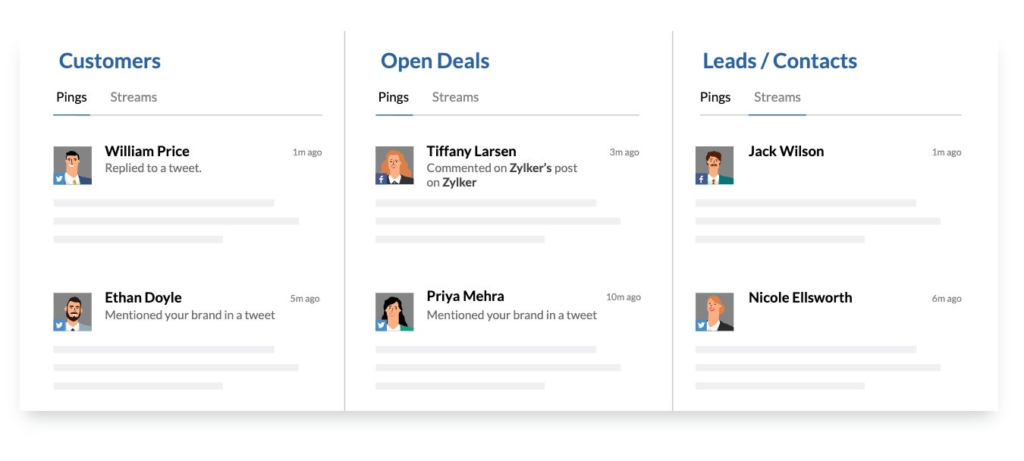
Omnichannel marketing, sales, and service facilitate engagement with leads and customers through various SMS, phone, email, and social media channels. This strategy helps brands reach more potential customers while keeping the content personalized and consistently branded. Using CRM software to integrate all these channels through one hub helps users manage brand voice and generate data-driven insights for lead nurturing. 1 Pipedrive CRM Employees per Company Size Micro (0-49), Small (50-249), Medium (250-999), Large (1,000-4,999), Enterprise (5,000+) Any Company Size Any Company Size Features Calendar, Collaboration Tools, Contact Management, and more 2 Creatio CRM Employees per Company Size Micro (0-49), Small (50-249), Medium (250-999), Large (1,000-4,999), Enterprise (5,000+) Medium (250-999 Employees), Large (1,000-4,999 Employees), Enterprise (5,000+ Employees) Medium, Large, Enterprise Features Dashboard, Document Management / Sharing, Email / Marketing Automation, and more 3 HubSpot CRM Employees per Company Size Micro (0-49), Small (50-249), Medium (250-999), Large (1,000-4,999), Enterprise (5,000+) Micro (0-49 Employees), Small (50-249 Employees), Medium (250-999 Employees), Large (1,000-4,999 Employees) Micro, Small, Medium, Large What is omnichannel? Omnichannel is a marketing, sales, and business term for integrating multiple channels to engage with customers. Channels include social media, telephony, email, SMS, and other digital platforms. Omnichannel is a customer-centric engagement strategy that focuses on the experience your customers have with your business from the beginning of a sales process through to post-sale. In terms of CRM software, omnichannel features are highly sought after to maximize customer engagement in the lead nurturing phase of the sales process. What is omnichannel marketing? Omnichannel marketing is a strategy that intentionally curates a brand experience for customers that stretches across multiple selling channels. Omnichannel marketing gives businesses more opportunities to target ideal customers directly and engage with them exactly where and how they prefer. Teams utilize CRM systems to streamline sales processes and use available add-ons for marketing functionality. For example, sales reps can take calls through the CRM, while also deploying email campaigns and creating new lead profiles from social media. With the help of the right CRM software, businesses can do all of this while also centralizing knowledge bases and providing data to support the sales team. Omnichannel vs multichannel While it might seem like omnichannel and multichannel could be interchangeable terms, there are key differences. A multichannel experience for a customer is more channel-centric and focuses on customer engagement across many channels. This experience is meant to promote and sell a product or service independently through many channels. Comparatively, an omnichannel experience is more customer-centric and focuses on customer support across many channels. Omnichannel connects different channels, devices, and platforms with the same information and adapts to the customer’s preferences based on behavior. Choosing a CRM with omnichannel features prioritizes the customer’s journey with your brand and uses data-backed customer insights to better understand marketing and sales strategy. Benefits and challenges of omnichannel The benefits of omnichannel marketing and the benefits of CRM slightly overlap in the way they both can improve the overall experience your customer has with your business. Some standout benefits include: Boosts personalization: Prioritize customer experience with personalized or targeted content that is relevant and engaging. Increases brand awareness: When customers are targeted across channels with their experience in mind, they are more motivated to familiarize themselves with your brand. Offers convenience: Customers can communicate with sales or support reps through any channel without jumping to a designated portal. As for challenges, omnichannel marketing might present the following: Consistency: It may take a lot of resources to ensure the brand experience is consistent for customers through all touchpoints. Data integration: When integrating multiple channels, there is a risk of delayed or missing data reporting if any system faces downtime. Best CRM Software Omnichannel examples Social media Social media can be a huge help in lead generation. When social media is connected to a CRM platform, reps and managers can track conversations about their brand. This way, the business has an unfiltered view of how their brand is received online. Channels like Facebook, Instagram, and LinkedIn are all powerful tools that can generate new leads directly into the CRM for further nurturing. Zoho CRM customer profiles with social media integration. Image: Zoho CRM Phone Telephony functionality can be a built-in or integrated feature with CRM software. It allows users to answer inbound calls or dial directly from the interface. This cuts out the time it might take to use a separate dialer or manually fact-check numbers. This is especially useful when all past interactions and notes are stored in the CRM software as well. Sales reps can access that information while on the phone with customers to troubleshoot in real-time. Zoho CRM telephony feature embedded into CRM. Image: Zoho CRM SEE: Learn how customer service teams can support sales reps with our list of the top CRM software for contact centers. Email Email is a go-to business communication tool that helps sales and marketing teams engage with new leads and current or past customers. Email marketing and drip campaigns are easy to deploy from CRM software. With preset templates and automations, various actions can trigger a drip campaign by sending customers engaging, targeted content. Example email segmentation tool from Pipedrive. Image: Pipedrive Website Your company’s website should provide you as much value and information as it does potential customers. With the help of landing pages, web forms, and live chat software, your website can be a channel for lead capturing and customer service. These forms and templates can be branded with your brand style and voice for consistent customer experience. CRM functionality can be useful for small businesses who want to level up their website and make it a functional communication tool. HubSpot webform builder with templates. Image: HubSpot Future of omnichannel marketing The rise of online engagement and digital marketing makes introducing omnichannel marketing into your business strategy necessary. As more social media platforms gain popularity and convenience, which is a driving motivator, customers want you to meet them where they are. The top CRM software options

Understanding Omnichannel: A Comprehensive Guide for Business Read More »

CIO Leadership Live Middle East with Paul Potgieter, Director – Technology, Product, and Platforms at NEOM

In this episode, we speak with Paul Potgieter, Director of Technology, Product, and Platforms at NEOM, who brings a wealth of experience as both a technologist and a leader in the Middle East’s business and tech sectors. With over a decade of shaping the region’s technology and business landscape, Paul shares what drew him to Saudi Arabia’s ambitious GIGA Projects, particularly NEOM. He delves into his personal philosophy, Vision 2023, and the crucial role technology plays in NEOM’s development, as well as the benefits of sustainability and innovation for the region’s future. Register Now source

CIO Leadership Live Middle East with Paul Potgieter, Director – Technology, Product, and Platforms at NEOM Read More »

Google, YouTube Can't Escape Suit Over Kids' Data Collection

By Allison Grande ( January 14, 2025, 11:17 PM EST) — A California federal judge has refused to release Google and YouTube from a proposed class action accusing them of illegally collecting children’s data to generate targeted advertising, while cutting Cartoon Network, DreamWorks, Hasbro Studios and several other owners of popular kid-friendly YouTube channels from the long-running dispute. … Law360 is on it, so you are, too. A Law360 subscription puts you at the center of fast-moving legal issues, trends and developments so you can act with speed and confidence. Over 200 articles are published daily across more than 60 topics, industries, practice areas and jurisdictions. A Law360 subscription includes features such as Daily newsletters Expert analysis Mobile app Advanced search Judge information Real-time alerts 450K+ searchable archived articles And more! Experience Law360 today with a free 7-day trial. source

Google, YouTube Can't Escape Suit Over Kids' Data Collection Read More »

Align B2B Strategy, Planning, And Execution To Achieve Growth With Precision And Purpose

Few things derail sustainable growth and customer experience in B2B like misaligned planning. When goals, paths to achieve them, and prioritization of efforts lack clarity, companies may over-rotate or miss opportunities for economies of scale. This is why operations leaders must align the business objectives created during B2B strategy and planning development with execution. Yet that doesn’t happen enough: According to Forrester’s Revenue Operations Survey, 2024, 59% of B2B operations professionals who have functional knowledge of their operations domain(s) and spend time developing functional plans say that their plans don’t align with corporate business objectives. While this misalignment highlights the critical need for better integration and sequencing of planning processes, there is also good news: 90% of these professionals agree that their plans align with other functional plans across go-to-market teams, indicating a foundation upon which to build. B2B planning involves multiple layers, each with its own focus, steps, and timeline. The planning process starts with a 3–5-year corporate strategy. This long-term vision is then translated into a 1–3-year product offering roadmap. Revenue planning follows, focusing on the annual fiscal year. These high-level plans cascade to functional plans, which should be updated monthly or quarterly. In fact, 79% of operations professionals who have functional knowledge of their operations domain(s) and spend time on planning, budget, or strategy update their marketing plans this frequently, and 90% do the same for their sales plans. Translating corporate strategy into actionable plans at different levels, such as product, revenue, functional, and operational, is among the primary challenges in B2B. Each layer has its own complexities and requires careful coordination to avoid misalignment. This process can be overwhelming and often leads to siloed thinking. To foster collaboration and effective use of resources, it’s crucial that B2B teams don’t just aim for growth but achieve it with precision and purpose. To do this, operations and planning leaders must: Align on priorities and a collaboration approach. Clear priorities prevent confusion and allow everyone to focus on the most important goals. Regular communication and collaboration across teams keeps everyone aligned. This involves setting up regular check-ins, using collaborative tools, and fostering a culture of open communication to ensure that all team members are on the same page and working toward the common goal. Define roles, timing, and milestones. Clearly defining who is responsible, accountable, consulted, and informed for each task means that everyone knows their role and can work efficiently. This clarity helps avoid premature or delayed actions. Regularly reviewing and adjusting roles and timelines helps maintain alignment and responsiveness to changing circumstances. Create a detailed project plan. Effectively sequencing tasks, timing, and milestones is crucial to align all involved efforts. This involves breaking down the project into manageable tasks, each with a clear deadline and specific milestones to track progress. A detailed project plan should specify resource allocation and include contingency plans to address potential obstacles. This plan should be a living document, regularly updated to reflect progress and any changes in strategy or priorities. This dynamic approach allows the organization to remain agile and responsive. By fostering a proactive rather than reactive approach, organizations can better navigate the complexities of B2B planning and execution. Document plan deliverables. Clearly outlining how tasks will be completed, including necessary interactions and optimizations, is crucial for successful execution. This involves creating documentation for each deliverable, specifying the required inputs, expected outputs, and quality standards. Inputs include all necessary resources, materials, and information required to complete each task, such as human resources, tools, and data. Outputs define the expected results or products of each task, including measurable outcomes such as completed reports or developed software features. Quality standards establish the criteria that each deliverable must meet to be considered successful, encompassing performance metrics, compliance with regulations, and adherence to best practices. Manage and govern execution. Track progress, connect the dots across functions, and maintain visibility to course-correct as needed. Governance keeps the organization on track with process steps, milestones, and overall goals. Implementing a robust management process helps monitor progress, identify potential issues early, and facilitate timely interventions. Regular status updates, performance metrics, and feedback loops are essential to aligning execution with the overall strategy and objectives. To learn more about how to unlock the full potential of your B2B operations by aligning strategy, planning, and execution, join us at Forrester’s B2B Summit North America from March 31 to April 3, 2025, in Phoenix. You’ll learn how to integrate, sequence, and synchronize your planning processes across go-to-market functions to drive toward a unified goal. This powerful approach not only prevents misalignment but also ignites collaboration, ensuring that all efforts fuel your overarching objectives. source

Align B2B Strategy, Planning, And Execution To Achieve Growth With Precision And Purpose Read More »

What’s Next for Open Source Software Security in 2025?

Open-source software is common throughout the tech world, and tools like software composition analysis can spot dependencies and secure them. However, working with open source presents security challenges compared with proprietary software. Chris Hughes, chief security advisor at open-source software security startup Endor Labs, spoke to TechRepublic about the state of open-source software security today and where it might go in the next year. “Organizations are starting to try to get some foundational things like governance in place to understand what we are using in terms of open source,” Hughes said. “Where does it reside in our enterprise? What applications are running it?” Open source security trends for 2025 For his work, Hughes defined open source as software for which source code is freely available and can be used to build other projects, possibly with some restrictions. Last year, Harvard Business School found organizations would need to invest $8.8 trillion in technology and labor time to recreate the software used in business if open-source software wasn’t available. “The estimates are 70-90% of all applications have open source, and roughly 90% of those code bases are entirely made up of open source,” Hughes said. For 2025, Hughes predicts: Widespread open-source software adoption will be accompanied by increasingly sophisticated attacks on OSS by malicious actors. Organizations will continue to put foundational OSS governance in place. More companies will use open-source and commercial tools to help them start to understand their OSS consumption. Organizations will perform risk-informed consumption of OSS. Enterprises will continue to push for vendor transparency regarding what OSS they use in their products. However, no widespread mandates will arise for this process. AI will continue to impact application security and open source in various ways, including organizations using AI to analyze code and remediate issues. Attackers will target widely used OSS AI libraries, projects, models, and more to launch supply chain attacks on the OSS AI community and commercial vendors. AI code governance, where organizations have more visibility into AI models, will become more common. Organizations increasingly want to know how secure their open source software is, including “how well is it maintained, who’s maintaining it and how quickly do they address vulnerabilities when they occur,” Hughes said. He highlighted the attack in April 2024 in which a string of social engineering attempts threatened open-source utilities, particularly opening a backdoor in the XZ Utils utility. “That one was really kind of sinister because the open source ecosystem is largely sustained by unpaid volunteers, folks doing this in their free time … and often not compensated, unpaid, etc.,” Hughes said. “So, taking advantage of that and preying on that was a pretty nefarious thing that got a lot of people’s attention.” Open source: Must-read coverage How is AI changing open-source security? In October 2024, the Open Source Initiative established a definition for open-source AI. According to the initiative, open-source AI has four key elements: the freedom to use, study, modify, and share the system for any purpose. Hughes said that defining open-source AI was important because of the rise of distribution platforms like Hugging Face. “These AI models, especially the open source ones, are widely used by many organizations and individuals around the world,” he said. “So we’re back to asking: What exactly is in this, and who contributed to it, and where is it f rom? And are there vulnerable components?” Hughes said that large corporations may have a better chance of talking transparently with their vendors about the entirety of their software supply chain than small companies. Therefore, the problem of not having visibility into the AI models used in their software can grow exponentially for smaller companies. SEE: Smart home device makers will soon be able to apply for a U.S. government seal of security approval. CISA encourages open-source software development security In March 2024, CISA finalized the secure software development self-attestation form, meant for developers of software used by the U.S. federal government to confirm they use secure development practices. Federal agencies may ask for other forms and attestations as well. On the commercial side, organizations may build similar requirements into their procurement processes. There is still an element of trust involved since the organization needs to trust the vendor will keep to their word. But the conversation is happening more often now than it did last year, in the wake of attacks on open source utilities, Hughes said. Solutions for the future of open source software security Performing software composition analysis isn’t enough going into 2025, Hughes said. IT professionals and security professionals should know that as software becomes more complex, the number of vulnerabilities has grown “to where it’s becoming a tax on developers to even navigate what needs to be fixed and what order of priority,” Hughes said. Companies like Endor Labs can provide insights on dependencies within open-source code, including indirect or transitive dependencies. “Being able to point to things like reachability and exploitability … could be a big benefit from the compliance perspective too, in terms of the burden on the organization and your development team,” he said. source

What’s Next for Open Source Software Security in 2025? Read More »

Fed. Circ. Judge Chides Attys For Omitting Key Argument

By Dani Kass ( January 14, 2025, 8:52 PM EST) — The Federal Circuit’s chief judge got frustrated Tuesday when neither party in a dispute over a 3G messaging patent had addressed what she considered to be the analysis’ starting point…. Law360 is on it, so you are, too. A Law360 subscription puts you at the center of fast-moving legal issues, trends and developments so you can act with speed and confidence. Over 200 articles are published daily across more than 60 topics, industries, practice areas and jurisdictions. A Law360 subscription includes features such as Daily newsletters Expert analysis Mobile app Advanced search Judge information Real-time alerts 450K+ searchable archived articles And more! Experience Law360 today with a free 7-day trial. source

Fed. Circ. Judge Chides Attys For Omitting Key Argument Read More »

47% of Businesses Weaken Sustainability Goals Due to Generative AI

Businesses would rather scale back their sustainability commitments than miss out on realising the benefits of generative artificial intelligence, according to a new report from Capgemini. Of those implementing the technology across most or all functions, 47% have “had to relook” at their original environmental goals. In July, Google came under fire after its annual environmental report revealed that its emissions had increased by 48% in four years thanks to the expansion of its data centres to support AI developments. It also stated that its goal to reach net-zero emissions across all its operations and value chain by 2030 is now “extremely ambitious” and “will require (Google) to navigate significant uncertainty.” For “Developing Sustainable GenAI,” the Capgemini Research Institute surveyed executives from 2,000 large organisations worldwide that were already working with GenAI. Almost half (47%) said their organisation’s greenhouse gas emissions had increased in the last year by an average of 6%, and a similar proportion (48%) linked a rise to their AI usage. Generative AI demands a substantial amount of energy and water GenAI has an aggressive environmental impact. The graphics processing units central to the technology’s operation require rare Earth metals that must be mined, releasing greenhouse gases. The hardware behind it also requires frequent upgrades, with studies suggesting this could create up to five million tonnes of e-waste by 2030. It is estimated that data centres will be responsible for up to 4% of global power demand by 2030, driven, at least in part, by AI. Training OpenAI’s GPT-4, with 1.76 trillion parameters, consumed an amount of energy equivalent to the annual power usage of five thousand U.S. households. This doesn’t even include the electricity required for inference, where the AI generates outputs based on new data. A substantial amount of water is also required to cool the servers. Running an inference of between 10 and 50 queries on a large language model uses about 500 ml of water. SEE: Sending One Email With ChatGPT is the Equivalent of Consuming One Bottle of Water The E.U. has the lofty goal of reducing the region’s 2030 greenhouse gas emissions to at least 11.7% lower than projected at the start of the decade. However, demand for bit barns in Europe is predicted to triple in that time, increasing their share of the region’s total energy demand by 3% and pushing that goal out of reach. More must-read AI coverage Businesses may not know, or even care, about the emissions attached to their AI usage Many businesses use AI now, with 80% having increased their investment in it since 2023, according to Capgemini. Nearly a quarter are now integrating generative AI into some or most of their locations or functions, up from 6% in 2023. SEE: 31% of Organizations Using Generative AI Ask It To Write Code However, the new report highlights that awareness of AI’s electricity and water demands is patchy. Only 38% of executives surveyed claim to be aware of the environmental impact of the GenAI they use, and 12% say their company measures its footprint. Of those surveyed that are aware of the impact, 51% say that AI use is one of the primary reasons for their organisation’s rise in emissions. They also expect it to increase the proportion of their emissions that come from internal operations within the next two years by 2.2%. The lack of businesses monitoring the environmental impact of their GenAI usage is not due to a lack of effort. Almost three-quarters (74%) of those surveyed said doing so is challenging due to limited transparency from hyperscalers and model providers. A report from the Uptime Institute found that fewer than half of data center owners and operators track metrics like renewable energy consumption and water usage. The emissions of data centres owned by Google, Microsoft, Meta, and Apple are likely to be about 662% higher than officially reported, according to The Guardian. This is largely due to renewable energy certificates and carbon offset schemes, which allow companies to claim they use renewable energy when they don’t. SEE: Power Shortages Stall Data Centre Growth in UK, Europe On the other hand, executives may not be concerned about the impact of AI usage on their company’s emissions. Only a fifth of respondents to the Capgemini survey ranked the environmental footprint among the top five factors when selecting or building GenAI models. Cost competitiveness was ranked among the top five considerations by 53% of executives. However, this is fundamentally connected to energy use, according to Samuel Young, AI practice manager at research firm Energy Systems Catapult. He said: “When implementing at scale, organisations quickly become sensitive to inference costs. They therefore have an incentive to adopt less energy-intensive models, which can reduce carbon impact.” source

47% of Businesses Weaken Sustainability Goals Due to Generative AI Read More »

Crypto Co.'s Lax Compliance Enabled Hackers, Suit Says

By Aislinn Keely ( January 14, 2025, 8:59 PM EST) — A proposed class action in California federal court accused digital asset exchange OKX of flouting U.S. laws and allowing criminals to launder stolen funds through its platform, including $725,000 worth of crypto looted from the crypto investor leading the suit…. Law360 is on it, so you are, too. A Law360 subscription puts you at the center of fast-moving legal issues, trends and developments so you can act with speed and confidence. Over 200 articles are published daily across more than 60 topics, industries, practice areas and jurisdictions. A Law360 subscription includes features such as Daily newsletters Expert analysis Mobile app Advanced search Judge information Real-time alerts 450K+ searchable archived articles And more! Experience Law360 today with a free 7-day trial. source

Crypto Co.'s Lax Compliance Enabled Hackers, Suit Says Read More »

Companies look to sell off assets to pay for AI investments

Instead of selling off assets, some organizations are using private equity funding to increase investments in AI, adds Claire Milligan, CEO of cloud cost optimization firm Aimably. In some cases, companies are turning to “creative” funding options, including private credit and so-called continuation funds to pay for AI projects that have not yet generated revenue growth, she says. “In private markets, investments in AI projects are seductive to equity investors as a justification for cash infusion to their holdings without the need to sell off assets,” Milligan says. “By capitalizing these projects as research and development, investors open the door to new sources of funding for existing portfolio companies, such as private credit or a transition to new fund vintages, without requiring investors to demonstrate value creation success to public markets.” The danger to investors and companies, however, is a continued lack of revenue from many AI projects, she adds. “Reinvestment activities into existing portfolio companies are necessary as these companies’ revenue performance has been lacking,” Milligan says. “If portfolio companies cannot reduce these projects to revenue engines, more recent fund vintages have a strong potential to deliver poor returns.” source

Companies look to sell off assets to pay for AI investments Read More »

AI is set to transform education — what enterprise leaders can learn from this development

Join our daily and weekly newsletters for the latest updates and exclusive content on industry-leading AI coverage. Learn More After six decades of dreaming and experimenting, we might be on the cusp of a technology-enabled revolution in education. The Arizona State Board for Charter Schools recently approved the application by Unbound Academy for a new online school that will replace traditional teachers with AI teaching assistants, promising to deliver 2.4 times the academic growth for students compared to results from conventional schools.  This advance is not the result of another incremental tech experiment — instead, it represents the latest chapter in a 60-year quest in computer assisted instruction (CAI) to transform education through technology. This time, the evidence suggests a true breakthrough might be near. If this Academy and similar initiatives are successful, it will mark the fulfillment of a long-held dream.   The idea of using computers to assist student learning dates to the 1950s, with the first application —Programmed Logic for Automatic Teaching Operations (PLATO) — appearing in 1961. PLATO offered interactive lessons and real-time feedback using terminals connected by telephone lines to a time-share computer system. Like other time-share systems, PLATO ultimately failed due to the high expenses required.  Other attempts at immersive, experimental learning famously included Second Life — a virtual world accessible through the Internet where people participated as avatars — in the early 2000s. Although not explicitly a CAI tool, Second Life demonstrated the potential for immersive virtual learning environments. At one point at least 300 universities around the world including Stanford and Harvard taught courses or conducted research on the platform. Ultimately, Second Life struggled due to a poor user interface (UI), robust technical requirements, a steep learning curve and an inability to scale. The advent of generative AI in 2017 marked a turning point in CAI, with tools like Writable and Photomath enhancing both teaching and learning. Writable, for example, uses AI to provide feedback on student writing, helping teachers manage large workloads. As reported by Axios, Writable uses ChatGPT to produce comments and observations that are sent to the teacher, who is expected to review and tweak them before providing the feedback to the students.  Such tools highlight AI’s growing role in addressing the long-standing resource constraints of traditional education. In some school districts in the U.S., primary class sizes exceed 40 students. If a teacher spent 10 minutes reading and critiquing a writing assignment from each student, that would be 400 minutes, or more than 6.6 hours outside of class time, to provide feedback for one assignment. That seems untenable, especially in combination with evaluating other student assignments. A boost from technology will help to address this challenge. AI-powered tutoring at scale In a more comprehensive approach, the Khan Academy, led by founder Sal Khan, has been offering free online education tutorials since 2008. In 2023, the company launched Khanmigo, an interactive AI tutor for students that incorporates ChatGPT.  In a 2023 TED Talk, Khan talked about the potential of Khanmigo for improving student performance. In the talk, he discussed a 1984 paper titled “The 2 Sigma Problem” by Professor of education Benjamin Bloom, then at the University of Chicago and Northwestern University.  Caption: Khan Academy founder Sal Khan discusses AI-powered tutoring in a 2023 TED Talk. Source: The often-cited paper argued that students receiving individualized tutoring performed two standard deviations better than those receiving only traditional classroom instruction. However, Bloom was aware that this level of tutoring was impractical due to resource constraints including the costs of obtaining human tutors. Bloom believed the solution was to devise more economical interventions that could approach the benefits of tutoring.  Khan argues that though the application of AI-infused technology, Khanmigo effectively overcomes the resource constraints. As noted in a Harvard Business School case study, Khan said that Khanmigo might be “that holy grail we’ve all been reading about in science fiction for years, about an AI that could emulate a human tutor.” Students who receive 1:1 human tutoring tested two standard deviations better than those who did not have individual tutoring. Source: https://web.mit.edu/5.95/www/readings/bloom-two-sigma.pdf  Some have pointed to flaws in the Bloom paper, questioning the evidence supporting his conclusion and dismissing the claims as being farfetched. In an effort to “separate science fiction from science fact,” Paul von Hippel, a professor and associate dean for research in the LBJ School of Public Affairs at the University of Texas, opined that the two standard deviation claim is both “exaggerated and oversimplified.” Nevertheless, there is little question that the application of technology tools could improve educational outcomes.  Balancing efficiency and human connection While AI tools show immense promise in addressing resource constraints, their adoption raises broader questions about the role of human connection in learning. Which brings us back to Unbound Academy. Students will spend two hours online each school morning working through AI-driven lessons in math, reading, and science. Tools like Khanmigo and IXL will personalize the instruction and analyze progress, adjusting the difficulty and content in real-time to optimize learning outcomes. The Charter application asserts that “this ensures that each student is consistently challenged at their optimal level, preventing boredom or frustration.”  Unbound Academy’s model significantly reduces the role of human teachers. Instead, human “guides” provide emotional support and motivation while also leading workshops on life skills. What will students lose by spending most of their learning time with AI instead of human instructors, and how might this model reshape the teaching profession?  The Unbound Academy model is already used in several private schools and the results they have obtained are used to substantiate the advantages it claims. Yet, it is not clear how a computer-based model will impact a student’s ability to foster human connections outside of a traditional school setting. These issues and questions highlight the complex trade-offs schools like Unbound Academy must navigate as they redefine the educational landscape. Is the revolution here? The Academy is not the only instance of AI being used in schools. Khanmigo is being piloted

AI is set to transform education — what enterprise leaders can learn from this development Read More »