Get Ready For A Wild Ride: What Proposed Appointments Mean For US Healthcare

The ride for healthcare leaders is about to get wild. Before the election, healthcare stood at a critical precipice. Now the industry is bracing for a reckoning under the second Trump administration. The potential policy shifts are becoming clearer as the inauguration nears. Although confirmations are still pending, six key individuals slated for top healthcare positions in the federal government signal upcoming changes: Robert F. Kennedy Jr. — secretary of the Department of Health and Human Services (HHS). If confirmed, Kennedy will oversee the FDA, CDC, NIH, and CMS. He has unorthodox views on vaccines and public health but strongly supports personal choice in care and primary care. Dr. Mehmet Oz — head of the Centers for Medicare and Medicaid (CMS) overseeing Medicare, Medicaid, and the Children’s Health Insurance Program, as well as the Affordable Care Act’s marketplace exchange. A longtime proponent of Medicare Advantage plans, Dr. Oz is being tasked with reducing waste and fraud within CMS. His financial investments, including a stake in UnitedHealth Group, have been called into question. Dr. Dave Weldon — director of the Centers for Disease Control and Prevention (CDC). A former Florida congressman, he criticized vaccine policies. Dr. Marty Makary — commissioner of the Food and Drug Administration (FDA). The incoming administration wants to evaluate chemicals present in the food supply, drugs, and biologics to address the “Childhood Chronic Disease Epidemic.” Dr. Jay Bhattacharya — director of the National Institutes of Health (NIH). Bhattacharya could dramatically affect the future of medical science. The NIH is the world’s largest public funder of biomedical research but is also likely to be among the top targets for restructuring. The first Trump administration proposed cutting the agency’s budget. Dr. Janette Nesheiwat — surgeon general. She has emphasized the benefits of getting vaccinated against infectious diseases. President-elect Trump has touted her commitment to access to affordable, quality healthcare and empowering individuals to take charge of their health. What Will Change In 2025 And Beyond? This group is likely to seek major shifts in health policy and practice. Agendas that previously focused on infectious disease will now focus on root causes of all chronic diseases. Potential shifts in policy will mean: Changes in coverage under the ACA. Members of the incoming administration such as vice president-elect Vance have suggested creating high-risk pools and reinstating preexisting condition restrictions. If implemented, access to affordable care will decrease, exacerbating existing and new conditions, leading to higher overall spending. Additionally, excluding vaccines from essential health benefits may give rise to higher health risks, especially in lower-income segments. Medicare Advantage regaining the advantage. Health insurers offering Medicare Advantage (MA) plans had a turbulent year. The annual rate-setting process under Dr. Oz could encourage MA expansion. Health insurers would stand to benefit from higher government reimbursement, and seniors would benefit from increased market competition. Price transparency getting a boost. We may see consumers benefit from a harder line on delivering price transparency. Efforts started under the first Trump administration, including on surprise medical bills, advanced under the Biden administration. Price transparency and legislation are still in their infancy, but providers and insurers should work to comply now to avoid penalties and improve customer experience. Less regulatory oversight to spur innovation. Fulfilling Kennedy’s commitment to overhaul the FDA risks significant deregulation of the pharmaceutical industry. This could potentially impact safety, innovation, and access to new treatments. Stakeholders must weigh the potential benefits, such as faster availability of new therapies, against the risks, such as the impact of diminished oversight on safety and already low public trust in healthcare. How To Prepare As Healthcare Enters A New Era The new administration promises to revolutionize the establishment. Consumers’ distrust and dissatisfaction with the status quo is likely to incite more change. But healthcare organizations (HCOs) can prepare for and adapt to potential policy shifts by: Relieving workforce pressure before it implodes. Clinician burnout persists. A rise in preventable conditions may push the system to a breaking point. Invest in cloud computing to store and access patient data more efficiently. Employ AI-powered tools to automate administrative tasks, freeing clinicians to concentrate on patient care. Creating educational content to spur customer engagement. Leverage blogs, videos, infographics, and other media to educate customers on health topics, treatments, and preventive measures. Platforms that support SEO and discovery on third-party listings become critical to customers searching for correct information. Customer experience platforms and other orchestration platforms such as DexCare enable hospitals to extend digital borders and attract and acquire more patients. Boosting longitudinal data tracking. Potential policy changes will likely emphasize the need for continuous data collection, especially for chronic conditions, to improve health outcomes and demonstrate the effectiveness of interventions. Today, 44% of consumers indicate that they started using wearable smart devices and/or medical devices in the past 12 months to support their overall health. Focus on incorporating new data sources and improving interoperability via standards such as FHIR and patient-reported outcomes. Increasing focus on the role of environmental health. HCOs’ policies and practices should consider how environmental factors impact public health. Reducing the public’s exposure to harmful chemicals and promoting healthier living and environments will strengthen the connection between HCO and customer. It will also position HCOs to meet any new mandates. Creating efficiency and speed. The administration wants to slash $2 trillion in federal spending. Targeting improper payments and fraud in Medicare and Medicaid will mean stricter documentation requirements and increased audits, adding to providers’ burdens. People close to the administration have posted on social media about increased scrutiny on the sector’s spending on DEI efforts. HCOs should prepare for sizable, swift changes and beef up their auditing capabilities. Want to chat about this topic and more? Forrester clients can schedule a guidance session for a deeper discussion. source

Get Ready For A Wild Ride: What Proposed Appointments Mean For US Healthcare Read More »
Top 5 Tech Trends at CES 2025

CES brought this year’s top AI products and consumer devices to Las Vegas for a week of reveals. NVIDIA shaped many of these trends as the company that contributed to and benefitted from the artificial intelligence boom the most. TechRepublic has rounded up the top trends in commercial products and AI from the show. Video Overview: Agentic AI is the next step for generative bots Agentic AI, a buzzword throughout the last half of 2024, was a hot topic at CES. Agentic AI typically strings together multiple actions by several generative AI services to automatically perform tasks that would otherwise have taken a human worker hours or days to complete. NVIDIA’s Blueprints for agentic AI are pre-built packages of NIM microservices and technologies from AI partners. For example, LangChain uses its own LangGraph, plus Llama 3.3 70B NVIDIA NIM microservices, to create reports. The agent searches the web and interprets the user’s request to provide the report in a given format. Accenture sees agentic AI as useful for managing inventory, personalizing care for patients in clinical trials, and troubleshooting problems with industrial equipment. The company partnered with NVIDIA on its AI Refinery platform for deploying agents in business environments. “Advancements in digitizing knowledge, new AI models, agentic AI systems and architecture enables enterprises to create their own unique cognitive digital brains,” said Karthik Narain, group chief executive of technology and chief technology officer at Accenture, in a press release. Next-generation GPUs revealed The chips powering generative AI training and inference and processors for laptops and PCs were at the top of my mind at CES 2025. The major processor announcements were: The GeForce RTX 5090 GPU is a beneficiary of NVIDIA’s top-of-the-line Blackwell architecture. Developers can also look at the $3,000 Project DIGITS, which NVIDIA calls a desktop supercomputer. Project DIGITS uses the one-pentaflop NVIDIA GB10 Grace Blackwell Superchip for prototyping, tuning, and deploying generative AI models. The Project DIGITS desktop can run a petaflop of AI computing. Image: NVIDIA “Fusing AI-driven neural rendering and ray tracing, Blackwell is the most significant computer graphics innovation since we introduced programmable shading 25 years ago,” NVIDIA CEO Jensen Huang said in a press release. SEE: Microsoft gives laptops from various manufacturers the Copilot+ label if the devices can run generative AI locally. More must-read AI coverage Could AI make humanoid robots happen? Huang expressed optimism about today’s generative AI finally making humanoid robot assistants a reality. Humanoid robots tend to garner attention for their sci-fi swagger. However, the attempt to commercialize them has been rocky, from the quiet retirement of Boston Dynamics’ Atlas robot to a human operator controlling an allegedly autonomous Optimus robot at a Tesla promotional event in October. NVIDIA’s differentiator is the Cosmos, which Huang called the “world foundation model platform.” The platform applies vast amounts of synthetic motion data to the problem. It builds on the Isaac GR00T research platform, which developers can access now. While GR00T helps a simulated robot learn from human movement, Cosmos creates physics-aware videos and models of physical environments to teach robots about navigating the world. AI comes to autonomous and augmented driving Autonomous cars are another CES staple. Full autonomy has remained a dream, but Waymo’s success marks a careful foray into making autonomous cars more common. NVIDIA wants a place in self-driving cars as well. Huang announced that NVIDIA’s self-driving platform, NVIDIA DRIVE AGX Hyperion, has passed two industry safety benchmarks. Toyota and others signed onto NVIDIA’s driver assistance operating system. Plus, Uber will use the Cosmos model to experiment with AI-powered self-driving vehicles. “Generative AI will power the future of mobility, requiring both rich data and very powerful computing,” said Dara Khosrowshahi, CEO of Uber, in a press release. “By working with NVIDIA, we are confident that we can help supercharge the timeline for safe and scalable autonomous driving solutions for the industry.” Elsewhere in automotive software, Bosch developed a cloud-based system to warn drivers — and the drivers nearby using the same program — when they’re driving against the flow of traffic. New laptops and laptop rebrandings go all-in on AI As a consumer-focused show, CES offered many more devices, including high-definition TVs and powerful gaming PCs. But we found the featured laptops to be most remarkable for business. Dell announced a new naming scheme and line of business laptops at CES 2025, among several other laptop and AI PC offerings. Lenovo leaned into AI with the ThinkBook Plus Gen 6 Rollable laptop, which unfolds from a 14-inch display to 16.7 inches and can run generative AI tools. Don’t try to roll the ThinkBook Plus Gen 6 Rollable into a tube shape, but the display does fold out. Image: Lenovo The Snapdragon X Plus CPU and AI features are in the remarkably light (2.2 pounds) Asus Zenbook A14. Samsung announced a new Galaxy Book5 line powered by Samsung’s Galaxy AI. “We are thrilled to make Galaxy AI and cutting-edge innovation accessible to more people than ever before, addressing their unique productivity needs on PC and other Galaxy devices,” said Changtae Kim, EVP and head of the new computing R&D team for mobile experience business at Samsung Electronics. TechRepublic covered CES 2025 remotely. source

Top 5 Tech Trends at CES 2025 Read More »

FBI Deletes China-Backed Malware From Windows Computers

By Rae Ann Varona ( January 14, 2025, 10:11 PM EST) — The Federal Bureau of Investigation and French law enforcement and security partners have deleted malware used by Chinese government-backed hackers from thousands of computers worldwide, including home computers in the U.S., the U.S. Attorney’s Office for the Eastern District of Pennsylvania announced Tuesday…. Law360 is on it, so you are, too. A Law360 subscription puts you at the center of fast-moving legal issues, trends and developments so you can act with speed and confidence. Over 200 articles are published daily across more than 60 topics, industries, practice areas and jurisdictions. A Law360 subscription includes features such as Daily newsletters Expert analysis Mobile app Advanced search Judge information Real-time alerts 450K+ searchable archived articles And more! Experience Law360 today with a free 7-day trial. source

FBI Deletes China-Backed Malware From Windows Computers Read More »

Google DeepMind researchers introduce new benchmark to improve LLM factuality, reduce hallucinations

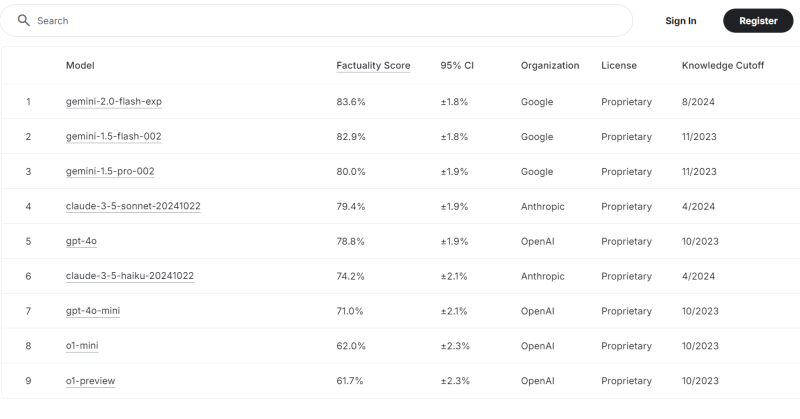
Join our daily and weekly newsletters for the latest updates and exclusive content on industry-leading AI coverage. Learn More Hallucinations, or factually inaccurate responses, continue to plague large language models (LLMs). Models falter particularly when they are given more complex tasks and when users are looking for specific and highly detailed responses.  It’s a challenge data scientists have struggled to overcome, and now, researchers from Google DeepMind say they have come a step closer to achieving true factuality in foundation models. They have introduced FACTS Grounding, a benchmark that evaluates LLMs’ ability to generate factually accurate responses based on long-form documents. Models are also judged on whether their responses are detailed enough to provide useful, relevant answers to prompts.  Along with the new benchmark, the researchers have released a FACTS leaderboard to the Kaggle data science community.  As of this week, Gemini 2.0 Flash topped the leaderboard, with a factuality score of 83.6%. Others in the top 9 include Google’s Gemini 1.0 Flash and Gemini 1.5 Pro; Anthropic’s Clade 3.5 Sonnet and Claude 3.5 Haiku; and OpenAI’s GPT-4o, 4o-mini, o1-mini and o1-preview. These all ranked above 61.7% in terms of accuracy. The researchers say the leaderboard will be actively maintained and continually updated to include new models and their different iterations.  “We believe that this benchmark fills a gap in evaluating a wider variety of model behaviors pertaining to factuality, in comparison to benchmarks that focus on narrower use cases…such as summarization alone,” the researchers write in a technical paper published this week. Weeding out inaccurate responses Ensuring factual accuracy in LLM responses is difficult because of modeling (architecture, training and inference) and measuring (evaluation methodologies, data and metrics) factors. Typically, researchers point out, pre-training focuses on predicting the next token given previous tokens.  “While this objective may teach models salient world knowledge, it does not directly optimize the model towards the various factuality scenarios, instead encouraging the model to generate generally plausible text,” the researchers write.  To address this, the FACTS dataset incorporates 1,719 examples — 860 public and 859 private — each requiring long-form responses based on context in provided documents. Each example includes:  A system prompt (system_instruction) with general directives and the order to only answer based on provided context; A task (user_request) that includes a specific question to be answered;  A long document (context_document) with necessary information.  To succeed and be labeled “accurate,” the model must process the long-form document and create a subsequent long-form response that is both comprehensive and fully attributable to the document. Responses are labeled “inaccurate” if the model’s claims are not directly supported by the document and not highly relevant or useful.  For example, a user may ask a model to summarize the main reasons why a company’s revenue decreased in Q3, and provide it with detailed information including a company’s annual financial report discussing quarterly earnings, expenses, planned investments and market analysis.  If a model then, say, returned: “The company faced challenges in Q3 that impacted its revenue,” it would be deemed inaccurate.  “The response avoids specifying any reasons, such as market trends, increased competition or operational setbacks, which would likely be in the document,” the researchers point out. “It doesn’t demonstrate an attempt to engage with or extract relevant details.”  By contrast, if a user prompted, “What are some tips on saving money?” and provided a compilation of categorized money-saving tips for college students, a correct response would be highly detailed: “Utilize free activities on campus, buy items in bulk and cook at home. Also, set spending goals, avoid credit cards and conserve resources.”  DeepMind uses LLMs to judge LLMs To allow for diverse inputs, researchers included documents of varying lengths, up to 32,000 tokens (or the equivalent of 20,000 words). These cover areas including finance, technology, retail, medicine and law. User requests are also broad, including Q&A generation, requests for summarization and rewriting.  Each example is judged in two phases. First, responses are evaluated for eligibility: If they don’t satisfy user requests, they are disqualified. Second, responses must be hallucination-free and fully grounded in the documents provided. These factuality scores are calculated by three different LLM judges — specifically Gemini 1.5 Pro, GPT-4o and Claude 3.5 Sonnet — that determine individual scores based on the percentage of accurate model outputs. Subsequently, the final factuality determination is based on an average of the three judges’ scores. Researchers point out that models are often biased towards other members of their model family — at a mean increase of around 3.23% — so the combination of different judges was critical to help ensure responses were indeed factual. Ultimately, the researchers emphasize that factuality and grounding are key factors to the future success and usefulness of LLMs. “We believe that comprehensive benchmarking methods, coupled with continuous research and development, will continue to improve AI systems,” they write.  However, they also concede: “We are mindful that benchmarks can be quickly overtaken by progress, so this launch of our FACTS Grounding benchmark and leaderboard is just the beginning.”  source

Google DeepMind researchers introduce new benchmark to improve LLM factuality, reduce hallucinations Read More »

戶戶送夥聖雅各福群會 CharityToday 推「戶戶送暖」計劃助弱勢長者

Screenshot 戶戶送宣布,與聖雅各福群會一站式援助搜尋及申請平台 CharityToday 攜手推出全新「戶戶送暖」計劃,致力凝聚社區力量,藉農曆新年這一親友共聚的傳統節慶時刻,展開為期 10 個月的送暖行動,攜手一眾顧客為社區中有需要的長者送暖。 計劃將為期 10 個月,由即日起,顧客凡於「戶戶超市」選購指定生活百貨,戶戶送將捐贈同款商品予有需要長者。計劃完結後,戶戶送義工團隊會將捐贈品整理成「戶戶送暖」福袋,並送到每位長者手中,為他們送暖,如戶戶送將生活百貨送到大家家中一樣。 是次計劃的參與方法十分簡單,顧客只需透過戶戶送平台在四間位於中環、屯門,觀塘及尖沙咀的 「戶戶超市」選購生活百貨時,選購在產品圖片右下角附有聖雅各福群會 CharityToday 標誌的產品, 便可參與。指定產品的產品說明亦附有計劃簡介,助顧客了解活動內容。有興趣選購計劃內所有指定 生活百貨的顧客,更可直接瀏覽戶戶超市「戶戶助人」頁面選購所有指定商品,為有需要的長者送上 暖暖祝福。 指定生活百貨包括地捫忌廉粟米蓉、珠江橋牌豆豉鯪魚、桂格即食燕麥片、壽桃牌上海麵、袋鼠牌低升糖指數白米,及螢美人日本米,全是易於保存及烹調,亦是長者日常所需的食物。由可以即食的商品至可烹調成美味及富營養佳餚的材料,這一系列的精選生活百貨讓一眾長者得到遠不止物質上的援助,更是大家所熟悉的家常便飯的味道。 戶戶送與聖雅各福群會 CharityToday 合作無間,致力解決長者糧食不足問題。早前推出的「FUN 享口福」計劃,便鼓勵顧客在使用戶戶送應用程式及網站時,可於結帳前選擇湊整訂單總額作捐款或作額外捐款,幫助有需要長者。 戶戶送香港區總經理 Nick Price 表示:「我們堅信能享用富營養膳食是大家的應有權利,故在營運戶 戶送業務的同時,我們亦一直致力解決本地糧食不足的問題。我們十分榮幸能夠與聖雅各福群會CharityToday 推出『戶戶送暖』計劃,讓我們在這一節慶時刻為社區送暖,鼓勵大眾與我們一起為弱 勢社群帶來實實在在的改變。我衷心鼓勵顧客與家人共聚天倫、喜迎蛇年的同時,於來年積極支持這 個別具意義的活動,共襄善舉!」 聖雅各福群會高級服務經理(企業拓展協作)何卓惠表示:「聖雅各福群會十分高興能繼續與戶戶送 有不同的合作,是次推出的『戶戶送暖』計劃,繼續為有需要的長者及弱勢群體帶來改變。計劃鼓勵戶戶送顧客在迎接新春佳節的同時,與社區有需要人士及其家庭一同分享傳統節日帶來的喜悅及溫暖, 可謂別具意義!」 戶戶送和聖雅各福群會 CharityToday 一直致力協助長者融入社會。去年,戶戶送與聖雅各福群會CharityToday 合作推出「戶戶送 x 聖雅各福群會 智能手機工作坊」,舉辦多個工作坊協助讓長者掌握日常科技應用,期望藉此收窄數碼鴻溝。工作坊反應亦十分踴躍,吸引超過 50 位長者參加。而『戶戶送暖』計劃是雙方長期合作的計劃,協助有需要長者的另一里程碑,由收窄數碼鴻溝到應對糧食不足問題,戶戶送將繼續致力為社區,尤其是較弱勢的長者,帶來積極改變。 LinkedIn Email Facebook Twitter WhatsApp source

戶戶送夥聖雅各福群會 CharityToday 推「戶戶送暖」計劃助弱勢長者 Read More »

Google Under Investigation to Determine Compliance with New UK Competition Law

Google is the first company investigated for potential strategic market status under the new U.K. Digital Markets, Competition and Consumers Act. If it receives the designation, bespoke conduct requirements will be drafted for the company to follow, preventing anti-competitive practices. “The investigation will assess Google’s position in search and search advertising services and how this impacts consumers and businesses, including advertisers, news publishers, and rival search engines,” the Competition and Markets Authority said in a press release. More Google news & tips What is the DMCCA? The DMCCA, which came into force on Jan. 1, is designed to regulate the behaviour of major digital firms with significant market power in the country. It grants the CMA new powers to impose requirements on tech companies with “Strategic Market Status,” reminiscent of the “gatekeeper” organisations that must abide by the E.U.’s Digital Markets Act. For the investigation into Google, the CMA will look at whether it is using its position to prevent innovation by others, such as withholding resources or designing AI services to limit how competing search engines could create equivalent features. The CMA will also assess whether the tech giant is using its dominant position to prioritise its search services (such as for shopping or travel), collecting and using consumer data without informed consent, and using publisher content without fair terms and conditions. SEE: Google Abusing Dominant Position in Ad Tech Sector, Says U.K. Government The DMCCA gives new enforcement powers to a group established inside the CMA called the Digital Markets Unit. It will draft a unique set of conduct requirements for each company designated as SMS, which they must abide by even before exhibiting anti-competitive practices to prevent them from occurring. Additionally, the DMU can make “pro-competition interventions” that will actively address a company’s adverse effects on competition that stem from its disproportionate market power. Conduct requirements for Google might include forcing it to make the user data it collects available to competitors or giving publishers more control over how their data is used, including in Google’s AI services. The CMA can continue to amend them even after completing the SMS investigation. SMS-designated firms must have substantial market power in digital activity, strategic significance, and either a global turnover of more than £25 billion or a U.K. turnover of more than £1 billion. The CMA will conduct investigations into each firm before applying for SMS status, which usually takes about nine months. In Google’s case, a decision will be made by October 2025, while interested parties can submit comments until Feb. 3. In August, the CMA rejected Google’s proposed policy changes regarding purchases made within apps listed on its Play Store, which had spurred an investigation. This suggested that the company would be one of the first to achieve SMS because, if the CMA accepted the changes, it would be limited in what actions it could take under the DMCCA. Search and search advertising, where an advertiser pays for its advert to appear next to the results from a user’s search, is the first of two areas of digital activity in which the CMA will launch SMS designation investigations this month. SEE: Regulator CMA to Scrutinize Microsoft and Other Cloud Service Providers in the UK “Millions of people and businesses across the UK rely on Google’s search and advertising services – with 90 per cent of searches happening on their platform and more than 200,000 UK businesses advertising there,” Sarah Cardell, chief executive of the CMA, said in a press release. “That’s why it’s so important to ensure these services are delivering good outcomes for people and businesses and that there is a level playing field, especially as AI has the potential to transform search services.” E.U. and U.S. also take issue with Google’s anticompetitive practices in Search In March 2024, Google temporarily removed some Search widgets, such as Google Flights, to allow more access to individual businesses in response to the E.U.’s Digital Markets Act coming into force. However, just a few weeks later, the E.U. opened an ongoing non-compliance investigation, as regulators claim it is promoting its own services above third parties’ in search results. In December, Google announced several more changes to its Search features to comply with the Act. In September 2024, the European Court of Justice upheld a €2.42 billion fine against Google for violating E.U. antitrust rules by favouring its own comparison shopping service, Google Shopping, in search results. Additionally, in August 2024, a federal judge ruled that the tech company monopolizes general search services and text ads, breaking antitrust law in the U.S. However, Google is not going down without a fight. The tech company successfully overturned a €1.5 billion antitrust fine it received from the European Commission in 2019 for preventing third parties using its AdSense platform from displaying competitor ads next to Google search results. Google was also handed a €4.34 billion fine from the European Commission in 2018 for abusing its dominance by pre-installing Google Search into Android devices but has since escalated an appeal to the European Court of Justice. source

Google Under Investigation to Determine Compliance with New UK Competition Law Read More »

Four challenges with ERP vendor-led AI roadmaps and how to solve them

CIOs have a tough balance to strike: On one hand, they’re tasked with maintaining a large number of applications – research from Salesforce shows that in 2023 organizations were using 1,061 different applications – in varying stages of age, all the while maintaining interoperability and security and reducing overall spend. On the other hand, they must look to the future state of the business with an eye toward innovation and investment in new technologies like artificial intelligence (AI). While savvy CIOs bring both business and technology acumen to the table, the most successful follow a business-driven IT roadmap, not one handed to them by their ERP vendor. Especially when it comes to AI. AI requires a shift in mindset Being in control of your IT roadmap is a key tenet of what Gartner calls composable ERP, an approach of “innovating around the edges” which often requires a mindset shift away from monolithic systems and instead toward assembling a mix of people, vendors, solutions, and technologies to drive business outcomes. And nothing necessitates this shift more than AI. AI is a generation-defining paradigm shift in the way the world works and lives. The technology has made tidal waves in society, as more than 180 million ChatGPT users tap the fastest growing app for everything from writing term papers to debugging code. And, as explained in Rethinking ERP Reimplementation in the Age of AI, AI is causing significant impact on enterprises worldwide. While vendors wield the promise of AI as a forcing function for reimplementation, customers who comply with vendor-dictated AI roadmaps likely face four significant challenges: Challenge 1: Roadmap limitations & delays How do SAP and Oracle stack up in terms of AI features and functions? In this nascent field, do they have the right technologists, engineers, and product developers to support continuing growth? Are they on the bleeding edge of this technology or are they simply following the pack? While they certainly could become powerful AI players, successful organizations need flexibility and should be able to select from AI industry leaders for technologies—beyond their ERP ecosystems—that meet business needs today, adopt technology from industry AI leaders that can easily plug into multiple databases across your entire enterprise. Why limit your enterprise’s innovative potential to the speed of a big ERP vendor? Will Henshall, a writer for Time magazine, reports that AI progress over the past 10 years has been nothing short of staggering. His article notes that over the past decade, AI’s performance has exceeded that of humans when it comes to speech recognition, image recognition, reading comprehension, language understanding, and common-sense completion. With such rapid development underway, your enterprise must have the flexibility to choose the right AI vendor to deliver the right AI solution at the right time in order to drive the best business outcomes. And while SAP and Oracle could emerge as major AI players, there’s a lot of greenfield out there. Your organization must direct a business-driven IT roadmap to stay ahead of the curve. Challenge 2: Leaving on-premises data behind For AI algorithms to be successful, they need a massive amount of historical data to draw from. As Gene Marks, a contributor to Forbes wrote, “For AI to do its job it needs to use data.” Remember the “garbage in, garbage out” adage: The more clean data available to an AI algorithm, the more predictive and fine-tuned the results will be. Henshall’s article in Time echoes the importance of data for training AI: More than half of the AI models Henshall analyzed since 2020 have training sets of 100 million or more data points. “In general, a larger number of data points means that AI systems have more information with which to build an accurate model of the relationship between the variables in the data, which improves performance,” he writes. With the high price of cloud storage, customers reimplementing on the vendor’s SaaS cloud might not take all their on-premises historical data with them. We often see organizations migrating only a few years’ worth of data, potentially leaving 10 or more years of data behind—the very data that’s the lifeblood of AI. There is no denying the fact that with more historical, clean data, the more accurate predictive analytics and data correlation can be. The value of the ERP in AI is the data that it contains, and that already exists today within the on-premises systems. It’s best to ingest the relevant, clean, and accurate data from ERP and other systems into a centralized external AI model for best results. Challenge 3: ERP vendors’ AI setups only look at data in the system Vendor-embedded AI typically can only work with ERP data. But there are many data stores across an organization that are independent of the ERP system that should be included in any enterprise AI implementation. So, leaving AI to a single monolithic ERP vendor makes little sense. The good news is that there’s a better way. You can adopt technology from industry AI leaders today that can easily plug into multiple databases across your entire enterprise This flexibility speaks to the power of having a composable ERP, especially one with a robust data orchestration layer. Making your data accessible across your organization will not only benefit your employees but also unlock new potential for more powerful AI algorithm use inside your organization. Challenge 4: Loss of license ownership risks cost increases & shrinkflation In addition to leaving your customizations and data behind, reimplementing on-premises ERP functionally to the subscription cloud could mean leaving your leverage of software license perpetual entitlement behind, which can lead to out-of-control costs and shrinkflation. According to recent financial estimates from Deloitte, many companies that have moved to cloud have incurred complex software licensing issues and costs that can reach as much as 24 percent of total information enterprise technology spend. Even after initial TCO analysis, “many organizations still encounter a cost explosion when the actual migration begins, in part because they were unaware of the licensing requirements for cloud, which can include licensing transfer, purchasing, and visibility issues,” Deloitte says. Turns out shrinkflation—the

Four challenges with ERP vendor-led AI roadmaps and how to solve them Read More »

The 13 best ideas, products and services of CES 2025

Join our daily and weekly newsletters for the latest updates and exclusive content on industry-leading AI coverage. Learn More The CES 2025 tech trade show is finally over in Las Vegas, after a grueling six days for me and crowds that numbered 141,000. As one of 6,000 journalists at the show, I walked around a lot to find the coolest tech. At or ahead of CES 2025, I recorded dozens of press events, interviews, and sessions. My conclusion? The robots are coming. And I, for one, welcome our new robot overlords. OK, maybe just a few of them. This year, I walked 46.79 miles, or 105,433 steps, over 5.5 days. Last year, I walked 46.78 miles, or 105,407 steps, over six days compared with 38.81 miles (or 87,447 steps) in 2023. My feet hurt and I managed to catch a mild version of conference crud. At least it wasn’t COVID. I wrote 65 stories (67 last year) ahead of and during CES and I moderated one panel on AI and gaming. I have a lot more stories to write based on interviews I did at the show. This story is about the coolest tech I saw in Las Vegas. If you had some FOMO from not going to the show, maybe this list of 13 items will help you feel better. CES Unveiled 2025 party. There were times it was not so easy to dive in. As I said going into the show, I felt like this was an magical year for new technology, triggered by the gift of generative AI. That was so apparent in the opening keynote about AI by Nvidia CEO Jensen Huang, though he acknowledged in a Q&A that he might have communicated the big picture message better. Now it’s time to analyze and make some sense of this. I hope you like these ideas, whether they are concepts or finished products. Here’s my list from last year at CES 2024, CES 2023 and the year before at CES 2022. This is the first time in a while I was able to get a selfie with Huang. Dean Takahashi and Nvidia CEO Jensen Huang. This year featured nearly 4,500 exhibitors, up from 4,300 exhibitors in 2024 and 3,000 exhibitors in 2023, and 4,000 (in-person) in 2020. Instead of rolling around my roller bag, I heeded the no roller bag warning and wore a backpack. Feeling a bit stiff from that. Here are the things that caught my eye. In some cases, like smart mirrors, I realize there are many players coming to the market, but these are the ones I saw up close. Nvidia is marrying tech for AI in the physical world with digital twins. This was a significant announcement that was fairly difficult to grasp, and I did not see it up close. In his opening keynote speech, Nvidia CEO Jensen Huang unveiled the Cosmos world foundation model platform to accelerate physical AI development. This means it will be far easier to create robots for the real world with smarter AI based on synthetic data. That data, generated by running simulations and learning from video, teaches the robot about the physical world in a way that just can’t be done in real-life testing. The platform includes state-of-the-art generative world foundation models, advanced tokenizers, guardrails and an accelerated video processing pipeline built to advance the development of physical AI systems such as autonomous vehicles (AVs) and robots. Physical AI models are costly to develop, and require vast amounts of real-world data and testing. Cosmos world foundation models, or WFMs, (trained on 20 million hours of video) offer developers an easy way to generate massive amounts of photoreal, physics-based synthetic data to train and evaluate their existing models. Developers can also build custom models by fine-tuning Cosmos WFMs. Cosmos models will be available under an open model license to accelerate the work of the robotics and AV community. Developers can preview the first models on the Nvidia API catalog, or download the family of models and fine-tuning framework from the Nvidia NGCTM catalog or Hugging Face. Companies like Agility Robotics are benefiting from such models in training their robots. Agility Robotics showed a robot that could take boxes and stack them on a conveyor belt. With robots coming faster and smarter, we’ll have to prepare society for the onset of what this will mean. Many fear robots will replace human workers, while companies say they’re addressing chronic shortages in the most difficult physical jobs. I think the most important task ahead is to create these innovative technologies that can help so many people while finding satisfying outcomes for the displaced. Nvidia Blackwell GeForce RTX 50 series graphics card Nvidia ate its own dogfood when it came to artificial intelligence. Nvidia took the wraps of DLSS 4, which uses AI to predict the next pixel that needs to be drawn and then preemptively renders the pixel based on that prediction. This is possible in part because the AI TOPS (a measure of AI performance) will be up to 4,000. The DLSS 4 now can generate multiple frames at once thanks to advanced AI technology. That makes for much better frame rates. Nvidia’s DLSS 4 AI tech is paying off. Nvidia showed that one scene could be rendered at 27 frames per second with the DLSS turned off, with a 71 millisecond PC latency. DLSS 2 can do that scene with its super resolution tech at 71 FPS and PC latency of 34 milliseconds. DLSS 3.5 can do the scene at 140 FPS and 33 milliseconds. But DLSS 4 comes in at a whopping 247 FPS and 34 milliseconds. DLSS 4 is more than eight times better performance than systems that aren’t using AI for the predictive processing. Do we need frame rates like this? Maybe not. But game developers will figure out how to make use of this technology. DLSS 4’s Multi Frame Generation can boost frame rates by using AI to generate up to three frames per rendered frame. It works

The 13 best ideas, products and services of CES 2025 Read More »

En todo el mundo, la desigualdad económica se considera un desafío importante

La mayoría de las personas manifiestan que la influencia política de los sectores ricos tiene una gran incidencia. Este comunicado de prensa se ha traducido al español desde la versión original en inglés. Una nueva encuesta de Pew Research Center, que incluyó 36 países y se dio a conocer hoy, señala que existe una preocupación generalizada por la desigualdad económica. Cuando se indaga en los factores que originan esta inequidad, la mayoría de las personas de los países comprendidos en la encuesta señalan las zonas de intersección entre la riqueza y la política. Una mediana del 54 % de los adultos en los países encuestados manifestó que la brecha entre ricos y pobres es un problema muy grave en su país. Por otro lado, una mediana del 30 % dice que es un problema moderadamente grave. Una mediana del 60 % considera que el hecho de que las personas ricas tengan demasiada influencia política contribuye enormemente a la desigualdad económica. De los seis factores acerca de los cuales consultamos, este es el más señalado por los encuestados, y encabeza la lista en 31 de los 36 países relevados. Nuestra encuesta también detectó una profunda ansiedad, en todo el mundo, acerca del futuro económico, y un fuerte interés en que se lleve a cabo una reforma económica. Una mediana del 57 % de las personas adultas de los países encuestados espera que la posición económica futura de sus hijos, en su respectivo país, sea peor que la de sus padres, en comparación con una mediana del 34 % que manifiesta que su situación será mejor. En 15 de 31 países en los cuales se pueden consultar las tendencias, el porcentaje del público que piensa que sus hijos estarán en una situación económica más desfavorable que la de sus padres es más alta en la actualidad que en las encuestas previas a la pandemia. La idea de cambiar el sistema económico goza de un amplio apoyo en los países encuestados. En todos ellos, excepto en tres (Singapur, los Países Bajos y Suecia), las mayorías manifiestan que su sistema económico necesita cambios significativos (mediana del 52 %) o una reforma completa (mediana del 20 %). En todos los países latinoamericanos relevados, muchas personas manifiestan que los seis factores acerca de los cuales consultamos contribuyen a la desigualdad económica. La idea de que la influencia política de los sectores de mayores ingresos contribuye a la desigualdad económica es particularmente común en la región, y aproximadamente siete de cada diez o más afirman que esto ocurre en cinco de los seis países latinoamericanos incluidos en la encuesta. Y suele expresarse con fuerza el sentimiento de que las diferentes oportunidades al momento del nacimiento contribuyen a la desigualdad económica; en términos generales, la mitad o más de las personas de Argentina, Brasil, Chile y Colombia comparten esta opinión.  También existen preocupaciones acerca de la discriminación racial y étnica. Las personas adultas de Brasil son particularmente propensas a manifestar que la discriminación racial o étnica contribuye notablemente a la desigualdad económica en su país: Esta opinión es compartida por el 64 % de las personas, lo cual constituye el mayor porcentaje entre los 36 países incluidos en la encuesta. Aproximadamente la mitad o más de las personas de Colombia, Perú y Chile también sostienen que este factor influye notablemente en la desigualdad, mientras que los argentinos son los menos proclives, en toda la región, a compartir esta opinión. En general, las personas de esta región son especialmente proclives a tener interés en que se realicen cambios económicos significativos en su país. Las mayorías, en la mayor parte de los países latinoamericanos relevados, desean que se introduzcan, al menos, cambios significativos en su sistema económico. Otras conclusiones importantes del informe: Factores que se considera que contribuyen a la desigualdad económica En casi todos los países encuestados, las mayorías sostienen que los seis factores en los cuales se centró el estudio conducen a la desigualdad económica al menos en una medida considerable. No obstante, existen diferencias sobre si cada una contribuye enormemente a esa situación. Una mediana del 48 % de los adultos manifiesta que los problemas con el sistema educativo de su país contribuyen enormemente a la desigualdad económica. Sri Lanka y Turquía son los dos únicos países en los cuales esto se considera el factor con mayor incidencia entre todos los incluidos en la pregunta. Alrededor de cuatro de cada diez personas señalan que el hecho de que algunas personas nazcan con más oportunidades que otras (40 %) y que algunas personas trabajen más arduamente que otras (39 %) son factores que contribuyen enormemente a la desigualdad económica. Un grupo más reducido señala el impacto de que los robots y las computadoras hagan el trabajo que anteriormente hacían los seres humanos (31 %) o de la discriminación contra las minorías raciales o étnicas (29 %). Percepciones globales de desigualdad y discriminación En nuestra encuesta, se preguntó qué dimensión tiene el problema de los diferentes tipos de desigualdad en cada país, lo cual incluye la brecha entre ricos y pobres (una mediana del 54 % lo considera un problema muy grave), la discriminación basada en la raza o el origen étnico de una persona (34 %), la desigualdad de derechos entre mujeres y hombres (31 %), y la discriminación basada en la religión de una persona (29 %). Muchos encuestados de los países relevados también consideran que esos son problemas moderadamente graves. Muchas personas consideran que estos son problemas muy graves en su país. En 35 de 36 países, más personas lo señalan en relación con la brecha entre ricos y pobres que respecto de cualquier otra cuestión. La discriminación religiosa es un motivo de preocupación algo menor, en general, que las demás cuestiones sobre las cuales se indagó. No obstante, en cinco países (Bangladesh, Francia, India, Nigeria y Sri Lanka), la mitad o más considera que la discriminación religiosa es un problema muy grave. Las personas de países de ingresos mediostienen más probabilidades que quienes viven en países de altos ingresos de ver cada forma de desigualdad como un problema muy grave en

En todo el mundo, la desigualdad económica se considera un desafío importante Read More »

E.U. Approves Synopsys and Ansys Merger

The European Commission on Jan. 10 conditionally approved the $35 billion acquisition of simulation software company Ansys by chip design software provider Synopsys. It represents the biggest tech deal since Broadcom acquired VMware for $69 billion in 2023. The approval is subject to Synopsys divesting its optics and photonics software arm and Ansys selling its PowerArtist tool, which is used for analysing power consumption in digital chips. These divestitures will require separate E.U. approval before the merger can proceed. “In a world where complex chips need increasing amounts of power, innovative software tools, like those offered by both Synopsys and Ansys, help chip designers build chips that consume less power to the benefit of customers and the environment,” Teresa Ribera, executive VP for Clean, Just and Competitive Transition, said in a statement. “We were concerned that this acquisition may have significantly harmed competition in certain global markets for design software for chips or other products.” What’s hot at TechRepublic Competition concerns addressed Synopsys first announced the acquisition in January 2024, claiming it wanted to expand its reach across silicon-to-systems designs, combining its expertise in electronic design automation with Ansys’ in simulation. Ansys accepted the deal to accelerate its growth and offer more integrated solutions to its customers. The two had already been working together for several years up to this point. Synopsys and Ansys compete in three key sectors, according to the EC and U.K. Competition and Markets Authority. The first is register transfer level power consumption analysis, which assesses a chip’s power demands and usage. The other two are optics and photonics software, both used to design and model light-related products like camera lenses, TV displays, car headlights, and lasers. The EC was concerned that the merger would result in “high combined market shares” and “high concentration levels” in these areas, leading to fewer competitors and inflated customer prices. To address this concern, the commission is demanding the sale of the Synopsys products CODE V, LightTools, LucidShape, RSoft, and ImSym, as well as Ansys’ PowerArtist. Synopsys has previously agreed to sell all these modelling solutions to another company once the Ansys acquisition has closed. “The commitments fully address the competition concerns by ensuring that there will be sufficient competition and choice in the global markets for the supply of optics, photonics, and register-transfer-level power consumption analysis software,” the Commission stated in its press release. Ansys confirmed it would divest its PowerArtist software on Jan. 6, stating it was  “to obtain regulatory approval for Synopsys’ proposed acquisition.” SEE: EU Approves NVIDIA Deal With Run:ai U.K. poised to approve the merger, but U.S. and China are still investigating The CMA announced that it had completed a preliminary investigation into the Synopsys-Ansys merger on Dec. 20. It found that the merger has the potential to substantially lessen competition in the chip design and light simulation market but may still approve it if the two companies submit acceptable mitigations. On top of reducing the choice of products in these areas, the CMA also suspected the deal would allow Synopsys and Ansys to limit their products’ interoperability to maintain dominance. However, the investigation found that this element is so important to their customers that they would switch providers if it was compromised, so they don’t have the incentive to do so. On Jan. 8, the CMA announced it was considering accepting the undertakings offered by Synopsys and Ansys to address competition concerns that involve divesting certain businesses. It has until March 5 to finally decide, but they could extend the deadline to May 6. Synopsys said it had “already taken steps to address all concerns raised by the CMA” in a statement. SEE: UK Regulator Probes Apple’s Mobile Browser Dominance Meanwhile, Synopsys is actively collaborating with the Federal Trade Commission to conclude its equivalent investigation and review of the proposed remedies, the company states. Synopsys also claims that China’s State Administration for Market Regulation is reviewing the merger filing, and it has been reported that the authority will request China-specific behavioral remedies. source

E.U. Approves Synopsys and Ansys Merger Read More »