OpenAI has begun building out its robotics team

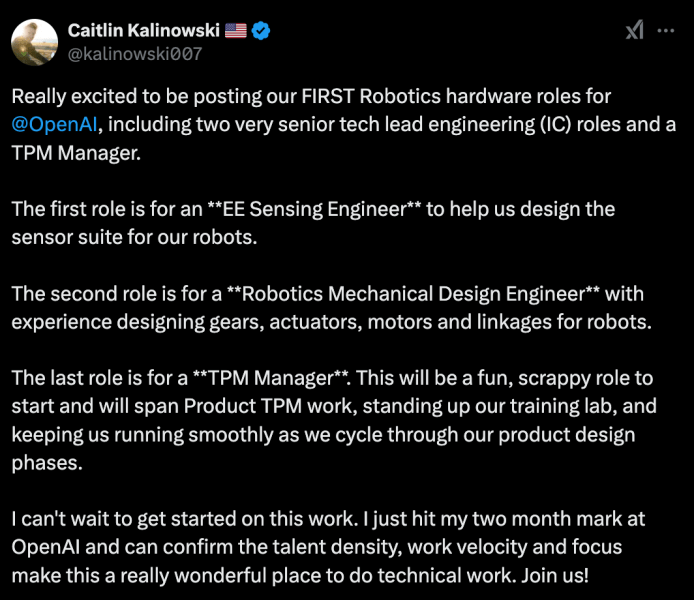
Join our daily and weekly newsletters for the latest updates and exclusive content on industry-leading AI coverage. Learn More OpenAI is best known for its AI models, which to date exist primarily on cloud servers, its website and in its apps for PCs and mobile devices. However, the company is not limiting its ambitions to the software realm: Today on X, Caitlin Kalinowski, a member of the technical staff at OpenAI and previously head of AR glasses at Meta, posted a message announcing that the firm is hiring its first hardware robotics roles. These include a systems integration electrical engineer “to help us the design sensor suite for our robots,” and a mechanical robotics product engineer to create “gears, actuators, motors and linkages for robots,” as well as a TPM manager on the robotics team “responsible for spearheading the logistics of our data-gathering lab, including ensuring contract workers have what they need to gather data from our test set-ups.” The listings also include a description of the new effort: “Our robotics team is focused on unlocking general-purpose robotics and pushing towards AG –level intelligence in dynamic, real-world settings. Working across the entire model stack, we integrate cutting-edge hardware and software to explore a broad range of robotic form factors. We strive to seamlessly blend high-level AI capabilities with the physical constraints of physical.“ Kalinowski herself announced her hiring at OpenAI a little more than two months ago “to lead robotics and consumer hardware.” Previously, OpenAI had reportedly been working on hardware with former Apple lead designer Jony Ive, and the company has partnered with robotics startup Figure to provide the models powering the latter’s humanoid robots. The new post from Kalinowski and job listings signal the company’s most serious and heaviest investment in building out its own robotics division to date, and could ultimately mean it competes with Figure. It wouldn’t be a new spot for OpenAI to be in, though, given it is also competing with and taking investment money from Microsoft. Read Kalinowski’s full post below: source

OpenAI has begun building out its robotics team Read More »

2025: The Digital Banking Landscape Is Poised For Another Transformative Year

In today’s rapidly changing financial landscape, providing an excellent digital experience is essential to gaining a customer experience-driven competitive edge. As we step into 2025, digital technologies will continue to shape and transform banking experiences. Now is the time to take the pulse of and fine-tune your strategy and actions! Customers Expect Nothing Less Than Great Digital Experiences Our latest report, The State Of Digital Experiences In Banking, 2025 (client-only access), highlights that consumers’ behaviors, preferences, and expectations keep evolving as digital touchpoints proliferate. In 2024, most banking customers used mobile banking apps as their primary channel to engage with their bank. And according to Forrester data, in 2024, 73% of online adults in Australia, 68% in the UK, and 65% in the US agreed that they should be able to accomplish any financial task through a mobile app. While customers are shifting en masse to digital, they still expect consistency and seamless interactions with their banks across an ever-wider range of channels and touchpoints. They value connected experiences that blend human and digital elements. They also expect their banks to deliver convenient and personalized experiences that help them perform regular banking tasks, access customer service, and achieve financial goals. Digital Banking Experiences Are Becoming Increasingly Humanlike, Connected, And Empowering Looking ahead, the report examines how leading organizations embrace emerging technology to enhance and transform digital experiences — setting the stage for the future of digital interactions. As revealed by our Digital Experience Review™, leading banks already combine broad functionality with strong user experience to deliver on ease of use and effectiveness in their digital channels and help customers achieve better outcomes. Competing for primacy, the savviest are keen to foster deeper and more meaningful engagement with their customers. They’re now increasingly focused on designing experiences that drive emotional engagement, and the most innovative organizations leverage emerging technologies and invest in modern architectures, systems, and capabilities to elevate their digital experiences. As a result, digital banking experiences are becoming increasingly: Humanlike. As banking customers gravitate to digital touchpoints, banks understand the critical need to deliver an exceptional user experience. They aim to minimize friction, reduce cognitive load, and simplify tasks. Additionally, the most innovative banks are exploring AI-powered interfaces to make digital interactions more natural and engaging. As a result, digital banking experiences are becoming more conversational, intuitive, and humanlike. Anticipate conversational banking to take off in 2025! Connected. To meet the needs and deliver the financial outcomes of the “always on” customer, banks must maintain a real-time, comprehensive view of their customers. They need to provide consistent, seamless, and context-rich experiences across various channels and touchpoints, embedding their products and services where customers need them most. APIs and open architectures facilitate integration, while AI and automation enhance efficiency. Consequently, digital banking experiences are becoming increasingly integrated and connected. In 2025, embedded finance will gain wider appeal. Empowering. To attract and retain customers while boosting trust and satisfaction, banks must show that they understand and can anticipate their customers’ unique financial needs. Leading banks leverage advanced technology, data, and analytics to develop a comprehensive view of customer behaviors, preferences, and intents. They optimize digital touchpoints based on customers’ context, preferred interaction modes, and activities. By engaging customers with highly personalized and relevant content and services at their moments of need, digital banking experiences are becoming more assistive, anticipatory, and agentive — ultimately becoming more empowering. We might expect a push toward autonomous finance in 2025. As you navigate the complexities of digital transformation, read our report, The State Of Digital Experiences In Banking, 2025, to understand the current landscape of digital banking experiences and prepare for the future. Stay tuned for more reports as we continue to explore the future of digital experiences, and schedule a guidance session or inquiry if you want to explore the topic further. source

2025: The Digital Banking Landscape Is Poised For Another Transformative Year Read More »

Dutch startup lands €4.75M for unique appoach to photonic chip-making

Eindhoven-based startup Photon IP has raised €4.75mn in seed funding as it looks to scale up its unique method for creating energy-efficient photonic chips.   AI systems, data centres, fibre-optic networks, and even some sensors rely on photonic chips to send and receive information using light. These chips are a big deal because they’re faster and use less energy than typical semiconductors, which transfer data through electricity.  But to make these high-performance, light-speed chips you need special compounds called III-V materials, such as indium phosphide.  “These materials are relatively scarce and expensive though, so the industry has been looking at ways of using silicon, leveraging all the scale and capability from the world of electronics,” Photon’s CCO John Anderton told TNW. Showcase your startup at TNW Conference Get noticed. Build brand awareness. Connect with the industry players who can help turn your big idea into the next big thing. However, combining III-V materials with silicon on one single chip is, simply put, bloody difficult. That’s exactly where Photon has found an attractive market opportunity.   Founded in 2022, the startup has developed a way to integrate III-V materials and silicon onto a single chip that can handle light better, use less power, and be mass-produced for things like faster internet, smarter AI systems, and high-precision sensors.    “There are many companies making photonic chips, but the challenge is finding the best way to combine and integrate these materials onto a single chip,” said Anderton. “We bring to market a unique, revolutionary technology that allows us to deliver the lowest energy use and the best performance while being scalable.”  Photon is fabless, meaning it outsources the chipmaking to established manufacturers, who make the chips to the startup’s specifications. The commercial value lies in Photon’s secret sauce. Amsterdam-based deep tech VC Innovation Industries led Photon’s seed round, with participation from Faber and the Brabant Development Agency. The venture arm of PhotonDelta, a photonics industry body based in Eindhoven, was the fourth and final investor. Photon IP has already secured €2mn in grant funding from the European Innovation Council. Today’s seed round is its second injection of private equity, following a €1.1mn investment in 2022 led by Polish early-stage photonics investment firm Vigo Ventures.   Photon told TNW it will use the fresh funding to grow its team as it looks to announce its first photonic chip products later this year.  source

Dutch startup lands €4.75M for unique appoach to photonic chip-making Read More »

NPS: Most Industries Should Focus On Eliminating Detractors To Boost Growth

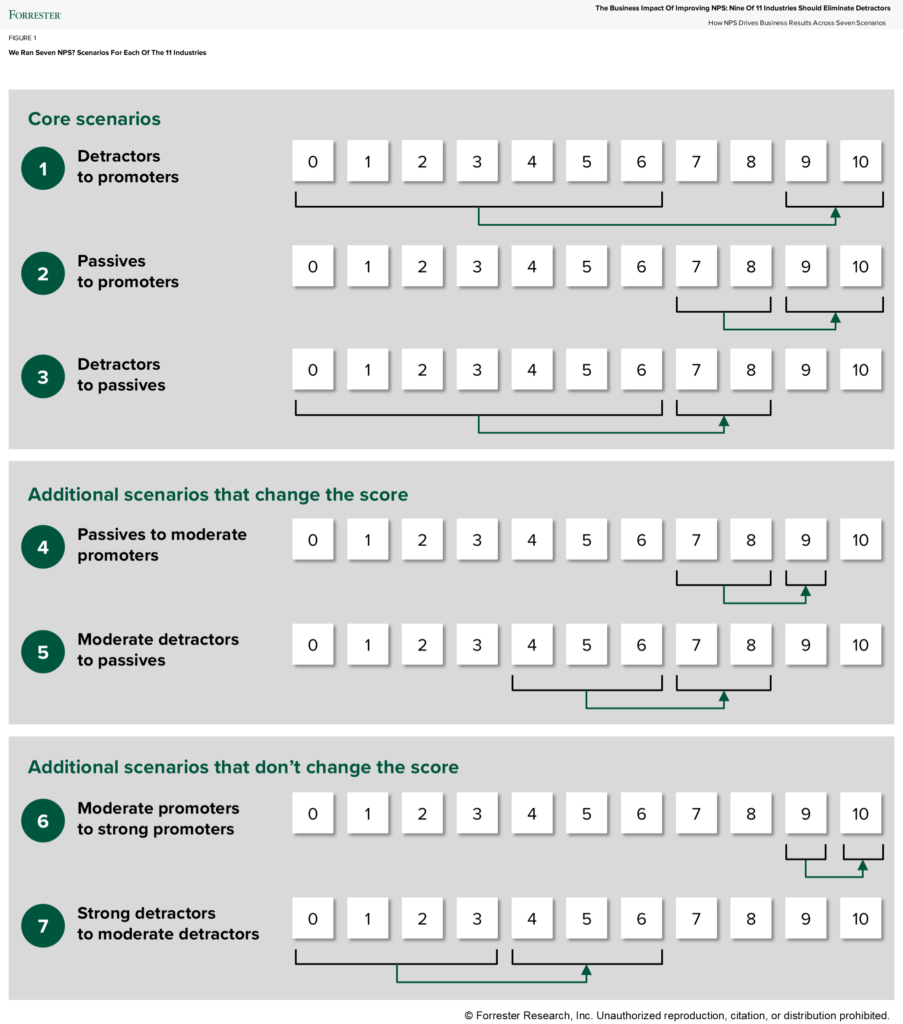
Are you a customer experience (CX) leader at a company using Net Promoter Score℠ (NPS)? Then you must be the most knowledgeable person on exactly how a change in NPS affects your organization’s key business metrics. Only then can you answer these critical questions: Where should you focus? Will you focus on CX improvements that remove pain points to reduce the number of detractors? Will you focus on designing new and differentiating experiences that may help you gain more promoters? Or both? Should you focus on turning strong detractors into moderate ones? How do you set better targets? How high should your NPS goal be? Have you reached a natural ceiling — aka, a higher goal isn’t worth it because the resulting lift in business metrics is negligible compared to the investments needed to achieve it? Should you only set a goal for the score itself, or do you need more granular targets (for example, for the share of promoters or detractors)? Our Monetary-Impact Calculator Models Seven Scenarios Of How NPS Drives Growth To help you do that, we just published The Business Impact Of Improving NPS: Nine Of 11 Industries Should Eliminate Detractors. For more info on the methodology, scroll down to the end. The report shows the detailed results of our analysis into how NPS drives business growth in seven scenarios. Five of those scenarios change the score and two of them don’t (the below graphic shows the scenarios). In our analysis, we: Derived a revenue potential for each customer. We combined NPS data and data on behavior intentions across 2022–2024 from our Customer Experience Benchmark Surveys with external data. Using that, we derived a revenue potential for each customer for all industries. The exception is investment firms, for which we modeled an assets-under-management potential. Calculated an average revenue potential for NPS categories and subcategories. Using our revenue potential numbers, we calculated an average revenue for the NPS categories (promoters, passives, and detractors). We then did the same for NPS subcategories (strong and moderate detractors, and strong and moderate promoters). Calculated a baseline revenue for each industry. For each industry, we multiplied the current share of customers per NPS (sub)category with the revenue potential of a customer in that (sub)category. Calculated the incremental growth in each industry by scenario. For each industry, we calculated how the scenario changes the share of customers in the NPS (sub)category, then multiplied that with the revenue potential of a customer in the respective (sub)category.   Most Industries Should Focus On Eliminating Detractors The good news is that in all industries, promoters spend more than detractors. If that wasn’t the case for your organization, telling your story will be harder. Other key results are: When comparing the main scenarios 1–3, most industries get a higher benefit from turning detractors into passives. The exception are airlines and investment firms, which benefit more from moving passives to promoters. When looking at other scenarios, in two industries, moving strong detractors to moderate ones (scenario 7) is most attractive. And for a specific industry, such as multichannel banking, scenario 3 (detractors to passives) is most attractive. Scenario 6 (turning moderate promoters into strong ones) is the least attractive. Apply This NPS Analysis To Your Own Business Start right now and: Analyze your own data. Complete this analysis for your own customers, using your own data for two reasons: 1) Our models are created at the industry level and individual brands’ models may differ from those and 2) using your company’s data will secure more buy-in internally. Set better targets and prioritize improvements. Socialize your insights, then kick-start internal discussions on setting more differentiated targets, and direct any driver analyses you do on those customer groups that you want to move. For details about our methodology, where the data comes from, and our calculations, see our report, How Customer Experience Drives Business Growth, 2024. source

NPS: Most Industries Should Focus On Eliminating Detractors To Boost Growth Read More »

皇玥攜手海洋公園推出熊貓系列禮品

主禮嘉賓(左起)皇玥董事長及首席執行官嚴運波博士、香港海洋公園行政總裁黃嗣輝先生。 隨著「熊貓經濟」被寫入新一份《施政報告》,近來本港不同界別均借助六隻大熊貓推動香港文化旅遊,盈盈、樂樂及牠們的新生龍鳳 胎寶寶,連同早前中央政府送贈本港的兩隻大熊貓安安和可可,大熊貓文化效應持續升溫!六隻大熊貓在香港落地生根,開枝散葉,既有象徵意義,也可產生實際效果。政府落實推動「熊貓經濟」吸引更多旅客訪港,勢為香港旅遊業、零售業及飲食業帶來正面影響。 雙品牌優勢全球銷售助推香港旅遊 皇玥控股創辦人兼董事長嚴運波博士表示,是次聯乘產品將會出口至全球:「今次是皇玥首次的跨界合作,其實之前曾經有不少品牌聯絡我們作聯乘,我們都不作考慮,但今次正因海洋公園是香港品牌,在全球已有很高知名度,而 且本身園區已有一定人流,聯乘 IP 又是熊貓,是本身皇玥也是紮根香港,100%香港製造的香港品牌,今次的合作絕對是天作之合!」皇玥預計,該系列將推動品牌年度銷售增長 20-30%。   「皇玥 x 熊貓」系列產品除了在海洋公園全新門店、紀念品店有售之外,皇玥全線 40 多間門店均會有售。鷹君集團於 2022 年入股皇玥,已幫皇玥走進全世界不同國家,而是次「皇玥 x 熊貓」系列同樣會出口至全球不同國家,向全世界推廣熊貓特色,除了讓外國旅客感受到「香港製造」的優良品質,也讓更多旅客認識香港海洋公園,從而增加更多人流。除產品推廣之外,皇玥也會將部分收益捐作慈善保育用途,整個合作都是意義非凡!熊貓系列產品首批目標出口市場包括歐盟、美國、加拿大、東南亞等地區。」 嚴博士續指:「皇玥未來的發展同樣是放眼全球,將來希望以發展海外門店為主,想將『香港製造』這個金漆招牌,靠著今次與海洋公園的聯乘,推廣至歐盟、美國、加拿大、東南亞等地區;同時,我們也致力將皇玥打造成香港手信品牌,尤其借助是次熊貓聯乘,更能讓外國旅客都知道皇玥不論在產品品質、包裝、設計都是上乘的。」  100%香港製造 在近年全球經濟不景氣的情況下,本港零售業、旅遊業持續疲弱,嚴博士表示短期內或會繼續受影響,但展望樂觀:「短期零售業應該會持續疲弱,以前旅客來港都會消費,現在主要是文化遊。就著這個改變和趨勢,相信也是海洋公園找我們合作的主要原因,因為熊貓產品本身就是文化產品,旅客會非常願意購買作為 手信和紀念品。而長期來說,經濟屬於周期性,我相信不久將來便會復甦。」 皇玥集團一直堅持出品高質餅食,堅持 100%香港製造,以時尚包裝傳統工藝,嚴博士強調:「皇玥不會因經濟下行而降低品質,不論經濟好壞我們都是這樣堅持,初衷從來不變。對我來說,品牌定位和價值是不受經濟影響的。」 「皇玥 x 熊貓」是次推出的產品定價親民,零售價港幣$100 以下的產品有超過 20 款,配合高質的餅食、實用的包裝和熊貓可愛的設計,性價比極高,對於旅客甚至香港人都有一定吸引力,嚴博士有信心能提升整體購買力。 LinkedIn Email Facebook Twitter WhatsApp The post 皇玥攜手海洋公園推出熊貓系列禮品 appeared first on VeriMedia. source

皇玥攜手海洋公園推出熊貓系列禮品 Read More »

New Payroll Compliance Penalties Driving Tech Adoption in Australia, Says Yellow Canary

A new survey by payroll tech firm Yellow Canary found that just 22% of Australian businesses have adopted proactive payroll compliance technology. Still, more may follow as they seek to reduce the legal and business risk of underpaying employees. Intentional employee underpayments were made a criminal offense on Jan. 5 following amendments to Australia’s Fair Work legislation, with individuals and businesses now potentially liable. While unintentional mistakes will not attract criminal penalties, Yellow Canary estimates underpayments represent between 1% and 3% of total headcount costs across the market. The Yellow Canary survey of 533 compliance leaders in Australia found the rising risk around underpayments is driving more tech buyers toward proactive payroll compliance tools: 23% plan to adopt technologies in the next one to two years. 21% of businesses plan to implement these tools in the next 12 months. 17% said they were satisfied with manual compliance processes. 15% were curious about more proactive payroll technologies but had no plans to implement them. “The introduction of the Closing Loopholes Acts, including the criminalisation of wage theft, marks a pivotal moment for Australian businesses,” Yellow Canary Managing Director Marcus Zeltzer said in the report. “Our research reveals while many businesses are making payroll compliance a top priority, a significant number are still relying on flawed manual processes or have not conducted thorough reviews.” SEE: Best practices for maintaining payroll compliance Payroll teams are concerned they are not paying staff correctly Almost half (48%) of those surveyed by research house Lonegran Research on behalf of Yellow Canary said they had been making payroll compliance a top priority ahead of the Closing Loopholes law. However, 93% of local businesses with at least 50 employees still said they had at least one area of concern regarding potential employee underpayments in their organisation as the law came into force. Additionally, 17% expressed general uncertainty about whether they were paying their staff correctly, while 19% suspect an actual underpayment issue may exist but have not confirmed it. Several key drivers of payroll underpayment concerns were identified in the research report: 39% of respondents had concerns with staying current with legislation and obligations, demonstrating the complexity of remaining compliant in an evolving regulatory environment. 37% cited concerns around a lack of internal communication, noting that collaboration and information flow across departments reduce errors and inconsistencies in payroll processes. A further 32% had concerns with time and resource constraints for payroll audits and historical reviews. Meanwhile, the reliability of payroll software in ensuring compliance was a concern for 31%, as was aligning rostering or time and attendance processes, which are often managed through system integrations. SEE: 8 best payroll software for Australian Businesses Only 7% of respondents said there are no areas of concern regarding potential underpayments. However, Yellow Canary said it was unclear if this reflected genuine assurance or lack of awareness, given it had found some non-compliance in 100% of clients in its work reviewing $70 billion in wages. More Australia coverage Proactive compliance and AI could improve payroll scorecard Australia has experienced widespread problems with underpayments — affecting large private and public sector organisations — in many cases due to Australia’s complex system of payment awards. The Yellow Canary report found many employers still rely on “less reliable” methods: 31% still conduct manual audits with spreadsheets. 32% review pay code configurations. 37% use sampling for payroll checks. SEE: A step-by-step guide to doing payroll (the right way) “While businesses may feel confident in their manual methods, these processes are flawed, prone to error, limited in scalability, and unable to keep up with the increasing complexity of compliance,” the report said. Adopting proactive payroll compliance technologies is expected to help reduce the problem by replacing more manual review processes with regular tech-supported audits of workforce payroll data. The incorporation of AI could support these efforts — but some businesses remain skeptical More than half (59%) of Australian businesses with 50 or more employees are optimistic about the potential of introducing artificial intelligence into their payroll compliance frameworks in the future. AI is not yet commonly used in payroll compliance in Australia, but the report said that the evolution of technology shows “great potential for being integrated into existing processes.” For instance, AI can be used to analyse payroll data patterns, and identify anomalies — such as incorrect pay codes, underpaid employees, or misclassifications — to provide payroll teams with real-time insights. However, 27% of respondents remain either skeptical of AI’s ability to improve payroll compliance or believe AI will introduce more challenges and complicate payroll processes in the future. “Businesses must navigate challenges such as integration issues, data privacy concerns, and resistance to change before widespread adoption [of AI],” the report said. source

New Payroll Compliance Penalties Driving Tech Adoption in Australia, Says Yellow Canary Read More »

The dirty little secret of ‘quick win’ IT

We all have them. By “we” I mean we process optimization consultants, and by “them” I mean our pithy and entertaining stories of how, with little more than a nudge, wink, or perceptive squint, we were able to double a client’s throughput while cutting their process cycle time and marginal costs in half, all the while reducing defects along the way. My personal favorite entailed getting a client team to stop gumming up the works. It turned out they were getting their work done by misusing one of their company’s ERP modules, thereby polluting the ERP database. We had IT train them in the use of a different module instead — one that was designed to support the exact process they wanted. Problem solved, for not enough effort to even bother billing the client for our time. The purpose of triumphant process stories like these is to instill a perception that we can find examples just like them in a client’s operations, slaying that client’s inefficiency dragons without even breathing hard — especially but not limited to the legendary “Anything not worth doing isn’t worth improving” opportunities. source

The dirty little secret of ‘quick win’ IT Read More »

Meta retreats from fact-checking content: what it means for businesses

Join our daily and weekly newsletters for the latest updates and exclusive content on industry-leading AI coverage. Learn More Facebook creator and Meta CEO Mark “Zuck” Zuckerberg shook the world again today when he announced sweeping changes to the way his company moderates and handles user-generated posts and content in the U.S. Citing the “recent elections” as a “cultural tipping point,” Zuck explained in a roughly five-minute-long video posted to his Facebook and Instagram accounts this morning (Tuesday, January 7) that Meta would cease using independent third-party fact checkers and fact-checking organizations to help moderate and append notes to user posts shared across the company’s suite of social networking and messaging apps, including Facebook, Instagram, WhatsApp and Threads. Instead, Zuck said that Meta would rely on a “Community Notes” style approach, crowdsourcing information from the users across Meta’s apps to give context and veracity to posts, similar to (and Zuck acknowledged this in his video) the rival social network X (formerly Twitter). Zuck cast the changes as a return to Facebook’s “roots” in free expression, and a reduction in over-broad “censorship.” See the full transcript of his remarks at the bottom of this article. Why this policy change matters to businesses With more than 3 billion users across its services and products worldwide, Meta remains the largest social network to date. In addition, as of 2022, more than 200 million businesses worldwide, most of them small, used the company’s apps and services — and 10 million were active paying advertisers on the platform, according to one executive. Meta’s new chief global affairs officer Joe Kaplan, a former deputy chief of staff for Republican President George W. Bush — who recently took on the role in what many viewed as a signal to lawmakers and the wider world of Meta’s willingness to work with the GOP-led Congress and White House following the 2024 election — also published a note to Meta’s corporate website describing some of the changes in greater detail. Already, some business executives such as Shopify’s CEO Tobi Lutke have seemingly embraced the announcement. As Lutke wrote on X today: “Huge and important change.” Founders Fund chief marketing officer and tech influencer Mike Solana also hailed the move, writing in a post on X: “There’s already been a dramatic decrease in censorship across the [M]eta platforms. but a public statement of this kind plainly speaking truth (the “fact checkers” were biased, and the policy was immoral) is really and finally the end of a golden age for the worst people alive.” However, others are less optimistic and receptive to the changes, viewing them as less about freedom of expression, and more about currying favor with the incoming administration of President-elect Donald J. Trump (to his second non-consecutive term) and the GOP-led Congress, as other business executives and firms have seemingly moved to do. “More free expression on social media is a good thing,” wrote the nonprofit Freedom of the Press Foundation on the social network BlueSky (disclosure: my wife is a board member of the non-profit). “But based on Meta’s track record, it seems more likely that this is about sucking up to Donald Trump than it is about free speech.” George Washington University political communication professor Dave Karpf seemed to agree, writing on BlueSky: “Two salient facts about Facebook replacing its fact-checking program with community notes: (1) community notes are cheaper. (2) the incoming political regime dislikes fact-checking. So community notes are less trouble. The rest is just framing. Zuck’s sole principle is to do what’s best for Zuck.” And Kate Starbird, professor at the University of Washington and cofounder of the UW Center for an Informed Public, wrote on BlueSky that: “Meta is dropping its support for fact-checking, which, in addition to degrading users’ ability to verify content, will essentially defund all of the little companies that worked to identify false content online. But our FB feeds are basically just AI slop at this point, so?” Reached by email, Damian Rollison, Director of Market Insights at AI marketing firm SOCi, also noted that Zuck and Meta appeared by emulating a more libertine approach toward online content moderation championed by X owner Elon Musk: “I think it’s safe to say that no one predicted Elon Musk’s chaotic takeover of Twitter would become a trend other tech platforms would follow, and yet here we are. We can see now in retrospect that Musk established a standard for a newly conservative approach to the loosening of online content moderation, one that Meta has now embraced in advance of the incoming Trump administration. What this will likely mean is that Facebook and Instagram will see a spike in political speech and posts on controversial topics. As with Musk’s X, where ad revenues are down by half, this change may make the platform less attractive to advertisers. It may also cement a trend whereby Facebook is becoming the social network for older, more conservative users and ceding Gen Z to TikTok, with Instagram occupying a middle ground between them.” When will the changes take place? Both Zuck and Kaplan stated in their respective video and text posts that the changes to Meta’s content moderation policies and practices would be coming to the U.S. in “the next couple of months.” Meta will discontinue its independent fact-checking program in the United States, launched in 2016, in favor of a community notes model inspired by X (formerly Twitter). This system will rely on users to write and rate notes, requiring agreement across diverse perspectives to ensure balance and prevent bias. According to its website, Meta had been working with a variety of organizations “certified through the non-partisan International Fact-Checking Network (IFCN) or European Fact-Checking Standards Network (EFCSN) to identify, review and take action” on content deemed “misinformation.” However, as Zuck opined in his video post, “after Trump first got elected in 2016 the legacy media wrote non-stop about how misinformation was a threat to democracy. We tried, in good faith, to address those concerns without becoming the arbiters of

Meta retreats from fact-checking content: what it means for businesses Read More »

How Nationwide Building Society Upgraded Its Marketing Mix Model

Nationwide Building Society (Nationwide), one of the largest insurance and financial services providers in the US, offers a diverse portfolio of products and services to both consumers and businesses. Because most sales are generated through intermediaries, Nationwide has employed marketing mix modeling (MMM) to measure marketing performance for nearly a decade. The company recently overhauled its approach, starting with the decision to centralize marketing measurement within its newly established marketing operations team. A New Marketing Operations Team Made MMM A Well-Oiled Machine In 2021, disconnected data sources, limited modeling capabilities, vague reporting, and immature tech hampered Nationwide’s MMM. To address these issues, marketing leadership established a marketing operations team to manage the data, processes, and technology related to marketing measurement. The team’s first order of business was developing a data strategy that: Centralized responsibility. Marketing ops took on responsibility for aggregating and preparing data for the model and reporting the findings. This meant the team needed robust tech that mitigated discrepancies and increased operational efficiencies. The team established the marketing data hub, a collection of technologies that automate the ingestion, curation, and sharing of data with internal stakeholders and external partners. Improved data validation and standardization. Marketing ops implemented two key initiatives that improved cross-functional collaboration and credibility of the model’s results. The team now validates the data with subject-matter experts across business lines and marketing teams before it enters the model, and a formalized marketing data taxonomy was created that is used by all Nationwide marketing employees, tech providers, and agencies. Outsourced the modeling to an expert. Nationwide had experience with in-house modeling but wanted to capitalize on advancing methodologies. The team selected Ipsos MMA for its granular measurement methodology, cookieless approach to attribution and modeling, and ability to incorporate brand-health tracking into the model. Since implementing these changes, Nationwide has improved its measurement of marketing activities, its ability to quantify the impact of brand campaigns, and expanded participation in MMM from other business lines. You can find the full details in our recently published case study (client access only), sourced from interviews with Nationwide and Ipsos MMA. To learn more about the case study, request a guidance session. For other questions about B2C marketing measurement, schedule time with Brad Haag, our new measurement analyst. source

How Nationwide Building Society Upgraded Its Marketing Mix Model Read More »

CIO Leadership Live Middle East with Shumon Zaman, Chief Information and Digital Officer at Ali&Sons

Overview In this episode, we sit down with Shumon Zaman, the Chief Information and Digital Officer at Ali&Sons, to explore the most significant technological advancements and trends shaping 2025. Zaman shares his insights on the evolving landscape of AI, machine learning, 5G, and cloud computing, particularly within the Middle East. As industries in the region continue to embrace digital transformation, he highlights standout applications and opportunities while discussing the challenges businesses may face in the coming years. Register Now source

CIO Leadership Live Middle East with Shumon Zaman, Chief Information and Digital Officer at Ali&Sons Read More »