In the future, we will all manage our own AI agents

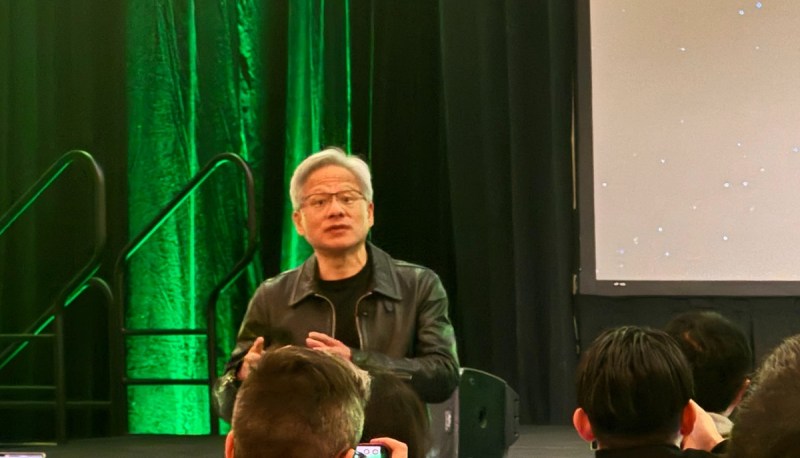
Join our daily and weekly newsletters for the latest updates and exclusive content on industry-leading AI coverage. Learn More Jensen Huang, CEO of Nvidia, gave an eye-opening keynote talk at CES 2025 last week. It was highly appropriate, as Huang’s favorite subject of artificial intelligence has exploded across the world and Nvidia has, by extension, become one of the most valuable companies in the world. Apple recently passed Nvidia with a market capitalization of $3.58 trillion, compared to Nvidia’s $3.33 trillion. The company is celebrating the 25th year of its GeForce graphics chip business and it has been a long time since I did the first interview with Huang back in 1996, when we talked about graphics chips for a “Windows accelerator.” Back then, Nvidia was one of 80 3D graphics chip makers. Now it’s one of around three or so survivors. And it has made a huge pivot from graphics to AI. Huang hasn’t changed much. For the keynote, Huang announced a video game graphics card, the Nvidia GeForce RTX 50 Series, but there were a dozen AI-focused announcements about how Nvidia is creating the blueprints and platforms to make it easy to train robots for the physical world. In fact, in a feature dubbed DLSS 4, Nvidia is now using AI to make its graphics chip frame rates better. And there are technologies like Cosmos, which helps robot developers use synthetic data to train their robots. A few of these Nvidia announcements were among my 13 favorite things at CES. After the keynote, Huang held a free-wheeling Q&A with the press at the Fountainbleau hotel in Las Vegas. At first, he engaged with a hilarious discussion with the audio-visual team in the room about the sound quality, as he couldn’t hear questions up on stage. So he came down among the press and, after teasing the AV team guy named Sebastian, he answered all of our questions, and he even took a selfie with me. Then he took a bunch of questions from financial analysts. I was struck at how technical Huang’s command of AI was during the keynote, but it reminded me more of a Siggraph technology conference than a keynote speech for consumers at CES. I asked him about that and you can see his answer below. I’ve included the whole Q&A from all of the press in the room. Here’s an edited transcript of the press Q&A. Jensen Huang, CEO of Nvidia, at CES 2025 press Q&A. Question: Last year you defined a new unit of compute, the data center. Starting with the building and working down. You’ve done everything all the way up to the system now. Is it time for Nvidia to start thinking about infrastructure, power, and the rest of the pieces that go into that system? Jensen Huang: As a rule, Nvidia–we only work on things that other people do not, or that we can do singularly better. That’s why we’re not in that many businesses. The reason why we do what we do, if we didn’t build NVLink72, who would have? Who could have? If we didn’t build the type of switches like Spectrum-X, this ethernet switch that has the benefits of InfiniBand, who could have? Who would have? We want our company to be relatively small. We’re only 30-some-odd thousand people. We’re still a small company. We want to make sure our resources are highly focused on areas where we can make a unique contribution. We work up and down the supply chain now. We work with power delivery and power conditioning, the people who are doing that, cooling and so on. We try to work up and down the supply chain to get people ready for these AI solutions that are coming. Hyperscale was about 10 kilowatts per rack. Hopper is 40 to 50 to 60 kilowatts per rack. Now Blackwell is about 120 kilowatts per rack. My sense is that that will continue to go up. We want it to go up because power density is a good thing. We’d rather have computers that are dense and close by than computers that are disaggregated and spread out all over the place. Density is good. We’re going to see that power density go up. We’ll do a lot better cooling inside and outside the data center, much more sustainable. There’s a whole bunch of work to be done. We try not to do things that we don’t have to. HP EliteBook Ultra G1i 14-inch notebook next-gen AI PC. Question: You made a lot of announcements about AI PCs last night. Adoption of those hasn’t taken off yet. What’s holding that back? Do you think Nvidia can help change that? Huang: AI started the cloud and was created for the cloud. If you look at all of Nvidia’s growth in the last several years, it’s been the cloud, because it takes AI supercomputers to train the models. These models are fairly large. It’s easy to deploy them in the cloud. They’re called endpoints, as you know. We think that there are still designers, software engineers, creatives, and enthusiasts who’d like to use their PCs for all these things. One challenge is that because AI is in the cloud, and there’s so much energy and movement in the cloud, there are still very few people developing AI for Windows. It turns out that the Windows PC is perfectly adapted to AI. There’s this thing called WSL2. WSL2 is a virtual machine, a second operating system, Linux-based, that sits inside Windows. WSL2 was created to be essentially cloud-native. It supports Docker containers. It has perfect support for CUDA. We’re going to take the AI technology we’re creating for the cloud and now, by making sure that WSL2 can support it, we can bring the cloud down to the PC. I think that’s the right answer. I’m excited about it. All the PC OEMs are excited about it. We’ll get all these PCs ready with Windows and WSL2. All the energy

In the future, we will all manage our own AI agents Read More »

Circular seeks redemption with new smart ring that could outshine Oura

French upstart Circular has unveiled a fresh challenge to Oura — the current lord of the smart rings. Circular has just released a new smart ring that offers two key advantages over Oura, which currently dominates the global market for the trendy wearables, which monitor your health metrics and display the info on an app.      Dubbed the Circular Ring 2, it’s a quantum leap forward from its predecessor, the Circular Slim, which The Verge described as a product that held “a lot of promise” but executed on “almost none of it.” Firstly, Circular has swapped the plastic shell in the old ring for titanium which is available in four finishes: black, silver, gold, and rose gold. The ring’s sensors have been given a complete overhaul, resulting in more accurate readings, the company said.  The 💜 of EU tech The latest rumblings from the EU tech scene, a story from our wise ol’ founder Boris, and some questionable AI art. It’s free, every week, in your inbox. Sign up now! Circular has also scrapped the USB charger for a wireless charging dock. The Ring 2’s battery life lasts up to an impressive eight days, one more day than the Oura Ring. However, the main innovation — a first for smart rings — is the addition of an FDA-cleared atrial fibrillation (AFib) sensor that reads the electrical activity of your heart, including the rate and rhythm.  As a result, Circular goes on to call its new ring a “discreet heart health companion.” It’s a bit cheesy, but the AFib sensor could provide a warning of an incoming stroke or heart attack — so the tagline has some substance.   Circular has also introduced a potentially game-changing digital sizing process. Instead of having to purchase a physical sizing kit prior to buying a smart ring, Circular allows you to measure your finger directly from your phone.  “This isn’t just a wearable,” said Amaury Kosman, Circular’s co-founder and CEO. “It’s a statement piece that empowers our users to take control of their wellness without compromising on style.” While the Ring 2 is a complete upgrade, the company has done away with a haptic motor that served as a vibrating alarm clock in the first iteration.   The Circular Ring 2 is expected to launch via a crowd-funding campaign in mid-to-late January before shipping in March with a starting price of $380. That’s a bit pricier than the Oura Ring 4 ($349). However, unlike Oura’s, the Circular ring is available subscription-free. While Circular’s new smart ring sounds great on paper, it remains to be seen whether it can pull it off and produce reliable devices at scale. If it does prove a success, that won’t necessarily be a bad thing for Oura though. The Finnish company receives a royalty fee for all Circular rings sold in the US, based on a multi-year patent infringement agreement signed last year. Ouch. source

Circular seeks redemption with new smart ring that could outshine Oura Read More »

Building an AI Council to Drive the 2025 Tech Revolution

Gartner recently shared that AI is the No. 1 technology that CEOs believe will significantly impact their industries within the next three years. However, as enterprise leaders have realized by now, turning AI’s promise into measurable outcomes requires more than technology — it demands aligned strategies, governance, and scalable operating models. AI councils have emerged as essential tools for enterprises to harness the full potential of this evolving technology, ensuring investments align with business goals and deliver tangible results.   AI Councils: Essential for ROI   AI initiatives can quickly become fragmented and ineffective without strategic coordination. In fact, Gartner revealed in its report that 49% of leaders note challenges scaling AI due to scattered approaches. This is where AI councils come into play. Acting as central hubs, these councils streamline efforts by unifying AI investments, helping enterprises move beyond experimental projects to scalable strategies that deliver measurable outcomes. For example, AI councils bridge insights across departments, from pre-sales to customer support, while establishing governance and literacy.   At the heart of AI transformation are CIOs, making them uniquely positioned to guide their organizations through an AI council approach. No longer confined to the traditional IT role, today’s CIOs are stepping forward as leaders of business transformation and revenue growth. With comprehensive access to enterprise data and systems, CIOs can align current AI initiatives with business goals and position this technology as a competitive differentiator and growth enabler.    Related:Why So Many Customer Experiences Are Mediocre at Best Establishing an AI Council   To effectively establish an AI council, business leaders must consider these three elements:   1. Identify stakeholders: Bring together leaders from cross-functional teams to ensure diverse perspectives and enterprise-wide alignment.   2. Set objectives and KPIs: Define clear, measurable goals for AI initiatives to track progress and demonstrate value.   3. Align strategies: Gartner emphasizes the importance of synchronizing AI strategies with IT and data and analytics plans to maximize synergy and streamline implementation.   Strategic Questions Every AI Council Should Address   A foundational aspect of an effective AI council is its ability to frame and address the right questions — those that maximize the impact of AI initiatives across an organization. By doing so, the council provides clarity, alignment, and actionable insights to guide strategic decisions.   Related:Tech Company Layoffs: The COVID Tech Bubble Bursts Questions serve as a unifying thread, connecting diverse roles, technologies, and objectives. They ensure that every AI-related initiative contributes to broader organizational goals. In my own experience with AI councils, these questions have been instrumental in guiding successful outcomes.   For instance, my enterprise’s AI council was established with a clear purpose: to act as a cohesive force across various roles, connecting experiments, pilots, proofs of concept, and broader investments in AI. This focus has helped the council provide meaningful answers to questions such as:   How can customer support teams leverage insights from pre-sales calls to enhance service and outcomes?   How do we create a through-line across go-to-market (GTM) roles to avoid isolated productivity improvements and foster collective advancement?   How can we extract maximum value from existing technologies within the enterprise tech stack?   Is there a consolidation opportunity, such as adopting a single tool or shared technologies, to enhance collaboration and efficiency across teams?   By addressing these questions, the AI council not only found impactful solutions but also surfaced additional questions that needed to be asked — ensuring a continuous cycle of refinement and innovation.   Related:Addressing the Skills Gap to Keep Up with the Evolution of the Cloud Measuring AI Outcomes and Driving ROI   Many organizations overestimate AI’s immediate potential, leading to challenges in scalability and implementation. For example, RAND recently shared that 80% of AI projects are failing. Insufficient training data, a focus on cutting-edge technology over user needs, inadequate infrastructure for deployment, and applying AI to problems beyond its current capabilities, are shared as common barriers to successful AI implementation.  AI councils enable enterprises to avoid common AI integration pitfalls like technology overhype by helping leaders focus on the impact of AI on business-critical objectives rather than the appeal of the technology itself. A successful AI council will track technology metrics such as: time saved on revenue-critical tasks, improved customer engagement, and cost savings. Gartner also recommends developing KPIs tied directly to business priorities for clearer impact evaluation.   The Future of AI Councils: A Strategic Imperative   As CIOs and enterprise leaders take on the challenge of scaling AI, the importance of a well-structured AI council cannot be overstated. It’s a strategic imperative, not just a tactical tool. By focusing on measurable impact, ensuring alignment across roles, and embracing a continuous cycle of refinement, AI councils position organizations to thrive in an AI-driven future.   source

Building an AI Council to Drive the 2025 Tech Revolution Read More »

How Trump 2.0 May Change Business In Latin America

By Matteson Ellis ( January 9, 2025, 5:52 PM EST) — Latin America stands to be central to the upcoming Trump administration’s foreign policy. Issues like unauthorized immigration, illicit drug trade, organized crime, bringing jobs back to the U.S. and China’s influence in the region seem dear to President-elect Donald Trump’s heart…. Law360 is on it, so you are, too. A Law360 subscription puts you at the center of fast-moving legal issues, trends and developments so you can act with speed and confidence. Over 200 articles are published daily across more than 60 topics, industries, practice areas and jurisdictions. A Law360 subscription includes features such as Daily newsletters Expert analysis Mobile app Advanced search Judge information Real-time alerts 450K+ searchable archived articles And more! Experience Law360 today with a free 7-day trial. source

How Trump 2.0 May Change Business In Latin America Read More »

Microsoft’s new rStar-Math technique upgrades small models to outperform OpenAI’s o1-preview at math problems

Join our daily and weekly newsletters for the latest updates and exclusive content on industry-leading AI coverage. Learn More Microsoft is doubling down on the potential of small language models (SLMs) with the unveiling of rStar-Math, a new reasoning technique that can be applied to small models to boost their performance on math problems using reasoning techniques — performance similar to, and in some cases exceeding, that of OpenAI’s o1-preview model. While still in a research phase — as outlined in a paper published on pre-review site arXiv.org and credited to eight authors at Microsoft, Peking University and Tsinghua University in China — the technique was applied to several different smaller open-source models including Microsoft’s own Phi-3 mini, Alibaba’s Qwen-1.5B (a 1.5-billion-parameter model), and Qwen-7B (a 7-billion-parameter model). It showed improved performance on all of them, even exceeding OpenAI’s previously most advanced model at the MATH (word problem solving) third-party benchmark of 12,500 questions covering various branches such as geometry and algebra, and all levels of difficulty. Ultimately, according to a post on Hugging Face, the researchers plan to make their code and data available on Github at https://github.com/microsoft/rStar, though one of the paper’s authors, Li Lyna Zhang, wrote in the comments on the Hugging Face post that the team is “still undergoing the internal review process for open-source release.” As such, “the repository remains private for now. Please stay tuned!” Community members expressed enthusiasm, calling the innovations “impressive” and praising the blend of Monte Carlo Tree Search (MCTS) with step-by-step reasoning. One commenter highlighted the simplicity and utility of using Q-values for step scoring, while others speculated on future applications in geometric proofs and symbolic reasoning. This news follows closely on the heels of the open-sourcing of Microsoft’s Phi-4 model, a smaller 14-billion-parameter AI system now available on Hugging Face under the permissive MIT license. While the Phi-4 release has expanded access to high-performance small models, rStar-Math showcases a specialized approach: using smaller AI systems to achieve state-of-the-art results in mathematical reasoning. rStar-Math works by using several different models and components to help a target small model ‘self-evolve’ The key to rStar-Math is that it leverages Monte Carlo Tree Search (MCTS), a method that mimics human “deep thinking” by iteratively refining step-by-step solutions to mathematical problems. The researchers used MCTS because it “breaks down complex math problems into simpler single-step generation tasks, reducing the difficulty” for smaller models. However, they didn’t just apply MCTS as other researchers have done. Instead, in a stroke of brilliance, they also ask the model they trained to always output its “chain-of-thought” reasoning steps as both natural language descriptions and Python code. They mandated the model would include the natural language responses as Python code comments, and only those outputs using Python would be used to train the model. The researchers also trained a “policy model” to generate math reasoning steps and a process preference model (PPM) to select the most promising steps to solving the problems, and improved them both over four rounds of “self-evolution,” with each model improving the other. For their starting data, the researchers said they used “747,000 math word problems from publicly available sources,” along with their solutions, but generated new steps for solving them with the two models described above. Record-breaking results After four rounds of self-evolution, rStar-Math achieved significant milestones: • On the MATH benchmark, the accuracy of the Qwen2.5-Math-7B model jumped from 58.8% to 90.0%, outperforming OpenAI o1-preview. • On the American Invitational Mathematics Examination (AIME), it solved 53.3% of problems, placing among the top 20% of high school competitors. These results highlight the power of SLMs in handling complex mathematical reasoning, traditionally dominated by larger systems. Smaller is better? In recent years, AI innovation has largely been driven by scaling up language models, with increasing parameters seen as a way to improve performance. Yet, the high costs associated with these massive models, from computational resources to energy consumption, have raised questions about scalability. Microsoft is offering an alternative path, focusing on efficiency. The release of rStar-Math further underscores this commitment by demonstrating how SLMs can rival — and in some cases exceed — the capabilities of their larger counterparts. Microsoft’s dual releases of Phi-4 and the rStar-Math paper suggest that compact, specialized models can provide powerful alternatives to the industry’s largest systems. Moreover, by outperforming larger competitors in key benchmarks, these models challenge the notion that bigger is always better. They open doors for mid-sized organizations and academic researchers to access cutting-edge capabilities without the financial or environmental burden of massive models. source

Microsoft’s new rStar-Math technique upgrades small models to outperform OpenAI’s o1-preview at math problems Read More »

5 Privacy Law Trends That Will Continue In 2025

By Liisa Thomas and Kathryn Smith ( January 9, 2025, 11:43 AM EST) — Much changed in the world in 2024. That holds true for privacy developments as well. We expect several developments from 2024 to carry over into 2025, and we outline five in this article: namely, developments in the realm of artificial intelligence, passive data collection, combining data from multiple sources, privacy program expectations, and managing vendors…. Law360 is on it, so you are, too. A Law360 subscription puts you at the center of fast-moving legal issues, trends and developments so you can act with speed and confidence. Over 200 articles are published daily across more than 60 topics, industries, practice areas and jurisdictions. A Law360 subscription includes features such as Daily newsletters Expert analysis Mobile app Advanced search Judge information Real-time alerts 450K+ searchable archived articles And more! Experience Law360 today with a free 7-day trial. source

5 Privacy Law Trends That Will Continue In 2025 Read More »

Finnish startup bags €29M to decarbonise this niche building material

From bricklaying robots to zero-carbon cement, startups are shaking up construction in a high-tech bid to build better, greener structures.  One of these early-stage ventures is Finland-based Aisti. Founded in 2019, the company has come up with a way to make acoustic tiles that are “carbon-negative.” Acoustic panels are a common construction material used to reduce noise and improve sound quality in buildings. Aisti has raised €29mn in a mix of VC and debt funding to build its first industrial-scale factory in Kitee, a small town about four hours northeast of Helsinki.  The startup plans to bring the tiles to market in the second half of 2026 and has already signed multiple offtake agreements with customers in the construction industry, it said.  Showcase your startup at TNW Conference Get noticed. Build brand awareness. Connect with the industry players who can help turn your big idea into the next big thing. Buildings alone are responsible for almost 40% of global emissions, so decarbonising construction is a critical piece of the sustainability puzzle.  Most acoustic tiles today are made from fibreglass, mineral wool or polyurethane, a type of plastic. Aisti’s panels, however, are made from wood fibres, which are sourced from sustainable timber or waste paper.  “Our production process is very resource-effective,” founder and CEO Mikko Paananen told TNW. “If every single acoustic tile in the world were manufactured with our technology, the need for wood fibres would be 700,000 tons annually which represents only the production of one medium-sized pulp mill.”  Aisti mixes the wood fibres with water and foaming chemicals similar to what is used in toothpaste. This forms a foam that is then moulded into squares and dried to make the finished tile. “The wood fibres stick together with natural hydrogen bonds, so no additional binders are needed making the material very light,” explained Paananen, adding that the company will be able to make the panels at a similar pricepoint to conventional mineral wool tiles.  Aisti’s patented material can also be adapted for use as thermal insulation, packaging materials, and composites.   “We aim to first serve the Nordic market, meeting the growing demand for more natural building solutions in the region,” said Paananen. “We’re thrilled to have strong support from investors and other partners as we embark on this next growth phase and bring our product to market.”  Technology for the built environment is set to attract $24bn in VC investment in 2024 as the sector outperforms key tech verticals like climate tech and fintech, according to the State of Built World Tech report released this week.   Aisti’s funding round attracted notable early-stage investors including Voima Ventures, Maki.vc, and Valve Ventures. Part of the funding includes non-equity financing, including a €5mn loan from Norion Bank, a €7mn public grant from the South Savo ELY Centre and a €8.5mn capital loan from the Finnish Climate Fund.   “We are proud to support Aisti in its mission to revolutionize acoustic solutions with sustainable, high-performance materials,” said Pirkka Palomäki, partner at Maki.vc, a Helsinki-based deep tech fund. “This funding milestone marks not only the start of an exciting growth phase but also a transformative step for the construction industry as a whole.” source

Finnish startup bags €29M to decarbonise this niche building material Read More »

CIOs are rethinking how they use public cloud services. Here’s why.

Where are those workloads going? “There’s a renewed focus on on-premises, on-premises private cloud, or hosted private cloud versus public cloud, especially as data-heavy workloads such as generative AI have started to push cloud spend up astronomically,” adds Woo. “By moving applications back on premises, or using on-premises or hosted private cloud services, CIOs can avoid multi-tenancy while ensuring data privacy.” That’s one reason why Forrester predicts four out of five so called cloud leaders will increase their investments in private cloud by 20% this year. That said, 2025 is not just about repatriation. “Private cloud investment is increasing due to gen AI, costs, sovereignty issues, and performance requirements, but public cloud investment is also increasing because of more adoption, generative AI services, lower infrastructure footprint, access to new infrastructure, and so on,” Woo says. Hidden costs of public cloud For St. Jude’s Research Hospital, the public cloud is a good way to get knowledge into the hands of researchers who aren’t part of their ecosystem today, says SVP and CIO Keith Perry. The hospital uses on-prem supercomputers to generate much of its research data, and the movement of that data into and out of the public cloud can become expensive. “The academic community expects data to be close to its high-performance compute resources, so they struggle with these egress fees pretty regularly,” he says. source

CIOs are rethinking how they use public cloud services. Here’s why. Read More »

Smoke, reflections and portals: Adobe’s TransPixar takes AI VFX to the next level

Join our daily and weekly newsletters for the latest updates and exclusive content on industry-leading AI coverage. Learn More A team from Adobe Research and Hong Kong University of Science and Technology (HKUST) has developed an artificial intelligence system that could change how visual effects are made for films, games and interactive media. The technology, called TransPixar, adds a crucial feature to AI-generated videos: the ability to create see-through elements like smoke, reflections, and ethereal effects that blend naturally into scenes. Current AI video tools typically can only generate solid images, making TransPixar a significant technical achievement. “Alpha channels are crucial for visual effects, allowing transparent elements like smoke and reflections to blend seamlessly into scenes,” said Yijun Li, project leader at Adobe Research and one of the paper’s authors. “However, generating RGBA video, which includes alpha channels for transparency, remains a challenge due to limited datasets and the difficulty of adapting existing models.” The breakthrough comes at a critical time as demand for visual effects continues to surge across the entertainment, advertising and gaming industries. Traditional VFX work often requires painstaking manual effort by artists to create convincing transparent effects. A demonstration of TransPixar’s transparency effects shows a photorealistic robot rendered with complex reflective surfaces and seamless alpha-channel blending, allowing the image to be integrated into any background. (Credit: Adobe Research) TransPixar: Bringing transparency to AI visual effects What makes TransPixar particularly notable is its ability to maintain high quality while working with very limited training data. The researchers accomplished this by developing a novel approach that extends existing video AI models rather than building one from scratch. “We introduce new tokens for alpha channel generation, reinitializing their positional embeddings, and adding a zero-initialized domain embedding to distinguish them from RGB tokens,” explained Luozhou Wang, lead author and researcher at HKUST. “Using a LoRA-based fine-tuning scheme, we project alpha tokens into the qkv space while preserving RGB quality.” In demonstrations, the system showed impressive results generating diverse effects from simple text prompts — from swirling storm clouds and magical portals to shattering glass and billowing smoke. The technology can also animate still images with transparency effects, opening up new creative possibilities for artists and designers. The research team has made their code publicly available on GitHub and deployed a demo on Hugging Face, allowing developers and researchers to experiment with the technology. A red aircraft generated by TransPixar demonstrates the AI system’s ability to create objects with precise transparency effects, shown here against a checkered background that reveals the seamless alpha channel integration — a key technical advancement in AI-generated visual content. (Credit: Adobe) Transforming VFX workflows for creators big and small Early testing shows TransPixar could make visual effects production faster and simpler, especially for smaller studios that can’t afford expensive effects work. While the system still needs significant computing power to process longer videos, its potential impact on the creative industry is clear. The technology matters far beyond technical improvements. As streaming services need more content and virtual production grows, AI-generated transparent effects could change how studios operate. Small teams could create effects that once required major studios, while bigger productions could finish projects much faster. TransPixar could be especially valuable for real-time uses. Video games, AR applications and live production could create transparent effects instantly — something that today requires hours or days of work. This advance comes at a key moment for Adobe as companies like Stability AI and Runway compete to develop professional effects tools. Major studios are already looking to AI to reduce costs, making TransPixar’s timing ideal. The entertainment industry faces three growing challenges: Viewers want more content, budgets are tight, and there aren’t enough effects artists. TransPixar offers a solution by making effects faster to create, less expensive, and more consistent in quality. The real question isn’t whether AI will transform visual effects — it’s whether traditional VFX workflows will even exist in five years. source

Smoke, reflections and portals: Adobe’s TransPixar takes AI VFX to the next level Read More »